



sustainability-logo

Journal Browser

Journal Browser

Innovative Strategies for Sustainable Livestock Production

A Special Issue of Sustainability (ISSN 2071-1050) belonging to the section "Sustainable Agriculture".

Deadline for manuscript submissions: 31 December 2026 | Viewed by 2565
Editors


E-Mail Website
Guest Editor
Department of Anatomy, Animal Production and Veterinary Clinical Sciences, Faculty of Veterinary Medicine, University of Santiago de Compostela, 27002 Lugo, Spain
Interests: sustainability; environmental impact; climate change; greenhouse gas emissions; dairy systems; animal nutrition; feed efficiency; innovative technologies; automation; digital farming; smart farming; precision livestock farming
Special Issues, Collections and Topics in MDPI journals

E-Mail Website
Guest Editor
School of Veterinary Medicine, Faculty of Health and Medical Sciences, University of Surrey, Daphne Jackson Road, Guildford GU2 7AL, Surrey, UK
Interests: veterinary sciences; animal nutrition; metabolism; physiology; lactation performance; adipogenesis; stem cells; cell metabolism; large animals; animal production
Special Issues, Collections and Topics in MDPI journals

Special Issue Information

Dear Colleagues,

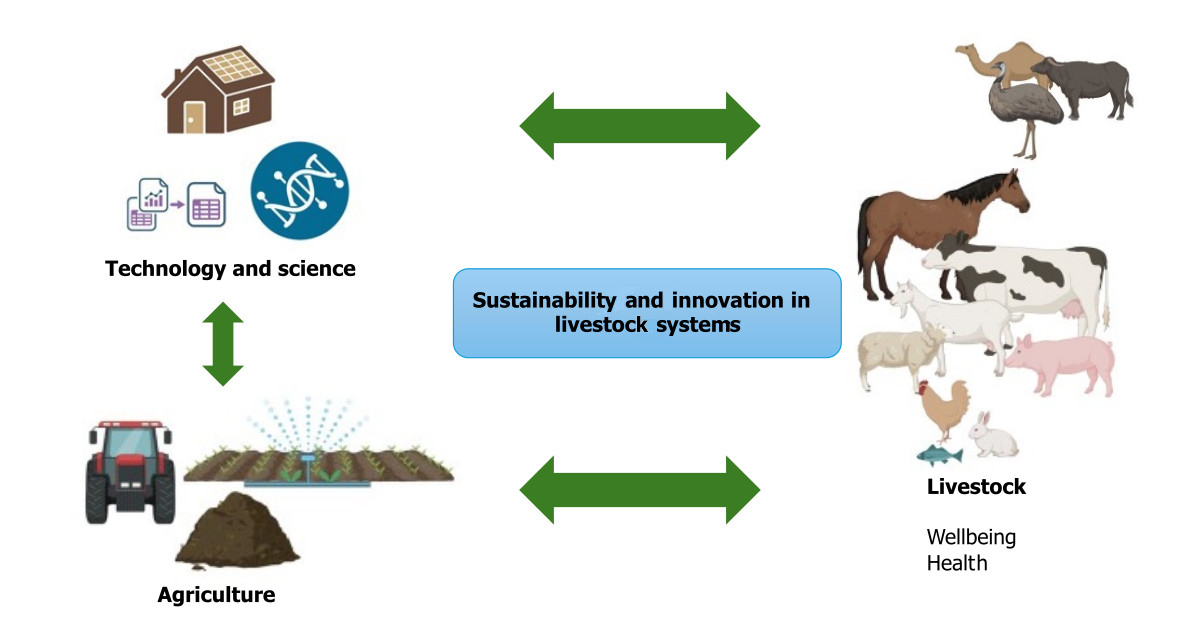
We are pleased to invite you to contribute to this Special Issue, which aims to collate current knowledge on management of livestock production with a focus on innovation and sustainability by integrating veterinary, agronomics, environmental sciences, engineering, animal welfare, and new technologies. We welcome articles, reviews and technical notes concerning “Innovative Strategies for Sustainable Livestock Production” such as the use of novel feeding strategies (plant secondary metabolites, feed additives, and by-products, etc.) to reduce greenhouse gas emissions from ruminants and to mitigate pollutants from monogastric production systems, the addition of livestock farm residues as organic soil amendments to increase its fertility, and the incorporation of new forages and crops to fight against desertification and erosion. Other topics of high relevance in this Issue include everything related to the application of innovative technologies, automation, digital farming (uses of sensors, AI, and data platforms), smart farming (uses of GPS, GIS, VRT, and satellite imagery), and precision livestock farming (uses of AI, IoT, robotics, and blockchain technology). Aside from innovation of farm technologies, we also welcome contributions that analyze its impact on livestock systems to reduce pollution and waste by environmental-friendly practices.

Dr. Ana Isabel Roca-Fernández
Dr. Magdalena Turrubiarte
Guest Editors

Manuscript Submission Information

Manuscripts should be submitted online at www.mdpi.com by registering and logging in to this website. Once you are registered, click here to go to the submission form. Manuscripts can be submitted until the deadline. All submissions that pass pre-check are peer-reviewed. Accepted papers will be published continuously in the journal (as soon as accepted) and will be listed together on the special issue website. Research articles, review articles as well as short communications are invited. For planned papers, a title and short abstract (about 250 words) can be sent to the Editorial Office for assessment.

Submitted manuscripts should not have been published previously, nor be under consideration for publication elsewhere (except conference proceedings papers). All manuscripts are thoroughly refereed through a single-anonymized peer-review process. A guide for authors and other relevant information for submission of manuscripts is available on the Instructions for Authors page. Sustainability is an international peer-reviewed open access semimonthly journal published by MDPI.

Please visit the Instructions for Authors page before submitting a manuscript. The Article Processing Charge (APC) for publication in this open access journal is 2400 CHF (Swiss Francs). Submitted papers should be well formatted and use good English. Authors may use MDPI's English editing service prior to publication or during author revisions.

Keywords

  • novel feeding strategies
  • greenhouse gas emissions
  • pollution
  • livestock farm residues
  • sustainability
  • environmental-friendly practices
  • innovative technologies
  • digital farming
  • smart farming
  • precision livestock farming

Benefits of Publishing in a Special Issue

  • Ease of navigation: Grouping papers by topic helps scholars navigate broad scope journals more efficiently.
  • Greater discoverability: Special Issues support the reach and impact of scientific research. Articles in Special Issues are more discoverable and cited more frequently.
  • Expansion of research network: Special Issues facilitate connections among authors, fostering scientific collaborations.
  • External promotion: Articles in Special Issues are often promoted through the journal's social media, increasing their visibility.
  • Reprint: MDPI Books provides the opportunity to republish successful Special Issues in book format, both online and in print.

Further information on MDPI's Special Issue policies can be found here.

Published Papers (3 papers)

Order results
Result details
Select all
Export citation of selected articles as:

Research

Jump to: Review

26 pages, 590 KB  
Article
Pathways Toward Sustainable Dairy Production: Scale Economies and Human Capital Barriers in the Heterogeneous Adoption of Digital Technologies in China
by Yuwen Qi, Jiqin Han, Xue Chang and Chunhua Yang
Sustainability 2026, 18(16), 8238; https://doi.org/10.3390/su18168238 - 11 Aug 2026
Viewed by 320
Abstract
Livestock digital technologies are pivotal to advancing sustainable agricultural development. However, their adoption rates in China’s livestock sector remain relatively low. Existing studies have largely overlooked the heterogeneous mechanisms through which herd size relates to the adoption of different types of agricultural digital [...] Read more.
Livestock digital technologies are pivotal to advancing sustainable agricultural development. However, their adoption rates in China’s livestock sector remain relatively low. Existing studies have largely overlooked the heterogeneous mechanisms through which herd size relates to the adoption of different types of agricultural digital technologies. Drawing on survey data from scaled dairy farms, this research employs an Instrumental Variable Probit (IV Probit) model to empirically examine the relationship between herd size and the adoption of information-intensive and knowledge-embedded digital technologies, as well as their effects on farm economic sustainability. The results indicate that herd size is positively associated with the adoption of both types of digital technologies. Further analysis reveals that herd expansion is associated with lower material and learning costs and higher sunk costs of farm-specific human capital. Moreover, the results suggest that the adoption of either type of digital technology is positively and significantly correlated with farm economic sustainability. These findings suggest that it is imperative to actively promote moderate-scale farm operations. Additionally, improving agricultural subsidy policies may promote the uptake of digital technologies to advance sustainable dairy farming. Full article
(This article belongs to the Special Issue Innovative Strategies for Sustainable Livestock Production)
Show Figures

Figure 1

10 pages, 1290 KB  
Communication
Practical Guidelines to Improve the Sustainability of Ventilation Fan Use in Agricultural Operations
by Nilroth Ly and Neslihan Akdeniz
Sustainability 2026, 18(5), 2453; https://doi.org/10.3390/su18052453 - 3 Mar 2026
Cited by 2 | Viewed by 923
Abstract
Ventilation systems in agricultural settings are designed to deliver specific air exchange rates, which are often not achievable using natural ventilation. In this study, we analyzed 105 agricultural ventilation fans tested between 2015 and 2025 at the Bioenvironmental and Structural Systems (BESS) Laboratory, [...] Read more.
Ventilation systems in agricultural settings are designed to deliver specific air exchange rates, which are often not achievable using natural ventilation. In this study, we analyzed 105 agricultural ventilation fans tested between 2015 and 2025 at the Bioenvironmental and Structural Systems (BESS) Laboratory, including 0.6, 0.9, 1.2, and 1.5 m diameter fans operating at static pressures ranging from 0 to 75 Pa. The main objective of the study is to develop and introduce guidelines to help select the most suitable ventilation fans to improve the sustainability of agricultural operations. Two web-based interactive calculators were developed to visualize fan performance relative to low- and high-performing fans of the same diameter. Our findings indicated that the ventilation efficiency ratio (VER) of the fans ranged from 2 to 50 m3 h−1 W−1, and larger fans consistently showed higher efficiency at typical operating pressures of 12.5 to 37.5 Pa. In general, variable-speed fans operated at 85%, rather than full capacity, achieved higher efficiency. Two cost comparison scenarios were examined. In the first scenario, the fan with a higher purchasing cost but also 35% higher efficiency resulted in a payback period of 4.1 years. In the second scenario, the difference in fan efficiencies was less than 3.5%, which did not help with recovering higher purchase costs during the 10-year analysis period. It was concluded that selecting fans solely based on purchase price can lead to higher long-term costs. To improve the sustainability of agricultural fans, VER and operating conditions need to be evaluated together and integrated into automated control strategies. Future studies can focus on integrating fans with high efficiencies into sensor-based automated ventilation control systems to quantify long-term energy savings in livestock buildings and other agricultural operations. Full article
(This article belongs to the Special Issue Innovative Strategies for Sustainable Livestock Production)
Show Figures

Graphical abstract

Review

Jump to: Research

33 pages, 3889 KB  
Review
From Decision-Support Tools to Digital Twins: A Review of Digital Farming, Data Platforms, and AI for Sustainable Dairy Systems
by Yijing Gong, Eduardo Noronha de Andrade Freitas and Victor E. Cabrera
Sustainability 2026, 18(13), 6900; https://doi.org/10.3390/su18136900 - 7 Jul 2026
Viewed by 587
Abstract
Sustainability targets for livestock require decision support that is both scientifically credible and operationally usable on farms. This integrative narrative review synthesizes the broader peer-reviewed literature on digital farming, artificial intelligence and machine learning, simulation modeling, optimization, and digital-twin concepts as applied to [...] Read more.
Sustainability targets for livestock require decision support that is both scientifically credible and operationally usable on farms. This integrative narrative review synthesizes the broader peer-reviewed literature on digital farming, artificial intelligence and machine learning, simulation modeling, optimization, and digital-twin concepts as applied to sustainable dairy systems, and uses selected peer-reviewed dairy studies from one integrated research program as illustrative worked examples that show how these elements can be connected end-to-end. We organize the synthesis around a data-to-decision pipeline that links data foundations and interoperability, governance and trust, analytics, decision engines, and deployment, comparing model classes by data needs, temporal resolution, interpretability, and deployment maturity. Recurring barriers to impact—weak ground truth, data drift, fragmented identifiers, and misaligned incentives—are highlighted alongside the design principles that address them. The contribution of the review is the transferable pipeline framework, demonstrated through worked examples drawn from one integrated research program; the program’s studies appear repeatedly because they together trace decisions across all pipeline layers, not because they constitute the field. We conclude with a practical roadmap and implementation checklist for designing and scaling decision-intelligence systems with transparent tradeoffs and measurable sustainability outcomes. Full article
(This article belongs to the Special Issue Innovative Strategies for Sustainable Livestock Production)
Show Figures

Figure 1

Back to TopTop