Progress in Biobased and Biodegradable Polymers
Share This Topical Collection
Editor
 Dr. Waldo M. Argüelles-Monal
Dr. Waldo M. Argüelles-Monal
E-Mail
Website
Collection Editor
Biopolymers Group, Centro de Investigación en Alimentación y Desarrollo, Hermosillo 83304, Sonora, Mexico
Interests: physical chemistry of polysaccharides for food and healthcare; stimuli-responsive and self-healing biopolymeric materials; derivatization of polysaccharides with a controlled macromolecular architecture, chitin, chitosan, alginate, pectin, carrageenan
Special Issues, Collections and Topics in MDPI journals
Topical Collection Information
Dear Colleagues,
The global mass production of plastics started in the 1950s; an estimated total of 8.3 to 9.1 million metric tons (Mt) have been manufactured up to now. Approximately 9% and 12% of these have been recycled and incinerated, respectively, whereas the remaining 79% has been accumulated in landfills or the natural environment, causing serious environmental issues. The demand for sustainability and a green economy has promoted research interest in polymer technologies to achieve the following goals:
- To replace the use of fossil-derived polymers in various applications with neat biomacromolecules or their derivatives.
- To employ green synthesis processes to recover and/or synthesize monomers derived from renewable resources (biobased monomers).
- To produce new, eco-friendly, biodegradable polymers based on these monomers in a short time.
This Topical Collection of Polymers aims to collect cutting-edge, state-of-the-art, original, full-length research articles and critical or tutorial reviews on the topic of ‘Biobased and Biodegradable Polymers’, including, but not limited to, the following topics:
- The properties of biomacromolecules and their applications in several fields.
- The synthesis and characterization of macromolecule derivatives with the desired properties.
- Eco-friendly processes used to recover biobased monomers from biomass.
- Biomass treatments for the production of monomers appropriate for polymer synthesis.
- The synthesis, properties, and applications of biobased and biodegradable polymers and copolymers.
- The development of biocomposites and nanocomposites.
- Biodegradable blends.
- Biobased polymer recycling methods and depolymerization techniques.
- The advantages of biomacromolecules and/or biobased and biodegradable polymers.
Dr. Waldo M. Argüelles-Monal
Collection Editor
Manuscript Submission Information
Manuscripts should be submitted online at www.mdpi.com by registering and logging in to this website. Once you are registered, click here to go to the submission form. All submissions that pass pre-check are peer-reviewed. Accepted papers will be published continuously in the journal (as soon as accepted) and will be listed together on the collection website. Research articles, review articles as well as short communications are invited. For planned papers, a title and short abstract (about 250 words) can be sent to the Editorial Office for assessment.
Submitted manuscripts should not have been published previously, nor be under consideration for publication elsewhere (except conference proceedings papers). All manuscripts are thoroughly refereed through a single-anonymized peer-review process. A guide for authors and other relevant information for submission of manuscripts is available on the Instructions for Authors page. Polymers is an international peer-reviewed open access semimonthly journal published by MDPI.
Please visit the Instructions for Authors page before submitting a manuscript.
The Article Processing Charge (APC) for publication in this open access journal is 2700 CHF (Swiss Francs).
Submitted papers should be well formatted and use good English. Authors may use MDPI's
English editing service prior to publication or during author revisions.
Keywords
- biomass
- biobased monomers
- eco-friendly polymers
- biomacromolecules
- biobased polymers
- biodegradable polymers
- polymer applications
Related Special Issue
Published Papers (1 paper)
2026
Open AccessArticle
Sustainable Atmospheric Water Harvesting Nanocomposite Films Based on Green-Synthesized Oxide–Chitosan
by
Noor Al-Sadeq, Alberto Romero and Victor M. Perez-Puyana
Viewed by 224
Abstract
This study focuses on sustainable atmospheric water harvesting (AWH) using film-containing green nanomaterials. Particular emphasis is given to chitosan as a sustainable biopolymer matrix due to its intrinsic hydrophilicity, biodegradability, film-forming ability and abundance of amino and hydroxyl functional groups that favor water
[...] Read more.
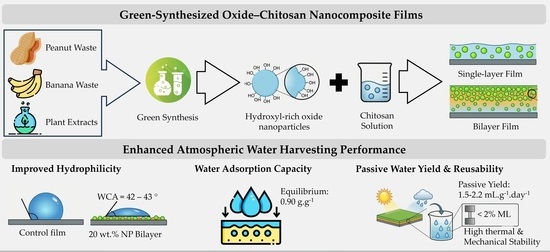
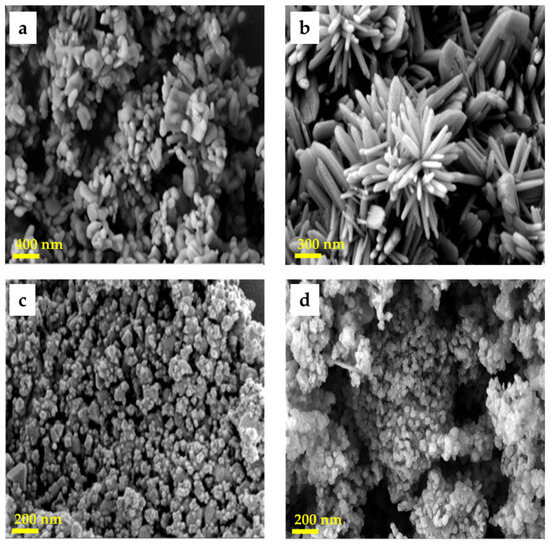
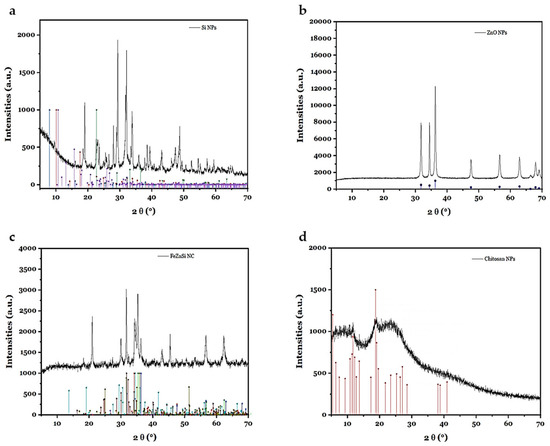
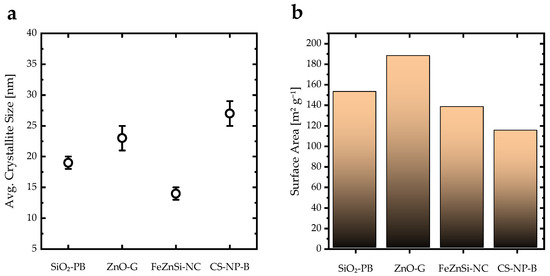
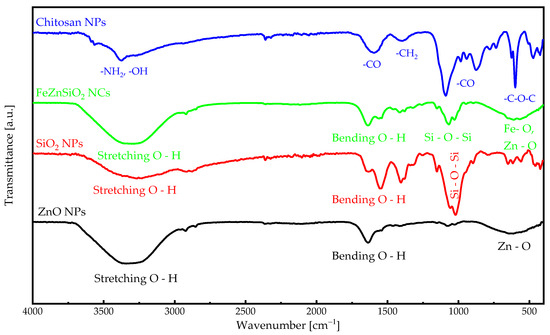
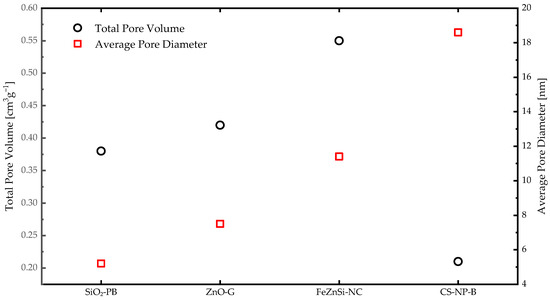
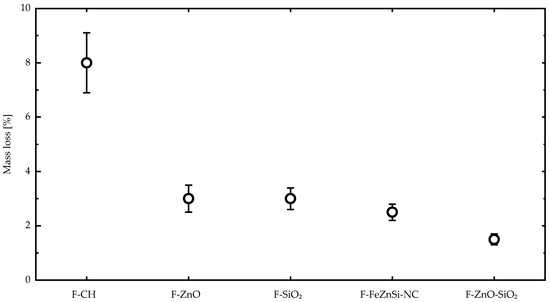
This study focuses on sustainable atmospheric water harvesting (AWH) using film-containing green nanomaterials. Particular emphasis is given to chitosan as a sustainable biopolymer matrix due to its intrinsic hydrophilicity, biodegradability, film-forming ability and abundance of amino and hydroxyl functional groups that favor water adsorption and nanoparticle interaction. ZnO, SiO
2 and Fe-Zn-SiO
2 nanoparticles with abundant hydroxyl groups were synthesized from plant-based materials such as biomass from peanut and banana wastes, as well as plant extracts. Nanocomposite membranes containing nanoparticles with a high specific surface area and moisture-sensitive behavior were successfully developed. Results showed that bilayer films outperformed monolayer systems in water harvesting performance. In particular, the bilayer film composed of Chitosan/G-ZnO (10 wt.%) on the top layer and Chitosan/G-SiO
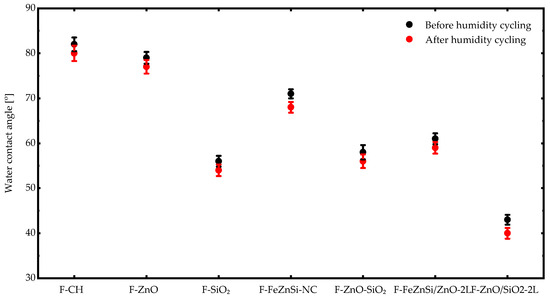
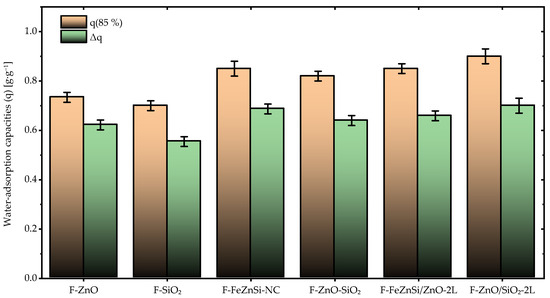
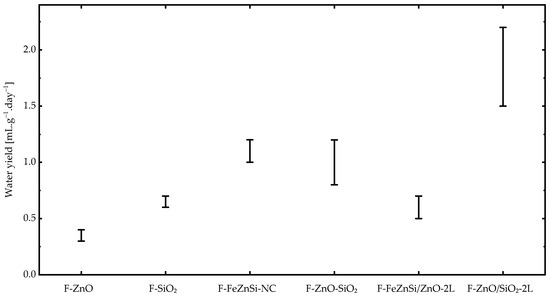
2 (10 wt.%) in the bottom layer displayed outstanding hydrophilic properties with water contact angles reduced to 42–43°. The material demonstrated an equilibrium adsorption capacity for water at 0.90 g/g and a passive yield of 1.5–2.2 mL/g per day. The improved adsorption behavior was attributed to the synergistic effect between the hydroxyl-rich oxide nanoparticles, the intrinsic water affinity of chitosan, and the layered porous structure. Moreover, the samples showed good thermal and mechanical stability and retained their structure after several uses. These findings highlight the potential of chitosan-centered green nanocomposites as sustainable materials for passive AWH applications.
Full article
►▼
Show Figures