


Journal Menu
► ▼ Journal Menu-
- Plants Home
- Aims & Scope
- Editorial Board
- Reviewer Board
- Topical Advisory Panel
- Early Career Editorial Board
- Instructions for Authors
- Special Issues
- Topics
- Sections & Collections
- Article Processing Charge
- Indexing & Archiving
- Editor’s Choice Articles
- Most Cited & Viewed
- Journal Statistics
- Journal History
- Journal Awards
- Society Collaborations
- Conferences
- Editorial Office
Journal Browser
► ▼ Journal BrowserNeed Help?
Announcements
10 June 2026
Interview with Dr. Ke Liu—Winner of the Plants Travel Award
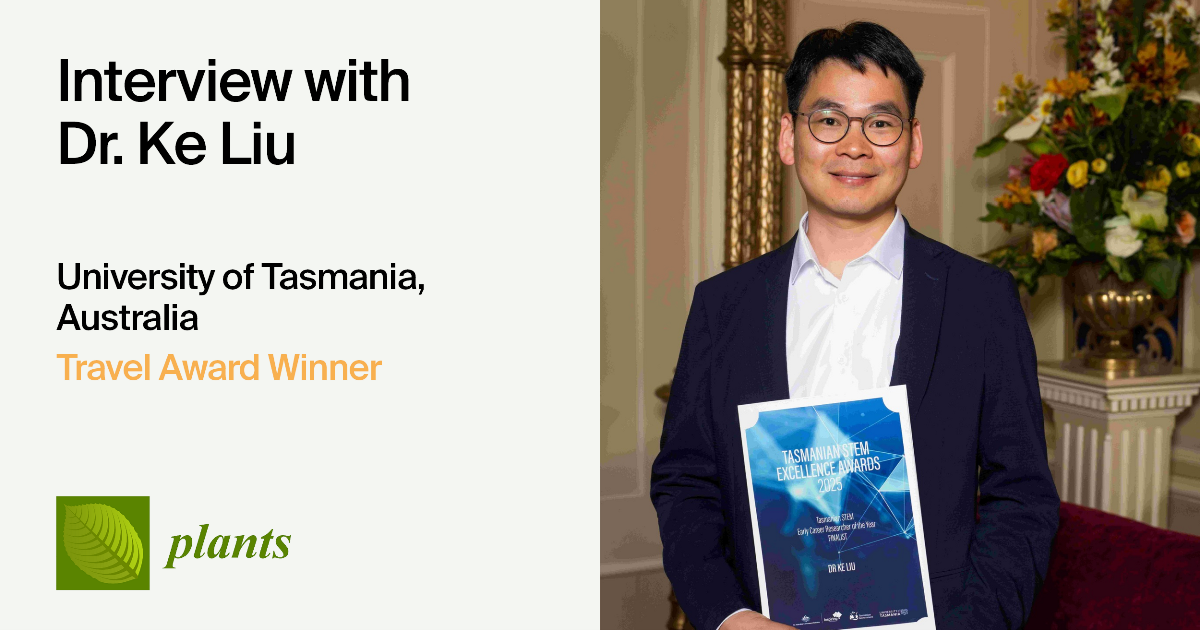
We are pleased to announce that Dr. Ke Liu has been awarded the Plants Travel Award. This award supports early-career researchers by facilitating their participation in key international conferences in the field of plant science, enabling them to present their outstanding work and engage with the global scientific community.
We were honored to interview Dr. Ke Liu and learn about his views on and experiences of scientific research and the award. The interview is summarized below:
1. Congratulations on receiving the Plants Travel Award! What motivated you to apply for this Travel Award in the first place?
Thank you—I am truly honoured to receive this award. I was motivated to apply because it offers a valuable opportunity to engage with leading researchers in plant and agricultural sciences, share my work with an international audience, and build meaningful collaborations.
2. Could you briefly introduce your current research focus and key research achievements?
My current research mainly focuses on climate adaptation science and agricultural systems modelling. My work has advanced the representation of soil waterlogging stress in farming systems models, repositioning waterlogging from a historically underrepresented agronomic constraint to a quantifiable and scenario-testable climate risk within mainstream crop–climate frameworks. I have led the development and implementation of generic waterlogging algorithms within many widely used modelling platforms. This work enables cross-regional and scenario-based quantification of waterlogging risk, contributing to improved climate resilience assessments in cropping systems.
3. What is the core argument or insight you will present in your keynote address?
The core message of my presentation is that climate risks to crop production are increasingly driven by compound and underrepresented stresses—such as waterlogging and pre-harvest sprouting—that are often overlooked in current modelling and management strategies. I will demonstrate how integrating process-based models with data-driven approaches can enhance risk prediction and support more targeted and effective adaptation strategies across scales.
4. In your opinion, how will attending the conference broaden your research vision and promote your future academic work?
Attending the conference will expose me to cutting-edge research across plant science, modelling, and climate adaptation, helping to refine my research questions and approaches. It will also provide opportunities to establish new collaborations, particularly in linking physiological understanding with large-scale modelling. These interactions will strengthen the interdisciplinary nature of my work and support the development of more impactful, globally relevant research.
5. In your opinion, what are the most important qualities of an outstanding researcher?
An outstanding researcher combines scientific curiosity with critical thinking and persistence. Equally important are integrity, openness to new ideas, and the ability to collaborate across disciplines. In applied fields like agricultural science, the capacity to translate research into real-world impact is also essential—ensuring that scientific advances contribute to addressing practical challenges such as food security and climate resilience.
