Conferences
30 October–3 November 2026, Hangzhou, China
The 1st International Conference on Modern Mathematical Physics (ICMMP 2026)

We would like to invite you to attend the 1st International Conference on Modern Mathematical Physics, organized by MDPI’s journals Modern Mathematical Physics (ISSN: 3024-5034), Symmetry (ISSN: 2073-8994, IF: 2.2), and Mathematics (ISSN: 2227-7390, IF: 2.2 ). The event will take place from 30 October to 3 November 2026 in Hangzhou, China.
This conference aims to bring together leading researchers to discuss recent advances, emerging challenges, and future directions in modern mathematical physics.
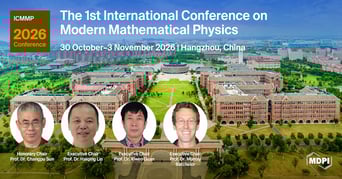
Honorary Chair:
- Prof. Dr. Changpu Sun, China Academy of Engineering Physics, Beijing, China.
Executive Chairs:
- Prof. Dr. Haiqing Lin, Zhejiang University, Hangzhou, China.
- Prof. Dr. Xiwen Guan, University of Chinese Academy of Sciences, Wuhan, China.
- Prof. Dr. Murray Batchelor, Australian National University, Canberra, Australia.
Speaker Announcement
We are delighted to introduce the confirmed Plenary Speakers and Keynote Speakers for ICMMP 2026.
*Speaker list under continuous update.
Plenary Speakers:
Prof. Augusto Smerzi, Shenzhen Technology University (SZTU), China
Prof. Smerzi is a Chair Professor at Shenzhen Technology University and known for pioneering work in quantum metrology, entanglement theory, and quantum parameter estimation. He introduced key advances in phase estimation and Fisher information methods, with his research spanning quantum sensing networks and coherent matter wave dynamics.
Prof. Piljin Yi, Korea Institute for Advanced Study, Korea
Prof. Piljin Yi is a leading KIAS physicist and known for seminal work in string theory, D0‑brane bound states, and supersymmetric solitons. He has spoken at major conferences, including Strings, and held key leadership roles at KIAS and in Korean scientific societies.
Prof. Thierry Giamarchi, University of Geneva, Switzerland
Prof. Giamarchi is a leading condensed matter theorist, known for groundbreaking work on low‑dimensional quantum systems, including the Bose glass phase and the Tomonaga–Luttinger liquid framework. He has made major contributions to understanding quantum materials and cold‑atom systems and is a Member of the French Academy of Sciences and an APS Fellow.
Prof. Yupeng Wang, Institute of Physics, Chinese Academy of Sciences, China
Prof. Wang, elected to the Chinese Academy of Sciences in 2021, is a leading physicist in mathematical physics and condensed matter theory. He is known for the off‑diagonal Bethe ansatz, the exactly solvable “Wang model,” and major advances in integrable and strongly correlated electron systems.
Keynote Speakers
Prof. Benjamin Doyon, King’s College London, UK
Prof. Doyon is a Professor of Theoretical Physics at King’s College London, renowned for founding Generalised Hydrodynamics and advancing the study of many‑body entanglement and fluctuations. He has earned major distinctions, including ERC Advanced and Synergy Grants and the 2025 Frontiers of Science Award.
Prof. Chi-Ming Chang, Tsinghua University, China
Prof. Chang is an Associate Professor at the Yau Mathematical Sciences Center, Tsinghua University, specializing in string theory, quantum field theory, and quantum gravity. He received the 2023 Frontiers of Science Award, was an invited speaker at Strings 2024, and is known for contributions to BPS spectra, black hole microstates, and exact nonperturbative methods.
Prof. Pasquale Calabrese, International School for Advanced Studies, Italy
Prof. Calabrese is a Full Professor at SISSA and a leading figure in low‑dimensional quantum systems, known for major contributions to entanglement theory and quantum quenches. A recipient of multiple ERC grants, he has helped shape the modern field of nonequilibrium quantum physics through influential and widely cited work.
Prof. Qiongyi He, Peking University, China
Prof. Qiongyi He is a Boya Distinguished Professor at Peking University working in quantum optics and quantum information, especially on quantum correlations and their applications. She has published widely and received major honors, including the Distinguished Young Scholars Fund, the Wang Daheng Optical Award, and the China Young Female Scientists Award.
Prof. Ruben Minasian, Université Paris-Saclay, France
Prof. Minasian is a CNRS Research Director at CEA Saclay and known for pioneering work on string theory dualities and realistic compactifications. His contributions have strongly linked mathematics and physics and earned him honors such as the Friedrich Wilhelm Bessel Award.
Prof. Rudolf A. Roemer, University of Warwick, UK
Prof. Römer is a Professor of Physics at the University of Warwick and known for influential work on quantum transport, disorder, and numerical modelling in condensed matter systems. A Fellow of the Institute of Physics, he leads the DisQS group and serves as Editor‑in‑Chief of Physica E.
Prof. Sameer Murthy, King’s College London, UK
Prof. Murthy is a Professor at King’s College London and known for pioneering work on quantum black holes, holography, and their links to modular forms. He has led an ERC project, served as Oppenheimer Visiting Professor at IAS, and received the 2025 Frontiers of Science Award.
Prof. Tomaz Prosen, University of Ljubljana, Slovenia
Prof. Prosen is a theoretical physics professor at the University of Ljubljana and known for groundbreaking work on nonequilibrium quantum many‑body systems. He discovered exact solutions and new conservation laws governing quantum transport and pioneered modern methods for identifying quantum chaos in spin‑1/2 systems.
Prof. Urs Schreiber, New York University Abu Dhabi, UAE
Prof. Schreiber is a theoretical physicist whose work applies algebraic topology and homotopy theory to foundational problems in quantum field theory and string theory. He has developed new frameworks for strongly interacting quantum vacua and is now helping build a topological quantum programming language for future robust quantum computing.
Prof. Yunfeng Jiang, Southeast University, China
Prof. Jiang is a Young Chief Professor at Southeast University whose research centers on quantum integrable models and quantum field theory. He has made notable contributions to AdS/CFT integrability, solvable irrelevant deformations, and the use of algebraic geometry methods in integrable systems.
Topics of interest:
S1. Quantum Field Theory, String and Brane Theory, and Gravitation.
S2. Integrable Models in Condensed Matter Physics and Statistical Physics.
S3. Quantum Information and Quantum Metrology.
S4. Atomic, Molecular, and Optical Physics.
S5. Nonlinear Dynamics and Computational Physics.
Instruction for Authors
Please submit your abstract by 10 July 2026 via https://sciforum.net/user/submission/create/1507.
You can register with an early-bird discount by 25 August 2026 at https://sciforum.net/event/ICMMP2026?section=#registration.
For details regarding abstract submission, poster submission, and publication opportunities, please refer to the “Instructions for Authors” Section: https://sciforum.net/event/ICMMP2026?section=#instructions.
For any enquiries regarding this event, please contact icmmp2026@mdpi.com.
We look forward to seeing you at the 1st International Conference on Modern Mathematical Physics!