



Innovative Materials for Bioelectronics in Wearable and Implantable Applications

A Special Issue of Micro (ISSN 2673-8023).

Deadline for manuscript submissions: 30 November 2026 | Viewed by 9722
Editors


E-Mail Website
Guest Editor
Tsinghua Changgung Hospital, School of Clinical Medicine, Tsinghua University, Beijing 100084, China
Interests: bioelectronics; bionic electronics; biosensors; energy harvesters; nanogenerators

E-Mail Website
Guest Editor
1. School of Biomedical Engineering, Tsinghua University, Beijing 100084, China
2. Tsinghua Changgung Hospital, School of Clinical Medicine, Tsinghua University, Beijing 100084, China
Interests: bioelectronic devices; self-powered sensors; biodegradable medical devices
Special Issues, Collections and Topics in MDPI journals

Special Issue Information

Dear Colleagues,

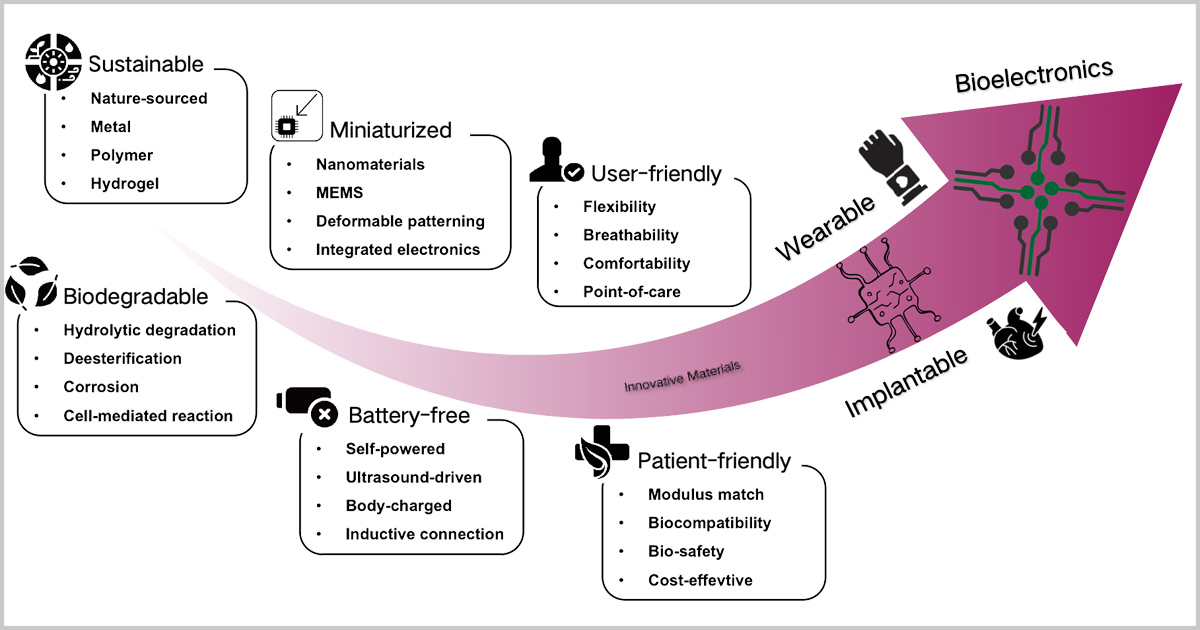
The field of bioelectronics is undergoing profound transformation and innovation, particularly showing great potential in wearable and implantable applications. Wearable electronics, such as smartwatches and electronic textiles, have gradually integrated into people's daily lives, offering convenient means of health management and activity tracking. Meanwhile, implantable electronics play a significant role in disease treatment and physiological function restoration, such as in pacemakers and neural stimulators. The realization of these applications relies on innovative materials that bridge the gap between biological systems and electronic devices. Flexible and stretchable conductive materials like liquid metals and conductive polymers not only meet the requirements of wearables for comfort and durability but also enhance the signal transmission efficiency and sensing accuracy of the devices due to their excellent electrical properties. Hydrogels, with high water content and tunable mechanical properties, can mimic the natural tissue environment, making them ideal materials for forming gentle interfaces with implantable devices. Energy conversion materials such as piezoelectric, triboelectric, and thermoelectric materials can harvest energy from biological motion, body heat, or the environment, reducing the dependency of electronics on external power sources. Stimulus-responsive materials can achieve the precise delivery of electrical pulses through means such as ultrasound, promoting nerve regeneration and tissue repair. These innovative materials not only improve the performance of bioelectronic devices but also ensure their seamless integration and long-term functionality with the human body, paving the way for continuous health monitoring and advanced therapeutic interventions.

This Special Issue emphasizes interdisciplinary research that bridges the fields of materials science, engineering, and biomedicine. It aims at exploring the latest scientific achievements and technological breakthroughs in the field of bioelectronic materials, as well as the challenges and future development directions they face. The research themes in this Special Issue highlight the transformative potential of material innovations in healthcare and underscore the importance of interdisciplinary collaboration in fully realizing the possibilities of bioelectronic technologies. These innovations offer new solutions for proactive health management, disease diagnosis, and personalized treatment. We hope that these interdisciplinary research outcomes will inspire more innovative ideas, driving the leapfrog development of bioelectronics in healthcare, biomedicine, and other fields, further improving human quality of life and expanding the boundaries of life science research. We welcome original research articles, reviews, communications, and perspective articles on themes.

Dr. Yang Zou
Prof. Dr. Zhou Li
Guest Editors

Manuscript Submission Information

Manuscripts should be submitted online at www.mdpi.com by registering and logging in to this website. Once you are registered, click here to go to the submission form. Manuscripts can be submitted until the deadline. All submissions that pass pre-check are peer-reviewed. Accepted papers will be published continuously in the journal (as soon as accepted) and will be listed together on the special issue website. Research articles, review articles as well as short communications are invited. For planned papers, a title and short abstract (about 250 words) can be sent to the Editorial Office for assessment.

Submitted manuscripts should not have been published previously, nor be under consideration for publication elsewhere (except conference proceedings papers). All manuscripts are thoroughly refereed through a single-anonymized peer-review process. A guide for authors and other relevant information for submission of manuscripts is available on the Instructions for Authors page. Micro is an international peer-reviewed open access quarterly journal published by MDPI.

Please visit the Instructions for Authors page before submitting a manuscript. The Article Processing Charge (APC) for publication in this open access journal is 1200 CHF (Swiss Francs). Submitted papers should be well formatted and use good English. Authors may use MDPI's English editing service prior to publication or during author revisions.

Keywords

  • innovative materials
  • bioelectronics
  • wearable
  • implantable
  • interdisciplinary

Benefits of Publishing in a Special Issue

  • Ease of navigation: Grouping papers by topic helps scholars navigate broad scope journals more efficiently.
  • Greater discoverability: Special Issues support the reach and impact of scientific research. Articles in Special Issues are more discoverable and cited more frequently.
  • Expansion of research network: Special Issues facilitate connections among authors, fostering scientific collaborations.
  • External promotion: Articles in Special Issues are often promoted through the journal's social media, increasing their visibility.
  • Reprint: MDPI Books provides the opportunity to republish successful Special Issues in book format, both online and in print.

Further information on MDPI's Special Issue policies can be found here.

Published Papers (4 papers)

Order results
Result details
Select all
Export citation of selected articles as:

Research

Jump to: Review

16 pages, 5099 KB  
Article
Semi-Interpenetrating Highly Conductive and Transparent Hydrogels for Wearable Sensors and Gesture-Driven Cryptography
by Dan Li, Hong Li, Yilin Wei, Lu Jiang, Hongqing Feng and Qiang Zheng
Micro 2025, 5(4), 53; https://doi.org/10.3390/micro5040053 - 23 Nov 2025
Cited by 4 | Viewed by 1288
Abstract
Developing conductive hydrogels that balance high conductivity, stretchability, transparency, and sensitivity for next-generation wearable sensors remains challenging due to inherent trade-offs. This study introduces a straightforward approach to fabricate a semi-interpenetrating double-network hydrogel comprising polyvinyl alcohol (PVA), polyacrylamide (PAM), and lithium chloride (LiCl) [...] Read more.
Developing conductive hydrogels that balance high conductivity, stretchability, transparency, and sensitivity for next-generation wearable sensors remains challenging due to inherent trade-offs. This study introduces a straightforward approach to fabricate a semi-interpenetrating double-network hydrogel comprising polyvinyl alcohol (PVA), polyacrylamide (PAM), and lithium chloride (LiCl) to overcome these limitations. Leveraging hydrogen bonding for energy dissipation and chemical cross-linking for structural integrity, the design achieves robust mechanical properties. The incorporation of 1 mol/L LiCl significantly enhances ionic conductivity, while also providing plasticizing and moisture-retention benefits. The optimized hydrogel exhibits impressive ionic conductivity (0.47 S/m, 113% enhancement), excellent mechanical performance (e.g., 0.177 MPa tensile strength, 730% elongation, 0.68 MJ m−3 toughness), high transparency (>85%), and superior strain sensitivity (gauge factors ~1). It also demonstrates rapid response/recovery and robust fatigue resistance. Functioning as a wearable sensor, it reliably monitors diverse human activities and enables novel, secure data handling applications, such as finger-motion-driven Morse code interfaces and gesture-based password systems. This accessible fabrication method yields versatile hydrogels with promising applications in health tracking, interactive devices, and secure communication technologies. Full article
Show Figures

Figure 1

12 pages, 3214 KB  
Article
Process of Fabricating Hyaluronic Acid-Based Milli-to-Microneedles Using the Bi-Directional Drawing Method
by Joon-Koo Kang, Kihak Lee, Yein Choi, Se-Gie Kim and Bonghwan Kim
Micro 2025, 5(2), 22; https://doi.org/10.3390/micro5020022 - 1 May 2025
Cited by 3 | Viewed by 2579
Abstract
Microneedles (MNs) have emerged as a promising tool for pain-free drug delivery, offering an alternative to traditional syringe-based methods. Among various types of MNs, dissolving microneedles fabricated from hyaluronic acid (HA) have gained attention due to their biocompatibility and ability to deliver drugs [...] Read more.
Microneedles (MNs) have emerged as a promising tool for pain-free drug delivery, offering an alternative to traditional syringe-based methods. Among various types of MNs, dissolving microneedles fabricated from hyaluronic acid (HA) have gained attention due to their biocompatibility and ability to deliver drugs with minimal discomfort. However, conventional HA MN fabrication techniques often limit needle lengths to a few hundred micrometers, which is insufficient for deeper drug penetration. This study introduces a novel fabrication method using bidirectional drawing lithography to extend the length of HA-based MNs. By adjusting the viscosity of HA solutions and employing a controlled pulling process, we demonstrate the feasibility of producing MNs with lengths ranging from millimeters to micrometers. An average height of 15 mm and tip diameters of approximately 80 μm were successfully produced. This advancement enhances the potential of HA MNs for transdermal drug delivery and interstitial fluid sampling. Full article
Show Figures

Figure 1

26 pages, 18981 KB  
Article
Fabrication and Analysis of Carboxylic Acid-Functionalized SWCNT/PDMS-Based Electrodes for ECG Monitoring via IoT
by Bani Gandhi and Raghava Srinivasa Nallanthighal
Micro 2025, 5(2), 16; https://doi.org/10.3390/micro5020016 - 4 Apr 2025
Cited by 2 | Viewed by 1582
Abstract
This paper presents the design and fabrication of flexible and gel-less electrodes using carboxylic acid-functionalized single-walled carbon nanotubes (SWCNT-COOHs) and polydimethylsiloxane (PDMS) at thirteen different concentrations. The dispersion was attained by magnetic stirring and sonication using isopropyl alcohol (IPA). Physical characterizations like Scanning [...] Read more.
This paper presents the design and fabrication of flexible and gel-less electrodes using carboxylic acid-functionalized single-walled carbon nanotubes (SWCNT-COOHs) and polydimethylsiloxane (PDMS) at thirteen different concentrations. The dispersion was attained by magnetic stirring and sonication using isopropyl alcohol (IPA). Physical characterizations like Scanning Electron Microscopy (SEM), Transmission Electron Microscopy (TEM), and Fourier Transform Infrared Spectroscopy (FTIR) were performed. The electrodes were fabricated using molds. The percolation threshold was achieved at 4 wt%. The ECG results were compared with conventional ECG electrodes and 3.5 wt% displayed the best results. Also, after using the electrodes for 5 days, the ECG signals did not degrade and no skin allergies were observed. The fabricated electrodes are suitable for long-term and continuous ECG monitoring, facilitated with the help of an Internet of Things (IoT) tracking system. The data can then be transmitted to the medical expert and loaded onto the cloud server for analysis. Full article
Show Figures

Figure 1

Review

Jump to: Research

56 pages, 6343 KB  
Review
Advanced 3D/4D Bioprinting of Flexible Conductive Materials for Regenerative Medicine: From Bioinspired Design to Intelligent Regeneration
by Kuikui Zhang, Lezhou Fang, Can Xu, Weiwei Zhou, Xiaoqiu Deng, Chenkun Shan, Quanling Zhang and Lijia Pan
Micro 2026, 6(1), 8; https://doi.org/10.3390/micro6010008 - 21 Jan 2026
Cited by 12 | Viewed by 2679
Abstract
Regenerative medicine is increasingly leveraging the synergies between bioinspired conductive biomaterials and 3D/4D bioprinting to replicate the native electroactive and hierarchical microenvironments essential for functional tissue restoration. However, a critical gap remains in the intelligent integration of these technologies to achieve dynamic, responsive [...] Read more.
Regenerative medicine is increasingly leveraging the synergies between bioinspired conductive biomaterials and 3D/4D bioprinting to replicate the native electroactive and hierarchical microenvironments essential for functional tissue restoration. However, a critical gap remains in the intelligent integration of these technologies to achieve dynamic, responsive tissue regeneration. This review introduces a “bioinspired material–printing–function” triad framework to systematically synthesize recent advances in: (1) tunable conductive materials (polymers, carbon-based systems, metals, MXenes) designed to mimic the electrophysiological properties of native tissues; (2) advanced 3D/4D printing technologies (vat photopolymerization, extrusion, inkjet, and emerging modalities) enabling the fabrication of biomimetic architectures; and (3) functional applications in neural, cardiac, and musculoskeletal tissue engineering. We highlight how bioinspired conductive scaffolds enhance electrophysiological behaviors—emulating natural processes such as promoting axon regeneration cardiomyocyte synchronization, and osteogenic mineralization. Crucially, we identify multi-material 4D bioprinting as a transformative bioinspired approach to overcome conductivity–degradation trade-offs and enable shape-adaptive, smart scaffolds that dynamically respond to physiological cues, mirroring the adaptive nature of living tissues. This work provides the first roadmap toward intelligent electroactive regeneration, shifting the paradigm from static implants to dynamic, biomimetic bioelectronic microenvironments. Future translation will require leveraging AI-driven bioinspired design and organ-on-a-chip validation to address challenges in vascularization, biosafety, and clinical scalability. Full article
Show Figures

Figure 1

Back to TopTop