Review

Advanced 3D/4D Bioprinting of Flexible Conductive Materials for Regenerative Medicine: From Bioinspired Design to Intelligent Regeneration


1
Institute of Intelligent Manufacturing, Nanjing Tech University, Nanjing 210009, China
2
School of Electronic Science and Engineering, Nanjing University, Nanjing 210023, China
3
National Collaborative Innovation Center of Advanced Microstructures, Nanjing University, Nanjing 210093, China
4
Department of Cardiac Surgery, Nanjing Drum Tower Hospital, The Affiliated Hospital of Nanjing University Medical School, Nanjing 210008, China
5
College of Mechanical and Power Engineering, Nanjing Tech University, Nanjing 211816, China
*
Authors to whom correspondence should be addressed.
Submission received: 7 November 2025 / Revised: 10 January 2026 / Accepted: 13 January 2026 / Published: 21 January 2026

Abstract

Regenerative medicine is increasingly leveraging the synergies between bioinspired conductive biomaterials and 3D/4D bioprinting to replicate the native electroactive and hierarchical microenvironments essential for functional tissue restoration. However, a critical gap remains in the intelligent integration of these technologies to achieve dynamic, responsive tissue regeneration. This review introduces a “bioinspired material–printing–function” triad framework to systematically synthesize recent advances in: (1) tunable conductive materials (polymers, carbon-based systems, metals, MXenes) designed to mimic the electrophysiological properties of native tissues; (2) advanced 3D/4D printing technologies (vat photopolymerization, extrusion, inkjet, and emerging modalities) enabling the fabrication of biomimetic architectures; and (3) functional applications in neural, cardiac, and musculoskeletal tissue engineering. We highlight how bioinspired conductive scaffolds enhance electrophysiological behaviors—emulating natural processes such as promoting axon regeneration cardiomyocyte synchronization, and osteogenic mineralization. Crucially, we identify multi-material 4D bioprinting as a transformative bioinspired approach to overcome conductivity–degradation trade-offs and enable shape-adaptive, smart scaffolds that dynamically respond to physiological cues, mirroring the adaptive nature of living tissues. This work provides the first roadmap toward intelligent electroactive regeneration, shifting the paradigm from static implants to dynamic, biomimetic bioelectronic microenvironments. Future translation will require leveraging AI-driven bioinspired design and organ-on-a-chip validation to address challenges in vascularization, biosafety, and clinical scalability.

1. Introduction

Regenerative medicine, dedicated to repairing or replacing damaged tissues and organs, represents a pivotal strategy for addressing critical diseases and trauma. However, conventional tissue repair strategies—including autografts (donor site morbidity, limited availability) [1,2], allografts (immune rejection, long-term side effects of immunosuppressants) [3,4,5], and artificial implants (lack of biofunctionality, poor integration, foreign body reactions) [6,7,8,9]—exhibit significant limitations, failing to meet the demands of functional restoration and personalized therapy.
Engineered tissue substitutes have emerged as a solution, aiming to integrate cells, biomaterials, and bioactive factors to construct functional tissue replacements [10,11]. Their core objectives encompass: (1) Functional Restoration: Moving beyond mere mechanical support to simulate the complex biological functions of native tissues (e.g., electrical signal conduction, metabolism, cell–cell interactions) [12,13,14,15]; (2) Personalized Therapy: Customization based on patient-specific anatomical and pathological characteristics [12,13,14,15]; and (3) Reduced Donor Dependency: Circumventing donor shortages and immune rejection [11,16]. Achieving these goals necessitates innovative materials and manufacturing technologies.
Conductive materials play an increasingly vital role in regenerative medicine. Bioelectrical signals (e.g., action potentials, piezoelectric effects) exert core regulatory functions over cellular behaviors (proliferation, differentiation, migration) and tissue regeneration [15,17,18,19,20]. Consequently, developing conductive materials capable of precisely mimicking the native electrophysiological microenvironment is paramount. Such materials (e.g., PEDOT:PSS, graphene, conductive hydrogels, piezoelectric materials) can significantly promote cell adhesion, directed differentiation, and tissue functional reconstruction by providing appropriate electrical stimulation or mechano-electrical coupling effects [21,22,23,24,25], showing particular promise in neural, cardiac, and bone tissue engineering.
Three-dimensional (3D) printing technology (additive manufacturing) provides a revolutionary tool for fabricating engineered tissue substitutes, particularly when combined with conductive materials [11]. Its core advantages include:
  • Customized Design. Precise matching of patient anatomy based on medical imaging data, optimizing scaffold porosity and mechanical properties [26,27].
  • Complex Structure Fabrication. Layer-by-layer construction of intricate 3D microarchitectures (e.g., biomimetic microchannels) difficult or impossible with traditional methods, providing enhanced microenvironments for cells and improving scaffold performance [28,29,30,31].
  • High Reproducibility and Control. Ensuring batch-to-batch consistency in scaffold properties (e.g., conductivity, mechanical characteristics) and biocompatibility, meeting clinical application standards [32].
  • Biocompatibility Assurance. Combining biocompatible materials (e.g., PLA, PCL) with optimized processes enables the fabrication of scaffolds with low toxicity and immunogenicity, and even allows for the direct printing of cells (bioprinting) [33,34,35].
The 3D/4D bioprinting of flexible conductive materials represents the convergence of the physiological regulatory capabilities of conductive materials and the spatial manufacturing advantages of 3D/4D printing. This approach is deeply rooted in the principles of biomimetics, which seeks to emulate the intricate structures and dynamic functions of native tissues. The nervous system’s coordinated electrical signaling, the heart’s synchronized electromechanical coupling, and bone’s inherent piezoelectricity all serve as powerful biological blueprints. By learning from and replicating these bioelectrical phenomena and hierarchical architectures, we can engineer scaffolds that not only replace lost tissue but also actively orchestrate its regeneration. It embodies the cutting-edge direction of regenerative medicine towards functionalization, precision, and personalization. Despite challenges such as balancing material properties, limitations in printing resolution, and hurdles in clinical translation, its potential is immense. This field is further benefiting from innovations like 4D printing (dynamic responsive scaffolds) [36] and integration with organ-on-a-chip/microfluidic technologies [37,38].
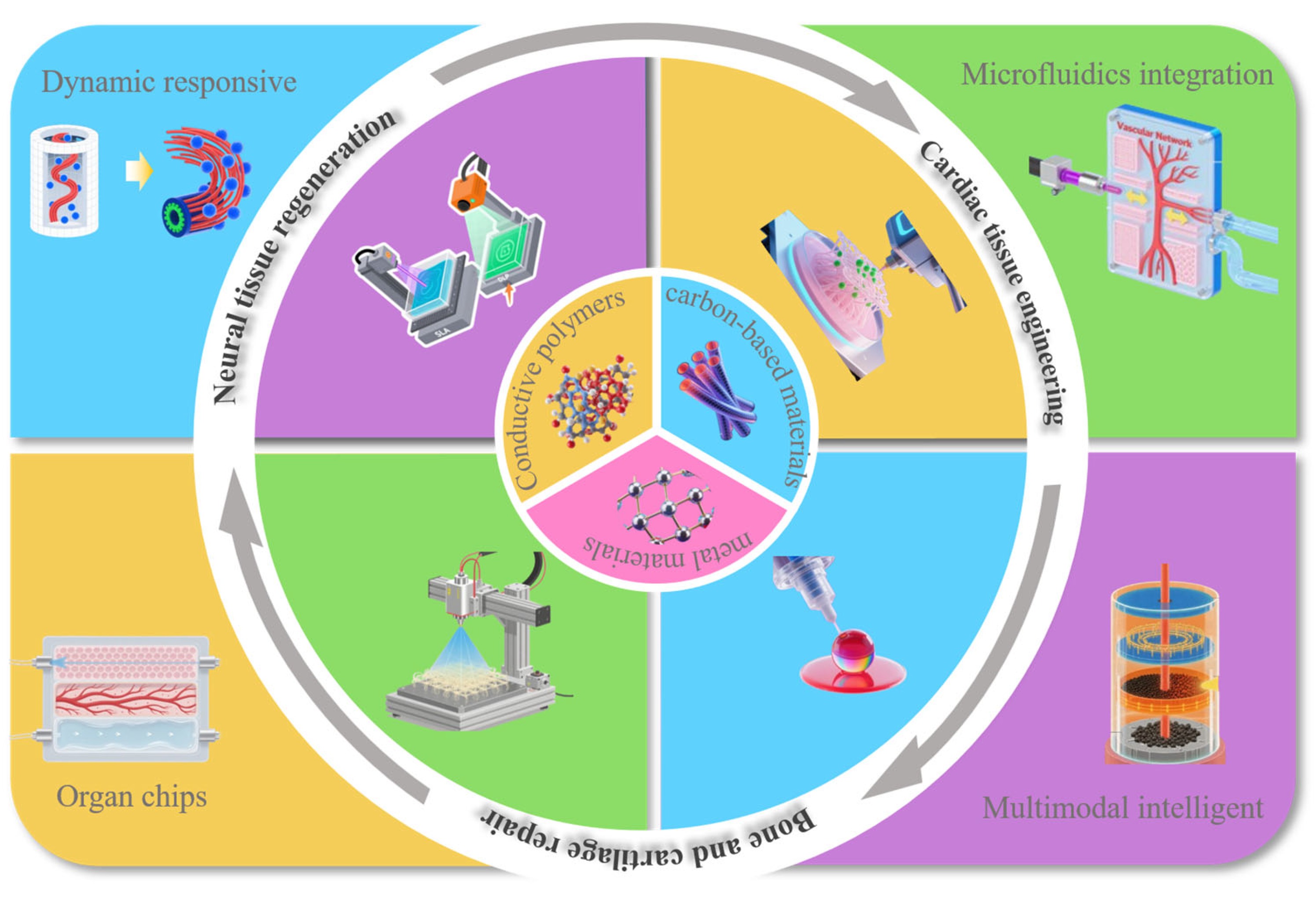
This review aims to systematically summarize the recent advancements in 3D/4D bioprinting technologies for flexible conductive materials within regenerative medicine. It will cover: (1) Classification and key properties of essential conductive materials; (2) Characteristics of mainstream 3D/4D printing techniques; (3) Application examples in neural, cardiac, and bone/cartilage repair; and (4) Current challenges and future directions. This comprehensive overview will provide researchers with a holistic perspective on this interdisciplinary field, facilitating technological innovation and clinical translation (Scheme 1).

2. Classification and Properties of Key Conductive Materials

The pursuit of intelligent regeneration begins with a bioinspired material foundation. The intrinsic electroresponsive properties of conductive materials are designed to mimic the fundamental bioelectrical signaling that governs cellular communication and tissue development in living organisms. This section systematically categorizes and analyzes key conductive material systems, evaluating their suitability for advanced 3D/4D bioprinting and their potential to actively orchestrate tissue repair by emulating native electroactive extracellular matrices.

2.1. Conductive Polymer Systems

Conductive polymer systems have emerged as a research hotspot in tissue engineering and regenerative medicine, particularly for applications requiring an electroactive environment (e.g., neural and myocardial tissues), owing to their unique performance advantages [39,40,41] (Figure 1a).
Conductive polymers (CPs) differ from traditional insulating polymers and additive conductive composites. Their conductivity originates from the inherent delocalized π-electron conjugation system along the polymer backbone, hence they are termed intrinsically conductive polymers. The core of their conductivity theory lies in the regulation of the electronic band structure through chemical or electrochemical “doping” processes, thereby achieving a controlled transition between insulating, semiconducting, and metallic states [48,49].
Basic conductive principles: doping and carriers
The conjugated backbone of CPs, represented by polyaniline (PANI), polypyrrole (PPy), and poly(3,4-ethylenedioxythiophene) (PEDOT), consists of alternating single and double bonds, forming an extended π-electron cloud. In the undoped intrinsic state, a bandgap exists between the valence and conduction bands, resulting in low conductivity (semiconductor or insulator).
Doping involves injecting or extracting electrons through oxidation (p-type doping) or reduction (n-type doping), generating localized charge defects such as polarons and bipolarons. These charged states create new energy levels within the band gap, dramatically increasing carrier concentration and mobility, leading to a sharp rise in conductivity (up to 102–105 S/cm) [50,51]. Dopants (e.g., PSS for PEDOT+, Cl for PPy+) are incorporated into the polymer matrix to maintain electrical neutrality.
Mixed ion–electron conduction in biological environments and its biological relevance
In aqueous or physiological environments, CPs exhibit mixed ion–electron conduction. The polymer network allows electron/hole migration along the conjugated backbone, while its porous, hydrophilic structure permits the penetration and migration of electrolyte ions (e.g., Na+, K+, Ca2+, Cl) [52]. This dual conduction property enables:
Efficient interfacial charge transfer: At the electrolyte interface, electron conduction couples with ion flux, enabling efficient charge injection/extraction. This is key to their low impedance and high charge storage capacity as bioelectrode materials [43].
Coupling with cell electrophysiology: Under an applied electric field, CP scaffolds not only conduct electrons but also, through ion migration, establish local ion concentration gradients and electric field distributions near the cell membrane. This more effectively mimics the natural extracellular electrochemical microenvironment, modulating the activity of voltage-gated ion channels [15,18].
The biological relevance of these conduction modes is direct. In neural engineering, the capacitive behavior (ion accumulation at the interface) of materials like PEDOT:PSS allows for high-fidelity recording of extracellular action potentials. Simultaneously, their faradaic charge transfer (via reversible doping) supports efficient electrical stimulation to promote neurite outgrowth, operating on the millisecond timescale of neuronal signaling. In cardiac patches, ionic conductivity facilitates the propagation of depolarization waves by modulating local ion concentrations (e.g., Ca2+), effectively lowering pacing thresholds and enhancing the synchronization of cardiomyocyte contractions. Thus, mixed conduction actively participates in the spatiotemporal regulation of bioelectrical cues, moving beyond mere impedance reduction.
Microstructure morphology and conductive pathways
Macroscopic conductivity is strongly dependent on the microscopic order of the polymer chains. Regions with high crystallinity and tight inter-chain packing facilitate carrier hopping transport. Post-processing techniques (e.g., solvent annealing, acid treatment, ionic liquid doping) are often employed to induce polymer chain self-assembly and phase separation, optimizing nanoscale conductive pathways and significantly improving overall conductivity [53]. In composites, CPs can form a continuous conductive phase or act as “molecular wires” coating or connecting insulating biopolymers or nanofillers to build a three-dimensional percolation network.
Biological relevance of mixed conduction modes
The dual ion-electron transport capability of CPs enables them to interface effectively with electrophysiological processes. For instance, in neural tissue engineering, the capacitive behavior (ion accumulation at the interface) allows PEDOT:PSS-based electrodes to record extracellular action potentials with high signal-to-noise ratio, while their faradaic charge transfer (via reversible doping) supports efficient electrical stimulation for neurite outgrowth. This is critical for matching the timescales of neuronal signaling (ms range). In cardiac patches, the ionic conductivity facilitates the propagation of depolarization waves by modulating local ion concentrations (e.g., Ca2+), thereby lowering the pacing threshold and enhancing synchronization of cardiomyocyte contractions. Thus, the mixed conduction not merely reduces impedance but actively participates in the spatiotemporal regulation of bioelectrical cues.
In summary, conductive polymers provide a unique, dynamically adjustable electroactive platform through their reversible doping states. Their hybrid ion-electron conduction properties make them ideal interface materials for connecting electronic devices with biological tissues. The following sections discuss the application and optimization strategies of PEDOT:PSS, PANI, and PPy in 3D/4D bioprinting.

2.1.1. Polythiophene Derivatives (PEDOT:PSS)

Poly(3,4-ethylenedioxythiophene):polystyrene sulfonate (PEDOT:PSS) is one of the most widely utilized conductive polymers, renowned for its high conductivity (typically 102 to 105 S/cm, Table 1). Its electrical conductivity can be significantly enhanced through doping or post-treatment methods [50]. For instance, Wang et al. proposed an ion-exchange mechanism that induces nanophase separation of PEDOT chains, thereby boosting conductivity [53]. Building on this, the conductivity of PEDOT:PSS hydrogels doped with ionic liquids (ILs) can reach 305 S/cm—approximately 8 times higher than undoped counterparts—while also exhibiting self-healing and shape-memory properties [53]. PEDOT:PSS offers excellent optical transparency, thermal stability, and biocompatibility, holding immense potential in biomedicine, particularly for tissue engineering requiring electrical stimulation and bioelectronic interfaces [42,52,54,55,56] (Figure 1b–d).
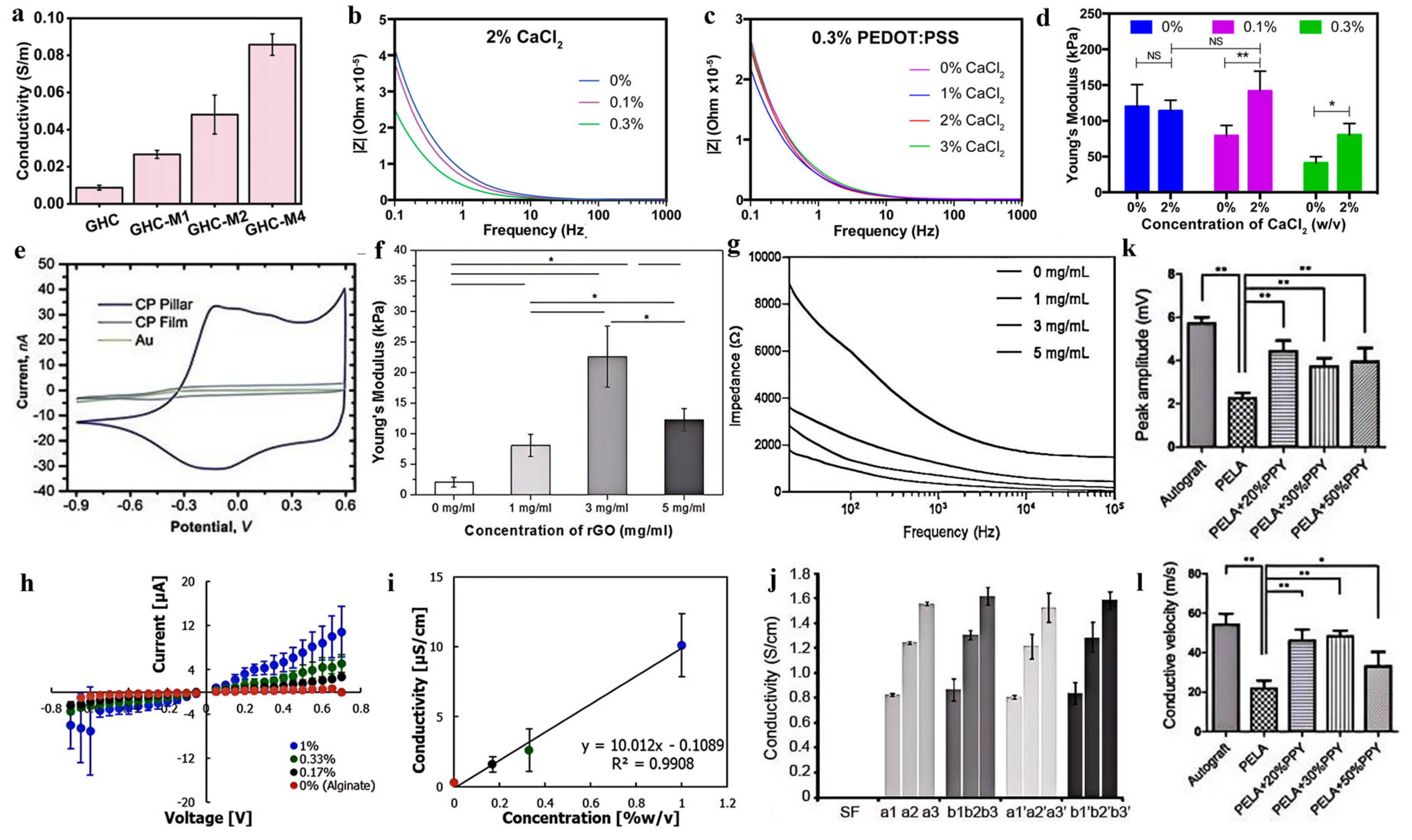
For example, Heo et al. developed a photocurable conductive hydrogel ink based on freeze-dried PEDOT:PSS and poly(ethylene glycol) diacrylate (PEGDA), patterned using desktop stereolithography (SLA) 3D printing. The material’s electrochemical performance (e.g., charge transfer capacity) and conductivity (measured via sheet resistance) significantly increased with PEDOT:PSS concentration. Although the compressive modulus slightly decreased (from 35.4 MPa to 26.3 MPa) with higher PEDOT:PSS loading, the conductive hydrogel provided excellent structural support for dorsal root ganglion (DRG) cells encapsulated in gelatin methacryloyl (GelMA) hydrogel and enabled systematic delivery of electrical stimulation to significantly enhance neuronal differentiation [56]. Tomaskovic-Crook et al. demonstrated directly ink-written PEDOT:PSS micro-pillar array electrodes (MEAs) combined with conductive biogels for 3D electrical stimulation of human neural stem cell (NSC)-derived neural tissues. Electrochemical characterization (cyclic voltammetry, impedance spectroscopy) revealed that the printed PEDOT:PSS micro-pillar electrodes exhibited significantly lower impedance (over two orders of magnitude lower at 100 Hz) and substantially higher charge storage capacity (CSC, up to 127 ± 5.6 mC cm−2) compared to gold electrodes and electro-polymerized conductive polymer film electrodes (Figure 1e). Electrical stimulation markedly promoted the formation of high-density mature neuronal bundles and enhanced the maturity of functional neural networks [43].
However, concerns exist regarding the potential long-term toxicity of the pristine PSS component, necessitating optimization via modification strategies such as acid treatment or ionic liquid incorporation. PEDOT:PSS is compatible with various printing techniques, including inkjet printing, extrusion-based 3D printing, and photopolymerization printing. It can also be composited with polymers (e.g., gelatin, alginate) or carbon nanomaterials (e.g., carbon nanotubes (CNTs), graphene) to expand its application performance and scope [44] (Figure 1f,g). For instance, PEDOT:PSS/CNT composites exhibited a 53% increase in conductivity and were used to fabricate flexible electrodes [67]. PEDOT:PSS/graphene hydrogels support 3D printing and neuronal cell growth. As a core material for neural interfaces, it can be 3D printed into microelectrode arrays. Yuk et al. developed a water-based ink achieving a conductivity of 155 S/m after curing while maintaining 15% tensile strain, suitable for neural signal acquisition [54,55]. In neural scaffolds, PEDOT:PSS promotes neuronal differentiation and accelerates axonal growth via electrical stimulation [43,56].

2.1.2. Polyaniline (PANI)

Polyaniline (PANI) is a typical intrinsic conductive polymer distinguished by its unique conjugated π-electron system [48]. Its molecular chain consists of alternating benzenoid (reduced) and quinoid (oxidized) rings, with conductivity reversibly tunable through acid/base doping-dedoping processes [49,51]. PANI exists in three primary oxidation states: the fully reduced leucoemeraldine (insulating), the partially oxidized emeraldine base (EB), which becomes conductive emeraldine salt (conductivity up to 103 S/cm, Table 1) [68] upon protonic acid doping, and the fully oxidized pernigraniline. PANI demonstrates good biocompatibility, but its non-degradability may elicit inflammatory responses [57,58,59]. It is primarily synthesized via oxidative polymerization or electrochemical deposition and is often composited with biodegradable polymers like collagen or chitosan [69].
Hsiao et al. developed electrospun aligned composite nanofiber meshes composed of PANI and poly(lactic-co-glycolic acid) (PLGA) serving as electroactive scaffolds to coordinate synchronous beating of cardiomyocytes. After HCl doping, the fibers became positively charged, attracting negatively charged adhesion proteins (e.g., fibronectin, laminin) to enhance cell adhesion. By optimizing the PANI/PLGA ratio (e.g., 0.5%/8%), conductivity was significantly increased to 3.1 × 10⁻³ S/cm. Cultured cardiomyocytes formed clusters on the scaffold, with cells within clusters exhibiting elongated morphology aligned along the fiber direction, expressing connexin 43, and achieving synchronized beating within clusters. Crucially, mimicking native cardiac electrical stimulation enabled synchronization of beating rates between different clusters, which is vital for ensuring electrical coupling of transplanted cells with host myocardium [70]. In tissue engineering, PANI facilitates synchronized beating of cardiomyocytes and promotes the oriented alignment of skeletal muscle cells [70].

2.1.3. Polypyrrole (PPy)

Polypyrrole (PPy), formed by oxidative polymerization of pyrrole monomers, has a conductivity mechanism reliant on doping processes (e.g., anion intercalation) [71]. This grants PPy a broad conductivity range (10−2 to 102 S/cm, Table 1), influenced by synthesis methods and dopants [72,73,74]. Research on PPy is particularly active in neural repair. While PPy exhibits good environmental stability and biocompatibility, its mechanical properties are relatively poor [60]. To overcome this, PPy is often composited with elastomers (e.g., PDMS) or conductive fillers (e.g., CNTs) [45,75] (Figure 1h,i). Common processing methods include chemical oxidative polymerization or electrochemical deposition [60,76].
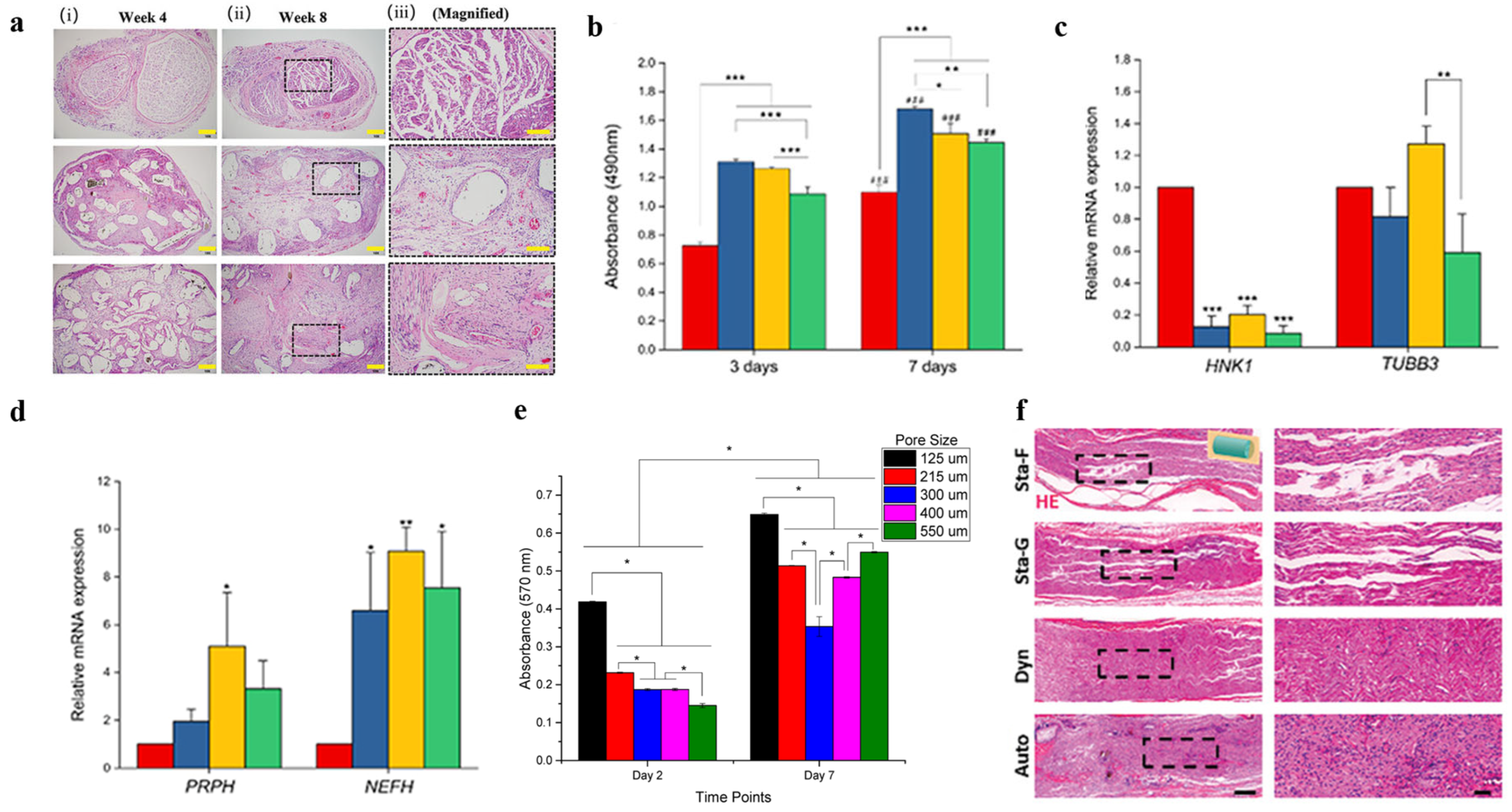
Zhao et al. and Zhou et al. focused on PPy/Silk fibroin (SF) composites for neural repair. Zhao et al. combined 3D bioprinting and electrospinning to fabricate PPy/SF conductive composite scaffolds, with conductivity enhanced (in the range of ~1 × 10⁻⁵ to 1 × 10⁻³ S/cm) via electrochemical PPy deposition. Schwann cells cultured on PPy/SF scaffolds under electrical stimulation (ES) showed enhanced viability, proliferation, migration, and upregulated expression of neurotrophic factors. Animal studies demonstrated that PPy/SF nerve conduits combined with ES effectively promoted axonal regeneration, remyelination, and activation of the MAPK signaling pathway [46,60]. (Figure 1j) Zhou et al. prepared poly(D,L-lactide)-co-polyethylene glycol/polypyrrole (PELA-PPy, containing 20%, 30%, 50% PPy) nerve conduits via electrospinning. In vitro studies confirmed good biocompatibility, supporting PC12 cell adhesion and proliferation. After 12 weeks of implantation in a rat sciatic nerve defect (10 mm) model, the PELA-PPy conduits (especially 30% PPy) performed nearly as well as autografts and significantly better than pure PELA conduits, evidenced by electrophysiological parameters (e.g., significantly improved peak amplitude (PA) of evoked action potentials and nerve conduction velocity (NCV)), total number of regenerated myelinated nerve fibers, axon diameter, myelin sheath thickness, and various immunohistochemical markers (S-100, laminin, neurofilament, BrdU, GFAP). This efficacy is attributed to PPy’s ability to transmit cell-derived endogenous electrical signals [47] (Figure 1k,l).
PPy finds diverse applications. As conductive scaffolds, it promotes neuronal axonal growth [46,76]; for instance, PPy/SF composite scaffolds facilitate ES-enhanced Schwann cell proliferation and axonal regeneration, and PPy/PDLLA conductive scaffolds achieve peripheral nerve repair outcomes comparable to autografts [47,60]. In energy storage, PPy improves cycling stability in lithium-sulfur battery electrodes [77] and delivers high power density in supercapacitors [78]. Furthermore, PPy/chitosan hydrogels promote neural stem cell differentiation under ES, aiding spinal cord injury repair [79].
Additionally, although reduced graphene oxide (rGO) belongs to carbon-based conductive materials rather than conductive polymers, it exhibits excellent performance in flexible conductive biomaterials, particularly for cardiac tissue engineering, often composited with biopolymers like GelMA. Shin et al. developed rGO-incorporated gelatin methacryloyl (GelMA) hybrid hydrogels for cardiac tissue construction. The inclusion of rGO significantly enhanced the hydrogel’s electrical conductivity and mechanical properties (e.g., compressive modulus). Electrochemical impedance spectroscopy showed significantly reduced impedance for rGO-containing samples. Interestingly, the compressive modulus peaked at an rGO concentration of 3 mg mL−1 (22.6 kPa), but higher concentrations (5 mg mL−1) caused a modulus decrease (12.6 kPa) due to reduced crosslinking density, which could be mitigated by extending UV crosslinking time. Compared to pure GelMA or GO-GelMA/CNT-GelMA with similar mechanical properties and particle concentrations, cardiomyocytes cultured on rGO-GelMA hydrogel sheets exhibited stronger contractility, faster spontaneous beating frequency, and improved cell viability, proliferation, and maturity. This strategy provides a foundation for building high-fidelity cardiac tissue models for drug screening, studies of cardiac tissue development, and in vitro disease modeling [44].

2.2. Carbon-Based Material Systems

Unlike conductive polymers that rely on intrinsically conjugated backbones, carbon-based materials such as graphene and carbon nanotubes (CNTs) often serve as functional fillers in composite biomaterials. Their conductivity originates from the excellent intrinsic conductivity of the filler itself, while the overall conductivity of the composite depends on whether the filler can form a three-dimensional percolation network within an insulating or weakly conductive polymer matrix (e.g., hydrogel, PLA, PCL).
Percolation theory: constructing conductive pathways
Percolation threshold: When the filler concentration is low, particles are isolated and dispersed, and the composite behaves as an insulator. As the filler content increases, particles begin to contact and form local clusters. When the filler concentration reaches a critical value—the percolation threshold—these clusters interconnect to form a continuous conductive pathway spanning the entire material, leading to a jump in composite conductivity by several orders of magnitude [61,80].
Network dependence: The final conductivity depends not only on the intrinsic conductivity of the filler (e.g., CNTs > 106 S/cm, metal nanowires > 107 S/cm) but also on filler dispersion uniformity, aspect ratio, orientation, and inter-filler contact resistance [81]. For example, high-aspect-ratio CNTs or nanowires can form connected networks at lower concentrations, exhibiting lower percolation thresholds [82].
Charge transport at the nanoscale: contact and tunneling
Under ideal direct physical contact between fillers, charge is conducted through ohmic transport. However, in printed composites, fillers are often separated by thin polymer layers or nanoscale gaps.
Quantum tunneling effect: When the gap between adjacent fillers is reduced to a few nanometers, electrons can tunnel through the insulating barrier with a certain probability. This effect allows conductive networks to form effectively even without direct physical contact, but tunneling resistance increases exponentially with gap distance, posing a challenge to network stability [83].
Interface optimization: Therefore, surface functionalization of fillers (e.g., carboxylated CNTs [62], citrate-coated Au nanoparticles [84]) aims not only to improve dispersion and reduce agglomeration but also to tailor inter-filler interfacial interactions, regulating contact resistance or promoting tighter packing.
Application considerations in bioprinting
Anisotropic conductive design: By utilizing shear forces or external fields (electric or magnetic) during printing to induce directional alignment of one-/two-dimensional fillers (e.g., CNTs, graphene nanosheets), scaffolds with anisotropic conductivity can be constructed. This enables preferential electrical signal transmission along specific directions to match the directional growth requirements of nerve axons or myocardial fibers [85,86].
Synergy of structure and function: While providing electrical conductivity, these nanofillers often significantly enhance the mechanical properties of composites (e.g., CNT toughening, graphene reinforcement) and may introduce additional functionalities (e.g., photothermal effect of graphene, plasmonic resonance of metal nanoparticles), laying the foundation for creating multimodal intelligent scaffolds [36,87].
In short, carbon-based fillers achieve composite conductivity by constructing a percolation network—a “topological” problem closely related to filler concentration, morphology, dispersion, and interface. The design essence is to achieve a stable and efficient conductive network with minimal filler usage, while balancing printability, mechanical properties, and biocompatibility. The implementation strategies and applications of graphene and carbon nanotube materials in printing inks and tissue engineering scaffolds are discussed in detail below.

2.2.1. Graphene

Graphene is a strictly two-dimensional material composed of a single atomic layer of carbon atoms arranged in a honeycomb lattice, with a thickness of ~0.34 nm. Its network of sp2-hybridized carbon atoms forms a unique electronic band structure, underpinning outstanding electrical conductivity (theoretically up to ~106 S/cm for single-layer) [88,89]. Graphene possesses a Young’s modulus of up to 1 TPa and strength of ~130 GPa, although it is relatively brittle [90]. Its ultra-high electron mobility and gapless nature make it promising for transparent electrodes. In composite forms used for bioprinting, conductivities typically range from 10−3 to 103 S/m (Table 1), suitable for mimicking the electrophysiological microenvironment.
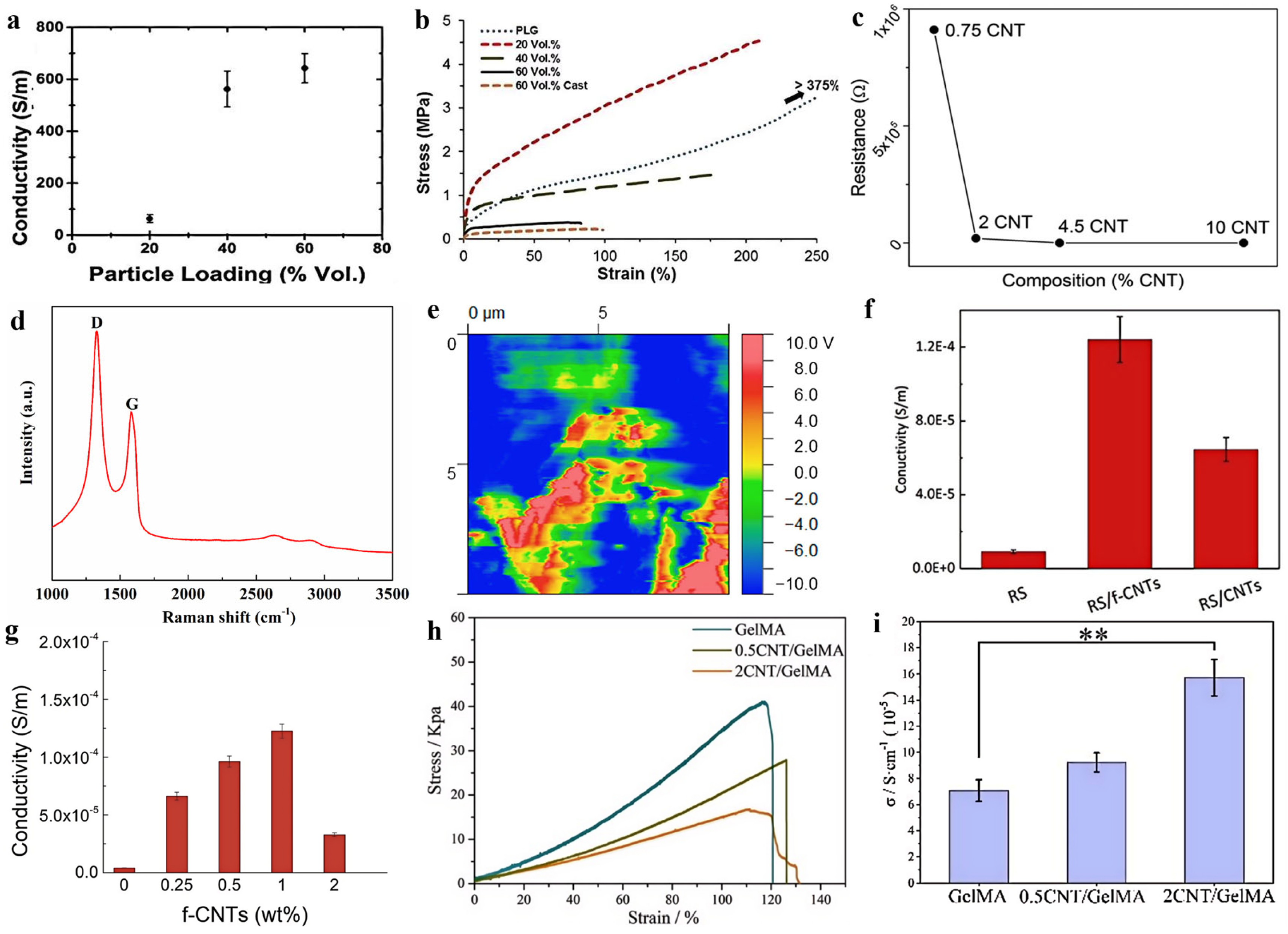
For example, Jakus et al. developed a 3D-printable liquid ink (“3DG”) by compositing graphene with poly(lactide-co-glycolide) (PLG). The composite exhibited tailorable conductivity (>800 S/m at 60 vol% graphene) and mechanical properties (higher graphene content increased conductivity but reduced ductility) [61]. The material supported neurogenic differentiation of human mesenchymal stem cells even without exogenous neurogenic stimuli, demonstrating excellent biocompatibility and surgical handleability, indicating significant potential for neural tissue repair and bioelectronic devices (Figure 2a,b).

2.2.2. Carbon Nanotubes (CNTs)

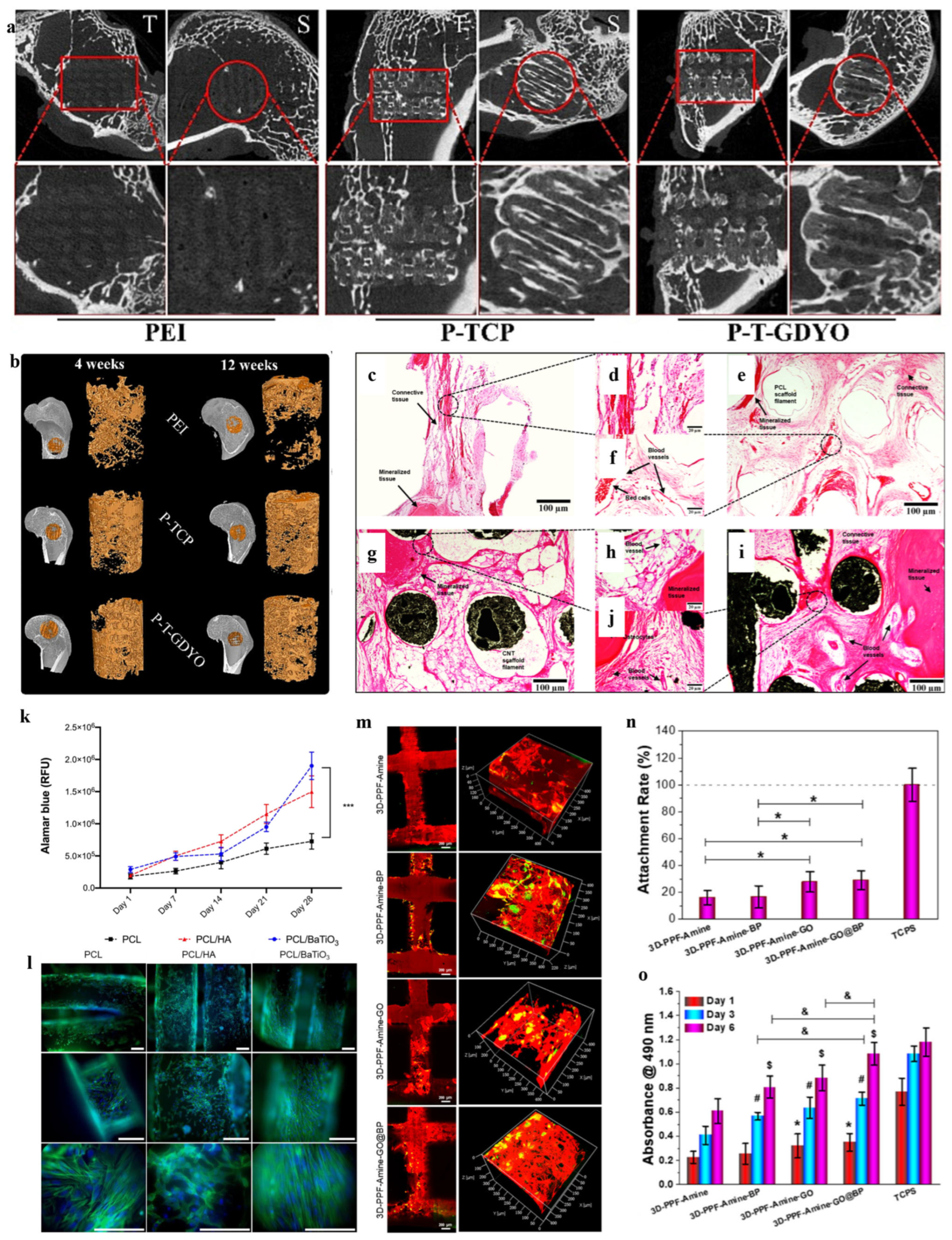
Carbon nanotubes (CNTs) are cylindrical structures formed by rolling graphene sheets. Based on the number of layers, they are classified into two types: Single-walled carbon nanotubes (SWCNTs), consisting of a single rolled graphene sheet, typically have diameters between 0.5 and 1.5 nm, exhibit one-dimensional quantum confinement effects, and possess high conductivity [81,82]. Multi-walled carbon nanotubes (MWCNTs) comprise multiple concentric graphene layers, often with diameters exceeding 100 nm and an interlayer spacing of ~0.34 nm, held together by van der Waals forces. Their multi-layered structure provides higher mechanical strength, but conductivity can be affected by the number of layers [81,82]. The structural differences between SWCNTs and MWCNTs arise from their rolling configurations (e.g., armchair, zigzag, or chiral), which determine whether their electronic properties are metallic or semiconducting [94]. Compared to graphene, CNTs achieve enhanced toughness through their rolled structure, and their composites with polymers further improve mechanical performance [95,96]. These superior properties stem from the robustness of the carbon-carbon bond and the two-dimensional geometric constraints, but practical application faces challenges like dispersion issues, such as CNT aggregation within polymers [80]. CNTs exhibit ultra-high intrinsic conductivity (>106 S/cm), which also varies by type: Armchair SWCNTs are metallic, while zigzag and chiral types are semiconducting; MWCNT conductivity is more complex due to their multi-layer structure [83,97]. Like graphene, CNTs offer advantages such as high specific surface area, mechanical strength, and chemical stability [98]. In applications, CNTs are also widely used in biomedicine and energy [62,63] (Figure 2c) (Table 1). For example, MWCNTs enhance the conductivity of neural scaffolds, promoting axonal extension [99], supporting human ADSC proliferation and osteogenic differentiation [91] (Figure 2d), increasing in the gene expression of specific tendon/ligament-related markers [92] (Figure 2e); CNT-filled PEDOT:PSS composites are used in flexible electrodes to lower impedance [100]; and CNT-reinforced PEDOT:PSS hydrogels enable 3D printing of flexible circuits [67].
Bon et al. developed a bioadhesive ink (RS/f-CNTs) composed of carboxyl-functionalized carbon nanotubes (f-CNTs) and regenerated silk fibroin (RS). This material exhibited good dispersibility (f-CNTs promoting dispersion to form a percolation network), tunable conductivity (increasing with f-CNTs content; optimal mechanical properties at 1 wt% f-CNTs with a modulus ~8 kPa and fracture strain > 600%), and excellent ductility (f-CNTs plasticizing RS) [62]. The composite could not only seal biological substrates, but its piezoelectric devices were successfully applied for in vivo respiration monitoring in rats (Figure 2f,g). It also served as a 3D printing ink (combined with PHBV) to fabricate bilayer hollow tubular structures that supported the adhesion and proliferation of human dermal fibroblasts [62]. Liu et al. presented a method for rapid and uniform coating of ssDNA@CNT nanocomplexes onto aminated 3D-printed poly(propylene fumarate) (PPF) scaffolds via electrostatic attraction. The ssDNA@CNT coating (solid conductivity > 200 S/m) significantly improved the scaffold surface’s cytocompatibility, promoting the adhesion, proliferation, and differentiation of pre-osteoblasts (upregulation of ALP, OCN, OPN genes). Combined with electrical stimulation (ES), it could further modulate cell behavior and enhance osteogenic differentiation [101]. Lee et al. utilized stereolithography (SLA) 3D printing to fabricate PEGDA hydrogel composite neural scaffolds with uniformly dispersed aminated MWCNTs. The incorporation of MWCNTs significantly increased the scaffold’s charge storage capacity (0.1% MWCNT scaffold reached 2.21 ± 0.12 mC cm−2, far exceeding 0.133 ± 0.09 mC cm−2 for pure PEGDA) and promoted the proliferation and early neuronal differentiation of neural stem cells (NSCs). Combined with biphasic pulsed electrical stimulation (500 µA), it further enhanced neuronal maturation [99]. Yao’s team developed CNT/GelMA composite fibers (prepared via rotating bath electrospinning) featuring micron-scale aligned structures, conductivity (on the order of ~10−4 S/cm), and soft mechanical properties matching neural tissue (Young’s modulus ~0.1–5 kPa). The material supported PC12 cell proliferation and aligned adhesion in vitro (enhanced by ES), and promoted neuronal differentiation and axon-like neurite outgrowth of NSCs. In a rat model of spinal cord injury (T9 transection), the implanted fibers retained CNTs at the injury site after GelMA degradation, improving tissue conductivity (Figure 2h,i). The aligned structure induced nerve fiber regeneration, and combined ES significantly enhanced remyelination and axonal regeneration, achieving a motor function recovery rate of 68.3% in rats [93]. CNTs composited with PEDOT:PSS improve supercapacitor performance (specific capacitance up to 23 mF/cm2) [102]. Regarding carbon black/graphite, Uřičář et al. achieved a resistivity of 0.9 Ω·cm using a polystyrene/graphite composite ink (60 wt% loading), although biocompatibility was somewhat limited [103].
In addition to carbon-based materials, MXenes (e.g., Ti3C2), as an emerging class of two-dimensional transition metal carbides/nitrides, show potential in biomedicine due to their large specific surface area, high conductivity, low toxicity, and biodegradability [64]. Rastin et al. uniformly dispersed Ti3C2 MXene nanosheets in hyaluronic acid/alginate (HA/Alg) hydrogels to develop a conductive cell-laden bioink (HEK-293 cells). This ink exhibited excellent rheological properties suitable for extrusion-based 3D bioprinting, enabling the construction of high-resolution, shape-retaining multi-layered structures. The incorporation of MXene significantly enhanced the ink’s conductivity (e.g., ~7200 μS/cm or 0.072 S/m at 5 mg mL−1 MXene), approaching the conductivity range of excitable tissues like the spinal cord (0.4–0.9 S/m), while also improving the ink’s compressive strength (5 mg mL−1 MXene). Crucially, this MXene nanocomposite ink demonstrated excellent cell viability (>95%) in both bulk hydrogels and 3D-printed constructs, offering a new option for conductive bioinks in neural engineering and tissue engineering [64].

2.3. Metal Materials

Metal nanomaterials (e.g., Au, Ag) function as conductive fillers following similar percolation principles but impart unique optical and biological properties due to their surface plasmon resonance (SPR) and ion release profiles, respectively. These additional functionalities enable multifunctional scaffolds that combine electrical conduction with, for example, photothermal therapy or antimicrobial activity.

2.3.1. Gold (Au)

Gold nanomaterials exhibit strong, tunable SPR in the visible to near-infrared range, enabling applications in deep-tissue imaging, photothermal therapy, and biosensing [84,104,105,106]. Their surfaces are easily functionalized to enhance biocompatibility and cell adhesion [84,107]. In conductive composites, they contribute to a percolative network, with reported conductivities around ~0.13 S/m in hydrogel formats [65] (Table 1).
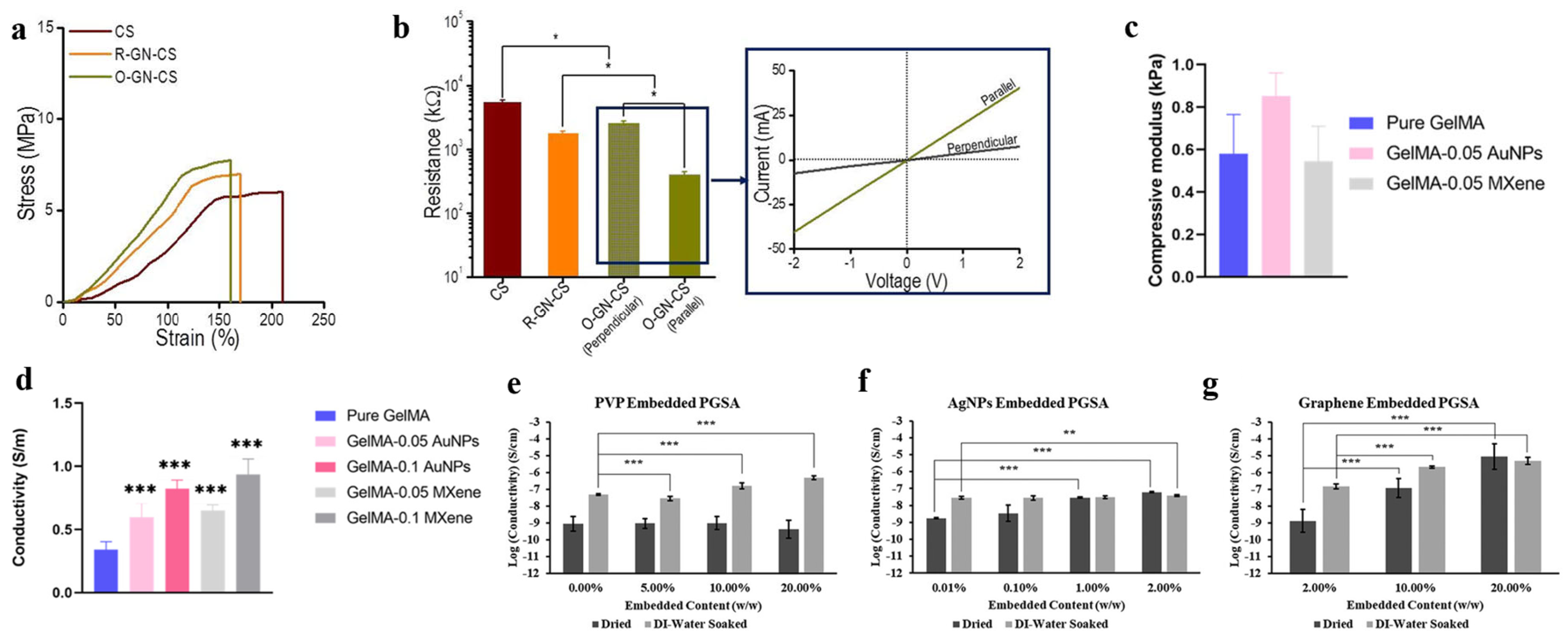
Baei et al. developed a conductive gold nanoparticle-chitosan (CS-GNP) hydrogel that performed exceptionally well in cardiac tissue engineering. Its conductivity increased with AuNP concentration (reaching 0.13 S/m for CS-2GNP), while the compressive modulus remained stable at 6.8 kPa [65]. Simultaneously, AuNPs offer significant advantages in photothermal therapy and biosensing, leveraging their plasmonic resonance effect [108,109]. For example, AuNPs can be used to construct electrochemical sensors for biomarker detection. In regenerative medicine, AuNPs are also involved in the critical process of electrical stimulation-induced cell differentiation [85] (Figure 3a,b). WonJin Kim et al. mixed gold nanowires (GNWs) with collagen bioink and achieved aligned nanowire orientation via electric field manipulation. This resulted in a composite scaffold with an increased compressive modulus of 5.4 MPa, inducing highly aligned myoblast organization and efficient myotube formation [85]. In cardiac tissue engineering, GNRs embedded within fibrin hydrogel enhanced current density, significantly improving the contractile function and long-term survival (>9 months) of human-derived cardiac tissues [110].

2.3.2. Silver (Ag)

Silver nanomaterials are renowned for their exceptional antibacterial properties and conductivity [112]. Their antibacterial mechanism relies on the release of silver ions (Ag+), which achieve broad-spectrum antimicrobial effects by disrupting bacterial membranes, interfering with the respiratory chain, and inhibiting DNA replication. In tissue repair, this property significantly reduces the infection risk of implants. For instance, silver-doped polycaprolactone (PCL) nanofiber dressings (Ag ≤ 1.0 wt%) effectively inhibited Staphylococcus aureus growth while maintaining hMSC viability [113]. Furthermore, silver-containing hydrogels (e.g., PEG@CNT-M-E), benefiting from sustained Ag+ release, can extend the antibacterial period to 28 days [114]. Regarding cell proliferation and migration, low concentrations of AgNPs (0.1 wt%) promote hMSC proliferation and migration, whereas high concentrations (>1.0 wt%) induce apoptosis [113]. Combining AgNPs with vascular endothelial growth factor (VEGF) enhances microvascular network formation [115]. Morphology design (nanoparticles, nanowires, etc.) and surface modification (e.g., chitosan coating) can optimize the degradation rate, mechanical strength, and drug-loading capacity of silver nanomaterials. Silver nanoliposomes (Lip@AgNPs) loaded with photosensitizers, combined with photodynamic therapy, can eradicate drug-resistant bacteria and stimulate fibroblast proliferation [114]. Nanocomposite Conductive Bioinks Based on Low-Concentration GelMA and MXene Nanosheets/Gold Nanoparticles Providing Enhanced Printability of Functional Skeletal Muscle Tissues [87] (Figure 3c,d). Graphene/silver nanocomposites (rGO/Ag) promote axonal extension through electrical signal conduction, while PGSA-Ag composites achieve a conductivity of 10−7 S/cm in the swollen state, supporting electrical stimulation applications in 3D-printed neural conduits [111,116] (Figure 3e–g).
Overall, the application of AgNPs in regenerative medicine primarily focuses on constructing antibacterial dressings and conductive scaffolds. For example, a flexible patch (ePatch) formed by integrating silver nanowires (AgNWs) into methacrylated alginate (MAA) showed a resistance increase of <20% after 6 days of immersion in body fluid, significantly accelerating rat wound healing (within 7 days) [66]. In bone regeneration, AgNPs can modulate MSC proliferation and differentiation and are highly regarded for their osteoinductive properties [117]. The antibacterial properties of AgNPs effectively prevent implant-associated infections, while their conductivity supports electrical stimulation-induced cell differentiation [109,118]. Oxidized sodium alginate/carboxymethyl chitosan/silver nanoparticle (OSA/CMCS/AgNPs) hydrogels, requiring no additional conductive fillers, achieve a conductivity of 0.0127 S/cm. They exhibit self-healing and antibacterial properties, significantly promoting the repair of full-thickness skin defects [119].
The diverse material systems—conductive polymers, carbon-based nanomaterials, and metals—each offer a unique combination of electrical, mechanical, and biological properties (summarized in Table 1). The selection of a material is guided by the target tissue’s electrophysiological needs (e.g., high CSC for neural interfaces, anisotropic conductivity for muscle), desired additional functions (e.g., antibacterial, photothermal), and compatibility with the chosen 3D/4D printing modality. A persisting challenge is balancing high conductivity with biodegradability and long-term biocompatibility. Future development lies in creating multifunctional hybrid composites and employing surface engineering strategies to optimize the interface between these smart materials and biological systems, fully realizing their potential for intelligent tissue regeneration.

3. 3D/4D Printing Technologies and Compatibility

However, the transformation of the above-mentioned conductive materials with excellent electrophysiological regulatory potential into implantable scaffolds that can truly simulate the complex structure and function of natural tissues faces enormous manufacturing challenges. Traditional tissue engineering manufacturing techniques, such as solvent casting-particle leaching, gas foaming, and electrospinning, can prepare porous structures, but they have inherent limitations in achieving patient-specific anatomical adaptation, accurate construction of complex three-dimensional internal structures (e.g., biomimetic vascular networks, heterogeneous cell distribution), and controllable distribution and integration of conductive materials in three-dimensional space [26,28]. These methods often make it difficult to accurately control the pore geometry, connectivity, and gradient changes in the scaffold, and they cannot embed conductive components (such as nanowires and conductive polymers) into the three-dimensional matrix in a preset patterned manner, thus limiting the construction of biomimetic electroactive microenvironments that can accurately transmit electrical signals and guide the directional growth of cells.
In this context, three-dimensional (3D) printing technology, especially 3D bioprinting based on additive manufacturing principles, offers a revolutionary tool to address this manufacturing bottleneck [11]. Its core advantages are precisely aimed at the shortcomings of traditional methods:
From “one thousand people” to “tailor-made”: based on the patient’s medical imaging data (e.g., CT, MRI), the ability to personalize can accurately match the anatomical morphology of defective tissue and achieve “personalized adaptation” of the implant [26,27].
From “simple porosity” to “structural bionics”: through layer-by-layer accumulation, complex three-dimensional microstructures (such as multi-level pores, microchannels with curved folds, and heterogeneous mechanical gradients) that are difficult to achieve with traditional techniques can be freely fabricated, providing cells with a highly biomimetic physical microenvironment [28,29,30,31].
From “mixing homogenization” to “spatial programming”: multi-material printing capabilities allow for the spatially precise arrangement and integration of conductive materials with insulating biomaterials and different cell types, thereby programming the construction of functionalized electroactive regions and signal conduction pathways at a three-dimensional scale [12,120].
Therefore, the combination of 3D/4D bioprinting and flexible conductive materials is not a simple superposition, but an inevitable integration. It represents a critical path for regenerative medicine from “static structure substitution” to “dynamic functional reconstruction”. Through printing technology, the electrophysiological regulation potential of conductive materials can be spatialized, functionalized, and personalized in complex biomimetic structures, and finally move towards the ultimate goal of building an “intelligent” bioelectronic microenvironment that can sense, respond to, and actively guide tissue regeneration.
This section critically assesses various 3D/4D printing modalities, focusing on their compatibility with conductive inks and their unique capabilities in fabricating next-generation, electroactive tissue scaffolds that mirror the form and function of native tissues.

3.1. Vat Photopolymerization (SLA/DLP)

Vat photopolymerization technologies, particularly Stereolithography (SLA) and Digital Light Processing (DLP)-based 3D/4D bioprinting, demonstrate significant application potential in regenerative medicine due to their high resolution (30–100 μm) and excellent shape fidelity [121,122,123,124,125,126]. Stereolithography (SLA) is a photopolymerization-based additive manufacturing technique that constructs three-dimensional structures by sequentially curing liquid photopolymer resin layers using an ultraviolet (UV) laser. Its core advantages include:
  • High-Precision Fabrication. Capable of micron-level resolution, enabling accurate replication of complex anatomical structures.
  • Rapid Prototyping. Significantly improved manufacturing efficiency compared to extrusion-based bioprinting due to faster layer curing speeds [127].
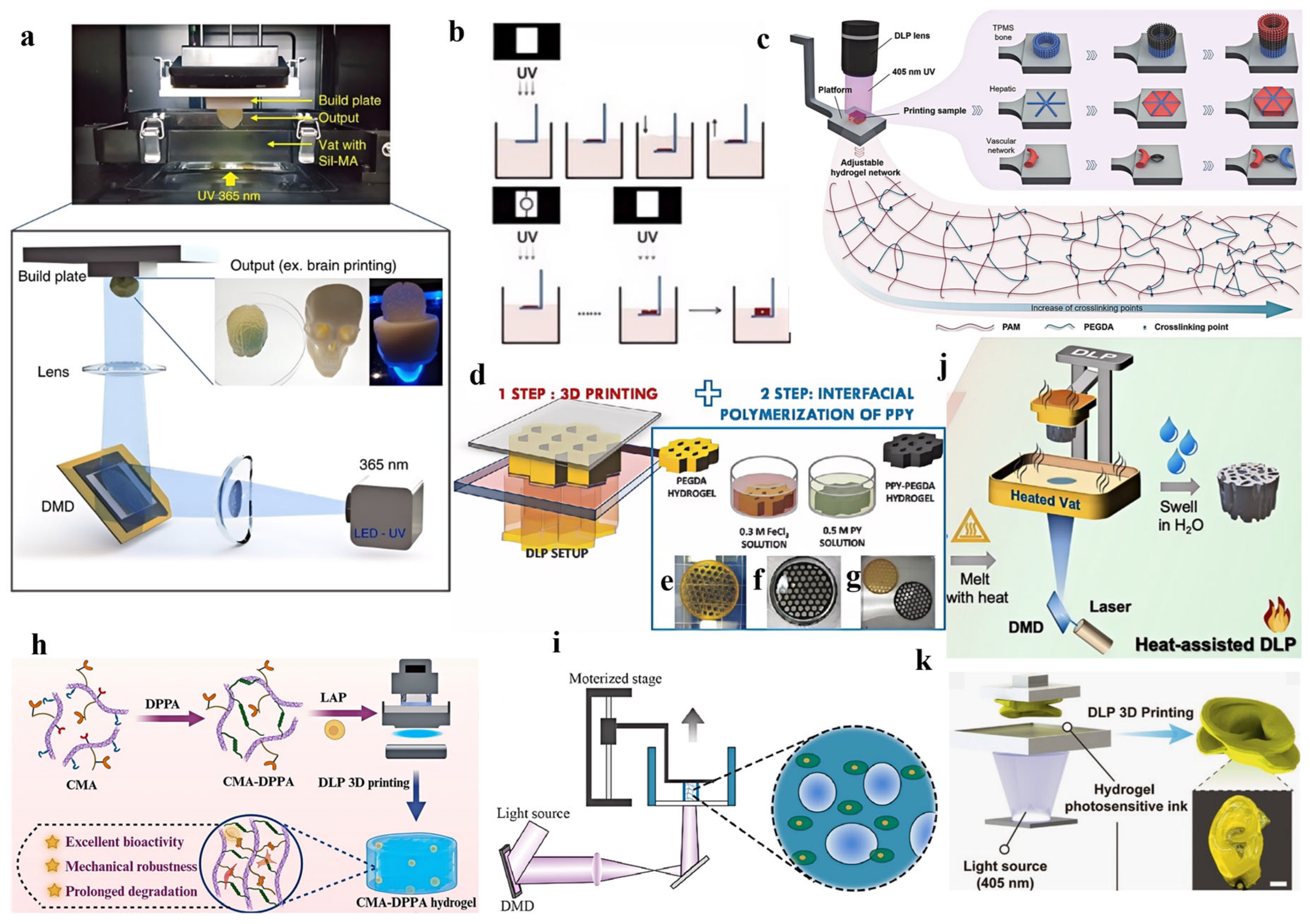
  • Enhanced Biocompatibility. Development using degradable resins (e.g., poly(d,l-lactide)—PDLLA) or novel bioinks (e.g., methacrylated silk fibroin—Sil-MA [126] (Figure 4a), glycidyl methacrylate-modified silk fibroin—Silk-GMA [128], dual-network methacrylated collagen-dimethylphenylphosphinate—CMA-DPPA [129]) significantly improves scaffold cytocompatibility, printability, and functionality [126,128,129].
Digital Light Processing (DLP) Bioprinting utilizes a digital micromirror device (DMD) to project predefined light patterns, photopolymerizing photosensitive materials (e.g., poly(ethylene glycol) diacrylate—PEGDA, gelatin methacryloyl—GelMA, methacrylated hyaluronic acid, Sil-MA, CMA-DPPA) within bioinks layer-by-layer to build 3D tissue scaffolds [126,129,134,135]. Compared to SLA, DLP cures an entire cross-section simultaneously via the DMD, resulting in faster printing speeds, particularly advantageous for fabricating objects with complex geometries [134,135]. Its core process involves:
Optical System. A light source (e.g., UV or blue light) is modulated by the DMD and focused onto the bioink reservoir via lenses [134].
Printing Strategy. Employs either “top-down” or “bottom-up” approaches, with the build platform moving incrementally to stack layers [134,135].
Bioink Requirements. Must possess photosensitivity (typically requiring photoinitiators like lithium phenyl-2,4,6-trimethylbenzoylphosphinate—LAP), biocompatibility, suitable rheological properties (e.g., moderate viscosity), and the ability to support cell viability and function [120,126,128,129,135].
Recently, Volumetric Bioprinting has emerged as a breakthrough technology. Based on inverse computed tomography principles, it utilizes multi-angle dynamic projections to accumulate light dose within a rotating bioresin vat, solidifying the entire 3D volume in one step. This enables the printing of centimeter-scale, complex free-form living tissue constructs (e.g., bone models, meniscal grafts, auricle models) within seconds to tens of seconds, dramatically overcoming the speed limitations of traditional layer-by-layer printing while maintaining high cell viability (>85%) [127].
High Resolution and Precise Structuring: SLA and DLP technologies achieve the construction of intricate architectures through the layer-by-layer curing of photopolymer resins [121,136]. SLA utilizes a laser beam to scan the resin surface, while DLP cures an entire layer at once via the DMD, significantly accelerating print speed. Both techniques can achieve resolutions as fine as ~39 μm, making them suitable for fabricating delicate structures such as microvascular networks, neural scaffolds, cartilage scaffolds, biomimetic organ models (heart, liver, brain, vascular trees), and even organ models featuring internal channels and cavities [120,126,127,128,131,132,133,137]. This high resolution provides a distinct advantage in mimicking the microstructure of native tissues, particularly in tissue engineering applications requiring precise control over cell alignment (e.g., guided by surface microstructures like spiral grooves or triply periodic minimal surfaces—TPMS) and electrical signal conduction [120,138]. Multi-material DLP printing further allows the integration of bioinks with different mechanical properties (e.g., modulus) within the same construct (such as PEGDA-AAm systems), enabling the precise replication of the heterogeneous mechanical characteristics of biological tissues (e.g., bone, liver lobules, vascular networks) and the construction of perfusable microchannel networks, providing a powerful tool for building complex tissue models [120] (Figure 4b,c).
Strategies for Achieving Conductivity. Researchers employ several strategies to incorporate conductive fillers or polymers into photopolymer resins:
Uniform Dispersion: Conductive polymers (e.g., PEDOT:PSS) are homogeneously dispersed within the photopolymer resin to ensure conductive network formation. Key challenges involve controlling filler concentration and dispersion to avoid compromising resin curing kinetics and print resolution [44,139].
Layered Printing: Alternating printing of conductive and insulating layers creates multi-layered structures. This enables localized conductivity while maintaining the overall mechanical strength and biocompatibility of the structure [140].
Post-Processing: Conductive layers are added to the surface or interior post-printing via chemical or physical methods (e.g., electroplating, coating, or interfacial polymerization). For example, sequentially immersing a DLP-printed PEGDA hydrogel in FeCl3 oxidant solution and pyrrole monomer solution can initiate interfacial polymerization of polypyrrole (PPy) within the hydrogel, imparting conductivity. This method is suitable for scenarios requiring high conductivity where conductive components would interfere with the photopolymerization process during printing [130,141] (Figure 4d–g).
Utilizing crystallized PEDOT:PSS mixed with PEGDA also allows direct SLA printing of 3D structures with good conductivity for neural tissue engineering applications [49].
Application Cases and Performance Optimization. Vat photopolymerization technologies have yielded significant results:
Conductive scaffolds fabricated via SLA/DLP (e.g., PEDOT:PSS composites, conductive hydrogels) exhibit good conductivity and effectively promote neuronal (e.g., dorsal root ganglion—DRG cells) proliferation, differentiation, and neurite outgrowth through electrical stimulation [56].
DLP printing using Sil-MA or Silk-GMA bioinks successfully produced cartilage scaffolds supporting high chondrocyte viability, proliferation, and cartilage matrix deposition, promoting the formation of new cartilage-like tissue and epithelium in rabbit tracheal defect models [126,128].
Dual-network CMA-DPPA bioinks formed high-precision, mechanically robust, and enzyme-resistant scaffolds via DLP printing, significantly accelerating ordered collagen deposition, epidermal regeneration, and wound healing in rat full-thickness skin defect models [129] (Figure 4h).
DLP-printed GelMA/dextran emulsions formed void-forming hydrogels, promoting the proliferation, migration, and spreading of encapsulated bone marrow mesenchymal stem cells (BMSCs), activating the YAP signaling pathway to significantly enhance osteogenic differentiation, and effectively promoting bone regeneration in vivo [132] (Figure 4i).
Using heat-assisted DLP printing of pure molten PEG resin (containing a tetra-armed macromolecular photoinitiator), followed by swelling, yielded “all-PEG” hydrogels with high mechanical toughness (compressive toughness 1.3 MJ m−3). This enabled the fabrication of porous scaffolds with trabecular bone-like structures, supporting cell adhesion and formation of bone-lining cell layers, offering a new strategy for bone tissue engineering [131] (Figure 4j).
DLP printing of elastic dual-network hydrogels with tunable stiffness (via component adjustment and metal-coordination bond density) enables high-fidelity fabrication of structurally complex biomimetic organ models (kidney, brain, heart, liver, vascular trees) for surgical training (e.g., cerebrovascular intervention simulation) and medical device testing [133] (Figure 4k).
Multi-material DLP printing facilitates the construction of complex cell-laden structures with heterogeneous mechanical properties and perfusable networks [120].
Researchers continuously improve the balance between print precision, mechanical strength, degradation resistance, conductivity, and biofunctionality by optimizing printing parameters (e.g., exposure time, layer thickness, light intensity) and ink formulations (e.g., dual-network crosslinking, adding light absorbers like tartrazine to control penetration depth), alongside developing novel bioinks (e.g., Sil-MA, CMA-DPPA) and printing strategies (volumetric printing, heat-assisted DLP) [126,128,129,131,132,133,142].
Despite their immense potential and ongoing breakthroughs (e.g., the speed revolution of volumetric printing, multi-material heterogeneous structure fabrication, complex organ model printing), SLA/DLP technologies face several challenges:
Impact of Conductive Fillers/Components on Photopolymerization. High concentrations of conductive fillers (e.g., carbon black, metal nanoparticles) or dark-colored conductive polymers (e.g., PEDOT:PSS, PPy) can absorb or scatter light, interfering with resin curing. This leads to reduced print resolution or necessitates higher exposure doses. Future efforts require developing novel fillers with less light interference or higher conductive efficiency, alongside new photopolymer resins/bioinks with better light transmittance to better accommodate conductivity needs [56,137].
Complexity of Multi-Material Printing. Achieving seamless integration and precise spatial arrangement of conductive materials, biomaterials with varying mechanical properties, and living cells within complex 3D structures remains technically challenging. Developing more advanced multi-material switching systems and innovative ink designs (e.g., dual networks like CMA-DPPA, multi-component systems like PEGDA-AAm) is a critical future direction [120,129,131,132,133,142].
Long-Term Stability and Biocompatibility. The long-term stability of conductive fillers in vivo, potential inflammatory responses, and chronic toxicity to encapsulated cells or surrounding tissues require deeper investigation. Developing biodegradable conductive materials (e.g., bio-polymer-based conductive composites) and more biocompatible methods for modifying conductive polymers is paramount [56].
Printing of High-Toughness Hydrogels. Printing pure synthetic high-toughness hydrogels (e.g., pure PEG) via traditional aqueous-based DLP is difficult. The strategy of heat-assisted DLP printing of molten PEG resin offers a novel pathway to overcome this challenge, but process optimization and validation in biological applications require further investigation [131].
Vascularization and Functional Integration. Achieving effective integration of vascular networks and functionality (e.g., innervation, metabolic activity) within printed large-volume, complex tissues remains a major hurdle. Volumetric printing and multi-material DLP printing for constructing perfusable channels represent promising avenues [120,127].

3.2. Extrusion-Based Printing

Extrusion-based printing stands as a widely utilized key technology in 3D bioprinting, playing a significant role in regenerative medicine. This is primarily attributed to its distinctive capabilities in processing high-viscosity bioinks and enabling cell-laden constructs [143,144]. Its core strengths lie in the precise control over extrusion parameters (e.g., temperature, pressure, speed, nozzle diameter) to fabricate complex porous structures while maintaining cell viability and function throughout the process. The following sections delve into three critical dimensions: low-temperature extrusion, the adaptability of cell-laden bioinks, and porous structure design.

3.2.1. Low-Temperature Extrusion

Low-temperature extrusion is a highly valuable technique within extrusion-based printing, designed to minimize thermal damage risks to cells and bioactive molecules within bioinks by reducing extrusion temperatures [145]. Traditional extrusion printing often requires higher temperatures and pressures, which can lead to decreased cell viability and loss of biomolecule activity [146]. In contrast, low-temperature extrusion focuses on optimizing the rheological properties of bioinks (e.g., viscosity and shear-thinning behavior), enabling stable extrusion within relatively low temperature ranges [42,147]. For instance, certain hydrogel-based bioinks exhibit excellent extrudability within the temperature range of 4 °C to 25 °C while ensuring high cell survival rates [42,148]. Furthermore, low-temperature extrusion can enhance printing precision and structural integrity by adjusting extrusion speed and nozzle diameter [149].
The value of low-temperature extrusion technology has been demonstrated in several studies. For example, sponge-like scaffolds with hierarchically interconnected pore structures, printed using low-temperature deposition modeling (LDM) technology, significantly enhanced mesenchymal stem cell (MSC) adhesion, retention, survival, and ingrowth, while promoting cell-material interactions. Crucially, these scaffolds improved the paracrine function of cultured MSCs, significantly upregulating the secretion of immunomodulatory, angiogenic, and osteogenic factors, thereby promoting vascularized bone regeneration both in vitro and in vivo. Research suggests that the integrin-FAK-AKT-YAP mechanotransduction pathway may mediate the stimulatory effect of this hierarchical porous structure on MSC paracrine function [145]. Similarly, magnesium (Mg)-incorporated poly(lactic-co-glycolic acid) (PLGA)/β-tricalcium phosphate (β-TCP) porous scaffolds (PTM) fabricated via low-temperature rapid prototyping (LT-RP) technology demonstrated excellent osteoinductive and angiogenic capabilities in a steroid-associated osteonecrosis (SAON) model, significantly promoting new bone formation, enhancing its mechanical properties, and exhibiting good biosafety [150].

3.2.2. Adaptability of Cell-Laden Bioinks

Cell-laden bioinks constitute the core material for extrusion-based printing, and their performance directly determines printing outcomes and the biological function of encapsulated cells [151]. Ideal bioinks must meet multiple requirements, including favorable rheology for extrudability, suitable mechanical strength to support printed structures, and excellent biocompatibility to maintain cell viability [152,153,154]. Common bioink types currently include natural polymers (e.g., gelatin, alginate) [29,155] and synthetic polymers (e.g., poly(ethylene glycol) diacrylate—PEGDA) [148].
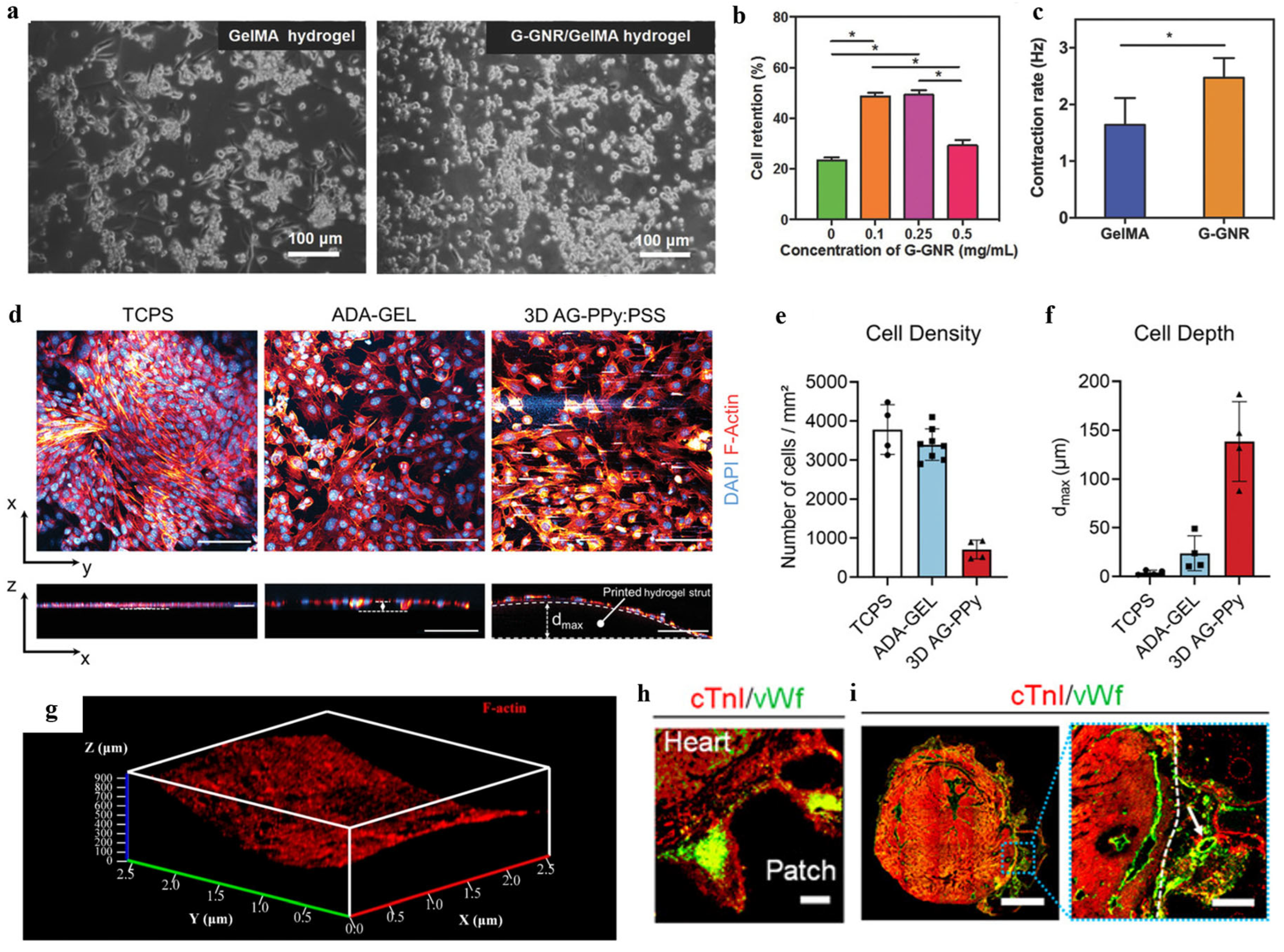
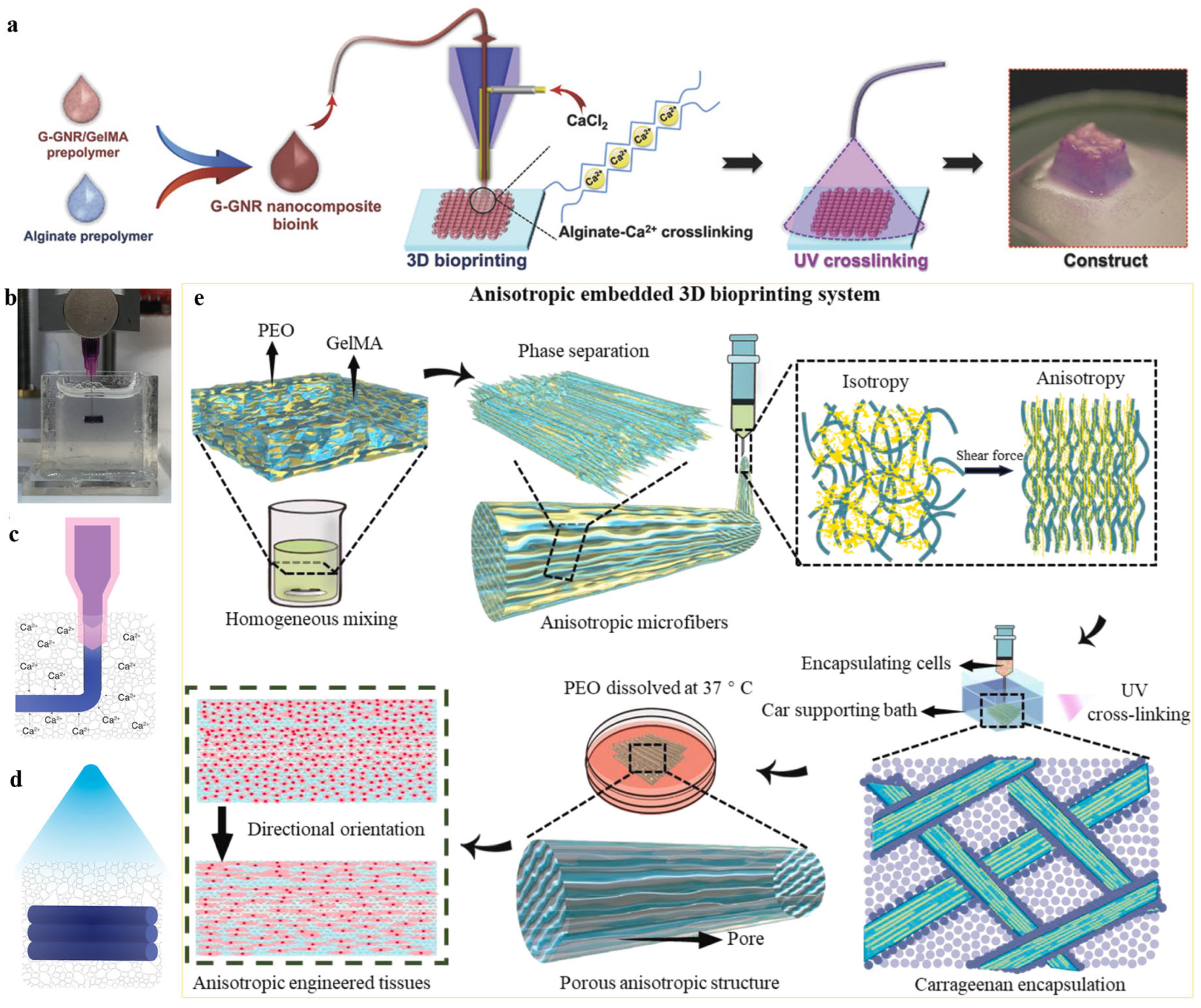
Incorporating conductive materials (e.g., graphene, multi-walled carbon nanotubes (MWCNTs), poly(3,4-ethylenedioxythiophene):polystyrene sulfonate (PEDOT:PSS), gold nanorods (GNRs)) into bioinks is a current research focus. Studies show this integration can enhance electrical conductivity without compromising, or even while promoting, cell proliferation, differentiation, and function [42,156]. For instance, gelatin methacryloyl (GelMA)-based bioink incorporating gold nanorods (G-GNRs) significantly improved conductivity, effectively addressing the insulating nature of traditional hydrogels and thereby promoting electrical signal propagation and synchronous contraction between cardiomyocytes [156] (Figure 5a). Similarly, biocompatible conductive hydrogels synthesized from GelMA and PEDOT:PSS can be bioprinted via a two-step method involving ionic crosslinking (Ca2+ crosslinking PSS) and photopolymerization (visible light crosslinking GelMA) to form complex 3D cell-laden structures. This ink offers tunable mechanical properties (Young’s modulus ~40–150 kPa) and conductivity, along with high cytocompatibility and cell spreading capability [42] (Figure 5b–d). Furthermore, composite scaffolds containing MWCNTs (0.25–3 wt%), prepared via 3D printing, not only enhanced protein adsorption and mechanical performance but also supported the early adhesion and proliferation of human adipose-derived mesenchymal stem cells (hADMSCs), indicating potential for bone regeneration [157]. Notably, high concentrations of MWCNTs (3 wt%) may cause a “sharkskin” surface phenomenon during extrusion due to altered melt rheology [157].
The adaptability of cell-laden bioinks also encompasses critical factors such as uniform cell distribution, high loading density, and high post-printing viability [86] (Figure 5e). Some studies optimize bioink crosslinking mechanisms, such as photopolymerization [29,42,157,158] or ionic crosslinking [42,155], to achieve rapid solidification during printing, thereby reducing cell damage during extrusion. For example, embedded printing within support baths (e.g., gelatin microparticle baths containing CaCl2 or kappa-carrageenan baths), as employed in techniques like Freeform Reversible Embedding of Suspended Hydrogels (FRESH), utilizes instantaneous ionic crosslinking to stabilize extruded filaments. This is often combined with photopolymerization to enhance final structural integrity, representing an effective strategy for achieving high-resolution, complex structure printing while preserving cell viability [42].

3.2.3. Porous Structure Design

Porous structure design is another crucial application direction for Extrusion-based printing in regenerative medicine [159]. The design and formation of pore structure is essentially to program the material deposition space through printing path planning, and its basic principles can be summarized into the following two core mechanisms:
Regular pore generation based on filament build-up (direct forming mechanism): This is the most basic and controllable pore formation method in extrusion printing. Pores exist as a “negative space” defined by the accumulation of printing filaments. Its size, shape, and connectivity are directly and precisely controlled by several key printing parameters:
Filament Diameter: Determined by the inner diameter of the nozzle, extrusion pressure, and ink rheological characteristics, it is the basic unit that constitutes the pore “wall”.
Road Width/Distance: The distance between two adjacent print path centerlines within the same layer. When the wire spacing is greater than the wire diameter, pores in the layer will occur. When equal to or less than the diameter of the wire, the side walls of the filament come into contact to form a dense or microporous structure.
Layer Height: The distance between two adjacent floors in the vertical direction. The ratio of layer height to wire diameter determines the degree of overlap between layers, which directly affects the vertical pore connectivity and the overall mechanical strength of the structure.
Infill pattern: The planning path such as grids, lines, and concentric circles directly determines the geometric configuration of the pores on the two-dimensional plane (such as squares, diamonds, hexagons). By programmatically stacking these two-dimensional patterns layer by layer, supplemented by rotational offsets between layers, complex and ordered three-dimensional porous networks can be constructed [151,159]. The porosity of this mechanism can be calculated directly from the above parameters using a mathematical model.
Complex pore generation based on sacrificial material or phase separation (indirect molding mechanisms): More advanced strategies are needed to create irregular and highly interconnected biomimetic pores closer to the natural extracellular matrix:
Sacrificial stencil method: A material (e.g., gelatin particles, Pluronic F127 hydrogel, salt crystals) that can be physically (e.g., melted, dissolved) or chemically removed after printing is co-printed or pre-filled with structural bioink. Removing this sacrificial phase after molding leaves a precisely designed macro/micro pore or chamber at the site it occupies. This method is key to the construction of embedded vascular networks and highly interoperable macroporous structures [42,143].
Emulsion printing/phase separation induces porosity: Immiscible phases (e.g., oil droplets, gases) are mixed into the bioink, and during the print curing process, these incompatible phases are separated from the continuous phase and form droplets or bubbles. By curing the continuous phase and removing the dispersed phase, micropores or nanopores defined by the size and distribution of the dispersed phase are obtained. This method can greatly increase the specific surface area of the material, promoting nutrient exchange and cell infiltration [132].
Therefore, pores are not random products, but predictable, designable geometric features.
The significance of porous structures lies in their ability to provide the necessary microenvironment for cell growth, facilitate nutrient transport, and enable metabolic waste removal [150,160]. Precise control over extrusion path, inter-layer distance, infill density, and other parameters enables the construction of porous scaffolds with varying pore sizes, porosities, and anisotropy [86,151,159].
Designing complex and functionalized porous structures is key. For instance, adjusting printing parameters (e.g., extrusion speed, layer height, infill density) has successfully yielded scaffolds with gradient porosity, mimicking the structural features of native tissues [161]. More importantly, pre-vascularization design is essential for the survival and integration of thick tissues (e.g., myocardium). Using dual cell-laden decellularized extracellular matrix (dECM) bioinks, multi-material extrusion printing enables the construction of spatially patterned pre-vascularized stem cell cardiac patches. Structures incorporating supportive polycaprolactone (PCL) layers and patterned cell layers enhance intercellular interactions and differentiation capacity, effectively promoting vascularization and myocardial matrix formation in vivo, significantly improving cardiac function post-myocardial infarction in rats [157].
Designing porous structures also requires balancing mechanical properties and biological functionality. For example, integrating conductive materials (e.g., GNRs, PEDOT:PSS, MWCNTs) [42,86,156,157] or bioactive factors/cells [29,145,150] with biodegradable polymers (e.g., PLGA, PLA) enables the fabrication of multifunctional scaffolds possessing specific conductivity, mechanical strength, and bioactivity for applications in bone, cartilage, or cardiac repair [63,145,150,156,157].
Furthermore, constructing porous tissues with biomimetic anisotropic structures (e.g., muscle, corneal stroma, meniscus) represents a cutting-edge frontier. Emerging embedded 3D bioprinting techniques utilize shear-aligning bioinks (e.g., GelMA/PEO). During extrusion, shear stress induces the alignment of components/cells within the bioink, coupled with the instantaneous immobilization provided by support baths (e.g., kappa-carrageenan). This allows the freeform printing of complex, porous biomimetic structures with defined micro-scale orientation (e.g., anisotropic vessels, muscle patches) in a single step. This oriented structure effectively guides cytoskeleton extension and tissue organization, offering a novel strategy for in vitro fabrication of anisotropic artificial tissues.

3.3. Inkjet Printing

Inkjet 3D/4D bioprinting technology offers unique advantages for the integration of electronic materials in regenerative medicine, leveraging its non-contact micro-droplet deposition capability (droplet volumes as low as picoliters) and high printing speed (thousands of drops per second) [162].

3.3.1. Technical Characteristics

Inkjet printing possesses several strengths, particularly in precision and multi-material compatibility.
Microscale Resolution and Cytocompatibility: It achieves spatial resolutions of 20–50 μm, suitable for fabricating electronic components like microelectrodes and biosensors [163]. The non-contact nature minimizes mechanical stress damage to cells, offering significant advantages for printing sensitive tissues such as neuronal scaffolds [164]. For instance, conductive inks containing silver nanoparticles can be inkjet-printed to construct neural network-like circuits for neural signal monitoring.
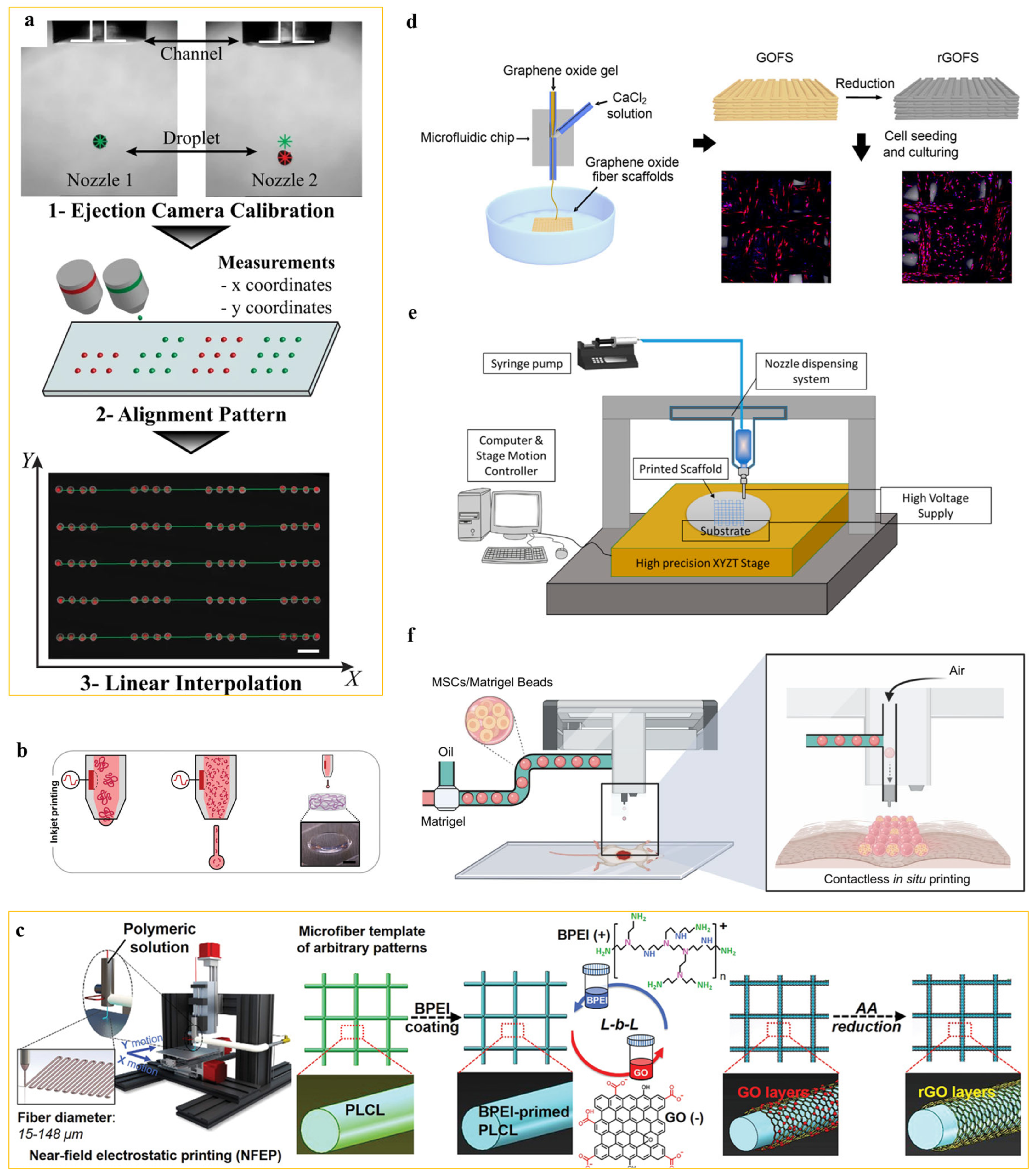
Multi-Material Compatibility: Inkjet systems support multi-printhead switching, enabling synchronous printing of multiple materials and facilitating the in situ integration of biomaterials and electronic materials [165]. Careful optimization of printing parameters for different bioinks allows for the 3D patterning of hydrogels based on relatively complex blueprints, creating high-resolution, multi-component living structures [164] (Figure 6a). For example, when constructing complex heterogeneous tissues containing multiple cell types (e.g., human amniotic fluid stem cells, canine smooth muscle cells, and bovine aortic endothelial cells), inkjet technology can mix cells with ionic crosslinkers (e.g., CaCl2) and precisely position them within alginate-collagen composites via layer-by-layer printing, forming 3D multi-cellular hybrid structures. Post-printing, cells maintain viability, normal proliferation rates, phenotypic expression, and physiological function [166]. Natural bioinks (e.g., collagen, gelatin) provide cell adhesion sites, while conductive polymers (e.g., PEDOT:PSS) or nano-metal inks (e.g., gold nanowires) impart electrical conductivity [167]. Their synergistic action enables the construction of “electroactive bio-scaffolds” that promote synchronized cardiomyocyte beating or directional neurite outgrowth.
Dynamic Structure Programming Potential: Combined with 4D printing concepts and stimuli-responsive materials (e.g., temperature-sensitive hydrogels), inkjet printing holds potential for creating intelligent scaffolds that adapt to physiological environments. For instance, gelatin inks loaded with carbon nanotubes can undergo controlled deformation upon electrical stimulation, mimicking vascular contraction.
Bioink Polymer Content Limitation: However, inkjet printing imposes restrictions on the polymer content of bioinks due to the risk of strong viscoelasticity within the nozzle, limiting printable concentrations. Sonochemical treatment, by shortening polymer chain lengths (e.g., in gelatin methacrylamide—GelMA) without damaging functional groups (e.g., methacryloyl groups), can effectively control viscoelasticity. This increases the maximum printable polymer concentration (e.g., from 3% to 10%), allowing the fabrication of high-resolution 3D hydrogel structures with varied physical properties (e.g., pore size, stiffness, degradation) and enabling the printing of 3D cell-laden multilayer structures with layers possessing distinct physical properties [168] (Figure 6b).

3.3.2. Material Compatibility

Material compatibility for inkjet printing requires meeting a triad of demands: biocompatibility, suitable rheological properties, and functional performance [173].
Rheological Properties: Ideal inks should exhibit viscosities between 4 and 25 mPa·s and surface tensions in the range of 30–50 mN/m. Shear-thinning behavior, achievable by additives like sodium alginate, is crucial for jetting compatibility [162]. Traditional droplet-on-droplet collision (DDC) inkjet 3D printing faces limitations with soft biomaterials due to ink constraints and complex collision dynamics. A sequential crosslinking strategy overcomes this by utilizing droplet collision-triggered rapid ionic crosslinking (e.g., sodium alginate—SA) to fix structures and capture target biomaterial precursors during printing. A secondary crosslinking step (e.g., photopolymerization of GelMA or non-photo-crosslinking of PEDOT:PSS) is applied post-printing. This strategy significantly expands the range of printable soft biomaterials, including both photo-crosslinkable and non-photo-crosslinkable materials [174].
Electrical Performance: Conductivity should typically exceed 1 S/cm (the threshold for effective cell stimulation). This can be achieved using gold/silver nanoparticle composites or conductive polymers [163]. For example, Mu et al. developed a silk fibroin-graphene composite ink with a conductivity of 5.2 S/cm that supported fibroblast proliferation, meeting the requirements for skin regeneration [175].
Controllable Degradation: Degradation rates should match tissue regeneration timelines. Hydrolysis rates can be tuned using copolymers like PLGA-PEG.

3.3.3. Application Challenges

Despite its advantages, inkjet printing faces several application challenges.
Cell Viability Bottleneck: Shear forces during the jetting process can still cause cell viability losses of 10–15% [176].
Electronic-Biological Interface Stability: The physiological fluid environment can induce metal ion leaching from printed electronics, leading to increased impedance over time [163].
Vascularization and Electrical Signal Coupling: Integrating microelectronic circuits with printed vascular networks (diameters typically > 200 μm) remains challenging. Developing multi-scale printing techniques using sacrificial materials (e.g., Pluronic F127 templates) is a critical need [177].
Constructing Vascular Networks: Vascularization is key for functional thick tissue engineering. Inkjet printing allows human microvascular endothelial cells (HMVECs) to be deposited as bioink alongside fibrinogen (acting as “biopaper”). During printing, cells are simultaneously deposited and arranged within microchannels formed by fibrin polymerization. These cells proliferate and form a confluent lining, ultimately generating 3D tubular microvascular structures [178]. This provides an engineering solution to the vascularization challenge in tissue engineering.

3.4. Other Bioprinting Methods

For applications requiring high-temperature polymer printing, the typically large fiber diameters (>100 μm) impair suitability for guiding neuron-like network formation. To overcome this, the recently established Near-field Electrostatic Printing (NFEP) technique [179], which combines electrospinning principles with 3D printing, offers a viable solution. NFEP uniquely reduces fiber diameters down to several micrometers while enabling structural complexity [180,181]. For example, Wang et al. used NFEP to print poly(l-lactide-co-ε-caprolactone) (PLCL) microfiber scaffolds. These scaffolds were then coated with graphene oxide (GO) via layer-by-layer (LbL) assembly and subsequently reduced in situ to reduced graphene oxide (rGO), creating 3D conductive scaffolds. Scaffolds coated with 25–50 layers of rGO exhibited excellent conductivity (≈0.95 S cm−1) and the ability to induce neuron-like network formation along the conductive microfibers under electrical stimulation (100–150 mV cm−1) [169] (Figure 6c).
Microfluidic 3D printing (M3DP) enables the fabrication of well-structured 3D graphene fiber scaffolds. Qing et al. integrated microfluidic spinning technology with a programmable 3D printing system to manufacture 3D GO microfiber scaffolds with tunable length and diameter. Subsequent hydrothermal reduction converted these GO scaffolds into conductive rGO microfiber scaffolds. Results demonstrated that graphene microfiber scaffolds can be readily constructed via M3DP, exhibiting tunable mechanical properties, good conductivity, and biocompatibility. SH-SY5Y cells adhered, proliferated, and exhibited effective directional growth on these scaffolds, indicating significant potential for treating central nervous system disorders and neuropharmacological testing [170] (Figure 6d).
For applications demanding extremely high resolution, Electrohydrodynamic (EHD) Bioprinting provides a microscale deposition strategy [171] (Figure 6e). Using functionalized alginate-based bioinks (e.g., peptide-grafted, fibrin-incorporated) combined with an optimized EHD platform (high voltage, short nozzle-substrate distance, precision motion stage), cell-laden microfilaments with diameters as small as 30 μm can be deposited. This process maintains high cell viability (>90%) and promotes cell spreading. Crucially, EHD bioprinting can achieve layer-specific alignment of cells within the printed filaments along the filament axis, enabling the construction of living architectures with cell-scale filament resolution to guide directional cell growth [182].
Addressing challenges in mesenchymal stem cell (MSC) delivery, a “Bead-jet” printer was developed for the intraoperative high-throughput formulation and printing of MSC-laden Matrigel microbeads. Studies showed that high-density encapsulation of MSCs within Matrigel microbeads enhanced their functionality (proliferation, migration, increased extracellular vesicle production) compared to low-density microbeads or high-density bulk encapsulation. High-density MSC-laden microbeads printed in a sparse pattern significantly improved therapeutic outcomes, such as promoting skeletal muscle regeneration (achieving near-native cell density, reducing fibrosis) and skin regeneration (hair follicle growth, dermal thickening) [172] (Figure 6f).

3.5. Functionalized Printing Parameter Optimization

The practical application of 3D-printed flexible conductive materials in regenerative medicine often necessitates a balance between resolution, mechanical strength, and conductivity, as these properties frequently exhibit trade-off relationships. For instance, pursuing high printing resolution may compromise mechanical strength, while increasing conductive filler content to enhance conductivity can reduce printing resolution. To address these challenges, several strategies can be employed.
Multi-material printing offers an effective solution by combining materials with distinct properties within a single scaffold to optimize resolution, mechanical strength, and conductivity [183]. Relevant research, such as that documented in [184,185], demonstrates this approach. A representative example is the multi-material printed serpentine microstructure presented in [186]. This structure synergistically leverages mechanical/piezoelectric stimulation by integrating polycaprolactone (PCL) microfibers for mechanical support, polyvinylidene fluoride (PVDF) microfibers for piezoelectric stimulation, and magnetic PCL/Fe3O4, whose deformation can be controlled via external magnets. This integration maximizes the advantages of each material, achieving enhanced overall performance.
Hierarchical design is another effective strategy. Its core principle involves tailoring printing parameters across different layers according to specific functional requirements. For example, high resolution can be prioritized in surface layers, while internal layers can be optimized for increased mechanical strength, as discussed in [36,187]. This approach allows for the concurrent optimization of multiple performance metrics, enabling different regions of the scaffold to fulfill distinct critical roles, thereby improving the scaffold’s holistic performance.
Furthermore, post-processing techniques provide robust support for scaffold optimization. Employing chemical or physical post-treatments, such as annealing or cross-linking, allows for the further refinement of scaffold properties, significantly enhancing their performance in practical applications [36,187].
The selection of an appropriate printing technology and material system is paramount to achieving the desired electro-mechanical properties and biological effects for specific regenerative applications. As summarized in Table 2, a wide range of strategies have been developed, each with its own advantages and limitations in terms of conductivity, resolution, and functional outcomes.
Leveraging the conductive scaffolds fabricated by the advanced printing technologies discussed above (Table 2), significant progress has been made in regenerating functional tissues, particularly in the realms of neural, cardiac, and musculoskeletal repair.

4. Advances in Regenerative Medicine Applications

In the rapidly evolving field of regenerative medicine, 3D/4D bioprinting technology for flexible conductive materials is expanding the boundaries of biomedical applications at an unprecedented pace. From intricate neural tissue repair to dynamic cardiac tissue regeneration and efficient bone and cartilage healing, this technology—leveraging its unique conductivity, biocompatibility, and ability to precisely construct complex architectures—offers innovative solutions for the regeneration of diverse tissues and organs. It heralds a new era in regenerative medicine, bringing renewed hope for health restoration to countless patients.

4.1. Neural Tissue Regeneration

The nervous system’s exquisite electrophysiology and highly aligned architecture make it a prime candidate for biomimetic, intelligent conductive scaffolds. Here, 3D/4D bioprinting enables the creation of guidance conduits and interfaces that do not merely support but actively stimulate and dynamically adapt to neural regeneration, emulating the natural guidance cues and electrical environment of the developing and regenerating nervous system. This section highlights how printed electroactive constructs can bridge complex nerve gaps, provide on-demand electrical cues, and seamlessly integrate with the host’s bioelectrical signaling network.
From electrical signals to axonal guidance and synaptic plasticity: In the nervous system, the microelectric fields or ES provided by conductive scaffolds directly mimic and amplify endogenous bioelectrical signals, promoting repair through the following mechanisms:
Ion channels and calcium signaling: ES can directly activate voltage-gated calcium ion channels (VGCCs) by depolarizing the cell membrane, resulting in a transient increase in intracellular Ca2+ concentration. This calcium influx is the core second messenger that drives a series of subsequent biochemical reactions, and it can:
activate Calmodulin (CaM) and its downstream kinases (e.g., CaMKII), which in turn phosphorylates and regulates cytoskeletal proteins (e.g., microtubules, actin), directly promoting growth cone steering and axonal extension [18,19].
trigger the release of presynaptic neurotransmitters (e.g., BDNF, GDNF) and enhances postsynaptic receptor expression, thereby promoting synaptic formation and neural network maturation [43,99].
Electrophysiological threshold vs. directivity: Neuronal growth cones are electrotaxial to constant or frequency-specific weak electric fields. This guiding effect is related to the asymmetric distribution of electric fields on cell membrane surface charges and receptors (such as nerve cell adhesion molecules), guiding axons to grow in a specific direction, and there is a field strength threshold (typically 50–150 mV/mm) for their effectiveness [19,169].
3D-printed conductive scaffolds demonstrate immense potential in neural tissue regeneration.
Peripheral Nerve Repair: In peripheral nerve injury repair, 3D-printed conductive scaffolds serve as nerve guidance conduits (NGCs). Materials like polycaprolactone/polypyrrole (PCL/PPy) are commonly employed, fabricated into three-dimensional porous NGCs using extrusion-based 3D/4D bioprinting techniques (e.g., electrohydrodynamic jetting—EHD-jetting) [171,208]. These scaffolds integrate high conductivity (>800 S/m), biocompatibility, and biodegradability, adeptly mimicking the neural tissue microenvironment [205] (Figure 7a). In peripheral nerve injury models, the scaffolds enhance Schwann cell viability, proliferation, and migration, and promote the expression of neurotrophic factors such as nerve growth factor (NGF) via their conductivity. This effectively guides axonal regeneration and myelination, outperforming non-conductive scaffolds and significantly improving functional nerve recovery, highlighting promising clinical translation prospects [23,200]. For instance, PCL/PPy scaffolds (PPy-b-PCL copolymer, 1% v/v) significantly promoted the proliferation of human embryonic stem cell-derived neural crest stem cells (hESC-NCSCs) and effectively guided their differentiation into mature peripheral neurons, evidenced by downregulation of HNK1 (an NCSC marker) and significant upregulation of neuronal genes (TUBB3, PRPH, NEFH), surpassing the effects of pure PCL scaffolds [23] (Figure 7b–d). Furthermore, scaffold pore size is critical for nerve repair. Studies indicate PCL scaffolds with a pore size of 125 ± 15 μm exhibit optimal performance in PC12 cell and hESC-NCSC proliferation, as well as expression of neural differentiation-related genes (e.g., β3-tubulin, NF-H, GAP-43). Their porosity (>60%) and mechanical properties more closely resemble native peripheral nerves, and their degradation rate aligns with nerve regeneration kinetics [171] (Figure 7e). Recently developed conductive multi-scale nerve guidance conduits (MF-NGCs) combine an electrospun nanofibrous sheath, a reduced graphene oxide (rGO)/PCL conductive microfiber skeleton, and an internal PCL microfiber structure. These conduits offer excellent permeability, mechanical stability, and conductivity. In vivo, they promote neovascularization and macrophage polarization towards the M2 phenotype, significantly enhancing axonal myelination, muscle recovery, and sciatic functional index, demonstrating superior comprehensive repair efficacy [205].
Spinal Cord Injury Repair: Similarly, 3D-printed conductive hydrogels show emerging prominence in spinal cord injury (SCI) repair. Focus centers on poly(3,4-ethylenedioxythiophene):polystyrene sulfonate (PEDOT:PSS) or gelatin methacryloyl (GelMA)-based conductive hydrogels. Biomorphic scaffolds mimicking the heterogeneous structure of spinal cord gray and white matter are constructed via vat photopolymerization (e.g., digital light processing—DLP) or extrusion-based 3D/4D bioprinting. These scaffolds activate neural stem cells (NSCs) under electrical stimulation (ES), promoting their differentiation into myelinating neurons and accelerating axonal growth. In rat SCI models, implanted conductive hydrogels lead to superior motor function recovery, attributed to the provision of electrochemical cues and mechanical support facilitating directed neural network regeneration [55,189]. For example, GelMA/chitosan (CS) hydrogels printed via DLP, incorporating PEDOT nanoparticles forming conductive pathways through interfacial polymerization (GelMA/CS-PEDOT), significantly enhanced hydrogel conductivity and mechanical properties. This conductive scaffold promoted PC12 cell and Schwann cell proliferation and neurite outgrowth in vitro, with ES further stimulating PC12 neurite elongation. In a rat 10 mm sciatic nerve defect model, the GelMA/CS-PEDOT conduit demonstrated exceptional repair efficacy. The number of myelinated nerve fibers and the GAP-43 positive area in the regenerated nerve tissue were significantly higher than in the non-conductive group and approached the effectiveness of autologous nerve grafts, effectively mitigating gastrocnemius muscle atrophy [189].
Neural Stem Cell Differentiation & Regeneration: Conductive materials combined with ES significantly enhance neural cell differentiation and regeneration. Multi-walled carbon nanotube (MWCNT) or graphene oxide (GO)-based conductive scaffolds, fabricated via 3D/4D bioprinting (e.g., stereolithography or EHD-jetting), are used for NSC culture. The high conductivity (200–600 S/m) of these scaffolds enables modulation of cell behavior—including proliferation, migration, and differentiation—under ES. Studies show ES upregulates neuron-specific genes (e.g., TUJ1, MAP2), driving early neuronal differentiation and synapse formation without requiring exogenous neurogenic factors. In vitro models demonstrate accelerated neurite extension and neural network maturation, opening new avenues for treating neurodegenerative diseases [99,210]. For instance, amine-functionalized MWCNT-incorporated poly(ethylene glycol) diacrylate (PEGDA) scaffolds fabricated via stereolithography feature surface nanostructures mimicking the native neural environment. This conductive scaffold significantly enhanced NSC adhesion (optimal at 52% porosity) and proliferation. Under biphasic pulsed ES (500 µA), it effectively promoted early neuronal differentiation (TUJ1 expression) and neurite outgrowth/maturation in NSCs [99].
4D-Printed Intelligent Neural Scaffolds: 4D-printed intelligent neural scaffolds enable dynamic regenerative guidance. Utilizing responsive conductive hydrogels (e.g., thermo- or pH-sensitive), 4D printing generates scaffolds that transform over time. These scaffolds change shape or conductivity in response to external stimuli (e.g., temperature, magnetic field, moisture), providing physical guidance and chemical cues. For example, graphene-based 4D scaffolds can adaptively contract to conform to nerve injury sites, simulating the physiological nerve bundle environment, thereby aiding directed cell migration and axonal alignment. In peripheral nerve regeneration, this dynamic property significantly enhances repair efficiency, reducing the need for secondary surgeries and highlighting advantages for personalized neural repair [209] (Figure 7f). A 4D-oriented dynamic scaffold based on shape memory polymer (SMP) utilizes synergistic on-demand micro-topography and deformation force-mediated mechanical stimulation (DFMS) to spatiotemporally regulate early robust proliferation, subsequent effective differentiation, and axon formation in neurons. This dynamic scaffold markedly accelerated morphological and functional recovery in large-segment nerve defects, achieving a 60% higher neural signal transmission efficiency compared to static scaffolds. It ultimately formed functional regenerated nerve bundles, with efficacy comparable to autografts. Deep transcriptomic analysis further revealed the pivotal role of the Piezo1/Camk2b pathway in regulating neuronal differentiation and axonal extension [209].
Neural Interfaces & Bioelectronics: 3D-printed conductive microstructures find wide application in neural interfaces and bioelectronics [198,211]. High-precision conductive microstructures, such as electrode arrays, are manufactured using techniques like two-photon polymerization or stereolithography, often employing PEDOT:PSS or metal nanoparticles [212]. These structures serve as neural prosthetics or brain–computer interfaces (BCIs) to record neural electrical signals and provide electrical stimulation. In neural engineering, they facilitate integration between neural tissue and electronic systems, aiding in restoring motor function for paralysis treatment. Their high signal-to-noise ratio and biocompatibility support long-term implantation. Furthermore, they model neural electrical activity on organ-on-a-chip platforms for drug testing and disease modeling [213].

4.2. Cardiac Tissue Engineering

The heart’s rhythmic function is governed by coordinated electrical impulses propagating through a highly aligned cellular syncytium, demanding scaffolds that are not just biocompatible but also electrophysiologically competent and structurally biomimetic. Intelligent cardiac patches must synchronize with native tissue and respond to dynamic physiological changes, inspired by the heart’s own electromechanical properties. This section explores how 3D/4D bioprinting of conductive materials is forging a new path towards creating living, beating, and responsive cardiac tissues for repairing the damaged heart.
The functional regeneration of myocardial tissue depends on the coordinated propagation of electrical impulses:
Actuation potential conduction and gap connection: Conductive scaffolds (such as gold-containing nanorods or CNTs) effectively facilitate the propagation of action potentials between cardiomyocytes by reducing extracellular resistance and enhancing local current density. This helps to upregulate the expression of connexin 43 (Cx43) with proper membrane localization, thereby enhancing slit junction communication, which is the electrophysiological basis for synchronized contraction [156,202,214].
Calcium transients and contractile function: Coordinated electrical conduction ensures synchronization of calcium transients within cells. Simultaneous calcium release (from sarcoplasmic reticulum) and reuptake is a prerequisite for cardiomyocytes to produce efficient, synchronized mechanical contractions. ES has been shown to regulate the expression of SERCA2a (sarcoplasmic reticulum pump) and lannicine receptors, optimize calcium cycling, and thereby improve cell contractility and diastolic function [17,201].
Electro-mechanical transduction pathway: Continuous, circadian ES activates pro-survival and proliferative signaling pathways, including ERK1/2 and PI3K/Akt, through the integrin-cytoskeleton pathway, inhibits apoptosis of cardiomyocytes, and promotes parasecretion of vascular endothelial growth factor (VEGF), thereby promoting angiogenesis while repairing the heart muscle [17,215].
The emergence of innovative technologies in cardiac tissue engineering has ushered in new breakthroughs for cardiac repair and regeneration. Significant progress has been made, particularly in the development of conductive cardiac patches. Conductive cardiac patches fabricated via 3D/4D bioprinting, such as gold nanorod/GelMA composites, can significantly enhance the electrical signal conduction capability of cardiomyocytes. Zhu et al. developed a bioink containing gold nanorods (GNRs) (G-GNR/GelMA) that promoted cardiomyocyte adhesion, increased cell retention (* p < 0.05), and facilitated synchronous contraction. Its low viscosity allowed for high-density cell encapsulation and high-resolution printing while minimizing shear stress; post-implantation, it also improved electrical integration in the infarct zone and reduced left ventricular dilation. Structures printed with this bioink exhibited a higher synchronous contraction frequency compared to structures without GNRs (* p < 0.05) [156] (Figure 8a–c). Similarly, oxidized alginate-gelatin/polypyrrole (ADA-GEL-PPy:PSS) hydrogels enhanced cardiomyocyte maturity under electrical stimulation, with their conductive network successfully mimicking the native myocardial microenvironment [194]. This hydrogel demonstrated 3D printability, biocompatibility, and improved cell seeding efficiency throughout the scaffold depth (z-direction) due to its open-pore structure formed during printing, facilitating 3D spatial cell distribution [194] (Figure 8d–f).
Concurrently, injectable conductive hydrogels show immense potential. Injectable conductive hydrogels, like PEDOT:PSS composite systems, offer minimally invasive repair of myocardial injury. Song et al. designed a PGA surgical suture-based biological spring capable of forming a 3D conductive network in vivo, promoting the oriented alignment of cardiomyocytes. Animal studies demonstrated its ability to restore conduction function in the infarct zone and reduce scarring [215]. Another study found that chitosan/gold nanoparticle thermosensitive hydrogels also offered advantages, supporting mesenchymal stem cell migration and cardiac differentiation [65].
4D dynamic cardiac scaffolds have become a research hotspot. Four-dimensional printing utilizes shape-memory materials, such as SOEA ink or graphene-containing near-infrared (NIR) photosensitive ink, to achieve dynamic shape changes in scaffolds. Yue et al. fabricated a 4D layered patch via a photolithography-stereolithography tandem strategy capable of autonomous bending to adapt to the cardiac beating curve [190]. Wang et al. employed digital light processing (DLP) to print 4D NIR-light-responsive cardiac structures with highly aligned microstructures. The scaffold curvature could be adjusted via NIR light exposure time to match the curvature topology of myocardial tissue; cell culture showed uniform distribution and good alignment of cells on the deformed curved structures [190] (Figure 8g). Furthermore, the GelMA-PEGDA patch developed by Cui et al. changed shape in vivo in synchrony with the cardiac cycle, significantly enhancing cell engraftment and vascularization [216] (Figure 8h,i). In a mouse model of chronic myocardial infarction, this 4D patch exhibited enhanced cell engraftment, vascular supply, and co-localization of cardiomyocytes (cTnI+) with neovessels (vWf+) four months post-implantation. Vascular cells bridged the interface between the patch and the myocardium and extended within the patch.
Multi-material conductive scaffolds also hold significant value. Multi-scale conductive scaffolds fabricated via hybrid electrohydrodynamic (EHD) printing, such as PCL/CNT composites, guided the directional growth of cardiomyocytes through layer-specific fiber alignment. The scaffold conductivity increased 5-fold, and the synchronized contraction amplitude tripled [202]. Compared to pure PCL microfiber scaffolds, primary cardiomyocytes on this multi-scale conductive scaffold exhibited significantly higher beating frequencies (23.7 ± 3.1 vs. 12.0 ± 1.0 BPM at day 4; 35.7 ± 2.1 vs. 19.3 ± 1.2 BPM at day 8; * p < 0.05) and more synchronous contraction behavior, attributed to enhanced intercellular electrical communication via improved conductivity [202]. MXene-PEG composite scaffolds employed high-resolution aerosol jet printing (e.g., Hilbert curve patterns) to create cell-level conductive patterns on PEG hydrogels. This promoted the alignment, maturation (significantly increased expression of MYH7, SERCA2, TNNT2), and synchronous beating of hiPSC-derived cardiomyocytes (hiPSC-CMs), increasing conduction velocity by 40%. Cells adhered well to the MXene patterns with high viability (>93% after 7 days in culture) [201]. Scaffolds containing 0.5 wt% GNPs demonstrated excellent performance, possessing suitable mechanical properties, sufficient wettability, and appropriate conductivity for cardiovascular applications. Their compressive strength and conductivity increased by approximately 9.1% and 25%, respectively. Conversely, the contact angle decreased by about 38%, indicating improved wettability [207].
Furthermore, electroactive drug delivery systems play a crucial role in cardiac tissue engineering. Conductive scaffolds synergized with electrical stimulation enhance therapeutic efficacy [17]. For instance, 3D-printed PCL/MWCNTs scaffolds combined with electrical stimulation promoted angiogenesis, doubling new bone density in a bone defect model [196]. Similarly, polypyrrole/silk fibroin (PPy/SF) scaffolds improved cardiac repair via electrically controlled VEGF release [46]. This PPy/SF composite (conductivity ~1 × 10⁻⁵–1 × 10⁻³ S/cm) also exhibited good biocompatibility, supporting Schwann cell adhesion, proliferation, and aligned organization (confirmed by EdU staining and S100β immunohistochemistry), indicating potential for neural tissue engineering [46].
Finally, regarding organoids and disease models, conductive bioink-printed cardiac microtissues, such as hiPSC-CM spheroids, are used for drug screening. Tao et al. developed bioprinted cardiac organoids capable of mimicking pathological contractions, providing a platform for arrhythmia research [217]. Additionally, 3D conductive microstructures fabricated via two-photon printing by Zhou et al. enabled real-time monitoring of cardiac electrical activity [139].

4.3. Bone and Cartilage Repair

While often perceived as static tissues, bone and cartilage possess inherent electroactivity and piezoelectricity that are crucial for their maintenance, healing, and mechanotransduction. The next frontier in orthopedics involves scaffolds that biomimic this piezoelectric microenvironment and intelligently deliver biophysical cues, learning from the body’s own electrical and mechanical signaling mechanisms to direct stem cell fate and accelerate functional regeneration.
Conductive materials play a central role in bone and cartilage repair. Bone and cartilage tissues exhibit piezoelectric effects, where mechanical stress can induce electrical charges. The potential difference naturally generated by bone tissue (50–200 mV) regulates osteoblast differentiation. Currently, 3D/4D bioprinting technology enables the fabrication of biomimetic scaffolds from conductive polymers (e.g., polypyrrole, polyaniline), carbon-based materials (graphene, carbon nanotubes), and piezoelectric ceramics (e.g., BaTiO3). These scaffolds effectively mimic the native electrical microenvironment of bone tissue, significantly enhancing cellular activity [218,219]. For instance, 3D-printed PCL/BaTiO3 composite scaffolds significantly promoted Saos-2 cell proliferation (p < 0.001) compared to pure PCL scaffolds after 28 days of culture, with cells adhering more uniformly along the scaffold filaments [219] (Figure 9a,b).
Mechanism of Charge Transfer: Electrical stimulation (e.g., 0.5–2 V) activates calcium ion channels, subsequently upregulating the expression of RUNX2 and osteocalcin (OCN), thereby robustly promoting osteogenic differentiation [221,222]. Conductive polycaprolactone/multi-walled carbon nanotube (PCL/MWCNTs) scaffolds combined with exogenous electrical stimulation (ES) significantly promoted bone tissue formation, angiogenesis, and mineralization in large rat calvarial defects, with the most pronounced effects observed in scaffolds containing 3 wt% MWCNTs [196] (Figure 9c–j).
4D Dynamic Responsiveness: Thermoresponsive hydrogels (e.g., gelatin-alginate), photosensitive polymers (e.g., gelatin methacryloyl), and photothermal-responsive materials (e.g., TCP/poly(D,L-lactide-co-trimethylene carbonate) (P(DLLA-TMC)) nanocomposite scaffolds incorporating black phosphorus nanosheets (BP)) undergo shape changes at 37 °C or under near-infrared (NIR) light stimulation, allowing them to conform to complex bone defect geometries [223,224]. Such photothermal-responsive scaffolds rapidly heat to 45 °C under NIR irradiation for shape reconfiguration suitable for minimally invasive implantation, subsequently locking their shape at body temperature (37 °C). They provide mechanical properties comparable to human cancellous bone while enabling the pulsed release of osteogenic peptides (OP) to enhance bone regeneration [223].
Printing Technology Innovation: Multi-Material Fusion: Multi-material fusion printing has yielded significant achievements [221]. Composites of polycaprolactone (PCL) and hydroxyapatite (HA) enhance mechanical strength, achieving Young’s moduli (0.8–3 GPa) matching cortical bone. Incorporating 2% graphene further increases conductivity to levels exceeding 10−3 S/m [225,226]. A low-temperature hybrid “dual-nozzle” 3D printing technique was employed to fabricate cell-laden bone tissue engineering scaffolds. These scaffolds comprised OP-loaded β-tricalcium phosphate (TCP)/poly(lactic-co-glycolic acid) (PLGA) (OP/TCP/PLGA, OTP) nanocomposite struts and gelatin/GelMA hydrogel rods laden with rat bone marrow-derived mesenchymal stem cells (rBMSCs). The biphasic scaffold exhibited a mechanical modulus of ~19.6 MPa, similar to human cancellous bone. OP was released sustainably (~78% cumulative release after 24 days). Encapsulated rBMSCs demonstrated high viability immediately post-printing (~87.4%), were released to anchor onto adjacent OTP strut surfaces, achieving uniform cell distribution (Cell Distribution Index, CDI > 82%), significantly outperforming scaffolds seeded with cells after printing (CDI ~30%) [227].
Microstructural Design: Microstructural design is also critical. Utilizing fused deposition modeling (FDM), scaffold porosity (70–90%) and pore size (200–500 μm) can be precisely controlled to optimize nutrient delivery and vascularization [228].
Osteogenic Efficacy: Osteogenic indicators are significantly enhanced. For example, the P-T-GDYO composite scaffold doped with 10 wt% β-TCP maintained mechanical properties within the cancellous bone range. It not only facilitated MC3T3-E1 cell adhesion and osteogenic differentiation but also effectively promoted endogenous bone regeneration in rabbit femoral condyle defects in vivo. Micro-CT 2D and 3D reconstructions revealed that new bone (high-density white regions) in the P-T-GDYO group integrated more tightly with surrounding bone tissue 12 weeks post-implantation [220] (Figure 9k,l). Furthermore, in a mouse subcutaneous infection model, P-T-GDYO achieved a 90.18% antibacterial rate against Staphylococcus aureus after NIR irradiation while maintaining good biocompatibility with tissues and organs [220]. Additionally, synergistic surface modification with two-dimensional materials like graphene oxide (GO) and black phosphorus (BP) significantly enhanced cell proliferation and osteogenic differentiation. GO primarily enhanced initial cell adhesion, while the slow oxidation of BP sustainably released phosphate ions to promote osteogenic differentiation. BP/GO co-modified scaffolds exhibited the highest cell density, more extended cell morphology, more focal adhesion formation, and stronger biomineralization and osteogenic marker expression [221] (Figure 9m–o).
Vascularization: Co-culture of conductive scaffolds with endothelial cells (e.g., HUVECs) under electrical stimulation can increase vascular density by 3.2-fold within 2 weeks, attributed to ES-induced VEGF secretion [229]. BP/GO co-modified scaffolds were also shown to synergistically enhance cell proliferation, osteogenic differentiation, and vascular network construction [221].
Cartilage Repair Characteristics: 3D-printed conductive hydrogels (e.g., polydopamine-hyaluronic acid) support chondrocyte viability exceeding 95% and increase type II collagen secretion by 60% [230]. Furthermore, gradient conductive scaffolds (high-porosity cartilage layer superficially, high-stiffness bone layer deep) can achieve osteochondral interface shear strengths of 8.7 MPa, approaching that of native tissue (10–15 MPa) [231].
Antibacterial and Anti-inflammatory Functionality: NIR-triggered GDYO-coated scaffolds (808 nm) induce localized heating to 52 °C, achieving >99% killing rate for S. aureus. The thermal effect also promotes BMSC migration [220]. MXene nanosheets suppress the release of the inflammatory cytokine IL-6 through photothermal conversion, thereby reducing the risk of immune rejection [229].
Technical Advantages and Clinical Potential:
Dynamic Adaptability: 4D-printed scaffolds deform under body temperature or pH stimuli (e.g., shape recovery rate >95%), enabling minimally invasive implantation followed by in situ expansion to conform to irregular defects [224]. For instance, thermosensitive PLA scaffolds exhibit a 15% pore size contraction at 37 °C, enhancing load-bearing stability [232]. Photothermal-responsive BP composite scaffolds achieve shape reconfiguration under NIR to precisely match irregular bone defect boundaries, locking their shape at body temperature to promote new bone formation and integration with host bone [223].
Personalized Repair: Patient-specific modeling based on CT data allows the printing of personalized auricular/mandibular scaffolds with errors <0.5 mm, combined with conductive materials to promote cartilage regeneration [233]. Clinical cases report an 88% functional recovery rate after implantation of personalized temporomandibular joint scaffolds [234].
Multimodal Synergistic Therapy: Scaffolds dual-loaded with electrical stimulation and growth factors (e.g., BMP-2) reduced the healing time of sheep femoral defects from 12 weeks to 8 weeks [235].
Despite progress, limitations remain. Trade-offs: Balancing mechanical properties and conductivity is challenging, as highly conductive materials can increase scaffold brittleness and reduce ultimate compressive strength. Long-term Biosafety: Degradation products of carbon nanomaterials in vivo may cause chronic inflammation; comprehensive toxicity data beyond 12 months is currently lacking. Vascular Network Construction: Vascularization speed in existing scaffolds lags behind bone regeneration; capillary ingrowth depth in large animal models is only 1.5 mm, falling short of the required >3 mm. Achieving uniform cell distribution within large-volume scaffolds remains challenging [227].
Future development focuses on:
Smart Material Development. Creating biodegradable conductive polymers (e.g., poly(3,4-ethylenedioxythiophene):polystyrene sulfonate—PEDOT:PSS) ensuring conductivity (10−2 S/cm) with a 6-month degradation cycle [236].
Biohybrid Printing. Integrating bioinks (e.g., alginate gels laden with MSCs) with conductive nanowires to simultaneously regulate cell viability and electrical signaling [227].
Advanced 6D Printing. Incorporating artificial intelligence for real-time monitoring of defect healing, enabling dynamic adjustment of electrical stimulation parameters (e.g., frequency, voltage) [229].

5. Current Challenges and Future Directions

Despite significant progress, the journey towards clinically viable intelligent and truly biomimetic bioprinting systems faces multifaceted hurdles. These challenges span from fundamental material-level trade-offs that hinder the perfect imitation of native tissue properties to complex manufacturing and regulatory barriers. This section candidly discusses these limitations and pivots to emerging, disruptive research directions that hold the key to achieving truly adaptive and autonomous bioinspired regenerative therapies.

5.1. Balancing Material Properties

The application of 3D-printed flexible conductive materials in regenerative medicine faces significant challenges, particularly in balancing conductivity with biodegradability. Conductive materials are valued for mimicking the electrophysiological properties of native tissues, yet their poor biodegradability limits utility for both short- and long-term implants [237,238]. Conductive polymers like polyaniline (PANI) and polypyrrole (PPy) offer excellent conductivity but exhibit slow degradation rates, potentially inducing foreign body reactions upon long-term implantation [239]. Carbon-based materials (e.g., graphene, carbon nanotubes (CNTs)) possess good conductivity and mechanical strength but are constrained by poor biodegradability and potential cytotoxicity [98,229]. Metal nanocomposites (e.g., Au, Ag, Pt nanoparticles) excel in biosensing and electrostimulation-induced differentiation; however, long-term ion release can cause cytotoxicity and inflammation [240,241].
Developing novel conductive materials that maintain high conductivity while achieving controlled biodegradability and low cytotoxicity is paramount. Future efforts focus on multifunctional composites combining conductive elements with biodegradable polymers (e.g., PLA, PCL) to optimize performance [86,242]. Surface modification techniques (e.g., plasma treatment, chemical grafting) offer effective strategies to enhance biocompatibility and degradation; oxidized graphene (GO) modified this way shows reduced cytotoxicity and improved biodegradability [229]. Novel conductive hydrogels like alginate/gelatin blended with varying concentrations of cellulose nanofibrils (CNF) demonstrate enhanced mechanical, electrical, and viscoelastic properties with excellent cytocompatibility, enabling post-printing formation of reinforced composite structures [195]. Embedding metal nanoparticles within biodegradable polymer matrices can maintain conductivity while reducing ion release rates, mitigating cytotoxicity [243]. Furthermore, long-term in vivo studies evaluating material stability, degradation kinetics, and tissue response are crucial for optimizing formulations and processing to enhance stability and biocompatibility for implants [244,245].

5.2. Limitations of Printing Technologies

Achieving high resolution alongside multi-material integration presents significant technical complexity in 3D/4D bioprinting. High-resolution printing demands precise control over printhead motion and material deposition, becoming increasingly challenging and costly at micron or nanoscales. While vat photopolymerization techniques (e.g., SLA/DLP) can achieve X-Y resolutions around 39 μm, they require stringent control over resin curing speed and layer thickness; minor deviations can cause print failure or structural defects [135,246].
Multi-material integration is complicated by the differing physicochemical properties of constituent materials. Combining conductive materials with biomaterials (e.g., bioinks) necessitates compatibility during printing and retained functionality in the final structure [141]. For instance, co-printing conductive polymers (e.g., PEDOT:PSS) with bioinks (e.g., alginate) requires precise tuning of ratios and parameters to ensure both conductivity and support for cell growth/differentiation [247,248]. Material switching also introduces complexities like cleaning and recalibration [246].
Cell viability during printing is compromised by conductive fillers (e.g., CNTs, metal nanoparticles). Their physicochemical properties—surface charge, size, shape, and dispersion within bioinks—can impede cell attachment, proliferation, and differentiation. CNTs, despite excellent conductivity/strength, exhibit surface-related toxicity potentially causing apoptosis or dysfunction upon prolonged exposure [239,249]. Mechanical stress during printing is another concern: in Extrusion-based printing, cells experience shear forces through the nozzle, exacerbated by filler presence, leading to damage or death [155]. Surface modification or coating of fillers can reduce toxicity and improve dispersion, mitigating negative effects on cells [229,250].
The transition from structural biomimicry to electrophysiological function biomimicry remains a major hurdle. Mimicking the complex signaling networks of native tissues—involving ion channels, electrochemical gradients, and intercellular communication—requires deep integration of materials science, biology, and engineering [86]. Precisely designing conductive materials to control local electric fields for guiding cell differentiation and tissue regeneration is still an unresolved challenge.

5.3. Barriers to Clinical Translation

Despite their immense potential, conductive materials face significant barriers in clinical translation for regenerative medicine [213].
Firstly, the molecular mechanisms of electrical stimulation (ES) remain incompletely elucidated. While ES promotes neuronal differentiation, cardiomyocyte alignment, and bone regeneration, its specific actions via pathways like Wnt/β-catenin or PI3K/Akt require deeper investigation [55,239]. The lack of standardized parameters (dose, frequency, duration) for ES effects leads to inconsistent results and clinical uncertainty. Most of the current research is in the proof-of-concept stage of small animal models. A responsible clinical translation pathway should include the following key milestones, with significant evidence gaps currently existing:
Pre-Translational Research:
Large animal model verification: In large animal models (pigs, sheep) whose anatomical physiology is closer to humans, it is necessary to carry out defect repair studies of large-size, weight-bearing or functional key parts, which is a necessary step towards clinical practice [16,235].
Disease model validation: Tested in animal models with comorbidities (e.g., diabetic peripheral neuropathy, ischemic cardiomyopathy) to evaluate its effectiveness in the pathological setting [93,196].
Clinical trial design:
Early clinical trials (Phase I/II) should focus on safety and feasibility. Indications should be selected in areas with relatively controllable risks and urgent clinical needs (such as peripheral nerve space defects) [16,208].
Identify clinical endpoints: Objective, widely recognized primary efficacy endpoints (e.g., nerve conduction velocity recovery rate, absolute left ventricular ejection fraction improvement, new bone volume on imaging) need to be defined and head-to-head comparative study design with current gold standard therapies (e.g., autologous nerve grafting, standard myocardial infarction treatment) [189,200,209].
Long-term follow-up plan: Postoperative follow-up for 3–5 years or more must be planned to monitor complete implant degradation, long-term stability of tissue remodeling, and late complications [9,244].
Secondly, safety evaluation standards specific to conductive materials are lacking. Long-term degradation may release metal ions or nanoparticles, causing cytotoxicity or immune responses. For example, silver nanoparticles (AgNPs), despite excellent conductivity/antimicrobial properties, pose unresolved concerns regarding cytotoxicity and biocompatibility [184]. Electrochemical stability is critical, as prolonged ES can cause surface oxidation/corrosion, impairing performance and safety. Current standards (e.g., ISO 10993 series) primarily address traditional biomaterials and inadequately cover the unique properties of conductive materials. This has led to a gap between scale and standardization from the laboratory to GMP production [251].
Material standardization: Bioinks must be self-formulated in the laboratory to pharmaceutical-grade raw materials with clear chemical composition, no animal origin, and minimal differences between batches [153,184]. Conductive additives must have strict quality control standards for purity, morphology and surface properties.
Process control and sterility assurance: The 3D bioprinting process must be carried out in a controlled and clean environment (at least ISO level 7 or higher) [135,142]. Maintaining cell viability after printing and aseptic treatment of scaffolds (e.g., whether they can tolerate radiation sterilization) are major technical challenges. The integration of process analytical technology (PAT) is crucial for monitoring print quality in real-time.
The paradox of personalization and standardization: the regulatory system is built on standardization, and the advantage of 3D printing lies in personalization. The solution lies in establishing a “certified manufacturing platform”—a regulator certifies specific printing systems, material libraries, and software workflows within which personalized implants are generated following a relatively simplified approval path (e.g., 510(k) special controls) [242,252].
Thirdly, personalized manufacturing faces dual barriers of cost and regulation. High-resolution printers (e.g., DLP) and specialized conductive bioinks are expensive. Precise environmental control (temperature, humidity, speed) further increases production costs [135,184]. Material development and optimization for specific tissues/organs demand substantial R&D investment with long timelines. Regulatory hurdles also impede progress. The regulatory framework for 3D-printed medical devices, particularly concerning conductive materials’ biocompatibility, long-term stability, and electrical safety, remains immature. Active implantable devices containing human cells, degradable polymers, and engineered nanomaterials (e.g., CNTs, MXenes) are at the forefront of regulatory science [252]. Currently, the US FDA’s Center for Biologics Evaluation and Research (CBER) and Center for Device and Radiological Health (CDRH) and the EU’s MDR (Medical Device Regulation) do not have a fully corresponding ready-made path [253].
Complexity of product classification: Such products may be defined as “combination products” and are subject to regulatory requirements for both medical devices and biologics (when containing cells). Its classification (Class III high-risk implants) dictates that rigorous premarket approval (PMA) must be carried out, with the highest level of evidence required.
Key security and performance considerations:
Long-term biocompatibility: It is necessary to exceed the ISO 10993 standard to provide long-term (>12 months) distribution, degradation products, immunogenicity, and potential genotoxicity data of nanomaterials in vivo [9,98,239]. This is a core concern for regulators.
Functional stability and electrical safety: The conductivity, mechanical integrity, and long-term stability and reliability of the stent must be demonstrated in a complex in vivo environment, and its safe operation window must be clarified [43,52].
Manufacturing process validation: The entire printing process, from digital files to physical devices, including software, material handling, and printing parameters, must be standardized, verifiable, and traceable, which is at the heart of GMP and the basis for regulatory submissions [135,242].
In short, realizing the clinical transformation of intelligent electroactive stents is a complex system engineering. The future direction of work should include:
Carry out “regulation-oriented design”: In the basic research phase, i.e., introduce early biocompatibility testing and scalability assessment to proactively avoid barriers to translation [184,254].
Using organ-on-a-chip as a “translational accelerator”: The organ-on-a-chip platform discussed in this paper is used for preclinical safety and efficacy prediction, optimizing scaffold design parameters and electrical stimulation protocols, reducing the dependence on exploratory animal experiments, and providing high-quality prior data for clinical trial design [38,255].
Build an industry-university-research healthcare management alliance: Materials scientists, engineers, clinicians, regulatory experts, and industry must intervene early and work together to develop product development strategies and evidence generation plans.
Only by honestly confronting and systematically addressing these challenges of science, regulation, and industrialization, the many exciting “breakthroughs” and “roadmaps” reviewed in this article can truly transform from a blueprint into a clinical reality that can benefit patients. This requires researchers in the field to be not only explorers of cutting-edge technologies, but also responsible planners of product transformation paths.

5.4. Emerging Research Directions

Cutting-edge research directions include 4D printed dynamic responsive materials, multimodal smart scaffolds, and organ-on-a-chip/microfluidic integration.

5.4.1. Four-Dimensional Printed Dynamic Responsive Materials

4D printing introduces a temporal dimension, enabling printed structures to dynamically transform under external stimuli (temperature, electric/magnetic fields). This holds great promise in regenerative medicine for dynamic tissue engineering and drug delivery. For example, thermosensitive shape-memory hydrogels can morph at body temperature to adapt to complex tissue environments, aiding cell growth and repair. Electro-responsive materials allow external electric fields to modulate cell behavior (e.g., neuronal differentiation/migration). Such materials can mimic the dynamic nature of native tissues, opening new possibilities [224,256].

5.4.2. Multimodal Smart Scaffolds

These scaffolds integrate functionalities like conductivity, photothermal response, and magneto-responsiveness to synergistically promote regeneration via multiple stimuli. Conductive scaffolds deliver ES to enhance nerve or cardiac tissue repair. Photothermal materials enable localized hyperthermia via near-infrared light, promoting angiogenesis and healing. Magneto-responsive elements allow mechanical properties or drug release to be controlled by external fields. These scaffolds provide structural support while enabling precise, multi-stimuli control over cell behavior, offering novel solutions for complex tissue regeneration [36,241].

5.4.3. Organ-on-a-Chip and Microfluidic Integration

Organ-on-a-chip technology uses microfluidics to mimic human organ physiology, creating efficient platforms for drug screening and disease modeling. Integrating 3D/4D bioprinting enables precise fabrication of complex vascular networks and tissue structures, enhancing functional mimicry. Examples include 3D-printed liver chips for drug metabolism/toxicity studies and heart chips for investigating cardiac disease mechanisms [255,257]. Microfluidic integration boosts chip functionality and advances personalized and precision medicine.
Advancements in 4D printing, multimodal smart scaffolds, and organ-on-a-chip/microfluidic integration hold significant promise. Four-dimensional printing will shift tissue engineering from static structures to dynamic functions. Multimodal scaffolds offer multifunctional support for complex regeneration. Organ chips provide powerful platforms for research and personalized medicine. Their convergence will drive regenerative medicine towards precision, functionality, and personalization [36,224,256]. However, clinical translation requires overcoming key challenges: establishing standardized evaluation protocols for material safety, stability, and functionality, and conducting large-scale clinical validation. Multidisciplinary collaboration across materials science, biomedical engineering, and clinical medicine is essential to realize this potential [258].

6. Conclusions and Future Perspectives

The deep integration of flexible conductive materials with 3D/4D printing technology is propelling regenerative medicine beyond “structural replacement” towards “functional reconstruction.” and further into the realm of “intelligent regeneration.” Systematic research has elucidated the interplay between material properties, processing parameters, and functionalities of conductive polymers, carbon-based nanomaterials, metals, and MXenes, enabling programmable multi-scale printing strategies validated in neural, cardiac, and osteochondral regeneration. Despite progress, core challenges persist: fundamental incompatibilities between conductivity and biodegradability, manufacturing complexities for high-resolution multi-material integration, and the lack of robust evaluation standards reconciling performance with safety.
Looking ahead, the trajectory of intelligent electroactive regeneration will be profoundly shaped by the integration of artificial intelligence (AI) and machine learning (ML). These technologies promise to revolutionize every stage of the development pipeline. AI algorithms can accelerate the discovery of novel conductive biomaterials with optimized properties by predicting structure-function relationships. In the printing process itself, ML-driven real-time monitoring and closed-loop control systems can ensure impeccable print fidelity and cellular viability, adapting parameters on-the-fly to correct defects and even guide 4D transformation behaviors. Furthermore, AI can analyze complex multiparametric data from organ-on-a-chip models to decode the mechanisms of electrical stimulation and predict long-term in vivo outcomes, ultimately enabling the inverse design of patient-specific scaffolds that are both structurally and functionally dynamic. This convergence of AI, advanced manufacturing, and biology will transition the field from a trial-and-error paradigm to a predictive, intelligent, and truly personalized era of regenerative medicine.

Author Contributions

Conceptualization, K.Z., Q.Z. and L.P.; investigation, K.Z., L.F. and C.X.; formal analysis, W.Z., X.D. and C.S.; writing—original draft preparation, K.Z.; writing—review and editing, K.Z., L.F., C.X., W.Z., X.D. and C.S.; supervision, Q.Z. and L.P.; funding acquisition, L.P. All authors have read and agreed to the published version of the manuscript.

Funding

The National Key Research and Development Program of China: 2021YFA1401100; the National Natural Science Foundation of China: 61825403; National Natural Science Foundation of China: 61921005; the Open Research Fund of State Key Laboratory of Digital Medical Engineering: 2024-M11.

Data Availability Statement

This article is a review article and does not contain any new data. All data discussed in this work are derived from previously published studies, which are cited throughout the text. No new datasets were generated or analyzed.

Conflicts of Interest

The authors declare no conflicts of interest.

References

  1. Sinha, S.; Schreiner, A.J.; Biernaskie, J.; Nickerson, D.; Gabriel, V.A. Treating pain on skin graft donor sites: Review and clinical recommendations. J. Trauma Acute Care Surg. 2017, 83, 954–964. [Google Scholar] [CrossRef] [PubMed]
  2. Wang, W.; Yeung, K.W.K. Bone grafts and biomaterials substitutes for bone defect repair: A review. Bioact. Mater. 2017, 2, 224–247. [Google Scholar] [CrossRef] [PubMed]
  3. Ajith, A.; Mulloy, L.L.; Musa, M.A.; Bravo-Egana, V.; Horuzsko, D.D.; Gani, I.; Horuzsko, A. Humanized Mouse Model as a Novel Approach in the Assessment of Human Allogeneic Responses in Organ Transplantation. Front. Immunol. 2021, 12, 687715. [Google Scholar] [CrossRef] [PubMed]
  4. Zhang, W.; Egashira, N.; Masuda, S. Recent Topics on The Mechanisms of Immunosuppressive Therapy-Related Neurotoxicities. Int. J. Mol. Sci. 2019, 20, 3210. [Google Scholar] [CrossRef]
  5. Goldaracena, N.; Cullen, J.M.; Kim, D.-S.; Ekser, B.; Halazun, K.J. Expanding the donor pool for liver transplantation with marginal donors. Int. J. Surg. 2020, 82, 30–35. [Google Scholar] [CrossRef]
  6. Silva-López, M.S.; Alcántara-Quintana, L.E. The Era of Biomaterials: Smart Implants? ACS Appl. Bio Mater. 2023, 6, 2982–2994. [Google Scholar] [CrossRef]
  7. Busscher, H.J.; van der Mei, H.C.; Subbiahdoss, G.; Jutte, P.C.; van den Dungen, J.J.A.M.; Zaat, S.A.J.; Schultz, M.J.; Grainger, D.W. Biomaterial-Associated Infection: Locating the Finish Line in the Race for the Surface. Sci. Transl. Med. 2012, 4, 153rv10. [Google Scholar] [CrossRef]
  8. Anderson, J.M.; Rodriguez, A.; Chang, D.T. Foreign body reaction to biomaterials. Semin. Immunol. 2008, 20, 86–100. [Google Scholar] [CrossRef]
  9. Carnicer-Lombarte, A.; Chen, S.-T.; Malliaras, G.G.; Barone, D.G. Foreign Body Reaction to Implanted Biomaterials and Its Impact in Nerve Neuroprosthetics. Front. Bioeng. Biotechnol. 2021, 9, 622524. [Google Scholar] [CrossRef]
  10. Langer, R.; Vacanti, J.P. Tissue Engineering. Science 1993, 260, 920–926. [Google Scholar] [CrossRef]
  11. Murphy, S.V.; Atala, A. 3D bioprinting of tissues and organs. Nat. Biotechnol. 2014, 32, 773–785. [Google Scholar] [CrossRef]
  12. Sikorski, P. Electroconductive scaffolds for tissue engineering applications. Biomater. Sci. 2020, 8, 5583–5588. [Google Scholar] [CrossRef]
  13. He, D.; Li, H. Biomaterials affect cell-cell interactions in vitro in tissue engineering. J. Mater. Sci. Technol. 2021, 63, 62–72. [Google Scholar] [CrossRef]
  14. McNamara, H.M.; Salegame, R.; Tanoury, Z.A.; Xu, H.; Begum, S.; Ortiz, G.; Pourquie, O.; Cohen, A.E. Bioelectrical domain walls in homogeneous tissues. Nat. Phys. 2020, 16, 357–364. [Google Scholar] [CrossRef]
  15. Kotwal, A.; Schmidt, C.E. Electrical stimulation alters protein adsorption and nerve cell interactions with electrically conducting biomaterials. Biomaterials 2001, 22, 1055–1064. [Google Scholar] [CrossRef]
  16. Lee, S.J.; Jeong, W.; Atala, A. 3D Bioprinting for Engineered Tissue Constructs and Patient-Specific Models: Current Progress and Prospects in Clinical Applications. Adv. Mater. 2024, 36, 2408032. [Google Scholar] [CrossRef]
  17. Zhang, Y.; Le Friec, A.; Zhang, Z.; Müller, C.A.; Du, T.; Dong, M.; Liu, Y.; Chen, M. Electroactive biomaterials synergizing with electrostimulation for cardiac tissue regeneration and function-monitoring. Mater. Today 2023, 70, 237–272. [Google Scholar] [CrossRef]
  18. da Silva, L.P.; Kundu, S.C.; Reis, R.L.; Correlo, V.M. Electric Phenomenon: A Disregarded Tool in Tissue Engineering and Regenerative Medicine. Trends Biotechnol. 2020, 38, 24–49. [Google Scholar] [CrossRef]
  19. Levin, M.; Pezzulo, G.; Finkelstein, J.M. Endogenous Bioelectric Signaling Networks: Exploiting Voltage Gradients for Control of Growth and Form. Annu. Rev. Biomed. Eng. 2017, 19, 353–387. [Google Scholar] [CrossRef]
  20. Liu, Z.; Wan, X.; Wang, Z.L.; Li, L. Electroactive Biomaterials and Systems for Cell Fate Determination and Tissue Regeneration: Design and Applications. Adv. Mater. 2021, 33, 2007429. [Google Scholar] [CrossRef]
  21. Kuzmenko, V.; Karabulut, E.; Pernevik, E.; Enoksson, P.; Gatenholm, P. Tailor-made conductive inks from cellulose nanofibrils for 3D printing of neural guidelines. Carbohydr. Polym. 2018, 189, 22–30. [Google Scholar] [CrossRef]
  22. Dvir, T.; Timko, B.P.; Brigham, M.D.; Naik, S.R.; Karajanagi, S.S.; Levy, O.; Jin, H.; Parker, K.K.; Langer, R.; Kohane, D.S. Nanowired three-dimensional cardiac patches. Nat. Nanotechnol. 2011, 6, 720–725. [Google Scholar] [CrossRef] [PubMed]
  23. Vijayavenkataraman, S.; Kannan, S.; Cao, T.; Fuh, J.Y.H.; Sriram, G.; Lu, W.F. 3D-Printed PCL/PPy Conductive Scaffolds as Three-Dimensional Porous Nerve Guide Conduits (NGCs) for Peripheral Nerve Injury Repair. Front. Bioeng. Biotechnol. 2019, 7, 266. [Google Scholar] [CrossRef] [PubMed]
  24. Huang, H.; Wang, K.; Liu, X.; Liu, X.; Wang, J.; Suo, M.; Wang, H.; Chen, S.; Chen, X.; Li, Z. Piezoelectric biomaterials for providing electrical stimulation in bone tissue engineering: Barium titanate. J. Orthop. Transl. 2025, 51, 94–107. [Google Scholar] [CrossRef] [PubMed]
  25. Bassett, C.A.L.; Becker, R.O. Generation of Electric Potentials by Bone in Response to Mechanical Stress. Science 1962, 137, 1063–1064. [Google Scholar] [CrossRef]
  26. Senkoylu, A.; Cetinkaya, M.; Daldal, I.; Necefov, E.; Eren, A.; Samartzis, D. Personalized Three-Dimensional Printing Pedicle Screw Guide Innovation for the Surgical Management of Patients with Adolescent Idiopathic Scoliosis. World Neurosurg. 2020, 144, e513–e522. [Google Scholar] [CrossRef]
  27. Zhou, J.; See, C.W.; Sreenivasamurthy, S.; Zhu, D. Customized Additive Manufacturing in Bone Scaffolds—The Gateway to Precise Bone Defect Treatment. Research 2023, 6, 0239. [Google Scholar] [CrossRef]
  28. Mandrycky, C.; Wang, Z.; Kim, K.; Kim, D.-H. 3D bioprinting for engineering complex tissues. Biotechnol. Adv. 2016, 34, 422–434. [Google Scholar] [CrossRef]
  29. Jang, J.; Park, H.-J.; Kim, S.-W.; Kim, H.; Park, J.Y.; Na, S.J.; Kim, H.J.; Park, M.N.; Choi, S.H.; Park, S.H.; et al. 3D printed complex tissue construct using stem cell-laden decellularized extracellular matrix bioinks for cardiac repair. Biomaterials 2017, 112, 264–274. [Google Scholar] [CrossRef]
  30. Xue, W.; Shi, W.; Kong, Y.; Kuss, M.; Duan, B. Anisotropic scaffolds for peripheral nerve and spinal cord regeneration. Bioact. Mater. 2021, 6, 4141–4160. [Google Scholar] [CrossRef]
  31. Ho, L.; Hsu, S.-H. Cell reprogramming by 3D bioprinting of human fibroblasts in polyurethane hydrogel for fabrication of neural-like constructs. Acta Biomater. 2018, 70, 57–70. [Google Scholar] [CrossRef] [PubMed]
  32. Hann, S.Y.; Cui, H.; Esworthy, T.; Zhou, X.; Lee, S.-J.; Plesniak, M.W.; Zhang, L.G. Dual 3D printing for vascularized bone tissue regeneration. Acta Biomater. 2021, 123, 263–274. [Google Scholar] [CrossRef] [PubMed]
  33. Zhou, J.; Li, Q.; Tian, Z.; Yao, Q.; Zhang, M. Recent advances in 3D bioprinted cartilage-mimicking constructs for applications in tissue engineering. Mater. Today Bio 2023, 23, 100870. [Google Scholar] [CrossRef] [PubMed]
  34. Ji, X.; Yuan, X.; Ma, L.; Bi, B.; Zhu, H.; Lei, Z.; Liu, W.; Pu, H.; Jiang, J.; Jiang, X.; et al. Mesenchymal stem cell-loaded thermosensitive hydroxypropyl chitin hydrogel combined with a three-dimensional-printed poly(ε-caprolactone)/nano-hydroxyapatite scaffold to repair bone defects via osteogenesis, angiogenesis and immunomodulation. Theranostics 2020, 10, 725–740. [Google Scholar] [CrossRef]
  35. Xiao, L.; Ye, M.; Fan, Y.; Liu, G.; He, H.; Xiao, J. Dual-network methacrylated collagen-magnesium hydrogels for enhanced biocompatibility and precision in DLP 3D bioprinting. Int. J. Biol. Macromol. 2025, 320, 145478. [Google Scholar] [CrossRef]
  36. Tamir, T.S.; Teferi, F.B.; Hua, X.; Leng, J.; Xiong, G.; Shen, Z.; Liu, Q. A review of advances in 3D and 4D bioprinting: Toward mass individualization paradigm. J. Intell. Manuf. 2024, 36, 5217–5246. [Google Scholar] [CrossRef]
  37. Mishra, A.; Singh, P.K.; Chauhan, N.; Roy, S.; Tiwari, A.; Gupta, S.; Tiwari, A.; Patra, S.; Das, T.R.; Mishra, P.; et al. Emergence of integrated biosensing-enabled digital healthcare devices. Sens. Diagn. 2024, 3, 718–744. [Google Scholar] [CrossRef]
  38. Park, J.Y.; Jang, J.; Kang, H.-W. 3D Bioprinting and its application to organ-on-a-chip. Microelectron. Eng. 2018, 200, 1–11. [Google Scholar] [CrossRef]
  39. Zahra, A.; Shayan, G.; Hossein, D.; Katayoun, D.; Seyed Mohammad, A.; Hadi, S. Conducting Polymers for Neural Tissue Engineering; CRC Press: Boca Raton, FL, USA, 2022; Volume 19, pp. 179–192. [Google Scholar]
  40. Guo, B.; Ma, P.X. Conducting Polymers for Tissue Engineering. Biomacromolecules 2018, 19, 1764–1782. [Google Scholar] [CrossRef]
  41. Wang, Y.; Gao, C.; Cheng, S.; Li, Y.; Huang, Y.; Cao, X.; Zhang, Z.; Huang, J. 3D Bioprinting of Double-Layer Conductive Skin for Wound Healing. Adv. Healthc. Mater. 2025, 14, 2404388. [Google Scholar] [CrossRef]
  42. Spencer, A.R.; Shirzaei Sani, E.; Soucy, J.R.; Corbet, C.C.; Primbetova, A.; Koppes, R.A.; Annabi, N. Bioprinting of a Cell-Laden Conductive Hydrogel Composite. ACS Appl. Mater. Interfaces 2019, 11, 30518–30533. [Google Scholar] [CrossRef]
  43. Tomaskovic-Crook, E.; Zhang, P.; Ahtiainen, A.; Kaisvuo, H.; Lee, C.-Y.; Beirne, S.; Aqrawe, Z.; Svirskis, D.; Hyttinen, J.; Wallace, G.G.; et al. Human Neural Tissues from Neural Stem Cells Using Conductive Biogel and Printed Polymer Microelectrode Arrays for 3D Electrical Stimulation. Adv. Healthc. Mater. 2019, 8, 1900425. [Google Scholar] [CrossRef] [PubMed]
  44. Shin, S.R.; Zihlmann, C.; Akbari, M.; Assawes, P.; Cheung, L.; Zhang, K.; Manoharan, V.; Zhang, Y.S.; Yüksekkaya, M.; Wan, K.-T.; et al. Reduced Graphene Oxide-GelMA Hybrid Hydrogels as Scaffolds for Cardiac Tissue Engineering. Small 2016, 12, 3677–3689. [Google Scholar] [CrossRef] [PubMed]
  45. Paul, A.A.; Kryukov, O.; Bandela, A.K.; Muadi, H.; Ashkenasy, N.; Cohen, S.; Marks, R.S. Development of Covalently Functionalized Alginate–Pyrrole and Polypyrrole–Alginate Nanocomposites as 3D Printable Electroconductive Bioinks. Materials 2025, 18, 3120. [Google Scholar] [CrossRef] [PubMed]
  46. Zhao, Y.-H.; Niu, C.-M.; Shi, J.-Q.; Wang, Y.-Y.; Yang, Y.-M.; Wang, H.-B. Novel conductive polypyrrole/silk fibroin scaffold for neural tissue repair. Neural Regen. Res. 2018, 13, 1455. [Google Scholar] [CrossRef]
  47. Zhou, Z.-F.; Zhang, F.; Wang, J.-G.; Chen, Q.-C.; Yang, W.-Z.; He, N.; Jiang, Y.-Y.; Chen, F.; Liu, J.-J. Electrospinning of PELA/PPY Fibrous Conduits: Promoting Peripheral Nerve Regeneration in Rats by Self-Originated Electrical Stimulation. ACS Biomater. Sci. Eng. 2016, 2, 1572–1581. [Google Scholar] [CrossRef]
  48. Kang, E.T.; Neoh, K.G.; Tan, K.L. Polyaniline: A polymer with many interesting intrinsic redox states. Prog. Polym. Sci. 1998, 23, 277–324. [Google Scholar] [CrossRef]
  49. Focke, W.W.; Wnek, G.E.; Wei, Y. Influence of oxidation state, pH, and counterion on the conductivity of polyaniline. J. Phys. Chem. 1987, 91, 5813–5818. [Google Scholar] [CrossRef]
  50. Angelo, M.; Andrea, N.; Giorgio, G.; Riccardo, P.; Dario, P. 3D printing of conductive organic polymers: Challenges and opportunities towards dynamic and electrically responsive materials. Mater. Today Chem. 2022, 26, 101135. [Google Scholar] [CrossRef]
  51. Sinha, S.; Bhadra, S.; Khastgir, D. Effect of dopant type on the properties of polyaniline. J. Appl. Polym. Sci. 2009, 112, 3135–3140. [Google Scholar] [CrossRef]
  52. Han, M.; Yildiz, E.; Kaleli, H.N.; Karaz, S.; Eren, G.O.; Dogru-Yuksel, I.B.; Senses, E.; Şahin, A.; Nizamoglu, S. Tissue-Like Optoelectronic Neural Interface Enabled by PEDOT:PSS Hydrogel for Cardiac and Neural Stimulation. Adv. Healthc. Mater. 2022, 11, 2102160. [Google Scholar] [CrossRef]
  53. Wang, J.; Li, Q.; Li, K.; Sun, X.; Wang, Y.; Zhuang, T.; Yan, J.; Wang, H. Ultra-High Electrical Conductivity in Filler-Free Polymeric Hydrogels Toward Thermoelectrics and Electromagnetic Interference Shielding. Adv. Mater. 2022, 34, 2109904. [Google Scholar] [CrossRef] [PubMed]
  54. Yuk, H.; Lu, B.; Lin, S.; Qu, K.; Xu, J.; Luo, J.; Zhao, X. 3D printing of conducting polymers. Nat. Commun. 2020, 11, 1604. [Google Scholar] [CrossRef] [PubMed]
  55. Kim, S.D.; Kim, K.; Shin, M. Recent advances in 3D printable conductive hydrogel inks for neural engineering. Nano Converg. 2023, 10, 41. [Google Scholar] [CrossRef]
  56. Heo, D.N.; Lee, S.-J.; Timsina, R.; Qiu, X.; Castro, N.J.; Zhang, L.G. Development of 3D printable conductive hydrogel with crystallized PEDOT:PSS for neural tissue engineering. Mater. Sci. Eng. C 2019, 99, 582–590. [Google Scholar] [CrossRef] [PubMed]
  57. Kamalesh, S.; Tan, P.; Wang, J.; Lee, T.; Kang, E.-T.; Wang, C.-H. Biocompatibility of electroactive polymers in tissues. J. Biomed. Mater. Res. 2000, 52, 467–478. [Google Scholar] [CrossRef]
  58. Wang, C.H.; Dong, Y.Q.; Sengothi, K.; Tan, K.L.; Kang, E.T. In-vivo tissue response to polyaniline. Synth. Met. 1999, 102, 1313–1314. [Google Scholar] [CrossRef]
  59. Bidez, P.R., 3rd; Li, S.; Macdiarmid, A.G.; Venancio, E.C.; Wei, Y.; Lelkes, P.I. Polyaniline, an electroactive polymer, supports adhesion and proliferation of cardiac myoblasts. J. Biomater. Sci. Polym. Ed. 2006, 17, 199–212. [Google Scholar] [CrossRef]
  60. Zhao, Y.; Liang, Y.; Ding, S.; Zhang, K.; Mao, H.-Q.; Yang, Y. Application of conductive PPy/SF composite scaffold and electrical stimulation for neural tissue engineering. Biomaterials 2020, 255, 120164. [Google Scholar] [CrossRef]
  61. Jakus, A.E.; Secor, E.B.; Rutz, A.L.; Jordan, S.W.; Hersam, M.C.; Shah, R.N. Three-Dimensional Printing of High-Content Graphene Scaffolds for Electronic and Biomedical Applications. ACS Nano 2015, 9, 4636–4648. [Google Scholar] [CrossRef]
  62. Bon, S.B.; Chiesa, I.; Degli Esposti, M.; Morselli, D.; Fabbri, P.; De Maria, C.; Morabito, A.; Coletta, R.; Calamai, M.; Pavone, F.S.; et al. Carbon Nanotubes/Regenerated Silk Composite as a Three-Dimensional Printable Bio-Adhesive Ink with Self-Powering Properties. ACS Appl. Mater. Interfaces 2021, 13, 21007–21017. [Google Scholar] [CrossRef] [PubMed]
  63. Gonçalves, E.M.; Oliveira, F.J.; Silva, R.F.; Neto, M.A.; Fernandes, M.H.; Amaral, M.; Vallet-Regí, M.; Vila, M. Three-dimensional printed PCL-hydroxyapatite scaffolds filled with CNTs for bone cell growth stimulation. J. Biomed. Mater. Res. B Appl. Biomater. 2016, 104, 1210–1219. [Google Scholar] [CrossRef] [PubMed]
  64. Rastin, H.; Zhang, B.; Mazinani, A.; Hassan, K.; Bi, J.; Tung, T.T.; Losic, D. 3D bioprinting of cell-laden electroconductive MXene nanocomposite bioinks. Nanoscale 2020, 12, 16069–16080. [Google Scholar] [CrossRef] [PubMed]
  65. Baei, P.; Jalili-Firoozinezhad, S.; Rajabi-Zeleti, S.; Tafazzoli-Shadpour, M.; Baharvand, H.; Aghdami, N. Electrically conductive gold nanoparticle-chitosan thermosensitive hydrogels for cardiac tissue engineering. Mater. Sci. Eng. C Mater. Biol. Appl. 2016, 63, 131–141. [Google Scholar] [CrossRef]
  66. Wang, C.; Jiang, X.; Kim, H.-J.; Zhang, S.; Zhou, X.; Chen, Y.; Ling, H.; Xue, Y.; Chen, Z.; Qu, M.; et al. Flexible patch with printable and antibacterial conductive hydrogel electrodes for accelerated wound healing. Biomaterials 2022, 285, 121479. [Google Scholar] [CrossRef]
  67. Criado-Gonzalez, M.; Dominguez-Alfaro, A.; Lopez-Larrea, N.; Alegret, N.; Mecerreyes, D. Additive Manufacturing of Conducting Polymers: Recent Advances, Challenges, and Opportunities. ACS Appl. Polym. Mater. 2021, 3, 2865–2883. [Google Scholar] [CrossRef]
  68. Boara, G.; Sparpaglione, M. Synthesis of polyanilines with high electrical conductivity. Synth. Met. 1995, 72, 135–140. [Google Scholar] [CrossRef]
  69. Huang, W.-S.; Humphrey, B.D.; MacDiarmid, A.G. Polyaniline, a novel conducting polymer. Morphology and chemistry of its oxidation and reduction in aqueous electrolytes. J. Chem. Soc. Faraday Trans. 1 Phys. Chem. Condens. Phases 1986, 82, 2385–2400. [Google Scholar] [CrossRef]
  70. Hsiao, C.-W.; Bai, M.-Y.; Chang, Y.; Chung, M.-F.; Lee, T.-Y.; Wu, C.-T.; Maiti, B.; Liao, Z.-X.; Li, R.-K.; Sung, H.-W. Electrical coupling of isolated cardiomyocyte clusters grown on aligned conductive nanofibrous meshes for their synchronized beating. Biomaterials 2013, 34, 1063–1072. [Google Scholar] [CrossRef]
  71. Wehrle, B.; Limbach, H.-H.; Mortensen, J.; Heinze, J. Solid-state 15N CPMAS NMR study of the structure of polypyrrole. Synth. Met. 1990, 38, 293–298. [Google Scholar] [CrossRef]
  72. Vernitskaya, T.Y.V.; Efimov, O.N. Polypyrrole: A conducting polymer, its synthesis, properties and applications. Russ. Chem. Rev. 1997, 66, 443–457. [Google Scholar] [CrossRef]
  73. Nishio, K.; Fujimoto, M.; Ando, O.; Ono, H.; Murayama, T. Characteristics of polypyrrole chemically synthesized by various oxidizing reagents. J. Appl. Electrochem. 1996, 26, 425–429. [Google Scholar] [CrossRef]
  74. Subramanian, P.; Clark, N.B.; Spiccia, L.; MacFarlane, D.R.; Winther-Jensen, B.; Forsyth, C. Vapour phase polymerisation of pyrrole induced by iron(III) alkylbenzenesulfonate salt oxidising agents. Synth. Met. 2008, 158, 704–711. [Google Scholar] [CrossRef]
  75. Wu, Y.; Zou, J.; Tang, K.; Xia, Y.; Wang, X.; Song, L.; Wang, J.; Wang, K.; Wang, Z. From electricity to vitality: The emerging use of piezoelectric materials in tissue regeneration. Burn. Trauma 2024, 12, tkae013. [Google Scholar] [CrossRef]
  76. Quigley, A.F.; Razal, J.M.; Thompson, B.C.; Moulton, S.E.; Kita, M.; Kennedy, E.L.; Clark, G.M.; Wallace, G.G.; Kapsa, R.M.I. A Conducting-Polymer Platform with Biodegradable Fibers for Stimulation and Guidance of Axonal Growth. Adv. Mater. 2009, 21, 4393–4397. [Google Scholar] [CrossRef]
  77. Hong, X.; Liu, Y.; Li, Y.; Wang, X.; Fu, J.; Wang, X. Application Progress of Polyaniline, Polypyrrole and Polythiophene in Lithium-Sulfur Batteries. Polymers 2020, 12, 331. [Google Scholar] [CrossRef]
  78. Huang, Y.; Li, H.; Wang, Z.; Zhu, M.; Pei, Z.; Xue, Q.; Huang, Y.; Zhi, C. Nanostructured Polypyrrole as a flexible electrode material of supercapacitor. Nano Energy 2016, 22, 422–438. [Google Scholar] [CrossRef]
  79. Jiang, L.; Wang, Y.; Liu, Z.; Ma, C.; Yan, H.; Xu, N.; Gang, F.; Wang, X.; Zhao, L.; Sun, X. Three-Dimensional Printing and Injectable Conductive Hydrogels for Tissue Engineering Application. Tissue Eng. Part B Rev. 2019, 25, 398–411. [Google Scholar] [CrossRef]
  80. Meng, J.; Song, J.; Zhang, X.; Wang, J.; Li, S. A highly stretchable carbon nanotube/reduced graphene oxide/poly(dimethylsiloxane) composite with high thermal conductivity as a flexible strain sensor. Compos. Commun. 2023, 42, 101693. [Google Scholar] [CrossRef]
  81. Ali, A.; Rahimian Koloor, S.S.; Alshehri, A.H.; Arockiarajan, A. Carbon nanotube characteristics and enhancement effects on the mechanical features of polymer-based materials and structures—A review. J. Mater. Res. Technol. 2023, 24, 6495–6521. [Google Scholar] [CrossRef]
  82. Zhao, X.; Ren, X.; Chen, Z.; Ge, C. Enhancement of mechanical and electrical properties of copper matrix composites by different types of carbon nanotubes. Mater. Charact. 2024, 218, 114575. [Google Scholar] [CrossRef]
  83. Charlier, J.-C.; Blase, X.; Roche, S. Electronic and transport properties of nanotubes. Rev. Mod. Phys. 2007, 79, 677–732. [Google Scholar] [CrossRef]
  84. Yadid, M.; Feiner, R.; Dvir, T. Gold Nanoparticle-Integrated Scaffolds for Tissue Engineering and Regenerative Medicine. Nano Lett. 2019, 19, 2198–2206. [Google Scholar] [CrossRef] [PubMed]
  85. Kim, W.; Jang, C.H.; Kim, G.H. A Myoblast-Laden Collagen Bioink with Fully Aligned Au Nanowires for Muscle-Tissue Regeneration. Nano Lett. 2019, 19, 8612–8620. [Google Scholar] [CrossRef] [PubMed]
  86. Shao, L.; Jiang, J.; Yuan, C.; Zhang, X.; Gu, L.; Wang, X. Omnidirectional anisotropic embedded 3D bioprinting. Mater. Today Bio 2024, 27, 101160. [Google Scholar] [CrossRef]
  87. Boularaoui, S.; Shanti, A.; Lanotte, M.; Luo, S.; Bawazir, S.; Lee, S.; Christoforou, N.; Khan, K.A.; Stefanini, C. Nanocomposite Conductive Bioinks Based on Low-Concentration GelMA and MXene Nanosheets/Gold Nanoparticles Providing Enhanced Printability of Functional Skeletal Muscle Tissues. ACS Biomater. Sci. Eng. 2021, 7, 5810–5822. [Google Scholar] [CrossRef]
  88. Geim, A.K.; Novoselov, K.S. The rise of graphene. Nat. Mater. 2007, 6, 183–191. [Google Scholar] [CrossRef]
  89. Walimbe, P.; Chaudhari, M. State-of-the-art advancements in studies and applications of graphene: A comprehensive review. Mater. Today Sustain. 2019, 6, 100026. [Google Scholar] [CrossRef]
  90. Lee, C.; Wei, X.; Kysar, J.W.; Hone, J. Measurement of the Elastic Properties and Intrinsic Strength of Monolayer Graphene. Science 2008, 321, 385–388. [Google Scholar] [CrossRef]
  91. Li, J.; Liu, X.; Crook, J.M.; Wallace, G.G. 3D Printing of Cytocompatible Graphene/Alginate Scaffolds for Mimetic Tissue Constructs. Front. Bioeng. Biotechnol. 2020, 8, 824. [Google Scholar] [CrossRef]
  92. Silva, M.; Gomes, S.; Correia, C.; Peixoto, D.; Vinhas, A.; Rodrigues, M.T.; Gomes, M.E.; Covas, J.A.; Paiva, M.C.; Alves, N.M. Biocompatible 3D-Printed Tendon/Ligament Scaffolds Based on Polylactic Acid/Graphite Nanoplatelet Composites. Nanomaterials 2023, 13, 2518. [Google Scholar] [CrossRef] [PubMed]
  93. Yao, S.; Yang, Y.; Li, C.; Yang, K.; Song, X.; Li, C.; Cao, Z.; Zhao, H.; Yu, X.; Wang, X.; et al. Axon-like aligned conductive CNT/GelMA hydrogel fibers combined with electrical stimulation for spinal cord injury recovery. Bioact. Mater. 2024, 35, 534–548. [Google Scholar] [CrossRef] [PubMed]
  94. Nanot, S.; Thompson, N.A.; Kim, J.-H.; Wang, X.; Rice, W.D.; Hároz, E.H.; Ganesan, Y.; Pint, C.L.; Kono, J. Single-Walled Carbon Nanotubes. In Springer Handbook of Nanomaterials; Vajtai, R., Ed.; Springer: Berlin/Heidelberg, Germany, 2013; pp. 105–146. [Google Scholar]
  95. Zare, Y. Modeling of tensile modulus in polymer/carbon nanotubes (CNT) nanocomposites. Synth. Met. 2015, 202, 68–72. [Google Scholar] [CrossRef]
  96. Fan, L.; Cai, X.; Wang, H.; Ye, J.; Hong, Y.; Ying, J. Toughening two-dimensional hybrid materials by integrating carbon nanotubes. Surf. Interf. 2023, 36, 102559. [Google Scholar] [CrossRef]
  97. Zhang, J.; Liu, D. Separation methods of single-walled carbon nanotubes. Chin. Sci. Bull. 2014, 59, 3240–3263. [Google Scholar] [CrossRef]
  98. Smart, S.K.; Cassady, A.I.; Lu, G.Q.; Martin, D.J. The biocompatibility of carbon nanotubes. Carbon 2006, 44, 1034–1047. [Google Scholar] [CrossRef]
  99. Lee, S.-J.; Zhu, W.; Nowicki, M.; Lee, G.; Heo, D.N.; Kim, J.; Zuo, Y.Y.; Zhang, L.G. 3D printing nano conductive multi-walled carbon nanotube scaffolds for nerve regeneration. J. Neural Eng. 2018, 15, 016018. [Google Scholar] [CrossRef]
  100. Zips, S.; Grob, L.; Rinklin, P.; Terkan, K.; Adly, N.Y.; Weiß, L.J.K.; Mayer, D.; Wolfrum, B. Fully Printed μ-Needle Electrode Array from Conductive Polymer Ink for Bioelectronic Applications. ACS Appl. Mater. Interfaces 2019, 11, 32778–32786. [Google Scholar] [CrossRef]
  101. Liu, X.; George, M.N.; Park, S.; Miller, A.L., II; Gaihre, B.; Li, L.; Waletzki, B.E.; Terzic, A.; Yaszemski, M.J.; Lu, L. 3D-printed scaffolds with carbon nanotubes for bone tissue engineering: Fast and homogeneous one-step functionalization. Acta Biomater. 2020, 111, 129–140. [Google Scholar] [CrossRef]
  102. Cho, K.G.; Kwon, Y.K.; Jang, S.S.; Seol, K.H.; Park, J.H.; Hong, K.; Lee, K.H. Printable carbon nanotube-based elastic conductors for fully-printed sub-1 V stretchable electrolyte-gated transistors and inverters. J. Mater. Chem. C 2020, 8, 3639–3645. [Google Scholar] [CrossRef]
  103. Uřičář, J.; Veselý, P.; Pilnaj, D.; Sedláček, J.; Brožek, J. 3D printing conductive pastes based on polystyrene/graphite composite. In Proceedings of the 2024 47th International Spring Seminar on Electronics Technology (ISSE), Prague, Czech Republic, 15–19 May 2024; pp. 1–4. [Google Scholar]
  104. Venditti, I. Engineered Gold-Based Nanomaterials: Morphologies and Functionalities in Biomedical Applications. A Mini Review. Bioengineering 2019, 6, 53. [Google Scholar] [CrossRef] [PubMed]
  105. Husni, P.; Shin, Y.; Jeon, H.; Lee, E.S.; Youn, Y.S.; Poon, C.-D.; Lim, C.; Oh, K.T. Development and characterization of pH-responsive nanocarriers for chemo-photothermal combination therapy of acidic tumors. J. Control. Release 2023, 359, 52–68. [Google Scholar] [CrossRef] [PubMed]
  106. Sudhakar, S.; Santhosh, P.B. Chapter Six—Gold Nanomaterials: Recent Advances in Cancer Theranostics. In Advances in Biomembranes and Lipid Self-Assembly; Iglič, A., Garcia-Sáez, A., Rappolt, M., Eds.; Academic Press: Cambridge, MA, USA, 2017; Volume 25, pp. 161–180. [Google Scholar]
  107. Fathi-Achachelouei, M.; Knopf-Marques, H.; Ribeiro da Silva, C.E.; Barthès, J.; Bat, E.; Tezcaner, A.; Vrana, N.E. Use of Nanoparticles in Tissue Engineering and Regenerative Medicine. Front. Bioeng. Biotechnol. 2019, 7, 113. [Google Scholar] [CrossRef] [PubMed]
  108. Zhang, S.; Lu, Q.; Wang, F.; Xiao, Z.; He, L.; He, D.; Deng, L. Gold–Platinum Nanodots with High-Peroxidase-like Activity and Photothermal Conversion Efficiency for Antibacterial Therapy. ACS Appl. Mater. Interfaces 2021, 13, 37535–37544. [Google Scholar] [CrossRef]
  109. Wu, S.; Li, A.; Zhao, X.; Zhang, C.; Yu, B.; Zhao, N.; Xu, F.-J. Silica-Coated Gold–Silver Nanocages as Photothermal Antibacterial Agents for Combined Anti-Infective Therapy. ACS Appl. Mater. Interfaces 2019, 11, 17177–17183. [Google Scholar] [CrossRef]
  110. Sesena-Rubfiaro, A.; Prajapati, N.J.; Lou, L.; Ghimire, G.; Agarwal, A.; He, J. Improving the development of human engineered cardiac tissue by gold nanorods embedded extracellular matrix for long-term viability. Nanoscale 2024, 16, 2983–2992. [Google Scholar] [CrossRef]
  111. Huang, W.-J.; Wang, J. Development of 3D-Printed, Biodegradable, Conductive PGSA Composites for Nerve Tissue Regeneration. Macromol. Biosci. 2023, 23, 2200470. [Google Scholar] [CrossRef]
  112. Campoccia, D.; Montanaro, L.; Arciola, C.R. A review of the clinical implications of anti-infective biomaterials and infection-resistant surfaces. Biomaterials 2013, 34, 8018–8029. [Google Scholar] [CrossRef]
  113. Sitnikova, N.A.; Solovieva, A.O.; Permyakova, E.S.; Sheveyko, A.N.; Shtansky, D.V.; Manakhov, A.M. Silver Ions Incorporation into Nanofibers for Enhanced hMSC Viability. Chemistry 2022, 4, 931–939. [Google Scholar] [CrossRef]
  114. Chota, A.; Abrahamse, H.; George, B.P. Green synthesis and characterization of AgNPs, liposomal loaded AgNPs and ZnPcS4 photosensitizer for enhanced photodynamic therapy effects in MCF-7 breast cancer cells. Photodiagn. Photodyn. Ther. 2024, 48, 104252. [Google Scholar] [CrossRef]
  115. Nandhini, J.; Karthikeyan, E.; Rajeshkumar, S. Nanomaterials for wound healing: Current status and futuristic frontier. Biomed. Technol. 2024, 6, 26–45. [Google Scholar] [CrossRef]
  116. Zhang, B.; Yan, W.; Zhu, Y.; Yang, W.; Le, W.; Chen, B.; Zhu, R.; Cheng, L. Nanomaterials in Neural-Stem-Cell-Mediated Regenerative Medicine: Imaging and Treatment of Neurological Diseases. Adv. Mater. 2018, 30, e1705694. [Google Scholar] [CrossRef]
  117. Damle, A.; Sundaresan, R.; Rajwade, J.M.; Srivastava, P.; Naik, A. A concise review on implications of silver nanoparticles in bone tissue engineering. Biomater. Adv. 2022, 141, 213099. [Google Scholar] [CrossRef] [PubMed]
  118. Chang, R.; Zhao, D.; Zhang, C.; Liu, K.; He, Y.; Guan, F.; Yao, M. Nanocomposite multifunctional hyaluronic acid hydrogel with photothermal antibacterial and antioxidant properties for infected wound healing. Int. J. Biol. Macromol. 2023, 226, 870–884. [Google Scholar] [CrossRef] [PubMed]
  119. Zhao, L.; Feng, Z.; Lyu, Y.; Yang, J.; Lin, L.; Bai, H.; Li, Y.; Feng, Y.; Chen, Y. Electroactive injectable hydrogel based on oxidized sodium alginate and carboxymethyl chitosan for wound healing. Int. J. Biol. Macromol. 2023, 230, 123231. [Google Scholar] [CrossRef] [PubMed]
  120. Yang, M.; Chu, L.; Zhuang, Y.; Qi, C.; Meng, S.; Liu, Z.; Kong, T. Multi-Material Digital Light Processing (DLP) Bioprinting of Heterogeneous Hydrogel Constructs with Perfusable Networks. Adv. Funct. Mater. 2024, 34, 2316456. [Google Scholar] [CrossRef]
  121. Melchels, F.P.W.; Feijen, J.; Grijpma, D.W. A review on stereolithography and its applications in biomedical engineering. Biomaterials 2010, 31, 6121–6130. [Google Scholar] [CrossRef]
  122. Yu, C.; Schimelman, J.; Wang, P.; Miller, K.L.; Ma, X.; You, S.; Guan, J.; Sun, B.; Zhu, W.; Chen, S. Photopolymerizable Biomaterials and Light-Based 3D Printing Strategies for Biomedical Applications. Chem. Rev. 2020, 120, 10695–10743. [Google Scholar] [CrossRef]
  123. Xu, X.; Awad, A.; Robles-Martinez, P.; Gaisford, S.; Goyanes, A.; Basit, A.W. Vat photopolymerization 3D printing for advanced drug delivery and medical device applications. J. Control. Release 2021, 329, 743–757. [Google Scholar] [CrossRef]
  124. Kuang, X.; Wu, J.; Chen, K.; Zhao, Z.; Ding, Z.; Hu, F.; Fang, D.; Qi, H.J. Grayscale digital light processing 3D printing for highly functionally graded materials. Sci. Adv. 2019, 5, eaav5790. [Google Scholar] [CrossRef]
  125. Pawar, A.A.; Saada, G.; Cooperstein, I.; Larush, L.; Jackman, J.A.; Tabaei, S.R.; Cho, N.-J.; Magdassi, S. High-performance 3D printing of hydrogels by water-dispersible photoinitiator nanoparticles. Sci. Adv. 2016, 2, e1501381. [Google Scholar] [CrossRef] [PubMed]
  126. Kim, S.H.; Yeon, Y.K.; Lee, J.M.; Chao, J.R.; Lee, Y.J.; Seo, Y.B.; Sultan, M.T.; Lee, O.J.; Lee, J.S.; Yoon, S.-I.; et al. Precisely printable and biocompatible silk fibroin bioink for digital light processing 3D printing. Nat. Commun. 2018, 9, 1620. [Google Scholar] [CrossRef] [PubMed]
  127. Bernal, P.N.; Delrot, P.; Loterie, D.; Li, Y.; Malda, J.; Moser, C.; Levato, R. Volumetric Bioprinting of Complex Living-Tissue Constructs within Seconds. Adv. Mater. 2019, 31, e1904209. [Google Scholar] [CrossRef] [PubMed]
  128. Hong, H.; Seo, Y.B.; Kim, D.Y.; Lee, J.S.; Lee, Y.J.; Lee, H.; Ajiteru, O.; Sultan, M.T.; Lee, O.J.; Kim, S.H.; et al. Digital light processing 3D printed silk fibroin hydrogel for cartilage tissue engineering. Biomaterials 2020, 232, 119679. [Google Scholar] [CrossRef]
  129. Xiao, L.; Ye, M.; Fan, Y.; Liu, G.; He, H.; Xiao, J. Dual-Cross-linked Methylacrylated Collagen-DPPA Bioinks for Precision DLP Bioprinting and Accelerated Skin Wound Healing. Biomacromolecules 2025, 26, 4308–4321. [Google Scholar] [CrossRef]
  130. Fantino, E.; Roppolo, I.; Zhang, D.; Xiao, J.; Chiappone, A.; Castellino, M.; Guo, Q.; Pirri, C.F.; Yang, J. 3D Printing/Interfacial Polymerization Coupling for the Fabrication of Conductive Hydrogel. Macromol. Mater. Eng. 2018, 303, 1700356. [Google Scholar] [CrossRef]
  131. Anindita, S.N.; Conti, R.; Zauchner, D.; Paunović, N.; Qiu, W.; Buzhor, M.G.; Krivitsky, A.; Luo, Z.; Müller, R.; Grützmacher, H.; et al. Tough PEG-only hydrogels with complex 3D structure enabled by digital light processing of “all-PEG” resins. Aggregate 2023, 4, e368. [Google Scholar] [CrossRef]
  132. Tao, J.; Zhu, S.; Liao, X.; Wang, Y.; Zhou, N.; Li, Z.; Wan, H.; Tang, Y.; Yang, S.; Du, T.; et al. DLP-based bioprinting of void-forming hydrogels for enhanced stem-cell-mediated bone regeneration. Mater. Today Bio 2022, 17, 100487. [Google Scholar] [CrossRef]
  133. Liu, D.; Jiang, P.; Wang, Y.; Lu, Y.; Wu, J.; Xu, X.; Ji, Z.; Sun, C.; Wang, X.; Liu, W. Engineering Tridimensional Hydrogel Tissue and Organ Phantoms with Tunable Springiness. Adv. Funct. Mater. 2023, 33, 2214885. [Google Scholar] [CrossRef]
  134. Garciamendez-Mijares, C.E.; Aguilar, F.J.; Hernandez, P.; Kuang, X.; Gonzalez, M.; Ortiz, V.; Riesgo, R.A.; Ruiz, D.S.R.; Rivera, V.A.M.; Rodriguez, J.C.; et al. Design considerations for digital light processing bioprinters. Appl. Phys. Rev. 2024, 11, 031314. [Google Scholar] [CrossRef]
  135. Lu, Z.; Gao, W.; Liu, F.; Cui, J.; Feng, S.; Liang, C.; Guo, Y.; Wang, Z.; Mao, Z.; Zhang, B. Vat photopolymerization based digital light processing 3D printing hydrogels in biomedical fields: Key parameters and perspective. Addit. Manuf. 2024, 94, 104443. [Google Scholar] [CrossRef]
  136. Bagheri, A.; Jin, J. Photopolymerization in 3D Printing. ACS Appl. Polym. Mater. 2019, 1, 593–611. [Google Scholar] [CrossRef]
  137. Bao, Y.; Paunović, N.; Leroux, J.-C. Challenges and Opportunities in 3D Printing of Biodegradable Medical Devices by Emerging Photopolymerization Techniques. Adv. Funct. Mater. 2022, 32, 2109864. [Google Scholar] [CrossRef]
  138. Li, H.; Dai, J.; Wang, Z.; Zheng, H.; Li, W.; Wang, M.; Cheng, F. Front Cover: Digital light processing (DLP)-based (bio)printing strategies for tissue modeling and regeneration. Aggregate 2023, 4, e270. [Google Scholar] [CrossRef]
  139. Zhou, X.; Liu, X.; Gu, Z. Photoresist Development for 3D Printing of Conductive Microstructures via Two-Photon Polymerization. Adv. Mater. 2024, 36, 2409326. [Google Scholar] [CrossRef]
  140. Zhou, J.; Vijayavenkataraman, S. 3D-printable conductive materials for tissue engineering and biomedical applications. Bioprinting 2021, 24, e00166. [Google Scholar] [CrossRef]
  141. Liu, X.; George, M.N.; Li, L.; Gamble, D.; Miller, A.L., II; Gaihre, B.; Waletzki, B.E.; Lu, L. Injectable Electrical Conductive and Phosphate Releasing Gel with Two-Dimensional Black Phosphorus and Carbon Nanotubes for Bone Tissue Engineering. ACS Biomater. Sci. Eng. 2020, 6, 4653–4665. [Google Scholar] [CrossRef]
  142. Patel, P.; Dhal, K.; Gupta, R.; Tappa, K.; Rybicki, F.J.; Ravi, P. Medical 3D Printing Using Desktop Inverted Vat Photopolymerization: Background, Clinical Applications, and Challenges. Bioengineering 2023, 10, 782. [Google Scholar] [CrossRef]
  143. Hinton, T.J.; Jallerat, Q.; Palchesko, R.N.; Park, J.H.; Grodzicki, M.S.; Shue, H.-J.; Ramadan, M.H.; Hudson, A.R.; Feinberg, A.W. Three-dimensional printing of complex biological structures by freeform reversible embedding of suspended hydrogels. Sci. Adv. 2015, 1, e1500758. [Google Scholar] [CrossRef]
  144. Naghieh, S.; Chen, X. Printability–A key issue in extrusion-based bioprinting. J. Pharm. Anal. 2021, 11, 564–579. [Google Scholar] [CrossRef]
  145. Lian, M.; Sun, B.; Han, Y.; Yu, B.; Xin, W.; Xu, R.; Ni, B.; Jiang, W.; Hao, Y.; Zhang, X.; et al. A low-temperature-printed hierarchical porous sponge-like scaffold that promotes cell-material interaction and modulates paracrine activity of MSCs for vascularized bone regeneration. Biomaterials 2021, 274, 120841. [Google Scholar] [CrossRef] [PubMed]
  146. Skardal, A. Chapter 1—Bioprinting Essentials of Cell and Protein Viability. In Essentials of 3D Biofabrication and Translation; Atala, A., Yoo, J.J., Eds.; Academic Press: Boston, MA, USA, 2015; pp. 1–17. [Google Scholar]
  147. Yue, Z.; Liu, X.; Coates, P.T.; Wallace, G.G. Advances in printing biomaterials and living cells: Implications for islet cell transplantation. Curr. Opin. Organ Transplant. 2016, 21, 467–475. [Google Scholar] [CrossRef] [PubMed]
  148. Murphy, S.V.; Skardal, A.; Atala, A. Evaluation of hydrogels for bio-printing applications. J. Biomed. Mater. Res. Part A 2013, 101, 272–284. [Google Scholar] [CrossRef] [PubMed]
  149. Panwar, A.; Tan, L.P. Current Status of Bioinks for Micro-Extrusion-Based 3D Bioprinting. Molecules 2016, 21, 685. [Google Scholar] [CrossRef]
  150. Lai, Y.; Li, Y.; Cao, H.; Long, J.; Wang, X.; Li, L.; Li, C.; Jia, Q.; Teng, B.; Tang, T.; et al. Osteogenic magnesium incorporated into PLGA/TCP porous scaffold by 3D printing for repairing challenging bone defect. Biomaterials 2019, 197, 207–219. [Google Scholar] [CrossRef]
  151. Gao, G.; Kim, B.S.; Jang, J.; Cho, D.-W. Recent Strategies in Extrusion-Based Three-Dimensional Cell Printing toward Organ Biofabrication. ACS Biomater. Sci. Eng. 2019, 5, 1150–1169. [Google Scholar] [CrossRef]
  152. Billiet, T.; Gevaert, E.; De Schryver, T.; Cornelissen, M.; Dubruel, P. The 3D printing of gelatin methacrylamide cell-laden tissue-engineered constructs with high cell viability. Biomaterials 2014, 35, 49–62. [Google Scholar] [CrossRef]
  153. Ouyang, L.; Yao, R.; Zhao, Y.; Sun, W. Effect of bioink properties on printability and cell viability for 3D bioplotting of embryonic stem cells. Biofabrication 2016, 8, 035020. [Google Scholar] [CrossRef]
  154. Hölzl, K.; Lin, S.; Tytgat, L.; Van Vlierberghe, S.; Gu, L.; Ovsianikov, A. Bioink properties before, during and after 3D bioprinting. Biofabrication 2016, 8, 032002. [Google Scholar] [CrossRef]
  155. Temirel, M.; Dabbagh, S.R.; Tasoglu, S. Shape Fidelity Evaluation of Alginate-Based Hydrogels through Extrusion-Based Bioprinting. J. Funct. Biomater. 2022, 13, 225. [Google Scholar] [CrossRef]
  156. Zhu, K.; Shin, S.R.; van Kempen, T.; Li, Y.-C.; Ponraj, V.; Nasajpour, A.; Mandla, S.; Hu, N.; Liu, X.; Leijten, J.; et al. Gold Nanocomposite Bioink for Printing 3D Cardiac Constructs. Adv. Funct. Mater. 2017, 27, 1605352. [Google Scholar] [CrossRef] [PubMed]
  157. Huang, B.; Vyas, C.; Roberts, I.; Poutrel, Q.-A.; Chiang, W.-H.; Blaker, J.J.; Huang, Z.; Bártolo, P. Fabrication and characterisation of 3D printed MWCNT composite porous scaffolds for bone regeneration. Mater. Sci. Eng. C Mater. Biol. Appl. 2019, 98, 266–278. [Google Scholar] [CrossRef] [PubMed]
  158. Lu, Y.; Mapili, G.; Suhali, G.; Chen, S.; Roy, K. A digital micro-mirror device-based system for the microfabrication of complex, spatially patterned tissue engineering scaffolds. J. Biomed. Mater. Res. Part A 2006, 77A, 396–405. [Google Scholar] [CrossRef] [PubMed]
  159. Armstrong, A.A.; Pfeil, A.; Alleyne, A.G.; Johnson, A.J.W. Process monitoring and control strategies in extrusion-based bioprinting to fabricate spatially graded structures. Bioprinting 2021, 21, e00126. [Google Scholar] [CrossRef]
  160. Mironov, A.V.; Grigoryev, A.M.; Krotova, L.I.; Skaletsky, N.N.; Popov, V.K.; Sevastianov, V.I. 3D printing of PLGA scaffolds for tissue engineering. J. Biomed. Mater. Res. Part A 2017, 105, 104–109. [Google Scholar] [CrossRef]
  161. Qu, H.; Han, Z.; Chen, Z.; Tang, L.; Gao, C.; Liu, K.; Pan, H.; Fu, H.; Ruan, C. Fractal Design Boosts Extrusion-Based 3D Printing of Bone-Mimicking Radial-Gradient Scaffolds. Research 2021, 2021, 9892689. [Google Scholar] [CrossRef]
  162. Li, X.; Liu, B.; Pei, B.; Chen, J.; Zhou, D.; Peng, J.; Zhang, X.; Jia, W.; Xu, T. Inkjet Bioprinting of Biomaterials. Chem. Rev. 2020, 120, 10793–10833. [Google Scholar] [CrossRef]
  163. Gonzalez, G.; Roppolo, I.; Pirri, C.F.; Chiappone, A. Current and emerging trends in polymeric 3D printed microfluidic devices. Addit. Manuf. 2022, 55, 102867. [Google Scholar] [CrossRef]
  164. Negro, A.; Cherbuin, T.; Lutolf, M.P. 3D Inkjet Printing of Complex, Cell-Laden Hydrogel Structures. Sci. Rep. 2018, 8, 17099. [Google Scholar] [CrossRef]
  165. Lee, D.K.; Sin, K.S.; Shin, C.; Kim, J.-H.; Hwang, K.-T.; Kim, U.-S.; Nahm, S.; Han, K.-S. Fabrication of 3D structure with heterogeneous compositions using inkjet printing process. Mater. Today Commun. 2023, 35, 105753. [Google Scholar] [CrossRef]
  166. Xu, T.; Zhao, W.; Zhu, J.-M.; Albanna, M.Z.; Yoo, J.J.; Atala, A. Complex heterogeneous tissue constructs containing multiple cell types prepared by inkjet printing technology. Biomaterials 2013, 34, 130–139. [Google Scholar] [CrossRef] [PubMed]
  167. Yan, K.; Li, J.; Pan, L.; Shi, Y. Inkjet printing for flexible and wearable electronics. APL Mater. 2020, 8, 120705. [Google Scholar] [CrossRef]
  168. Lee, Y.; Park, J.A.; Tuladhar, T.; Jung, S. Sonochemical Degradation of Gelatin Methacryloyl to Control Viscoelasticity for Inkjet Bioprinting. Macromol. Biosci. 2023, 23, 2200509. [Google Scholar] [CrossRef] [PubMed]
  169. Wang, J.; Wang, H.; Mo, X.; Wang, H. Reduced Graphene Oxide-Encapsulated Microfiber Patterns Enable Controllable Formation of Neuronal-Like Networks. Adv. Mater. 2020, 32, 2004555. [Google Scholar] [CrossRef]
  170. Qing, H.; Ji, Y.; Li, W.; Zhao, G.; Yang, Q.; Zhang, X.; Luo, Z.; Lu, T.J.; Jin, G.; Xu, F. Microfluidic Printing of Three-Dimensional Graphene Electroactive Microfibrous Scaffolds. ACS Appl. Mater. Interfaces 2020, 12, 2049–2058. [Google Scholar] [CrossRef]
  171. Vijayavenkataraman, S.; Zhang, S.; Thaharah, S.; Sriram, G.; Lu, W.F.; Fuh, J.Y. Electrohydrodynamic Jet 3D Printed Nerve Guide Conduits (NGCs) for Peripheral Nerve Injury Repair. Polymers 2018, 10, 753. [Google Scholar] [CrossRef]
  172. Cao, Y.; Tan, J.; Zhao, H.; Deng, T.; Hu, Y.; Zeng, J.; Li, J.; Cheng, Y.; Tang, J.; Hu, Z.; et al. Bead-jet printing enabled sparse mesenchymal stem cell patterning augments skeletal muscle and hair follicle regeneration. Nat. Commun. 2022, 13, 7463. [Google Scholar] [CrossRef]
  173. Guo, Y.; Patanwala, H.S.; Bognet, B.; Ma, A.W.K. Inkjet and inkjet-based 3D printing: Connecting fluid properties and printing performance. Rapid Prototyp. J. 2017, 23, 562–576. [Google Scholar] [CrossRef]
  174. Zhao, D.; Xu, H.; Ye, Z.; Yan, J.; Yang, H.; Wang, Y.; Yin, J. Sequential-crosslinking facilitated droplet-droplet collision inkjet 3D printing of soft biomaterials. Addit. Manuf. 2025, 106, 104809. [Google Scholar] [CrossRef]
  175. Mu, X.; Agostinacchio, F.; Xiang, N.; Pei, Y.; Khan, Y.; Guo, C.; Cebe, P.; Motta, A.; Kaplan, D.L. Recent advances in 3D printing with protein-based inks. Prog. Polym. Sci. 2021, 115, 101375. [Google Scholar] [CrossRef]
  176. Saunders, R.E.; Derby, B. Inkjet printing biomaterials for tissue engineering: Bioprinting. Int. Mater. Rev. 2014, 59, 430–448. [Google Scholar] [CrossRef]
  177. Genova, T.; Roato, I.; Carossa, M.; Motta, C.; Cavagnetto, D.; Mussano, F. Advances on Bone Substitutes through 3D Bioprinting. Int. J. Mol. Sci. 2020, 21, 7021. [Google Scholar] [CrossRef] [PubMed]
  178. Cui, X.; Boland, T. Human microvasculature fabrication using thermal inkjet printing technology. Biomaterials 2009, 30, 6221–6227. [Google Scholar] [CrossRef] [PubMed]
  179. Bisht, G.S.; Canton, G.; Mirsepassi, A.; Kulinsky, L.; Oh, S.; Dunn-Rankin, D.; Madou, M.J. Controlled Continuous Patterning of Polymeric Nanofibers on Three-Dimensional Substrates Using Low-Voltage Near-Field Electrospinning. Nano Lett. 2011, 11, 1831–1837. [Google Scholar] [CrossRef]
  180. Sun, D.; Chang, C.; Li, S.; Lin, L. Near-field electrospinning. Nano Lett. 2006, 6, 839–842. [Google Scholar] [CrossRef]
  181. He, X.-X.; Zheng, J.; Yu, G.-F.; You, M.-H.; Yu, M.; Ning, X.; Long, Y.-Z. Near-Field Electrospinning: Progress and Applications. J. Phys. Chem. C 2017, 121, 8663–8678. [Google Scholar] [CrossRef]
  182. Qiu, Z.; Zhu, H.; Wang, Y.; Kasimu, A.; Li, D.; He, J. Functionalized alginate-based bioinks for microscale electrohydrodynamic bioprinting of living tissue constructs with improved cellular spreading and alignment. Bio-Des. Manuf. 2023, 6, 136–149. [Google Scholar] [CrossRef]
  183. Jakus, A.E.; Shah, R.N. Multi and mixed 3D-printing of graphene-hydroxyapatite hybrid materials for complex tissue engineering. J. Biomed. Mater. Res. Part A 2017, 105, 274–283. [Google Scholar] [CrossRef]
  184. Khan, S.B.; Chen, S.; Sun, X. Advancements in polymer nanocomposite manufacturing: Revolutionizing medical breakthroughs via additive manufacturing. Polym. Bull. 2024, 81, 9465–9517. [Google Scholar] [CrossRef]
  185. Rayhan, T.; Islam, A.; Khan, M.; Hasan, A.; Mobarak, H.; Rimon, I.H.; Hossain, N. Advances in additive manufacturing of nanocomposite materials fabrications and applications. Eur. Polym. J. 2024, 220, 113406. [Google Scholar] [CrossRef]
  186. Han, K.; Mao, M.; Fu, L.; Zhang, Y.; Kang, Y.; Li, D.; He, J. Multimaterial Printing of Serpentine Microarchitectures with Synergistic Mechanical/Piezoelectric Stimulation for Enhanced Cardiac-Specific Functional Regeneration. Small 2024, 20, 2401561. [Google Scholar] [CrossRef] [PubMed]
  187. Cai, R.; Gimenez-Camino, N.; Xiao, M.; Bi, S.; DiVito, K.A. Technological advances in three-dimensional skin tissue engineering. Rev. Adv. Mater. Sci. 2023, 62, 20220289. [Google Scholar] [CrossRef]
  188. Lee, J., Jr.; Ng, H.Y.; Lin, Y.-H.; Liu, E.-W.; Lin, T.-J.; Chiu, H.-T.; Ho, X.-R.; Yang, H.-A.; Shie, M.-Y. The 3D printed conductive grooved topography hydrogel combined with electrical stimulation for synergistically enhancing wound healing of dermal fibroblast cells. Biomater. Adv. 2022, 142, 213132. [Google Scholar] [CrossRef] [PubMed]
  189. Han, Y.; Sun, M.; Lu, X.; Xu, K.; Yu, M.; Yang, H.; Yin, J. A 3D printable gelatin methacryloyl/chitosan hydrogel assembled with conductive PEDOT for neural tissue engineering. Compos. Part B Eng. 2024, 273, 111241. [Google Scholar] [CrossRef]
  190. Wang, Y.; Cui, H.; Wang, Y.; Xu, C.; Esworthy, T.J.; Hann, S.Y.; Boehm, M.; Shen, Y.-L.; Mei, D.; Zhang, L.G. 4D Printed Cardiac Construct with Aligned Myofibers and Adjustable Curvature for Myocardial Regeneration. ACS Appl. Mater. Interfaces 2021, 13, 12746–12758. [Google Scholar] [CrossRef]
  191. Chai, X.; Lou, Y.; Nie, L.; Shavandi, A.; Yunusov, K.E.; Sun, Y.; Jiang, G. A three-dimensional printable conductive composite dressing for accelerating wound healing under electrical stimulation. Colloids Surf. B Biointerfaces 2025, 245, 114264. [Google Scholar] [CrossRef]
  192. Dixon, D.T.; Landree, E.N.; Gomillion, C.T. 3D-Printed Demineralized Bone Matrix-Based Conductive Scaffolds Combined with Electrical Stimulation for Bone Tissue Engineering Applications. ACS Appl. Bio Mater. 2024, 7, 4366–4378. [Google Scholar] [CrossRef]
  193. Serafin, A.; Culebras, M.; Oliveira, J.M.; Koffler, J.; Collins, M.N. 3D printable electroconductive gelatin-hyaluronic acid materials containing polypyrrole nanoparticles for electroactive tissue engineering. Adv. Compos. Hybrid Mater. 2023, 6, 109. [Google Scholar] [CrossRef]
  194. Distler, T.; Polley, C.; Shi, F.; Schneidereit, D.; Ashton, M.D.; Friedrich, O.; Kolb, J.F.; Hardy, J.G.; Detsch, R.; Seitz, H.; et al. Electrically Conductive and 3D-Printable Oxidized Alginate-Gelatin Polypyrrole:PSS Hydrogels for Tissue Engineering. Adv. Healthc. Mater. 2021, 10, 2001876. [Google Scholar] [CrossRef]
  195. Serafin, A.; Murphy, C.; Rubio, M.C.; Collins, M.N. Printable alginate/gelatin hydrogel reinforced with carbon nanofibers as electrically conductive scaffolds for tissue engineering. Mater. Sci. Eng. C Mater. Biol. Appl. 2021, 122, 111927. [Google Scholar] [CrossRef]
  196. e Silva, E.P.; Huang, B.; Helaehil, J.V.; Nalesso, P.R.L.; Bagne, L.; de Oliveira, M.A.; Albiazetti, G.C.C.; Aldalbahi, A.; El-Newehy, M.; Santamaria, M., Jr.; et al. In vivo study of conductive 3D printed PCL/MWCNTs scaffolds with electrical stimulation for bone tissue engineering. Bio-Des. Manuf. 2021, 4, 190–202. [Google Scholar] [CrossRef]
  197. Wibowo, A.; Vyas, C.; Cooper, G.; Qulub, F.; Suratman, R.; Mahyuddin, A.I.; Dirgantara, T.; Bartolo, P. 3D Printing of Polycaprolactone–Polyaniline Electroactive Scaffolds for Bone Tissue Engineering. Materials 2020, 13, 512. [Google Scholar] [CrossRef] [PubMed]
  198. Zurita, F.; Grob, L.; Erben, A.; Del Duca, F.; Clausen-Schaumann, H.; Sudhop, S.; Hayden, O.; Wolfrum, B. Fully 3D-Printed Cuff Electrode for Small Nerve Interfacing. Adv. Mater. Technol. 2023, 8, 2200989. [Google Scholar] [CrossRef]
  199. Cheng, R.; Liu, Z.; Li, M.; Shen, Z.; Wang, X.; Zhang, J.; Sang, S. Peripheral nerve regeneration with 3D printed bionic double-network conductive scaffold based on GelMA/chitosan/polypyrrole. Int. J. Biol. Macromol. 2025, 304, 140746. [Google Scholar] [CrossRef]
  200. Vijayavenkataraman, S.; Thaharah, S.; Zhang, S.; Lu, W.F.; Fuh, J.Y.H. 3D-Printed PCL/rGO Conductive Scaffolds for Peripheral Nerve Injury Repair. Artif. Organs 2019, 43, 515–523. [Google Scholar] [CrossRef]
  201. Basara, G.; Saeidi-Javash, M.; Ren, X.; Bahcecioglu, G.; Wyatt, B.C.; Anasori, B.; Zhang, Y.; Zorlutuna, P. Electrically conductive 3D printed Ti3C2Tx MXene-PEG composite constructs for cardiac tissue engineering. Acta Biomater. 2022, 139, 179–189. [Google Scholar] [CrossRef]
  202. Lei, Q.; He, J.; Li, D. Electrohydrodynamic 3D printing of layer-specifically oriented, multiscale conductive scaffolds for cardiac tissue engineering. Nanoscale 2019, 11, 15195–15205. [Google Scholar] [CrossRef]
  203. Dutta, S.D.; Ganguly, K.; Randhawa, A.; Patil, T.V.; Patel, D.K.; Lim, K.-T. Electrically stimulated 3D bioprinting of gelatin-polypyrrole hydrogel with dynamic semi-IPN network induces osteogenesis via collective signaling and immunopolarization. Biomaterials 2023, 294, 121999. [Google Scholar] [CrossRef]
  204. Luque, G.C.; Picchio, M.L.; Daou, B.; Lasa-Fernandez, H.; Criado-Gonzalez, M.; Querejeta, R.; Filgueiras-Ramas, D.; Prato, M.; Mecerreyes, D.; Ruiz-Cabello, J.; et al. Printable Poly(3,4-ethylenedioxythiophene)-Based Conductive Patches for Cardiac Tissue Remodeling. ACS Appl. Mater. Interfaces 2024, 16, 34467–34479. [Google Scholar] [CrossRef]
  205. Fang, Y.; Wang, C.; Liu, Z.; Ko, J.; Chen, L.; Zhang, T.; Xiong, Z.; Zhang, L.; Sun, W. 3D Printed Conductive Multiscale Nerve Guidance Conduit with Hierarchical Fibers for Peripheral Nerve Regeneration. Adv. Sci. 2023, 10, 2205744. [Google Scholar] [CrossRef]
  206. Zhang, Y.; Le Friec, A.; Sun, D.; Chen, M. Sinusoidal stretchable fibrous electrodes regulate cardiac contraction. Chem. Eng. J. 2023, 455, 140555. [Google Scholar] [CrossRef]
  207. Ghaziof, S.; Shojaei, S.; Mehdikhani, M.; Khodaei, M.; Jafari Nodoushan, M. Electro-conductive 3D printed polycaprolactone/gold nanoparticles nanocomposite scaffolds for myocardial tissue engineering. J. Mech. Behav. Biomed. Mater. 2022, 132, 105271. [Google Scholar] [CrossRef] [PubMed]
  208. Petcu, E.B.; Midha, R.; McColl, E.; Popa-Wagner, A.; Chirila, T.V.; Dalton, P.D. 3D printing strategies for peripheral nerve regeneration. Biofabrication 2018, 10, 032001. [Google Scholar] [CrossRef] [PubMed]
  209. Sun, M.; You, D.; Zhan, N.; Liu, C.; Zhang, X.; Lin, L.; Zhang, J.; Lou, Y.; Chen, Y.; Liu, C.; et al. 4D Oriented Dynamic Scaffold for Promoting Peripheral Nerve Regeneration and Functional Recovery. Adv. Funct. Mater. 2024, 34, 2305827. [Google Scholar] [CrossRef]
  210. Shin, S.R.; Li, Y.-C.; Jang, H.L.; Khoshakhlagh, P.; Akbari, M.; Nasajpour, A.; Zhang, Y.S.; Tamayol, A.; Khademhosseini, A. Graphene-based materials for tissue engineering. Adv. Drug Deliv. Rev. 2016, 105, 255–274. [Google Scholar] [CrossRef]
  211. Yu, J.; Wan, R.; Tian, F.; Cao, J.; Wang, W.; Liu, Q.; Yang, H.; Liu, J.; Liu, X.; Lin, T.; et al. 3D Printing of Robust High-Performance Conducting Polymer Hydrogel-Based Electrical Bioadhesive Interface for Soft Bioelectronics. Small 2024, 20, 2308778. [Google Scholar] [CrossRef]
  212. Ruggiero, A.; Criscuolo, V.; Grasselli, S.; Bruno, U.; Ausilio, C.; Bovio, C.L.; Bettucci, O.; Santoro, F. Two-photon polymerization lithography enabling the fabrication of PEDOT:PSS 3D structures for bioelectronic applications. Chem. Commun. 2022, 58, 9790–9793. [Google Scholar] [CrossRef]
  213. Heinrich, M.A.; Liu, W.; Jimenez, A.; Yang, J.; Akpek, A.; Liu, X.; Pi, Q.; Mu, X.; Hu, N.; Schiffelers, R.M.; et al. 3D Bioprinting: From Benches to Translational Applications. Small 2019, 15, 1805510. [Google Scholar] [CrossRef]
  214. Shevach, M.; Maoz, B.M.; Feiner, R.; Shapira, A.; Dvir, T. Nanoengineering gold particle composite fibers for cardiac tissue engineering. J. Mater. Chem. B 2013, 1, 5210–5217. [Google Scholar] [CrossRef]
  215. Song, C.; Zhang, X.; Wang, L.; Wen, F.; Xu, K.; Xiong, W.; Li, C.; Li, B.; Wang, Q.; Xing, M.M.Q.; et al. An Injectable Conductive Three-Dimensional Elastic Network by Tangled Surgical-Suture Spring for Heart Repair. ACS Nano 2019, 13, 14122–14137. [Google Scholar] [CrossRef]
  216. Cui, H.; Liu, C.; Esworthy, T.; Huang, Y.; Yu, Z.-x.; Zhou, X.; San, H.; Lee, S.-j.; Hann, S.Y.; Boehm, M.; et al. 4D physiologically adaptable cardiac patch: A 4-month in vivo study for the treatment of myocardial infarction. Sci. Adv. 2020, 6, eabb5067. [Google Scholar] [CrossRef]
  217. Xu, T.; Baicu, C.; Aho, M.; Zile, M.; Boland, T. Fabrication and characterization of bio-engineered cardiac pseudo tissues. Biofabrication 2009, 1, 035001. [Google Scholar] [CrossRef] [PubMed]
  218. Chen, A.; Su, J.; Li, Y.; Zhang, H.; Shi, Y.; Yan, C.; Lu, J. 3D/4D printed bio-piezoelectric smart scaffolds for next-generation bone tissue engineering. Int. J. Extrem Manuf. 2023, 5, 32007. [Google Scholar] [CrossRef]
  219. Mancuso, E.; Shah, L.; Jindal, S.; Serenelli, C.; Tsikriteas, Z.M.; Khanbareh, H.; Tirella, A. Additively manufactured BaTiO3 composite scaffolds: A novel strategy for load bearing bone tissue engineering applications. Mater. Sci. Eng. C Mater. Biol. Appl. 2021, 126, 112192. [Google Scholar] [CrossRef] [PubMed]
  220. Wang, H.; Xu, X.; Mei, X.; Zeng, D.; Ying, B.; Yu, Z.; Liu, S.; Li, R.; Qin, Y. 3D-printed porous PEI/TCP composite scaffolds loaded with graphdiyne oxide on the surface for bone defect repair and near-infrared light-responsive antibacterial. Mater. Des. 2024, 237, 112569. [Google Scholar] [CrossRef]
  221. Liu, X.; Miller, A.L., II; Park, S.; George, M.N.; Waletzki, B.E.; Xu, H.; Terzic, A.; Lu, L. Two-Dimensional Black Phosphorus and Graphene Oxide Nanosheets Synergistically Enhance Cell Proliferation and Osteogenesis on 3D Printed Scaffolds. ACS Appl. Mater. Interfaces 2019, 11, 23558–23572. [Google Scholar] [CrossRef]
  222. Leppik, L.; Oliveira, K.M.C.; Bhavsar, M.B.; Barker, J.H. Electrical stimulation in bone tissue engineering treatments. Eur. J. Trauma Emerg. Surg. 2020, 46, 231–244. [Google Scholar] [CrossRef]
  223. Wang, C.; Yue, H.; Liu, J.; Zhao, Q.; He, Z.; Li, K.; Lu, B.; Huang, W.; Wei, Y.; Tang, Y.; et al. Advanced reconfigurable scaffolds fabricated by 4D printing for treating critical-size bone defects of irregular shapes. Biofabrication 2020, 12, 045025. [Google Scholar] [CrossRef]
  224. Kalogeropoulou, M.; Díaz-Payno, P.J.; Mirzaali, M.J.; van Osch, G.J.V.M.; Fratila-Apachitei, L.E.; Zadpoor, A.A. 4D printed shape-shifting biomaterials for tissue engineering and regenerative medicine applications. Biofabrication 2024, 16, 22002. [Google Scholar] [CrossRef]
  225. Soleymani, S.; Naghib, S.M. 3D and 4D printing hydroxyapatite-based scaffolds for bone tissue engineering and regeneration. Heliyon 2023, 9, e19363. [Google Scholar] [CrossRef]
  226. Kalali, A.; Rezaie, H.; Hesaraki, S.; Khodaei, M.; Teimoory, F.; Saboori, A. 3D printing of composite scaffolds based on polycaprolactone matrix reinforced with monticellite and akermanite for bone repair, mechanical and biological properties. Materialia 2024, 34, 102057. [Google Scholar] [CrossRef]
  227. Lai, J.; Wang, C.; Liu, J.; Chen, S.; Liu, C.; Huang, X.; Wu, J.; Pan, Y.; Xie, Y.; Wang, M. Low temperature hybrid 3D printing of hierarchically porous bone tissue engineering scaffolds with in situ delivery of osteogenic peptide and mesenchymal stem cells. Biofabrication 2022, 14, 045006. [Google Scholar] [CrossRef] [PubMed]
  228. Song, P.; Zhou, C.; Fan, H.; Zhang, B.; Pei, X.; Fan, Y.; Jiang, Q.; Bao, R.; Yang, Q.; Dong, Z.; et al. Novel 3D porous biocomposite scaffolds fabricated by fused deposition modeling and gas foaming combined technology. Compos. Part B Eng. 2018, 152, 151–159. [Google Scholar] [CrossRef]
  229. Li, N.; Cui, J.; Chi, M.; Thieringer, F.M.; Sharma, N. Building a better bone: The synergy of 2D nanomaterials and 3D printing for bone tissue engineering. Mater. Des. 2023, 234, 112362. [Google Scholar] [CrossRef]
  230. Wang, S.; Zhao, S.; Yu, J.; Gu, Z.; Zhang, Y. Advances in Translational 3D Printing for Cartilage, Bone, and Osteochondral Tissue Engineering. Small 2022, 18, e2201869. [Google Scholar] [CrossRef]
  231. Xu, J.; Ji, J.; Jiao, J.; Zheng, L.; Hong, Q.; Tang, H.; Zhang, S.; Qu, X.; Yue, B. 3D Printing for Bone-Cartilage Interface Regeneration. Front. Bioeng. Biotechnol. 2022, 10, 828921. [Google Scholar] [CrossRef]
  232. Qu, M.; Wang, C.; Zhou, X.; Libanori, A.; Jiang, X.; Xu, W.; Zhu, S.; Chen, Q.; Sun, W.; Khademhosseini, A. Multi-Dimensional Printing for Bone Tissue Engineering. Adv. Healthc. Mater. 2021, 10, 2001986. [Google Scholar] [CrossRef]
  233. Maroulakos, M.; Kamperos, G.; Tayebi, L.; Halazonetis, D.; Ren, Y. Applications of 3D printing on craniofacial bone repair: A systematic review. J. Dent. 2019, 80, 1–14. [Google Scholar] [CrossRef]
  234. Vyas, J.; Shah, I.; Singh, S.; Prajapati, B.G. Biomaterials-based additive manufacturing for customized bioengineering in management of otolaryngology: A comprehensive review. Front. Bioeng. Biotechnol. 2023, 11, 1234340. [Google Scholar] [CrossRef]
  235. Koons, G.L.; Diba, M.; Mikos, A.G. Materials design for bone-tissue engineering. Nat. Rev. Mater. 2020, 5, 584–603. [Google Scholar] [CrossRef]
  236. Chen, A.Y.; Pegg, E.; Chen, A.; Jin, Z.; Gu, G.X. 4D Printing of Electroactive Materials. Adv. Intell. Syst. 2021, 3, 2100019. [Google Scholar] [CrossRef]
  237. Asim, S.; Tabish, T.A.; Liaqat, U.; Ozbolat, I.T.; Rizwan, M. Advances in Gelatin Bioinks to Optimize Bioprinted Cell Functions. Adv. Healthc. Mater. 2023, 12, 2203148. [Google Scholar] [CrossRef] [PubMed]
  238. Shang, W.; Liu, Y.; Wan, W.; Hu, C.; Liu, Z.; Wong, C.T.; Fukuda, T.; Shen, Y. Hybrid 3D printing and electrodeposition approach for controllable 3D alginate hydrogel formation. Biofabrication 2017, 9, 025032. [Google Scholar] [CrossRef] [PubMed]
  239. Handral, H.K.; Natu, V.P.; Cao, T.; Fuh, J.Y.H.; Sriram, G.; Lu, W.F. Emerging trends and prospects of electroconductive bioinks for cell-laden and functional 3D bioprinting. Bio-Des. Manuf. 2022, 5, 396–411. [Google Scholar] [CrossRef]
  240. Muller, J.; Huaux, F.; Moreau, N.; Misson, P.; Heilier, J.-F.; Delos, M.; Arras, M.; Fonseca, A.; Nagy, J.B.; Lison, D. Respiratory toxicity of multi-wall carbon nanotubes. Toxicol. Appl. Pharmacol. 2005, 207, 221–231. [Google Scholar] [CrossRef]
  241. Shanmugam, D.K.; Anitha, S.C.; Souresh, V.; Madhavan, Y.; Sampath, S.; Venugopal, D.C.; Saravanan, M. Current advancements in the development of bionic organs using regenerative medicine and 3D tissue engineering. Int. J. Bioprint 2023, 38, 2242732. [Google Scholar] [CrossRef]
  242. Barcena, A.J.R.; Ravi, P.; Kundu, S.; Tappa, K. Emerging Biomedical and Clinical Applications of 3D-Printed Poly(Lactic Acid)-Based Devices and Delivery Systems. Bioengineering 2024, 11, 705. [Google Scholar] [CrossRef]
  243. Hahn, A.; Brandes, G.; Wagener, P.; Barcikowski, S. Metal ion release kinetics from nanoparticle silicone composites. J. Control. Release 2011, 154, 164–170. [Google Scholar] [CrossRef]
  244. Ananth, K.P.; Jayram, N.D. A comprehensive review of 3D printing techniques for biomaterial-based scaffold fabrication in bone tissue engineering. Ann. 3D Print. Med. 2024, 13, 100141. [Google Scholar] [CrossRef]
  245. Xie, Z.-T.; Zeng, J.; Miyagawa, S.; Sawa, Y.; Matsusaki, M. 3D puzzle-inspired construction of large and complex organ structures for tissue engineering. Mater. Today Bio 2023, 21, 100726. [Google Scholar] [CrossRef]
  246. Tavares-Negrete, J.A.; Babayigit, C.; Najafikoshnoo, S.; Lee, S.W.; Boyraz, O.; Esfandyarpour, R. A Novel 3D-Bioprinting Technology of Orderly Extruded Multi-Materials via Photopolymerization. Adv. Mater. Technol. 2023, 8, 2201926. [Google Scholar] [CrossRef]
  247. Shamma, R.N.; Sayed, R.H.; Madry, H.; EL Sayed, N.S.; Cucchiarini, M. Triblock Copolymer Bioinks in Hydrogel Three-Dimensional Printing for Regenerative Medicine: A Focus on Pluronic F127. Tissue Eng. Part B Rev. 2022, 28, 451–463. [Google Scholar] [CrossRef] [PubMed]
  248. Puistola, P.; Miettinen, S.; Skottman, H.; Mörö, A. Novel strategy for multi-material 3D bioprinting of human stem cell based corneal stroma with heterogenous design. Mater. Today Bio 2024, 24, 100924. [Google Scholar] [CrossRef] [PubMed]
  249. Marovič, N.; Ban, I.; Maver, U.; Maver, T. Magnetic nanoparticles in 3D-printed scaffolds for biomedical applications. Nanotechnol. Rev. 2023, 12, 20220570. [Google Scholar] [CrossRef]
  250. Chauhan, N.; Saxena, K.; Rawal, R.; Jain, U. Advanced Bioink Materials for Tissue Engineering Applications. Curr. Tissue Microenviron. Rep. 2024, 5, 13–23. [Google Scholar] [CrossRef]
  251. Moroni, L.; Boland, T.; Burdick, J.A.; De Maria, C.; Derby, B.; Forgacs, G.; Groll, J.; Li, Q.; Malda, J.; Mironov, V.A.; et al. Biofabrication: A Guide to Technology and Terminology. Trends Biotechnol. 2018, 36, 384–402. [Google Scholar] [CrossRef]
  252. Morrison, R.J.; Kashlan, K.N.; Flanangan, C.L.; Wright, J.K.; Green, G.E.; Hollister, S.J.; Weatherwax, K.J. Regulatory Considerations in the Design and Manufacturing of Implantable 3D-Printed Medical Devices. Clin. Transl. Sci. 2015, 8, 594–600. [Google Scholar] [CrossRef]
  253. European Union. Regulation (EU) 2017/745 of the European Parliament and of the Council. Available online: https://eur-lex.europa.eu/eli/reg/2017/745/oj/eng (accessed on 1 January 2025).
  254. Xia, D.; Chen, J.; Zhang, Z.; Dong, M. Emerging polymeric biomaterials and manufacturing techniques in regenerative medicine. Aggregate 2022, 3, e176. [Google Scholar] [CrossRef]
  255. Knowlton, S.; Yenilmez, B.; Tasoglu, S. Towards Single-Step Biofabrication of Organs on a Chip via 3D Printing. Trends Biotechnol. 2016, 34, 685–688. [Google Scholar] [CrossRef]
  256. Osouli-Bostanabad, K.; Masalehdan, T.; Kapsa, R.M.I.; Quigley, A.; Lalatsa, A.; Bruggeman, K.F.; Franks, S.J.; Williams, R.J.; Nisbet, D.R. Traction of 3D and 4D Printing in the Healthcare Industry: From Drug Delivery and Analysis to Regenerative Medicine. ACS Biomater. Sci. Eng. 2022, 8, 2764–2797. [Google Scholar] [CrossRef]
  257. Bosmans, C.; Rodriguez, N.G.; Karperien, M.; Malda, J.; Teixeira, L.M.; Levato, R.; Leijten, J. Towards single-cell bioprinting: Micropatterning tools for organ-on-chip development. Trends Biotechnol. 2024, 42, 739–759. [Google Scholar] [CrossRef]
  258. Huang, G.; Zhao, Y.; Chen, D.; Wei, L.; Hu, Z.; Li, J.; Zhou, X.; Yang, B.; Chen, Z. Applications, advancements, and challenges of 3D bioprinting in organ transplantation. Biomater. Sci. 2024, 12, 1425–1448. [Google Scholar] [CrossRef]
Scheme 1. Paradigm shift towards intelligent regeneration: The synergistic interplay of materials, printing, and function in 3D/4D−bioprinted conductive scaffolds. The synergistic paradigm of “biomimetic materials−printing−function” proposed in this review systematically depicts a complete path to “smart regeneration”. The core logic lies in the rational design of biomimetic conductive materials (Section 2) and the use of advanced 3D/4D printing technology (Section 3) for spatial programming, and finally the construction of intelligent scaffolds that can guide the reconstruction of specific tissue functions. This review focuses on three key application areas that are highly sensitive to electrophysiological signals: Neural tissue regeneration: Designed to repair peripheral nerve and spinal cord injuries. Its design principles focus on constructing anisotropic conductive channels to guide axonal directional growth and simulate neural action potentials through electrical stimulation (ES) to promote myelination and synchronization with neural networks. Cardiac tissue engineering: The goal is to repair injuries such as myocardial infarction. Its core is to construct a bionic myocardial patch with synchronous electrical conduction ability to coordinate the electromechanical coupling of cardiomyocytes and restore the synchronous contraction function of the heart. Bone/cartilage repair: Using the piezoelectric properties of bone tissue, scaffolds with both conductivity and biomechanical properties are designed to activate osteoblast differentiation and mineralization through electrical signals generated by ES or mechanical loading, and promote the integrated regeneration of the bone−cartilage interface. To achieve these specific functions, the field is undergoing a paradigm evolution from static to dynamic, from single to integrated, and its cutting−edge direction is driven by four intersecting concepts: Dynamic response: the core behavioral characteristics of the smart stand. By using stimulus−responsive materials through 4D printing (Section 3), the shape and performance of the implant are adapted (e.g., to fit the curvature of the heart), and to provide guidance for air conditioning and control. Multimodal intelligence: the material basis for dynamic response. It refers to the integration of conductive, photothermal, magnetic and other multifunctional composite material systems (Section 5.4.2) to support synergistic treatment. Microfluidic Integration: Enabling technology to ensure organizational survival and maturity. It is not only a platform for precision printing, but also the key to building an embedded 3D vascular network and realizing perfusion culture (Section 3.3.3). Organ chips: A verification bridge connecting the laboratory and the clinic. High−throughput optimization and testing of personalized treatment regimens by constructing in vitro pathology models containing patient cells (Section 5.4.3).
Micro 06 00008 sch001
Figure 1. Performance of 3D−bioprintable conductive polymer composites for neural and cardiac interfaces. (a) Electrical conductivity of GHC and GHCM hydrogels. Reproduced from ref. [41] (b) EIS spectra of hydrogels cross−linked with 2% (w/v) calcium chloride containing varying concentrations of PEDOT:PSS. (c) EIS spectra of hydrogel samples containing 7% GelMA and 0.3% PEDOT:PSS, cross−linked with varied concentrations of calcium chloride. (d) Young’s modulus of hydrogels formed by using various concentrations of PEDOT:PSS, cross−linked with control PBS or 2% calcium chloride solution (NS (Normal Saline), * p < 0.05, ** p < 0.01). (bd) Reproduced from ref. [42] (e) Electrochemical performance of printed conducting−polymer (CP) pillar electrodes, Cyclic voltammograms showing superior capacitance of CP pillars versus CP film and bare Au controls. Reproduced from ref. [43] (f) Compressive elastic modulus of fully swollen rGO−GelMA hydrogels as a function of rGO concentration (* p < 0.05). (g) Electrical impedance spectra of rGO−GelMA hydrogels with varying rGO concentrations. (f,g) Reproduced from ref. [44] Electrical conductivity test. (h) Current–voltage plot of alginate@PPy−NP expressed as percentage (PPY %). (i) Plot of concentration−dependent conductivity of alginate@PPy−NP in percentage (PPY %). (h,i) Reproduced from ref. [45] (j) Electrical conductivity of 3D−bioprinted aligned PPy/SF scaffolds as a function of fiber diameter and inter−channel distance (mean ± SEM, n = 3). Reproduced from ref. [46] (k) Peak amplitude (PA) detection (mV) at 12 weeks after implantation (n = 6, ** p < 0.05). (l) Nerve conductive velocities (NCV, m/s) at 12 weeks after implantation (n = 6, ** p < 0.05). (k,l) Reproduced from ref. [47].
Micro 06 00008 g001
Figure 2. 3D−printed carbon nanomaterial scaffolds enabling intelligent bioelectronic interfaces. (a) Electrical conductivity along the fiber direction for non−annealed 3D−printed PLG–graphene filaments as a function of graphene loading (400 μm nozzle). (b) Representative quasi−static tensile stress–strain curves of 3D−printed PLG, 3D−printed PLG–graphene composites, and cast 60 vol% graphene composite. (a,b) Reproduced from ref. [61] (c) Electrical resistance determined by means of I–V curves. Reproduced from ref. [63] (d) Raman spectrum confirming structural properties of 3D reduced graphene oxide/alginate (RGO/Alg) conductive scaffolds. Reproduced from ref. [91] (e) Maps of surface potential (V) obtained from HDKFM potential for composites containing PLA + 0.5[(f − EG) + Ag]. Reproduced from ref. [92] (f) Electrical conductivity of RS, RS/CNTs, and RS/f−CNTs films. (g) Electrical conductivity of RS/f−CNTs films as a function of f−CNTs loading (0–3 wt%). (f,g) Reproduced from ref. [62] (h) Representative tensile stress–strain curves of GelMA and CNT/GelMA hydrogel fibers. (i) Calculated electrical conductivity of hydrogel fibers with 0, 0.5 and 2 mg mL−1 CNT incorporation (** p < 0.01). (h,i) Reproduced from ref. [93].
Micro 06 00008 g002
Figure 3. Metallic nano−bioinks for fabricating electroactive and anisotropic tissue constructs. (a) Representative tensile stress–strain curves for CS, randomly oriented (R−GN−CS), and aligned (O−GN−CS) gold−nanowire collagen scaffolds. (b) Current–voltage (I–V) curves and directional resistance measurements demonstrating anisotropic electrical conductivity in O−GN−CS (parallel vs. transverse to aligned nanowires) (* p < 0.05). (a,b) Reproduced from ref. [85] (c) Compressive moduli of pure GelMA, GelMA−AuNPs, and GelMA−MXene hydrogels (n ≥ 3, no significant differences). (d) Electrical conductivity of pure GelMA, GelMA−AuNPs, and GelMA−MXene hydrogels as a function of filler concentration (mean ± SD) (*** p < 0.001). (c,d) Reproduced from ref. [87] (e) Direct−current electrical conductivity of dried and DI−water–swollen PGSA−PVP composites with 0–20 wt% PVP (*** p < 0.001). (f) Direct−current electrical conductivity of dried and DI−water–swollen PGSA−Ag composites with 0–2 wt% AgNPs (** p < 0.01, *** p < 0.001). (g) Direct−current electrical conductivity of dried and DI−water–swollen PGSA−G composites with 0–20 wt% graphene (*** p < 0.001). (eg) Reproduced from ref. [111].
Micro 06 00008 g003
Figure 4. Photopolymerization−based 3D/4D bioprinting strategies for spatially programmable conductive scaffolds. (a) Schematic of the digital−light−processing (DLP) 3D printing workflow for Sil−MA hydrogel constructs. Reproduced from ref. [126] (b) Schematic of the DLP 3D Bioprinting Process. (c) Schematic of multi−material DLP 3D bioprinting workflow for heterogeneous PEGDA−AAm hydrogel constructs, illustrating denser cross−linking networks with increasing PEGDA/AAm ratio and layer−by−layer photopolymerization (λ = 405 nm). (b,c) Reproduced from ref. [120] (d) Schematic of the two−step procedure: DLP printing of PEGDA hydrogel followed by in situ interfacial polymerization of polypyrrole (PPy) to yield 3D conductive PEGDA/PPy structures. (e) as−printed PEGDA scaffold. (f) PEGDA scaffold after oxidant (FeCl3) uptake. (g) final 3D PEGDA/PPy conductive hydrogel. (dg) Reproduced from ref. [130] (h) Schematic illustration of the dual−cross−linking DLP 3D bioprinting process: sequential DPPA−mediated collagen cross−linking followed by photopolymerization of CMA to fabricate mechanically robust CMA−DPPA hydrogels for full−thickness skin repair. Reproduced from ref. [129] (i) Schematic of “water−free” heat−assisted DLP 3D printing of all−PEG hydrogels at 90 °C, illustrating temperature−controlled resin tray and printing head with digital micromirror device (DMD). Reproduced from ref. [131] (j) Schematic of void−forming hydrogel fabrication via DLP−based 3D bioprinting under 405 nm visible−light polymerization. Reproduced from ref. [132] (k) Formulation of photocurable hydrogel ink (AAm/AMPS/LAP/MBAA/tartrazine in DI water) and the layer−by−layer DLP printing workflow under 405 nm UV light, with inset showing the 3D−printed auricular hydrogel prosthesis. Reproduced from ref. [133].
Micro 06 00008 g004
Figure 5. Extrusion Bioprinting of Anisotropic Conductive Constructs. (a) Schematic of the three−step 3D bioprinting workflow with G−GNR nanocomposite bioink: coaxial extrusion of GelMA−G−GNR/alginate (internal) and CaCl2 (external) to ionically cross−link alginate into microfibers, layer−by−layer deposition, and UV photo−cross−linking of GelMA to finalize the 30−layer construct (inset). Reproduced from ref. [156] (b) Photograph of GelMA/PEDOT:PSS bioink being extruded into a cold Ca2+−containing gelatin microgel support bath. (c) Schematic cross−section showing gelatin microparticles supporting the extruded filament while Ca2+ ions diffuse in to ionically cross−link PSS chains. (d) Subsequent visible−light exposure cross−links GelMA to stabilize the printed construct (FRESH process). (ce) Reproduced from ref. [42] (e) Schematic of the omnidirectional anisotropic embedded 3D bioprinting system: shear−oriented bioink is extruded into a κ−carrageenan granular support bath, preserving aligned fiber microstructure to enable freeform assembly of anisotropic tissue constructs. Reproduced from ref. [86].
Micro 06 00008 g005
Figure 6. High−precision Printing Modalities for Microscale Bioelectronics. (a) Three−step assessment of nozzle alignment and ejection synchronization: (1) homogeneous droplet ejection from 70 µm channels, (2) printing of alternating red–green linear spot arrays, (3) microscopy and spline−fitting analysis for spatial accuracy (scale bar = 500 µm). Reproduced from ref. [164] (b) Schematic illustrating sonochemical reduction in GelMA polymer chain length to lower viscoelasticity and enable reliable inkjet printing of high−concentration inks; inset shows a 6% (w/v) sonicated GelMA hydrogel disc printed via inkjet (scale bar = 3 mm). Reproduced from ref. [168] (c) Schematic of near−field electrostatic printing (NFEP) and layer−by−layer coating to fabricate rGO−encapsulated PLCL microfiber patterns (15–150 µm diameter) via controlled Taylor−cone jet deposition and subsequent rGO wrapping. Reproduced from ref. [169] (d) Schematic of microfluidic 3D printing (M3DP) for fabricating 3D graphene electroactive microfibrous scaffolds. Reproduced from ref. [170] (e) Schematic diagram of the EHD jetting system. Reproduced from ref. [171] (f) Schematic of the bead−jet printing workflow: continuous microfluidic formulation of monodispersed MSC−laden Matrigel droplets, in−line gelation, and contactless jetting onto an injured tissue surface for in situ therapeutic patterning. Reproduced from ref. [172].
Micro 06 00008 g006
Figure 7. 3D/4D−bioprinted electroactive guidance systems for intelligent neural regeneration. (a) Representative H&E−stained cross−sections of regenerated nerve tissue at 4 and 8 weeks post−implantation (i, ii: 200 µm; iii: 100 µm), showing enhanced cellular and tissue ingrowth in microfiber−reinforced NGCs (MF−NGC) versus microhoneycomb NGCs (MH−NGC). Reproduced from ref. [205] (b) MTS cell−proliferation assay of hESC−NCSCs on PCL and PCL/PPy scaffolds after 3 and 7 days (### p < 0.001 vs. day 3; * p < 0.05, ** p < 0.01, *** p < 0.001 vs. PCL). (c,d) RT−PCR gene−expression profiles of neural−crest (HNK1) and neuronal (TUBB3, PRPH, NEFH) markers on PCL and PCL/PPy scaffolds (n = 3; * p < 0.05, ** p < 0.01, *** p < 0.001). (bd)Reproduced from ref. [23] (e) PC12 cell proliferation on PCL scaffolds of five pore sizes (125 ± 15, 215 ± 15, 300 ± 15, 400 ± 15, 550 ± 15 µm) after 2 and 7 days of culture, quantified by PrestoBlue assay (570 nm absorbance; n = 3, * p < 0.05). Reproduced from ref. [171] (f) Histological evaluation (H&E staining) of sciatic−nerve morphological recovery at 16 weeks post−operation: dense, well−aligned nerve fibers in the 4D−oriented dynamic NGC (Dyn) group compared with autograft (Auto), static flat (Sta−F), and static grooved (Sta−G) controls (scale bars: 200 µm and 50 µm). Reproduced from ref. [209].
Micro 06 00008 g007
Figure 8. 4D−bioprinted dynamic scaffolds and conductive patches for functional cardiac tissue engineering. (a) Phase−contrast micrographs of cardiomyocytes on pristine 7% GelMA hydrogel versus 0.1 mg mL−1 G−GNR/7% GelMA hydrogel after 1 day of culture. (b) Quantified cell−retention rate on day 1 demonstrating significantly higher retention on G−GNR/GelMA hydrogel (* p < 0.05). (c) Spontaneous beating frequencies of 3D−printed constructs using GelMA/alginate bioink versus G−GNR nanocomposite bioink (* p < 0.05). (ac) Reproduced from ref. [156] (d) Multiphoton fluorescence micrographs (top view and x–z projections) of ATDC−5 cells cultured for 7 days on TCPS, ADA−GEL, and 3D−printed AG−PPy hydrogels (nuclei: DAPI, blue; F−actin: rhodamine−phalloidin, red; scale bars: 100 µm). (e) Quantified cell numbers on each substrate (n = 4). (f) Maximum cell penetration depth (dmax) as a metric for 3D seeding efficiency on hydrogel scaffolds. (df) Reproduced from ref. [194] (g) F−actin staining revealing uniform cell alignment and distribution on the curved surface of 4D constructs after NIR−triggered shape transformation (scale bar applicable). Reproduced from ref. [190] (h) Immunostaining for cTnI (red) and vWf (green) on 4D cellularized patches at week 3 post−implantation, showing hiPSC−CMs and hECs with nascent capillary formation (scale bar = 100 µm). (i) Immunostaining for cTnI (red) and vWf (green) on 4D cellularized patches at week 10 post−implantation, revealing mature hiPSC−CMs, extensive neovascularization, and capillary lumens at the patch–myocardium interface (scale bars = 800 µm overview, 100 µm inset). (h,i) Reproduced from ref. [216].
Micro 06 00008 g008
Figure 9. 3D−bioprinted piezoelectric and electroactive scaffolds for intelligent osteochondral regeneration. (a) Micro−CT two−dimensional reconstruction images 12 weeks after implantation. (T: transverse section, S: sagittal section). (b) Micro−CT 3D reconstructed images 4 and 12 weeks after implantation. (a,b) Reproduced from ref. [220] (c,d) Natural bone−tissue regeneration with electrical stimulation (ES) at 60 days: overview and high−magnification views showing limited mineralization and scarce vessel formation. (e,f) PCL scaffold + ES: improved vascularization but modest mineralized bone. (g,h) PCL/0.75 wt% MWCNTs scaffold + ES: increased mineralized bone with embedded osteocytes. (i,j) PCL/3 wt% MWCNTs scaffold + ES: extensive mineralized bone formation, demonstrating dose−dependent enhancement of osteogenesis under ES. (cj) Reproduced from ref. [196] (k) Proliferation assay of Saos-2 cell lines when cultured in PCL (black), PCL/HA (red) and PCL/BaTiO3 (blue) scaffolds. Cell proliferation was measured by Alamar blue fluorescence at different time points and up to day 28 showing higher proliferation in both PCL/HA and PCL/BaTiO3 composite scaffolds compared to pristine PCL scaffolds at day 28. Statistical analysis at day 28 using One-way ANOVA returned: PCL vs. PCL/BaTiO3 p-value < 0.001 (***), PCL vs. PCL/HA p-value < 0.05 (*), and no significance between PCL/HA vs. PCL/BaTiO3. Data are presented as mean ± SD (n = 2, N = 3). (l) Morphology of Saos-2 cell lines in PCL, PCL/HA and PCL/BaTiO3 scaffolds. Immunostained images of Saos −2 cells at day 28 in tested 3D composite scaffolds. Nucleus stained is by DAPI (blue) and actin stained by Phalloidin alexa fluor 488 (green) and imaged at different magnification using inverted microscope. Scale bars 200 μm. (k,l) Reproduced from ref [219] (m) 3D confocal immunofluorescence images (vinculin–green, F−actin–red) of MC3T3 pre−osteoblasts after 6 days on 3D−printed scaffolds. (n) Cell−attachment rate 6 h post−seeding (n = 4; * p < 0.05). (o) Cell−proliferation kinetics on days 1, 3, and 6 post−seeding (n = 4; *, #, $, &: p < 0.05 versus 3D−PPF−Amine group at the respective days). (mo) Reproduced from ref. [221].
Micro 06 00008 g009
Table 1. Key Properties of Representative Conductive Materials for 3D/4D Bioprinting in Tissue Engineering.
Material SystemConductivity RangeElastic Modulus RangeCharge Storage
Capacity/Impedance
Primary
Tissue Target
Key Functional
Outcomes
Reference
PEDOT:PSS (pure/hydrogel)102–105 S/cm26–35 MPa
(compressive)
CSC: up to 127 mC cm−2; Low impedance
(<1 kΩ at 1 kHz)
Neural, CardiacEnhances neuronal differentiation, supports synchronous cardiomyocyte beating[50,52,56]
PANI (doped)10−4–103 S/cmCardiac, Skeletal musclePromotes cardiomyocyte cluster synchronization, supports aligned myotube formation[57,58,59]
PPy (composite)10−2–102 S/cm0.059–1.08 MPaNeural, Peripheral nerveFacilitates Schwann cell proliferation, axonal regeneration under ES[45,60]
Graphene/GO/rGO composites10−3–103 S/m0.1–22.6 kPa
(compressive)
Reduced impedance in EISNeural, Cardiac, BonePromotes neurogenesis, enhances cardiomyocyte maturation, supports osteogenesis[61]
CNTs (MWCNT/SWCNT)>106 S/cm
(intrinsic)
84 MPa (composite)CSC: 2.21 mC cm−2
(0.1% in PEGDA)
Neural, BoneEnhances NSC differentiation, osteogenic differentiation under ES[62,63]
MXene (Ti3C2) nanosheets~0.072 S/m
(in HA/Alg)
Increased with loadingNeural, CardiacSupports high cell viability, enables high-resolution bioprinting[64]
Au nanoparticles/nanowires~0.13 S/m
(in CS hydrogel)
5.4 MPa
(composite)
Cardiac, MuscleImproves electrical coupling between cardiomyocytes, promotes myoblast alignment[65]
Ag nanowires/particlesResistance increase <20% after 6 days in fluidSkin, BoneAntibacterial, enhances wound healing, supports ES[66]
CSC = Charge Storage Capacity; EIS = Electrochemical Impedance Spectroscopy; ES = Electrical Stimulation.
Table 2. Comparison of 3D/4D bioprinting techniques for fabricating electroactive tissue engineering scaffolds.
MethodMaterial
Composition
Electrical PropertiesMechanical PropertiesResolutionApplicationEffectsRef.
SLAPEDOT:PSS-PEGDA resin8.2–13.8 mS cm−1E = 26.3 ± 4.2 MPa≤10 µmNeural>95% DRG viability, ↑ neurite outgrowth[56]
SLAPEGDA + MWCNT-NH22.21 mC cm−2 (CSC)1.1 MPa (↑ 189%)190 ± 50 µm voxelNerve↑ neurite length 113%, ↑ TUJ1/GFAP with ES[99]
SLAPPF scaffold + ssDNA@CNT coating>200 S/mN/A101.6 µm layerBone↑ ALP, OCN, RUNX2 under ES[101]
SLA + ESPPy/silk fibroin0.114 mS/mm0.059 MPa427 nm layerNerve↑ axon diameter 1.5×[60]
SLA + electrospinningPPy/SF + SF nanofiber1.13 × 10−3 S/cmN/A80–180 µm channelNerveOptimal Schwann cell proliferation at 80/500 µm[46]
DLPGelMA + PEDOT:PSS microgroovesImpedance ↓ 2× vs. control45.2 ± 3.1 kPa (P4)200 µm grooveSkin7-day complete regeneration with ES[188]
DLPGelMA/CS + PEDOT shell0.18 S m−1 (100× ↑)E = 604.7 kPa (↑ 16×)50 µm layerNerve↑ axon length 2× vs. control[189]
DLPPGSA-PVP1.63 × 10−4 S/cmElastic, 27% swell100 µm grooveNerve250 µm/day healing rate with ES[111]
DLPPEGDA + graphene1.85 × 10−4 S/m189% modulus ↑25–100 µm grooveMyocardium ↑↑ CM maturation[190]
ExtrusionPVA/κ-Carrageenan + PEDOT:PSS + CmZnO4.95–5.32 mS cm−1743 kPa tensile, 394 kPa compressive100 µm poreInfected wound95% closure by day 12, ↑ angiogenesis[191]
ExtrusionGelMA + PEDOT:PSS bioink10−2–10−1 S cm−1G′ ≈ 1 kPa (4 °C)120–140 µmCardiac/Neural>95% C2C12 viability, maintains contractility[42]
ExtrusionPCL + DBM4.77 × 105 Ω/sq (20% coat)E = 107.2 ± 6.1 MPa410 µm nozzleBoneN/A[192]
ExtrusionGelatin:HA:PPy-NP4.3 µS cm−1E = 1.08 ± 0.26 MPa~200 µm filamentSpinal cord>84% NSC/MSC viability, aligned growth[193]
ExtrusionADA-GEL + PPy:PSS1.0–1.4 S m−1E ↑ 10-fold (≈1.3 MPa)250–900 µm strutCartilage↑ z-seeding depth, cytocompatible[194]
ExtrusionAlg-Gel + CNF4.1 × 10−4 S/cm534.7 ± 2.7 kPa410–450 µmCardiac/Neural>88% fibroblast viability[195]
ExtrusionPCL + MWCNT1 × 10−2 S cm−1 (3 wt%)84 MPa (↑ 70%)366–397 µm poreBone↑ new bone area 2× with ES[196]
ExtrusionPCL + PANI microparticles2.5 × 10−4 S/cm (1 wt%)68.4 MPa375 µm fiberBone88% viability (0.1 wt% PANI)[197]
ExtrusionCNF/SWCNT ink3.8 × 10−1 S cm−1Yield > 20 Pa, thixotropic1 mm guideNeural↑ neurite length 100–200 µm[21]
ExtrusionHA/Alg + MXene5.5 mS cm−1Modulus ↑ with MXene660 µm nozzleNeural>95% viability, physiological conductivity[64]
ExtrusionGelMA + AuNP/MXene0.82–0.94 S m−10.54–0.61 kPa215–220 µm filamentSkeletal muscleFusion index ↑ 2.1× (AuNP), 97% viability[87]
InkjetAgNP microelectrodes~30 kΩ @ 1 kHzN/ASub-µmLocust nerveMinimally invasive cuff interface[198]
Dual-ink plottingGelMA/CS + in situ PPy IPN7.97 × 102 S cm−159.2 kPa (↑ 3.3×)200–250 µm filamentPeripheral nerveN/A[199]
EHD-jetPCL + rGO or PPy-b-PCL fibers10−3–10−2 S cm−1E = 16.8 ± 3 MPa5 µm fiberNerve guide↑ PC12 neurite, Schwann-cell migration[200]
EHD-jetPCL/PPy-b-PCL0.09 µS cm−1 (PCL)204 ± 6.7 MPa30–44 µm fiberNGC↑ proliferation 2.5× (0.5% PPy)[23]
Aerosol jetMXene-PEG hydrogel1.1 × 104 S/m7–145 kPa (tunable)1–5 µm dropletCardiac↑ MYH7 2.3× vs. glass[201]
Hybrid EHDPEDOT:PSS-PEO/PCL fibers1.72 × 103 S/m13 MPa2.5–9.5 µmCardiacLayer-specific cell alignment[202]
DIWGelMA-PPy dynamic semi-IPN12.8 mS cm−1 (wet)E ≈ 3.8 MPa, toughness 324 kJ m−3400 µm nozzleBone93% hBMSC viability, ↑ mineralization & M2 macrophage[203]
DIWPVA + PEDOT:PSS125–894 mS m−1E = 125–894 mS m−1 (matched)600 µmCardiac patch77.7% CM sensitivity, Ca2+ fidelity[204]
MEWPCL/Collagen(4.3 ± 2.4) × 10−4 S m−1retains 84.1% of initial stress after 100 cycles (60% strain)574 ± 14 nmNerve↑ neurite length 4.4× (7 d)[205]
MEWPCL + Au-sputter sinusoidal mesh1.16/0.75 S m−1 (anisotropic)1.1 MPa (long)11.5 µm fiberCardiacSynchronous beating, no fibrosis[206]
NFEPPLCL + rGO microfibers0.95 S cm−1Elastic PLCL core15–150 µmNeural3D neuronal networks under ES[169]
M3DPrGO microfibers~500 Ω·cmScaffolds maintain structural integrity post-hydrothermal reduction.100–200 µm fiberNeural/Cardiac>90% SH-SY5Y viability, aligned growth[170]
FDMPCL + 0.5 wt% AuNP0.8 S/m (↑ 25%)43.4 ± 5.2 MPa300 µm layerCardiac patchNon-cytotoxic, enhanced integration[207]
ElectrospinningCollagen/PCL + graphene0.39 S/m (0.5 wt%)39.5 MPa280 nm fiberNerveNCV ↑ to 73% of normal[77]
Disclaimer/Publisher’s Note: The statements, opinions and data contained in all publications are solely those of the individual author(s) and contributor(s) and not of MDPI and/or the editor(s). MDPI and/or the editor(s) disclaim responsibility for any injury to people or property resulting from any ideas, methods, instructions or products referred to in the content.