


Journal Menu
► ▼ Journal Menu-
- Metabolites Home
- Aims & Scope
- Editorial Board
- Reviewer Board
- Topical Advisory Panel
- Early Career Editorial Board
- Instructions for Authors
- Special Issues
- Topics
- Sections & Collections
- Article Processing Charge
- Indexing & Archiving
- Editor’s Choice Articles
- Most Cited & Viewed
- Journal Statistics
- Journal History
- Journal Awards
- Conferences
- Editorial Office
Journal Browser
► ▼ Journal BrowserNeed Help?
Announcements
29 July 2026
Metabolites | Interview with One of the Authors—Mr. Asad Riaz
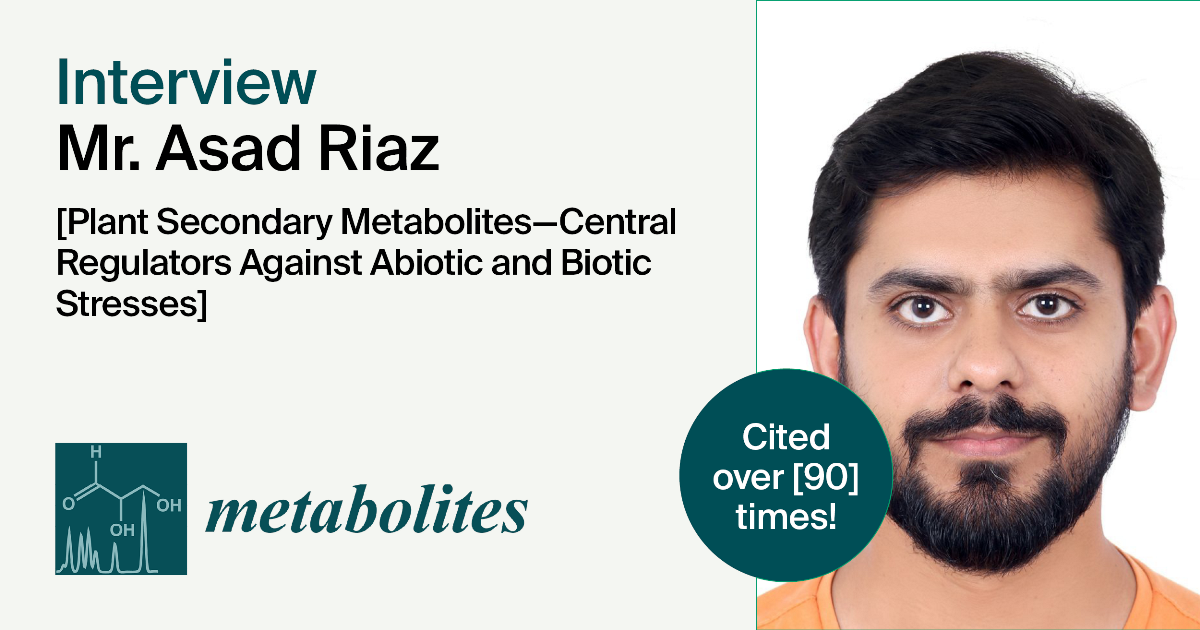
We had the pleasure of speaking with Mr. Asad Riaz, correspondence author of the the Editor’s Choice Article in Metabolites (ISSN 2218-1989). Below, he discusses his research focus, paper, and further reflections on study development.
“Plant Secondary Metabolites—Central Regulators Against Abiotic and Biotic Stresses”
by Ameer Khan, Farah Kanwal, Sana Ullah, Muhammad Fahad, Leeza Tariq, Muhammad Tanveer Altaf, Asad Riaz, and Guoping Zhang
Metabolites 2025, 15(4), 276; https://doi.org/10.3390/metabo15040276
Available online: https://www.mdpi.com/2218-1989/15/4/276
The following is an interview with Mr. Asad Riaz:
1. Could you briefly introduce yourself and describe your main research focus?
I am Asad Riaz, a PhD candidate at the Queensland Alliance for Agriculture and Food Innovation (QAAFI), The University of Queensland, and a member of the ARC Centre of Excellence for Plant Success in Nature and Agriculture.
My primary research is in the quantitative genetics of plant architecture, particularly tillering, where I combine GWAS, haplotype analysis, transcriptomics, and field experiments across planting densities to understand how plants regulate growth and yield. Alongside this, I have a long-standing interest in plant stress metabolism. I began my research training with Prof. Guoping Zhang and have continued collaborating with his group on transcriptomics and metabolomics under abiotic stress. Working at the interface of quantitative genetics and metabolism is what shaped my perspective on this review: I am interested in the functional layer that connects genotype to stress resilience, and ultimately in translating that knowledge into climate-resilient crop varieties.
2. Could you briefly describe the main research content of your Highly Cited Paper, as well as its key innovative highlights?
Our review, “Plant Secondary Metabolites—Central Regulators Against Abiotic and Biotic Stresses”, synthesises the diverse roles of plant secondary metabolites in protecting plants against environmental and biological challenges. We examine the major groups, flavonoids, phenolics, terpenoids, alkaloids, tannins, lignins, and sulphur- and nitrogen-containing compounds and discuss their biosynthesis, regulatory networks, and stress-responsive functions.
A key innovative aspect is that we integrate findings across multiple metabolite classes and multiple stress conditions within a single conceptual framework. Rather than examining metabolite groups in isolation, we show how these compounds collectively contribute to adaptation, signalling, antioxidant defence, pathogen resistance, and stress tolerance. We also discuss emerging opportunities to harness these pathways through modern breeding, biotechnology, and genetic engineering, and identify knowledge gaps and future directions that could accelerate the development of climate-resilient crops.
3. Would you mind sharing what inspired your research?
The inspiration came from the growing pressure climate change is placing on agriculture. Crops worldwide are increasingly exposed to drought, salinity, heat, emerging diseases, and pest outbreaks. Working on plant stress responses, our team was struck by how effectively plants survive these conditions despite being unable to escape their environment.
Secondary metabolites drew our attention because they represent one of the most sophisticated defence systems in plants, functioning not only as protective molecules but also as signalling agents that regulate complex physiological responses. Although a great deal of research had been done on individual metabolite classes, we felt there was a clear need for a review that connected those discoveries within a broader framework of plant resilience. That gap is what motivated the study.
4. What were the biggest challenges you encountered during this study, and how did you overcome them?
The main challenge was the sheer volume and diversity of the literature. Secondary metabolites encompass thousands of chemically diverse compounds whose functions vary across species, stress types, and environmental conditions. A related difficulty was integrating work from very different disciplines, plant physiology, molecular biology, biochemistry, genetics, metabolomics, and crop science, since most studies focus on a single metabolite or stress, making a unified picture hard to assemble.
We addressed this through a systematic and critical review approach: evaluating recent advances carefully, identifying mechanisms common across studies, and organising the literature around functional themes such as biosynthesis, signalling, defence, and stress adaptation. That structure allowed us to offer an integrated perspective useful to readers from a range of backgrounds.
5. How do you see this research evolving or influencing future studies in the field?
I believe plant metabolism research is moving toward a systems-level understanding. Advances in metabolomics, transcriptomics, genomics, and computational biology are creating real opportunities to unravel how metabolic networks regulate stress responses, and integrating these layers with quantitative genetics is where I see much of the progress happening.
I expect increasing emphasis on identifying the key regulatory nodes controlling beneficial metabolite production, and on understanding how those pathways interact with other physiological processes. That knowledge will support precision breeding and genome-editing strategies that improve resilience without sacrificing productivity. Beyond stress tolerance, secondary metabolites also offer routes to reduce reliance on chemical pesticides and strengthen crop adaptation to climate change. I hope our review provides a useful foundation for researchers working in these directions.
6. What advice would you give to early career researchers who aim to publish impactful work in Plant Metabolism?
First, prioritise scientific rigour; lasting work is built on strong experimental design, reproducibility, and careful interpretation.
Second, take communication seriously. A well-designed study only has impact if others can follow it, so learning to write clearly, structure an argument, and present your work to audiences outside your immediate field is a skill worth deliberate practice, not an afterthought once the data are in.
Third, collaborate globally. My own experience moving between research groups in China and Australia, and working with colleagues across several countries, has shaped my thinking more than any single technique I learned. Different groups bring different tools, crops, and questions, and international collaboration exposes you to problems you would never encounter in one lab. Reach out to people whose work you admire; most are more willing to engage than early-career researchers expect.
Finally, be patient and don’t get discouraged. Research is rarely a straight path, and those who make lasting contributions tend to be the ones who stay curious and persistent.
