




Emerging Lightweight Metallic and Non-Metallic Materials: From Properties to Applications
A special issue of Materials (ISSN 1996-1944). This special issue belongs to the section "Mechanics of Materials".
Deadline for manuscript submissions: 20 September 2026 | Viewed by 5965
Editors

Interests: civil engineering; materials engineering; masonry structures; RC structures; FEM modeling; diagnostic of structures; reinforcement of the structure with steel and FRP materials
Special Issues, Collections and Topics in MDPI journals

Interests: modeling and simulation of industrial processes with particular emphasis on non-linear systems; synthesis, implementation and testing of advanced control systems; Q-learning algorithm for continuous process control; predictive algorithms using two-state control; strength machines for testing construction materials and analyzing their properties

Interests: civil engineering; material engineering; geotechnics; FEM modeling; reinforcement of soils with plastic materials

Interests: civil engineering; material engineering; masonry structures; non-metallic materials; FEM modeling; reinforcement of structures with steel and FRP materials

Interests: civil engineering; material engineering; masonry structures; RC structures; FEM modeling; structural diagnostics; reinforcement of structures with steel and FRP materials
Special Issue Information
Dear Colleagues,
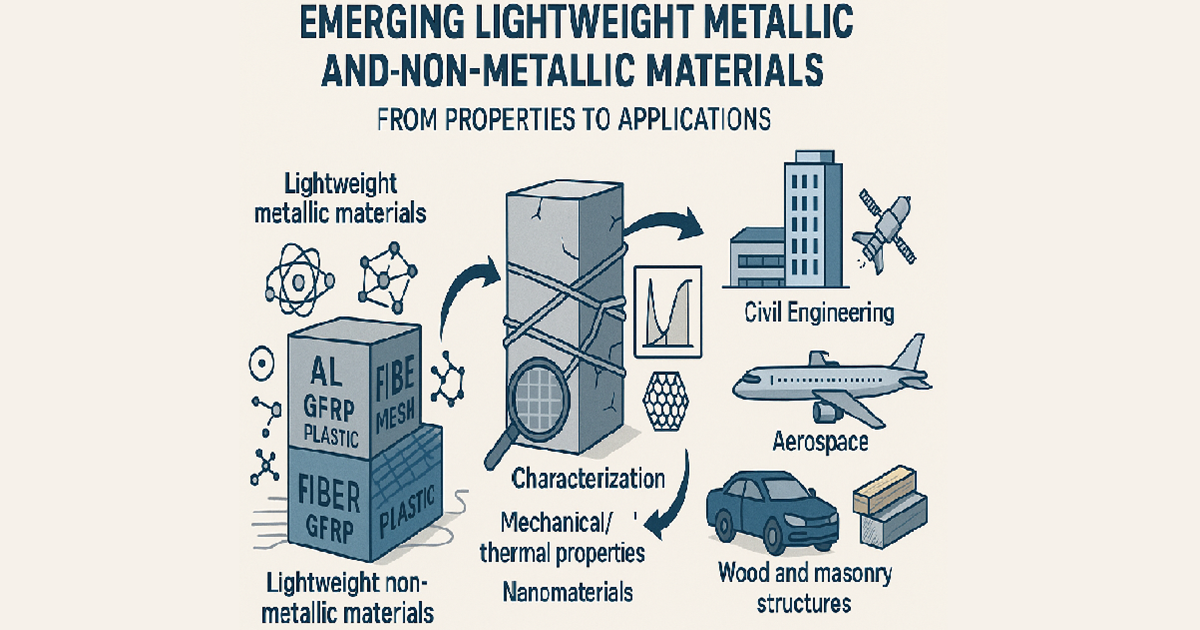
We cordially invite you to contribute a scientific article to our upcoming Special Issue, "Emerging Lightweight Metallic and Non-Metallic Materials: From Properties to Applications". This Special Issue aims to bring together cutting-edge research and recent advances in the development, characterization and application of lightweight metallic and non-metallic materials.
Articles should be related to Material, Civil and Mechanical Engineering and concern research on both metallic and non-metallic materials themselves and their potential applications. Publications concerning the properties of modern metal alloys and nanomaterials used in the construction, space, aviation and automotive industries will be of particular value.
This Special Issue is an excellent opportunity for researchers to showcase interdisciplinary work that bridges the gap between material science and real engineering applications. It will consider the applications of non-metallic materials in the construction material industry, structural reinforcements and problems regarding the maintenance and durability of structures (reinforced concrete, masonry and wooden structures), and geotechnics materials (fibre mesh, gabions etc.). Due to the interdisciplinary nature of this Special Issue, we hope to receive research from many different researchers on Emerging Lightweight Metallic and Non-Metallic Materials.
Prof. Dr. Radoslaw Jasiński
Dr. Krzysztof Stebel
Dr. Slavka Harabinova
Dr. Iwona Galman
Dr. Krzysztof Grzyb
Guest Editors
Manuscript Submission Information
Manuscripts should be submitted online at www.mdpi.com by registering and logging in to this website. Once you are registered, click here to go to the submission form. Manuscripts can be submitted until the deadline. All submissions that pass pre-check are peer-reviewed. Accepted papers will be published continuously in the journal (as soon as accepted) and will be listed together on the special issue website. Research articles, review articles as well as short communications are invited. For planned papers, a title and short abstract (about 250 words) can be sent to the Editorial Office for assessment.
Submitted manuscripts should not have been published previously, nor be under consideration for publication elsewhere (except conference proceedings papers). All manuscripts are thoroughly refereed through a single-anonymized peer-review process. A guide for authors and other relevant information for submission of manuscripts is available on the Instructions for Authors page. Materials is an international peer-reviewed open access semimonthly journal published by MDPI.
Please visit the Instructions for Authors page before submitting a manuscript. The Article Processing Charge (APC) for publication in this open access journal is 2600 CHF (Swiss Francs). Submitted papers should be well formatted and use good English. Authors may use MDPI's English editing service prior to publication or during author revisions.
Keywords
- lightweight materials
- material engineering
- emerging materials
- sustainable materials
- structural reinforcements
- nanomaterials
- aviation industry
- automotive industry
- steel reinforcement
- FRP reinforcement
- GFRP mesh
- plastic fiber
Benefits of Publishing in a Special Issue
- Ease of navigation: Grouping papers by topic helps scholars navigate broad scope journals more efficiently.
- Greater discoverability: Special Issues support the reach and impact of scientific research. Articles in Special Issues are more discoverable and cited more frequently.
- Expansion of research network: Special Issues facilitate connections among authors, fostering scientific collaborations.
- External promotion: Articles in Special Issues are often promoted through the journal's social media, increasing their visibility.
- Reprint: MDPI Books provides the opportunity to republish successful Special Issues in book format, both online and in print.
Further information on MDPI's Special Issue policies can be found here.
