

You are currently viewing a new version of our website. To view the old version click .

Machine Learning and Knowledge Extraction

Machine Learning and Knowledge Extraction is an international, peer-reviewed, open access, quarterly journal on machine learning and applications, see our video on YouTube explaining the MAKE journal concept. 

Quartile Ranking JCR - Q1 (Engineering, Electrical and Electronic | Computer Science, Artificial Intelligence | Computer Science, Interdisciplinary Applications)

All Articles (612)

This paper presents an Artificial Neural Network (ANN) approach for estimating total real and reactive power losses in electrical power systems. Three network architectures were explored: the Multilayer Perceptron (MLP), the Radial Basis Function (RBF) network, and the Generalized Regression Neural Network (GRNN). The main advantage of the proposed methodology lies in its ability to rapidly compute power loss values throughout the system. ANN models are especially effective due to their capacity to capture the nonlinear characteristics of power systems, thus eliminating the need for iterative procedures. The applicability and effectiveness of the approach were evaluated using the IEEE 14-bus test system and compared with the continuation power flow method, which estimates losses using conventional numerical techniques. The results indicate that the ANN-based models performed well, achieving mean squared error (MSE) values below the predefined threshold during both training and validation (0.001). Notably, the networks accurately estimated the total power losses within the expected range, with residuals on the order of 10−4. Among the models tested, the RBF network showed slightly superior performance in terms of error metrics, requiring fewer centers to meet the established criteria compared to the MLP and GRNN models (11 centers). However, the GRNN achieved the shortest processing time; even so, all three networks produced satisfactory and consistent results, particularly in identifying the critical points of electrical power systems, which is of fundamental importance for ensuring system stability and operational reliability.

26 December 2025
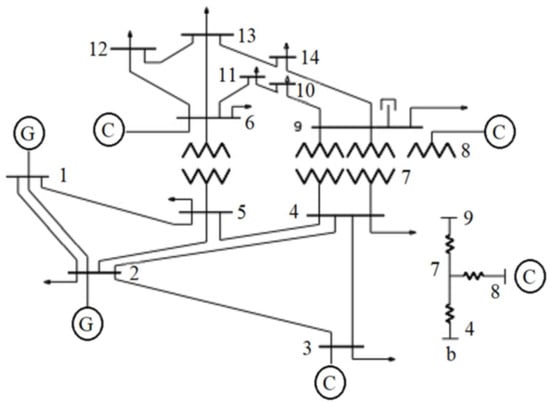
IEEE 14-bus test system utilized in this work.

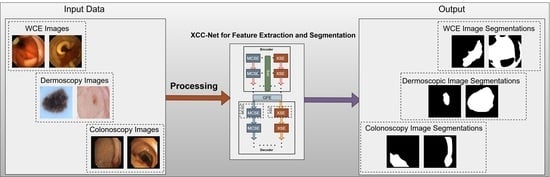
Encoder–decoder models are widely used for pixel-level segmentation due to their ability to capture and combine multiscale features. However, skip connections between the encoder and decoder often require cropping to mitigate border pixel loss during convolutions, which can introduce inefficiencies and limit performance. This study explores the potential of modifying these connections by removing direct encoder-to-decoder links to enhance segmentation accuracy. We propose a novel architecture, termed XCC-Net, which features two context-capturing pathways and two symmetric pathways for enlargement. These pathways are interconnected via channels, enabling automated detection of structures with varied shapes. The XCC-Net’s X-shaped architecture links skip connections exclusively between encoder-to-encoder and decoder-to-decoder, omitting direct encoder-to-decoder feature transfers to potentially improve performance. The XCC-Net model was evaluated on multiple medical imaging datasets, including wireless capsule endoscopy (WCE), colonoscopy, and dermoscopy images. Experimental results showed that XCC-Net outperformed state-of-the-art segmentation models, achieving dice coefficients of 91.70%, 89.26%, 87.15%, and 79.07% on the MICCAI 2017 (Red Lesion), PH2, CVC-ClinicDB, and ISIC 2017 datasets, respectively. XCC-Net’s X-shaped architecture, with its unique skip connections, demonstrates improved segmentation performance across various medical imaging tasks.

25 December 2025

An overview of the proposed XCC-Net architecture illustrating its symmetric X-shaped design. The network includes two parallel encoding subnetworks, XSE and MCSE, connected through the PFE module. The outputs of these encoders are passed to the GFE bottleneck. The decoding stage consists of two corresponding subnetworks, XSD and MCSD, which produce the final segmentation output.

Enhancing GNN Explanations for Malware Detection with Dual Subgraph Matching

  • Hossein Shokouhinejad,
  • Roozbeh Razavi-Far and
  • Griffin Higgins
  • + 1 author

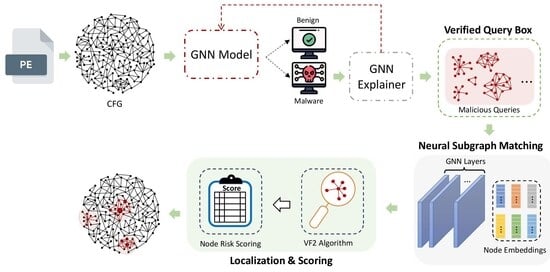
The increasing sophistication of malware has challenged the effectiveness of conventional detection techniques, motivating the adoption of Graph Neural Networks (GNNs) for their ability to model the structural and semantic information embedded in control flow graphs. While GNNs offer high detection performance, their lack of transparency limits their applicability in security-critical domains. To address this, we present an explainable malware detection framework, which contains a dual explainer. This dual explainer integrates a GNN explainer with a neural subgraph matching approach and the VF2 algorithm. The proposed method identifies and verifies discriminative subgraphs during training, which are later used to explain new predictions through efficient matching. To enhance the generalization of the neural subgraph matcher, we train it using curriculum learning, gradually increasing subgraph complexity to improve matching quality. Experimental evaluations on benchmark datasets demonstrate that the proposed framework retains high classification accuracy while significantly improving interpretability. By unifying explainable graph learning techniques with subgraph matching, the proposed framework enables analysts to gain actionable insights, fostering greater trust in GNN-based malware detectors.

21 December 2025

The proposed malware detection framework with dual explanation.

An Integrated Artificial Intelligence Tool for Predicting and Managing Project Risks

  • Andreea Geamanu,
  • Maria-Iuliana Dascalu and
  • Ana-Maria Neagu
  • + 1 author

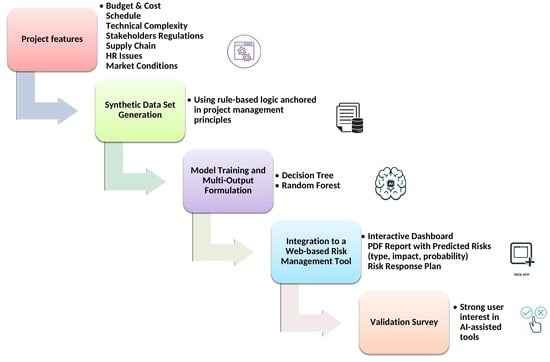
Artificial Intelligence (AI) is increasingly used to enhance project management practices, especially in risk analysis, where traditional tools often lack predictive capabilities. This study introduces an AI-based tool that supports project teams in identifying and interpreting risks through machine learning and integrated documentation features. A synthetic dataset of 5000 project instances was generated using deterministic rules across 27 input variables, enabling the training of multi-output Decision Tree and Random Forest models to predict risk type, impact, probability, and response strategy. Due to the rule-based structure of the dataset, both models achieved near-perfect classification performance, with Random Forest showing slightly better regression accuracy. These results validate the modelling pipeline but should not be interpreted as real-world predictive accuracy. The trained models were deployed within a web platform offering prediction visualization, automated PDF reporting, result storage, and access to a structured risk management plan template. Survey feedback highlights strong user interest in AI-assisted mitigation suggestions, dashboards, notifications, and mobile access. The findings demonstrate the potential of AI to improve proactive risk assessment and decision-making in project environments.

20 December 2025

Component Diagram of the Integrative Tool for Risk Predictions in Projects.

News & Conferences

Issues

Open for Submission

Editor's Choice

Get Alerted

Add your email address to receive forthcoming issues of this journal.

XFacebookLinkedIn
Mach. Learn. Knowl. Extr. - ISSN 2504-4990