1. Introduction
Artificial Intelligence (AI) has increasingly become a strategic asset across industries, enabling automated decision-support, advanced analytics, and real-time insights. In project management (PM), AI adoption has accelerated significantly in recent years, supported by global market projections indicating a rise from USD 2.5 billion in 2023 to USD 5.7 billion by 2028 [
1,
2]. AI-enabled tools assist project teams by automating routine tasks, analyzing large volumes of project data, and providing predictive insights that enhance planning accuracy and execution efficiency. Generative AI and Machine Learning (ML) further extend these capabilities by producing intelligent summaries, scenario-based recommendations, and adaptive risk assessments that augment the project manager’s decision-making process [
3,
4,
5,
6].
Despite these advances, AI applications for risk management remain limited, particularly in predictive modelling and integrated decision support. Existing solutions tend to focus on task automation, document processing, or isolated risk registers, with few providing multi-output risk prediction (type, impact, probability, and response); interpretable ML models tailored to project features; user-friendly platforms linking prediction, documentation, and visualization, or empirical validation through practitioner feedback.
Furthermore, many organizations still rely on qualitative assessments, expert judgement, or static checklists, which are prone to inconsistency, bias, and limited scalability. These limitations highlight a clear gap in the availability of AI-driven tools that combine predictive analytics with practical usability for everyday project management.
To address this gap, this study proposes an AI-based risk management system that integrates supervised and unsupervised ML techniques to support project teams throughout the risk identification and mitigation process. A comprehensive synthetic dataset of 5000 project instances was generated to train a multi-output Random Forest model capable of predicting key risk variables. The system is integrated into a light-weight web application that enables interactive prediction, result storage, automatic reporting, and access to a structured risk management template. A user survey further evaluates practitioner needs and expectations, offering insights into desired functionalities for modern AI-driven PM tools.
The main contributions of this study are as follows: (1) Development of a multi-output ML framework for predicting risk type, probability, impact, and response strategy; (2) Construction of a large, rule-based synthetic dataset reflecting diverse project characteristics and risk conditions; (3) Empirical comparison of Decision Tree (DT) and Random Forest (RF) models for multi-output risk prediction; (4) Implementation of an integrated web-based platform that operationalizes predictive analytics in a practical Project Management (PM) context; (5) Validation of user needs through a dedicated survey targeting PM practitioners.
The remainder of this paper is structured as follows.
Section 2 reviews AI applications in PM.
Section 3 discusses existing approaches to AI-enabled risk management.
Section 4 presents the proposed ML framework, dataset generation process, and integrated tool architecture.
Section 5 reports the evaluation results and practitioner survey findings.
Section 6 concludes the study and outlines directions for future research.
While the ML algorithms used in this study (Decision Tree and Random Forest) are well-established, the novelty of our work lies in the integration of a complete multi-output prediction pipeline, the transparent construction of a reproducible synthetic dataset, and the development of an end-to-end operational tool linking prediction, visualization, reporting, and practitioner feedback. Current PM risk tools typically treat risk factors independently, provide only qualitative assessments, or lack predictive components. By contrast, our approach models multiple interdependent risk outputs simultaneously and embeds the resulting predictive engine into an accessible practitioner-oriented platform. Nonetheless, we acknowledge that synthetic data cannot fully capture real-world risk complexity; therefore, as future work, we plan to incorporate an additional dataset-either anonymized industrial data or semi-synthetic data augmented with noise-to benchmark model generalizability under more realistic conditions.
2. Related Work
2.1. AI in Project Management
As AI adoption continues to expand across industries, its transformative influence on project management has become increasingly evident. Organizations seeking to improve efficiency, anticipate risks, and strengthen data-driven decision making now view AI not only as a supporting technology but as a strategic partner in project execution. This section examines how AI—particularly generative AI—is reshaping traditional project management processes through automation, predictive analytics, and intelligent decision support.
Recent peer-reviewed studies further strengthen this trend. El Khatib and Al Falasi show that AI-supported decision processes significantly improve collaboration and information flow in complex projects [
7]. Similarly, Salimimoghadam demonstrates that AI-augmented decision making reshapes governance structures by enabling more adaptive and data-driven managerial responses [
8]. New AI-enabled project dashboards and planning tools have also emerged which highlight the integration of predictive analytics, automated scheduling, and real-time reporting into organizational PM ecosystems [
9,
10].
Generative Artificial Intelligence (GenAI) leverages advanced models capable of learning patterns from vast amounts of data to generate new content such as text, code, images, and designs. These models function as conversational agents that produce coherent, human-like responses and adapt through continuous learning and feedback. Although GenAI is frequently associated with creative applications, its ability to summarize information, adapt content, and generate context-aware outputs makes it particularly valuable for project management tasks. Prior studies show that GenAI can automate report creation, update timelines, produce concise summaries of large datasets, and recommend corrective actions throughout the project lifecycle [
11,
12]. It may also advise on the presentation of ideas, identify drivers of potential project failure, and anticipate conditions under which a project should or should not be initiated. By automating repetitive tasks, GenAI frees project managers to concentrate on strategic analysis, stakeholder engagement, and higher-level decision making.
Practical examples further illustrate these benefits. As noted by Michael McCullough, Project Manager at Amtrak, AI-enabled transcription and summarization tools can automatically brief late participants during meetings, generate consolidated minutes, and assign action items—substantially reducing administrative workload. While such technologies provide substantial support, they do not inherently understand the deeper contextual nuances of language; human oversight therefore remains essential when interpreting AI-generated insights. Nonetheless, GenAI has the potential to substantially increase project efficiency, improve risk preparedness, enhance stakeholder satisfaction, and contribute to overall project success.
Beyond practical examples, recent academic studies confirm the value of generative AI in project environments. Naji et al. [
13] explain how GenAI enhances scenario-based reasoning and reduces decision ambiguity in engineering projects. Recent reviews show that AI-enabled project management tools significantly expand decision support, enabling earlier detection of risks and performance deviations. For instance, Taboada et al. [
9] conclude that predictive analytics and AI-driven decision support are increasingly used for project monitoring and control, while Felicetti et al. [
14] documents empirical cases where AI dashboards and predictive models improved early identification of schedule, budget or resource deviations and Valentine [
15] argues that generative models fundamentally accelerate knowledge extraction from large and unstructured data sources. Together, these contributions position GenAI as a catalyst for higher-quality, evidence-based project decision making.
The importance of leveraging past project knowledge has also been highlighted in recent PMI work. Brunet [
16] demonstrates how generative AI can bridge the persistent gap between data collection and actionable insights by consolidating historical information—such as Lessons Learned—and transforming it into practical recommendations for future initiatives. This approach offers a promising direction for organizational learning and evidence-based project management [
17].
A growing number of AI-enabled tools further contributes to this transformation. Platforms such as PMI Infinity, the ChatGPT 5.2 AI Assistant for Jira, and Microsoft Copilot provide automated reporting, predictive analytics, and intelligent navigation through large repositories of project management resources. PMI Infinity, built on GPT-based architecture, enables members to access curated best practices, validated sources, and recommended prompts for real-time problem solving. Similarly, tools integrated into Jira or Microsoft 365 enhance productivity by recommending tasks, analyzing project status, and assisting with scheduling and prioritization [
18,
19].
These industry developments are aligned with findings from recent research on AI-enabled PM tools. Nindartin et al. [
20] demonstrate that ensemble learning significantly improves the prediction of project cost deviations, while Ashtari et al. [
21] demonstrate that machine-learning models can assess and predict cost-overrun risks in construction projects, enhancing early risk detection and proactive mitigation.
As project managers adopt these advanced tools, they must also develop the ability to formulate precise and meaningful questions [
22]. The quality of GenAI outputs depends heavily on the quality of user input, and project managers remain responsible for decisions made based on AI-assisted insights. Strong business acumen and domain expertise remain crucial, as GenAI can support—but not replace—professional judgement. When used effectively, GenAI can help project managers rapidly acquire domain insights, evaluate emerging trends, simulate potential scenarios, and refine project strategies based on organizational context.
In practice, project managers can use GenAI to articulate challenges, request analyses grounded in industry data, and obtain best practices or step-by-step recommendations. AI models may also simulate project outcomes under various assumptions, enabling teams to validate and adjust their strategies. Iterative use—combined with human verification—allows AI systems to refine outputs over time and better align with organizational needs. While GenAI enhances general project management capabilities, its potential is particularly strong in specialized domains such as risk management, where predictive analytics and automated assessments can significantly strengthen project resilience.
In parallel, emerging research highlights the importance of integrating AI within broader digital transformation strategies. For example, Gao et al. [
23] identify both drivers and barriers for AI adoption in project-based organizations, emphasizing the need for interpretable, user-friendly tools. Qian et al. [
24] and Goyal et al. [
25] also discuss the challenges of obtaining real project data and propose synthetic or semi-synthetic datasets for benchmarking risk prediction models—approaches directly aligned with our methodological choices.
2.2. AI in Risk Management
As described in PMBOK Guide, the book of reference for PM, “Project Risk Management comprises the procedures of conducting risk management planning, identification, analysis, response planning, response implementation, and monitoring risk on a project” [
26]. The aim of project risk management is to maximize the possibility of project success by lowering the chance and/or effect of negative risks and raising the likelihood and/or effect of positive risks. All projects involve inherent risks due to their unique nature, varying complexity, constraints, and stakeholder expectations. Successful project risk management seeks to identify and manage risks that could undermine project goals. Risks exist at both individual and overall project levels, with individual risks potentially impacting specific project objectives and overall project risk representing the cumulative effect of all uncertainties. Project risk management processes aim to mitigate negative risks (threats) while capitalizing on positive risks (opportunities). Managing overall project risk involves minimizing negative variations, maximizing positive outcomes, and ensuring the probability of achieving project objectives remains high.
Recent studies also stress the role of AI and machine learning in automating risk detection and forecasting. Yaseen et al. [
27] used Random Forest models to predict schedule delays with high reliability, while Goyal et al. [
25] showed that rule-based synthetic datasets can effectively validate ML risk pipelines when confidential industrial data cannot be shared. These contributions highlight the growing need for predictive, data-driven risk assessment solutions that complement conventional PMBOK processes.
To handle developing risks, project risk management procedures should be repeated and carried out all the way through the project lifecycle. Acceptable degrees of risk exposure are defined by risk thresholds, which also direct risk management activities. Good practices seek to guarantee that all kinds of hazards are taken into account and handled successfully, therefore raising the general effectiveness and worth of undertakings.
Regarding threats, five further tactics might be taken into consideration:
Escalate: Escalation is reasonable when a risk is outside the project’s purview or beyond the power of the project manager. Higher up in the company, the risk is controlled, and the pertinent party receives details for ownership acceptance. The project team stops monitoring escalating dangers after that.
Avoid: Risk avoidance entails eliminating the threat or protecting the project from its impact. It is suitable for high-priority threats with a high probability of occurrence and a significant negative impact. Actions may include changing project plans or objectives to eliminate the threat entirely or isolating project objectives from the threat’s impact.
Transfer: Risk transfer involves shifting ownership of the threat to a third party, who will manage the risk and bear its impact. This often involves payment of a risk premium and can be achieved through mechanisms like insurance, performance bonds, or warranties.
Mitigate: Risk mitigation entails reducing the probability of occurrence and/or impact of a threat. Early action is more effective, and examples include adopting simpler processes, conducting more tests, or incorporating redundancy into systems. Prototype development can potentially be a part of mitigation to lower risks.
Accept: Risk acceptance acknowledges the threat’s existence without proactive action. It is suitable for low-priority threats or when it is not feasible to address them otherwise. Active acceptance involves establishing contingency reserves, while passive acceptance involves periodic review to ensure threats do not change significantly.
According to SEI [
28], once recognized, the hazards can be ranked and assessed according to likelihood and effect using qualitative risk analysis. This involves implementing preventive measures to minimize risks and creating detailed contingency plans for high-risk scenarios. Choosing mitigation plans specific to each risk, ranking risks according to likelihood and possible impact, setting aside enough time and money for mitigation measures, and delegating clear duties to the project team are all important first steps. Regular review and updates to the response plan are crucial, ensuring its effectiveness in addressing evolving risks and challenges. By fostering a proactive and adaptive approach to risk management, organizations can enhance project resilience and improve overall success.
To facilitate a structured understanding of typical sources of uncertainty encountered in projects, we adopt the risk categorization recommended in the PMBOK Guide [
29].
Table 1 summarizes the main risk types commonly described in the project management literature, including technical, organizational, external, financial, schedule-related, and stakeholder-related risks. This classification provides the conceptual foundation for the risk prediction outputs later modelled by our ML system.
Project leaders embracing innovation are increasingly leveraging technology to identify and mitigate risks more effectively. By harnessing unbiased data to discern clear patterns, teams can proactively address potential problems and ensure they are adequately prepared for emerging threats. For example, companies like Aecom and Boeing utilize drones, waterborne aircraft, and advanced analytics to assess risks such as flooding and safety issues in various phases of aircraft development. Vishwajeet Uddanwadiker from Boeing emphasizes the importance of a holistic approach to data analysis, combining domain knowledge with advanced analytics to model safety risks accurately [
30].
Automation tools, including AI and ML, play a significant role in generating insights and freeing up project leaders’ time for strategic decision-making. However, it is crucial for project leaders to balance AI-driven insights with human input and analysis, as projects are ultimately managed and executed by people. While AI and technology can enhance productivity and project outcomes, it is essential to address resistance to change and ensure that stakeholders’ feedback is considered in decision-making processes. Striking a balance between technology and human involvement is key to successful risk management and project execution.
Building on the advances of AI in risk management, we propose a dedicated risk tool that integrates predictive analytics and automated assessment capabilities to enhance organizational decision-making and mitigate project uncertainties.
3. Methodology
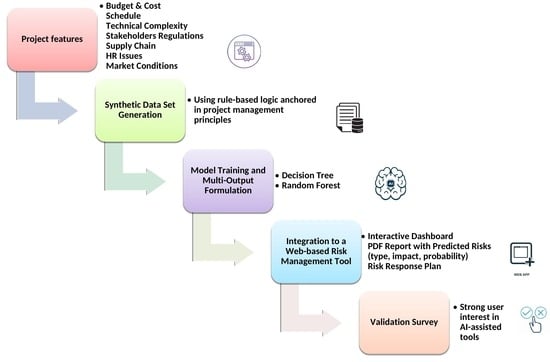
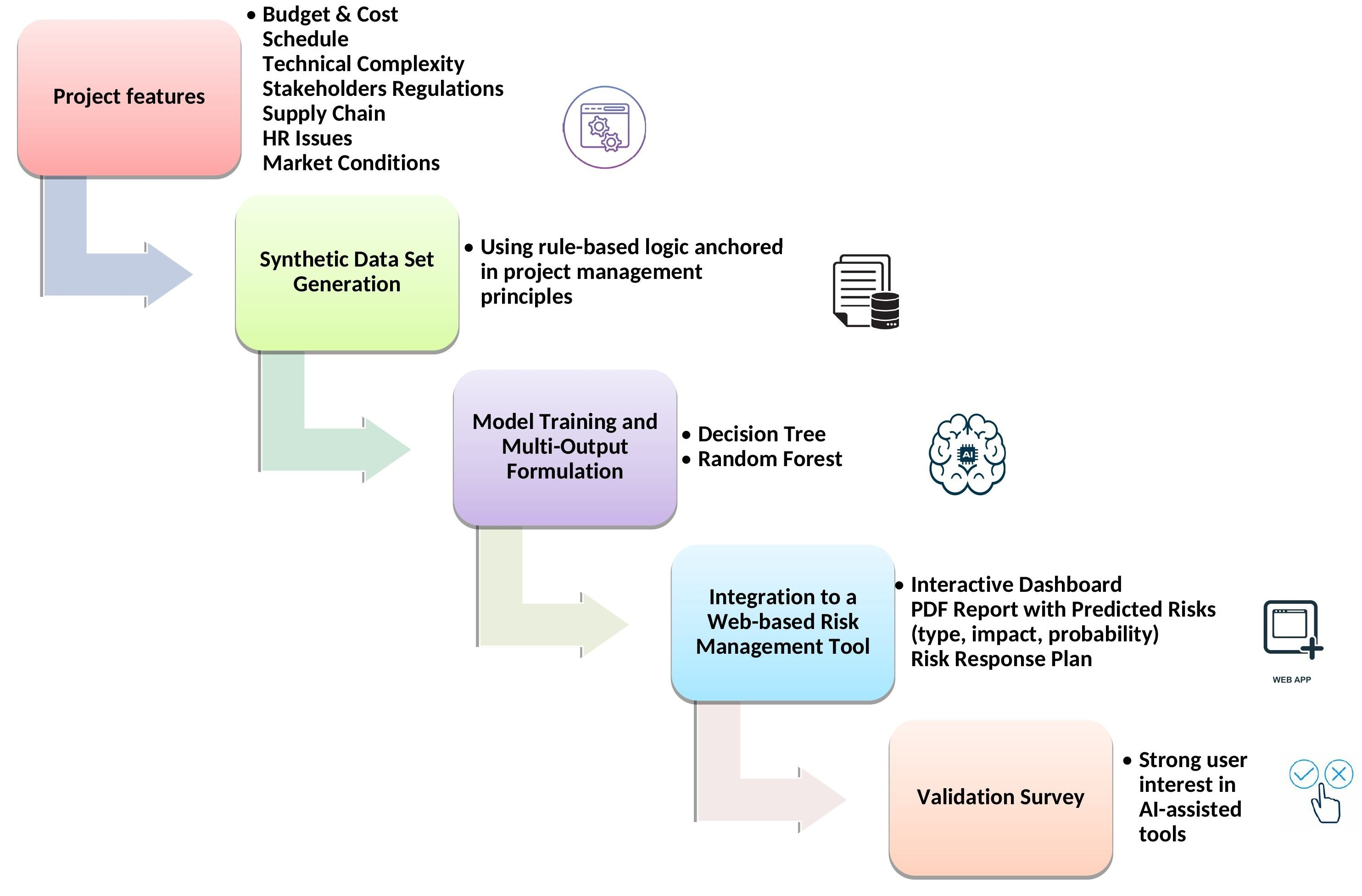
This study follows a structured methodology combining dataset construction, multi-output machine learning, model evaluation, and system integration. The overall research workflow is further described.
3.1. Research Flow
Define risk components based on PM standards (type, impact, probability, response).
Construct a 5000-instance synthetic dataset using rule-based logic.
Preprocess and encode the dataset (categorical encoding, scaling of ordinal values).
Train multi-output models (Decision Tree and Random Forest).
Evaluate using classification (Hamming Loss, Exact Match Ratio) and regression metrics (MAE).
Deploy models within an interactive web-based tool.
Collect practitioner feedback through a focused survey.
3.2. Dataset Generation and Structure
Because real project risk datasets are proprietary and confidential, we generated a reproducible synthetic dataset of 5000 project instances (see the
Supplementary Material). Each instance contains 27 input variables reflecting financial, operational, technical, environmental, and stakeholder dimensions (
Table 2).
Categorical features (e.g., industry, economic conditions) were sampled using balanced discrete distributions. Continuous and ordinal variables (e.g., budget, variance, complexity) were produced using uniform, normal, or bounded integer distributions to reflect realistic ranges.
The mapping between input attributes and output risk labels follows a structured conceptual rationale grounded in established project-risk taxonomies. Input variables were grouped according to causal relationships consistently documented in PM standards and empirical research. For example, requirements volatility and budget variance are primary drivers of cost-related risks, while supplier reliability and task interdependence strongly influence schedule-related risks. Likewise, high project complexity combined with low team experience increases coordination and stakeholder-related risks. These conceptual linkages define how multiple input factors are consolidated into broader output categories (risk type, impact, probability, and response plan), ensuring that the dataset reflects meaningful project-risk mechanisms rather than arbitrary groupings. This rationale forms the conceptual foundation for the deterministic rules applied in the subsequent step.
Risk outputs were assigned deterministically using rule-based logic anchored in PM principles. For example:
high technical complexity → technical risk;
large cost variance → financial risk;
high regulatory impact → compliance risk;
high probability + high impact → “mitigate” response plan.
This deterministic mapping ensures internal consistency and provides a controlled environment for model benchmarking.
Because the synthetic dataset was generated using predefined rule dependencies, the output variables (risk probability, impact level, risk category, and response plan) are inherently determined by combinations of input attributes. As a result, the ML model is expected to reproduce these deterministic mappings with very high accuracy. We emphasize that this behaviour should not be interpreted as evidence of superior model performance but rather as validation that the modelling pipeline correctly reconstructs the logical structure encoded in the data. The goal of the synthetic dataset is therefore not to demonstrate predictive generalization but to provide a controlled, fully transparent environment in which the feature—output relationships are traceable, explainable, and reproducible. This controlled setup allows us to validate the architecture, data workflows, and evaluation procedures before applying the framework to empirical project-risk datasets where relationships are non-deterministic and performance metrics carry substantive meaning.
3.3. Model Training and Multi-Output Formulation
The prediction task involves jointly estimating four dependent variables. We adopt a multi-output supervised learning framework, where classification and regression heads are trained simultaneously using Decision Tree and Random Forest algorithms. Categorical features were numerically encoded using Scikit-learn’s preprocessing modules.
Model training used an 80/20 train–validation split with a fixed random seed (42) to ensure reproducibility. Decision Tree and Random Forest models were trained using default Scikit-learn hyperparameters with max_depth = None and n_estimators = 100 for RF. Categorical features were encoded using Scikit-learn’s OrdinalEncoder, and the multi-output formulation was implemented as a parallel approach in which each target is predicted independently within a unified model.
3.4. Evaluation Metrics
Classification performance for risk type and response plan was assessed using Hamming Loss and Exact Match Ratio. Regression accuracy for probability and impact was measured using Mean Absolute Error (MAE). This combination allows a holistic assessment of model behaviour across multiple target types.
3.5. System Integration
The final trained models were embedded into a Flask-based web application featuring prediction dashboards, PDF reporting, result storage, and a structured risk management plan template. This integration demonstrates practical applicability and supports real-world adoption.
4. Machine Learning Tool to Predict Risks in Projects
The strategic importance of identifying risks as both threats and opportunities is undeniable, but every team can benefit from a tech upgrade. Investing in AI and emerging tech tools enables companies and project leaders to better understand, identify, and manage risks, ultimately limiting the probability and impact of unexpected events. According to a 2022 survey by PwC, executives are increasingly allocating resources to risk management technology, particularly focusing on data analytics, process automation, and threat detection [
31].
Automation not only reduces cognitive biases but also allows for real-time analysis of data, revealing patterns and flagging noteworthy changes. With examples like Shell utilizing AI and ML to improve supply chain visibility [
32] and Boeing employing digital twin models to achieve a 40% increase in first-time quality of components and systems [
33], there is a big payout for deploying digitally driven risk management solutions. Amazon Web Services company emphasizes that AI and ML can identify high-level vulnerabilities and prevent risks from cascading through dependent projects, facilitating optimal decision-making [
34]. By tapping into AI and ML to collect and analyze data from multiple sources and projects, leaders can efficiently compare, analyze, and optimize information, turning it into strategic insights for the entire project ecosystem. While teams cannot hand off all risk management to AI, strategically leveraging technology accelerates the risk management process, allowing project leaders to focus on analyzing results and improving predictive success.
We developed a tool based on an ML algorithm that takes into consideration project features (input) and predicts the risk type, level, impact, and probability (output): see
Table 2. Because project features can differ substantially according to the industry, project scope, and specific operational contexts, we used a scoring system that will help project teams and stakeholders consistently evaluate the risks associated with each project.
To operationalize the ML-based prediction task, each project instance was represented using 27 carefully constructed input features. These variables cover financial, operational, organizational, environmental, and stakeholder-related aspects that influence project exposure to risk.
Table 2 provides a detailed description of each feature, the measurement scale used, and the corresponding four output dimensions predicted by our system: risk type, impact, probability, and response strategy. This structured formulation ensures consistency in model training and provides a transparent mapping between project characteristics and the resulting risk profile.
One powerful Python ML library is Scikit-learn [
35], which we also used. Several classification ML algorithms from Scikit-learn were tried (e.g., DT, RF classifier), in order to decide what is the best model for risk prediction. ML techniques were chosen for project risk prediction because they provide a robust and data-driven framework capable of capturing complex, non-linear relationships among project variables that traditional statistical or rule-based algorithms often fail to model. Unlike conventional approaches that depend on predefined formulas, fixed thresholds, or expert-assigned weights, ML algorithms can automatically learn from historical data, adapt to new contexts, and improve predictive accuracy over time. This adaptability is particularly valuable in dynamic project environments, where risk factors and interdependencies evolve continuously. Compared with fuzzy logic systems, which are effective in handling linguistic uncertainty but depend on manually defined membership functions and rule sets, ML models offer superior scalability and objectivity. Fuzzy logic approaches require extensive expert calibration and are less flexible when applied to heterogeneous or large-scale datasets. In contrast, ML algorithms infer decision boundaries directly from data, allowing them to discover hidden correlations and generalize to unseen projects without human intervention. Consequently, ML provides a more adaptive, accurate, and generalizable solution for quantitative risk prediction, while fuzzy logic remains complementary for qualitative reasoning when data availability is limited [
36].
4.1. Dataset Construction
A synthetic dataset of 5000 project instances was generated to train and evaluate the proposed machine learning models. Because real-world project risk datasets are typically confidential and not publicly available, a rule-based generator was implemented to simulate realistic project behaviour across diverse industries and operational contexts. The dataset includes 27 input variables describing financial, operational, organizational, environmental, and stakeholder-related aspects of projects, as seen in
Table 2. The generated data is available here:
https://ctipub-my.sharepoint.com/:x:/g/personal/maria_dascalu_upb_ro/EWoIN5rPSuFBkkXs8AMKKsoBbwGiC8aOod-qVsV5ANveyA?e=3DdrnJ, accessed on 15 November 2025.
Categorical attributes (e.g., project industry, legal risk) were sampled using balanced discrete distributions, while continuous and ordinal variables (e.g., budget, schedule variance, technical complexity) were generated using uniform, normal, or bounded integer distributions.
A dedicated deterministic function assigned each project its corresponding risk outputs:
Risk Type (Technical, Operational, Financial, Compliance)
Risk Impact (1–10)
Risk Probability (20–100%)
Risk Response Plan (mitigate, avoid, transfer, accept)
Assignment rules were based on project management logic. For example, high technical complexity and elevated security threats triggered technical risks, while cost variance and budget instability increased the likelihood of financial risks. Because these decision rules encode direct relationships, the resulting dataset exhibits low ambiguity and strong internal consistency—an important factor explaining model performance in subsequent experiments.
4.2. Prediction Problem Formulation and Machine Learning Models
The goal of the proposed system is to predict project risks using a multi-output supervised learning framework. Each project instance is represented as a feature vector:
The prediction task involves estimating a set of four dependent outputs:
where
y1 represents the risk type (multiclass classification);
y2 represents the risk impact (regression);
y3 represents the risk probability (regression);
y4 represents the risk response plan (multiclass classification).
Because the outputs are interdependent (e.g., high impact tends to align with certain response strategies), a multi-output learning setup is preferable to training independent models. The dataset was split into 80% training and 20% testing, with all categorical features encoded numerically to enable compatibility with tree-based algorithms.
Two ML approaches were evaluated. DT classifiers and regressors were selected as baseline models due to their interpretability and ability to model non-linear decision boundaries. They were applied using a MultiOutputClassifier and MultiOutputRegressor framework.
4.3. Evaluation Metrics and Experimental Results
Two evaluation categories were used: classification and regression. Regarding classification, we computed Hamming Loss (manual implementation due to multi-output multiclass nature) and Exact Match Ratio (percentage of samples where both risk type and response plan are predicted correctly). Regarding regression, we calculated Mean Absolute Error (MAE) for both impact and probability. This set of metrics provides a complete view of predictive performance across both discrete and continuous outputs.
Table 3 summarizes the performance of both models on the synthetic dataset.
4.4. Interpretation of Results
Given the deterministic nature of the dataset generation rules, DT performed exceedingly well, effectively learning the explicit relationships embedded in the data. RF, as an ensemble method based on bootstrap aggregation, was used for both classification and regression tasks. They typically generalize better than single trees, especially in noisy or high-dimensional datasets. Although the synthetic dataset is highly structured, RF still yielded slightly superior regression performance due to variance reduction across trees.
These results reflect the strong predictability inherent in a dataset where input–output relationships follow explicit rules. The models correctly recover the generative logic and replicate it with minimal error.
Accordingly, these findings should be interpreted as validation of the modelling pipeline, not evidence of real-world predictive superiority. Performance on actual project portfolios would naturally be lower due to noise, incomplete information, and overlapping risk patterns.
A key limitation of this study is the use of synthetic, rule-based data. While this approach ensures reproducibility and controllability, it also leads to deterministic relationships that inflate predictive performance. As a result, the high accuracy values reported in
Section 3.3 reflect internal consistency rather than real-world generalizability. Future work will incorporate anonymized industrial datasets, introduce controlled noise, and explore probabilistic risk modelling to better simulate real project uncertainty.
4.5. Integrative Tool
The trained models are deployed inside a web-based application built using the Flask framework. In
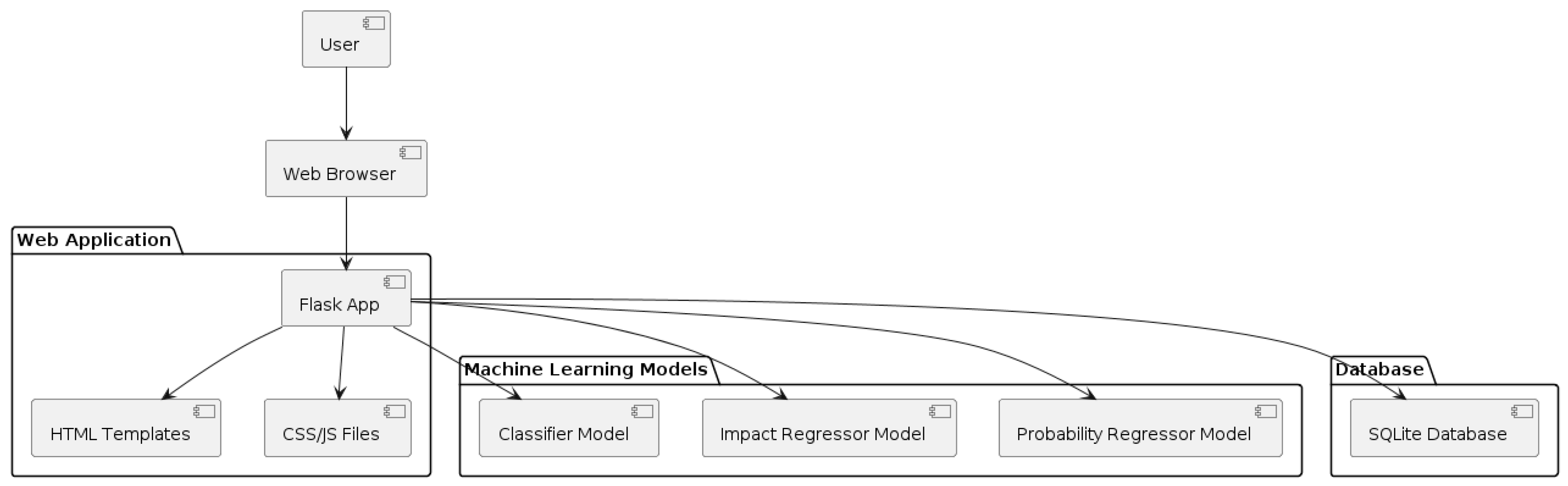
Figure 1, there is the component diagram of the developed tool, highlighting key parts such as the user interface, risk prediction module, authentication module and the database.
Figure 1 presents the system’s component architecture, illustrating the separation of concerns between the presentation layer, the application logic, the machine-learning services, and the persistence layer. The user interacts with the system through a standard web browser, which issues HTTP requests to the Flask application. Flask functions as the central controller, responsible for routing, request handling, session management, and orchestrating downstream service calls.
Within the web application boundary, HTML templates and CSS/JavaScript assets provide the client-side rendering and interface logic. These static resources are served directly by Flask and executed on the client side, enabling form submission, asynchronous updates, and communication with backend inference endpoints.
The ML subsystem is encapsulated as a separate component cluster consisting of three independent models:
Flask invokes these models via internal function calls, passing preprocessed input features and receiving predictions in a structured format. The models operate independently, enabling parallel execution and modular retraining without affecting the rest of the system. Their encapsulation also ensures clear version control and reproducibility of inference results.
The persistence layer is implemented using an SQLite database, which provides lightweight, file-based storage for user-submitted project data, prediction results, and generated reports. Flask manages database interactions through CRUD operations, supporting both synchronous writes (e.g., logging predictions) and asynchronous reads (e.g., loading historical entries).
Data flows between components follow a well-defined request/response pattern:
User input is collected in the browser.
Flask validates and preprocesses the input.
The backend invokes the appropriate ML models.
Predictions are stored in the SQLite database.
Results are assembled into an HTML response and delivered back to the user.
This architecture provides a modular, maintainable, and scalable structure, allowing the ML components, UI templates, and database layer to evolve independently while ensuring reliable end-to-end interaction across the system.
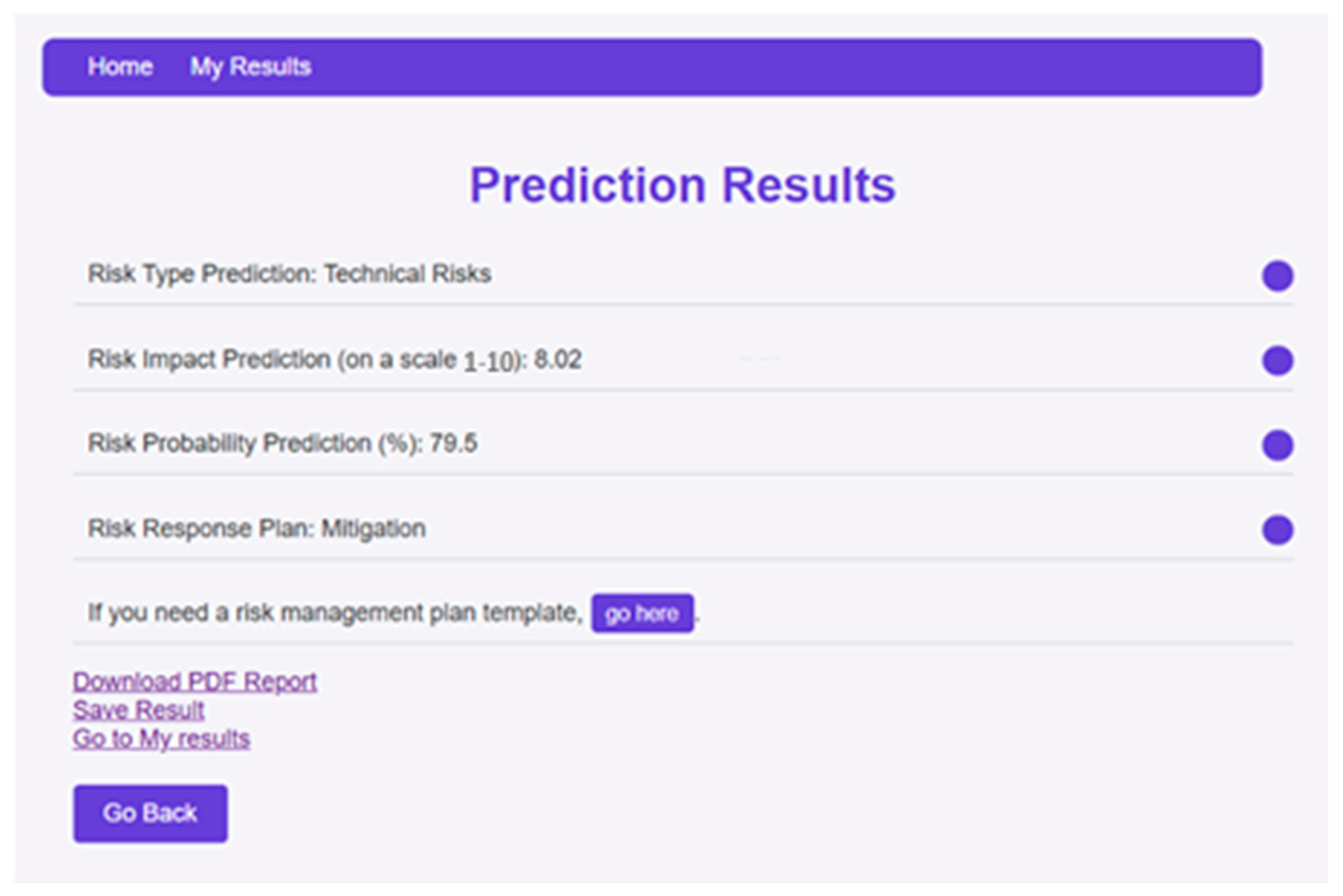
The system integrates: an ML inference module for predicting risk outputs, a user authentication component, a result storage engine via SQLAlchemy, an interactive prediction dashboard (see
Figure 2), automatic PDF reporting tools, and a downloadable risk management plan template. This project tool enables practitioners to enter project data, obtain predictions instantly, and maintain a repository of previous analyses.
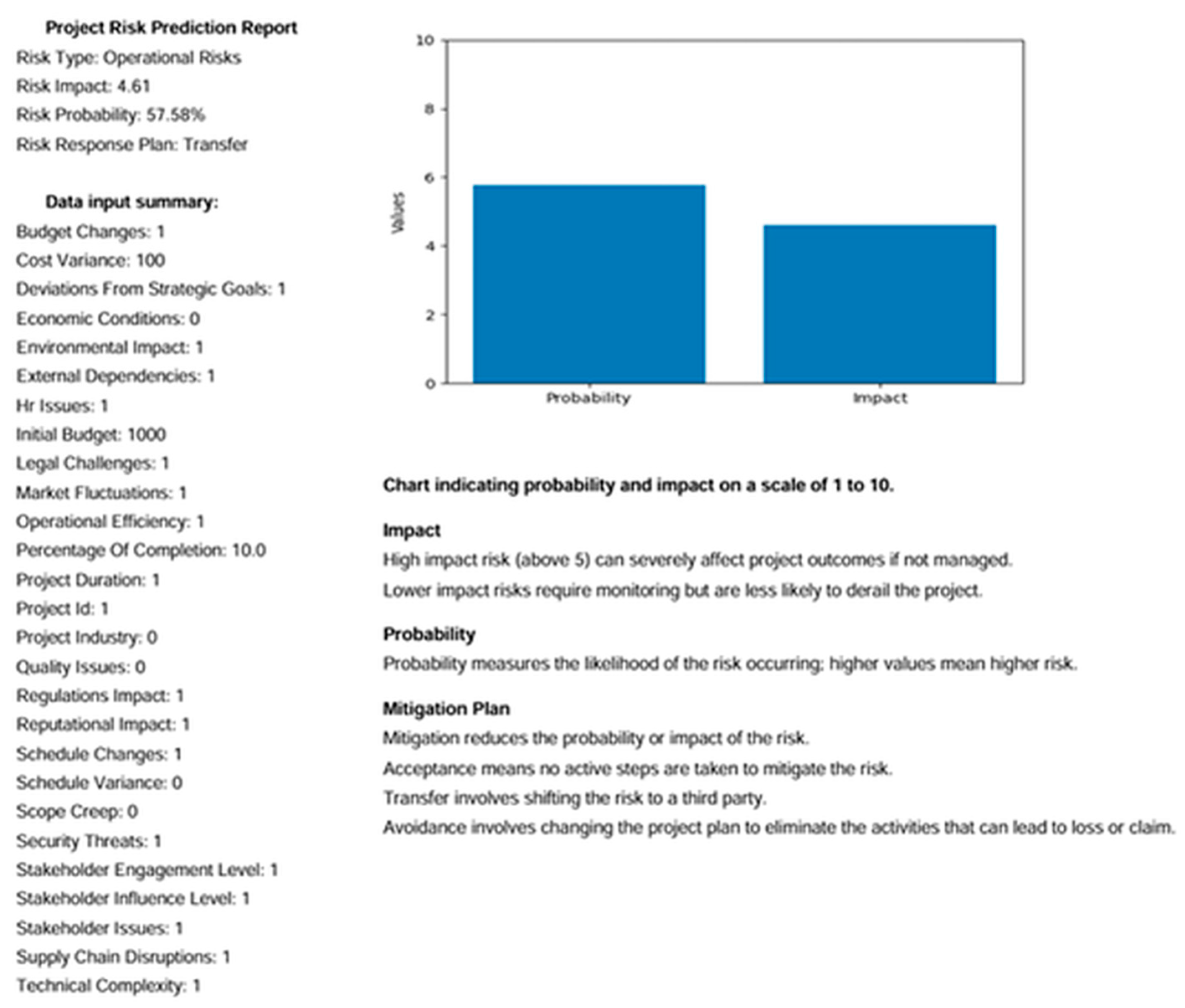
The download report functionality produces a PDF report including the latest prediction and input data. The report has a bar chart displaying the likelihood and impact values: see
Figure 3. If the session lacks any prediction or input data, the user will be automatically returned to the home page. Users can obtain a downloadable and shareable report of their prediction results using this method.
In addition, the user has access to a Risk Management Plan template that they can use to brainstorm potential risks and their impact, offering also thorough mitigation strategies for every risk. PMs will find great use for this template since it provides an organized and understandable approach to managing risks, guaranteeing that we are ready for any problems that may arise during the project, having a structured brainstorming document.
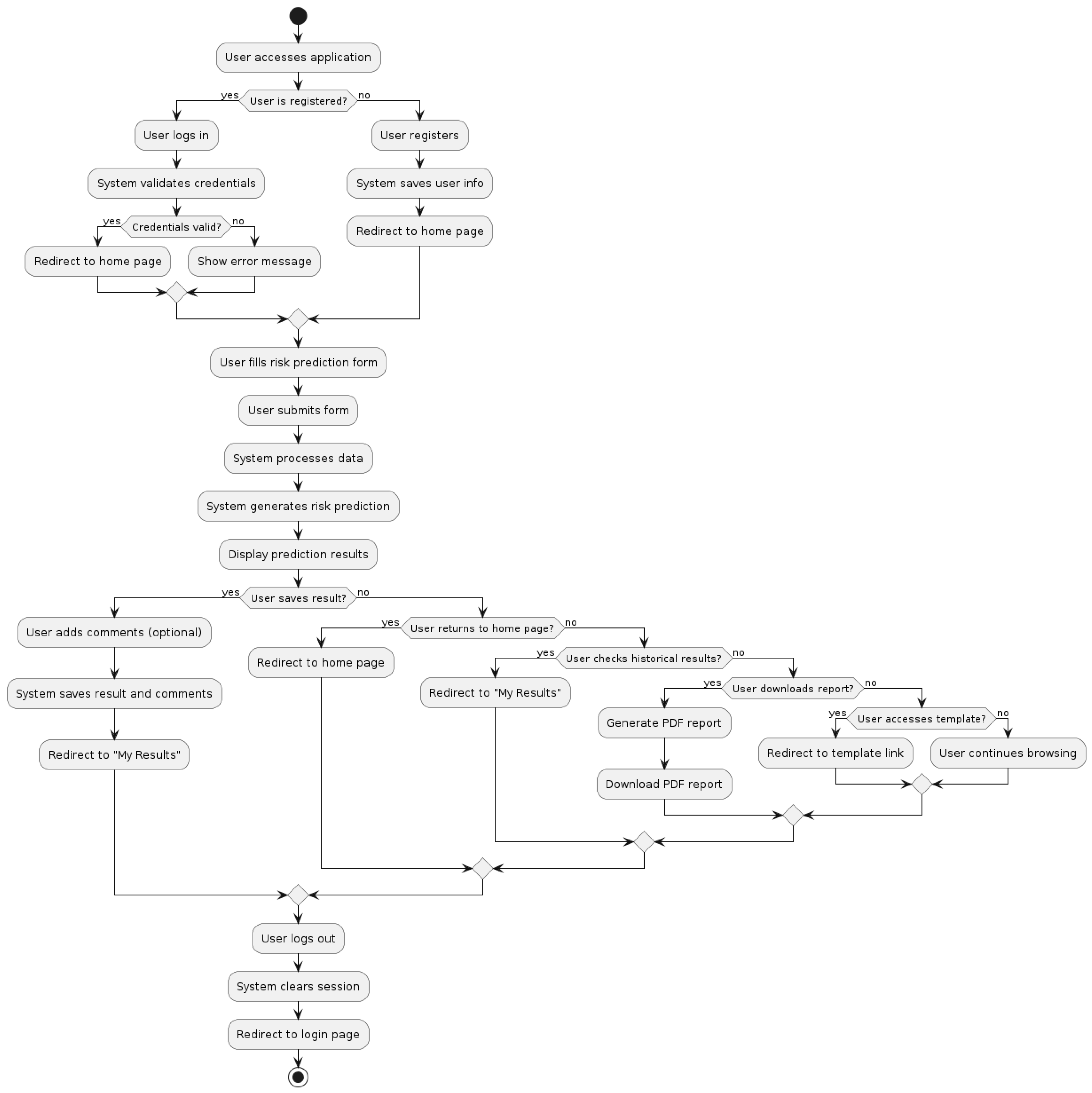
A complete activity diagram of the tool is available in
Figure 4.
The activity diagram outlines the end-to-end interaction flow within the risk-prediction web application. After accessing the system, the user either authenticates or registers, triggering the corresponding backend processes for credential validation and account creation. Once authenticated, the user submits a risk-prediction form, which the system processes through the application logic and connected machine-learning models. The generated prediction is presented to the user, who may optionally save the result, add comments, view historical records, or generate a downloadable PDF report. Conditional branches capture user decisions such as navigating back to the home page, accessing stored results, or downloading supplemental templates. The workflow concludes with the logout operation, during which the system terminates the session and redirects the user to the login interface. Overall, the diagram illustrates the orchestration of authentication, data processing, ML inference, storage operations, and session management within the application architecture.
4.6. Survey Feedback
We conducted a survey to gather opinions regarding the potential functionalities of the application: see
Appendix A Most responders are between the ages of 22 and 44, and include both genders, with a slight preference for females. Many participants hold a Bachelor’s degree, while others have a Master’s degree or have completed high school. Engineering, information technology, project management, and medical engineering are among the many areas of competence available. The respondents’ project management experience ranges from less than a year to more than ten years, with a notable concentration in the 1–3- and 4–6-year groupings. This diversified background provides a detailed picture of how many experts approach AI in risk management. The vast majority of respondents utilize project management software on a regular basis, with many claiming daily or weekly usage. This emphasizes the importance of digital technologies for efficient project management. However, a few respondents stated occasional or monthly use, implying that not all professionals rely extensively on these technologies.
The survey collected a total of N = 32 responses (convenience sampling), obtained by distributing the questionnaire to project management practitioners and graduate engineering students through academic mailing lists and professional networks. Participation was voluntary and anonymous. All Likert-scale items used a 5-point response format (1 = very low/very dissatisfied, 5 = very high/very satisfied), enabling descriptive statistical analysis of central tendencies and response distributions. A brief assessment of potential sampling bias was also performed: the dataset is slightly skewed toward early-career professionals and users with moderate PM tool experience, which may influence the perceived usefulness of AI-based functionalities. Nonetheless, the diverse expertise represented in the sample (engineering, IT, PM, business) provides valuable exploratory insights into user expectations for AI-enabled risk management tools.
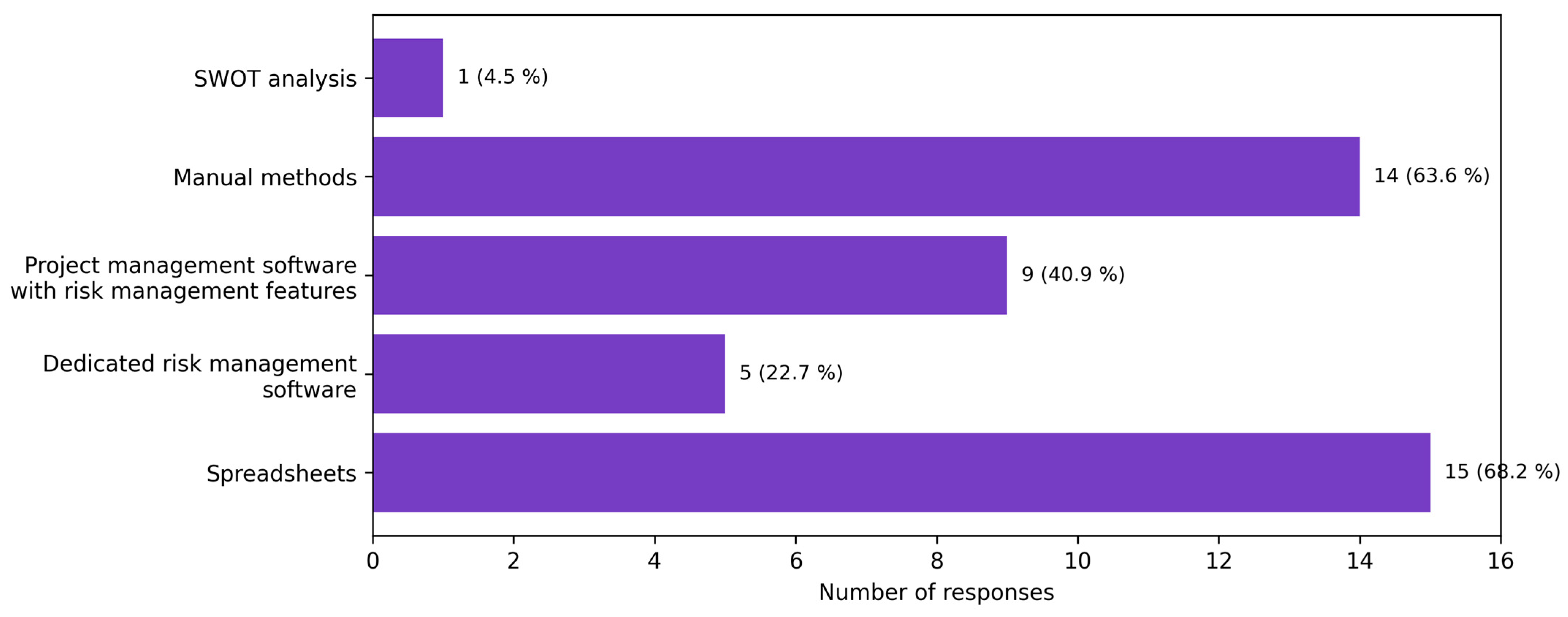
The majority of respondents believe risk management is important. Risk management is performed using a variety of tools, including spreadsheets, dedicated software, and manual approaches. Project management software with built-in risk management tools is also widely used, as presented in
Figure 5. Satisfaction with present risk management tools varies, with many respondents reporting moderate to high satisfaction, although some see potential for improvement.
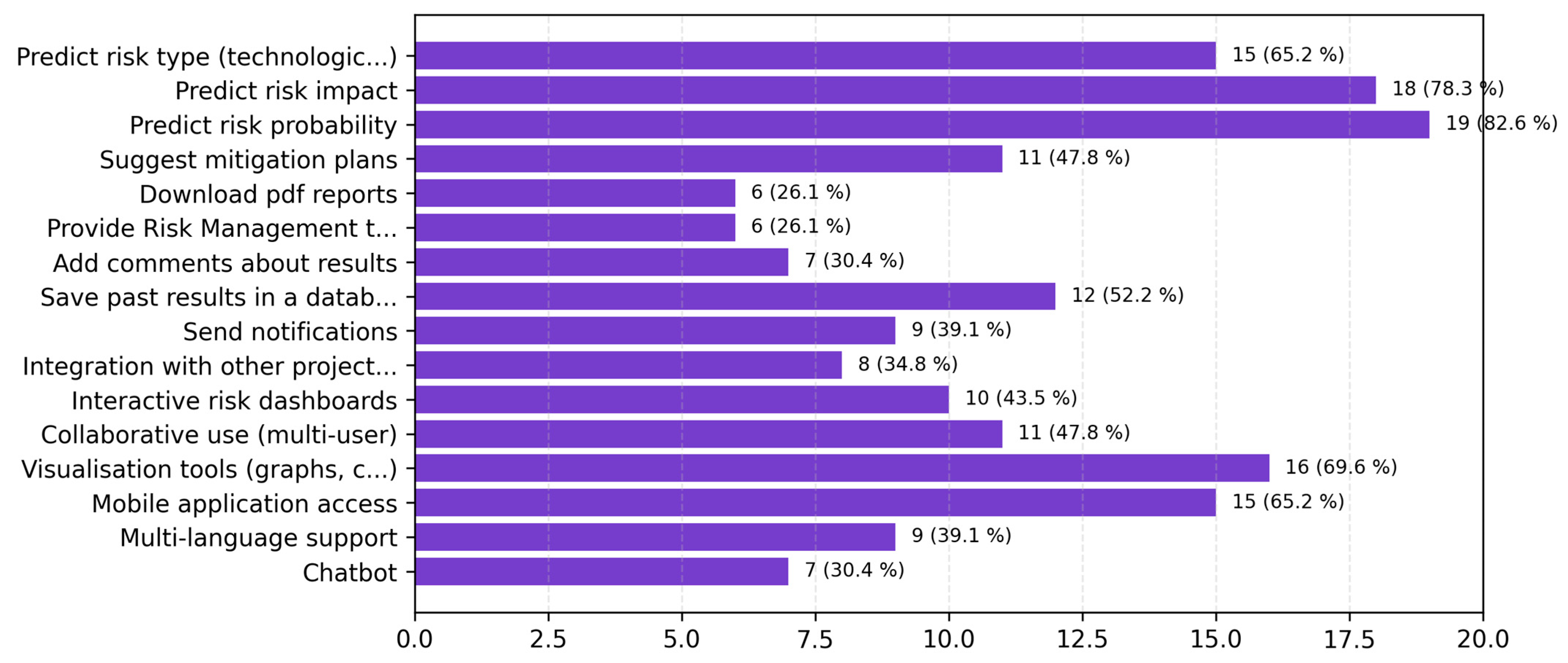
There is widespread agreement on the value of embedding AI predictions into risk management solutions. Most respondents feel that AI can considerably improve risk management by forecasting risk kinds, impacts, and probabilities. AI-based risk management apps should have capabilities that suggest mitigation methods, save previous results, issue notifications, and provide interactive dashboards. Respondents also stressed the importance of mobile accessibility, multilingual support, and collaborative tools. A few participants mentioned the possibility of AI chatbots to help with risk management: see
Figure 6.
Respondents provided good response, demonstrating a broad interest in AI-powered project management systems. They saw AI’s promise for providing more accurate risk assessments and facilitating improved decision-making. Some respondents mentioned a desire for improved visualization capabilities and integration with existing project management software, indicating a preference for seamless and user-friendly interfaces. This analysis emphasizes the need of building AI-based risk management tools that meet the unique needs of project managers from various areas. The collected input will be essential in developing the application and ensuring it meets user expectations effectively.
5. Discussions
The results demonstrate the feasibility of integrating multi-output ML models into an operational PM risk management tool. Theoretically, this work contributes to bridging a recognized gap between qualitative PM standards and quantitative, data-driven approaches to risk prediction. Unlike traditional risk registers or checklist-based assessments, the system models interdependencies between risk type, impact, probability, and response strategy, offering a more holistic representation of project uncertainty.
Practically, the deployed tool offers project teams immediate value through automated prediction, structured documentation, and visual reporting. Survey findings indicate strong practitioner interest in AI-assisted mitigation suggestions, dashboards, and notification systems. These insights provide guidance for enhancing AI-enabled PM environments.
Despite the near-perfect classification performance, results must be interpreted cautiously. The determinism of the synthetic dataset results in high internal consistency and artificially elevated accuracy. Therefore, the current findings validate the modelling pipeline rather than providing a real-world benchmark.
Several limitations should be acknowledged:
Synthetic determinism: The dataset encodes direct rules, limiting the model’s exposure to ambiguity, noise, or contradictory patterns typical in real projects. Because risk labels were generated using rule-based logic, the learning task becomes highly structured and presents little ambiguity. As a consequence, the near-perfect accuracy observed—especially in classification—is not indicative of real-world performance but reflects the internal consistency between the input features and the deterministic mapping rules.
Generalizability: High accuracy cannot be extrapolated to real-world settings without validation on industrial datasets.
Scope of risk factors: The feature set, while comprehensive, may omit domain-specific risks relevant to particular industries.
Lack of temporal data: Real project risks evolve over time, but the dataset does not include time-series characteristics.
Survey scale: Practitioner feedback, while insightful, is based on a modest sample size.
The next phase of this project will therefore involve (i) incorporating real project data from industrial partners, (ii) extending the dataset with stochastic noise to simulate uncertainty, and (iii) evaluating model behaviour under incomplete, noisy, or conflicting project information.
6. Conclusions
This study introduced an AI-based risk prediction tool that integrates supervised machine learning models with an intuitive, practitioner-oriented web platform to support modern project teams in proactive risk assessment. Using a synthetic dataset of 5000 project instances—generated through deterministic rule-based logic over 27 input variables—the system is capable of predicting four essential dimensions of project risk: type, impact, probability, and recommended response plan. The Random Forest model consistently outperformed the Decision Tree baseline, particularly on regression tasks; however, the deterministic nature of the dataset resulted in near-perfect classification accuracy for both models, indicating that the reported results validate the modelling pipeline rather than serving as real-world predictive benchmarks.
Beyond prediction capabilities, the integrative platform includes a suite of practical features such as interactive result visualization, automatic PDF reporting, user accounts, historical storage of analyses, and access to a structured Risk Management Plan template. Survey responses from practitioners further confirmed the tool’s relevance, highlighting the need for AI-supported mitigation suggestions, dynamic dashboards, notification systems, and seamless integration with existing project management workflows. These findings align with previous observations in the literature emphasizing the importance of digital tools and intelligent decision support in risk-intensive technological environments [
37,
38,
39].
Future work will focus on several key directions: (1) training and validating the models on anonymized real-world project datasets; (2) introducing controlled noise and probabilistic logic to better reflect uncertainty; (3) incorporating explainable AI (XAI) components to increase transparency of model recommendations; (4) integrating the system with enterprise project management ecosystems such as Jira and Microsoft Project; and (5) expanding the survey to a larger and more diverse professional population.
Overall, the results demonstrate that AI-enabled tools have strong potential to enhance project preparedness, strengthen decision-making processes, and support proactive risk management across a wide range of organizational contexts.