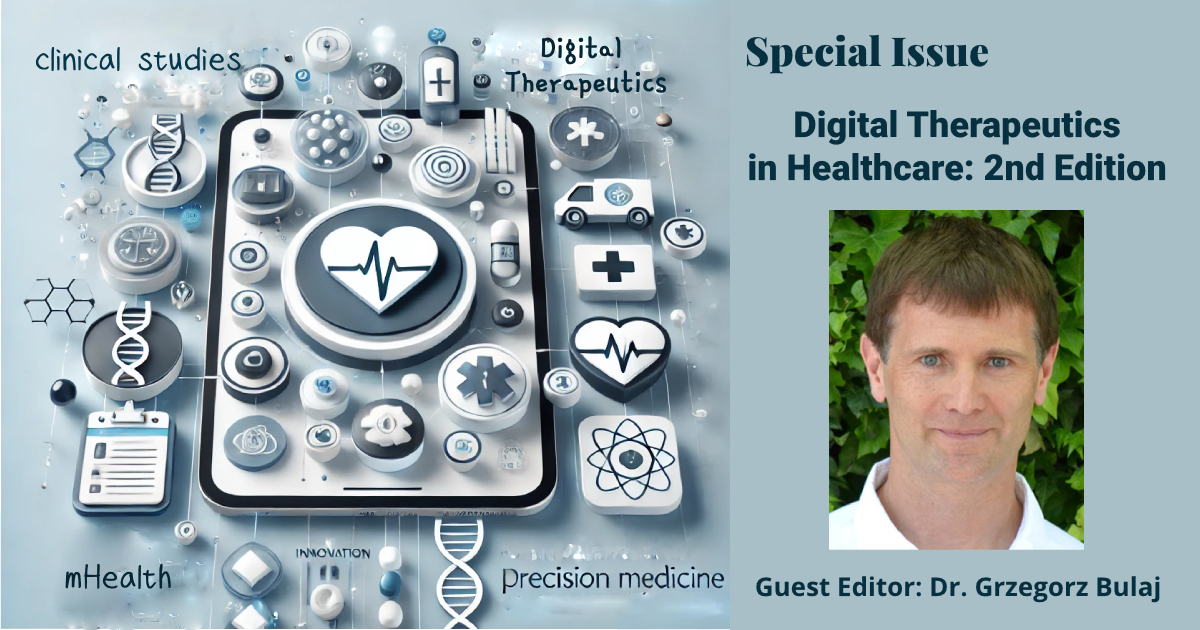



Digital Therapeutics in Healthcare: 2nd Edition

A special issue of Healthcare (ISSN 2227-9032).

Deadline for manuscript submissions: 29 October 2026 | Viewed by 4732

Editor


E-Mail Website
Guest Editor
Department of Medicinal Chemistry, Skaggs Pharmacy Institute, University of Utah, Salt Lake City, UT 84112, USA
Interests: digital health technologies; digital therapeutics; drug-digital combination therapies; mHealth; self-management; chronic diseases; pain; epilepsy; depression
Special Issues, Collections and Topics in MDPI journals

Special Issue Information

Dear Colleagues,

Digital transformation in healthcare has observed an emergence of digital therapeutics (DTx, mobile medical apps, software as medical devices) formulated to treat and prevent specific medical conditions. Due to the ability of DTx to deliver just-in-time, patient-centered therapeutic content, the integration of DTx with pharmacotherapies can advance precision medicine beyond genomics, epigenomics, and pharmacogenomics. The Food and Drug Administration has enabled the development of combination therapies comprising DTx and pharmaceutical drugs through the “prescription drug use-related software” regulatory pathway. A recent authorization of adjunctive DTx for major depressive disorder also illustrates a means to create drug–digital combination therapies.

Examples of challenges in the adoption of DTx in healthcare include attrition rates, digital health literacy, scalability, reimbursement, cybersecurity risks, and data governance. Research and clinical development of DTx are paralleled with advances in wearables for digital biomarkers and other digital health technologies. Studies on the clinical efficacy and cost effectiveness of digital therapies support the evidence-based implementation of DTx in healthcare systems.

A unique feature of DTx projects is their cross-disciplinary nature, spanning areas such as computer science and engineering, clinical development, healthcare, public health, cybersecurity, business, and regulatory affairs. This Special Issue welcomes articles covering diverse aspects of advancing DTx, from early development stages through to implementation into healthcare. Its goal is to provide a cross-disciplinary dialogue platform to share ideas and results related to DTx. We invite research articles, reviews, perspectives, and other types of articles describing the design, clinical evaluations (pilot studies and pivotal RCTs), cost effectiveness, implementation, business, and regulatory aspects of DTx.

Dr. Grzegorz Bulaj
Guest Editor

Manuscript Submission Information

Manuscripts should be submitted online at www.mdpi.com by registering and logging in to this website. Once you are registered, click here to go to the submission form. Manuscripts can be submitted until the deadline. All submissions that pass pre-check are peer-reviewed. Accepted papers will be published continuously in the journal (as soon as accepted) and will be listed together on the special issue website. Research articles, review articles as well as short communications are invited. For planned papers, a title and short abstract (about 250 words) can be sent to the Editorial Office for assessment.

Submitted manuscripts should not have been published previously, nor be under consideration for publication elsewhere (except conference proceedings papers). All manuscripts are thoroughly refereed through a single-anonymized peer-review process. A guide for authors and other relevant information for submission of manuscripts is available on the Instructions for Authors page. Healthcare is an international peer-reviewed open access semimonthly journal published by MDPI.

Please visit the Instructions for Authors page before submitting a manuscript. The Article Processing Charge (APC) for publication in this open access journal is 2700 CHF (Swiss Francs). Submitted papers should be well formatted and use good English. Authors may use MDPI's English editing service prior to publication or during author revisions.

Keywords

  • digital therapeutics
  • mHealth
  • clinical studies (pilot and pivotal)
  • effectiveness
  • healthcare
  • cost effectiveness
  • implementation and scalability
  • regulatory affairs
  • prescription drug use-related software
  • digital health literacy
  • reimbursement
  • cybersecurity risks and privacy

Benefits of Publishing in a Special Issue

  • Ease of navigation: Grouping papers by topic helps scholars navigate broad scope journals more efficiently.
  • Greater discoverability: Special Issues support the reach and impact of scientific research. Articles in Special Issues are more discoverable and cited more frequently.
  • Expansion of research network: Special Issues facilitate connections among authors, fostering scientific collaborations.
  • External promotion: Articles in Special Issues are often promoted through the journal's social media, increasing their visibility.
  • Reprint: MDPI Books provides the opportunity to republish successful Special Issues in book format, both online and in print.

Further information on MDPI's Special Issue policies can be found here.

Related Special Issue

Published Papers (2 papers)

Order results
Result details
Select all
Export citation of selected articles as:

Other

25 pages, 1992 KB  
Perspective
Metformin-Enhanced Digital Therapeutics for the Affordable Primary Prevention of Diabetes and Cardiovascular Diseases: Advancing Low-Cost Solutions for Lifestyle-Related Chronic Disorders
by Brian Farley, Emi Radetich, Joseph DAlessandro and Grzegorz Bulaj
Healthcare 2025, 13(24), 3220; https://doi.org/10.3390/healthcare13243220 - 9 Dec 2025
Cited by 2 | Viewed by 2842
Abstract
Each year, over 1 million people in the United States die from diabetes and cardiovascular diseases (CVDs). These largely preventable chronic conditions also create a financial burden on patients, payers, and healthcare systems. The popularity of GLP-1-based management of cardiometabolic conditions can escalate [...] Read more.
Each year, over 1 million people in the United States die from diabetes and cardiovascular diseases (CVDs). These largely preventable chronic conditions also create a financial burden on patients, payers, and healthcare systems. The popularity of GLP-1-based management of cardiometabolic conditions can escalate healthcare spending, while incentivizing digitization of semaglutide (Ozempic, Wegovy), tirzepatide (Mounjaro), and others using the “prescription drug use-related software” (PDURS) framework. In this article, we highlight opportunities to advance digital-first interventions and metformin-enhanced digital therapeutics (DTx) for the primary prevention of diabetes and CVDs. Metformin is a low-cost antidiabetic medication that is effective in preventing diabetes and cardiovascular adverse events. Concurrently, digital health technologies for managing chronic conditions, e.g., Dario Health, Omada Health, and WellDoc, enable digital-first and drug + digital combination therapies for prediabetes and those at risk for CVDs. We describe incentives for advancing Affordable Primary Prevention (APP), suggesting that nonprofit healthcare systems, such as Kaiser Permanente, Intermountain Health or Ascension Health, payers such as Cigna and Aetna/CVS Health, or private equity investors can leverage their venture funds to support development of metformin-enhanced DTx. In conclusion, (1) the PDURS framework can accelerate innovation of preventive medicine by bridging precision digital interventions with low-cost generic drugs, and (2) integrating healthy behaviors with pharmacotherapies is essential for the financially sustainable prevention of lifestyle-related chronic diseases. Full article
(This article belongs to the Special Issue Digital Therapeutics in Healthcare: 2nd Edition)
Show Figures

Figure 1

27 pages, 1268 KB  
Systematic Review
Evaluating the Impact of Regulatory Guidelines on Market Adoption and Implementation of Telehealth for COPD Patients: A Systematic Literature Review
by Noha Saeed Alghamdi, Nora Ann Colton and Paul Taylor
Healthcare 2025, 13(22), 2858; https://doi.org/10.3390/healthcare13222858 - 11 Nov 2025
Cited by 3 | Viewed by 1012
Abstract
Purpose: Telehealth (TH) offers promising solutions for enhancing the management of chronic obstructive pulmonary disease (COPD), particularly in resource-limited or remote settings. However, regulatory uncertainty remains a significant barrier to adopting and integrating TH technologies into routine care. This systematic review aims to [...] Read more.
Purpose: Telehealth (TH) offers promising solutions for enhancing the management of chronic obstructive pulmonary disease (COPD), particularly in resource-limited or remote settings. However, regulatory uncertainty remains a significant barrier to adopting and integrating TH technologies into routine care. This systematic review aims to evaluate the role of regulatory guidelines in implementing and adopting TH solutions for COPD care and to identify key barriers and facilitators shaping these regulatory efforts. Methods: Following PRISMA guidelines, a comprehensive search of five databases up to 18 October 2025 (PubMed, Web of Science, Scopus, CINAHL, and JSTOR) and grey literature was conducted. Studies and governmental reports were included if they examined regulatory frameworks, stakeholder perspectives, or implementation challenges related to TH in COPD care. Study quality was assessed using the Critical Appraisal Skills Programme (CASP) tool. Narrative and data synthesis were employed. Results: From 343 identified records, 33 sources (18 peer-reviewed studies and 15 governmental/organizational reports) met the inclusion criteria. Findings revealed wide disparities in the existence, specificity, and enforcement of TH regulatory guidelines across countries. Developed nations often had more structured yet nonspecific frameworks, while emerging health systems, such as Saudi Arabia, exhibited fragmented but evolving regulatory landscapes. Common barriers included unclear stakeholder roles, inadequate funding, technological limitations, and resistance to organizational change. Conclusions: Clear, inclusive, and context-sensitive regulatory guidelines are essential to support the successful integration of TH in COPD care. Enhanced regulatory clarity can improve patient trust, engagement, and adherence by addressing safety, accountability, and accessibility concerns. Future research should focus on stakeholder-informed policies that reflect the practical realities of healthcare delivery in both developed and emerging systems. Full article
(This article belongs to the Special Issue Digital Therapeutics in Healthcare: 2nd Edition)
Show Figures

Figure 1

Back to TopTop