

- Article

Effect of Temperature on the Glass Delamination in End-of-Life of Crystalline Silicon Photovoltaic Panels
- Soroush Khakpour,
- Francesco Nocera and
- Lorena Saitta
- + 2 authors
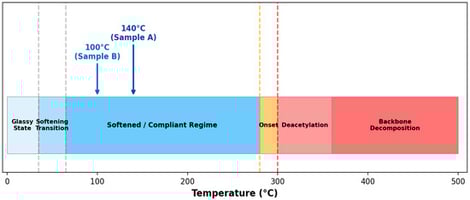
In this study, the effect of temperature on thermal-assisted glass delamination was investigated using two treatment conditions differing in the set temperature of the process (100 °C vs. 140 °C). Thermogravimetric Analysis (TGA) confirmed that ethylene-vinyl acetate (EVA) remains thermally stable up to about 280 °C, with degradation onset near 300 °C, ensuring that both treatments operate below decomposition. Differential Scanning Calorimetry (DSC) analysis identified an endothermic transition attributable to the melting of crystalline regions in EVA within the thermal range of 35–65 °C, indicating enhanced polymer chain mobility at elevated temperatures. This endothermic transition corresponds to the melting of polyethylene crystallites within the EVA copolymer and should not be interpreted as a glass transition, since the Tg of EVA is typically located at approximately −30 to −35 °C. Fourier Transform Infrared (FTIR) analysis verified preservation of ester functional groups, confirming the absence of chemical degradation. The morphological analysis performed via Scanning Electron Microscopy (SEM) revealed a clear temperature-dependent morphology of EVA after thermal-assisted delamination. At 140 °C, enhanced polymer softening and viscous flow led to smoother surfaces and more uniform interfacial separation, whereas at 100 °C, limited mobility resulted in heterogeneous, fragmented residues and predominantly cohesive failure. These results highlight that optimizing temperature is key to balancing effective delamination with residue minimization, supporting more sustainable PV recycling.
1 April 2026