

Journal Menu
► ▼ Journal Menu-
- Fermentation Home
- Aims & Scope
- Editorial Board
- Topical Advisory Panel
- Early Career Editorial Board
- Instructions for Authors
- Special Issues
- Topics
- Sections & Collections
- Article Processing Charge
- Indexing & Archiving
- Editor’s Choice Articles
- Most Cited & Viewed
- Journal Statistics
- Journal History
- Journal Awards
- Editorial Office
Journal Browser
► ▼ Journal BrowserNeed Help?
Announcements
10 June 2026
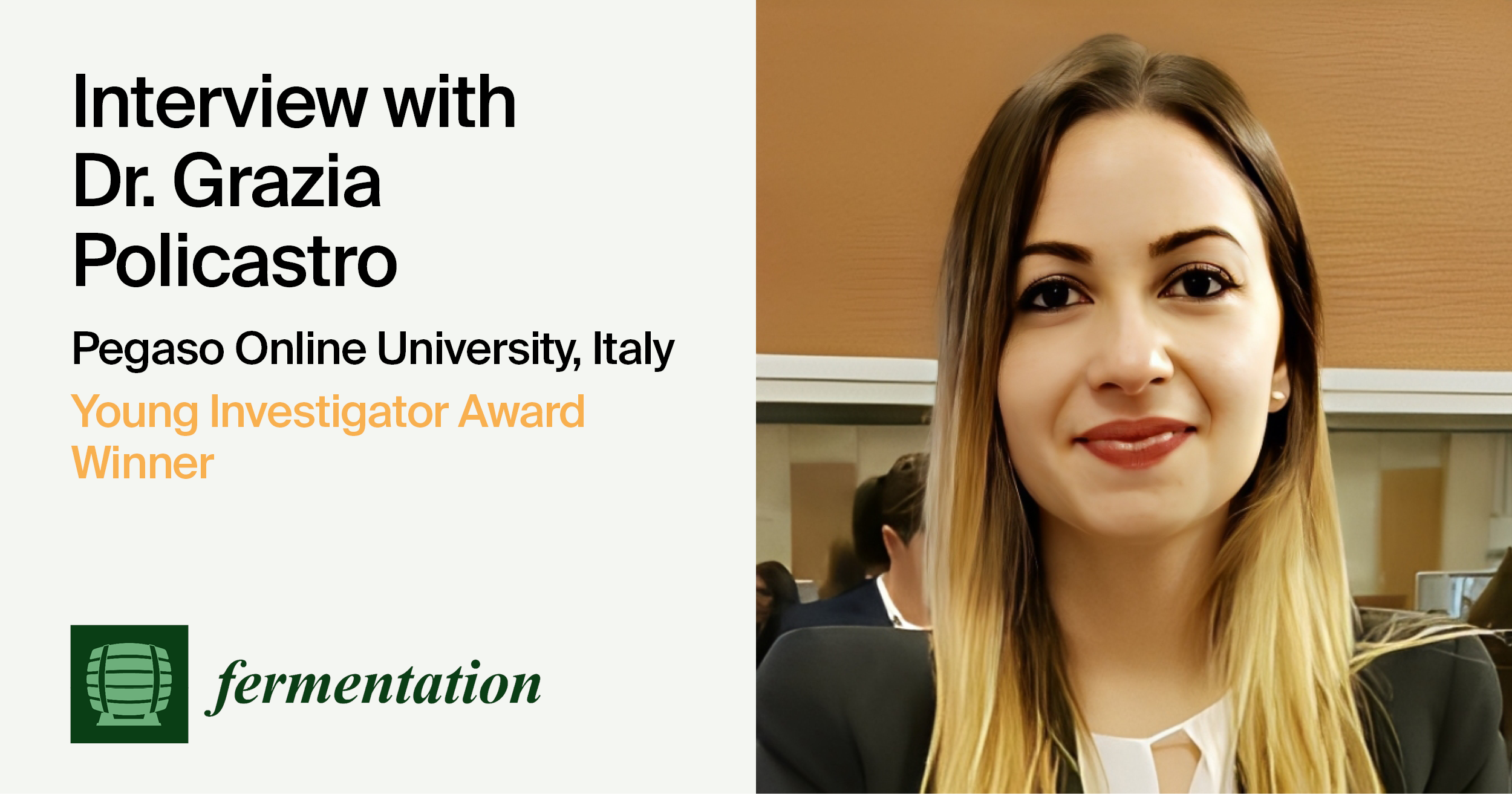
Interview with Dr. Grazia Policastro—Winner of the Fermentation Young Investigator Award
1. Could you briefly introduce yourself and share your current research focus?
I graduated in environmental engineering from the University of Naples Federico II, where I also completed my PhD on resource recovery from waste through fermentation-based biorefinery processes. During my PhD, I was a visiting researcher at Delft University of Technology, where I further developed my expertise in environmental biotechnology and resource recovery. Currently, I am an Assistant Professor of sanitary and environmental engineering at Pegaso University. My research focuses on developing sustainable biotechnological processes for converting waste and wastewater into valuable resources. I am also interested in Life Cycle Assessment (LCA) as a tool to evaluate the environmental sustainability of emerging technologies. My goal is to contribute to the transition toward more sustainable and resource-efficient environmental systems.
2. Could you please share the most impressive breakthrough in your research career, either in terms of ideas or research results?
One of the most significant achievements of my research has been improving our understanding of how mixed microbial communities can be shaped to convert waste streams into specific target products, such as biohydrogen, biopolymers, and other valuable biochemicals. Biological processes already exist in nature, but the real challenge is understanding how to steer them toward a desired outcome. Together with my PhD supervisor and colleagues, I have worked on identifying the operational conditions that select for specific microbial populations and drive metabolic pathways toward the production of desired compounds. We have developed strategies for microbial community selection and enrichment that enhance process performance and product yields. What has surprised me most is that, despite their complexity and unpredictability, mixed microbial communities can often be guided toward producing the desired products through the careful design of process conditions. Seeing a complex natural ecosystem respond in the way we hypothesized has been one of the most rewarding aspects of my research.
3. What motivated you to pursue a career in academia?
The moment I realized I wanted to pursue a research career was during my experimental master's thesis. I still clearly remember thinking that I would love to do that for the rest of my life. I had always been a curious person and enjoyed learning new things, but conducting research firsthand was a completely different experience. What fascinated me most was the opportunity to explore questions whose answers were still unknown and the possibility of being the first person to observe or notice something new. Equally important were the people I met at the beginning of this journey. My supervisor and colleagues played a fundamental role in encouraging me to pursue a research career. Working with people who shared the same curiosity, enthusiasm, and desire to understand how things work made me realize that academia was the right path for me.
4. What challenges have you encountered in your work, and how did you overcome them?
One of the biggest challenges in research is learning to deal with setbacks and uncertainty. In academia, things do not always go as planned. These situations can be discouraging, especially at the beginning of a career. Over the years, I have learned the importance of being patient and persistent. Not every effort leads to immediate success, and sometimes progress takes longer than expected. I have learned not to get discouraged by difficulties but to see them as opportunities for growth and learning. Every challenge has helped me become more resilient.
5. Could you share your experiences of collaborating with Fermentation?
My experience with Fermentation has been very positive. I have contributed to the journal both as an author and as a Guest Editor, which allowed me to appreciate different aspects of the publication process. One aspect that I particularly value is its open-access model. I strongly believe that scientific knowledge should be freely accessible to everyone, regardless of institutional or economic barriers. Participating in the Fermentation Young Investigator Award was also a very positive and meaningful experience. I was surprised and honored to realize that experts from different countries and scientific backgrounds considered my research worthy of this recognition. For me, this award represents not only a personal achievement but also an encouragement to continue pursuing research in this field with enthusiasm and dedication.
6. In your view, what are the most promising directions in your research that you are excited about?
I find the development of integrated biorefinery concepts particularly promising, where waste and wastewater are not used to produce a single product but are valorized through interconnected processes that maximize resource recovery. I believe this approach has the potential to support the transition toward a more circular and sustainable economy. I am also particularly excited about the possibility of scaling up the processes that we have studied and optimized at a laboratory scale. Moving from lab-scale experiments to pilot-scale applications is both a scientific and engineering challenge, but it is also a necessary step toward real-world implementation. We are starting to move in this direction, with the recent submission of a patent application on integrated biorefinery systems. I look forward to testing these technologies under more realistic conditions and exploring their potential for practical application.
7. What advice would you give to early career researchers or young scientists who are just starting their academic journey?
My advice to early career researchers is to follow their curiosity, as it is one of the main driving forces in research. I would also encourage them to learn from the people around them. Research is rarely an individual effort, and some of the most valuable lessons come from interacting with colleagues, mentors, and collaborators with different expertise and perspectives. Being open to new ideas and willing to learn from others can greatly enrich both your scientific knowledge and your professional growth. I would also encourage them to be patient. Research can be demanding and things do not always go as planned. However, it is also incredibly rewarding. The satisfaction that comes from reaching a milestone, as well as the experiences that this career can offer, is truly priceless. Finally, I would encourage young researchers to keep an open mind about their future. In some academic systems, pursuing an academic career can be challenging, and career trajectories do not always develop as one might initially expect. Sometimes, leaving is a consequence of structural limitations and not a personal failure. On the other hand, the skills developed through research are valuable in many different contexts. Research teaches you how to think beyond established boundaries. Regardless of the path they ultimately choose, young researchers should recognize that this experience will enrich them both professionally and personally.
8. Do you have any suggestions or advice for our journal?
I particularly appreciate the commitment to supporting early career researchers and promoting collaboration among scientists from different disciplines. Indeed, many of today’s challenges require integrated and multidisciplinary approaches. One possible suggestion would be to consider introducing a junior editor program, where early career researchers could work alongside experienced editors and learn more about the editorial and peer-review process. I believe this could be a valuable opportunity for young scientists to develop new skills, gain insight into scientific publishing, and become more actively involved in the research community while benefiting from the guidance and mentorship of senior editors.
