




Journal Menu
► ▼ Journal Menu-
- Entropy Home
- Aims & Scope
- Editorial Board
- Reviewer Board
- Topical Advisory Panel
- Video Exhibition
- Instructions for Authors
- Special Issues
- Topics
- Sections & Collections
- Article Processing Charge
- Indexing & Archiving
- Editor’s Choice Articles
- Most Cited & Viewed
- Journal Statistics
- Journal History
- Journal Awards
- Society Collaborations
- Conferences
- Editorial Office
Journal Browser
► ▼ Journal Browser-
arrow_forward_ios
Forthcoming issue
arrow_forward_ios Current issue - Vol. 28 (2026)
- Vol. 27 (2025)
- Vol. 26 (2024)
- Vol. 25 (2023)
- Vol. 24 (2022)
- Vol. 23 (2021)
- Vol. 22 (2020)
- Vol. 21 (2019)
- Vol. 20 (2018)
- Vol. 19 (2017)
- Vol. 18 (2016)
- Vol. 17 (2015)
- Vol. 16 (2014)
- Vol. 15 (2013)
- Vol. 14 (2012)
- Vol. 13 (2011)
- Vol. 12 (2010)
- Vol. 11 (2009)
- Vol. 10 (2008)
- Vol. 9 (2007)
- Vol. 8 (2006)
- Vol. 7 (2005)
- Vol. 6 (2004)
- Vol. 5 (2003)
- Vol. 4 (2002)
- Vol. 3 (2001)
- Vol. 2 (2000)
- Vol. 1 (1999)
Need Help?
Announcements
27 April 2026
Meet Us at the 31st Australasian Conference on Information Security and Privacy (ACISP 2026), 6–9 July 2026, Perth, Australia

MDPI will attend the 31st Australasian Conference on Information Security and Privacy as an exhibitor. This meeting will be held in Perth, Australia, from 6 to 9 July 2026.
ACISP 2026 will take place in the beautiful and historic city of Perth, and will offer a unique opportunity to connect, learn, and shape the future of our field. It will be organized by the University of Western Australia (UWA) and Edith Cowan University (ECU). The conference’s topics of interest include, but are not limited to, the following:
- Information;
- Blockchains;
- Future Internet;
- Algorithms;
- Computers;
- Cryptography;
- Entropy;
- JCP;
- MAKE;
- Network;
- Software.
If you are attending this conference, please feel free to start an online conversation with us. Our delegates look forward to meeting you in person at our booth and answering any questions you may have. For more information about the conference, please visit the following website: https://acisp.org/.
24 April 2026
Entropy | Selected Papers on Non-Equilibrium Thermodynamics

We are pleased to highlight ten notable papers on non-equilibrium thermodynamics published in Entropy (ISSN: 1099-4300) in 2024 and 2025. We invite you to explore these contributions, which reflect recent advances and emerging directions in non-equilibrium thermodynamics.
1. “Fluctuation Theorems for Heat Exchanges between Passive and Active Baths”
by Massimiliano Semeraro, Antonio Suma and Giuseppe Negro
Entropy 2024, 26(6), 439; https://doi.org/10.3390/e26060439
Available online: https://www.mdpi.com/1099-4300/26/6/439
2. “Fluctuation Relation for the Dissipative Flux: The Role of Dynamics, Correlations and Heat Baths”
by Xubin Lin Lamberto Rondoni and Hong Zhao
Entropy 2024, 26(2), 156; https://doi.org/10.3390/e26020156
Available online: https://www.mdpi.com/1099-4300/26/2/156
3. “Not All Fluctuations Are Created Equal: Spontaneous Variations in Thermodynamic Function”
by James P. Crutchfield and Cina Aghamohammadi
Entropy 2024, 26(11), 894; https://doi.org/10.3390/e26110894
Available online: https://www.mdpi.com/1099-4300/26/11/894
4. “Restoring the Fluctuation–Dissipation Theorem in Kardar–Parisi–Zhang Universality Class through a New Emergent Fractal Dimension”
by Márcio S. Gomes-Filho, Pablo de Castro, Danilo B. Liarte and Fernando A. Oliveira
Entropy 2024, 26(3), 260; https://doi.org/10.3390/e26030260
Available online: https://www.mdpi.com/1099-4300/26/3/260
5. “Stochastic Entropy Production for Classical and Quantum Dynamical Systems with Restricted Diffusion”
by Jonathan Dexter and Ian J. Ford
Entropy 2025, 27(4), 383; https://doi.org/10.3390/e27040383
Available online: https://www.mdpi.com/1099-4300/27/4/383
6. “Entropy Production in a System of Janus Particles”
by Andrés Arango-Restrepo, Juan David Torrenegra-Rico and J. Miguel Rubi
Entropy 2025, 27(2), 112; https://doi.org/10.3390/e27020112
Available online: https://www.mdpi.com/1099-4300/27/2/112
7. “Methods to Calculate Entropy Generation”
by Jude A. Osara and Michael D. Bryant
Entropy 2024, 26(3), 237; https://doi.org/10.3390/e26030237
Available online: https://www.mdpi.com/1099-4300/26/3/237
8. “Thermodynamic Insights into Symmetry Breaking: Exploring Energy Dissipation across Diverse Scales”
by Andrés Arango-Restrepo and J. Miguel Rubi
Entropy 2024, 26(3), 231; https://doi.org/10.3390/e26030231
Available online: https://www.mdpi.com/1099-4300/26/3/231
9. “Local Equilibrium Approximation in Non-Equilibrium Thermodynamics of Diffusion”
by Kim R. Kristiansen and Bjørn Hafskjold
Entropy 2025, 27(4), 400; https://doi.org/10.3390/e27040400
Available online: https://www.mdpi.com/1099-4300/27/4/400
by Tatsuaki Wada and Antonio Maria Scarfone
Entropy 2025, 27(7), 710; https://doi.org/10.3390/e27070710
Available online: https://www.mdpi.com/1099-4300/27/7/710
24 April 2026
Prof. Dr. William Gerwick Appointed Chair of the 2026 Tu Youyou Award Committee
We are honored to announce that Prof. Dr. William Gerwick will serve as the Chair of the 2026 Tu Youyou Award Committee.
A world-renowned authority in marine natural products chemistry and pharmacology, Professor Gerwick is a Distinguished Professor at both the Scripps Institution of Oceanography and the Skaggs School of Pharmacy and Pharmaceutical Sciences at the University of California San Diego (UCSD). His pioneering work at the intersection of ocean sciences and drug discovery makes him a fitting leader for an award centered on transformative medicinal breakthroughs.
Under Professor Gerwick’s stewardship, the 2026 Tu Youyou Award Committee will focus on recognizing innovative and impactful research in natural products chemistry and medicinal chemistry, particularly work with the potential to drive meaningful advances in both scientific understanding and human health.
To provide further insight into his perspectives, we include below an interview with Professor Gerwick, in which he reflects on his scientific journey, his views on the field, and his vision for the Tu Youyou Award.
A Conversation with the Chair

1. Could you please introduce yourself and your research journey?
My research focuses on the natural products of marine algae and cyanobacteria, their application in medicine, their biosynthesis using genomic approaches, and innovative methods in the structure elucidation of natural products.
I received my BS degree from the University of California at Davis, my PhD from the University of California at San Diego, and conducted postdoctoral work at the University of Connecticut. After a couple of years in a junior faculty position at the Department of Chemistry at the University of Puerto Rico, I spent 21 years as Professor of Pharmacy at Oregon State University. In 2005, I returned to my PhD institution at the Scripps Institution of Oceanography and the Skaggs School of Pharmacy and Pharmaceutical Sciences at UC San Diego, where I am currently a Distinguished Professor of Oceanography and Pharmaceutical Sciences.
Throughout my career, I have been dedicated to advancing the field through both leadership and mentorship. I have served as president of the American Society of Pharmacognosy, chaired and co-chaired several major research conferences, and served as an associate editor for the Journal of Natural Products. I am a Fellow of the American Association for the Advancement of Science (AAAS) and of the American Society of Pharmacognosy. I have trained over 100 doctoral and postdoctoral students, and my research group has published nearly 500 papers and more than 25 patents on topics in the natural product sciences and medicinal chemistry.
2. What motivated you to accept the role of Chair of the 2026 Tu Youyou Award Committee?
Of course, I am a huge supporter of all awards that are given in recognition of excellent scientific research, and especially so in the natural products sciences and medicinal chemistry. However, this award is truly special in that it recognizes scientific excellence as well as impact, and is given in the name of an individual, Tu Youyou, who clearly had many challenges along the path to reach the pinnacle of her success. Not only was she the first Chinese person to win a Nobel prize in this area, but she was also the first Chinese woman to receive a Nobel prize, and this was achieved without graduate education in China or elsewhere. It’s a true testament to what can be achieved by hard work, determination, and vision. To read the history of her extraordinary approach to discovering novel antimalarial compounds from Traditional Chinese Medicine is truly inspirational. It is, therefore, the inspiration provided by the extraordinary life and career of Tu Youyou that motivated me to accept the Chair of the Award Committee for 2026.
3. How do you view the role of natural products chemistry and medicinal chemistry in today’s scientific landscape, and what major advances over the past decade have shaped this field?
A quite remarkable integration of fields is currently transforming natural products science and medicinal chemistry. In natural products, we are seeing integration of different omics methods, from metabolites to proteins to nucleic acids. Sophisticated biological and pharmacological approaches are driving the discovery of exquisitely potent and selective natural products. Advances are being made to integrate molecular-level recognition of natural products with chemical ecological studies, and sophisticated methods of structure determination using Artificial Intelligence or pioneering new tools such as microED are being applied with increasing frequency. High-level synthetic methodologies, such as protecting group-free synthetic routes, are enhancing medicinal chemistry, accelerating the identification of lead molecules with attractive pharmaceutical properties at an increasing pace.
4. How do you consider the balance between fundamental discovery (e.g., new molecules or mechanisms) and practical impact (e.g., therapeutic applications)?
Many individuals are excellent scientists and mentors, and have essential roles in developing our culture that values science and the scientific method. It should also be pointed out that not all scientific discoveries are going to have a broad societal impact, but they are nevertheless critical to the overall body and structure of science. But it is a truly remarkable individual who makes a key scientific discovery, recognizes its potential value to society in general, and then has the skills and determination to bring it forward as a useful product. That was the type of person the Tu Youyou is, and that is the type of person who is honored by the prize in her name.
5. What do you see as the key challenges or opportunities currently facing the field?
We are on the crux of an amazing revolution in many of the sciences, including natural products and medicinal chemistry; the purposeful application of Artificial Intelligence to solving many of the difficulties involved in the search for new pharmaceuticals from Nature. AI is transforming how we select organisms for study, what pharmaceutical targets to go after, rapidly resolving the chemical structures of new compounds, identifying efficient routes to their chemical synthesis, understanding their molecular mechanisms of action, and finally, designing their clinical application. The role of people in these pursuits is changing. Increasingly, the human role will be providing overall vision: what can we do? What should we do? And it is important to remember that AI is providing hypotheses, not truth. Scientists with expert domain knowledge will be critical for discerning the correctness of hypotheses put forth by AI. Altogether, advances in technology, expanding knowledge, and the appropriate use of AI methods are preparing society to be able to address emerging diseases, such as pandemics, as well as conditions that are not effectively treated by currently existing therapeutics.
6. How do you expect the Tu Youyou Award to contribute to the advancement of natural product chemistry, medicinal chemistry, and human health over the coming years?
The Tu Youyou Award is potentially transformative for the broad fields of natural products science and medicinal chemistry as it brings a significantly increased level of visibility to these topics and their contributions to human health. It will be crucial to have excellent communication to news agencies, social media and other communication outlets so that the general public is informed and educated on the high impact of these natural product/medicinal chemistry contributions. This will bring increased funding, attract promising students, and generally enrich the interface of these fields with the health sector.
7. What message would you like to convey to the research community and the public during this open nomination phase?
This prize gives broad societal visibility to the role that natural products have had in shaping a majority of our current medicines, as well as understanding the life forms with whom we share the planet. Further, it recognizes a woman scientist working under sub-optimal conditions who could persevere and make discoveries of global impact. The prize and what it represents, therefore, inspires current and future generations to engage in the study of Nature and its relationship to Human Health, to overcome adversity, and to aspire to making one’s life impactful.
About the Tu Youyou Award
Established in 2016, the Tu Youyou Award seeks to honor those who excel in the fields of natural products chemistry and medicinal chemistry. This award offers a total prize of CHF 100,000, which will be equally divided among the winners if there is more than one, with each recipient receiving an award medal and a certificate.
The 2026 Tu Youyou Award is open for nominations until 31 October 2026. We encourage all eligible candidates to participate in this prestigious recognition, as this award not only honors individual achievement but also encourages further scientific exchange, exploration and discovery in critical areas of medicine.
If you are interested in participating, please visit the Tu Youyou Award website for more information on the nomination requirements.
20 April 2026
Entropy | Issue Cover Articles Published in 2025

The articles presented below were chosen by the Editorial Office of Entropy (ISSN: 1099-4300) as cover papers for Issues 1–12 of Volume 27. They cover a range of topics within the journal’s scope and are intended to offer valuable insights and useful references for researchers working in related areas.
1. “Kinetic Theory with Casimir Invariants—Toward Understanding of Self-Organization by Topological Constraints”
by Zensho Yoshida
Entropy 2025, 27(1), 5; https://doi.org/10.3390/e27010005
Available online: https://www.mdpi.com/1099-4300/27/1/5
2. “Thermodynamics-like Formalism for Immiscible and Incompressible Two-Phase Flow in Porous Media”
by Alex Hansen and Santanu Sinha
Entropy 2025, 27(2), 121; https://doi.org/10.3390/e27020121
Available online: https://www.mdpi.com/1099-4300/27/2/121
3. “Adsorption Kinetics Model of Hydrogen on Graphite”
by Jean-Marc Simon and Guilherme Carneiro Queiroz da Silva
Entropy 2025, 27(3), 229; https://doi.org/10.3390/e27030229
Available online: https://www.mdpi.com/1099-4300/27/3/229
4. “An Informational–Entropic Approach to Exoplanet Characterization”
by Sara Vannah, Ian D. Stiehl and Marcelo Gleiser
Entropy 2025, 27(4), 385; https://doi.org/10.3390/e27040385
Available online: https://www.mdpi.com/1099-4300/27/4/385
5. “Kolmogorov Capacity with Overlap”
by Anshuka Rangi and Massimo Franceschetti
Entropy 2025, 27(5), 472; https://doi.org/10.3390/e27050472
Available online: https://www.mdpi.com/1099-4300/27/5/472
6. “Quantum Mpemba Effect from Non-Normal Dynamics”
by Stefano Longhi
Entropy 2025, 27(6), 581; https://doi.org/10.3390/e27060581
Available online: https://www.mdpi.com/1099-4300/27/6/581
7. “Including Quantum Effects in Molecular Simulations Using the Feynman–Kleinert Linearized Path Integral Method”
by Jens Aage Poulsen and Gunnar Nyman
Entropy 2025, 27(7), 702; https://doi.org/10.3390/e27070702
Available online: https://www.mdpi.com/1099-4300/27/7/702
8. “A Formal Definition of Scale-Dependent Complexity and the Multi-Scale Law of Requisite Variety”
by Alexander F. Siegenfeld and Yaneer Bar-Yam
Entropy 2025, 27(8), 835; https://doi.org/10.3390/e27080835
Available online: https://www.mdpi.com/1099-4300/27/8/835
9. “Entropy, Fidelity, and Entanglement During Digitized Adiabatic Quantum Computing to Form a Greenberger–Horne–Zeilinger (GHZ) State”
by Nathan D. Jansen and Katharine L. C. Hunt
Entropy 2025, 27(9), 891; https://doi.org/10.3390/e27090891
Available online: https://www.mdpi.com/1099-4300/27/9/891
10. “EEG Complexity Analysis of Psychogenic Non-Epileptic and Epileptic Seizures Using Entropy and Machine Learning”
by Hesam Shokouh Alaei, Samaneh Kouchaki, Mahinda Yogarajah and Daniel Abasolo
Entropy 2025, 27(10), 1044; https://doi.org/10.3390/e27101044
Available online: https://www.mdpi.com/1099-4300/27/10/1044
11. “Morphology, Polarization Patterns, Compression, and Entropy Production in Phase-Separating Active Dumbbell Systems”
by Lucio Mauro Carenza, Claudio Basilio Caporusso, Pasquale Digregorio, Antonio Suma, Giuseppe Gonnella and Massimiliano Semeraro
Entropy 2025, 27(11), 1105; https://doi.org/10.3390/e27111105
Available online: https://www.mdpi.com/1099-4300/27/11/1105
by Deviprasath Palani, Florian Hasse, Philip Kiefer, Frederick Böckling, Daniel L. Stick, Dustin Hite, Ulrich Warring and Tobias Schaetz
Entropy 2025, 27(12), 1208; https://doi.org/10.3390/e27121208
Available online: https://www.mdpi.com/1099-4300/27/12/1208
20 April 2026
Entropy | Highly Cited Papers from 2024
To keep you abreast of advancements in the development and application of entropic and information-theoretic studies, Entropy (ISSN: 1099-4300) is pleased to present our selection of highly cited papers that were published in 2024.
This curated selection covers a range of topics, including self-supervised learning, relativistic fluid dynamics, semantic communication, generative diffusion models, and multipartite entanglement, among others.
We hope that you find inspiration in these cutting-edge studies.
1. “To Compress or Not to Compress—Self-Supervised Learning and Information Theory: A Review”
by Ravid Shwartz Ziv and Yann LeCun
Entropy 2024, 26(3), 252; https://doi.org/10.3390/e26030252
Available online: https://www.mdpi.com/1099-4300/26/3/252
2. “Theories of Relativistic Dissipative Fluid Dynamics”
by Gabriel S. Rocha, David Wagner, Gabriel S. Denicol, Jorge Noronha and Dirk H. Rischke
Entropy 2024, 26(3), 189; https://doi.org/10.3390/e26030189
Available online: https://www.mdpi.com/1099-4300/26/3/189
3. “Semantic Communication: A Survey of Its Theoretical Development”
by Gangtao Xin, Pingyi Fan and Khaled B. Letaief
Entropy 2024, 26(2), 102; https://doi.org/10.3390/e26020102
Available online: https://www.mdpi.com/1099-4300/26/2/102
4. “A Joint Communication and Computation Design for Probabilistic Semantic Communications”
by Zhouxiang Zhao, Zhaohui Yang, Mingzhe Chen, Zhaoyang Zhang and H. Vincent Poor
Entropy 2024, 26(5), 394; https://doi.org/10.3390/e26050394
Available online: https://www.mdpi.com/1099-4300/26/5/394
5. “In Search of Dispersed Memories: Generative Diffusion Models Are Associative Memory Networks”
by Luca Ambrogioni
Entropy 2024, 26(5), 381; https://doi.org/10.3390/e26050381
Available online: https://www.mdpi.com/1099-4300/26/5/381
6. “The Inverse of Exact Renormalization Group Flows as Statistical Inference”
by David S. Berman and Marc S. Klinger
Entropy 2024, 26(5), 389; https://doi.org/10.3390/e26050389
Available online: https://www.mdpi.com/1099-4300/26/5/389
7. “Applications of Entropy in Data Analysis and Machine Learning: A Review”
by Salomé A. Sepúlveda-Fontaine and José M. Amigó
Entropy 2024, 26(12), 1126; https://doi.org/10.3390/e26121126
Available online: https://www.mdpi.com/1099-4300/26/12/1126
8. “A Roadmap for NF-ISAC in 6G: A Comprehensive Overview and Tutorial”
by Azar Hakimi, Diluka Galappaththige and Chintha Tellambura
Entropy 2024, 26(9), 773; https://doi.org/10.3390/e26090773
Available online: https://www.mdpi.com/1099-4300/26/9/773
9. “Multipartite Entanglement: A Journey through Geometry”
by Songbo Xie, Daniel Younis, Yuhan Mei and Joseph H. Eberly
Entropy 2024, 26(3), 217; https://doi.org/10.3390/e26030217
Available online: https://www.mdpi.com/1099-4300/26/3/217
10. “Maximum Geometric Quantum Entropy”
by Fabio Anza and James P. Crutchfield
Entropy 2024, 26(3), 225; https://doi.org/10.3390/e26030225
Available online: https://www.mdpi.com/1099-4300/26/3/225
We would like to take this opportunity to thank all the research groups that submitted these exceptional papers for their contributions to Entropy. We would greatly appreciate it if you could circulate this document among your colleagues or through your network.
If you would like to learn more about the contributions published in Entropy, please click on the following link: https://www.mdpi.com/journal/entropy.
16 April 2026
Entropy Outstanding Reviewer Award—Winners Announced

We are pleased to announce the winners of the Entropy 2025 Outstanding Reviewer Award. The Editorial Board and editorial team of Entropy (ISSN: 1099-4300) would like to acknowledge the time and effort dedicated by our reviewers in evaluating the manuscripts submitted to this journal. Thanks to their efforts, the high quality and quick turnaround of Entropy are maintained.
Winners:
- Fatih Ozaydin, Tokyo International University, Japan;
- Marco Favretti, University of Padova, Italy;
- Alberto Porta, 1 University of Milan, Italy; 2 IRCCS Policlinico San Donato, Italy;
- Alastair Rae, University of Birmingham, UK;
- Guido Fioretti, University of Bologna, Italy.
Prizes:
- CHF 500;
- A 50% discount voucher for article processing fees (valid for one year);
- A certificate.
Entropy Editorial Office
16 April 2026
MDPI’s Newly Launched Journals in the First Quarter of 2026
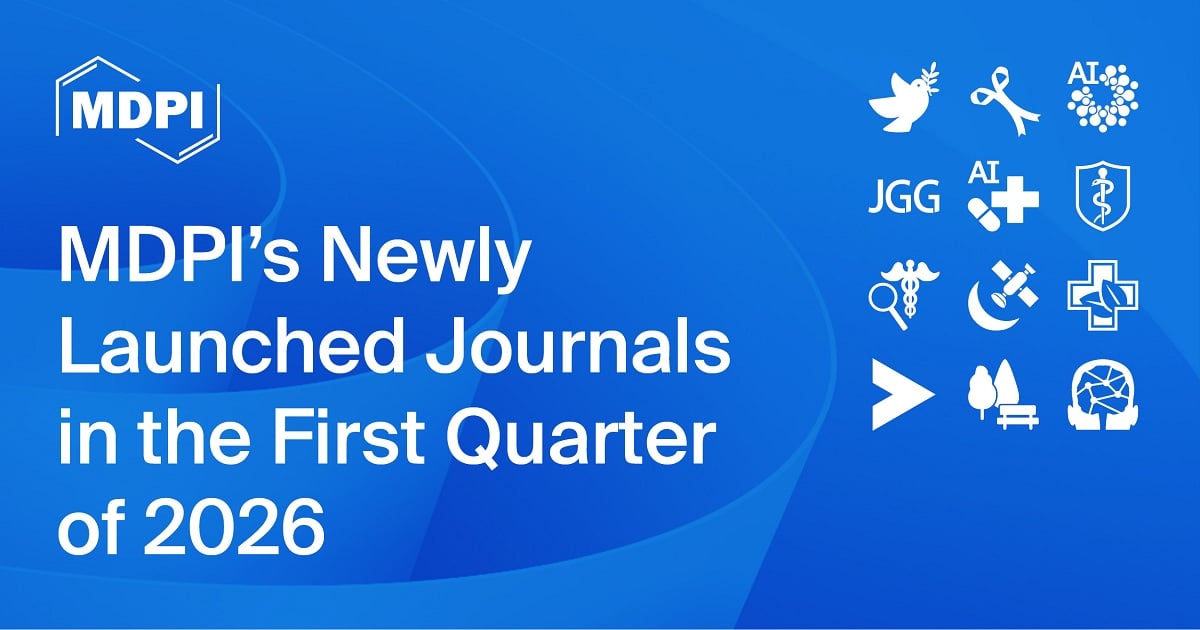
Our portfolio of journals available for publishing up-to-date research in immediate open access format has been further expanded. In the first quarter of 2026, nine new journals released their inaugural issues and three transferred journals released their first issue as part of MDPI, covering the subjects of clinical medicine, chemistry, computer science & mathematics, engineering, environment & ecology, and social sciences & psychology.
We extend our gratitude to the Editors-in-Chief, Associate Editors, and Editorial Board Members who will shape the future course of these brand-new journals. Each journal is dedicated to upholding strong editorial standards through a thorough peer review process, ensuring impactful open access scholarship.
Please feel free to browse and discover more about the new journals below.
|
New Journals |
Founding Editor(s)-in-Chief |
Journal Topics (Selected) |
|
|
Prof. Dr. Matt Oehlschlaeger, |
AI-based chemical data analysis, prediction, and discovery; AI-enabled chemical reaction prediction, synthesis planning, and retrosynthesis; AI in bioorganic chemistry and chemical biology; digital twins and simulation of chemical processes; AI-powered chemical education and pedagogy | |
|
|
Prof. Dr. Guang Jia, |
occupational hazards and exposure science; occupational health effects and susceptibility; occupational risk assessment and management; occupational health intervention, promotion, and policy | |
|
|
Prof. Dr. Alessandro Miani, |
environmental exposures and health; the built environment and public health; One Health approach; environmental justice and health equity; environmental policies and interventions | |
|
|
Prof. Dr. Miriam H. A. Bopp, |
neuroimaging technology and tool; multimodal neuroimaging integration and analysis; |
|
|
Prof. Dr. Raul A. Urrutia, |
personalized translational and clinical oncology research that contribute to a deeper understanding of cancer diagnoses, prognoses, prevention, and treatment specifically for individual patients | |
|
|
Prof. Dr. Pierre Boulanger, |
AI in disease detection, diagnosis, prediction, and treatment; medical informatics; AI in genomics and precision medicine; AI in drug discovery and development; |
|
|
Prof. Dr. Zhaokui Wang, |
astrodynamics; spacecraft technology; satellite technology; space transportation; space vehicle design, propulsion, and avionics; space energy, power and propulsion | |
|
|
Prof. Dr. Richard J Hauer, |
park design, planning, and evaluation; park and art; park, industrialization, urbanization, and civilization; park and education; park and smart society; park role in SDGs; park services for humans | |
|
|
Prof. Dr. Stacey L. Connaughton, |
conflict resolution; peacebuilding; peacemaking; mediation, reconciliation, and transitional justice; sustaining peace | |


|
Transferred Journals |
Editor(s)-in-Chief |
Journal Topics (Selected) |
|
|
Prof. Dr. Gianluigi Vendemiale, |
physiology and pathology of aging; biogerontology; epidemiology; clinical geriatrics; pharmacology; geriatric nursing | |
|
|
Prof. Dr. Michele Maffia, |
cellular and developmental biology; physiology, pathophysiology and endocrinology; diagnostic tools, therapies and public health | |
|
|
Dr. Warren S. Joseph, |
foot and ankle medicine; podiatric medicine | |


We would like to thank everyone who has supported the development of open access publishing. If you would like to create a new journal, you are welcome to send an application here or contact the New Journal Committee (newjournal-committee@mdpi.com).
14 April 2026
MDPI Webinar | World Quantum Day—Session 3, 14 April 2026

MDPI is excited to announce a special webinar in celebration of World Quantum Day on 14 April 2026. This event aims to promote public understanding of quantum science and technology and to highlight their profound impact on modern society.
Date: 14 April at 2:00 p.m. CEST | 8:00 p.m. CST Asia
Webinar ID: 894 4233 6040
Webpage: https://sciforum.net/event/MWQDW2026-3
Register now for free:

Program:
|
Speaker |
Presentation Title |
Time in CEST |
Time in CST (Asia) |
|
MDPI Introduction |
2:00–2:05 p.m. |
8:00–8:05 p.m. |
|
|
Dr. Davi Geiger |
Quantum Phase Space Entropy and the Arrow of Time |
2:05–2:25 p.m. |
8:05–8:25 p.m. |
|
Dr. Michael Parker |
The Quanta of Action and Entropy in Real and Imaginary Thermodynamic Time |
2:25–2:45 p.m. |
8:25–8:45 p.m. |
|
|
Q&A Session |
2:45–2:55 p.m. |
8:45–8:55 p.m. |
|
|
Webinar Closing |
2:55–3:00 p.m. |
8:55–9:00 p.m. |
After registering, you will receive a confirmation email containing information on how to join the webinar. Registrations with academic and institutional email addresses will be prioritized.
Unable to attend? Register anyway, and we will let you know when the recording is available to watch.
Webinar Chair and Keynote Speakers:
- Dr. Davi Geiger, Courant Institute, New York University, USA;
- Dr. Michael C. Parker, University of Essex, UK.
13 April 2026
MDPI Webinar | World Quantum Day—Session 2, 14 April 2026

MDPI is excited to announce a special webinar in celebration of World Quantum Day on 14 April 2026. This event aims to promote public understanding of quantum science and technology and to highlight their profound impact on modern society.
Date: 14 April at 8:00 a.m. CEST | 2:00 p.m. CST Asia
Webinar ID: 831 5594 6905
Webpage: https://sciforum.net/event/MWQDW2026-2
Register now for free:

Program:
| Speaker | Presentation Title | Time in CEST | Time in CST (Asia) |
| MDPI Introduction | 8:00–8:05 a.m. | 2:00–2:05 p.m. | |
| Dr. Marco Avesani | “Quantum Technologies for Secure Communications” | 8:05–8:25 a.m. | 2:05–2:25 p.m. |
| Dr. Lock Yue Chew | “Quantum Switch Refrigeration” | 8:25–8:45 a.m. | 2:25–2:45 p.m. |
| Dr. Dario Ferraro | “Opportunities and Challenges of Quantum Batteries” | 8:45–9:05 a.m. | 2:45–3:05 p.m. |
| Q&A Session | 9:05–9:25 a.m. | 3:05–3:25 p.m. | |
| Webinar Closing | 9:25–9:30 a.m. | 3:25–3:30 p.m. |
After registering, you will receive a confirmation email containing information on how to join the webinar. Registrations with academic and institutional email addresses will be prioritized.
Unable to attend? Register anyway, and we will let you know when the recording is available to watch.
Webinar Chair and Keynote Speakers:
- Dr. Dario Ferraro, University of Padova & ThinkQuantum, Italy;
- Dr. Lock Yue Chew, Nanyang Technological University, Singapore;
- Dr. Marco Avesani, Physics Department, University of Genoa, Italy.
13 April 2026
MDPI Webinar | World Quantum Day—Session 1, 14 April 2026

MDPI is excited to announce a special webinar in celebration of World Quantum Day on 14 April 2026. This event aims to promote public understanding of quantum science and technology and to highlight their profound impact on modern society.
Date: 14 April at 4:00 a.m. CEST | 10:00 a.m. CST Asia
Webinar ID: 873 5663 7014
Webpage: https://sciforum.net/event/MWQDW2026-1
Register now for free:

Program:
|
Speaker |
Presentation Title |
Time in CEST |
Time in CST (Asia) |
Time in EDT (13 April) |
|
|
MDPI Introduction |
4:00–4:05 a.m. |
10:00–10:05 a.m. |
10:00–10:05 p.m. |
|
Dr. Ken Wharton |
Retrocausal Quantum Models: 10 Reasons to Take Them Seriously |
4:05–4:25 a.m. |
10:05–10:25 a.m. |
10:05–10:25 p.m. |
|
Dr. Ruth E. Kastner |
The Quantum Defeat of Maxwell’s Demon |
4:25–4:45 a.m. |
10:25–10:45 a.m. |
10:25–10:45 p.m. |
|
Dr. Anindita Maiti |
AI-for-Quantum needs Physics-for-AI |
4:45–5:05 a.m. |
10:45–11:05 a.m. |
10:45–11:05 p.m. |
|
Dr. Pavan Hosur |
High-efficiency superconducting diodes - from critical phenomena to universal digital logic |
5:05–5:25 a.m. |
11:05–11:25 a.m. |
11:05–11:25 p.m. |
|
|
Q&A Session |
5:25–5:40 a.m. |
11:25–11:40 a.m. |
11:25–11:40 p.m. |
|
|
Webinar Closing |
5:40–5:45 a.m. |
11:40–11:45 a.m. |
11:40–11:45 p.m. |
After registering, you will receive a confirmation email containing information on how to join the webinar. Registrations with academic and institutional email addresses will be prioritized.
Unable to attend? Register anyway, and we will let you know when the recording is available to watch.
Webinar Chair and Keynote Speakers:
- Dr. Ken Wharton, Department of Physics and Astronomy, San Jose State University, USA;
- Dr. Ruth E. Kastner, University of Maryland, College Park, USA;
- Dr. Anindita Maiti, Postdoctoral Research Fellow at Perimeter Institute for Theoretical Physics, Canada;
- Dr. Pavan Hosur, University of Houston, USA.
