



Trustworthy AI for Bioinformatics, EHRs, and Remote Monitoring
A special issue of Electronics (ISSN 2079-9292). This special issue belongs to the section "Artificial Intelligence".
Deadline for manuscript submissions: 20 November 2026 | Viewed by 437
Special Issue Editors

Interests: machine learning; artificial intelligence; bioinformatics; biomedical signal processing; explainable AI; imaging; electronic health records; model validation; clinical AI

Interests: artificial intelligence; machine learning; deep learning; computational biology; biological modelling; policy
Special Issue Information
Dear Colleagues,
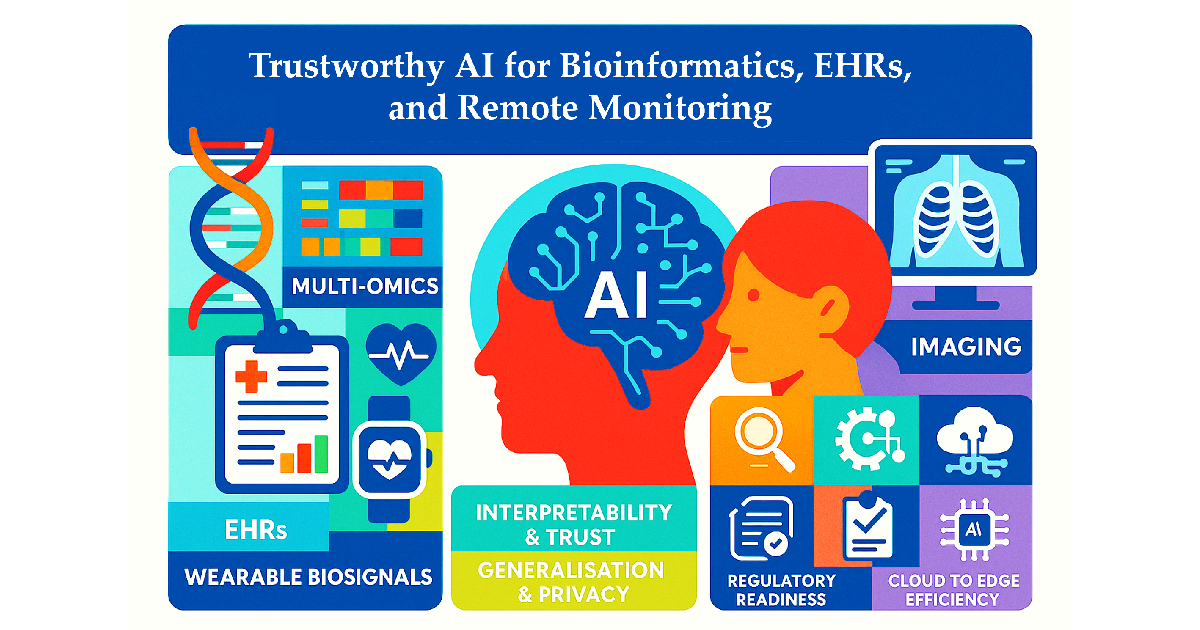
Transformative advances in artificial intelligence (AI) and data analytics are reshaping modern bioinformatics and digital health, from multi-omics and imaging to wearable biosignals and electronic health records (EHRs). Yet, despite impressive benchmark results, key translational challenges persist: interpretability and trust, robust generalisation, data governance and privacy, regulatory readiness, and computational efficiency from cloud to edge. This Special Issue of Electronics seeks high-quality contributions that push scientifically rigorous and clinically meaningful AI forward, with a particular emphasis on reproducibility, transparent reporting, standards-based interoperability, and deployability.
We welcome original research, resources, and perspectives that advance AI for bioinformatics and e-health, spanning (i) novel learning paradigms (self-supervised, foundation, and multimodal models and causal/probabilistic approaches) with a clear path to clinical utility; (ii) methods for explainability, calibration/uncertainty, robustness, and external validation; (iii) EHR- and registry-centred analytics with privacy-preserving learning (federated learning and differential privacy) and interoperability; (iv) wearable and remote monitoring biosignals and telehealth/mHealth pipelines, including digital phenotyping and patient-generated health data; (v) clinical imaging and multi-omics integration that informs diagnosis, prognosis, or therapy selection; (vi) resource-efficient inference and IoMT/edge AI (tinyML, on-device learning, and hardware–algorithm co-design) with reliability at the point of care; (vii) human-centred design and workflow integration (usability, clinician-in-the-loop, and safety and alert fatigue); (viii) governance and regulation for SaMD, including post-market surveillance and cybersecurity; and (ix) evaluation that matters, including but not limited to prospective/pragmatic studies, real-world evidence, equity impact, and health economic assessment.
Submissions should foreground data quality, clear problem statements, and evaluable claims with appropriate baselines and statistically sound comparisons. We encourage research articles, benchmark datasets, open-source software, registered reports, systematic reviews, and perspectives/roadmaps for responsible translation. Interdisciplinary studies bridging engineering, biology, and clinical science are particularly welcome, as are works demonstrating prospective validation, real-world deployment, or human-in-the-loop evaluation. By bringing together method developers, domain scientists, clinicians, and digital health practitioners, this Special Issue aims to showcase credible, reproducible, and deployable AI that advances bioinformatics and improves patient and population health.
Dr. Liam Butler
Dr. Roy Sanderson
Guest Editors
Manuscript Submission Information
Manuscripts should be submitted online at www.mdpi.com by registering and logging in to this website. Once you are registered, click here to go to the submission form. Manuscripts can be submitted until the deadline. All submissions that pass pre-check are peer-reviewed. Accepted papers will be published continuously in the journal (as soon as accepted) and will be listed together on the special issue website. Research articles, review articles as well as short communications are invited. For planned papers, a title and short abstract (about 250 words) can be sent to the Editorial Office for assessment.
Submitted manuscripts should not have been published previously, nor be under consideration for publication elsewhere (except conference proceedings papers). All manuscripts are thoroughly refereed through a single-blind peer-review process. A guide for authors and other relevant information for submission of manuscripts is available on the Instructions for Authors page. Electronics is an international peer-reviewed open access semimonthly journal published by MDPI.
Please visit the Instructions for Authors page before submitting a manuscript. The Article Processing Charge (APC) for publication in this open access journal is 2400 CHF (Swiss Francs). Submitted papers should be well formatted and use good English. Authors may use MDPI's English editing service prior to publication or during author revisions.
Keywords
- artificial intelligence
- machine learning
- bioinformatics
- computational biology
- multi-omics
- genomics & transcriptomics
- medical imaging
- biosignal analytics
- electronic health records
- explainable AI
- clinical translation
- werable devices
- digital health
- lab-to-bedside
Benefits of Publishing in a Special Issue
- Ease of navigation: Grouping papers by topic helps scholars navigate broad scope journals more efficiently.
- Greater discoverability: Special Issues support the reach and impact of scientific research. Articles in Special Issues are more discoverable and cited more frequently.
- Expansion of research network: Special Issues facilitate connections among authors, fostering scientific collaborations.
- External promotion: Articles in Special Issues are often promoted through the journal's social media, increasing their visibility.
- Reprint: MDPI Books provides the opportunity to republish successful Special Issues in book format, both online and in print.
Further information on MDPI's Special Issue policies can be found here.
