



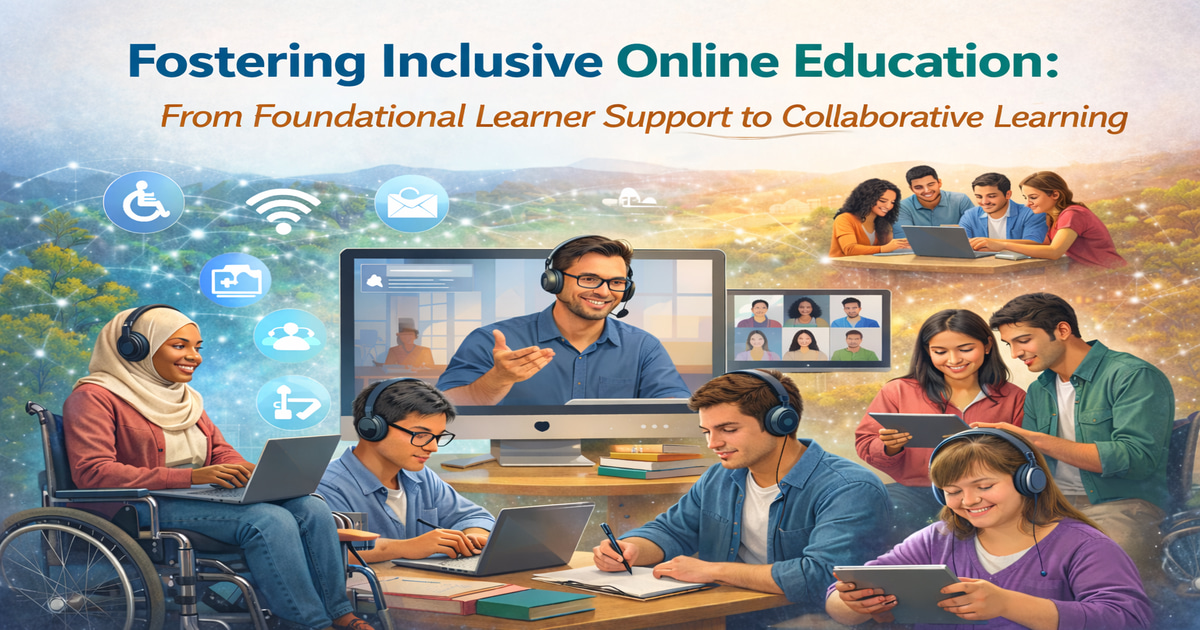
Fostering Inclusive Online Education: From Foundational Learner Support to Collaborative Learning
A special issue of Education Sciences (ISSN 2227-7102). This special issue belongs to the section "Technology Enhanced Education".
Deadline for manuscript submissions: 10 July 2026 | Viewed by 270
Special Issue Editors

Interests: online education; collaborative learning; authentic learning; inclusive education; innovation in higher education; new and emerging digital technologies; online learning transformation
Special Issues, Collections and Topics in MDPI journals

Interests: innovation in teaching and learning; learning analytics and teaching practice; inclusive education; artificial intelligence in optometry education; colour vision perception and visual processing
Special Issue Information
Dear Colleagues,
The rapid expansion of online education has fundamentally reshaped contemporary teaching and learning across the higher education context. Accelerated by the COVID-19 pandemic and sustained by ongoing digital transformation, online learning environments have become more central to the learning experience rather than a peripheral mode of educational delivery. While this expansion has created new opportunities for access, flexibility, and innovation, it has also exposed and, in some cases, exacerbated existing inequities related to digital access, learner preparedness, accessibility, participation, and belonging.
Inclusive online education extends beyond the provision of technological infrastructure or the digitisation of content. It requires intentional pedagogical design, robust learner support, and the cultivation of learning environments in which diverse learners can meaningfully engage, collaborate, and succeed. Learners vary widely in terms of prior educational experience, digital literacy, language background, disability, cultural identity, caring responsibilities, employment status, and geographic location. Without targeted foundational support and inclusive design principles, online education risks reproducing exclusion under the guise of flexibility.
At the same time, research increasingly highlights the importance of social presence, interaction, and collaboration in online learning. Collaborative learning approaches, such as peer learning, group projects, discussion-based pedagogies, and co-creation of knowledge, can foster engagement, deepen learning, and support learner persistence. However, collaborative activities in online environments must be carefully designed to ensure they are accessible, equitable, and supportive rather than burdensome or exclusionary. This creates a pressing need to examine how foundational learner support can be aligned with inclusive collaborative practices across diverse online contexts.
As institutions continue to invest heavily in online and blended learning, there is a growing imperative to move beyond emergency or efficiency-driven approaches towards inclusive, learner-centred, and socially connected online education. Research in this area is critical for informing evidence-based practice, policy development, and institutional strategy. Understanding how foundational supports (such as orientation, scaffolding, feedback, and accessibility measures) intersect with collaborative pedagogies can help educators design online learning experiences that are both inclusive and pedagogically robust.
The aim of this Special Issue is to advance the understanding of how inclusive online education can be fostered through the integration of foundational learner support and collaborative learning approaches. It seeks to showcase empirical and practice-oriented research that examines inclusive design, pedagogical innovation, learner experiences, and institutional strategies in online and digitally mediated learning environments.
The scope of the Special Issue is intentionally broad and interdisciplinary, welcoming contributions from higher education contexts. Original research articles are invited for submission. Research topics may include, but are not limited to, the following:
- Inclusive design principles and frameworks for online learning;
- Foundational learner support in online education (e.g., orientation, scaffolding, feedback, academic skills development);
- Accessibility and universal design for learning (UDL) in digital environments;
- Digital equity, access, and participation in online education;
- Learner preparedness, digital literacy, and transition to online learning;
- Inclusive assessment and feedback practices in online contexts;
- Collaborative learning pedagogies and peer learning in online environments;
- Designing inclusive online group work and collaborative assessment;
- Social presence, belonging, and community building in online learning;
- Technology-enhanced collaboration and inclusive learning tools;
- Instructor roles and professional development for inclusive online teaching;
- Learner experiences and perspectives on inclusion and collaboration online;
- Institutional policies and strategies supporting inclusive online education.
Dr. Chris Campbell
Dr. Vanessa Honson
Guest Editors
Manuscript Submission Information
Manuscripts should be submitted online at www.mdpi.com by registering and logging in to this website. Once you are registered, click here to go to the submission form. Manuscripts can be submitted until the deadline. All submissions that pass pre-check are peer-reviewed. Accepted papers will be published continuously in the journal (as soon as accepted) and will be listed together on the special issue website. Research articles, review articles as well as short communications are invited. For planned papers, a title and short abstract (about 250 words) can be sent to the Editorial Office for assessment.
Submitted manuscripts should not have been published previously, nor be under consideration for publication elsewhere (except conference proceedings papers). All manuscripts are thoroughly refereed through a double-blind peer-review process. A guide for authors and other relevant information for submission of manuscripts is available on the Instructions for Authors page. Education Sciences is an international peer-reviewed open access monthly journal published by MDPI.
Please visit the Instructions for Authors page before submitting a manuscript. The Article Processing Charge (APC) for publication in this open access journal is 1800 CHF (Swiss Francs). Submitted papers should be well formatted and use good English. Authors may use MDPI's English editing service prior to publication or during author revisions.
Keywords
- inclusive education
- inclusive learning environments
- inclusive online culture
- inclusive online education
- collaborative learning
- inclusive online collaborative learning
- online collaborative tools
- higher education
Benefits of Publishing in a Special Issue
- Ease of navigation: Grouping papers by topic helps scholars navigate broad scope journals more efficiently.
- Greater discoverability: Special Issues support the reach and impact of scientific research. Articles in Special Issues are more discoverable and cited more frequently.
- Expansion of research network: Special Issues facilitate connections among authors, fostering scientific collaborations.
- External promotion: Articles in Special Issues are often promoted through the journal's social media, increasing their visibility.
- Reprint: MDPI Books provides the opportunity to republish successful Special Issues in book format, both online and in print.
Further information on MDPI's Special Issue policies can be found here.
