



Sleep in Children

A topical collection in Children (ISSN 2227-9067). This collection belongs to the section "Pediatric Pulmonary and Sleep Medicine".

Viewed by 1908

Editors


E-Mail Website1 Website2
Collection Editor
Sleep Laboratory, Institute of Nutrition and Food Technology (INTA), University of Chile, Macul, Santiago 7830489, Chile
Interests: sleep development throughout the lifespan; sleep/nutrition interaction; sleep medicine; sleep and cognitive performance; automated processing of sleep patterns
Special Issues, Collections and Topics in MDPI journals

Topical Collection Information

Dear Colleagues,

We are pleased to invite you to contribute to this Topical Collection focusing on a child’s sleep. A young child engages in sleeping activities more than in any other activity during the 24-hour cycle. However, what constitutes sleep behavior and sleep patterns suitable for a child’s development remain open questions.

Many disorders occur in both children and adults, and may have similar features, but some sleep behaviors might be uniquely disturbed during childhood.  Examples of these pediatric sleep disorders are cot death, inappropriate sleep transition schedules or certain parasomnias that are more prevalent in childhood years. At the same time, studies are progressively showing that in our 21st century society, children are not obtaining the sleep appropriate for their stages of development. Nonetheless, the scientific community unraveling the role of sleep in a child’s development remains challenged. That is, a growing body of studies discusses the benefits of sleep and the downsides of poor sleep, but important questions worthy of our consideration remain unanswered; e.g., What are the age-related differences in sleep physiology? What are the age-related differences in sleep behaviors? What is normal versus abnormal across child development? What are culturally adept caregiver-child sleep interactions? Which assessment, treatment and management of sleep disorders is best tailored to the needs of a developing child?

In addition, to date, a growing body of studies suggest that sleep-related pathology may cause, mimic, or exacerbate daytime symptomatology across development. Vividly investigated is the impact of poor sleep on cognitive development and school performance, with reported effect sizes ranging from 0.05 to 0.35 denoting the unignorable association. Other developmental domains may have been overshadowed by this interest in learning and memory capacity during childhood, but are equally relevant to a child’s growth.

The aim of this Topical Collection is, therefore, to increase our understanding of the role of sleep in children. Studies investigating the outcomes of poor sleep, the impact of poor health on a child’s sleep, as well as environmental influences (e.g., family, sleep environment) on a child’s sleep are solicited. Similarly, studies on the treatment or management of pediatric sleep disorders, or new devices and apps to track or monitor their sleep are welcomed.

This Topical Collection invites manuscripts reporting original research and reviews, investigating the sleep of children—newborns, infants, toddlers, school-aged children and adolescents.

Related Webinar: https://www.mdpi.com/journal/children/announcements/5773

You may choose our Joint Topical Collection in IJERPH.

Prof. Dr. Karen Spruyt
Prof. Dr. Patricio Peirano
Collection Editors

Manuscript Submission Information

Manuscripts should be submitted online at www.mdpi.com by registering and logging in to this website. Once you are registered, click here to go to the submission form. Manuscripts can be submitted until the deadline. All submissions that pass pre-check are peer-reviewed. Accepted papers will be published continuously in the journal (as soon as accepted) and will be listed together on the collection website. Research articles, review articles as well as short communications are invited. For planned papers, a title and short abstract (about 250 words) can be sent to the Editorial Office for assessment.

Submitted manuscripts should not have been published previously, nor be under consideration for publication elsewhere (except conference proceedings papers). All manuscripts are thoroughly refereed through a single-blind peer-review process. A guide for authors and other relevant information for submission of manuscripts is available on the Instructions for Authors page. Children is an international peer-reviewed open access monthly journal published by MDPI.

Please visit the Instructions for Authors page before submitting a manuscript. The Article Processing Charge (APC) for publication in this open access journal is 2400 CHF (Swiss Francs). Submitted papers should be well formatted and use good English. Authors may use MDPI's English editing service prior to publication or during author revisions.

Keywords

  • polysomnography
  • sleep epidemiology
  • sleep behaviors
  • child development
  • sleep tool
  • sleep treatment
  • sleep health
  • cognition
  • socio-emotional behavior
  • sleep disorders

Published Papers (1 paper)

2026

19 pages, 563 KB  
Article
The Role of Sleep in Mediating Mental Health Symptoms During the COVID-19 Pandemic in Children with and Without ADHD
by Presley MacMillan, Fakir Md Yunus, Maria A. Rogers, Yuanyuan Jiang, Emma A. Climie, Janet W. T. Mah and Penny Corkum
Children 2026, 13(1), 82; https://doi.org/10.3390/children13010082 - 5 Jan 2026
Viewed by 263
Abstract
Background: The COVID-19 virus is a source of both acute and chronic stress for many people. This stress could uniquely impact children and their mental health. Research has shown that children with neurodevelopmental disorders such as Attention-Deficit/Hyperactivity Disorder (ADHD) are at an increased [...] Read more.
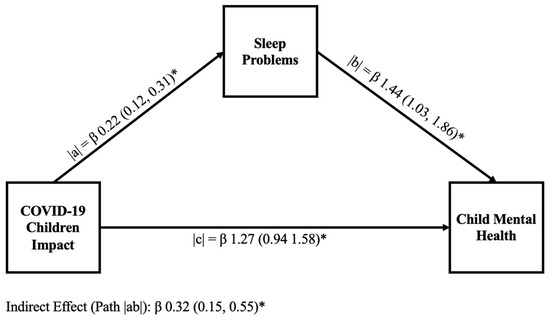
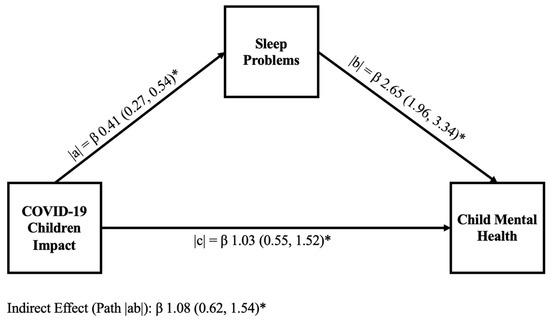
Background: The COVID-19 virus is a source of both acute and chronic stress for many people. This stress could uniquely impact children and their mental health. Research has shown that children with neurodevelopmental disorders such as Attention-Deficit/Hyperactivity Disorder (ADHD) are at an increased risk of negative mental health symptoms due to stress, but high-quality sleep may be associated with a protective role against these symptoms. We, therefore, aimed to investigate whether the impacts of COVID-19 and sleep problems were independently linked with children’s mental health and to examine whether sleep could mediate the relationship between COVID-19 impact and child mental health. Finally, we sought to compare the degree to which sleep problems could mediate this relationship in children without ADHD and in children with ADHD. Methods: In this cross-sectional study, a total of 304 parents of children were sampled from a larger study investigating the impact of the COVID-19 pandemic on Canadian families and children in the spring of 2021. Parents reported on their children’s mental health, sleep, and the impacts of COVID-19 on their child. Of the total sample, 234 children were reported as having an ADHD diagnosis, and 70 children were reported to not have ADHD. Results: We found that both the impact of COVID-19 and sleep problems independently and positively contributed to the mental health symptoms (p < 0.001) experienced by children with ADHD and without ADHD. Children with ADHD were found to have higher scores for COVID-19 child impact, sleep problems, and negative mental health. However, sleep problems had a greater impact on the mental health of children without ADHD compared to ADHD children. Additionally, the results suggest that sleep problems mediated ~20% of the relationship between COVID-19 impact and child mental health in children with ADHD and ~51% of this relationship in children without ADHD. Conclusions: The findings emphasize the significant role of sleep in mediating child mental health symptoms during periods of stress in children without ADHD and in children with ADHD. We highlight the importance of considering sleep quality and supporting healthy sleep in times of stress to improve child mental health symptoms. Full article
Show Figures

Figure 1

Back to TopTop