



Green Cities: Designs for Health and Sustainability
A special issue of Buildings (ISSN 2075-5309). This special issue belongs to the section "Architectural Design, Urban Science, and Real Estate".
Deadline for manuscript submissions: 26 June 2026 | Viewed by 378
Special Issue Editor

Interests: aquatic ecology; urban ecology; human–nature interactions; sustainability; One Health
Special Issues, Collections and Topics in MDPI journals
Special Issue Information
Dear Colleagues,
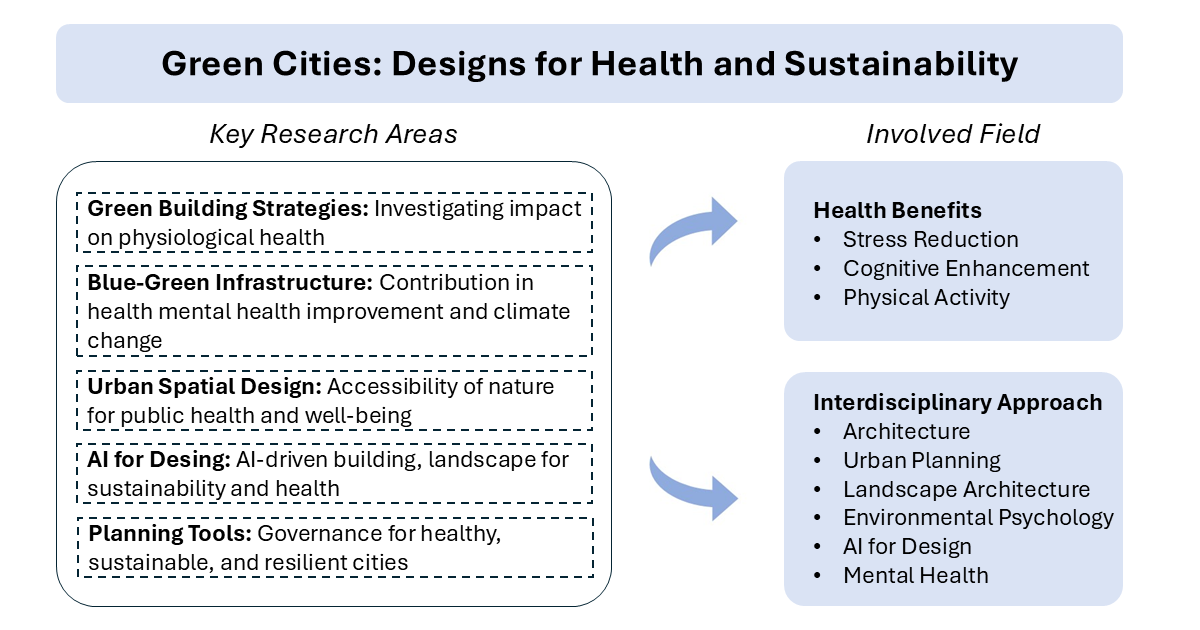
Cities worldwide are facing increasing environmental pressures alongside rising public demand for health, wellbeing, and high-quality living environments. Sustainable design—encompassing blue–green infrastructure, green building strategies, and ecological urban planning—has become a crucial pathway for advancing resilient and health-supportive urban development. Growing empirical evidence highlights that nature-integrated environments, biophilic design, and coherent ecological networks can improve residents’ physiological and psychological health and enhance overall quality of life.
The purpose of this Special Issue of Buildings is to focus on contributions that investigate how built and natural environments jointly influence human emotions, cognition, stress recovery, physical activity, social interaction, and long-term mental health. We welcome the submission of multi-scale research spanning indoor spaces, building courtyards, neighborhood environments, and large-scale blue–green systems, with an emphasis on uncovering mechanisms linking spatial configurations and environmental quality to human wellbeing.
Topics of interest include, but are not limited to, the following:
- Impacts of green building strategies (natural lighting, ventilation, biophilic materials, and high-performance envelopes) on physiological health indicators, such as stress, heart rate variability, thermal comfort, and sleep quality;
- Effects of blue–green infrastructure (rivers, lakes, wetlands, parks, and ecological corridors) on mental health, urban heat mitigation, social cohesion, and psychological resilience;
- Relationships between morphology, accessibility, sensory qualities, and visual perception of urban natural spaces and residents’ cognitive functioning and health outcomes;
- Artificial intelligence (AI) technology for buildings, landscape architecture, and cities, design principles, planning tools, and governance mechanisms that promote health-oriented sustainable cities under demographic change, climate uncertainty, and environmental equity challenges;
- Integration of multi-source data—physiological monitoring, environmental sensing, spatial analysis, and social-behavioral surveys—to support evidence-based design and planning.
This Special Issue aims to provide a cross-disciplinary platform bridging architecture, urban planning, landscape architecture, environmental psychology, public health, geography, ecology, and data science. We welcome contributions, including original research articles, reviews, case studies, methodological advancements, and interdisciplinary perspectives that explore sustainable blue–green designs for healthy and resilient cities.
Prof. Dr. Yixin Zhang
Guest Editor
Manuscript Submission Information
Manuscripts should be submitted online at www.mdpi.com by registering and logging in to this website. Once you are registered, click here to go to the submission form. Manuscripts can be submitted until the deadline. All submissions that pass pre-check are peer-reviewed. Accepted papers will be published continuously in the journal (as soon as accepted) and will be listed together on the special issue website. Research articles, review articles as well as short communications are invited. For planned papers, a title and short abstract (about 250 words) can be sent to the Editorial Office for assessment.
Submitted manuscripts should not have been published previously, nor be under consideration for publication elsewhere (except conference proceedings papers). All manuscripts are thoroughly refereed through a single-blind peer-review process. A guide for authors and other relevant information for submission of manuscripts is available on the Instructions for Authors page. Buildings is an international peer-reviewed open access semimonthly journal published by MDPI.
Please visit the Instructions for Authors page before submitting a manuscript. The Article Processing Charge (APC) for publication in this open access journal is 2600 CHF (Swiss Francs). Submitted papers should be well formatted and use good English. Authors may use MDPI's English editing service prior to publication or during author revisions.
Keywords
- green–blue space
- green buildings
- human health
- public health and wellbeing
- ecosystem services
- sustainability
- Artificial Intelligence
- climate resilience
Benefits of Publishing in a Special Issue
- Ease of navigation: Grouping papers by topic helps scholars navigate broad scope journals more efficiently.
- Greater discoverability: Special Issues support the reach and impact of scientific research. Articles in Special Issues are more discoverable and cited more frequently.
- Expansion of research network: Special Issues facilitate connections among authors, fostering scientific collaborations.
- External promotion: Articles in Special Issues are often promoted through the journal's social media, increasing their visibility.
- Reprint: MDPI Books provides the opportunity to republish successful Special Issues in book format, both online and in print.
Further information on MDPI's Special Issue policies can be found here.
