



Journal Menu
► ▼ Journal Menu-
- Batteries Home
- Aims & Scope
- Editorial Board
- Reviewer Board
- Topical Advisory Panel
- Instructions for Authors
- Special Issues
- Topics
- Sections & Collections
- Article Processing Charge
- Indexing & Archiving
- Editor’s Choice Articles
- Most Cited & Viewed
- Journal Statistics
- Journal History
- Journal Awards
- Society Collaborations
- Conferences
- Editorial Office
Journal Browser
► ▼ Journal BrowserNeed Help?
Announcements
26 May 2026
Interview with Prof. Dr. Yaxiang Lu—Winner of the Batteries Young Investigator Award
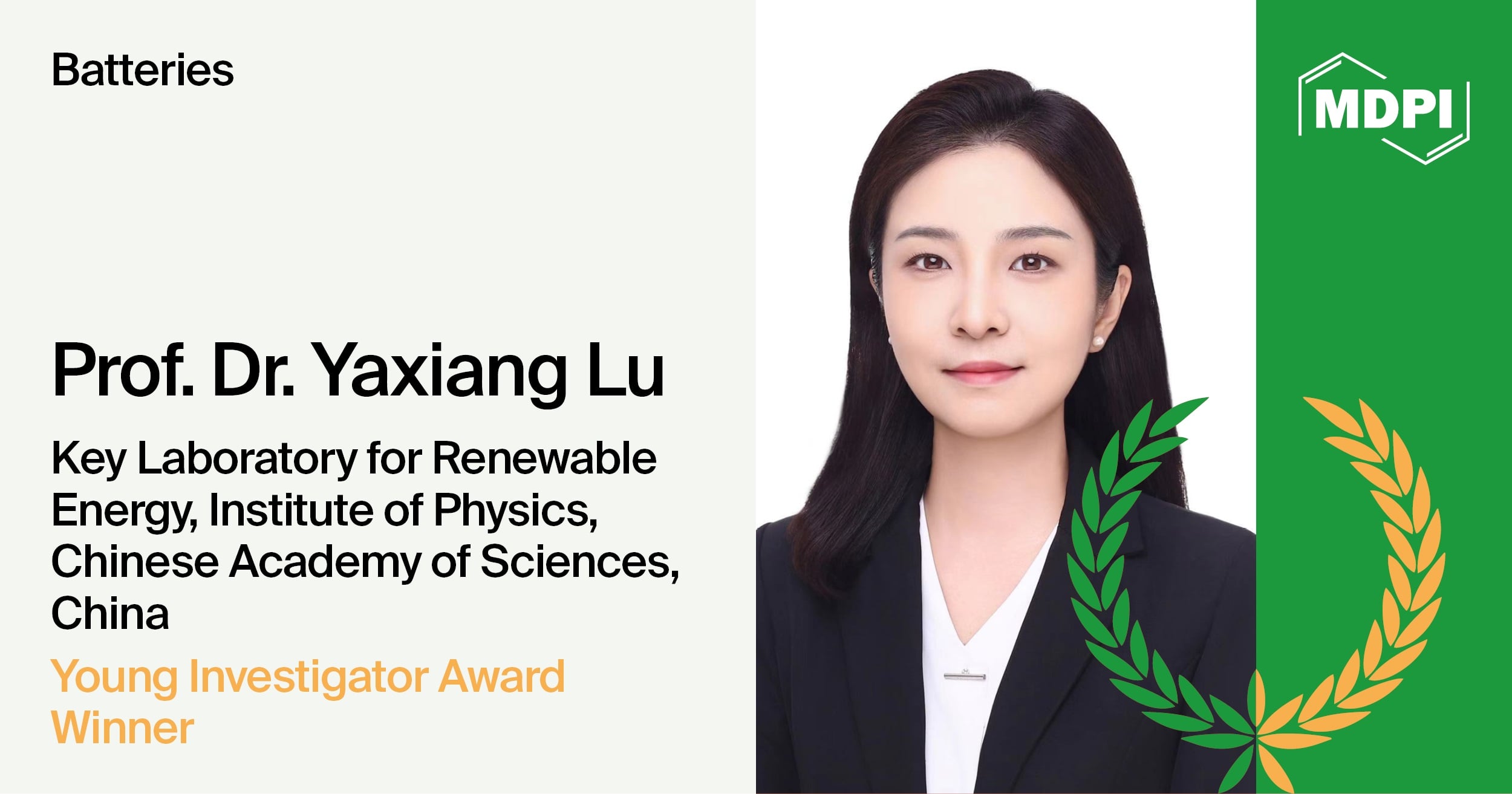
Name: Prof. Dr. Yaxiang Lu
Affiliation: Key Laboratory for Renewable Energy, Institute of Physics, the Chinese Academy of Sciences, Beijing 100190, China
Research Interests: low-cost and high-performance electrode materials; compatible and robust electrode/electrolyte interfaces; the structure–property relationships of materials; new energy storage systems such as aqueous Na/K-ion batteries
Prof. Dr. Yaxiang Lu is a professor at the Institute of Physics, the Chinese Academy of Sciences (IOP-CAS). Her research focuses on advanced electrode and electrolyte materials, interface engineering, and sodium storage mechanisms for Na-ion batteries. She has published over 80 peer-reviewed papers in leading scientific journals including Science and Nature Energy, accumulating more than 15,000 citations and an H-index of 60. Additionally, she co-authored a book titled “Na-Ion Batteries: Science and Technology”. Her recent honors include the China Youth May Fourth Medal (2026), the Batteries Young Investigator Award (2025), the China Youth Science and Technology Award (2024), the Energy Storage Materials Young Scientist Award (2023), and the First Prize of the Beijing Science and Technology Award (2022).
The following is an interview with Prof. Dr. Yaxiang Lu:
1. Could you briefly introduce yourself to our readers and tell us a little bit about your fields of interest?
I am a researcher at the Institute of Physics, the Chinese Academy of Sciences (IOP-CAS), where I focus on sodium-ion battery technology, particularly the development of key materials and underlying energy storage mechanisms. My work centers on addressing the resource limitations of lithium by advancing safe, low-cost, and high-performance sodium-based alternatives aligned with national energy strategies.
Currently, I am especially interested in the design of novel electrode and electrolyte materials for solid-state sodium batteries. The overarching goal is to simultaneously enhance energy density, cycling stability, and safety, critical pillars for the next generation of sustainable energy storage systems.
2. Could you elaborate on how you initially learned about the Batteries journal? Furthermore, what inspired you to apply for the Batteries Young Investigator Award 2025?
I first got to know Batteries when I was invited to join the journal’s Early Career Advisory Board. That role introduced me to the editorial team and the journal’s mission, and I later had the chance to attend an in-person editorial meeting, which deepened my appreciation for its community-oriented approach.
As an active researcher in solid-state batteries, I also contributed a review article on halide-based solid electrolytes, an emerging class of materials with high ionic conductivity and good stability, which was published in Batteries.
Given that our daily work revolves entirely around battery materials and devices, it means a great deal to be recognized by a journal so closely connected to our field. Receiving the Batteries Young Investigator Award 2025 is both a personal honor and a strong encouragement for our team’s ongoing efforts to develop intrinsically safe and resource-sustainable energy storage technologies.
3. Do you have any advice for aspiring young researchers looking to make a meaningful impact in their respective fields?
Focus on solving real-world problems: ground your research in genuine scientific or societal challenges. Ask yourself: Does this work address a significant gap or need? Impactful research often starts with the right question.
Cultivate original and creative thinking–don’t just follow trends. Strive to develop novel ideas, approaches, or perspectives that push boundaries. Innovation often happens at the intersection of disciplines, so stay curious beyond your immediate field.
Maintain the drive to test ideas rigorously: having a great idea isn’t enough, be willing to design careful experiments, iterate through failures, and validate your hypotheses with solid evidence. Persistence and hands-on effort turn concepts into credible contributions.
Communicate your work effectively through high-quality publications: publishing in reputable, peer-reviewed journals is essential for sharing knowledge, gaining visibility, and contributing to the global scientific dialogue.
4. What’s the secret to a happy scientific life? Have you ever encountered any difficulties conducting research and how did you overcome them?
A happy scientific life isn’t about avoiding hardship, it’s about finding meaning and growth within it. Like many researchers, I’ve certainly faced my share of challenges: repeated experimental failures, weeks or even months with no fresh ideas, moments of self-doubt, and more. What helped me most was learning to reframe obstacles not as signs of failure or inadequacy, but as natural parts of the research process. I also made a habit of seeking feedback early, breaking overwhelming problems into manageable steps, and taking time to acknowledge small victories. Often, simply talking with a trusted colleague reminded me that I wasn’t alone and that sense of connection made all the difference.
5. What is your opinion of the open access model of publishing?
I support the open access (OA) publishing model in principle, it promotes wider dissemination of knowledge, accelerates scientific progress, and ensures public access to research, especially for institutions and individuals without expensive journal subscriptions.
However, the current reliance on high article processing charges (APCs) shifts the financial burden from readers to authors, which can disadvantage researchers from low-income countries or underfunded institutions. A more equitable open access system should explore alternative funding models to ensure broad accessibility without compromising fairness.
6. Which research topics do you think are of particular interest to the research community in the coming years?
In my opinion in the coming years, key research directions in the battery community will include:
- Intrinsic safety: developing inherently stable materials and systems free from thermal runaway risks;
- Batteries for extreme conditions: enabling reliable operation under extreme temperatures, pressure, or radiation;
- Novel battery chemistries, such as solid-state K⁺/Zn²⁺/H- batteries, multivalent systems (e.g., Mg²⁺, Ca²⁺), and dual-ion batteries, among others;
- Materials recycling and sustainability: establishing closed-loop, low-energy recycling to secure critical resources;
- AI for batteries: integrating artificial intelligence to accelerate materials discovery, interface engineering, and lifetime prediction.
7. Could you share your vision for the future of your research and the contributions you aspire to make in the field of batteries?
Looking ahead, my research aims to push the boundaries of solid-state sodium-ion batteries through several interconnected goals.
First, we are developing novel amorphous sodium-ion solid electrolytes, particularly halide- and oxyhalide-based systems that combine high ionic conductivity, wide electrochemical stability, and intrinsic safety. Paired with compatible high-capacity electrode materials, these innovations aim to significantly boost both energy density and thermal reliability.
Second, we seek to unravel the fundamental mechanisms governing ion transport in disordered solid electrolytes. Understanding how local structure, defects, and interfaces influence Na+ migration will guide the rational design of next-generation materials.
Finally, we are actively integrating artificial intelligence and high-throughput computational screening into our discovery pipeline. By combining data-driven approaches with targeted experiments, we hope to accelerate the development cycle of solid-state battery materials from concept to prototype in a more efficient and sustainable way.
Ultimately, I aspire to contribute practical, scalable solutions that help realize safe, low-cost, and resource-abundant energy storage for a decarbonized future.
8. As the winner of this award, is there something you want to express or someone to thank the most?
As the recipient of this award, I would like to express my deepest gratitude to several people who have made this recognition possible.
First and foremost, I am profoundly thankful to Academician Liquan Chen for his constant encouragement, visionary guidance, and unwavering support for solid-state battery research in China. His pioneering spirit continues to inspire our entire field.
I also owe immense thanks to my colleagues at the Institute of Physics, the Chinese Academy of Sciences—our daily scientific exchanges, collaborative problem-solving, and shared dedication have been instrumental to our progress.
Finally, none of this work would be possible without my students. Their curiosity, hard work, and late nights in the lab are the true engine behind every result we publish. This award belongs to them as much as it does to me.
