



Climate Change Adaptation and Mitigation in Buildings and Urban Areas
A special issue of Applied Sciences (ISSN 2076-3417). This special issue belongs to the section "Energy Science and Technology".
Deadline for manuscript submissions: closed (28 February 2022) | Viewed by 13902
Special Issue Editors

Interests: computational fluid dynamics; heat transfer; building physics; energy efficiency; experimental measurements; environmental impact
Special Issues, Collections and Topics in MDPI journals

Interests: heat transfer; building physics; energy efficiency; experimental measurements; environmental impact
Special Issues, Collections and Topics in MDPI journals

Interests: building physics; energy efficiency; experimental measurements; simulation; heat transfer; sustainability
Special Issues, Collections and Topics in MDPI journals
Special Issue Information
Dear Colleagues,
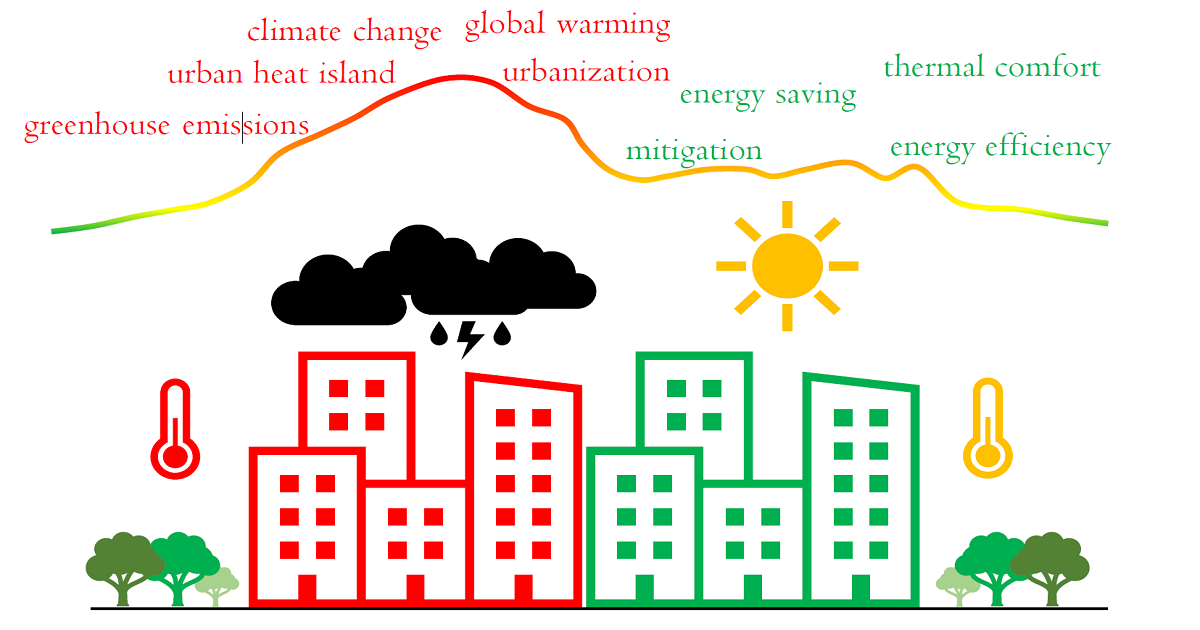
The increase of people living in large cities and the expansion of new urban areas are keys to defining new sustainable models. It is estimated that about 70% of the EU’s population lives in urban areas, and this is expected to reach 80% in 2030. The rapid increase of energy demand is a general constant around the world. This growth responds to various reasons, among which the increasing awareness of global warming caused by greenhouse emissions, the inevitable exhaustion of traditional energy sources in the following decades (fossil fuels), and the need for countries to assure energy self-dependence stand out. In addition, the contribution of energy consumption from buildings is about 40% of the overall energy use in developed countries. For developing countries, growth in population and urbanization, increasing demand for building services and comfort levels, together with the increased time spent inside buildings assure that the sharp rise in trends in building energy use will continue for a long time.
Therefore, climate changes and urbanization are the main causes behind the increase of floods, heat waves, drought, hurricanes, and rising sea levels all around the world. In large cities, air temperatures, both in summer and winter, are higher than in the surrounding rural areas and contribute to the urban heat island phenomenon.
This Special Issue intends to cover the gap between single-building investigation perspectives and the larger scale (neighborhoods, districts, cities) in order to achieve energy savings, mitigate the urban heat island, and improve indoor or outdoor thermal comfort. Papers selected for this Special Issue are subject to a rigorous peer review procedure with the aim of a rapid and wide dissemination of research results, developments, and applications.
Potential topics include but are not limited to the following:
- Urban heat island;
- Climate change;
- Thermal loads of buildings;
- Building and urban area simulation;
- Energy retrofit of buildings;
- Urban building energy modeling;
- Microclimate mitigation analysis;
- Indoor and outdoor thermal comfort;
- Weather analysis under a climate change context affecting energy performance of the built environment;
- Urban energy balance analysis and simulation;
- Building energy resilience to climate change;
- Case studies;
- Cool materials;
- Green wall and green roof;
- Energy efficiency in buildings;
- Retroreflective materials.
Therefore, manuscripts within these research areas are most welcome.
Dr. Gabriele Battista
Dr. Emanuele de Lieto Vollaro
Dr. Claudia Guattari
Editors
Manuscript Submission Information
Manuscripts should be submitted online at www.mdpi.com by registering and logging in to this website. Once you are registered, click here to go to the submission form. Manuscripts can be submitted until the deadline. All submissions that pass pre-check are peer-reviewed. Accepted papers will be published continuously in the journal (as soon as accepted) and will be listed together on the special issue website. Research articles, review articles as well as short communications are invited. For planned papers, a title and short abstract (about 250 words) can be sent to the Editorial Office for assessment.
Submitted manuscripts should not have been published previously, nor be under consideration for publication elsewhere (except conference proceedings papers). All manuscripts are thoroughly refereed through a single-blind peer-review process. A guide for authors and other relevant information for submission of manuscripts is available on the Instructions for Authors page. Applied Sciences is an international peer-reviewed open access semimonthly journal published by MDPI.
Please visit the Instructions for Authors page before submitting a manuscript. The Article Processing Charge (APC) for publication in this open access journal is 2400 CHF (Swiss Francs). Submitted papers should be well formatted and use good English. Authors may use MDPI's English editing service prior to publication or during author revisions.
Keywords
- Urban heat island
- Numerical model
- Mitigation technique
- Energy performance
- Energy efficiency
- Thermal comfort
- Case studies
Benefits of Publishing in a Special Issue
- Ease of navigation: Grouping papers by topic helps scholars navigate broad scope journals more efficiently.
- Greater discoverability: Special Issues support the reach and impact of scientific research. Articles in Special Issues are more discoverable and cited more frequently.
- Expansion of research network: Special Issues facilitate connections among authors, fostering scientific collaborations.
- External promotion: Articles in Special Issues are often promoted through the journal's social media, increasing their visibility.
- Reprint: MDPI Books provides the opportunity to republish successful Special Issues in book format, both online and in print.
Further information on MDPI's Special Issue policies can be found here.
