You are currently viewing a new version of our website. To view the old version click .

AI Chemistry

AI Chemistry is an international, peer-reviewed, scholarly, open access journal on the intersection of artificial intelligence and chemistry published quarterly online by MDPI.

All Articles (3)

Raman spectroscopy has become an important tool for biomedical analysis due to its ability to provide label-free, non-destructive molecular fingerprints of biological samples. However, existing deep learning approaches for classifying biological Raman spectra often focus on specific datasets and lack generalizability and interpretability. In this study, BioRamanNet is presented, an interpretable and generalizable deep learning framework designed for classifying a wide range of biological Raman spectra. The model integrates adaptive one-dimensional convolutional layers and squeeze-and-excitation (SE) blocks within a residual network architecture to enhance feature extraction. BioRamanNet was evaluated using four representative Raman spectral datasets—breast cells, extracellular vesicles and particles (EVPs), viruses, and bacteria—achieving classification accuracies of 99.5%, 100%, 99.8%, and 85.3%, respectively. To improve model interpretability, a perturbation-based analysis using Voigt noise was introduced to identify key wavenumber regions influencing classification. These regions were found to correspond closely with known Raman biomarkers, validating their biological significance. The results of this work demonstrate that BioRamanNet is a powerful and interpretable tool for analyzing diverse biological Raman spectra and holds promise for advancing machine learning-assisted biomedical diagnostics.

18 November 2025
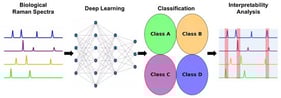
The schematic outlines the workflow for classifying biological Raman spectral data including breast cells, EVPs, viruses, and bacteria. The process begins with the acquisition of Raman spectra from raw biological samples, resulting in the construction of a structured Raman spectral dataset. A specialized deep neural network is then applied to classify the spectral data, enabling the distinction of different biological samples.

Despite the value of molecular packing (MP) calculations in modeling the properties of organic crystals, its widespread adoption is hindered by the absence of a simple tool broadly accessible to non-specialists, and by the lack of reliability inherent to transferable force fields. To fill these gaps, we describe a versatile workflow, leveraging recent progress in the application of machine learning to the parameterization of interatomic potentials. It is provided as a Python script based only on free academic software running on any Linux system. A key ingredient to this workflow is a recent neural network pretrained to predict bespoke force field parameters for any organic compound on the basis of its molecular diagram. The resulting graph-based force field (GB-FF) is fed into the Tinker simulation engine and applied to crystal structures generated using the USPEX crystal structure prediction package. This low-cost workflow is found to outperform current state-of-the-art procedures based on heavily parameterized force fields, thus demonstrating the value of machine-learned bespoke potential parameters.

21 October 2025

Overview of the current workflow taking advantage of a recent graph-based force field generator [15] for routine conversion of 2D molecular diagrams to low-energy crystal structures.

Identifying the most reactive conformation of a molecule is a central challenge in computational chemistry, particularly when reactivity depends on subtle conformational effects. While most conformation search tools aim to find the lowest-energy structure, they often overlook the electronic descriptors that govern chemical reactivity. In this work, we present GAELLE, a cheminformatics tool that combines conformer generation with quantum reactivity descriptors to identify the most reactive structure of a molecule in solution. GAELLE integrates an evolutionary algorithm with fast semiempirical quantum chemical calculations (xTB), enabling the automated ranking of conformers based on HOMO–LUMO gap minimization (Pearson’s principle of maximum hardness) and electrophilicity index (Parr’s electrophilicity scale). Solvent effects are accounted for via implicit solvation models (GBSA/ALPB) to ensure realistic evaluation of reactivity in solution. The method is fully SMILES-driven, open-source, and scalable to medium-sized drug-like molecules. Applications to reactive intermediates, bioactive conformations, and pre-reactive complexes demonstrate the method’s relevance for mechanism elucidation, molecular design, and in silico screening. GAELLE is publicly available and offers a reactivity-focused alternative to traditional energy-minimization tools in conformational analysis.

8 September 2025

Evolution of descriptors across GAELLE generated conformation with a genetic algorithm. (Top) Electrophilicity index (in blue) 
  ω
 [eV] plotted for each conformer ranked by increasing reactivity (i.e., decreasing 
  ω
). (Bottom) Global hardness 
  η
 (in violet) [eV] for the same set of conformers, ranked in ascending order. Each point demonstrates the search for the lowest electrophilicity and higher hardness; hence, the algorithm will find the most reactive structure after 15 evolutions.

News & Conferences

Issues

Open for Submission

Editor's Choice

Get Alerted

Add your email address to receive forthcoming issues of this journal.

XFacebookLinkedIn
AI Chem. - ISSN 3042-6723