AI-Powered Agricultural Robots: From Field Sensing to Autonomous Operation

A special issue of Agriculture (ISSN 2077-0472). This special issue belongs to the section "Agricultural Technology".

Deadline for manuscript submissions: closed (25 March 2026) | Viewed by 3907

Special Issue Editors

Mechanical Engineering Department, Texas A&M University at Corpus Christi, Corpus Christi, TX 78404, USA
Interests: AI-driven robotics; autonomous harvesting; multi-sensor fusion; precision agriculture; field phenotyping; digital twins
Special Issues, Collections and Topics in MDPI journals

E-Mail Website
Guest Editor
Electrical Engineering Department, Texas A&M University at Corpus Christi, Corpus Christi, TX 78404, USA
Interests: control systems; robotics

Special Issue Information

Dear Colleagues,

The rapid integration of artificial intelligence (AI) into agricultural robotics has transformed how we monitor, analyze, and manage crop production. Traditional farming has relied heavily on manual labor and basic mechanization but advances in field sensing, computer vision, and machine learning have enabled robots to perform complex tasks with increasing precision and autonomy. Over the past decade, significant progress has been made in multi-modal sensing technologies—including RGB, multispectral, hyperspectral, LiDAR, and wearable plant sensors—combined with AI-driven decision-making to enhance crop monitoring and productivity.

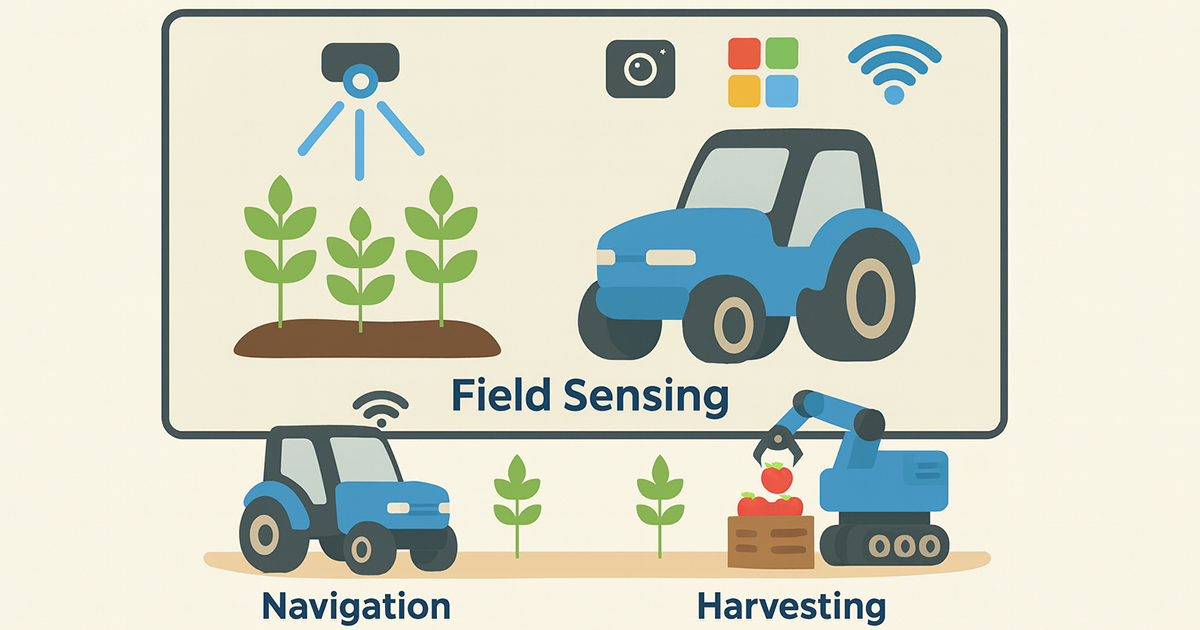
This Special Issue focuses on cutting-edge research and practical innovations in AI-powered agricultural robots, spanning the entire pipeline from field sensing to autonomous operation. Topics of interest include robotic perception, multi-sensor fusion, crop phenotyping, real-time growth monitoring, precision harvesting, field navigation, and bio-feedback control systems. We are particularly interested in contributions that integrate deep learning, reinforcement learning, physics-informed models, and digital twin frameworks for robust, data-driven agricultural solutions.

We invite original research articles, reviews, and case studies that address innovations in robotics, AI algorithms, sensor integration, and autonomous systems for sustainable agriculture. Submissions demonstrating practical field deployments, simulation-to-real transfer, and cross-disciplinary advances are highly encouraged. This Special Issue aims to foster collaboration between researchers, practitioners, and industry experts to accelerate the adoption of next-generation AI-powered agricultural robotics.

Dr. Dugan Um
Dr. Thang Nguyen
Guest Editors

Manuscript Submission Information

Manuscripts should be submitted online at www.mdpi.com by registering and logging in to this website. Once you are registered, click here to go to the submission form. Manuscripts can be submitted until the deadline. All submissions that pass pre-check are peer-reviewed. Accepted papers will be published continuously in the journal (as soon as accepted) and will be listed together on the special issue website. Research articles, review articles as well as short communications are invited. For planned papers, a title and short abstract (about 250 words) can be sent to the Editorial Office for assessment.

Submitted manuscripts should not have been published previously, nor be under consideration for publication elsewhere (except conference proceedings papers). All manuscripts are thoroughly refereed through a single-blind peer-review process. A guide for authors and other relevant information for submission of manuscripts is available on the Instructions for Authors page. Agriculture is an international peer-reviewed open access semimonthly journal published by MDPI.

Please visit the Instructions for Authors page before submitting a manuscript. The Article Processing Charge (APC) for publication in this open access journal is 2600 CHF (Swiss Francs). Submitted papers should be well formatted and use good English. Authors may use MDPI's English editing service prior to publication or during author revisions.

Keywords

  • AI-driven robotics
  • autonomous harvesting
  • multi-sensor fusion
  • precision agriculture
  • field phenotyping
  • digital twins

Benefits of Publishing in a Special Issue

  • Ease of navigation: Grouping papers by topic helps scholars navigate broad scope journals more efficiently.
  • Greater discoverability: Special Issues support the reach and impact of scientific research. Articles in Special Issues are more discoverable and cited more frequently.
  • Expansion of research network: Special Issues facilitate connections among authors, fostering scientific collaborations.
  • External promotion: Articles in Special Issues are often promoted through the journal's social media, increasing their visibility.
  • Reprint: MDPI Books provides the opportunity to republish successful Special Issues in book format, both online and in print.

Further information on MDPI's Special Issue policies can be found here.

Published Papers (3 papers)

Order results
Result details
Select all
Export citation of selected articles as:

Research

Jump to: Review

28 pages, 3527 KB  
Article
Autonomous Tomato Harvesting System Integrating AI-Controlled Robotics in Greenhouses
by Mihai Gabriel Matache, Florin Bogdan Marin, Catalin Ioan Persu, Robert Dorin Cristea, Florin Nenciu and Atanas Z. Atanasov
Agriculture 2026, 16(8), 847; https://doi.org/10.3390/agriculture16080847 - 11 Apr 2026
Cited by 1 | Viewed by 1470
Abstract
Labor shortages and the need for increased productivity have accelerated the development of robotic harvesting systems for greenhouse crops; however, reliable operation under fruit occlusion and clustered arrangements remains a major challenge, particularly due to the limited integration between perception and motion planning [...] Read more.
Labor shortages and the need for increased productivity have accelerated the development of robotic harvesting systems for greenhouse crops; however, reliable operation under fruit occlusion and clustered arrangements remains a major challenge, particularly due to the limited integration between perception and motion planning modules. The paper presents the design and experimental validation of an autonomous robotic system for greenhouse tomato harvesting. The proposed platform integrates a rail-guided mobile base, a six-degrees-of-freedom robotic manipulator, and an adaptive end effector with a hybrid vision framework that combines convolutional neural networks and watershed-based segmentation to enable robust fruit detection and localization under occluded conditions. The proposed approach enables improved separation of overlapping fruits and provides accurate spatial localization through stereo vision combined with IMU-assisted camera-to-robot coordinate transformation. An occlusion-aware trajectory planning strategy was developed to generate collision-free manipulation paths in the presence of leaves and stems, enhancing harvesting safety and reliability. The system was trained and evaluated using a dataset of real greenhouse images supplemented with synthetic data augmentation. Experimental trials conducted under practical greenhouse conditions demonstrated a fruit detection precision of 96.9%, recall of 93.5%, and mean Intersection-over-Union of 79.2%. The robotic platform achieved an overall harvesting success rate of 78.5%, reaching 85% for unobstructed fruits, with an average cycle time of 15 s per fruit in direct harvesting scenarios. The rail-guided mobility significantly improved positioning stability and repeatability during manipulation compared with fully mobile platforms. The results confirm that integrating hybrid perception with occlusion-aware motion planning can substantially improve the functionality of robotic harvesting systems in protected cultivation environments. The proposed solution contributes to the advancement of automation technologies for greenhouse vegetable production and supports the transition toward more sustainable and labor-efficient agricultural practices. Full article
Show Figures

Figure 1

33 pages, 14779 KB  
Article
A Vision-Based Robot System with Grasping-Cutting Strategy for Mango Harvesting
by Qianling Liu and Zhiheng Lu
Agriculture 2026, 16(1), 132; https://doi.org/10.3390/agriculture16010132 - 4 Jan 2026
Viewed by 1832
Abstract
Mango is the second most widely cultivated tropical fruit in the world. Its harvesting mainly relies on manual labor. During the harvest season, the hot weather leads to low working efficiency and high labor costs. Current research on automatic mango harvesting mainly focuses [...] Read more.
Mango is the second most widely cultivated tropical fruit in the world. Its harvesting mainly relies on manual labor. During the harvest season, the hot weather leads to low working efficiency and high labor costs. Current research on automatic mango harvesting mainly focuses on locating the fruit stem harvesting point, followed by stem clamping and cutting. However, these methods are less effective when the stem is occluded. To address these issues, this study first acquires images of four mango varieties in a mixed cultivation orchard and builds a dataset. Mango detection and occlusion-state classification models are then established based on YOLOv11m and YOLOv8l-cls, respectively. The detection model achieves an AP0.5–0.95 (average precision at IoU = 0.50:0.05:0.95) of 90.21%, and the accuracy of the classification model is 96.9%. Second, based on the mango growth characteristics, detected mango bounding boxes and binocular vision, we propose a spatial localization method for the mango grasping point. Building on this, a mango-grasping and stem-cutting end-effector is designed. Finally, a mango harvesting robot system is developed, and verification experiments are carried out. The experimental results show that the harvesting method and procedure are well-suited for situations where the fruit stem is occluded, as well as for fruits with no occlusion or partial occlusion. The mango grasping success rate reaches 96.74%, the stem cutting success rate is 91.30%, and the fruit injury rate is less than 5%. The average image processing time is 119.4 ms. The results prove the feasibility of the proposed methods. Full article
Show Figures

Figure 1

Review

Jump to: Research

45 pages, 6002 KB  
Review
Transport Robots in Protected Horticulture: A Review of Key Technologies, Representative Systems, and Future Directions
by Zhenwei Liang, Shengjie Yu and Baihao Yu
Agriculture 2026, 16(11), 1145; https://doi.org/10.3390/agriculture16111145 (registering DOI) - 23 May 2026
Abstract
Protected horticulture moves fragile pots, plug trays, seedlings, harvested products, and carriers through narrow, humid, and crowded spaces. Transport robots must therefore integrate locomotion, perception, localization, handling, placement, scheduling, and human–robot interaction rather than operate as simple carts. This structured narrative review reorganizes [...] Read more.
Protected horticulture moves fragile pots, plug trays, seedlings, harvested products, and carriers through narrow, humid, and crowded spaces. Transport robots must therefore integrate locomotion, perception, localization, handling, placement, scheduling, and human–robot interaction rather than operate as simple carts. This structured narrative review reorganizes evidence from seedling transplanting, nursery operations, harvest support, manipulation, perception, and autonomous navigation around the complete transport chain: target recognition, pickup, loading, loaded navigation, docking, unloading or placement, payload protection, and workflow feedback. The synthesis covers mobile platforms, payload support, perception and localization, motion control, gentle handling, digital support, and fleet coordination. Three barriers remain: short laboratory tests rarely provide season-long evidence; many prototypes are too specialized for variable workflows; and benchmarks seldom combine motion accuracy, handling reliability, payload quality, and resilience. Progress will require modular platforms, robust sensing, payload-safe control, standardized interfaces, and closer co-design between robotics and horticultural operations. Full article
Back to TopTop