


Token Economy for Sustainable Education in the Future: A Scoping Review

Abstract
1. Introduction
2. Materials and Methods
- Scoping review research questions
3. Results
4. Discussion
- Behavior management
- Learning engagement
- Types of token economy for education sustainability
5. Conclusions
- Limitation
- Recommendations
Author Contributions
Funding
Institutional Review Board Statement
Informed Consent Statement
Data Availability Statement
Conflicts of Interest
References
- Skinner, B.F. Science and Human Behavior; The Free Press: New York, NY, USA, 1953; pp. 80–313. [Google Scholar]
- Grant, M.J.; Booth, A.A. Typology Of Reviews: An Analysis Of 14 Review Types And Associated Methodologies. Health Inf. Libr. J. 2009, 26, 91–108. [Google Scholar] [CrossRef]
- Arksey, H.; O’Malley, L. Scoping studies: Towards a methodological framework. Int. J. Soc. Res. Methodol. 2005, 8, 19–32. [Google Scholar] [CrossRef]
- Peters, M.D.J.; Godfrey, C.M.; Khalil, H.; McInerney, P.; Parker, D.; Soares, C.B. Guidance for conducting systematic scoping reviews. Int. J. Evid. Based Health 2015, 13, 141–146. [Google Scholar] [CrossRef]
- Lewis, M. Pedagogical implications of the lexical approach. In Second Language Vocabulary Acquisition: A Rationale for Pedagogy; Coady, J., Huckin, T., Eds.; Cambridge University Press: Cambridge, UK, 1997; p. 255. [Google Scholar]
- Adibsereshki, N.; Abkenar, S.J.; Ashoori, M.; Mirzamani, M. The effectiveness of using reinforcements in the classroom on the academic achievement of students with intellectual disabilities. J. Intellect. Disabil. 2015, 19, 83–93. [Google Scholar] [CrossRef]
- Ahkam, M.; Anwar, H.; Aryanti, A. The Application of Token Economy Method to Increase the Middle School Students’ Motivation in Learning Mathematics. In Proceedings of the 3rd International Conference on Education, Science, and Technology (ICEST 2019), Makassar, Indonesia, 19–20 October 2019; Atlantis Press: Paris, France, 2020; pp. 165–167. [Google Scholar] [CrossRef]
- Aljuhaish, S.F.; Othman, J.; Senom, F. Saudi EFL Teachers’ Identity Formation in Saudi Schools: A case Study. Arab. World Engl. J. 2020, 11, 431–445. [Google Scholar] [CrossRef]
- Alqahtani, R.M. The Effects of a Token Economy System to Improve Social, Academic, and Behavior Skills with Children in KSA. Int. J. Learn. Dev. 2020, 10, 11–19. [Google Scholar] [CrossRef]
- Arkoosh, M.; Weber, K.P.; McLaughlin, T.F. The Effects of Motivational/Reward System and a Spelling Racetrack on Spelling Performance in General Education: A Case Report. Open Educ. J. 2009, 2, 17–20. [Google Scholar] [CrossRef][Green Version]
- Aziz, N.A.A.; Yasin, M.H.M. Token Economy to Improve Concentration among Students with Learning Disabilities in Primary School. J. ICSAR 2018, 2, 32–36. [Google Scholar] [CrossRef]
- Bakara, N.A.; Zainal, M.S. The Effects Of Using Positive Reinforcement Techniques To Reduce Disruptive Behavior Of Pupil With Adhd. In Global Conferences Series: Social Sciences, Education And Humanities (Gcssseh); Redwhite Press: Padang, Indonesia, 2020; pp. 107–114. [Google Scholar] [CrossRef]
- Boniecki, K.A.; Moore, S. Breaking the Silence: Using a Token Economy to Reinforce Classroom Participation. Teach. Psychol. 2003, 30, 224–227. [Google Scholar] [CrossRef]
- Boyer, S. The Effects of a Token Reward System on Reading Comprehension. J. Appl. Educ. Res. 2017, 1, 4. Available online: https://scholars.fhsu.edu/jaer/vol1/iss1/4 (accessed on 10 June 2021).
- Cahya, T.; Kusnadi, A.N.; Anggraeni, A. The Influence Of Tangible Rewards To Student’s Motivation In 4th Grade Sdn Sinargalih 1 Ciranjang Students. Proj. Prof. Engl. Educ. 2018, 1, 350–356. [Google Scholar] [CrossRef]
- Chansaengsee, S. Behavior Modification Using The Differential Reinforcement Of Low Rates Technique And Token Economy To Improve English Handwriting Among Thai Students. Hum. Behav. Dev. Soc. 2019, 20, 41–49. [Google Scholar]
- Chen, P.-H.; Wu, J.-R. Rewards For Reading: Their Effects On Reading Motivation. J. Instr. Pedagog. 2010, 3, 1–8. [Google Scholar]
- Chen, P.; Kuo, R.; Chang, M.; Heh, J.-S. The effectiveness of using in-game cards as reward. Res. Pract. Technol. Enhanc. Learn. 2017, 12, 1–23. [Google Scholar] [CrossRef] [PubMed]
- Glascott, T.; Belfiore, P.J. The Effects Of Token Reinforcement, In The Form Of A Lottery, On Noncompliance In An Urban Third Grade Classroom. Psychol. Behav. Sci. Int. J. 2019, 001–007. [Google Scholar] [CrossRef]
- Gomez, C.; Rothermel, M.; Olsen, J.; Gautum, C. Positive Reward System Encourages Student Engagement in Anatomy Courses. Int. J. Exerc. Sci. Conf. Proc. 2019, 9, 35. Available online: https://digitalcommons.wku.edu/ijesab/vol9/iss7/35 (accessed on 10 June 2021).
- Hahs, A.D.; Miller, S. ABA in the Special Education Classroom: Promoting; Scientific & Academic Publishing: Rosemead, CA, USA, 2014; pp. 95–102. [Google Scholar] [CrossRef]
- Hakulinen, L.; Auvinen, T.; Korhonen, A. The Effect of Achievement Badges on Students’ Behavior: An Empirical Study in a University-Level Computer Science Course. Int. J. Emerg. Technol. Learn. 2015, 10, 18. [Google Scholar] [CrossRef]
- Hemamalini, D.T. Effectiveness Of Token Economy In Reducing Temper Tantrums Among The Intellectually Disabled Children. Int. J. Indian Psychol. 2020, 8, 155–161. [Google Scholar] [CrossRef]
- Higgins, J.W.; Williams, R.L.; Mclaughlin, T.F. The Effects Of A Token Economy Employing Instructional Consequences For A Third-Grade Students With Learning Dissabilities: A Data-Based Case Study. Educ. Treat. Child. 2001, 24, 99–106. [Google Scholar]
- Hopewell, K.; McLaughlin, T.F.; Derby, K.M. The Effects of Reading Racetrack with Direct Instruction Flashcards and a Token System on Sight Word Acquisition For Two Primary Students with Severe Conduct Disorders. Electron. J. Res. Educ. Psychol. 2017, 9, 693–710. [Google Scholar] [CrossRef][Green Version]
- Ihiegbulem, O.T.; Ihiegbulem, V.N.; Igwebuike, D. Effect of Token Economy on Academic Achievement of Secondary School Students: Implications for Counselling. Mediterr. J. Soc. Sci. 2011, 2, 87. Available online: https://www.richtmann.org/journal/index.php/mjss/article/view/10886 (accessed on 19 June 2021).
- Indrawati, I.; Marzuki, M.; Malik, A.R. Investigating The Effect Of Reward And Punishment On The Student’s Learning Achievement And Discipline. Linguist. Engl. Educ. Art (LEEA) J. 2021, 4, 337–350. [Google Scholar] [CrossRef]
- Irianjani, N.D.; Rohmah, F.A. Applying token economy to improve attention of child with ADHD. J. Early Child. Care Educ. 2020, 3, 1–13. [Google Scholar] [CrossRef]
- Kasyulita, E.; Armelida. An analysis of students’ motivation in learning english after given rewards at the eight grade students’ of smpn 3 rambah. J. Engl. Educ. 2019, 5, 23–36. [Google Scholar] [CrossRef]
- Klimas, A.; Mclaughlin, T.F. The Effects Of A Token Economy System To Improve Social And Academic Behavior With A Rural Primary Aged Child With Dissabilities. Int. J. Spec. Educ. 2007, 22, 72–77. [Google Scholar]
- Leblanc, G. Enhancing Intrinsic Motivation Through The Use Of A Token Economy. Essays Educ. 2004, 11, 1–20. [Google Scholar]
- Lun, B.W.; Dhillon, S.K.; Ahmad, K. The Introduction Of A Secondary Reinforcer During Therapy Based On The Aba Model For Children With Autisme. J. Sains Kesihat. Malays. 2016, 14, 89–102. [Google Scholar] [CrossRef]
- Metekohy, B.; Sahertian, N.L.; Ming, D. Contribution Of Token Type Cooperative Learning Models For In The Haruru Christian Middle School. Psychol. Educ. 2021, 58, 982–994. [Google Scholar] [CrossRef]
- Meyer, H.D.; Tripp, G.; Beckers, T.; Oord, S.V. Conditional Learning Deficits In Children With Adhd Can Be Reduced Through Reward Optimization And Response-Specific Reinforcement. Res. Child Adolesc. Psychopathol. 2021, 49, 1165–1178. [Google Scholar] [CrossRef]
- Phungphai, K.; Boonmoh, A. Students’ Perception towards the Use of Rewards to Enhance Their Learning Behaviours and Self-Development. JEE (J. Engl. Educ.) 2021, 7, 39–55. [Google Scholar] [CrossRef]
- Prawiro, I.Y.; Anggrarini, N. An Exploration Of Potential Rewards In English For Young Learner (EYL) Classroom. Wiralodra Engl. J. 2019, 3, 329–343. [Google Scholar] [CrossRef]
- Putri, N.; Refnaldi, R. Rewards And Punishments Given By The Teacher In Teaching English As Foreign Language In Indonesian Context. J. Engl. Lang. Teach. 2020, 9, 75. [Google Scholar] [CrossRef]
- Purba, J.M.; Putri, D.E. Effect Of Token Economy Therapy For Reducing Attachment Behavior Among Pre-School Children In Kindergarten. Elevate 2018, 1, 70–75. [Google Scholar] [CrossRef]
- Rijal, F.S.; Dahlan, T.H. The Design of Behavior Modification Program with Token Economy in Elementary School. In Proceedings of the International Conference on Educational Psychology and Pedagogy—“Diversity in Education” (ICEPP 2019), Bandung, Indonesia, 2 May 2019; Atlantis Press: Paris, France, 2020; pp. 106–109. [Google Scholar]
- Saber, J.L. Dojo Tokens: The Effects Of A Token Economy On Undergraduate Student behavior And Performance. J. Adv. Mark. Educ. 2017, 25, 1–13. [Google Scholar]
- Shakespeare, S.; Peterkin, V.M.S.; Bourne, P.A. A Token Economy: An Approach used for Behaviour Modifications among Disruptive Primary School Children. Int. J. Emerg. Ment. Health Hum. Resil. 2018, 20, 1–11. [Google Scholar] [CrossRef]
- Sidiq, M.S.; Mulawarman, M.; Awalya, A. The Effectiveness Of Behavioral Counseling With Token Economy And Behavior Contract Techniques To Reduce Academic Procrastination. J. Bimbing. Konseling 2020, 9, 76–84. [Google Scholar] [CrossRef]
- Stanfield, G.M. Incentives: The Effects on Reading Attitude and Reading Behaviors of Third-Grade Students. Corinthian 2008, 9, 8. Available online: https://kb.gcsu.edu/thecorinthian/vol9/iss1/8 (accessed on 10 June 2021).
- Stephen, V.K.; Singh, D.P. Study Of The Relationship Between Student And Teachers In Terms Of Reinforcement In Primary Schools Of The Allahabad. IOSR J. Humanit. Soc. Sci. 2017, 22, 26–33. [Google Scholar] [CrossRef]
- Sumiati, T.; Septiani, N.; Widodo, S.A.; Caturiasari, J. Building children’s learning motivation through positive reinforcement in science and math classroom. J. Phys. Conf. Ser. 2019, 1318, 012023. [Google Scholar] [CrossRef]
- Syamsudin, M.A.; Rasyid, H. The Effects of Verbal Reward and Punishment on Gross Motor Learning Activities for Children 4–5 Years Old. In Advances in Social Science, Education and Humanities Research, Proceedings of the International Conference on Special and Inclusive Education (ICSIE 2018), Yogyakarta, Indonesia, 25–26 October 2018; Atlantis Press: Paris, France, 2019; Volume 296, pp. 387–390. [Google Scholar] [CrossRef]
- Tiano, J.D.; Fortson, B.L.; McNeil, C.B.; Humphreys, L.A. Managing classroom behavior of Head Start children using response cost and token economy procedures. J. Early Intensiv. Behav. Interv. 2005, 2, 28–39. [Google Scholar] [CrossRef]
- Whitney, T.; Cooper, J.T.; Lingo, A.S. Using A Token Economy Combined With A Mystery Motivator For A Student With Autism Exhibiting Challenging Behavior. Kentucky Teacher Education. J. Teach. Educ. Div. Ky. Counc. Except. Child. 2019, 5, 1–23. [Google Scholar]
- Yaseen, M.K.; Tahar, M.M. The Use Of Economy Token To Reduce Tantrum Among Autistic Students. J. Penelit. Dan Pengemb. Pendidik. Luar Biasa 2018, 5, 20–25. [Google Scholar]
- Zlomke, K.; Zlomke, L. Token economy plus self-monitoring to reduce disruptive classroom behaviors. Behav. Anal. Today 2003, 4, 177–182. [Google Scholar] [CrossRef][Green Version]
- Irawati, I.; Syafei, A.F. The Use Of Reward And Punishment To Increase Young Learners’ Motivation In Learning English As Foreign Language Adapted To Indonesian Context. J. Engl. Lang. Teach. 2016, 5, 265–271. [Google Scholar] [CrossRef]
- Loi, D.P.; Uyen, N.T. Motivating Efl Classroom Participation By Rewarding. J. Appl. Linguist. Lang. Res. 2016, 3, 177–189. [Google Scholar]
- Sari, N.W.I.; Paradina, N.L.P.T. The Use of Reinforcement in Writing and Speaking Skill for Adult Learners in Mahasaraswati University. In Proceedings of the 5th Asia Pasific Education Conference (AECON 2018), Purwokerto, Indonesia, 13–14 October 2018; Atlantis Press: Paris, France, 2018; pp. 111–119. [Google Scholar]
- Jabeen, L.; Iqbal, N.; Haider, N.; Iqbal, S. Cross Correlation Analysis of Reward & Punishment on Students Learning Behavior. Int. Lett. Soc. Humanist. Sci. 2015, 59, 61–64. [Google Scholar] [CrossRef][Green Version]
- Khaliq, D.A.; Douna, M.S.; Ahsan, M. Role Of Reinforcement Or Punishment In Learning English Language: A Study At Secondary Level In Southern Punjab Pakistan. Int. J. Bus. Soc. Sci. 2016, 7, 137–146. [Google Scholar]
- Kinyanjui, M.W.; Aloka, P.J.; Mutisya, S.K.; Ndeke, F.N.; Nyang’Ara, N.M. Classroom Reinforcement Schedules and Their Effectiveness in Selected Kenyan Primary Schools. J. Educ. Soc. Res. 2015, 5, 41–52. [Google Scholar] [CrossRef]
- Sak, A.P.; Sak, A.P.; Çiçek, L.B. The Persistence Of Reward And Punishment In Preschool Classrooms. J. Educ. Instr. Stud. World 2016, 6, 55–63. [Google Scholar]
- Ali, Z.; Tatlah, I.A.; Saeed, M. Motivation And Student’s Behavior: A Tertiary Level Study. Int. J. Psychol. Couns. 2011, 3, 29–33. [Google Scholar]
- Fiske, K.E.; Isenhower, R.W.; Bamond, M.J.; Delmolino, L.; Sloman, K.N.; LaRue, R.H. Assessing the value of token reinforcement for individuals with autism. J. Appl. Behav. Anal. 2015, 48, 448–453. [Google Scholar] [CrossRef] [PubMed]
- Steel, A.; Silson, E.H.; Stagg, C.J.; Baker, C. The impact of reward and punishment on skill learning depends on task demands. Sci. Rep. 2016, 6, 36056. [Google Scholar] [CrossRef] [PubMed]
- Varghese, S.C.; Valsaraj, B.P.; Shalini. Effectiveness Of Token Economy On Temper Tantrum Among Intellectually. Int. J. Health Sci. Res. 2015, 6, 264–269. Available online: https://www.ijhsr.org/IJHSR_Vol.6_Issue.1_Jan2016/39.pdf (accessed on 10 June 2021).
- Visaria, S.; Dehejia, R.; Chao, M.M.; Mukhopadhyay, A. Unintended consequences of rewards for student attendance: Results from a field experiment in Indian classrooms. Econ. Educ. Rev. 2016, 54, 173–184. [Google Scholar] [CrossRef]
- Widya, D.; Wantina, Y.A.S. The Implementation Of Reward And Punishment Towards Student Perception In English Learning At Ikip Siliwangi. Prof. J. Engl. Educ. 2019, 2, 776–782. [Google Scholar] [CrossRef]
- Williamson, R.L.; Mcfadzen, C. Evaluating The Impact Of Token Economy Methods On Student On-Task Behavior Within An Inclusive Canadian Classroom. Int. J. Technol. Incl. Educ. 2020, 9, 1531–1541. Available online: https://infonomics-society.org/wp-content/uploads/Evaluating-the-Impact-of-Token-Economy-Methods-on-Student.pdf (accessed on 10 June 2021). [CrossRef]
- Wolfe, B.D.; Dattilo, J.; Gast, D.L. Effects Of A Token Economy System Within The Context Of Cooperative Games On Social Behaviors Of Adolescents With Emotional And Behavioral Disorders. Ther. Recreat. J. 2003, 37, 124–141. [Google Scholar]
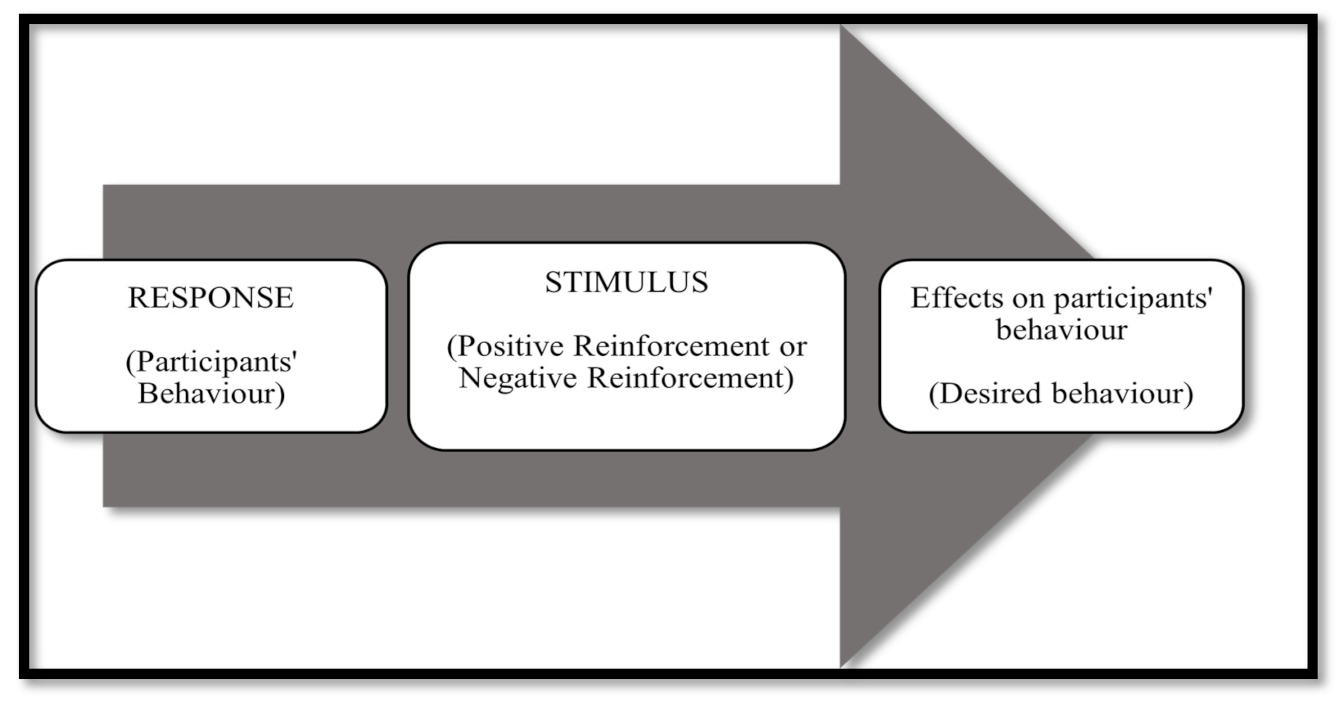

| Operant Behavior | |
|---|---|
| Positive reinforcement • Praise • Monetary rewards • Natural reinforcers • Social reinforcers • Tangible reinforcers • Token reinforcers | Negative reinforcement • Taking away • Removing |
| Criteria | Inclusion Criteria | Exclusion Criteria |
|---|---|---|
| Focus of study | Token economy in education | Token economy in different settings |
| Participants | Learners/students/pupils | Non learners/students/pupils |
| Types of intervention | Positive reinforcement | Negative reinforcement |
| Context of study | Types of token economy/intervention procedure | No information on types of token economy used |
| Types of outcomes | Behavior management and learning engagement | No information on behavior management and learning engagement |
| Positive Reinforcement | |
|---|---|
| Physical reinforcers • Cookies • Books • Stickers • Candy • Gifts • Crayons • Pencils • Chocolates • Plaques • Fruits • Certificates • Counterfeit money | Activity reinforcers • Choose a game • Recess/break • Extra time • Watch TV • Play • Snack with the teacher • No homework for a week |
| Social reinforcers • Grades • Applause • Smiles • Stickers • Awards • Compliments • Nomination in the school bulletin • Hand stamp • Display work | Rental privileges • Games • Hand puppets • Laptop • Table toys • Sports • Books • CDs • Magazines • Colouring books • Jump rope |
| • Classroom privileges • Constructing rules • Collecting books • Being a tutor • Being the monitor • Be first in line | |
| Negative Reinforcement | |
|---|---|
| Warning Memorizing vocabulary Decreasing students’ points Moving students’ seats | Inconvenient punishment Timeouts/timeout chairs Deprivation of their favorite activities/items Running around the field Standing in the area Doing assignments outside the classroom Standing in front of the class Throwing away the rubbish |
| Spoken punishment Use nonverbal cues Use a penalty Assign detention or timeout Design an individual contract Punishment by words Punishment by action | Physical punishment Pinching |
| Study | Objective | Intervention | Results |
|---|---|---|---|
| [6] | The purpose of this study was to compare the effectiveness of two kinds of reinforcements, tangible reinforcements and social reinforcements, on the academic achievement of eighth-grade female students with intellectual disabilities in the science subject. | Physical reinforcer and social reinforcement |
|
| [7] | The research aimed to determine the effect of the application of the token economy method on mathematics learning motivation. | Token economy |
|
| [8] | This paper discusses a study on students’ and teachers’ perceptions of the token economy system and the means of the implementation in Saudi schools. | Physical reinforcer |
|
| [9] | The study aimed to define the effect of a token economy system in improving social, academic, and behavior skills with children. | Token economy | Using a token economy helps students to accomplish the targeted reactions. A positive learning environment is a recipe for increasing students’ participation in academic activities. Furthermore, by extending the positive behaviors that children exhibit in the classroom to other areas, students can improve their social skills. |
| [10] | The purpose of this study was to employ and evaluate the use of a spelling racetrack with a single general education student with low performance in spelling. | Racetrack reward system | Significant differences were found for treatment for correct answers (F = 32; df = 3; p = 0.0004) and errors (F = 26; df = 3; p = 0.001). Follow-up tests using a Schefft’s F test found significant differences for correct answers and for errors, except for the initial baseline and the last baseline |
| [11] | This study aimed to increase students’ concentration on learning and facilitate this process in the classroom. | Physical reinforcer | The use of token economies helps to improve students’ attentiveness while completing assignments. |
| [12] | This study aimed to examine the effects of using positive reinforcement techniques to reduce disruptive behavior among children on the Attention Deficit Hyperactive Disorder (ADHD) Integrated Special Education Program (PPKI) in a school in Kuala Lumpur | Positive reinforcement and rewarding technique | There was a decrease in disruptive behavior and an improvement in pupils’ attentiveness. |
| [13] | To evaluate the effectiveness of the token economy by recording the degree of participation in an introductory psychology class before, during, and after implementation of the token economy | Token economy | Level of directed and nondirected participation grew during the token economy and then returned to baseline after the token economy was removed. |
| [14] | The aim of this study was to analyze the relationship between a token reward system and reading comprehension scores | Physical reinforcer |
|
| [15] | To describe how tangible rewards can improve students’ motivation | Physical reinforcer | Pupils were motivated to engage because they were given a physical reinforcer. |
| [16] | To study how behavior modification can be used to enhance students’ English handwriting. | Token economy, Differential Reinforcement of Low Rates (DRL) |
|
| [17] | The purpose of this study was to realize a predictive model of rewards and identify reward predictors for reading motivation. | Physical reinforcer, social reinforcer |
|
| [18] | To evaluate the effectiveness of the use of cards in a trading card game as education rewards. | Web-based multiplayer trading card game to allow teachers to choose cards as rewards |
|
| [19] | The purpose of this study was to examine the effects of a token economy, in the form of a lottery system, on noncompliant behavior for a group of 10 3rd grade students enrolled in a K-8th grade urban school. | Token economy |
|
| [20] | To determine Kinesiology students’ perceptions of a token economy in flipped Human Anatomy and Physiology I and II courses | Physical reinforcer |
|
| [21] | The present study depicted the utility of including basic behavior-analytic principles and strategies to facilitate on-task behavior in a classroom for individuals with autism | Physical reinforcer |
|
| [22] | Evaluate the use of achievement badges in the TRAKLA2 online learning environment, where students solve interactive, automatically assessed exercises in a Data Structures and Algorithms course throughout the semester | Achievement badges |
|
| [23] | The present research was undertaken to determine the effectiveness of a token economy in reducing temper tantrums among children with intellectual disabilities. | Token economy |
|
| [24] | The purpose of this investigation was to determine if a token reinforcement program could decrease three inappropriate behaviors (getting out of seat, shouting out, and poor posture) in an elementary student with learning disabilities. | Token economy |
|
| [25] | The purpose of this study was to evaluate the effectiveness of a reading racetrack with direct instruction flashcards and a token system on sight word acquisition for two primary students with severe conduct disorders | Token economy |
|
| [26] | The study centered on determining the effect of a token economy on the academic achievement of secondary school students. | Token economy |
|
| [27] | This study aimed to investigate the effect of reward and punishment on student achievement and discipline | Physical reinforcer, social reinforcer | The effect of reward and punishment on student accomplishment and discipline, among other things, improves students’ excitement for learning, pushes students to sustain their achievements, and makes students more disciplined in their studies. |
| [28] | The purpose of this study was to determine the effectiveness of a token economy in improving the attention of children with ADHD when completing a task. | Token economy |
|
| [29] | The purpose of this research was to find out the eighth grade students’ motivation in learning English after given rewards at the SMPN 3 Rambah. | Physical reinforcer |
|
| [30] | The purpose of the present case report was to evaluate the effects of an individual token economy with a young child with a severe behavioral disorder. | Token system |
|
| [31] | To examine the link between intrinsic motivation and external rewards by describing the experiences of twenty-seven academically underperforming adolescents who were enrolled in an after-school program in a New York City public junior high school that implemented a token economy. | Physical reinforcer |
|
| [32] | Objectives of this study were to increase spontaneous requests and decrease challenging behaviors among children with autism by introducing a secondary reinforcer during therapy based on the ABA model | Physical reinforcer, social reinforcer |
|
| [33] | This study aimed to apply a learning model including development of a syllabus and a Learning Implementation Plan (RPP). | Token economy |
|
| [34] | The study explored whether this impairment can be remediated by increasing rewards for correct responding or by reinforcing correct conditional choice behavior with situationally specific outcomes (differential outcomes) | Physical reinforcer |
|
| [35] | This study investigated students’ perceptions of the use of rewards in the classroom for enhancing behaviors and self- development | Physical reinforcer and social reinforcer |
|
| [36] | This study will also focus on the benefits of potential rewards in motivating EYL students in learning English. | Physical reinforcer, activity reinforcer, social reinforcer |
|
| [37] | The purpose of this study was to analyze the types of reward and punishment, as well as looking at the possible reasons that they are used by teachers. | Physical reinforcer, activity reinforcer, social reinforcer |
|
| [38] | To determine the effect of economic token therapy for reducing attachment behavior among kindergarten students. | Token economy |
|
| [39] | To design and develop behavior modification programs through a token economy | Token economy |
|
| [40] | This purpose of this study was to investigate the effects of implementing a web-based token economy, ClassDojo, on the academic behavior and performance of undergraduate sales students at a large AACSB-accredited university | Token economy |
|
| [41] | This research sought to examine and determine the impact that the token economy system as a behavior modifier has on disruptive behavior in classrooms among a group of primary level students in the parish of Manchester, Jamaica. | Token economy |
|
| [42] | This study was intended to examine the effectiveness of behavioral counselling with a token economy and behavior contract techniques to reduce academic procrastination in students of SMP IT Insan Cendekia Semarang. | Token economy and behavior contract techniques |
|
| [43] | The purpose of this study was to investigate whether third-grade literacy students who receive incentive rewards as part of their instruction would exhibit significantly higher reading habits and attitudes toward recreational reading than they did before the incentives were introduced. | Physical reinforcer |
|
| [44] | The purpose of the study was to determine the relationship between teacher and students in terms of reinforcements, their effectiveness, and the academic performance of primary school students in the Allahabad district. | Physical reinforcer |
|
| [45] | This research is based on how the teacher builds learning motivation in 5–6-year-old children | Social reinforcer |
|
| [46] | The purpose of this research was to determine the effects of verbal rewards and punishments on gross motor learning for children 4–5 years old. | Social reinforcer and punishment |
|
| [47] | The efficacy of three behavior management techniques used in a Head Start classroom was examined. The three techniques included: (a) techniques currently used by the teacher, (b) response cost, and (c) the level system (token economy). | Reinforcement and token economy |
|
| [48] | This study examined the effectiveness of a token economy combined with a mystery motivator in decreasing inappropriate behaviors displayed by a student with an autism spectrum disorder in a small group setting. | Mystery rewards, points chart |
|
| [49] | This study aimed to determine the effectiveness of using a token economy in reducing the negative behavior of autistic students. | Economy token and rewards |
|
| [50] | The current study examined the effectiveness of a combined token economy and self-monitoring package with youths displaying a major mental illness and severe aggressive and persistent disruptive behaviors. | Token economy and self-monitoring |
|
Publisher’s Note: MDPI stays neutral with regard to jurisdictional claims in published maps and institutional affiliations. |
© 2021 by the authors. Licensee MDPI, Basel, Switzerland. This article is an open access article distributed under the terms and conditions of the Creative Commons Attribution (CC BY) license (https://creativecommons.org/licenses/by/4.0/).
Share and Cite
Tan, K.H.; Kasiveloo, M.; Abdullah, I.H. Token Economy for Sustainable Education in the Future: A Scoping Review. Sustainability 2022, 14, 716. https://doi.org/10.3390/su14020716
Tan KH, Kasiveloo M, Abdullah IH. Token Economy for Sustainable Education in the Future: A Scoping Review. Sustainability. 2022; 14(2):716. https://doi.org/10.3390/su14020716
Chicago/Turabian StyleTan, Kim Hua, Mathura Kasiveloo, and Imran Ho Abdullah. 2022. "Token Economy for Sustainable Education in the Future: A Scoping Review" Sustainability 14, no. 2: 716. https://doi.org/10.3390/su14020716
APA StyleTan, K. H., Kasiveloo, M., & Abdullah, I. H. (2022). Token Economy for Sustainable Education in the Future: A Scoping Review. Sustainability, 14(2), 716. https://doi.org/10.3390/su14020716

