


The Metabolic Demand of Firefighting: A Systematic Review

 ,
,  ,
,  ,
, 
Abstract
1. Introduction
2. Results
2.1. Occupational Tasks
2.2. Time Duration
2.3. Oxygen Uptake (VO2)
2.4. Metabolic Equivalents (METS)
3. Discussion
3.1. Average Metabolic Demand of Firefighting Tasks
3.2. Metabolic Demand of Individual Firefighting Tasks
3.2.1. Stair/Ladder Climbing
3.2.2. Victim Drag/Rescue
3.2.3. Hose Carry and Fire Suppression
3.2.4. Limitations
4. Materials and Methods
4.1. Search Strategy and Information Sources
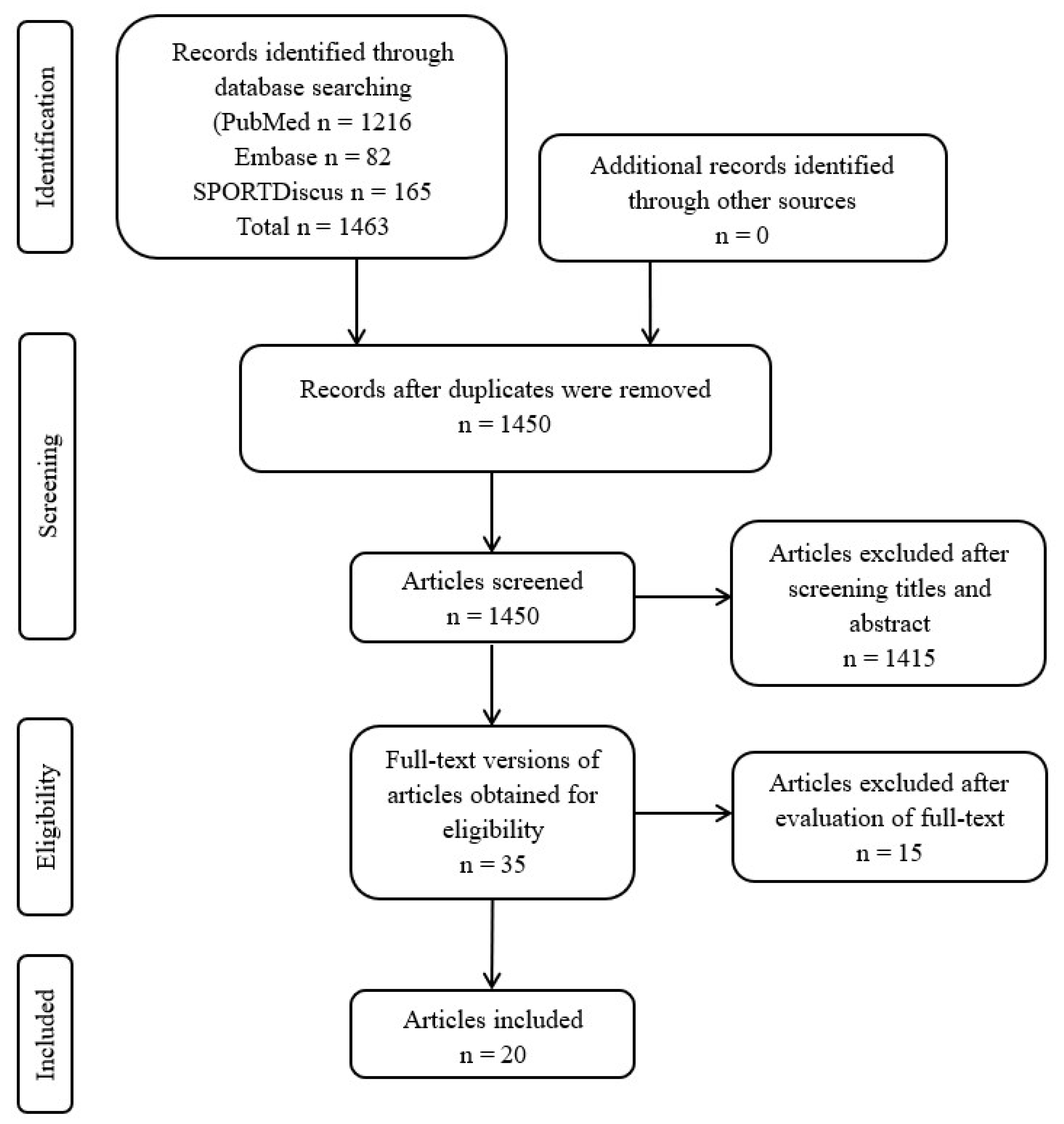
4.2. Selection Process
4.3. Eligibility Criteria
4.4. Data Extraction and Data Items
4.5. Risk of Bias Assessment
5. Conclusions
Author Contributions
Funding
Conflicts of Interest
References
- Lesniak, A.Y.; Bergstrom, H.C.; Clasey, J.L.; Stromberg, A.J.; Abel, M.G. The Effect of Personal Protective Equipment on Firefighter Occupational Performance. J. Strength Cond. Res. 2020, 34, 2165–2172. [Google Scholar] [PubMed]
- Perroni, F.; Tessitore, A.; Cibelli, G.; Lupo, C.; D’Artibale, E.; Cortis, C.; Cignitti, L.; De Rosas, M.; Capranica, L. Effects of simulated firefighting on the responses of salivary cortisol, alpha-amylase and psychological variables. Ergonomics 2009, 52, 484–491. [Google Scholar] [PubMed]
- Smith, D.L.; Petruzzello, S.J.; Chludzinski, M.A.; Reed, J.J.; Woods, J.A. Selected hormonal and immunological responses to strenuous live-fire firefighting drills. Ergonomics 2005, 48, 55–65. [Google Scholar]
- Williams-Bell, F.M.; Villar, R.; Sharratt, M.T.; Hughson, R.L. Physiological demands of the firefighter Candidate Physical Ability Test. Med. Sci. Sports Exerc. 2009, 41, 653–662. [Google Scholar] [PubMed]
- Zare, S.; Hemmatjo, R.; Allahyari, T.; Hajaghazadeh, M.; Hajivandi, A.; Aghabeigi, M.; Kazemi, R. Comparison of the effect of typical firefighting activities, live fire drills and rescue operations at height on firefighters’ physiological responses and cognitive function. Ergonomics 2018, 61, 1334–1344. [Google Scholar] [CrossRef]
- Elsner, K.L.; Kolkhorst, F.W. Metabolic demands of simulated firefighting tasks. Ergonomics 2008, 51, 1418–1425. [Google Scholar]
- Louhevaara, V.; Ilmarinen, R.; Griefahn, B.; Kunemund, C.; Makinen, H. Maximal physical work performance with European standard based fire-protective clothing system and equipment in relation to individual characteristics. Eur. J. Appl. Physiol. Occup. Physiol. 1995, 71, 223–229. [Google Scholar] [PubMed]
- Marcel-Millet, P.; Ravier, G.; Groslambert, A. Effect of Protective Equipment on Firefighters’ External and Internal Workloads During a Simulated Rescue Intervention. J. Strength Cond. Res. 2022, 36, 2291–2297. [Google Scholar] [PubMed]
- Taylor, N.A.; Lewis, M.C.; Notley, S.R.; Peoples, G.E. A fractionation of the physiological burden of the personal protective equipment worn by firefighters. Eur. J. Appl. Physiol. 2012, 112, 2913–2921. [Google Scholar]
- Michaelides, M.A.; Parpa, K.M.; Henry, L.J.; Thompson, G.B.; Brown, B.S. Assessment of physical fitness aspects and their relationship to firefighters’ job abilities. J. Strength Cond. Res. 2011, 25, 956–965. [Google Scholar]
- National Fire Protection Association NFPA. Standard on Health-Related Fitness Programs for Fire Department Members. Available online: https://www.nfpa.org/codes-and-standards/all-codes-and-standards/list-of-codes-and-standards/detail?code=1583 (accessed on 10 October 2024).
- Kales, S.N.; Soteriades, E.S.; Christophi, C.A.; Christiani, D.C. Emergency duties and deaths from heart disease among firefighters in the United States. N. Engl. J. Med. 2007, 356, 1207–1215. [Google Scholar] [CrossRef] [PubMed]
- Fahy, R.F.; Petrillo, J.T. Firefighter Fatalities in the US in 2021. Available online: https://www.usfa.fema.gov/downloads/pdf/publications/firefighter-fatalities-2021.pdf (accessed on 10 October 2024).
- Butcher, S.J.; Jones, R.L.; Eves, N.D.; Petersen, S.R. Work of breathing is increased during exercise with the self-contained breathing apparatus regulator. Appl. Physiol. Nutr. Metab. 2006, 31, 693–701. [Google Scholar] [CrossRef]
- Smith, D.L.; Petruzzello, S.J.; Kramer, J.M.; Misner, J.E. The effects of different thermal environments on the physiological and psychological responses of firefighters to a training drill. Ergonomics 1997, 40, 500–510. [Google Scholar] [CrossRef] [PubMed]
- Ensari, I.; Motl, R.W.; Klaren, R.E.; Fernhall, B.; Smith, D.L.; Horn, G.P. Firefighter exercise protocols conducted in an environmental chamber: Developing a laboratory-based simulated firefighting protocol. Ergonomics 2017, 60, 657–668. [Google Scholar] [CrossRef] [PubMed]
- Louhevaara, V.; Smolander, J.; Korhonen, O.; Tuomi, T. Maximal working times with a self-contained breathing apparatus. Ergonomics 1986, 29, 77–85. [Google Scholar] [CrossRef]
- Sothmann, M.; Saupe, K.; Raven, P.; Pawelczyk, J.; Davis, P.; Dotson, C.; Landy, F.; Siliunas, M. Oxygen consumption during fire suppression: Error of heart rate estimation. Ergonomics 1991, 34, 1469–1474. [Google Scholar] [CrossRef]
- Perroni, F.; Guidetti, L.; Cignitti, L.; Baldari, C. Absolute vs. weight-related maximum oxygen uptake in firefighters: Fitness evaluation with and without protective clothing and self-contained breathing apparatus among age group. PLoS ONE 2015, 10, e0119757. [Google Scholar] [CrossRef]
- Perroni, F.; Tessitore, A.; Lupo, C.; Cortis, C.; Cignitti, L.; Capranica, L. Do Italian fire fighting recruits have an adequate physical fitness profile for fire fighting? Sport Sci. Health 2009, 4, 27–32. [Google Scholar] [CrossRef]
- Dreger, R.W.; Jones, R.L.; Petersen, S.R. Effects of the self-contained breathing apparatus and fire protective clothing on maximal oxygen uptake. Ergonomics 2006, 49, 911–920. [Google Scholar] [CrossRef]
- Lee, J.Y.; Bakri, I.; Kim, J.H.; Son, S.Y.; Tochihara, Y. The impact of firefighter personal protective equipment and treadmill protocol on maximal oxygen uptake. J. Occup. Environ. Hyg. 2013, 10, 397–407. [Google Scholar] [CrossRef]
- Kesler, R.M.; Ensari, I.; Bollaert, R.E.; Motl, R.W.; Hsiao-Wecksler, E.T.; Rosengren, K.S.; Fernhall, B.; Smith, D.L.; Horn, G.P. Physiological response to firefighting activities of various work cycles using extended duration and prototype SCBA. Ergonomics 2018, 61, 390–403. [Google Scholar] [PubMed]
- Tofari, P.J.; Laing Treloar, A.K.; Silk, A.J. A quantification of the physiological demands of the army emergency responder in the Australian army. Mil. Med. 2013, 178, 487–494. [Google Scholar] [CrossRef] [PubMed]
- von Heimburg, E.; Medbo, J.I. Energy cost of the Trondheim firefighter test for experienced firefighters. Int. J. Occup. Saf. Ergon. 2013, 19, 211–225. [Google Scholar]
- Adams, J.; Roberts, J.; Simms, K.; Cheng, D.; Hartman, J.; Bartlett, C. Measurement of functional capacity requirements to aid in development of an occupation-specific rehabilitation training program to help firefighters with cardiac disease safely return to work. Am. J. Cardiol. 2009, 103, 762–765. [Google Scholar] [PubMed]
- Bycura, D.K.; Dmitrieva, N.O.; Santos, A.C.; Waugh, K.L.; Ritchey, K.M. Efficacy of a Goal Setting and Implementation Planning Intervention on Firefighters’ Cardiorespiratory Fitness. J. Strength Cond. Res. 2019, 33, 3151–3161. [Google Scholar]
- Dreger, R.W.; Petersen, S.R. Oxygen cost of the CF-DND fire fit test in males and females. Appl. Physiol. Nutr. Metab. 2007, 32, 454–462. [Google Scholar]
- Holmer, I.; Gavhed, D. Classification of metabolic and respiratory demands in fire fighting activity with extreme workloads. Appl. Ergon. 2007, 38, 45–52. [Google Scholar]
- Mamen, A.; Heimburg, E.D.V.; Oseland, H.; Medbo, J.I. Examination of a new functional firefighter fitness test. Int. J. Occup. Saf. Ergon. 2021, 27, 460–471. [Google Scholar]
- Mamen, A.; Oseland, H.; Medbo, J.I. A comparison of two physical ability tests for firefighters. Ergonomics 2013, 56, 1558–1568. [Google Scholar] [CrossRef]
- Williams-Bell, F.M.; Boisseau, G.; McGill, J.; Kostiuk, A.; Hughson, R.L. Physiological responses and air consumption during simulated firefighting tasks in a subway system. Appl. Physiol. Nutr. Metab. 2010, 35, 671–678. [Google Scholar]
- Bilzon, J.L.; Scarpello, E.G.; Smith, C.V.; Ravenhill, N.A.; Rayson, M.P. Characterization of the metabolic demands of simulated shipboard Royal Navy fire-fighting tasks. Ergonomics 2001, 44, 766–780. [Google Scholar] [CrossRef] [PubMed]
- Burdon, C.A.; Carstairs, G.L.; Linnane, D.M.; Middleton, K.J. Identifying Physically Demanding Tasks Performed by the Royal Australian Navy for the Development of a Physical Employment Standard. J. Occup. Environ. Med. 2019, 61, e384–e393. [Google Scholar] [CrossRef]
- Perroni, F.; Tessitore, A.; Cortis, C.; Lupo, C.; D’Artibale, E.; Cignitti, L.; Capranica, L. Energy cost and energy sources during a simulated firefighting activity. J. Strength Cond. Res. 2010, 24, 3457–3463. [Google Scholar] [CrossRef] [PubMed]
- Siddall, A.G.; Stevenson, R.D.; Turner, P.F.; Stokes, K.A.; Bilzon, J.L. Development of role-related minimum cardiorespiratory fitness standards for firefighters and commanders. Ergonomics 2016, 59, 1335–1343. [Google Scholar]
- von Heimburg, E.D.; Rasmussen, A.K.; Medbo, J.I. Physiological responses of firefighters and performance predictors during a simulated rescue of hospital patients. Ergonomics 2006, 49, 111–126. [Google Scholar] [CrossRef]
- Williams-Bell, F.M.; Boisseau, G.; McGill, J.; Kostiuk, A.; Hughson, R.L. Air management and physiological responses during simulated firefighting tasks in a high-rise structure. Appl. Ergon. 2010, 41, 251–259. [Google Scholar]
- Säynäjäkangas, P.; Halonen, J.; Lusa, S.; Borgenström, J.; Kukonlehto, T.; Tuomi, P.; Kotamäki, A.; Pietilä, T.; Mänttäri, A.; Punakallio, A. Metabolic demands of a simulated smoke-diving drill. Ergonomics 2024, 67, 1524–1534. [Google Scholar] [PubMed]
- Walker, A.; Argus, C.; Driller, M.; Rattray, B. Repeat work bouts increase thermal strain for Australian firefighters working in the heat. Int. J. Occup. Environ. Health 2015, 21, 285–293. [Google Scholar] [CrossRef]
- Taylor, N.A.; Peoples, G.E.; Petersen, S.R. Load carriage, human performance, and employment standards. Appl. Physiol. Nutr. Metab. 2016, 41, S131–S147. [Google Scholar] [CrossRef]
- Abel, M.G.; Mortara, A.J.; Pettitt, R.W. Evaluation of circuit-training intensity for firefighters. J. Strength Cond. Res. 2011, 25, 2895–2901. [Google Scholar] [CrossRef]
- Wu, H.C.; Wang, M.J. Relationship between maximum acceptable work time and physical workload. Ergonomics 2002, 45, 280–289. [Google Scholar] [CrossRef] [PubMed]
- Smith, D.L.; Horn, G.P.; Goldstein, E.; Petruzzello, S.J. Firefighter fatalities and injuries: The role of heat stress and PPE. 2008. Available online: https://www.fsi.illinois.edu/documents/research/fflsrc_finalreport.pdf (accessed on 13 January 2025).
- Gleeson, M. Temperature regulation during exercise. Int. J. Sports Med. 1998, 19 (Suppl. 2), S96–S99. [Google Scholar] [CrossRef]
- Page, M.J.; McKenzie, J.E.; Bossuyt, P.M.; Boutron, I.; Hoffmann, T.C.; Mulrow, C.D.; Shamseer, L.; Tetzlaff, J.M.; Akl, E.A.; Brennan, S.E.; et al. The PRISMA 2020 statement: An updated guideline for reporting systematic reviews. BMJ 2021, 372, n71. [Google Scholar] [CrossRef] [PubMed]
- Ainsworth, B.E.; Haskell, W.L.; Whitt, M.C.; Irwin, M.L.; Swartz, A.M.; Strath, S.J.; O’Brien, W.L.; Bassett, D.R., Jr.; Schmitz, K.H.; Emplaincourt, P.O.; et al. Compendium of physical activities: An update of activity codes and MET intensities. Med. Sci. Sports Exerc. 2000, 32, S498–S504. [Google Scholar] [CrossRef] [PubMed]
- Jette, M.; Sidney, K.; Blumchen, G. Metabolic equivalents (METS) in exercise testing, exercise prescription, and evaluation of functional capacity. Clin. Cardiol. 1990, 13, 555–565. [Google Scholar] [CrossRef]
- Dixon-Woods, M.; Sutton, A.; Shaw, R.; Miller, T.; Smith, J.; Young, B.; Bonas, S.; Booth, A.; Jones, D. Appraising qualitative research for inclusion in systematic reviews: A quantitative and qualitative comparison of three methods. J. Health Serv. Res. Policy 2007, 12, 42–47. [Google Scholar]

| Author Population | Firefighting Tasks | Age (Years) | Time Duration (s) | Heart Rate (bpm) | Mean RVO2 (mL·kg−1·min−1) | Mean METS | CASP Score |
|---|---|---|---|---|---|---|---|
| Adams et al. 2009 23 healthy male firefighters | Full obstacle course **: 1. Ladder carry, raise, and extension (4.3 m foot ladder) 2. Forcible entry (used a 5.1 kg sledge hammer) 3. High-rise pack (carried a 26.8 kg high-rise hose for 5 floors) 4. Hand line advancement (advanced a charged double-jacketed hand line for 22.9 m). Crawled for 15.2 m and pulled the hose for 15.2 m. 5. Victim rescue (lifted and dragged a 74.8 kg dummy for 22.9 m) 6. Pike Pole (simulated pulling ceilings 7. Equipment Carry (walked 25.9 m with a 10.9 kg chainsaw, then another 25.9 m with a 21.1 kg smoke ejector) Firefighters walked a total of 123.4 m between events. | 31.7 ± 8.5 | not informed | 170 ± 9 (mean) | 41.7 * | 11.9 ± 1.5 | 7/11 |
| Bilzon et al. 2001 34 male and 15 female Royal Navy personnel | Two simulated demanding Royal Navy firefighting tasks while wearing PPE and SCBA: 1. Descended a 2.8 m ladder while carrying a 10 kg hose under the arm. They dropped the hose, walked a distance of 14 m and ascended a 2 m ladder back to starting point. Cycle was repeated six times 2. Supported a 10 kg hose with the right hand and opened the nozzle to spray a wall in a “figure-of-eight” motion. Hose was on for 20 s then off for 10 s. Cycle was repeated eight times. | 26 ± 6.9 (males) 26 ± 5.8 (females) | 1. 240 2. 240 | 1. Males: Not informed 2. Males: 149 ± 23 1. Females: 166–176 2. Females: 166–176 (mean during last minute of tasks) | 1. Males: 39 ± 5 2. Males: 23 ± 6 1. Females: 34 ± 5 2. Females: 24 ± 6 | 1. Males: 11.1 * 2. Males: 6.6 * 1. Females: 9.7 * 2. Females 6.9 * | 9/11 |
| Burdon et al. 2019 11 male and 1 female Royal Australian Navy personnel | Three simulations: 1. Firefighting (teams of two): Walked 45 m, descended a 2.7 m ladder, and performed gas cooling for 8 min while holding a 4.5 kg nozzle close to the body. 2. Toxic Hazard 1 (teams of three): Descended two ladders, walked 22.5 m and placed an emergency lift support on a 70 kg dummy. They then ascended a ladder and pulled the dummy with lifting support. 3. Toxic Hazard 2 (teams of two): Walked 22.5 m. One dragged a 70 kg dummy for 15 m and assisted with the fire hose lift. Both firefighters performed a lift and carry with the 70 kg dummy. | 26.4 ± 6.2 | 1. 769 2. 418 3. 485 | 1. 126 ± 16 (mean) 147 ± 18 (peak) 2. 131 ± 15 (mean) 163 ± 16 (peak) 3. 134 ± 17 (mean) 174 ± 11 (peak) | 1. 16.6 ± 3.0 2. 18.4 ± 2.9 3. 20.2 ± 3.7 | 1. 4.7 * 2. 5.3 * 3. 5.8 * | 8/11 |
| Bycura et al. 2019 20 male firefighters | Modified CPAT ** 1. Stair Climb: Firefighters walked up and down a stairwell for 3 min at a pace of 60 steps per min while carrying a 11.3 kg hose over right shoulder. 2. Hose Drag: Replicated CPAT event. 3. Equipment Carry: Used two 11.3 kg weight places to simulate saws. 4. Ladder Raise and Extension: Replicated CPAT event. 5. Forcible Entry: Firefighters struck a car quarter panel 10 times using a 4.5 kg sledge hammer. 6. Search: Replicated CPAT event through a darkened burn room. 7. Rescue: Replicated CPAT event with 77.1 kg hose. 8. Ceiling Breach and Pull: Firefighters raised a 20.4 kg Olympic barbell simulating the pike pole overhead 3 times. They then grasped the rope of a fixed 0.6 m extension ladder as high up and down 5 times. Sequence was repeated 4 times. | 44.1 ± 6.4 | 900 | 157 ± 2 (mean) | 25.2 | 7.2 * | 8/11 |
| Dreger & Petersen 2007 30 male and 23 female firefighters | Firefighters had to complete a simulated firefighter work circuit as fast as possible. 1. Hose Carry: 16.5 kg hose for 15.24 m. 2. Ladder Carry and Raise: 13.6 kg ladder for 15.24 m. 3. Hose Drag: With nozzle on shoulder, they walked 30.48 m. 4. Ladder Climb 1: Climbed up and down (3.45 m) 3 times. 5. Rope Pull: Pulled a 16 mm static nylon rope attached to a bundle of hose. 6. Forcible Entry: Hammered a rubber truck tire filled with sand bags with a 4.5 kg sledge hammer. 7. Victim Rescue: Dragged a 68.2 kg mannequin for 30.48 m. 8. Ladder Climb 2: Climbed up and down (3.45 m) 3 times. 9. Ladder Lower and Carry: Lowered a 3.6 m aluminum roof ladder (13.6 kg) and carried it for 15.24 m. 10. Spreader Tool Carry: Picked and carried a 36.4 spreader tool for 15.24 m. | 29.0 ± 6.8 (males) 25.8± 5.6 (females) | Males: 365.2 ± 56.3 Females: 442.3 ± 50.8 | Males: 168 ± 10 (mean) Females: 171 ± 12 (mean) | Males: 42.4 ± 4.4 Females: 34.8 ± 4.0 | Males: 12.1 * Females: 9.9 * | 9/11 |
| Elsner & Kolkhorst 2008 20 male active firefighters | Firefighters had to complete a simulated firefighter work circuit as fast as possible. 1. Moved a 41 kg hose for 35 m and connected to a hydrant. 2. Carried a 33 kg ladder for approximately 30 m and raised it to a window. 3. Donned their SCBA without putting regulator in mouth. 4. Advanced two sections of a fire hose (82 kg) for 20 m. 5. Hammered a 75 kg wood block with a 4.5 kg sledgehammer. 6. Climbed three flights of stairs. 7. Pulled the two sections of the fire hose (82 kg) with a rope from ground to third floor. 8. Advanced a fire hose through a cluttered area for 30 m. 9. Returned to ground level while shoulder loading a fire hose pack (23 kg). 10. Located a 75 kg mannequin and dragged it for 30 m. | 37.4 ± 8.5 | 699 ± 132 | 175 ± 7 (mean) | 29.1 ± 8.0 | 8.3 ± 2.2 | 8/11 |
| Ensari et al. 2017 20 male and 1 female firefighters | Firefighters performed four tasks inside an environmental chamber (temperature 47 °C and humidity 30%). All tasks were performed for two minutes with two minutes of rest in between. 1. Stair Climb. 2. Hose Advance. 3. Search. 4. Overhaul. | 29 ± 8.2 | 1. 120 2. 120 3. 120 4. 120 | Approximate values 1. 162 2. 175 3. 178 4. 182 (mean) | 1. 37.5 2. 34.2 3. 37.8 4. 31.4 | 1. 10.7 * 2. 9.8 * 3. 10.8 * 4. 8.9 * | 9/11 |
| Holmér & Gavhed 2007 15 male professional firefighters | Typical firefighting tasks were completed as fast as possible. 1. Walked/ran on flat ground. 2. Climbed three flights of stairs in a tower and descended four flights. 3. Walked/ran to and crawled through a narrow passage. 4. Walked/ran to and through a house in ruins with two shields at each side. 5. Walked/ran to a house and went up and down three flights of stairs. 6. Repeated 3, 4, and 1. | 34.9 ± 8.3 | 1337 ± 205 | 168 ± 11 (mean) | 33.9 | 9.7 * | 8/11 |
| Kesler et al. 2017 29 male firefighters and 1 female firefighter | Firefighting activities performed in an environmental chamber (temperature 47 °C and humidity 30%). All tasks performed for two minutes. Three different variations with same activities (a. Stair Climb; b. Hose Advance; c. Search; d. Overhaul). 1. 2 min rest between tasks. 2. 2 min rest between tasks and executed each task twice with 5 min rest outside chamber before the second bout. 3. 2 min rest between tasks and executed each task twice. | 30.4 ± 1.5 | 1. 1140 2. 2280 3. 2100 | Results from a single-bout 30 min cylinder SCBA a. 163 ± 2 b. 176 ± 2 c. 177 ± 2 d. 180 ± 2 (peak) | Results from a single-bout 30 min cylinder SCBA (RVO2 peak) a = 28.4 ± 0.9 b = 24.9 ± 0.7 c = 25.0 ± 0.8 d = 19.8 ± 0.7 | Results from a single-bout 30 min cylinder SCBA (RVO2 peak) a = 8.1 * b = 7.1 * c = 7.1 * d = 5.7 * | 9/11 |
| Mamen et al. 2013 20 male professional firefighters and 1 senior officer | Firefighters performed the 10 events of the Canadian Test (Dreger & Petersen 2007) as fast as possible. They were not allowed to run. | 38 ± 7 | 327 ± 26 | 174 ± 12 (peak) | Approximately 40 | Approximately 11.4 * | 8/11 |
| Mamen et. al. 2021 33 male professional firefighters | Firefighters performed the Fredrikstad Test, a modified version of the Canadian Test (Dreger & Petersen 2007, Mamen et al. 2013). An additional hose drag was added after “ladder climb 2” and “ladder climb 3” was added after the “ladder lower and carry”. A total of 12 tasks were completed. | 37 ± 7 | 596 ± 66 | 179 ± 11 (peak) | Approximately 40 | Approximately 11.4 * | 8/11 |
| Perroni et al. 2010 20 male professional firefighters | Firefighters completed a total of four tasks: 1. Child Rescue: Climbed a firemen’s ladder and descended a 3-floor building carrying a 20 kg child dummy. 2. 250 m Run 1. 3. Find an Exit: Completed a maze in a dark chamber. 4. 250 m Run 2. | 32 ± 6 | 1. 81.8 ± 25.3 2. 92.8 ± 24.6 3. 437.5 ± 116.6 4. 91.5 ± 23.7 | 1. 145 ± 21 2. 166 ± 9 3. 165 ± 10 4. 170 ± 14 (mean) | 1. 29.4 ± 6.8 2. 38.5 ± 6.5 3. 28.2 ± 6.8 4. 34.9 ± 7.1 | 1. 8.4 * 2. 11.0 * 3. 8.1 * 4. 9.9 * | 8/11 |
| Säynäjäkangas et al. 2024 34 male and 3 female firefighters | Firefighters completed an updated version of the Finish smoke-diving drill that comprised 5 tasks: 1. Walking without and with two rolls of hose. 2. Stair climbing: Ascended and descended stairs until a total vertical ascent of 20 m was reached. 3. Hammering a truck tire: Performed this task until the truck tire had moved 3 m. 4. Hose pull: Pulled the hose through obstacles. Task was performed twice. 5. Hose rolling. | 36.1 ± 9.0 | 1. 158.9 ± 17.1 2. 152.4 ± 15.2 3. 49.2 ± 26.4 4. 159.6 ± 43.3 5. 70.4 ± 13.2 | 1. 117 ± 12 2. 137 ± 12 3. 153 ± 14 4. 164 ± 10 5. 157 ± 13 (mean) | 1. 20.8 ± 2.8 2. 28.9 ± 2.4 3. 25.1 ± 2.0 4. 35.2 ± 4.6 5. 26.6 ± 3.7 | 1. 5.9 * 2. 8.3 * 3. 7.2 * 4. 10.1 * 5. 7.6 * | 9/11 |
| Siddall et al. 2016 50 male and 12 female operational firefighters | Firefighters completed a total of five tasks: 1. Hose Run: Took turns carrying four 13 kg hoses from fire engine to hydrant for a total distance of 700 m. 2. Equipment Carry: Carried a 25 kg barbell eight times on a 25 m course. 3. Stair Climb: The ascended six floors while carrying a 50 kg high-rise pack, descended, swapped the high-rise pack for a 25 kg dumbbell and repeated the task. 4. Casualty Evacuation: Took turns carrying/dragging assorted items (37 kg hose reel, 4 kg sledgehammer, and a 55 kg dummy) in a 25 m square course for about 2.5 min 5. Wild-land Fire: Advanced in an undulating grassy terrain while using a standard 5 kg fire beater. They went uphill (50 m) and downhill two times while equipped with the fire beater and two times without (total = 400 m). | 40 ± 10 (males) 37 ± 7 (females) | 1. 305 2. 131 3. 364 4. 150 5. 412 | Peak steady state of males and females combined 1. 171 ± 11 2. 141 ± 16 3. 166 ± 13 4. 159 ± 13 5. 137 ± 14 (mean) | Peak steady state of males and females combined 1. 47 ± 8 2. 29 ± 5 3. 42 ± 7 4. 36 ± 6 5. 29 ± 5 | Peak steady state of males and females combined 1. 13.4 * 2. 8.3 * 3. 12.0 * 4. 10.3 * 5. 8.3 * | 9/11 |
| Sothmann et al. 1991 10 male firefighters | Firefighters completed a total of seven tasks: 1. Climbed four flights of stairs while holding a standard fire-axe. 2. Entered a 54 °C room filled with non-toxic smoke and searched for dummy. 3. Removed a 68 kg dummy from the room and dragged it 15 m down a hallway. 4. Re-entered the smoke room and performed 20 pulls on a simulated pike pole. 5. Walked down three flights of stairs, picked a 23 kg hand pump and carried back the upstairs. 6. Re-entered the smoke room and chopped through a 10 × 10 cm block of wood. 7. Performed 20 more pulls on the simulated pike pole. | 31 ± 8 | 495 ± 143 | 176 ± 10 | 31.0 ± 7.0 | 8.9 * | 7/11 |
| Tofari et al. 2013 10 male Army emergency responders and 3 non-career firefighters | Participants executed a total of 4 tasks: 1. Fire Suppression: Operated a 51 mm charged fire hose and extinguished the fire of three vehicles. 2. Urban Search and Rescue: Entered a building with a 38 mm charged fire hose, searched and evacuated a 30 kg child dummy and a 70 kg adult dummy. Task was executed inside a dark and smoky hot-fire cell environment heated to 70 °C. 3. Stair Climbing Carrying Equipment: Ascended four flights of stairs while carrying a 36 kg pump ventilator. Walked 28.5, dropped the ventilator and descended four flight of stairs. Repeated task while carrying either two 13.6 kg rolled hoses or one rolled hose and one 7.6 kg Halligan tool. 4. Using Cutting Tools. Performed a casualty (75.3 kg dummy) extraction from a simulated vehicle accident. Quick-cut saw (11.5 kg) and cutters (11.7 kg) were used for 5 min. | 28.4 ± 6.4 | 1. 638 2. 1212 3. 544 4. 300 | 1. 155 ± 12 (mean) 170 ± 17 (peak) 2. 130 ± 10 (mean) 153 ± 13 (peak) 3. Not informed 4. Not informed | 1. 23.2 ± 3.3 2. 26.4 ± 1.4 3. 25.9 ± 0.7 4. 16.9 ± 5.5 | 1. 6.6 * 2. 7.6 * 3. 7.4 * 4. 4.8 * | 8/11 |
| Von Heimburg et al. 2007 14 male part-time firefighters | 1. Firefighters climbed six floors. 2. Rescued six simulated patients (total weight 80 kg each) into a safety zone on the same floor. In addition to their firefighting ensemble, they carried a 10 m fire hose, an axe, and a flashlight. Were subdivided into Faster (n = 8) and Slower (n = 6) groups. | 38 ± 9 | 1. 90 ± 31 2. 296 ± 60 | 1. 167 ± 13 2. 182 ± 15 (peak) | 1. 34 ± 4 2. 44 ± 5 | 1. 9.7 * 2. 12.6 * | 9/11 |
| Von Heimburg and Medbo 2013 21 male professional firefighters | Firefighters executed three main tasks: 1. Emergency: Performed seven tasks to reach the “scene of fire”. Tasks included solving a puzzle, balancing on a 2.5 m wide beam, carrying and dragging a 32 kg fire hose for 58 m, connecting and disconnecting the fire hose, carrying four 23 kg cans for 11 m, and crawling through a 2 m tunnel. Lastly, they walked 58 m to heat chamber. 2. Heat Chamber: Carried ten 18 kg concrete blocks for a total distance of 210 m inside a heat chamber kept at 120–140 °C. 3. Retreat: Performed the same tasks performed during “Emergency” in a reverse order. Total distance walked was 582 m. | 42 ± 9 | 720 ± 180 | 170 ± 10 (mean) | 35 ± 7 | 10.0 * | 7/11 |
| Williams-Bell et al. 2009 33 male and 3 female firefighters | Firefighters performed two tasks: 1. High-rise Stair Climb: Ascended flights of stairs while carrying an 18 kg high-rise pack. Upon achieving 55% of air consumption, they dropped the high-rise pack and descended the stairs toward the exit. 2. Search and Rescue: Ascended five stories while carrying an 18-kg high-rise pack. Dropped the high-rise pack and crawled for 18.3 m. Used a sledge hammer to hit a forcible entry simulator. Entered a room and carried a 75 kg mannequin for 23 m. Descended five stories and reached a safe exit. | 40.7 ± 6.6 | 1. 622 2. 327 | 1. 166 * 2. 160 ± 13 (mean) | 1. 38.3 2. 34.1 | 1. 10.9 * 2. 9.7 * | 9/11 |
| Williams-Bell et al. 2010 33 male and 3 female firefighters | Firefighters performed a total of seven tasks in a simulated subway scenario: 1. 1-Floor Descent: Descended one story while carrying a 22 kg high-rise pack over shoulder. 2. Approach Walk: Walked 284 m into the station. 3. Ladder Setup: Dropped the 22 kg high-rise pack and attached a ladder to mount a subway car. 4. Car Search: Searched for a victim through two subway cars (55 m). 5. Guide-Rescue: Rescued a 75 kg mannequin for 27.5 m. 6. Retreat-Walk: Descended the subway car and walked 284 m back to initial stairwell. 7. 1-Floor Ascent: Ascended one story to exit the scene. | 41.5 ± 6.5 (males) 31.7 ± 1.5 (females) | 730 ± 70 | 138 ± 17 (mean) | 24.3 ± 4.5 | 6.9 * | 7/11 |
| Database | Search Terms | Filters | Results (n) |
|---|---|---|---|
| PubMed | (VO2max) OR (oxygen consumption) OR (oxygen uptake) OR (cardiorespiratory fitness) OR (energy cost) OR (carbon dioxide output) AND (Occupational test) OR (task performance) OR (occupation) AND (“firefighter”[Title/Abstract]) OR (“Firefighting”[Title/Abstract]) NOT (cancer) NOT (disease) NOT (review) NOT (meta-analysis) | Sort by best match | 1216 |
| Embase | (firefighter:ab,ti OR ‘fire fighter’:ab,ti OR firefighting:ab,ti OR ‘fire service’:ab,ti) AND (VO2max:ab,ti OR ‘oxygen consumption’:ab,ti OR ‘oxygen uptake’:ab,ti OR ‘cardiorespiratory fitness’:ab,ti) | Sort by best match | 82 |
| SPORTDiscus | (firefighter OR fire fighters OR fire service OR firefighting) AND (cardiorespiratory endurance or cardiorespiratory fitness OR cardiorespiratory function OR maximal oxygen uptake OR VO2max OR maximal oxygen intake OR air consumption) | Search modes SmartText searching | 165 |
Disclaimer/Publisher’s Note: The statements, opinions and data contained in all publications are solely those of the individual author(s) and contributor(s) and not of MDPI and/or the editor(s). MDPI and/or the editor(s) disclaim responsibility for any injury to people or property resulting from any ideas, methods, instructions or products referred to in the content. |
© 2025 by the authors. Licensee MDPI, Basel, Switzerland. This article is an open access article distributed under the terms and conditions of the Creative Commons Attribution (CC BY) license (https://creativecommons.org/licenses/by/4.0/).
Share and Cite
dos Santos, M.L.; Lockie, R.G.; Orr, R.; Dinyer-McNeely, T.; Smith, D.; McDonald, S.; Dawes, J. The Metabolic Demand of Firefighting: A Systematic Review. Physiologia 2025, 5, 12. https://doi.org/10.3390/physiologia5020012
dos Santos ML, Lockie RG, Orr R, Dinyer-McNeely T, Smith D, McDonald S, Dawes J. The Metabolic Demand of Firefighting: A Systematic Review. Physiologia. 2025; 5(2):12. https://doi.org/10.3390/physiologia5020012
Chicago/Turabian Styledos Santos, Marcel Lopes, Robert G. Lockie, Robin Orr, Taylor Dinyer-McNeely, Doug Smith, Samantha McDonald, and Jay Dawes. 2025. "The Metabolic Demand of Firefighting: A Systematic Review" Physiologia 5, no. 2: 12. https://doi.org/10.3390/physiologia5020012
APA Styledos Santos, M. L., Lockie, R. G., Orr, R., Dinyer-McNeely, T., Smith, D., McDonald, S., & Dawes, J. (2025). The Metabolic Demand of Firefighting: A Systematic Review. Physiologia, 5(2), 12. https://doi.org/10.3390/physiologia5020012

