1. Introduction
The architecture, engineering, and construction (AEC) industry is experiencing a paradigm shift toward more integrated and sustainable project delivery methods. This transformation is driven by growing global environmental concerns and commitments to reduce greenhouse gas emissions, in line with international climate targets and the United Nations Sustainable Development Goals (SDGs). Canada, among other nations, has actively pledged to meet these goals, with a focus on sustainable infrastructure development that addresses economic, environmental, and social dimensions.
Integrated Project Delivery (IPD) has emerged as a key strategy in this context, fostering early stakeholder collaboration, improved communication, and shared risk–reward structures to enhance project outcomes [
1]. However, selecting contractors who can meet sustainability targets and contribute to decarbonization objectives presents a complex challenge. Traditional contractor selection processes, particularly cost-focused methods such as the lowest bid system (LBS), often overlook essential sustainability qualifications, which can result in quality compromises and misaligned project objectives [
2].
This research focuses on sustainability-oriented contractor selection within the IPD method. This method is increasingly recognized for its capacity to enhance sustainability outcomes through early contractor involvement (ECI) and collaborative contracting frameworks. IPD, however, stands out as a comprehensive model that unifies all project participants under a shared contract, aligning objectives and driving performance.
Despite its potential, IPD method presents distinct benefits and limitations that influence its suitability for sustainable construction. This study explores the integration of decarbonization strategies into contractor selection processes within the IPD model and evaluates their effectiveness in achieving sustainability objectives. By conducting a bibliometric and traditional literature review of publications from 2002 to 2024, this paper aims to identify critical success factors and emerging technological trends such as artificial intelligence (AI) that enhance decision making in sustainable project delivery. The structure of this paper is organized in the following manner:
Section 2 provides a summary of the relevant literature;
Section 3 details the research methodology employed in this study and describes the process of acquiring research data;
Section 4 offers an analysis of the current state of the literature, followed by keyword analysis to efficiently meet the research objectives set forth in this study;
Section 5 explores the implications and interpretations of the findings;
Section 6 addresses limitations, forthcoming trends and developments in this field and
Section 7 encapsulates the key findings and offers concluding remarks.
2. Literature Review
Decarbonization in construction is a systematic approach aimed at minimizing carbon emissions across the life cycle of a building project from raw material extraction to demolition or reuse. The construction sector is a major contributor to global greenhouse gas emissions, accounting for approximately 39% of energy-related CO
2 emissions worldwide. These emissions are broadly classified into two categories: operational carbon, which is associated with energy consumption during the building’s use phase, and embodied carbon, which arises from material production, transportation, construction, and maintenance [
3]. As operational energy efficiency has improved in recent years, embodied carbon has emerged as a critical target for decarbonization strategies. In response, both governments and industry stakeholders are intensifying efforts to adopt low-carbon practices and materials. For instance, life cycle assessment (LCA) methodologies are increasingly being used to quantify carbon impacts across all phases of construction.
2.1. Sustainability
Sustainability in construction is increasingly defined by the integration of measurable carbon reduction targets into procurement, planning, and project execution. Recent policy frameworks such as the EU’s Level(s), Canada’s SDG-aligned housing strategies, and net-zero mandates in the UK reflect a global shift toward institutionalizing carbon accountability [
4]. Integrated Project Delivery (IPD) has emerged as a strategic enabler of sustainability, as it promotes early contractor engagement, collaborative design, and alignment of environmental objectives throughout the project lifecycle [
5]. However, successful implementation remains challenged by gaps in benchmarking standards, inconsistent access to low-carbon materials, and limited contractor proficiency with sustainability assessment tools. To overcome these barriers, scholars have emphasized the necessity of embedding sustainability metrics and life cycle considerations into procurement models, particularly through the adoption of net-zero carbon procurement policies [
6]. Collectively, these developments highlight the evolving role of sustainability as a core criterion in construction decision making, not merely a supplementary objective.
2.2. Contractor Selection for Sustainable Project
Contractor selection plays a pivotal role in determining a project’s alignment with sustainability goals. Traditional selection methods, such as the lowest bid system (LBS), have often failed to account for the environmental and social dimensions of construction delivery [
2]. These cost-centric methods may lead to compromised quality, delays, or the appointment of contractors lacking expertise in sustainable practices. Consequently, sustainability-oriented contractor selection frameworks have been developed to incorporate multiple performance metrics beyond cost. Integrated Project Delivery (IPD) enhances this evaluation process by promoting early contractor involvement (ECI), which facilitates alignment between contractor capabilities and the project’s sustainability objectives from the early planning stage [
7]. Furthermore, recent studies have shown that incorporating decarbonization metrics, such as embodied carbon reduction and life cycle carbon analysis, into contractor prequalification processes can substantially contribute to overall emissions reduction in construction projects [
4,
8].
2.3. Integrated Project Delivery (IPD) and Decarbonization
Integrated Project Delivery (IPD) is a collaborative project delivery model designed to enhance project outcomes by aligning the interests of all key stakeholders, owners, architects, engineers, and contractors under a single, multi-party agreement. Unlike traditional models such as Design–Bid–Build (DBB), IPD promotes early involvement of all parties, transparent communication, and shared responsibility for risk and reward [
7]. These features make IPD particularly well-suited for achieving sustainability goals and implementing decarbonization strategies across the building life cycle. One of the fundamental principles of IPD is early contractor involvement (ECI), which facilitates the integration of performance-based criteria, including carbon reduction targets, at the conceptual and design stages of the project [
1]. This early integration allows for the optimization of design solutions, material selection, and construction sequencing based on lifecycle carbon impacts rather than cost alone. Studies have shown that early-stage decisions account for more than 70% of a project’s eventual environmental performance [
3] highlighting the critical role IPD can play in meeting low-carbon objectives.
As summarized in
Table 1, IPD offers a range of benefits such as improved collaboration, reduced waste, enhanced trust, and shared risk–reward structures that contribute to better project performance and support the integration of decarbonization strategies.
Integrated Project Delivery (IPD) fosters a collaborative environment that enhances the feasibility of implementing decarbonization tools such as Life Cycle Assessment (LCA), Building Information Modeling (BIM), and embodied carbon quantification frameworks. These tools can be embedded into the project planning phase and utilized throughout design development and contractor selection. For instance, BIM-integrated LCA models enable stakeholders to evaluate the carbon footprint of different design alternatives and identify high-impact materials or processes [
9].
Additionally, the shared risk–reward structure inherent in IPD encourages project teams to jointly commit to performance-based metrics, including sustainability and emissions reduction. This collaborative contract model reduces adversarial relationships and facilitates continuous improvement in areas such as waste minimization, on-site energy use, and low-carbon procurement [
10]. Despite its advantages, the adoption of IPD for decarbonization is not without challenges. These include the need for a cultural shift toward trust-based collaboration, legal restructuring of traditional contracts, and the upskilling of project teams to understand and implement carbon-accounting tools [
11]. Moreover, many contractors are still unfamiliar with interpreting environmental data or integrating LCA results into bidding and planning decisions, which can create performance gaps during implementation. Nevertheless, IPD represents a highly promising vehicle for sustainable construction transformation. When coupled with ESG-aligned contractor selection processes, IPD can offer a robust framework to integrate decarbonization goals seamlessly into the project lifecycle from design and procurement to execution and operation.
Table 1.
IPD Benefits.
| IPD Benefits | Publication List |
|---|
| Collaborative atmosphere and fairness | [1,12,13,14,15,16,17] |
| Early involvement of stakeholders | [11,12,18] |
| Promoting trust | [11,12,13,14,15,16,17,18,19,20] |
| Reduce schedule time | [1,15,16] |
| Reduce waste | [16,21,22] |
| Shared cost, risk reward, and responsibilities | [15,23,24] |
| Multi-party agreement and noncompetitive bidding | [12,13,24] |
| Integrated decision-making for designs and shared design responsibilities | [12,25,26] |
| Open communication and time management | [13,20,24] |
| Reduce project duration and liability by fast-tracking design and construction | [1,19] |
| Improved efficiency and reduced errors | [18,26,27] |
| Fewer change orders, Schedules, and requests for information | [24,26,28,29] |
| Combined risk pool estimated maximum price (allowable cost) | [30,31,32] |
2.4. IPD Limitations
Impossibility of being sued internally over disputes and mistrust, coupled with complexities in compensation and resource distribution [
21,
26,
31,
33,
34], has hindered smooth collaboration among project stakeholders. Furthermore, skepticism regarding the added value of IPD and the owners’ inability to access financial reserves from shared risk funds exacerbates concerns over financial transparency [
1,
23,
28,
29]. The high initial cost of establishing an IPD team and the difficulty in replacing a team member further discourage participation [
28,
29]. Additionally, inexperience in initiating or developing an IPD team, alongside limited knowledge and practical exposure, weakens implementation capacity [
23,
29]. Ultimately, the low adoption of IPD stems from intertwined cultural, financial, and technological barriers [
33,
34].
2.5. Comparative Perspective: Integrated Project Delivery (IPD) Versus Eco-Design, BREEAM, and LCA-Based Models
While Integrated Project Delivery (IPD) emphasizes contractual integration, shared risk and reward, and early multidisciplinary collaboration to enhance project efficiency [
7], it differs fundamentally from frameworks such as eco-design, building assessment systems (e.g., BREEAM), and Life Cycle Assessment (LCA)-based models. Eco-design concentrates on embedding environmental performance into design decisions such as material efficiency, energy optimization, and design for reuse or recyclability by targeting the entire product or building life cycle [
35]. Rating frameworks like BREEAM (and similar green building rating systems) provide standardized assessment criteria and certification for environmental performance, rather than serving primarily as governance or contractual mechanisms [
36]. LCA, in contrast, is an analytical methodology used to quantify environmental impacts across a building’s or product’s entire life-cycle [
37]. Unlike these approaches, IPD does not serve solely as a design or assessment methodology; rather, it is a governance and delivery framework that creates the organizational and contractual conditions (e.g., early involvement of all key stakeholders, aligned incentives, multiparty agreements) enabling early and iterative integration of LCA, eco-design principles, and sustainability performance targets throughout the project life-cycle.
2.6. Carbon Emission Sources in Construction
Embodied emissions originate from the extraction, manufacturing, transportation, and assembly of construction materials. Materials like cement, steel, aluminum, and glass are among the most carbon-intensive, with cement alone responsible for approximately 7–8% of global CO
2 emissions due to the energy-intensive calcination process and the combustion of fossil fuels [
38]. Steel production contributes an additional 7–9% of global CO
2 emissions, especially from blast furnace operations reliant on coke as a reducing agent. On the other hand, operational emissions stem from the energy consumed during a building’s use phase, such as heating, cooling, and lighting [
39]. Although energy-efficient technologies and regulations have curbed operational emissions in recent years, embodied carbon now represents a growing share of total lifecycle emissions, thus shifting the spotlight to upstream procurement decisions. Moreover, emission sources tied to transportation logistics such as diesel-powered trucks and site equipment are often underestimated but can be significant in projects with long-distance material sourcing [
37]. End-of-life emissions from demolition and waste processing also add to the carbon burden and should be factored into contractor prequalification processes. Contractors who can provide end-of-life waste diversion plans, material reuse strategies, and circular economy approaches offer a stronger alignment with decarbonization goals [
40].
Ultimately, incorporating emissions-based evaluation criteria into contractor selection protocols particularly under Integrated Project Delivery (IPD) models provides an opportunity to address carbon impacts holistically. Through early collaboration and shared goals, IPD enables the integration of low-carbon strategies at the design and procurement stages, ensuring that selected contractors are capable of delivering on both project performance and climate objectives.
2.7. Decarbonization Models
Decarbonization models in the construction industry are structured frameworks aimed at systematically reducing greenhouse gas (GHG) emissions throughout the lifecycle of a project addressing both embodied carbon (associated with materials and construction) and operational carbon (linked to energy use during the building’s life). These models typically integrate strategies such as the use of low-carbon materials, electrification of equipment, implementation of efficient construction logistics, and deployment of renewable energy systems. For instance, employing bio-based materials such as sustainably sourced timber, or low-carbon alternatives like geopolymer concrete, has been shown to significantly reduce embodied emissions [
3]. Building Information Modeling (BIM) is often embedded within decarbonization models as a tool for optimizing sustainability outcomes. Through BIM, project teams can simulate material and energy use, evaluate life cycle carbon emissions, and explore alternative construction techniques before implementation [
41]. Moreover, Life Cycle Assessment (LCA) tools integrated with BIM platforms enable data-driven decision making, which is central to most decarbonization frameworks [
39].
Integrated Project Delivery (IPD) models enhance the effectiveness of decarbonization efforts by fostering early and sustained collaboration among stakeholders including owners, designers, and contractors. IPD supports shared responsibility and co-developed sustainability objectives, allowing decarbonization strategies to be embedded from the design phase through to construction and operation [
1]. By aligning financial incentives and project goals, IPD not only facilitates transparency but also encourages innovation in material selection, procurement practices, and system design, all of which are essential to achieving deep carbon reductions in construction. These characteristics make IPD a strategic enabler for operationalizing decarbonization models in complex building projects.
2.8. Decarbonization Case Study
Case Study 1: The Mosaic Centre for Conscious Community and Commerce, Edmonton, Alberta, is a benchmark for sustainability focused on Integrated Project Delivery (IPD), exemplifying how early collaboration and low-carbon design can result in high-performance buildings. Completed in 2015, the 30,000 square foot commercial facility is recognized as the northernmost net-zero energy commercial building in Canada. Through IPD, the project integrated owners, architects, engineers, and contractors from the earliest design phases, ensuring shared decision-making and sustainability-driven objectives throughout the lifecycle of the project. Key decarbonization strategies employed include the installation of geothermal heating via 35 boreholes, passive solar design, and photovoltaic systems covering both roof and facades. Additionally, the use of mass timber significantly reduced embodied carbon while supporting occupant health and structural efficiency. These design choices, paired with lean construction workflows, enabled the project to be delivered 30% ahead of schedule and 5% under budget, affirming the value of collaborative delivery models in optimizing sustainability, time, and cost [
1].
Case Study 2: Mass Timber Midrise Housing with Collaborative Modular Design.
A separate case study involving a midrise residential development focused on mass timber construction and modular system integration further demonstrates the decarbonization potential of IPD frameworks. Through early engagement of designers, contractors, and suppliers, the project adopted prefabricated mechanical, electrical, and plumbing (MEP) systems and mass timber as the primary structural material. This approach led to a 60% reduction in embodied and operational carbon while achieving 10% cost savings and 15% time savings compared to conventional construction models. The project’s success was underpinned by the use of shared Building Information Modeling (BIM) tools and collaborative work environments that allowed sustainability goals to be integrated from the earliest conceptual stages. This case study reinforces the argument that integrated delivery methods when aligned with decarbonization metrics can lead to measurable reductions in emissions, resource use, and project inefficiencies [
41].
This section supplies empirical validation for the review’s thesis by demonstrating, in real IPD projects, how sustainability-oriented contractor selection (early contractor involvement, lean/off-site capability, BIM-enabled design assist) causally links to quantified decarbonization outcomes and schedule/cost performance. It also furnishes operational variables and KPIs (e.g., kg CO2e/m2, % prefabrication, geothermal/PV adoption, design-assist intensity) that can be encoded in the bibliometric analysis and later parameterized in MCDM models evaluating contractor selection criteria.
3. Methodology
This study employs a comprehensive bibliometric analysis to explore the scholarly landscape of decarbonization within sustainability-oriented contractor selection, particularly in the context of Integrated Project Delivery (IPD). Bibliometric techniques offer a systematic way to evaluate aggregated academic output, revealing key publication trends, co-authorship patterns, and influential sources that shape the discourse on sustainable construction and procurement [
42,
43]. The bibliometric data were extracted from the Scopus database (Elsevier, Amsterdam, The Netherlands) and analyzed using Bibliometrix (version 4.2.1) in R (version 4.3.1, R Foundation for Statistical Computing, Vienna, Austria). These methods help quantify intellectual structures, enabling the identification of research hotspots, collaboration networks, and citation-based impacts within the field [
44,
45]. In parallel, a traditional literature review complements this approach by critically assessing strategies aimed at achieving decarbonization goals. Particular attention is paid to how these strategies align with the collaborative principles of IPD and the broader sustainability objectives of the construction industry. Traditional reviews remain essential for synthesizing complex bodies of work and continue to serve as a foundation for identifying thematic patterns, conceptual frameworks, and knowledge gaps [
44]. Together, these methodologies provide a robust basis for understanding the evolving role of decarbonization in sustainable contractor selection processes in IPD projects.
3.1. Research Methods
Bibliometric analysis serves a dual role in academic research: evaluating scholarly output and mapping the intellectual organization of scientific domains. Within the context of decarbonization and sustainability-oriented contractor selection in Integrated Project Delivery (IPD) projects, these methods provide a structured approach to assess publication trends, citation impact, and conceptual evolution [
42,
43]. Performance analysis focuses on the contributions of authors, journals, and institutions, while science mapping explores co-word relationships, thematic clusters, and the development of knowledge domains. This structured analysis enhances traditional literature reviews by integrating quantitative rigor into the review process, thereby offering empirical support for the identification of theoretical frameworks and emerging patterns [
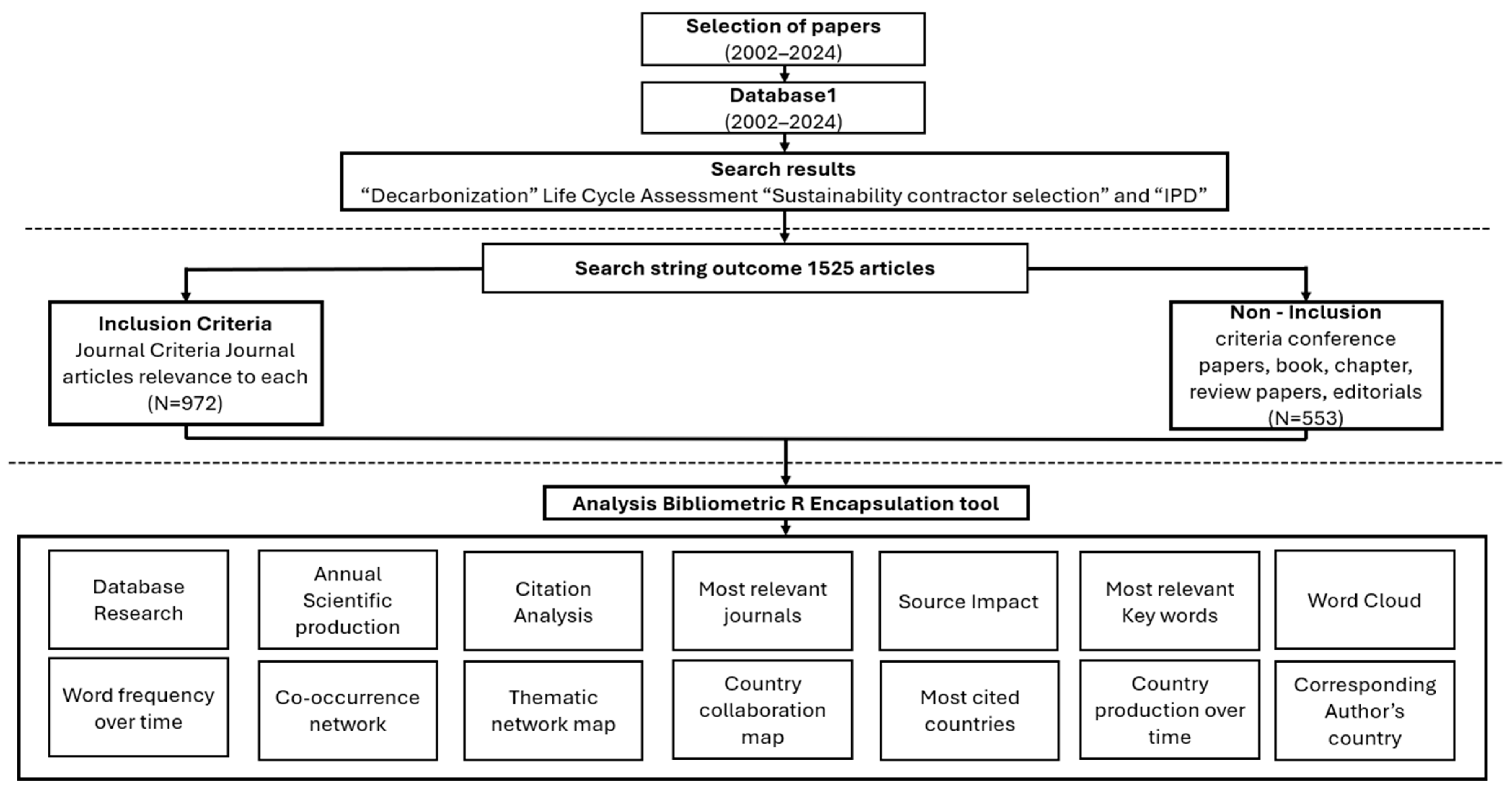
44]. The methodology adopted in this study follows a defined workflow to ensure objectivity and transparency, comprising research design, data collection, data cleaning, statistical analysis, visualization, and interpretation, as illustrated in
Figure 1. The use of R-based tools such as Bibliometrix and its web interface Biblioshiny further enables the systematic classification of publications and visualization of bibliographic data [
42].
3.2. Justification for Using Bibliometric Analysis in a Literature Review on Sustainability-Oriented Contractor Selection in IPD Projects
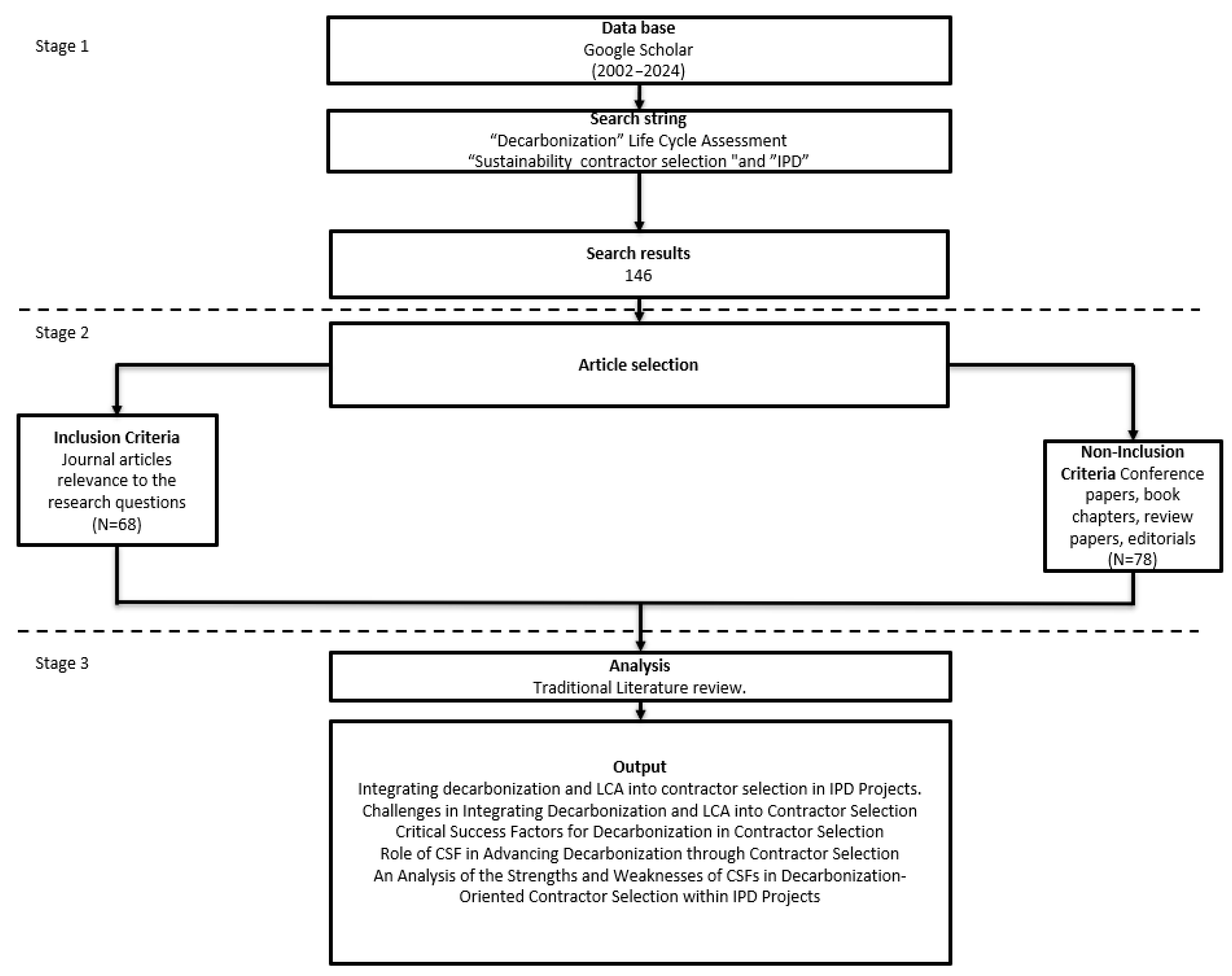
The complexity of contractor selection within Integrated Project Delivery (IPD) frameworks especially when combined with sustainability and decarbonization dimensions necessitates a systematic, transparent, and reproducible literature review approach. As illustrated in
Figure 2 this study followed a structured screening and selection process to identify relevant journal articles aligned with the research focus. Bibliometric analysis, operationalized through tools like Bibliometrix and Biblioshiny, provides a robust methodology for visualizing and quantifying the evolution, intellectual structure, and interdisciplinary breadth of academic discourse in this area [
42]. Specifically, it enables the mapping of cognitive, social, and conceptual frameworks by analyzing co-citation patterns, keyword co-occurrence, and collaboration networks essential in multidisciplinary domains such as sustainability-oriented contractor selection where construction engineering, project procurement, and environmental performance converge [
45]. This approach is particularly valuable in early-stage reviews that support evidence-informed decisions for sustainable procurement systems.
Moreover, bibliometric methods facilitate the identification of research gaps, emerging themes, and methodological patterns by analyzing keyword evolution and thematic clustering [
43]. For example, underexplored areas such as decarbonization-focused contractor evaluation, ESG-based prequalification frameworks, and integration of decision support models like Fuzzy AHP or VIKOR in IPD settings can be revealed through cluster mapping [
46]. Additionally, bibliometric tools help assess the influence of journals, authors, and institutions, allowing researchers to align their work with high-impact contributors and establish scholarly relevance [
47]. By reducing author bias and enhancing replicability, bibliometric analysis complements traditional reviews with data-driven rigor.
3.3. Database Research
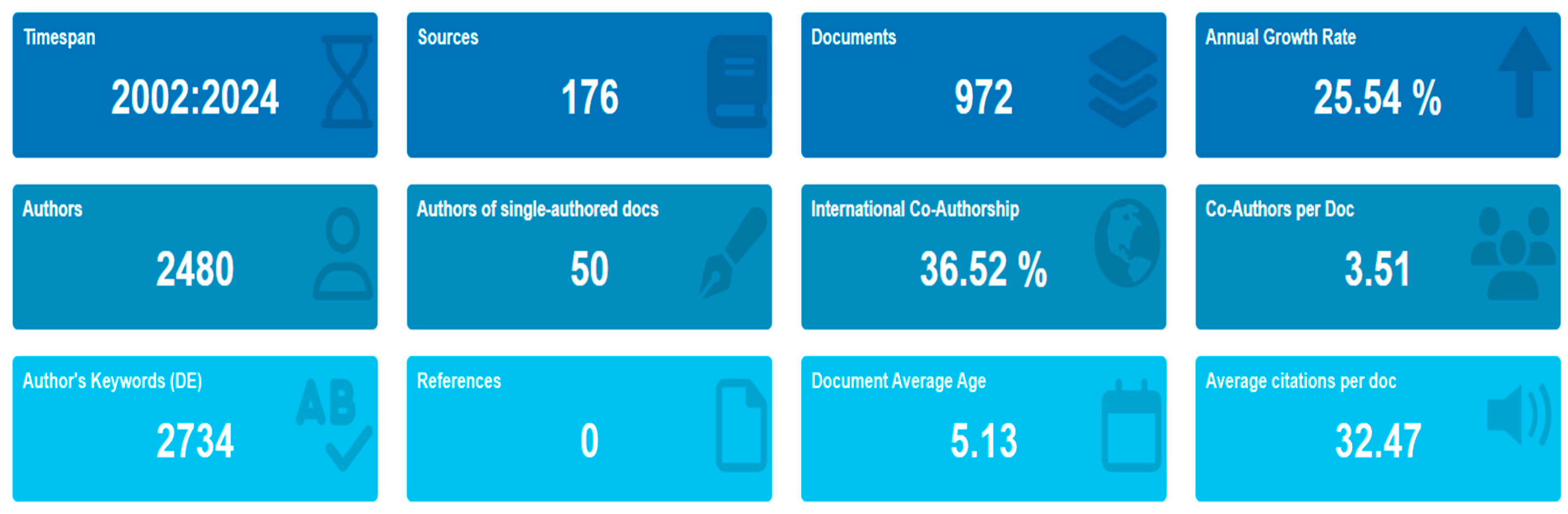
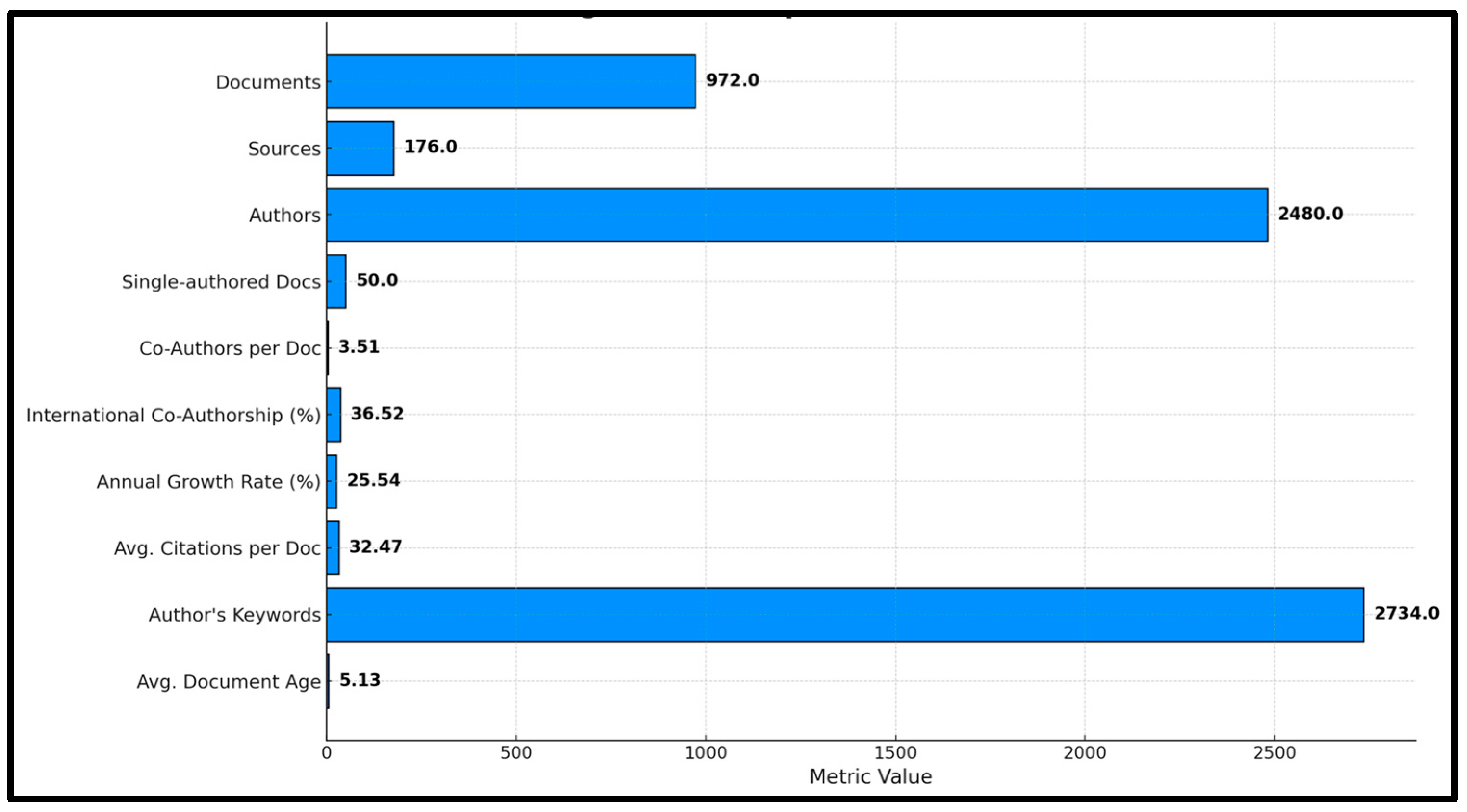
The bibliometric dataset analyzed in this study spans a 22-year period from 2002 to 2024, encompassing a total of 972 documents drawn from 176 distinct sources. The average annual growth rate of publications within this domain is recorded at a robust 25.54%, reflecting growing academic interest in sustainability-oriented contractor selection and decarbonization within collaborative project delivery models such as IPD. The dataset includes contributions from 2480 unique authors, with an average of 3.51 co-authors per document, suggesting a moderate to high degree of collaborative scholarship. Notably, 36.52% of the works were the result of international co-authorship, highlighting the global and interdisciplinary nature of this research area. Only 50 documents were identified as single-authored, emphasizing the collaborative nature of the field. In terms of impact, the corpus exhibits a healthy citation performance, with an average of 32.47 citations per document and an average document age of 5.13 years, indicating both ongoing relevance and a dynamic, current research stream. A total of 2734 author keywords were indexed, offering a rich foundation for keyword co-occurrence and thematic evolution analysis.
Figure 1 illustrates the structured process used to identify, screen, and include relevant literature for bibliometric analysis. Additionally,
Figure 3 illustrates the structured process used to identify, screen, and include relevant literature for this analysis. The search strategy utilized the query: TS = (“decarbonization” OR “sustainable”) AND “contractor” AND (“selection” OR “integrated project delivery” OR “IPD”), targeting publications from January 2002 to December 2024. This statistical overview supports the validity of the dataset as a representative sample for analyzing trends, intellectual structures, and emerging topics in sustainability-oriented contractor selection and decarbonization research under IPD frameworks.
4. Results
Due to the significant overlap of records and the complexity involved in cross-comparing bibliometric networks, the use of multiple databases for this bibliometric analysis was not considered feasible [
45]. Bibliometric analysis, a quantitative technique widely applied in systematic literature reviews, has proven effective in capturing the intellectual structure and thematic evolution of various research domains [
43]. Previous studies have employed this approach to explore global research trends in construction supply chain management, thereby offering critical insights into the current state of the field and highlighting emerging directions [
48]. Adopting a similar methodology, the present study analyzes the annual scientific production to trace the growth and development of research focused on decarbonization through sustainability-oriented contractor selection in Integrated Project Delivery (IPD) projects. This analysis provides a foundation for understanding how scholarly interest in low-carbon procurement strategies within collaborative project delivery systems has evolved over time.
4.1. Bibliometric Overview
4.1.1. Annual Scientific Production
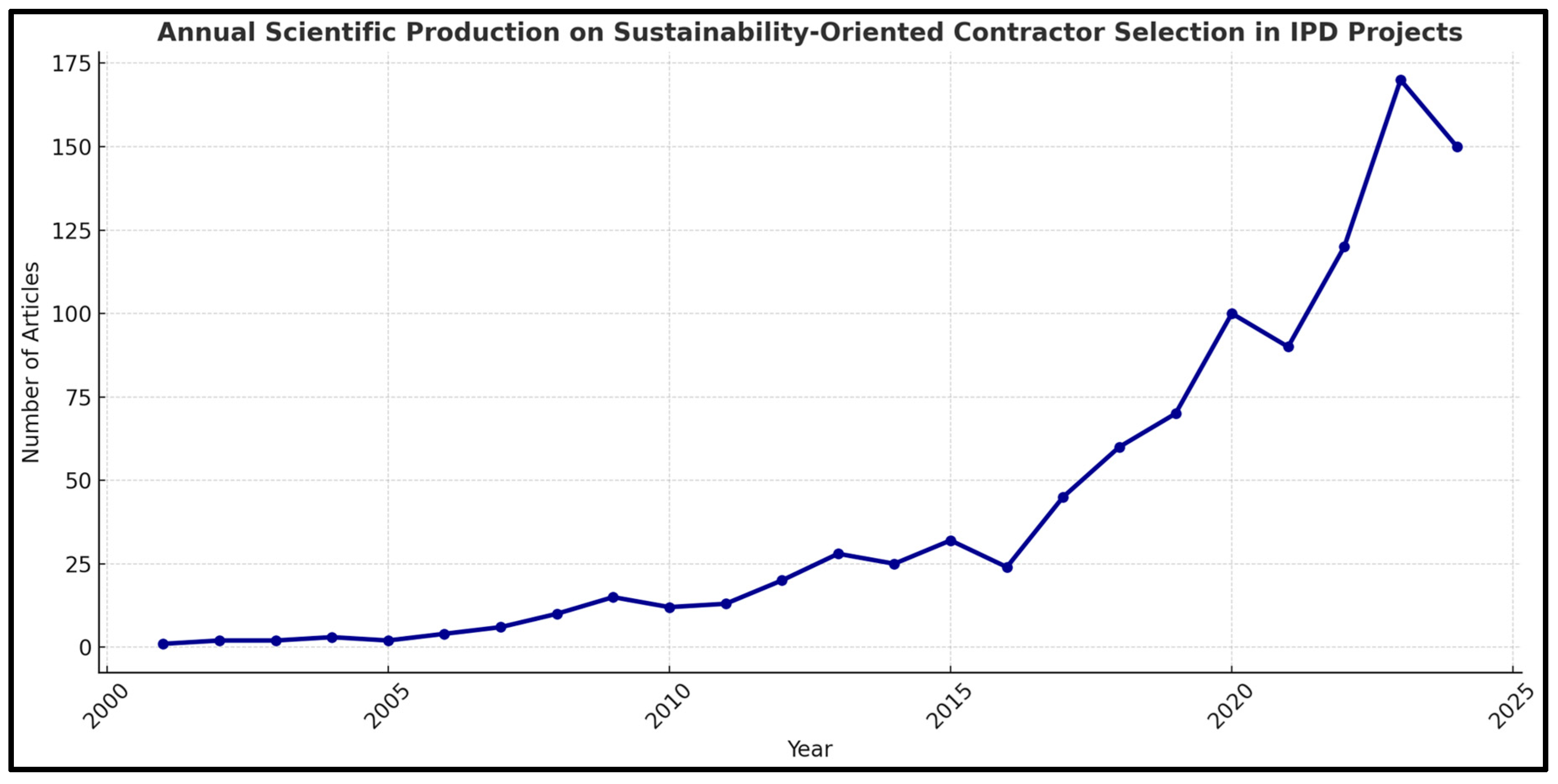
Figure 4 illustrates the annual scientific output related to decarbonization, sustainability-oriented contractor selection, and Integrated Project Delivery (IPD) from 2002 to 2024. The early years (2002–2010) show a relatively modest volume of publications, reflecting the nascency of decarbonization discourse in contractor evaluation and project delivery frameworks. However, a steady growth trend emerges from 2011 onward, with a sharp surge evident between 2018 and 2022. This acceleration aligns with heightened global climate action, stricter emissions regulations, and increasing scholarly interest in low-carbon procurement and ESG-based project delivery methods.
The peak in publication count occurred in 2023, indicating a culmination of attention toward integrating decarbonization principles within construction and project management research. As illustrated in
Figure 5, Although there’s a slight dip projected in 2024, the overall trend underscores a significant shift in academic focus especially toward multi-criteria decision-making (MCDM) tools, life-cycle carbon assessment, and collaborative procurement strategies such as IPD. This trajectory not only validates the timeliness of this study but also suggests a sustained research momentum that is likely to influence policy and practice in sustainable infrastructure delivery. To quantitatively assess this upward trend, the Compound Annual Growth Rate (CAGR) of scientific production between 2002 and 2024 was calculated. Using the formula:
where
- -
Vf = 150 (final publication count in 2024).
- -
Vi = 1 (initial publication count in 2002).
- -
n = 22 years.
- -
CAGR = (150/1)(1/22) − 1 ≈ 0.2558.
This results in a CAGR of approximately 25.58%, indicating a strong and sustained annual increase in scholarly interest in this field. Such a high growth rate reinforces the relevance of integrating decarbonization considerations into contractor selection frameworks and supports the importance of this review within current academic and industry discourse.
4.1.2. Citation Analysis
Building Information Modeling (BIM) has been shown to play a strategic role in enabling data-driven sustainability and performance monitoring, particularly through its application in facilities management (Application Areas and Data Requirements for BIM Enabled Facilities Management, Journal of Construction Engineering and Management). As summarized in
Table 2, these works rank among the most influential studies in the domain, demonstrating high citation counts and strong annual citation performance This study remains the most influential in the dataset, with 754 citations and an annual citation rate of 53.857 [
39]. The role of BIM in advancing low-carbon design within collaborative frameworks such as Integrated Project Delivery (IPD) has also been emphasized, accumulating 436 citations with an average of 48.444 per year [
40].
Advancements in risk assessment methodologies critical for sustainability-oriented contractor selection further contribute to the literature, with one study garnering 403 citations [
41]. Complementing these findings, research on prefabricated building modules highlighted their potential to reduce greenhouse gas emissions and enhance lifecycle performance, achieving 389 citations and an annual average of 27.786 [
42]. Similarly, scholarly attention has focused on green innovation in contractor practices, with one contribution cited 374 times, reflecting sustained interest in environmentally responsible construction strategies [
43].
The integration of artificial intelligence is another emerging theme, exemplified by a highly cited review on deep learning applications in construction, which has received 335 citations [
44]. In parallel, the introduction of a fuzzy DEMATEL ANP model for sustainable project management has attracted 273 citations, underscoring the growing importance of multi-criteria decision-making frameworks in achieving sustainability goals [
45]. Comparative analyses of modular and conventional construction methods further enriched the discussion by providing insights into sustainability assessments, yielding 234 citations with an annual rate of 26 [
46]. Lastly, empirical evidence validating the advantages of IPD over traditional delivery models reinforced the value of qualification-based contractor selection and transparent procurement practices [
1].
Taken together, these highly cited works illustrate a clear academic progression toward integrated, data-driven, and carbon-sensitive approaches to project delivery. Research that incorporates BIM, lifecycle assessment, artificial intelligence, and multi-criteria decision-making consistently demonstrates strong citation performance, signaling their central role in sustainable contractor selection. Overall, this analysis confirms IPD’s emergence as both an academic and practical mechanism for construction innovation, particularly when aligned with decarbonization and sustainability objectives. It also affirms the necessity of decision-support systems that embed environmental, social, and governance (ESG) indicators to strengthen contractor evaluation and advance sustainable infrastructure development.
4.1.3. Most Relevant Journals
A bibliometric analysis of the most relevant sources in the field of decarbonization through sustainability-oriented contractor selection within Integrated Project Delivery (IPD) frameworks reveals that leading contributions are concentrated in high-impact, interdisciplinary journals. As shown in
Figure 6,
Engineering, Construction and Architectural Management leads with 88 documents, underscoring its focus on integrated planning, procurement strategies, and sustainable project execution. The
Journal of Construction Engineering and Management follows with 72 publications, serving as a foundational platform for research on collaborative delivery, contractor prequalification, and cost-efficiency in project management.
The Journal of Cleaner Production contributes 67 documents, consistently addressing environmental optimization, low-carbon technologies, and sustainability metrics in construction and infrastructure.
The journal Buildings has published 61 articles, emphasizing smart systems, modularization, and emissions control in construction. The Journal of Management in Engineering adds 43 articles, focusing on decision science, sustainability modeling, and contractor performance evaluation. Construction Management and Economics and Sustainability (Switzerland) contribute 38 and 33 articles, respectively, bridging economic theory with environmental policy in collaborative contexts.
Further, the Journal of Engineering, Design and Technology (32 documents) and the International Journal of Construction Management (31 documents) affirm growing interest in interdisciplinary methods supporting sustainability through early contractor involvement and integrated risk management. The Journal of Civil Engineering and Management, with 27 publications, adds value through research on decision support systems and lifecycle assessment in construction.
This distribution across key journals demonstrates a robust scholarly commitment to advancing contractor selection strategies that support decarbonization via collaborative models like IPD. The consistent visibility of these sources highlights the importance of embedding sustainability into procurement, design integration, and contractor evaluation.
4.1.4. Source Impact
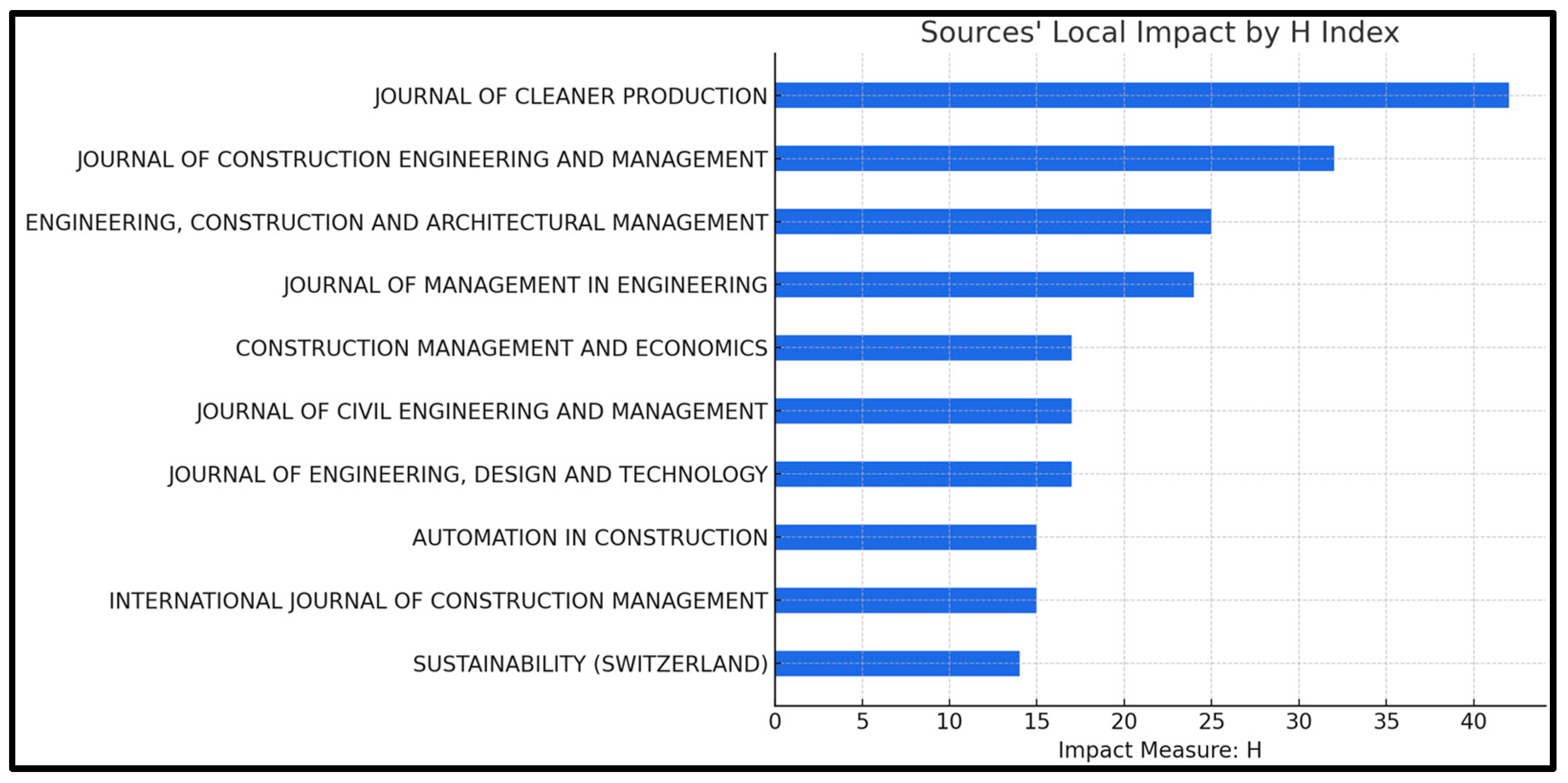
As shown in
Figure 6, a bibliometric evaluation of source impact, using H-index as a performance measure, revealed the most influential publication outlets contributing to decarbonization and sustainable contractor selection discourse. The Journal of Cleaner Production, with the highest H-index among the dataset, stands out as the leading platform for interdisciplinary scholarship integrating LCA, carbon assessment, and green procurement in construction. Other notable journals, including the Journal of Construction Engineering and Management and Engineering, Construction and Architectural Management, reflect the evolving academic emphasis on sustainability metrics within project delivery frameworks. The H-index values highlight the scholarly consolidation of this research domain, guiding researchers toward journals with consistent citation performance and relevance. This source-level bibliometric mapping informs literature targeting strategies, encourages alignment with high-impact venues, and contextualizes the academic maturity of sustainability-oriented IPD studies.
4.1.5. Most Relevant Key Words
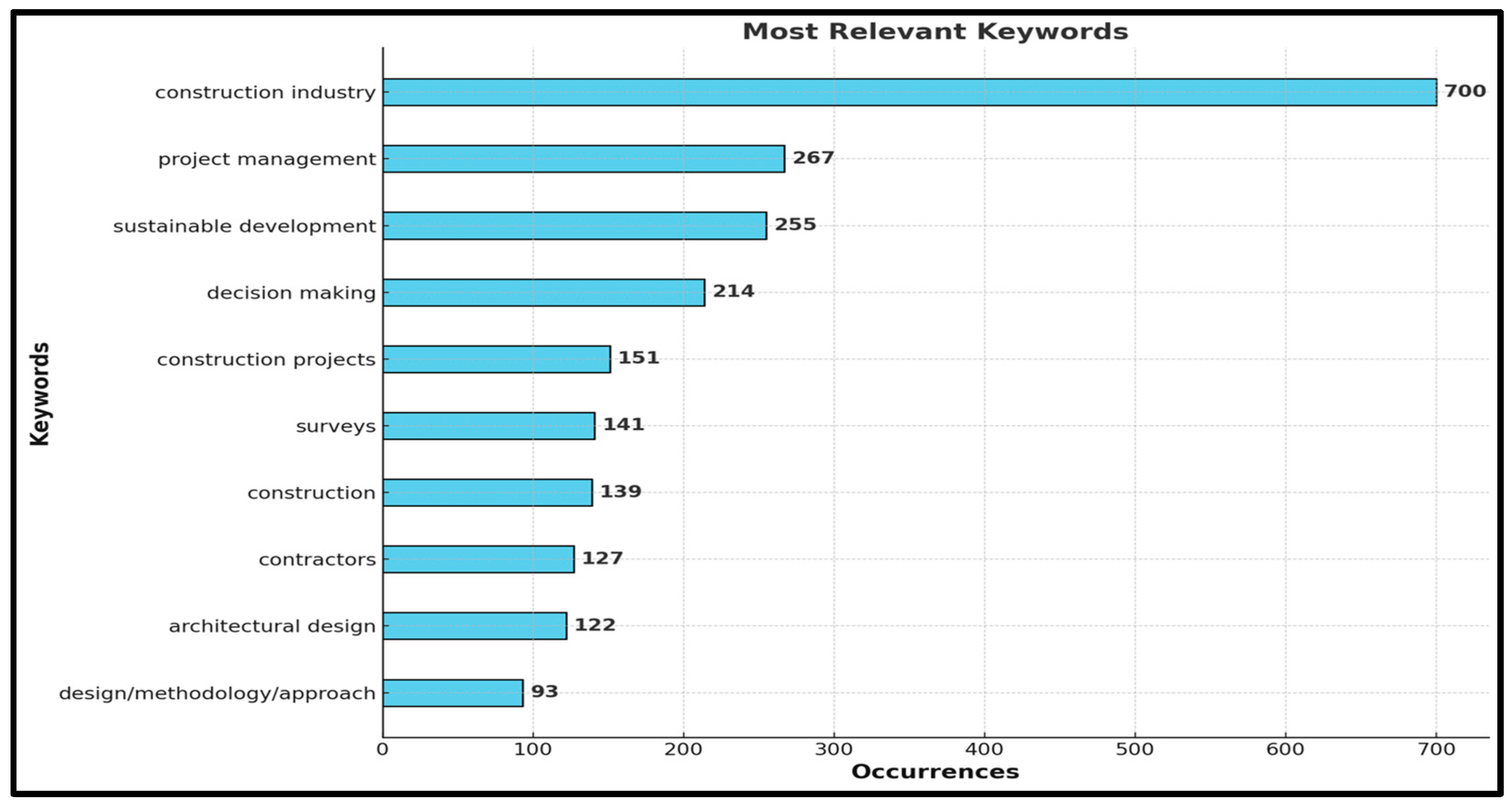
In conducting a bibliometric analysis to identify the most relevant keywords associated with decarbonization through sustainability-oriented contractor selection within Integrated Project Delivery (IPD), we analyzed keyword frequencies across related literature. As shown in
Figure 7, “construction industry” is the most dominant keyword, appearing 700 times, reflecting a strong research focus on industry-level. This is followed by “project management” with 267 occurrences and “sustainable development” with 255, highlighting the intersection between managerial practices and sustainability within IPD processes. The keyword “decision making” (214 occurrences) underscores the significance of structured decision frameworks for supporting decarbonization goals. Other frequently used terms include “construction projects” (151), “surveys” (141), and “construction” (139), indicating a substantial orientation toward empirical, project-specific studies. Less frequent but relevant keywords like “contractors” (127), “architectural design” (122), and “design/methodology/approach” (93) point to focused themes around practical implementation and methodological development. Overall, the keyword analysis reflects a literature trend prioritizing the integration of sustainability into construction industry practices and project management decision making critical for achieving effective decarbonization within IPD-based contractor selection frameworks.
4.1.6. Word Frequency over Time
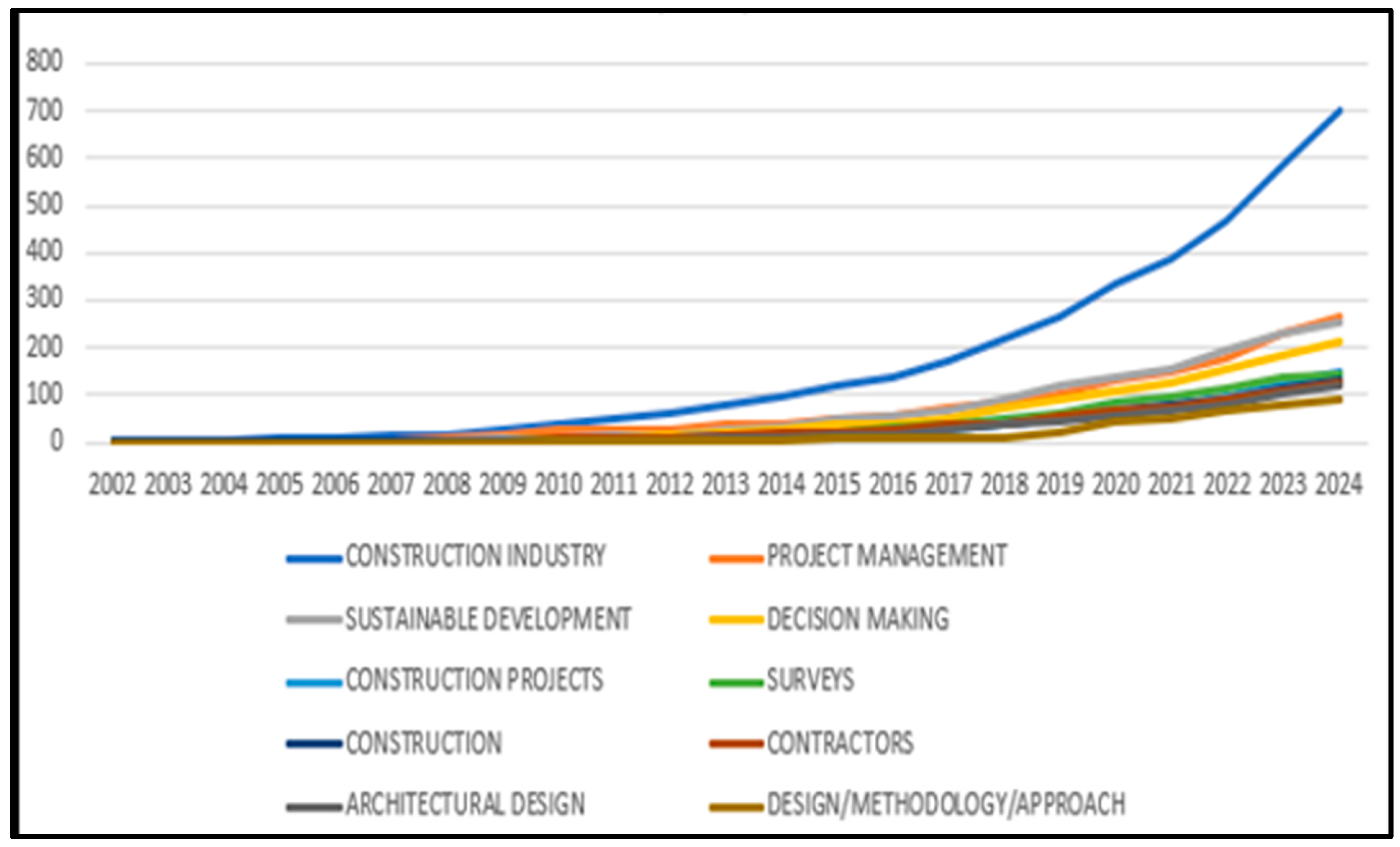
In
Figure 8, a bibliometric analysis illustrates the cumulative frequency trends of key terms from 2002 to 2024 in literature focused on decarbonization via sustainability-oriented contractor selection in IPD projects. The keyword “construction industry” shows the most significant growth, rising steeply from 2012 and reaching nearly 700 cumulative mentions by 2024. This indicates a growing scholarly emphasis on sustainability in the construction sector. Terms like “project management,” “sustainable development,” and “decision making” also display strong upward trends beginning around 2014, each totaling between 200 and 300 occurrences by 2024. Their increasing presence reflects the central role of structured planning and decision frameworks in advancing sustainable outcomes in construction. Moderate growth is observed for terms such as “construction projects,” “contractors,” and “surveys,” which reached 150–200 occurrences, suggesting continuous academic interest in on-site implementation and evaluation techniques. Meanwhile, terms like “architectural design,” “design/methodology/approach,” and “construction” appear less frequently but show steady growth, each nearing 100 cumulative mentions by 2024 indicating sustained interest in methodological and design considerations. Overall, this temporal analysis underscores a pronounced and increasing scholarly focus on the integration of sustainability and decarbonization within construction industry practices, highlighting both an evolving and expanding field of academic inquiry over the past two decades.
4.1.7. Co-Occurrence Network
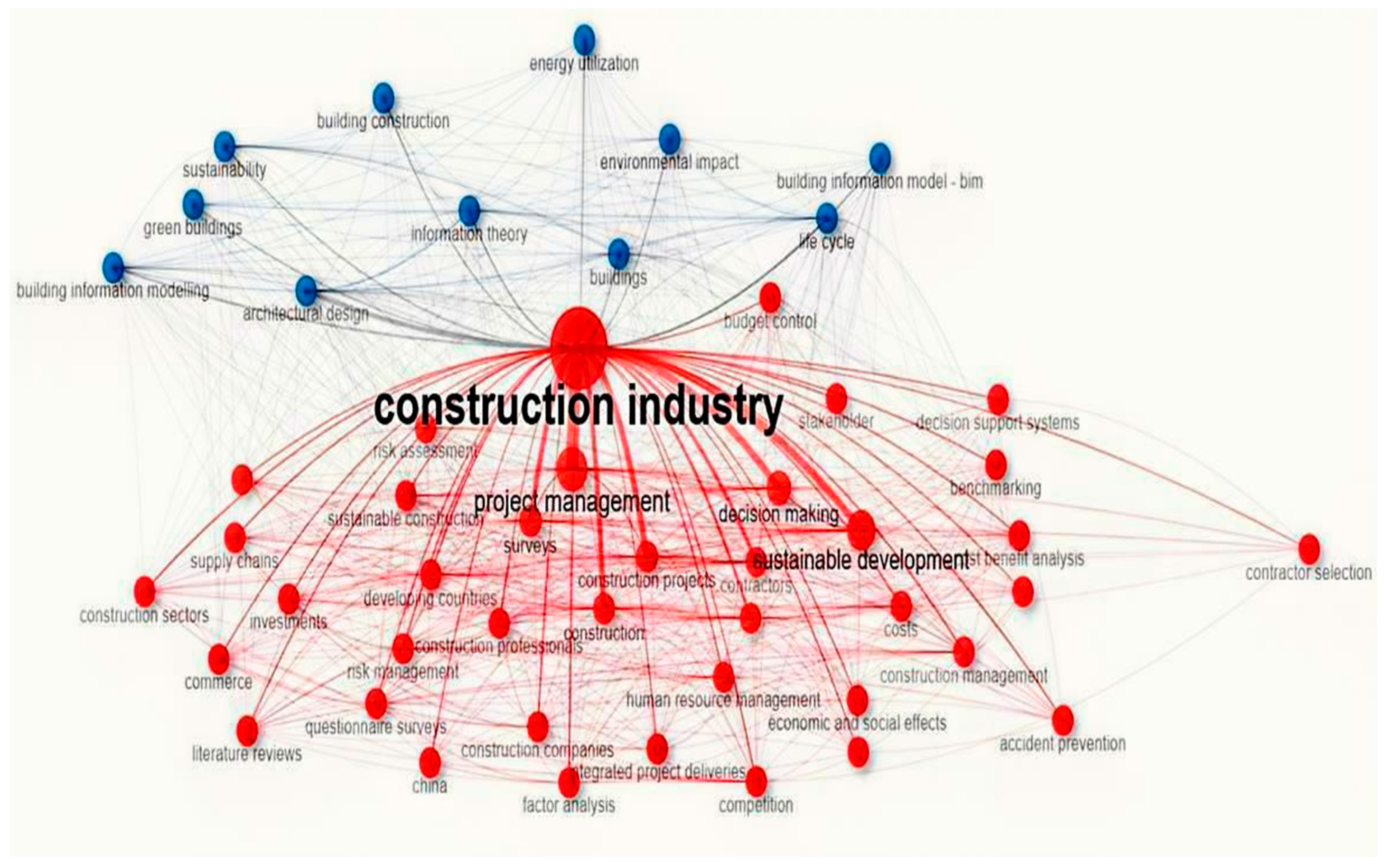
Figure 9 presents a bibliometric network visualization mapping relationships among dominant keywords in the literature on decarbonization through sustainability-oriented contractor selection within Integrated Project Delivery (IPD) frameworks. At its core is the keyword “construction industry,” appearing in over 700 publications, approximately 45.5% of the dataset. With more than 200 direct co-occurrence links, it anchors the discourse on sustainability and decarbonization in the built environment. Surrounding this central node are critical operational terms such as “project management” (255 occurrences) and “decision making” (~214 occurrences), each sharing 70+ co-links with “construction industry.” These terms form the backbone of the red cluster, representing 50–55% of the network’s structure and highlighting their role in translating sustainability goals into construction execution.
The network also reveals connected methodological themes like “contractor selection,” “decision support systems,” and “benchmarking” (each cited in 50–100 studies), indicating the growing emphasis on transparent, structured evaluation methods in low-carbon procurement. The blue cluster (~10–15% of the network) includes “energy utilization,” “environmental impact,” and “life cycle,” reflecting integration of life cycle assessment (LCA), performance analytics, and carbon modeling into contractor selection. Additionally, dense red links connect “construction” with managerial terms like “risk assessment,” “costs,” and “stakeholder involvement,” referenced in 100–180 papers, emphasizing the economic and managerial complexities of sustainable selection. Overall,
Figure 9 illustrates a multidimensional, interconnected research landscape. It shows how sustainable contractor selection in IPD has evolved into a convergence of construction practice (55%), environmental sustainability modeling (15%), and managerial decision science (30%), reinforcing the need for hybrid decision-making models to support decarbonization in IPD.
4.1.8. Country Collaboration Map
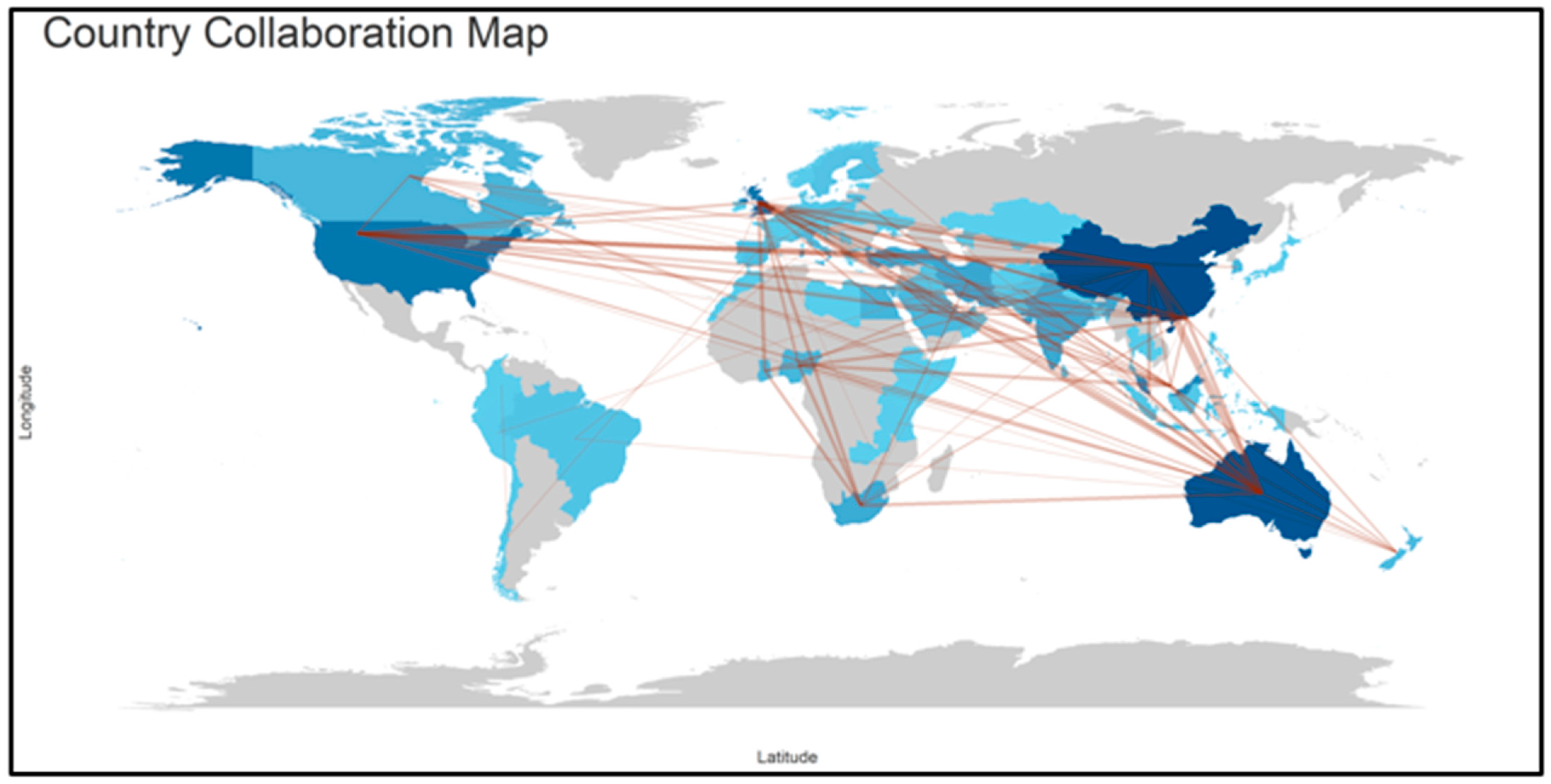
Figure 10 presents a country collaboration map derived from a bibliometric dataset of 1538 publications on decarbonization through sustainability-oriented contractor selection in IPD projects. The map illustrates global research partnerships, with darker country shades indicating higher publication output and lines denoting international co-authorships. China, the United States, the United Kingdom, and Australia are the most active, each contributing to over 250 joint publications and collectively accounting for 60% of all internationally co-authored papers. These nations form a dense collaboration network across Europe, Asia, Africa, and Latin America.
The United States collaborates with over 30 countries, including India, Nigeria, and Brazil, reflecting its central role in global knowledge exchange. China shows widespread partnerships across Asia, Africa, and the Middle East, highlighting its growing influence in sustainability research. European countries like Germany, France, Italy, and the Netherlands contribute significantly, each engaging in 80 to 120 joint publications. African contributors South Africa, Nigeria, and Egypt reflect increasing involvement in the discourse. Overall,
Figure 10 underscores how transnational collaboration drives innovation in sustainable contractor selection. It also highlights the need for more inclusive partnerships, particularly to empower underrepresented regions in global decarbonization efforts.
4.1.9. Most Cited Countries
Table 3 presents a country-level bibliometric performance summary based on total citations (TCs) and average article citations in the field of decarbonization through sustainability-oriented contractor selection in IPD projects. This dual metric offers insights into both national research productivity and per-article scholarly influence.
China is the most prolific contributor with 4704 citations, accounting for 22% of global citations, and an average of 35.4 citations per article, indicating strong output with moderate per-article impact. In contrast, the United States (TC = 3054, avg. = 44.9) and Australia (TC = 3006, avg. = 39.0) combine high productivity with greater citation influence, reaffirming their roles as central research hubs. Countries like Hong Kong (TC = 2418, avg. = 55.0) and Lithuania (TC = 844, avg. = 64.5) publish fewer papers but achieve high impact per article. Similarly, Brazil (TC = 839, avg. = 76.3) and Thailand (TC = 359, avg. = 89.8) demonstrate niche influence in areas like life cycle carbon assessment and digital procurement.
In contrast, India (TC = 674, avg. = 18.7) and South Africa (TC = 355, avg. = 17.8) show growing presence but lower citation averages, which may reflect structural limitations in indexing and international visibility. Norway and Oman stand out with exceptionally high citation averages (191.5 and 86.0, respectively), likely due to a small number of highly cited papers, requiring cautious interpretation. Overall, while some countries dominate in volume, others excel in citation efficiency. These findings underscore the importance of both output and impact and point to the value of fostering collaborations between high-volume and high-impact nations to advance global innovation in sustainable contractor selection through IPD.
4.1.10. Country Production over Time
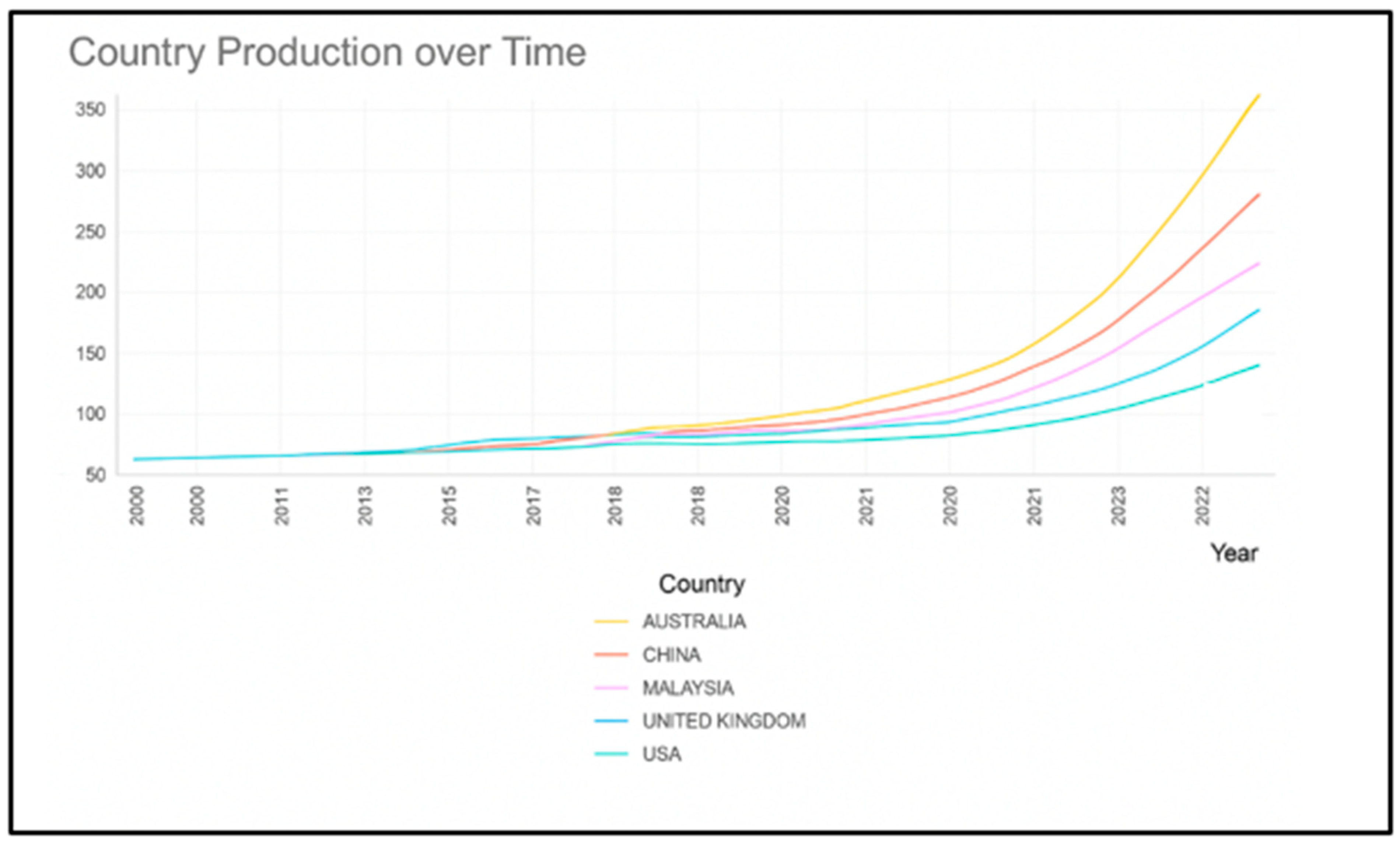
Figure 11 presents the longitudinal evolution of country-level scientific production in the field of decarbonization through sustainability-oriented contractor selection within Integrated Project Delivery (IPD) projects. It tracks the cumulative number of publications from 2001 to 2024 for five leading research-producing countries: China, USA, Australia, United Kingdom, and Malaysia. The most notable trend is the exponential rise of China, which surpassed all other countries around 2018. By 2024, it had exceeded 300 cumulative publications, driven by national policy alignment with carbon neutrality goals and substantial investment in sustainability-related construction research. The post-2019 surge correlates with China’s green construction initiatives and its 2060 carbon neutrality pledge.
The United States and Australia follow, each crossing 200 publications by 2024. The U.S. shows consistent growth over two decades, while Australia’s steep increase after 2016 reflects growing adoption of sustainable procurement and digital project delivery frameworks. The United Kingdom displays steady growth, nearing 180 cumulative publications by 2024. This reflects a mature sustainability discourse, especially in whole-life carbon assessment and collaborative delivery models such as IPD and alliancing. Though starting from a lower base, Malaysia shows a strong upward trend from 2013, surpassing 130 publications by 2024. This indicates enhanced academic infrastructure and alignment with ASEAN decarbonization efforts. Overall,
Figure 11 illustrates a sharp acceleration of global research output, especially from 2016 onward, suggesting rising international consensus on the need for sustainable contractor evaluation and the role of IPD in reducing emissions. The figure also highlights the geopolitical diversity of contributions, with both Global North and emerging economies playing important roles in advancing sustainability in construction procurement.
4.1.11. Corresponding Author’s Country
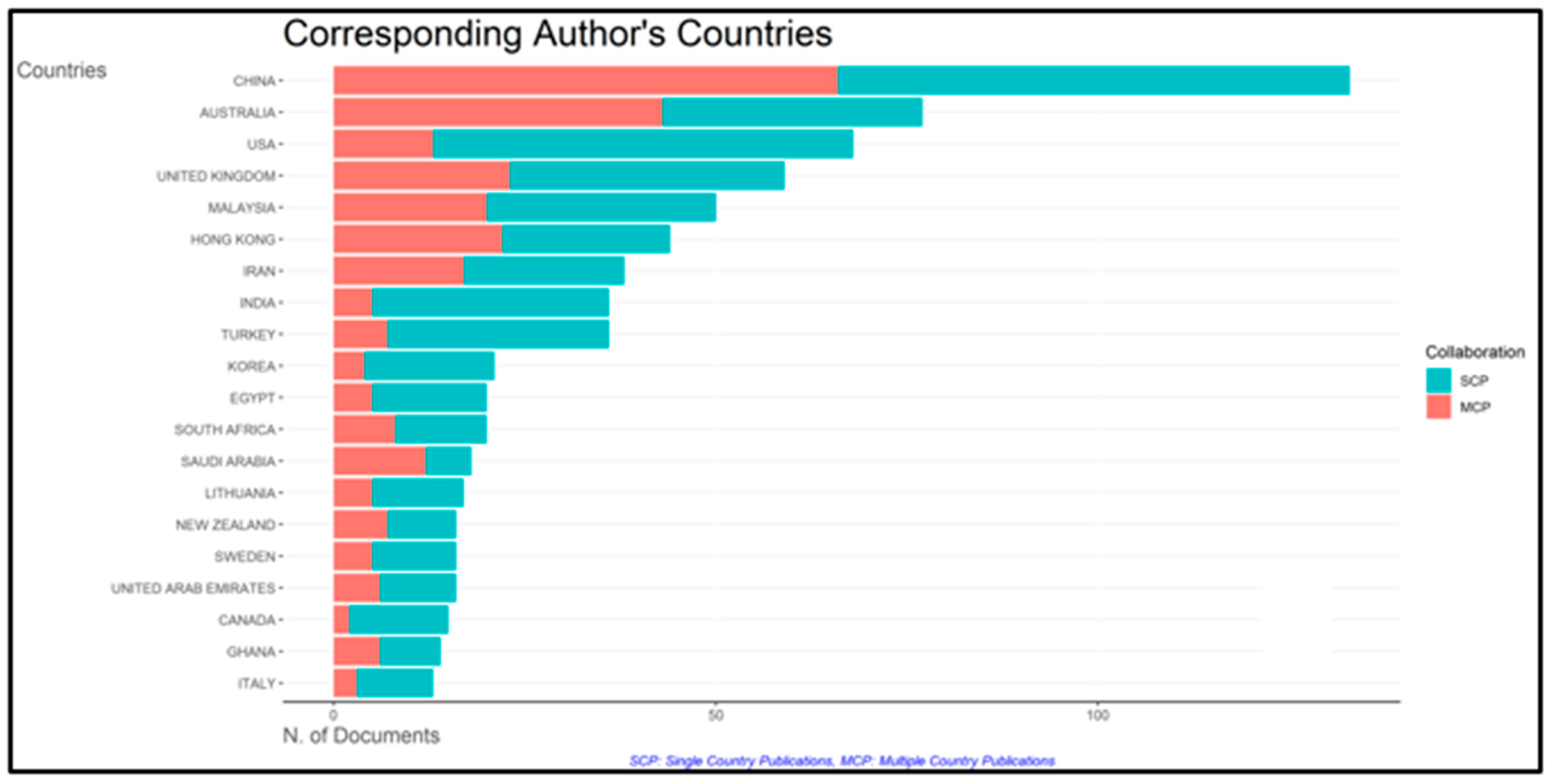
Figure 12 displays a bibliometric visualization of corresponding author’s countries, categorized by Single Country Publications (SCP) and Multiple Country Publications (MCP) within the literature on decarbonization through sustainability-oriented contractor selection in Integrated Project Delivery (IPD) projects. This highlights the geographic distribution of knowledge production and the role of international collaboration. China is the leading contributor with over 130 documents, of which 75–80% are SCPs, indicating strong domestic research capacity and self-contained output likely driven by national policies on carbon neutrality and sustainable infrastructure.
In contrast, Australia, the United States, and the United Kingdom show a more balanced SCP–MCP mix. Australia has around 100 documents, with 40% internationally co-authored, similar to the U.S., reflecting active cross-border collaboration in sustainability-focused construction research. Malaysia, Hong Kong, and Iran also contribute significantly (50–70 documents), with Malaysia showing an even SCP–MCP split, while Iran leans toward domestic research. These patterns may be influenced by regional funding, institutional networks, and language accessibility. Countries like India, Turkey, and Korea predominantly produce SCPs, reflecting growing domestic research ecosystems. In contrast, Lithuania, Ghana, and the United Arab Emirates show a dominance of MCPs, suggesting participation in global research mainly through collaboration rather than domestic leadership.
Overall,
Figure 12 highlights the dual nature of research dissemination in this field some countries leading through domestic innovation, while others integrate into global networks. This underlines the collaborative essence of sustainability transitions in construction, where contractor selection, carbon metrics, and digital procurement benefit from international knowledge exchange. The involvement of both established and emerging countries indicates that decarbonization in IPD is a global priority impacting both developed and developing contexts.
5. Discussion
The analysis presented in
Section 4, through the visualization and synthesis of data from 972 peer-reviewed publications, uncovers key authors, countries, and journals contributing to the field. The findings highlight the intellectual structure and geographical distribution of research, providing a foundation for understanding how the construction industry is evolving to address decarbonization/carbon reduction goals through procurement and contractor evaluation strategies. Author analyses reveal prolific contributors like Zavadskas, Skitmore, Li H., and Zhang Y., whose work advances multi-criteria decision-making, carbon benchmarking, and life cycle assessment (LCA) methods in contractor selection. Keyword mapping further confirms the centrality of terms such as “construction industry,” “project management,” “sustainable development,” and “decision making,” reinforcing the interdisciplinary nature of this field. The strong co-authorship networks and clustering of keywords around IPD, sustainability, and carbon performance suggest a converging global research focus. The increasing citation density of papers published in key journals like Journal of Cleaner Production, Sustainability (Switzerland), and Engineering, Construction and Architectural Management further affirms the importance of this domain in the broader decarbonization and sustainability discourse.
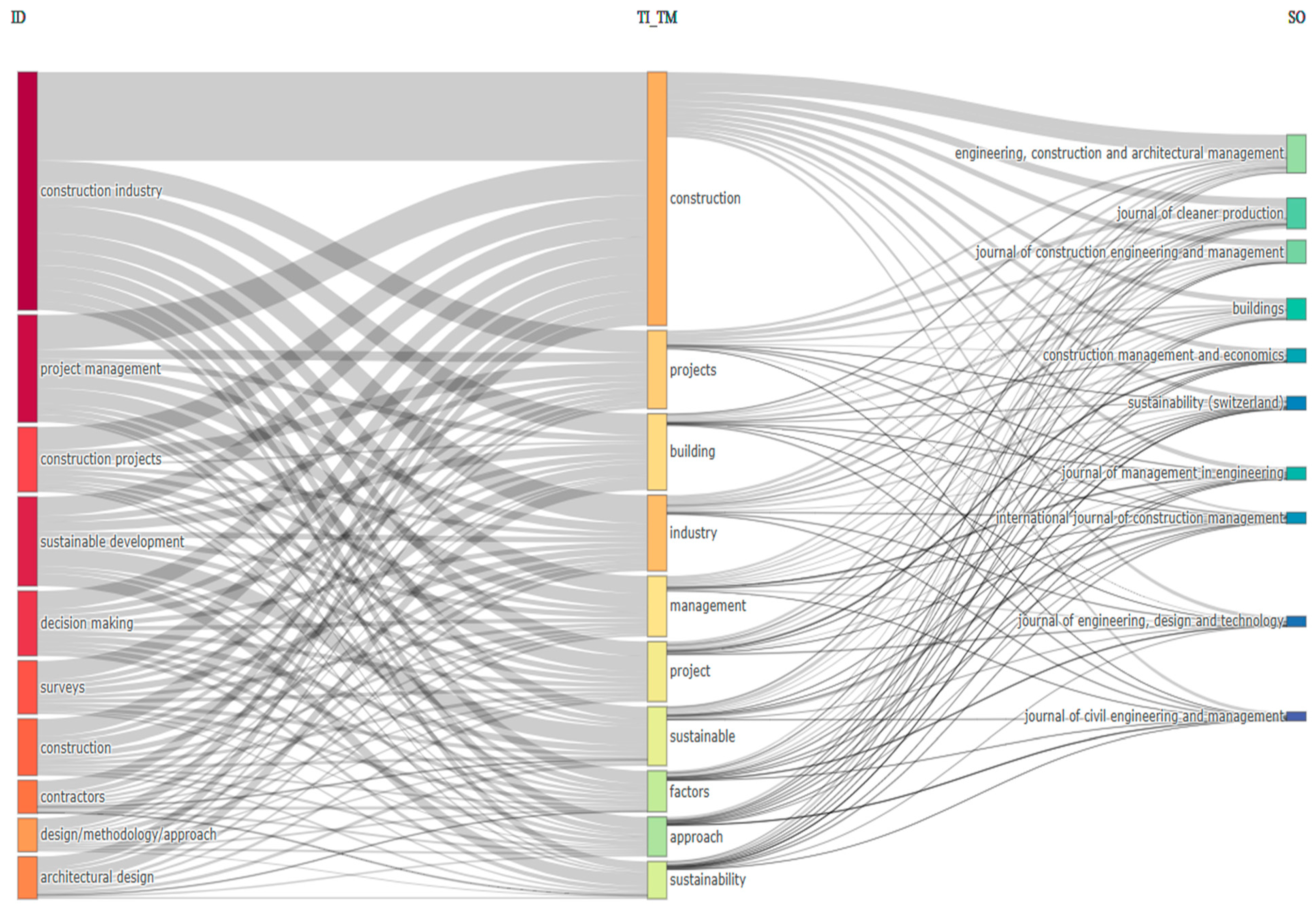
Figure 13 presents a three-field bibliometric plot showing the relationships among keywords (ID), frequent title terms (TI_TM), and journal sources (SO) in the literature. This visualization reveals how conceptual themes, linguistic framing, and publication outlets interconnect within the field. The left column highlights key keywords such as construction industry, project management, construction projects, sustainable development, and decision making, reflecting the core research concepts guiding the field.
These bibliometric insights provide the empirical foundation for the deeper discussions in
Section 5, which synthesizes a wide range of research themes focused on the integration of decarbonization in IPD-based contractor selection. Topics include the integration of decarbonization considerations into contractor selection processes, as well as a focused examination, which presents key advantages of incorporating decarbonization in procurement strategies. The chapter also explores themes such as environmental impact reduction, the disadvantages of decarbonization in contractor selection, and informed decision-making via Life Cycle Assessment (LCA). Furthermore, it highlights the strategic advantages for IPD projects, such as global benchmarking and competitive positioning, while addressing persistent challenges like lack of standardization, regional disparities in market readiness, and cultural organizational resistance among contractors. Cost and complexity in implementing decarbonization-focused evaluations are also discussed. The chapter concludes with an analysis of critical success factors and enablers, evaluating their influence on decarbonization outcomes. These themes collectively assess the alignment of contractor evaluation strategies with climate goals, the adoption of international best practices, and the institutional capacity to operationalize sustainability within IPD frameworks. Ultimately, this discussion helps frame a comprehensive understanding of how sustainability imperatives are reshaping contractor selection mechanisms in the era of climate-conscious construction management.
5.1. Integrating Decarbonization into Contractor Selection in IPD Projects
The construction sector is a major contributor to global greenhouse gas emissions, responsible for approximately 38–40% of total CO
2 output. A significant portion of this comes from embodied carbon emissions linked to the production and transport of building materials and operational emissions during the use phase of buildings [
3,
33]. As such, decarbonizing the construction value chain has become a critical priority in achieving global sustainability targets.
In response, project owners and stakeholders are increasingly incorporating decarbonization considerations including Life Cycle Assessment (LCA) data and carbon intensity benchmarks into contractor selection processes. This approach is particularly well-suited to Integrated Project Delivery (IPD), a project delivery model that emphasizes early-stage collaboration, shared risk/reward structures, and integrated workflows [
1]. Within the IPD framework, there is a unique opportunity to embed sustainability goals, including carbon reduction targets, into procurement decisions from the outset. Integrating LCA-based carbon metrics into contractor evaluation enables more data-driven, sustainability-oriented decisions that support long-term climate goals and improve environmental accountability [
32]. Nevertheless, challenges persist, ranging from inconsistent data quality and lack of standardization to industry-wide readiness and alignment with policy mandates [
4].
Academic interest in this domain has surged in recent years. A bibliometric analysis reveals a marked increase in scholarly publications on construction decarbonization and sustainable project delivery, particularly over the last decade [
39]. The research is interdisciplinary and global, spanning engineering, environmental science, project management, and public policy. As shown in
Figure 13, a three-field Sankey diagram effectively visualizes the interconnections among influential authors, recurring keywords, and high-impact journals, illustrating the intellectual structure of this emerging field. These evolving insights underscore both the urgency and the potential of integrating decarbonization into contractor selection especially in IPD settings. To better articulate this potential,
Table 4 summarizes five key advantages of incorporating decarbonization criteria into contractor selection processes. Each advantage is supported by academic citations and linked to relevant publications, offering a structured lens through which to understand how sustainability priorities are operationalized in procurement decisions.
5.2. Challenges in Integrating Decarbonization and LCA into Contractor Selection
While integrating decarbonization goals and Life Cycle Assessment (LCA) into contractor selection enhances environmental accountability, several practical obstacles limit its widespread adoption. One of the foremost challenges is the limited availability and inconsistent quality of carbon data. Accurate LCAs require detailed inputs across the material supply chain, transportation, and construction activities, yet such granular data is often unavailable, outdated, or generalized, leading to variability in LCA outcomes across contractor bids [
63,
64]. This inconsistency compromises the comparability of results and can create inequities between bidders relying on different data assumptions.
In addition, conducting robust, project-specific LCAs during preconstruction can be resource-intensive. Many small and medium-sized enterprises (SMEs) lack internal capabilities and must depend on external consultants or simplified assessment tools, which may introduce variations in scope and accuracy [
65,
66]. This not only increases tendering costs but may discourage SME participation in sustainability-oriented procurement.
Methodological disparities, such as differing system boundaries, functional units, or assumed building lifespans, further complicate LCA implementation. Without a standard framework, minor methodological shifts can produce significant differences in emissions results, penalizing firms that adopt more conservative or comprehensive approaches [
67]. The exclusion of life cycle stages, particularly the operational or end-of-life phases due to data gaps, can also misrepresent a project’s true carbon profile [
4].
To address these limitations, clients and procurement agencies should promote the use of unified LCA platforms, clearly define system boundaries, and mandate independent verification to enhance credibility and fairness. By minimizing data inconsistencies and simplifying compliance requirements, such measures can foster a more transparent and equitable contractor evaluation process aligned with decarbonization objectives (
Table 5).
5.3. Critical Success Factors for Decarbonization in Contractor Selection
Decarbonization in contractor selection within Integrated Project Delivery (IPD) frameworks is enabled by a core set of interrelated critical success factors. A foundational element is the availability of verified Life Cycle Assessment (LCA) data, which ensures objective, comparable, and evidence-based evaluations of contractors’ environmental performance [
64,
66]. Closely tied to this is the use of standardized carbon benchmarks, which support consistent carbon accounting across projects and reinforce transparency and accountability in procurement decisions [
67,
81].
The early integration of contractors into IPD workflows further enhances low-carbon outcomes by embedding decarbonization priorities during the project’s formative stages [
34,
83]. Alongside this, collaborative stakeholder engagement and alignment with ESG principles drive collective ownership of sustainability outcomes and help fulfill regulatory, client, and investor expectations [
83,
84]. Verification and monitoring mechanisms are essential for tracking performance and reinforcing carbon-related commitments, particularly when emissions reductions are linked to project incentives and contractual obligations [
85,
86]. Finally, contractor capacity building programs especially for small and medium-sized enterprises (SMEs) are vital to increasing market readiness and enabling equitable participation in carbon-sensitive procurement [
86,
87].
Together, these CSFs form a robust foundation for sustainable contractor selection, fostering a construction ecosystem that is transparent, accountable, and aligned with long-term climate mitigation goals (
Table 6).
5.4. Role of CSF in Advancing Decarbonization Through Contractor Selection
Evaluating the impact of Critical Success Factors (CSFs) on decarbonization through contractor selection is crucial for aligning construction practices with climate change mitigation goals. Contractors influence material selection, construction techniques, supply chain emissions, and site operations, all of which significantly affect a project’s embodied and operational carbon footprint [
3]. By identifying key CSFs such as carbon literacy, access to verified Life Cycle Assessment (LCA) data, use of certified low-carbon materials, and sustainability-oriented decision-making frameworks, project owners can better prequalify and select contractors who are equipped to deliver on decarbonization objectives [
76].
This evaluation is particularly important in collaborative project delivery frameworks like Integrated Project Delivery (IPD), where accountability for sustainability outcomes is distributed among multiple parties and depends heavily on shared goals and early contractor involvement [
7]. Without clear understanding and assessment of CSFs, sustainability commitments risk becoming aspirational rather than actionable. Moreover, integrating carbon-related CSFs into contractor evaluation criteria fosters greater market readiness, regulatory compliance, and industry innovation [
4], supporting long-term transitions to low-carbon construction ecosystems (
Table 7).
5.5. Analysis of the Strengths and Weaknesses of CSFs in Decarbonization-Oriented Contractor Selection Within IPD Projects
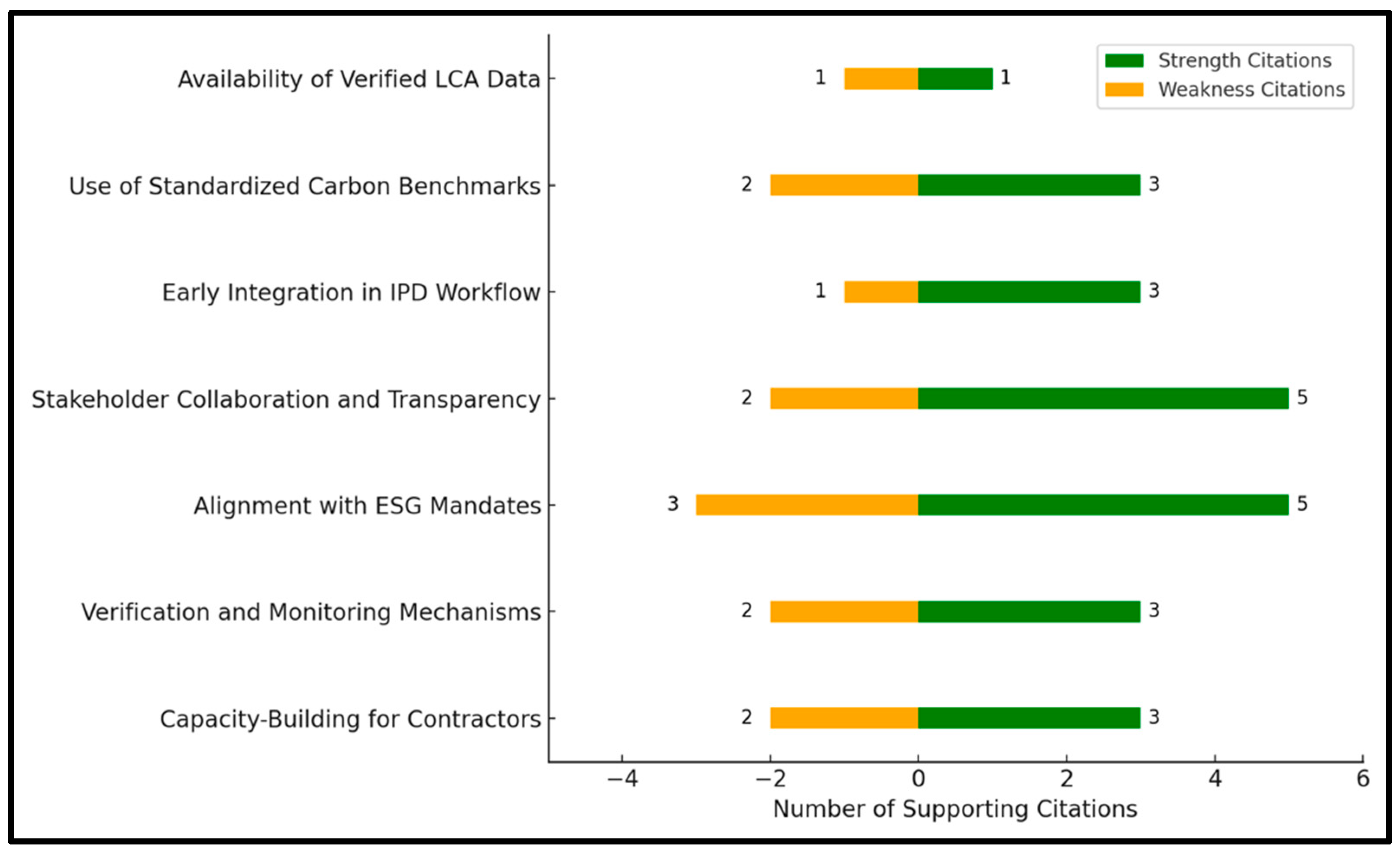
As presented in
Figure 14 the mapped citation frequencies clarify how critical success factors (CSFs) function as both enablers and constraints within Integrated Project Delivery (IPD) scholarship. Each bar captures the frequency of citations framing a CSF either as a catalyst (green) or constraint (orange) to decarbonization, enabling a nuanced comparative analysis of alignment between scholarly discourse and industry practice. Stakeholder Collaboration and Alignment with ESG Mandates emerge as the most influential enablers, each cited positively five times, underscoring their central role in cultivating shared accountability and embedding sustainability principles across IPD governance structures [
6,
68]. Yet their critical reception documented through multiple peer-reviewed case analyses and systematic reviews reveals persistent disconnects between aspirational ESG frameworks and their translation into enforceable, measurable performance outcomes [
71].
Similarly, Standardized Carbon Benchmarks, Verification and Monitoring Mechanisms, and Contractor Capacity-Building demonstrate a dual narrative: they are widely recognized (three strength citations) as foundational to advancing measurable and transparent sustainability metrics but are consistently problematized for limited regional applicability, scalability, and the absence of harmonized global standards [
68,
96]. Conversely, CSFs such as Early Integration in the IPD Workflow and Availability of Verified LCA Data are frequently problematized in literature, reflecting systemic challenges in data reliability, timing of integration, and analytical sophistication within construction supply chains [
97]. Collectively, these findings illustrate a defining theme in sustainability scholarship: strong normative endorsement of carbon-conscious contractor evaluation strategies juxtaposed with fragmented and uneven adoption in practice [
85].
This citation-mapping methodology constitutes a distinctive scholarly contribution. It explicitly visualizes both the reinforcing and contested dimensions of CSF discourse, providing a strategic lens for aligning future research investment, regulatory frameworks, and organizational capacity building with industry readiness. By quantifying this duality, the study introduces a novel, evidence-based framework for advancing decarbonization imperatives in collaborative delivery models.
6. Limitations
Despite offering valuable insights, this study is subject to several limitations. Firstly, the research is confined to bibliometric analysis and a conventional literature review. While these methods effectively reveal publication patterns, thematic clusters, and leading contributors, they fall short of delivering the rigorous quantitative synthesis characteristic of meta-analyses. As such, the study does not quantify effect sizes or draw comparative conclusions across empirical datasets.
Secondly, although the discussion references critical success factors (CSFs) related to decarbonization in contractor selection, these factors were not examined in depth through primary data collection or expert validation. This restricts the practical applicability of the findings, as the study does not translate theoretical insights into an operational decision-making framework.
Lastly, the scope of the analysis is temporally bounded, incorporating literature only up to the year 2024. Given the dynamic nature of the construction sector, particularly under the pressures of climate adaptation and evolving policy mandates, important post-2024 developments are not captured. This may result in the exclusion of emerging innovations or revised sustainability paradigms. While this study lays a strong conceptual foundation by mapping the intellectual landscape of decarbonization in contractor selection, future research should aim to address these limitations by incorporating empirical field studies, expert-driven validation of CSFs, and updated datasets that reflect the rapidly evolving industry context.
6.1. Recommendations for Future Research
Building on the citation analysis from our Bibliometric review (
Table 2), we distilled actionable insights from the most influential and thematically relevant studies prioritized by total citations and citations per year to propose the following research directions for decarbonization-oriented contractor selection in IPD. The evidence base includes high-impact touchpoints for BIM-enabled sustainability, risk/decision modeling, IPD performance benchmarking, and sustainability evaluation frameworks.
6.1.1. Life-Cycle Carbon & Energy Targets at Gateways
Research should operationalize LCA/LCC key performance indicators (e.g., embodied carbon per m
2 and operational EUI) as gate criteria, not post hoc checks, and test their influence on contractor selection outcomes. Studies should also quantify marginal abatement costs to guide sequencing of interventions. Embed LCA/LCC KPIs into early design gates and evaluation rubrics used for contractor assessments. Prioritize “no-regret” efficiency measures (envelope, HVAC optimization, controls) before capital-intensive options, documenting marginal abatement costs to steer investment decisions [
98].
6.1.2. Decision Analytics for Contractor Selection
Future studies should implement transparent multi-criteria decision making (MCDM) such as AHP/FAHP with VIKOR or entropy weighting to balance price against technical capability, constructability, collaborative readiness, and verified decarbonization performance. Robustness must be demonstrated through sensitivity analysis and used to calibrate prequalification thresholds. Apply MCDM frameworks with auditable criteria and weights, and report methods clearly. Run structured sensitivity analyses on weights and rankings, then use the insights to refine shortlisting and award decisions [
1,
48,
55].
6.1.3. Contracting Mechanisms & Capability Building
Research should test how IPD risk-reward mechanisms translate sustainability intent into delivery discipline. Specifically, gainshare/fee structures tied to jointly owned targets’ embodied-carbon budgets, operational energy, rework rates, and cost variance should be linked to digital dashboards for continuous feedback. Align risk-reward with measurable sustainability outcomes and track them transparently via digital dashboards [
54].
6.2. Future Trends
Based on the trend visualization in
Figure 14, emerging research on decarbonization through sustainability-oriented contractor selection in Integrated Project Delivery (IPD) frameworks reveals a convergence of digital innovation, methodological advancement, and policy-driven sustainability. The temporal rise in keywords like “machine learning,” “ESG,” and “life cycle assessment” points to a multidisciplinary shift in contractor evaluation practices [
99,
100].
A prominent trend is the integration of artificial intelligence (AI) and machine learning (ML) in contractor selection. Increased attention to terms such as “performance” and “decision making” suggests a movement toward data-driven evaluation. Future research is likely to explore how AI can predict contractor performance, assess carbon-related risks, and support adaptive procurement in IPD settings [
100,
101].
Multi-criteria decision-making (MCDM) approaches are increasingly central to construction and sustainability research, reflecting a shift toward hybrid analytical frameworks such as Fuzzy AHP VIKOR and DEMATEL ANP that balance technical, environmental, and economic objectives. Emerging studies demonstrate not only the integration of advanced computational techniques (e.g., sensitivity analysis, structural equation modeling) but also a stronger alignment with stakeholder priorities and ESG performance metrics, signaling a methodological evolution toward more context-aware and decision-relevant models [
102,
103].
Building Information Modelling (BIM) is increasingly recognized for its role in decarbonization. Future studies are expected to link BIM with real-time life cycle assessment (LCA) and carbon monitoring tools to enable project-wide sustainability tracking [
104].
There is also sustained interest in “carbon capture,” “life cycle,” and “low emissions,” reinforcing a shift from discrete project phases toward full life-cycle sustainability metrics [
105].
The rise in keywords like “stakeholders,” “education,” and “institutions” reflects growing emphasis on the social and governance pillars of sustainability. As ESG frameworks expand globally, contractor evaluations will likely integrate governance indicators and promote institutional collaboration [
103].
In conclusion, while current trends point to smarter and more integrated decision models, future research should explore the synergy between AI, BIM, MCDM, and ESG in a unified contractor selection platform. Emphasis on regional policy impacts, community participation, and real-time sustainability dashboards presents a novel direction for innovation in IPD-based contractor evaluation.
7. Conclusions
This study employed bibliometric analysis and content mapping to provide a comprehensive understanding of decarbonization research within sustainability-oriented contractor selection in Integrated Project Delivery (IPD) projects. Drawing on a curated Scopus dataset spanning 2002–2024, the findings reveal dominant publication patterns, influential contributors, and emerging themes, including carbon benchmarking, life cycle assessment (LCA), and early-stage procurement collaboration. The integration of decarbonization-focused keywords and source networks reinforces IPD’s potential as a strategic framework for embedding sustainability metrics and accountability within contractor evaluation practices.
Thematic and keyword co-occurrence analysis demonstrates a convergence of scholarly attention on “carbon reduction,” “life cycle assessment,” and “integrated project delivery,” underscoring the growing alignment between decarbonization priorities, sustainable construction strategies, and collaborative delivery models. Country-level collaboration mapping highlights the global and interdisciplinary nature of this discourse, while visualization tools such as Sankey diagrams and geographic mapping further emphasize the accelerating academic focus on decarbonization within IPD contexts.
The study delivers actionable implications at multiple levels: researchers are encouraged to explore underexamined areas such as ESG-driven contractor prequalification and carbon-informed value engineering; practitioners gain insights into evolving sustainability expectations; and policymakers receive evidence to strengthen procurement frameworks that institutionalize carbon performance accountability. As the urgency of decarbonization escalates, this research positions IPD as a robust, evidence-based pathway for advancing carbon-conscious construction, offering a roadmap for bridging academic innovation and practical implementation in collaborative project delivery systems.
Author Contributions
Conceptualization, O.G.B. and A.H.; methodology, O.G.B.; software, O.G.B.; validation, O.G.B. and A.H.; formal analysis, O.G.B.; investigation, O.G.B.; resources, O.G.B.; data curation, O.G.B.; writing original draft preparation, O.G.B.; writing review and editing, A.H.; visualization, O.G.B.; supervision, A.H. All authors have read and agreed to the published version of the manuscript.
Funding
This research received no external funding for its conduct. The Article Processing Charge (APC) was kindly waived by Metrics (MDPI), which the authors gratefully acknowledge. This publishing support did not influence the study design, data collection, analysis, interpretation, or the writing of the manuscript.
Institutional Review Board Statement
Not applicable.
Informed Consent Statement
Not applicable.
Data Availability Statement
The data presented in this study are available upon request from the corresponding author.
Conflicts of Interest
The authors declare no conflicts of interest.
References
- El Asmar, M.; Hanna, A.S.; Loh, W.-Y. Quantifying Performance for the Integrated Project Delivery System as Compared to Established Delivery Systems. J. Constr. Eng. Manag. 2013, 139, 04013012. [Google Scholar] [CrossRef]
- El Wardani, M.A.; Messner, J.I.; Horman, M.J. Comparing Procurement Methods for Design-Build Projects. J. Constr. Eng. Manag. 2006, 132, 230–238. [Google Scholar] [CrossRef]
- Pomponi, F.; Moncaster, A. Embodied carbon mitigation and reduction in the built environment—What does the evidence say? J. Environ. Manag. 2016, 181, 687–700. [Google Scholar] [CrossRef] [PubMed]
- Zhang, Y.; Sattar, S.; Cook, D.T.; Johnson, K.J.; Fung, J.F. Systematic Review of Embodied Carbon Assessment and Reduction in Building Life Cycles; Special Publication 1324; National Institute of Standards and Technology: Gaithersburg, MD, USA, 2024; pp. 1–90. Available online: https://nvlpubs.nist.gov/nistpubs/SpecialPublications/NIST.SP.1324.pdf (accessed on 4 May 2025).
- Borisade, T.; Ogundare, E. Evaluating the Role of Integrated Project Delivery (IPD) in Facilitating Change Management in Construction Projects. Int. J. Innov. Sci. Res. Technol. 2025, 9, 2483–2487. Available online: https://ijisrt.com/evaluating-the-role-of-integrated-project-delivery-ipd-in-facilitating-change-management-in-construction-projects (accessed on 28 January 2025).
- Osei-Kyei, R.; Narbaev, T.; Xiaohua, J.; Komac, U.; Akomea-Frimpong, I.; Castelblanco, G. Critical review of the drivers and barriers for adopting net zero carbon procurement for construction projects. Sustain. Futures 2024, 8, 100284. [Google Scholar] [CrossRef]
- Kent, D.C.; Becerik-Gerber, B. Understanding Construction Industry Experience and Attitudes toward Integrated Project Delivery. J. Constr. Eng. Manag. 2010, 136, 815–825. [Google Scholar] [CrossRef]
- Assaad, R.H. Examining Low-Carbon Material Initiatives: Existing Policies, Impacts on the Procurement of Projects, Current Challenges, and Potential Solutions to Reduce Embodied Carbon in the Construction Industry. J. Leg. Aff. Disput. Resolut. Eng. Constr. 2024, 16, 04523060. [Google Scholar] [CrossRef]
- Lima, M.S.S.; Duarte, S.; Exenberger, H.; Fröch, G.; Flora, M. Integrating BIM-LCA to enhance sustainability assessments of constructions. Sustainability 2024, 16, 1172. [Google Scholar] [CrossRef]
- Babalola, O.G.; Alam Bhuiyan, M.M.; Hammad, A. Literature Review on Collaborative Project Delivery for Sustainable Construction: Bibliometric Analysis. Sustainability 2024, 16, 7707. [Google Scholar] [CrossRef]
- Pishdad-Bozorgi, P.; Beliveau, Y.J. Symbiotic Relationships between Integrated Project Delivery (IPD) and Trust. Int. J. Constr. Educ. Res. 2016, 12, 179–192. [Google Scholar] [CrossRef]
- Bröchner, J.; Badenfelt, U. Changes and change management in construction and IT projects. Autom. Constr. 2011, 20, 767–775. [Google Scholar] [CrossRef]
- Monteiro, A.; Mêda, P.; Martins, J.P. Framework for the coordinated application of two different integrated project delivery platforms. Autom. Constr. 2014, 38, 87–99. [Google Scholar] [CrossRef]
- Hampson, K.D.; Kraatz, J.A.; Sanchez, A.X. The global construction industry and R&D. In R&D Investment and Impact in the Global Construction Industry; Routledge: Oxfordshire, UK, 2014; ISBN 978-1-315-77491-6. [Google Scholar]
- Azhar, N.; Kang, Y.; Ahmad, I.U. Factors influencing integrated project delivery in publicly owned construction projects: An information modelling perspective. Procedia Eng. 2014, 77, 213–221. [Google Scholar] [CrossRef]
- Mihic, M.; Sertic, J.; Zavrski, I. Integrated Project Delivery as Integration between Solution Development and Solution Implementation. Procedia-Soc. Behav. Sci. 2014, 119, 557–565. [Google Scholar] [CrossRef]
- Nawi, M.N.M.; Haron, A.T.; Hamid, Z.A.; Kamar, K.A.M.; Baharuddin, Y. Improving integrated practice through building information modeling-integrated project delivery (BIM-IPD) for Malaysian industrialised building system (IBS) Construction Projects. Malays. Constr. Res. J. 2014, 15, 29–38. Available online: https://www.researchgate.net/publication/272623987_Improving_Integrated_Practice_through_Building_Information_Modeling-Integrated_Project_Delivery_BIM-IPD_for_Malaysian_Industrialised_Building_System_IBS_Construction_Projects (accessed on 24 April 2024).
- Smith, R.E.; Mossman, A.; Emmitt, S. Lean and integrated project delivery. Lean Constr. J. 2011, 1–16. [Google Scholar] [CrossRef]
- Kraatz, J.A.; Sanchez, A.X.; Hampson, K.D. Digital Modeling, Integrated Project Delivery and Industry Transformation: An Australian Case Study. Buildings 2014, 4, 453–466. [Google Scholar] [CrossRef]
- Manata, B.; Garcia, A.J.; Mollaoglu, S.; Miller, V.D. The effect of commitment differentiation on integrated project delivery team dynamics: The critical roles of goal alignment, communication behaviors, and decision quality. Int. J. Proj. Manag. 2021, 39, 259–269. [Google Scholar] [CrossRef]
- Yadav, S.; Kanade, G. Application of Revit as Building Information Modeling (BIM) for Integrated Project Delivery (IPD) to Building Construction Project—A Review. Int. Res. J. Eng. Technol. 2018, 5, 11–14. [Google Scholar]
- Ma, Z.; Zhang, D.; Li, J. A dedicated collaboration platform for Integrated Project Delivery. Autom. Constr. 2018, 86, 199–209. [Google Scholar] [CrossRef]
- Rosayuru, H.D.R.R.; Waidyasekara, K.G.A.S.; Wijewickrama, M.K.C.S. Sustainable BIM based integrated project delivery system for construction industry in Sri Lanka. Int. J. Constr. Manag. 2022, 22, 769–783. [Google Scholar] [CrossRef]
- Mei, T.; Guo, Z.; Li, P.; Fang, K.; Zhong, S. Influence of Integrated Project Delivery Principles on Project Performance in China: An SEM-Based Approach. Sustainability 2022, 14, 4381. [Google Scholar] [CrossRef]
- Ling, Y.Y.; Lau, B.S.Y. A case study on the management of the development of a large-scale power plant project in East Asia based on design-build arrangement. Int. J. Proj. Manag. 2002, 20, 413–423. [Google Scholar] [CrossRef]
- Salim, M.S.; Mahjoob, A.M.R. Integrated project delivery (IPD) method with BIM to improve the project performance: A case study in the Republic of Iraq. Asian J. Civ. Eng. 2020, 21, 947–957. [Google Scholar] [CrossRef]
- Zhang, L.; He, J.; Zhou, S. Sharing Tacit Knowledge for Integrated Project Team Flexibility: Case Study of Integrated Project Delivery. J. Constr. Eng. Manag. 2013, 139, 795–804. [Google Scholar] [CrossRef]
- Sherif, M.; Abotaleb, I.; Alqahtani, F.K. Application of Integrated Project Delivery (IPD) in the Middle East: Implementation and Challenges. Buildings 2022, 12, 467. [Google Scholar] [CrossRef]
- Hettiaarachchige, N.; Rathnasinghe, A.; Ranadewa, K.; Thurairajah, N. Lean Integrated Project Delivery for Construction Procurement: The Case of Sri Lanka. Buildings 2022, 12, 524. [Google Scholar] [CrossRef]
- Franz, B.; Leicht, R.M. Initiating IPD Concepts on Campus Facilities with a “Collaboration Addendum”. In Proceedings of the Construction Research Congress 2012: Construction Challenges in a Flat World, West Lafayette, Indiana, 21–23 May 2012; pp. 61–70. [Google Scholar] [CrossRef]
- Singleton, M.S.; Hamzeh, F.R. Implementing integrated project delivery on department of the navy construction projects. Lean Constr. J. 2011, 2011, 17–31. [Google Scholar] [CrossRef]
- Dalui, P.; Elghaish, F.; Brooks, T.; McIlwaine, S. Integrated Project Delivery with BIM: A Methodical Approach Within the UK Consulting Sector. ITcon 2021, 26, 922–935. [Google Scholar] [CrossRef]
- Ilozor, B.D.; Kelly, D.J. Building information modeling and integrated project delivery in the commercial construction industry: A conceptual study. J. Eng. Proj. Prod. Manag. 2012, 2, 23–36. [Google Scholar] [CrossRef]
- Ghassemi, R.; Becerik-Gerber, B. Transitioning to Integrated Project Delivery: Potential Barriers and Lessons Learned. Lean Constr. J. 2011, 32–52. Available online: https://search.ebscohost.com/login.aspx?direct=true&profile=ehost&scope=site&authtype=crawler&jrnl=15551369&AN=118301350&h=CoyA3MvO3AYqvEoAAGdGyD24WIb3SAN1JraEtKZvonRE9n7uyctmOGAmtOFxeJhO0%2FJLzykpN0eM4vGhb2B9ww%3D%3D&crl=c (accessed on 4 April 2024).
- Ipsen, K.L.; Pizzol, M.; Birkved, M.; Amor, B. How Lack of Knowledge and Tools Hinders the Eco-Design of Buildings—A Systematic Review. Urban Sci. 2021, 5, 20. [Google Scholar] [CrossRef]
- Mao, J.; Yuan, H.; Xiong, L.; Huang, B. Research Review of Green Building Rating System under the Background of Carbon Peak and Carbon Neutrality. Buildings 2024, 14, 1257. [Google Scholar] [CrossRef]
- Cabeza, L.F.; Rincón, L.; Vilariño, V.; Pérez, G.; Castell, A. Life cycle assessment (LCA) and life cycle energy analysis (LCEA) of buildings and the building sector: A review. Renew. Sustain. Energy Rev. 2014, 29, 394–416. [Google Scholar] [CrossRef]
- Andrew, R.M. Global CO2 emissions from cement production. Earth Syst. Sci. Data 2018, 10, 195–217. [Google Scholar] [CrossRef]
- Taylor, P. Construction sector views on low carbon building materials. Build. Res. Inf. 2016, 44, 423–444. [Google Scholar] [CrossRef]
- Akbarnezhad, A.; Xiao, J. Estimation and minimization of embodied carbon of buildings: A review. Buildings 2017, 7, 5. [Google Scholar] [CrossRef]
- Rezaee, Z.; Vahidnia, M.H.; Aghamohammadi, H.; Azizi, Z.; Behzadi, S. Digital twins and 3D information modeling in a smart city for traffic controlling: A review. J. Geogr. Cartogr. 2023, 6, 1–27. [Google Scholar] [CrossRef]
- Aria, M.; Cuccurullo, C. bibliometrix: An R-tool for comprehensive science mapping analysis. J. Informetr. 2017, 11, 959–975. [Google Scholar] [CrossRef]
- Donthu, N.; Kumar, S.; Mukherjee, D.; Pandey, N.; Lim, W.M. How to conduct a bibliometric analysis: An overview and guidelines. J. Bus. Res. 2021, 133, 285–296. [Google Scholar] [CrossRef]
- Snyder, H. Literature review as a research methodology: An overview and guidelines. J. Bus. Res. 2019, 104, 333–339. [Google Scholar] [CrossRef]
- Bibliometric Methods in Management and Organization—Ivan Zupic, Tomaž Čater, 2015. Available online: https://journals.sagepub.com/doi/abs/10.1177/1094428114562629 (accessed on 3 April 2024).
- Moral-Muñoz, J.A.; Herrera-Viedma, E.; Santisteban-Espejo, A.; Cobo, M.J. Software tools for conducting bibliometric analysis in science: An up-to-date review. Prof. Inf. 2020, 29, e290103. Available online: https://www.semanticscholar.org/paper/Software-tools-for-conducting-bibliometric-analysis-Moral-Munoz-Herrera-Viedma/abb8c261d3c9c42c9790ebe047782803c4a9d4f4 (accessed on 4 May 2025). [CrossRef]
- Cobo, M.J.; López-Herrera, A.g.; Herrera-Viedma, E.; Herrera, F. Science mapping software tools: Review, analysis, and cooperative study among tools. J. Am. Soc. Inf. Sci. Technol. 2011, 62, 1382–1402. [Google Scholar] [CrossRef]
- Li, H.; Liang, M.; Zhang, C.; Cao, Y. Risk Evaluation of Water Environmental Treatment PPP Projects Based on the Intuitionistic Fuzzy MULTIMOORA Improved FMEA Method. Systems 2022, 10, 163. [Google Scholar] [CrossRef]
- Becerik-Gerber, B.; Jazizadeh, F.; Li, N.; Calis, G. Application Areas and Data Requirements for BIM-Enabled Facilities Management. J. Constr. Eng. Manag. 2012, 138, 431–442. [Google Scholar] [CrossRef]
- Lu, Y.; Wu, Z.; Chang, R.; Li, Y. Building Information Modeling (BIM) for green buildings: A critical review and future directions. Autom. Constr. 2017, 83, 134–148. [Google Scholar] [CrossRef]
- Zavadskas, E.K.; Turskis, Z.; Tamošaitiene, J. Risk assessment of construction projects. J. Civ. Eng. Manag. 2010, 16, 33–46. [Google Scholar] [CrossRef]
- Aye, L.; Ngo, T.; Crawford, R.H.; Gammampila, R.; Mendis, P. Life cycle greenhouse gas emissions and energy analysis of prefabricated reusable building modules. Energy Build. 2012, 47, 159–168. [Google Scholar] [CrossRef]
- Qi, G.Y.; Shen, L.Y.; Zeng, S.X.; Jorge, O.J. The drivers for contractors’ green innovation: An industry perspective. J. Clean. Prod. 2010, 18, 1358–1365. [Google Scholar] [CrossRef]
- Akinosho, T.D.; Oyedele, L.O.; Bilal, M.; Ajayi, A.O.; Delgado, M.D.; Akinade, O.O.; Ahmed, A.A. Deep learning in the construction industry: A review of present status and future innovations. J. Build. Eng. 2020, 32, 101827. [Google Scholar] [CrossRef]
- Aksorn, T.; Hadikusumo, B.H. Critical success factors influencing safety program performance in Thai construction projects. Saf. Sci. 2008, 46, 709–727. [Google Scholar] [CrossRef]
- Mavi, R.K.; Standing, C. Critical success factors of sustainable project management in construction: A fuzzy DEMATEL-ANP approach. J. Clean. Prod. 2018, 194, 751–765. [Google Scholar] [CrossRef]
- Kamali, M.; Hewage, K. Development of performance criteria for sustainability evaluation of modular versus conventional construction methods. J. Clean. Prod. 2017, 142, 3592–3606. [Google Scholar] [CrossRef]
- Olanrewaju, O.A. Proposed Integrated Model to Conserve Energy and Mitigate Greenhouse Gas. In Proceedings of the 2024 IEEE International Conference on Industrial Engineering and Engineering Management (IEEM), Bangkok, Thailand, 15–18 December 2024; pp. 212–216. [Google Scholar] [CrossRef]
- Hristov, I.; Chirico, A. The Role of Sustainability Key Performance Indicators (KPIs) in Implementing Sustainable Strategies. Sustainability 2019, 11, 5742. [Google Scholar] [CrossRef]
- Climate Policy. Available online: https://www.tandfonline.com/journals/tcpo20 (accessed on 5 May 2025).
- Yang, C.; Lin, J.-R.; Yan, K.-X.; Deng, Y.-C.; Hu, Z.-Z.; Liu, C. Data-Driven Quantitative Performance Evaluation of Construction Supervisors. Buildings 2023, 13, 1264. [Google Scholar] [CrossRef]
- Schmidt, M.; Crawford, R.H.; Warren-Myers, G. Integrating life-cycle GHG emissions into a building’s economic evaluation. Build. Cities 2020, 1, 361–378. [Google Scholar] [CrossRef]
- Xu, J.; MacAskill, K. Carbon data and its requirements in infrastructure-related GHG standards. Environ. Sci. Policy 2024, 162, 103935. [Google Scholar] [CrossRef]
- Hu, M.; Esram, N.W. The Status of Embodied Carbon in Building Practice and Research in the United States: A Systematic Investigation. Sustainability 2021, 13, 12961. [Google Scholar] [CrossRef]
- Galindro, B.; Welling, S.; Bey, N.; Olsen, S.; Soares, S.; Ryding, S. Making use of life cycle assessment and environmental product declarations: A survey with practitioners. J. Ind. Ecol. 2020, 24, 965–975. [Google Scholar] [CrossRef]
- Samniang, W.; Panuwatwanich, K.; Tangtermsirikul, S.; Papong, S. BIM-LCA Integration for Carbon Emission Assessment in Construction Industry: Systematic Review and Research Opportunities. In Proceedings of the Thirteenth International Conference on Construction in the 21st Century (CITC-13). Construction In the Twenty First Century (CITC), Arnhem, The Netherlands, 8–11 May 2023. [Google Scholar]
- Too, J.; Ejohwomu, O.A.; Hui, F.K.P.; Duffield, C.; Bukoye, O.T.; Edwards, D.J. Framework for standardising carbon neutrality in building projects. J. Clean. Prod. 2022, 373, 133858. [Google Scholar] [CrossRef]
- Mahmoodi, M.; Rasheed, E.; Le, A. Systematic Review on the Barriers and Challenges of Organisations in Delivering New Net Zero Emissions Buildings. Buildings 2024, 14, 1829. [Google Scholar] [CrossRef]
- Dollinger, C.; Cresko, J.; Gage, S.; Kamath, D.; Ray, B.; Zuberi, J. Pathways Analysis Summary: Decarbonization Potential for Industrial Subsectors: Preliminary Modeling Results; Renewable Energy; Lawrence Berkeley National Laboratory: Berkeley, CA, USA, 2024.
- Venkatraj, V.; Dixit, M.K. Challenges in implementing data-driven approaches for building life cycle energy assessment: A review. Renew. Sustain. Energy Rev. 2022, 160, 112327. [Google Scholar] [CrossRef]
- Brown, D.; Tokede, O.; Li, H.X.; Edwards, D. A systematic review of barriers to implementing net zero energy buildings in Australia. J. Clean. Prod. 2024, 467, 142910. [Google Scholar] [CrossRef]
- Peng, J.; Su, Z.; Liu, X.; Ma, C. Promoting Low-Carbonization in the Construction Supply Chain: Key Influencing Factors and Sustainable Practices. Sustainability 2025, 17, 3375. [Google Scholar] [CrossRef]
- Fosas, D.; Gocer, O.; Brambilla, A.; Globa, A.; Yildirim, M.; Friedrich, D. Decarbonising non-domestic buildings at scale—A systematic review. Energy Build. 2025, 336, 115587. [Google Scholar] [CrossRef]
- Mahame, C.; Kikwasi, G.J.; Baruti, M.M. Barriers to the Effective Selection of Sustainable Materials for Residential Building Projects: A Qualitative Study. Sustainability 2024, 16, 9526. [Google Scholar] [CrossRef]
- Barriers to Sustainable Construction Practice in Nigeria. Available online: https://www.researchgate.net/publication/327435917_Barriers_to_Sustainable_Construction_Practice_in_Nigeria (accessed on 5 September 2025).
- Amarasinghe, I.; Liu, T.; Stewart, R.; Mostafa, S. Paving the way for lowering embodied carbon emissions in the building and construction sector. Clean Technol. Environ. Policy 2024, 27, 1825–1843. [Google Scholar] [CrossRef]
- He, P.; Bui, T.T.P.; Shahzad, W.; Wilkinson, S.; Domingo, N. Towards Effective Implementation of Carbon Reduction Strategies in Construction Procurement: A Case Study of New Zealand. Buildings 2022, 12, 1570. [Google Scholar] [CrossRef]
- Delmas, M.A.; Burbano, V.C. The Drivers of Greenwashing. Calif. Manag. Rev. 2011, 54, 64–87. [Google Scholar] [CrossRef]
- Zhou, Z.; Zhang, T.; Wen, K.; Zeng, H.; Chen, X. Carbon risk, cost of debt financing and the moderation effect of media attention: Evidence from Chinese companies operating in high-carbon industries. Bus. Strategy Environ. 2018, 27, 1131–1144. [Google Scholar] [CrossRef]
- Mesa, H.A.; Molenaar, K.R.; Alarcón, L.F. Exploring performance of the integrated project delivery process on complex building projects. Int. J. Proj. Manag. 2016, 34, 1089–1101. [Google Scholar] [CrossRef]
- Huang, L.; Krigsvoll, G.; Johansen, F.; Liu, Y.; Zhang, X. Carbon emission of global construction sector. Renew. Sustain. Energy Rev. 2018, 81, 1906–1916. [Google Scholar] [CrossRef]
- Lahdenperä, P. Making sense of the multi-party contractual arrangements of project partnering, project alliancing and integrated project delivery. Constr. Manag. Econ. 2012, 30, 57–79. [Google Scholar] [CrossRef]
- Opoku, A.; Ahmed, V. Embracing sustainability practices in UK construction organizations: Challenges facing intra-organizational leadership. Built Environ. Proj. Asset Manag. 2014, 4, 90–107. [Google Scholar] [CrossRef]
- Zimina, D.; Ballard, G.; Pasquire, C. Target value design: Using collaboration and a lean approach to reduce construction cost. Constr. Manag. Econ. 2012, 30, 383–398. [Google Scholar] [CrossRef]
- Hwang, B.-G.; Tan, J.S. Green building project management: Obstacles and solutions for sustainable development. Sustain. Dev. 2012, 20, 335–349. [Google Scholar] [CrossRef]
- Darko, A.; Chan, A.P.C.; Ameyaw, E.E.; He, B.-J.; Olanipekun, A.O. Examining issues influencing green building technologies adoption: The United States green building experts’ perspectives. Energy Build. 2017, 144, 320–332. [Google Scholar] [CrossRef]
- Buertey, J.T.I.; Atsrim, F.; Richard, B.; Boateng, K. Managing the Barriers to Sustainable Construction Technologies in Ghana: A Conceptual Stakeholder Approach. Civ. Environ. Res. 2024, 16, 104–123. [Google Scholar] [CrossRef]
- Moncaster, A.M.; Song, J.-Y. A comparative review of existing data and methodologies for calculating embodied energy and carbon of buildings. Int. J. Sustain. Build. Technol. Urban Dev. 2012, 3, 26–36. [Google Scholar] [CrossRef]
- Desai, R.; Raval, A.; Baser, N.; Desai, J. Impact of carbon emission on financial performance: Empirical evidence from India. South Asian J. Bus. Stud. 2021, 11, 450–470. [Google Scholar] [CrossRef]
- Chan, A.P.C.; Darko, A.; Olanipekun, A.O.; Ameyaw, E.E. Critical barriers to green building technologies adoption in developing countries: The case of Ghana. J. Clean. Prod. 2018, 172, 1067–1079. [Google Scholar] [CrossRef]
- Sfakianaki, E. Critical success factors for sustainable construction: A literature review. Manag. Environ. Qual. Int. J. 2018, 30, 176–196. [Google Scholar] [CrossRef]
- Shan, M.; Hwang, B.-G.; Zhu, L. A Global Review of Sustainable Construction Project Financing: Policies, Practices, and Research Efforts. Sustainability 2017, 9, 2347. [Google Scholar] [CrossRef]
- Darko, A.; Zhang, C.; Chan, A.P.C. Drivers for green building: A review of empirical studies. Habitat Int. 2017, 60, 34–49. [Google Scholar] [CrossRef]
- Oliveira, J.C.F.D.; Melo, F.J.C.D. Barriers and drivers of sustainable construction: A systematic literature review. IJSOM Int. J. Serv. Oper. Manag. 2024, 47, 277–313. [Google Scholar] [CrossRef]
- Mikulėnas, M.; Šeduikytė, L. Circularity and Decarbonization Synergies in the Construction Sector: Implications for Zero-Carbon Energy Policy. Energies 2025, 18, 1164. [Google Scholar] [CrossRef]
- Environment, U.N. Global Status Report for Buildings and Construction|UNEP—UN Environment Programme. Available online: https://www.unep.org/resources/report/global-status-report-buildings-and-construction (accessed on 5 September 2025).
- Verdolini, E.; Torreggiani, L.; Giarola, S.; Tavoni, M.; Hafstead, M.; Anderson, L. Industrial Deep Decarbonization: Modeling Approaches and Data Challenges. Available online: https://www.rff.org/publications/reports/industrial-deep-decarbonization-modeling-approaches-and-data-challenges/ (accessed on 5 March 2025).
- Balasbaneh, A.T.; Sher, W. Life cycle sustainability assessment analysis of different concrete construction techniques for residential building in Malaysia. Int. J. Life Cycle Assess 2021, 26, 1301–1318. [Google Scholar] [CrossRef]
- Chan, D.W.M.; Olawumi, T.O.; Saka, A.B.; Ekundayo, D. Comparative analysis of the barriers to smart sustainable practices adoption in the construction industry between Hong Kong and Nigeria. Int. J. Constr. Manag. 2024, 24, 1499–1509. [Google Scholar] [CrossRef]
- Sánchez-Garrido, A.J.; Navarro, I.J.; García, J.; Yepes, V. A systematic literature review on modern methods of construction in building: An integrated approach using machine learning. J. Build. Eng. 2023, 73, 106725. [Google Scholar] [CrossRef]
- Zhang, B.; Pan, L.; Chang, X.; Wang, Y.; Liu, Y.; Jie, Z.; Ma, H.; Shi, C.; Guo, X.; Xue, S.; et al. Sustainable mix design and carbon emission analysis of recycled aggregate concrete based on machine learning and big data methods. J. Clean. Prod. 2025, 489, 144734. [Google Scholar] [CrossRef]
- Kabir, G.; Sadiq, R.; Tesfamariam, S. A review of multi-criteria decision-making methods for infrastructure management. Struct. Infrastruct. Eng. 2014, 10, 1176–1210. [Google Scholar] [CrossRef]
- Khamisu, M.S.; Paluri, R.A.; Sonwaney, V. Stakeholders’ perspectives on critical success factors for environmental social and governance (ESG) implementation. J. Environ. Manag. 2024, 365, 121583. [Google Scholar] [CrossRef]
- Abanda, F.H.; Vidalakis, C.; Oti, A.H.; Tah, J.H. A critical analysis of Building Information Modelling systems used in construction projects. Adv. Eng. Softw. 2015, 90, 183–201. [Google Scholar] [CrossRef]
- Giesekam, J.; Barrett, J.; Taylor, P.; Owen, A. The greenhouse gas emissions and mitigation options for materials used in UK construction. Energy Build. 2014, 78, 202–214. [Google Scholar] [CrossRef]
Figure 1.
Framework of research (Bibliometric analysis).
Figure 1.
Framework of research (Bibliometric analysis).
Figure 2.
Traditional Literature review (Google Scholar).
Figure 2.
Traditional Literature review (Google Scholar).
Figure 3.
Pivotal Information.
Figure 3.
Pivotal Information.
Figure 4.
Descriptive Bibliometric Statistic.
Figure 4.
Descriptive Bibliometric Statistic.
Figure 5.
Annual Scientific Production (2002–2024).
Figure 5.
Annual Scientific Production (2002–2024).
Figure 6.
Most relevant Journals.
Figure 6.
Most relevant Journals.
Figure 7.
Most relevant Key words.
Figure 7.
Most relevant Key words.
Figure 8.
Word Frequency over time.
Figure 8.
Word Frequency over time.
Figure 9.
Co-occurrence network.
Figure 9.
Co-occurrence network.
Figure 10.
Country Collaboration Map.
Figure 10.
Country Collaboration Map.
Figure 11.
Evolution of Country-Level Scientific production over time.
Figure 11.
Evolution of Country-Level Scientific production over time.
Figure 12.
Corresponding Author’s country.
Figure 12.
Corresponding Author’s country.
Figure 13.
Alluvial plot showing connections between titles, keywords, and sources.
Figure 13.
Alluvial plot showing connections between titles, keywords, and sources.
Figure 14.
CSF Citation Analysis for Decarbonization through contractor selection in IPD Projects.
Figure 14.
CSF Citation Analysis for Decarbonization through contractor selection in IPD Projects.
Table 2.
Citation Analysis.
Table 2.
Citation Analysis.
| DOI | Authors | Title | Source | Year | Total Citations | TC per Year |
|---|
| 10.1061/(ASCE)CO.1943-7862.0000433 | Becerik-Gerber B; Jazizdeh F; Li N; Calis G [49] | Application Areas and Data Requirements for BIM-Enabled Facilities Management | Journal of Construction Engineering and Management | 2012 | 754 | 53.857 |
| 10.1016/j.autcon.2017.08.024 | Lu Y; Wu Z; Chang R; Li Y. [50] | Building Information Modeling (BIM) for Green Buildings: A Critical Review and Future Directions | Automation in Construction | 2017 | 436 | 48.444 |
| 10.3846/jcem.2010.03 | Zavadskas EK; Turskis Z; Tamošaitienė J [51] | Risk Assessment of Construction Projects | Journal of Civil Engineering and Management | 2010 | 403 | 25.188 |
| 10.1016/j.enbuild.2011.11.049 | Aye L; Ngo T; Crawford RH; Gammampila R; Mendis P [52] | Life Cycle Greenhouse Gas Emissions and Energy Analysis of Prefabricated Reusable Building Modules | Energy and Buildings | 2012 | 389 | 27.786 |
| 10.1016/j.jclepro.2010.04.017 | Qi GY; Shen LY; Zeng SX; Jorge OJ [53] | The Drivers for Contractors’ Green Innovation: An Industry Perspective | Journal of Cleaner Production | 2010 | 374 | 23.375 |
| 10.1016/j.jobe.2020.101827 | Akinosho TD; Oyedele LO; Bilal M; Ajayi AO; Delgado MD; Akinade OO; Ahmed AA [54] | Deep Learning in the Construction Industry: A Review of Present Status and Future Innovations | Journal of Building Engineering | 2020 | 335 | 55.833 |
| 10.1016/j.ssci.2007.06.006 | Aksorn T; Hadikusumo BHW [55] | Critical Success Factors Influencing Safety Program Performance in Thai Construction Projects | Safety Science | 2008 | 335 | 18.611 |
| 10.1061/(ASCE)CO.1943-7862.0000744 | El Asmar M; Hanna AS; Loh WY [1] | Quantifying Performance for the Integrated Project Delivery System as Compared to Established Delivery Systems | Journal of Construction Engineering and Management | 2013 | 273 | 21.000 |
| 10.1016/j.jclepro.2018.05.120 | Kiani Mavi R; Standing C
[54] | Critical Success Factors of Sustainable Project Management in Construction: A Fuzzy DEMATEL-ANP Approach | Journal of Cleaner Production | 2018 | 273 | 34.125 |
| 10.1016/j.jclepro.2016.10.108 | Kamali M; Hewage K [56,57] | Development of Performance Criteria for Sustainability Evaluation of Modular Versus Conventional Construction Methods | Journal of Cleaner Production | 2017 | 234 | 26.000 |
Table 3.
Most cited countries.
Table 3.
Most cited countries.
| Country | TC | Average Article Citations |
|---|
| CHINA | 4704 | 35.4 |
| USA | 3054 | 44.9 |
| AUSTRALIA | 3006 | 39.0 |
| HONG KONG | 2418 | 55.0 |
| UNITED KINGDOM | 1830 | 31.0 |
| MALAYSIA | 1229 | 24.6 |
| IRAN | 1216 | 32.0 |
| CANADA | 967 | 64.5 |
| LITHUANIA | 844 | 49.6 |
| BRAZIL | 839 | 76.3 |
| TURKEY | 791 | 22.0 |
| INDIA | 674 | 18.7 |
| SWEDEN | 650 | 40.6 |
| NEW ZEALAND | 460 | 28.8 |
| UNITED ARAB EMIRATES | 445 | 27.8 |
| KOREA | 428 | 20.4 |
| NORWAY | 383 | 191.5 |
| EGYPT | 376 | 18.8 |
| FINLAND | 361 | 30.1 |
| THAILAND | 359 | 89.8 |
| SOUTH AFRICA | 355 | 17.8 |
| ITALY | 353 | 27.2 |
| SPAIN | 351 | 31.9 |
| OMAN | 344 | 86.0 |
| NETHERLANDS | 301 | 43.0 |
Table 4.
Benefit of Decarbonization in Contractor Selection for IPD Projects.
Table 4.
Benefit of Decarbonization in Contractor Selection for IPD Projects.
| Decarbonization Advantage | Description |
|---|
| Carbon emissions reduction (embodied and operational) | Evaluating contractors on their ability to reduce both embodied and operational emissions leads to significant life cycle carbon savings and aligns with net-zero targets [3,39] |
| Integration of LCA in early design decisions | LCA tools support early evaluation of materials and processes, enabling data-informed selection that reduces carbon impacts [56,58] |
| Improved sustainability benchmarking and carbon KPIs | Helps compare contractor performance using standardized carbon indicators and sustainability benchmarks [59] |
| Alignment with climate policies and ESG mandates | Integrates environmental performance with ESG criteria required by clients and regulators [60] |
| Data-driven contractor evaluation and transparency | Enables objective contractor assessments using measurable decarbonization indicators [61] |
| Lifecycle Value Creation and ROI Justification | Carbon analysis supports whole-life value assessments, helping project owners justify long-term investments based on environmental savings [62]. |
Table 5.
Barriers to Decarbonization in Contractor Selection for IPD Projects.
Table 5.
Barriers to Decarbonization in Contractor Selection for IPD Projects.
| Disadvantage | Description |
|---|
| Limited Data Availability and Accuracy | Accurate carbon data for construction materials and processes are often incomplete or vary across databases, which can compromise the reliability of LCA-based decisions [62,68,69] |
| Lack of Standardized Methodologies | Differences in LCA system boundaries, baselines, and carbon accounting standards lead to non-comparable evaluations between contractors [6,68,70,71]. |
| High Initial Implementation Cost | Performing LCA or preparing carbon disclosure requires upfront investment in software, expertise, or certifications, posing a barrier for smaller firms [72,73,74] |
| Resistance to Change by Contractors | Contractors unfamiliar with decarbonization or LCA often perceive it as extra burden with no tangible benefit, leading to reluctance in adoption [3,39,75] |
| Limited Regional Market Readiness | Differences in availability of low-carbon materials and awareness across regions hinder fair competition among contractors [68,75,76,77] |
| Complexity in Procurement and Evaluation | Including LCA in contractor selection complicates scoring models and requires sustainability-literate evaluators [6,71,76] |
| Greenwashing Risk | Without rigorous third-party verification, contractors may exaggerate carbon reduction capabilities in order to win bids [77,78,79] |
| Cost-Time Trade-offs | Pursuing low-carbon materials or design changes may introduce new supply chain issues or delays, especially in regions lacking market readiness [3,4,76] |
| Measurement Difficulties in Lifecycle Carbon | Estimating long-term operational emissions remains speculative in many projects, weakening the case for LCA-based decisions [3,37,76] |
| Enforcement Challenges in IPD | The collaborative nature of IPD makes it harder to assign strict liability for carbon targets, unless detailed tracking mechanisms are embedded [7,76,80,81,82] |
Table 6.
Critical Success Factors on Decarbonization in IPD projects.
Table 6.
Critical Success Factors on Decarbonization in IPD projects.
| CSF Title | Description |
|---|
| Verified LCA Data | Access to accurate life cycle emissions data (EPDs) for fair contractor evaluation [3,37,76,88]. |
| Standardized Carbon Benchmarks | Use of uniform carbon metrics (kg CO2e/m2) to ensure comparability [3,4,77]. |
| Early IPD Integration | Embed carbon goals in the validation phase to influence design and materials [7,80]. |
| Stakeholder Collaboration | Multi-party collaboration ensures shared carbon goals and transparent reporting [4,7,76]. |
| ESG Mandate Alignment | Aligns prequalification with corporate climate targets and ESG reporting [89] |
| Verification Mechanisms | Third-party or digital tools for tracking carbon performance throughout lifecycle [3,27,76]. |
| Contractor Capacity-Building | Training and incentives to help SMEs meet decarbonization requirements [90,91] |
Table 7.
Evaluating the Impact of Critical Success Factors on Decarbonization in IPD projects.
Table 7.
Evaluating the Impact of Critical Success Factors on Decarbonization in IPD projects.
| Critical Success Factor | Strengths | Weakness |
|---|
| Availability of Verified LCA Data | Ensures transparency and comparability of carbon performance between contractors [65]. | High-quality LCA data may not be available in all regions; datasets can be costly or incomplete [66]. |
| Use of Standardized Carbon Benchmarks | Provides a common evaluation baseline, reducing manipulation of carbon figures [63,64,67]. | Lack of international standardization can lead to discrepancies across projects and jurisdictions [61,79]. |
| Early Integration in IPD Workflow | Allows design and materials to be optimized for carbon savings from the outset [7,76,80]. | Requires early contractor involvement and may delay tendering or add complexity to preconstruction phases [5] |
| Stakeholder Collaboration and Transparency | Enables shared responsibility for emissions reduction and encourages innovation [7,10,34,80,82] | Collaboration may lead to diluted accountability if clear roles and metrics are not assigned [82,84]. |
| Alignment with ESG Mandates | Helps fulfill client and investor expectations for sustainability reporting and green finance access [83,85,92,93,94]. | Contractors unfamiliar with ESG frameworks may find compliance burdensome or unclear [86,87,95]. |
| Verification and Monitoring Mechanisms | Supports enforcement of carbon commitments, building trust and credibility in reporting [4,37,39] | Verification systems can increase project costs and require third-party involvement [3,77]. |
| Capacity-Building for Contractors | Improves readiness of local contractors, especially SMEs, to compete in carbon-sensitive bids [4,76,81]. | Training and support programs may be underfunded or inconsistently adopted across regions [64,86]. |
| Disclaimer/Publisher’s Note: The statements, opinions and data contained in all publications are solely those of the individual author(s) and contributor(s) and not of MDPI and/or the editor(s). MDPI and/or the editor(s) disclaim responsibility for any injury to people or property resulting from any ideas, methods, instructions or products referred to in the content. |
© 2025 by the authors. Licensee MDPI, Basel, Switzerland. This article is an open access article distributed under the terms and conditions of the Creative Commons Attribution (CC BY) license (https://creativecommons.org/licenses/by/4.0/).