


Abstract
We analysed all proven cases of SARS-CoV-2 on sea-going vessels entering or present in the Port of Rotterdam to illustrate the burden of the corona pandemic on commercial shipping. We calculated the notification rate (NR) per arrival and attack rate per vessel and correlated outbreak sizes by vessel type over time during the pandemic using routinely gathered data from the port and public health (PH) authorities.
1. Introduction
Outbreaks of SARS-CoV-2 on cruise ships and a ‘No sail order’ issued in March 2020 in the USA, were early indicators of the impact of the pandemic on commercial shipping. We describe the burden of SARS-CoV-2 on sea-going vessels arriving at Rotterdam, the largest commercial port in Europe, and recommend efficiencies for future pandemic response at ports in the Netherlands and beyond.
2. Material and Methods
Suspected SARS-CoV-2 events on sea-going vessels were notified to port and public health (PH) authorities pre-arrival via the maritime declaration of health. All suspected and proven cases were addressed as per internal protocol (Figure 1). We linked data from port and PH information systems from 1 January 2020 to 31 July 2021, derived a notification rate (NR) of SARS-CoV-2 events (≥1 case on board) per arrival, and an attack rate (AR) per vessel (confirmed cases among crew members). We compared AR by vessel type (workship/tanker/cargo/passenger), during wildtype-, alpha- and delta-dominant calendar periods.
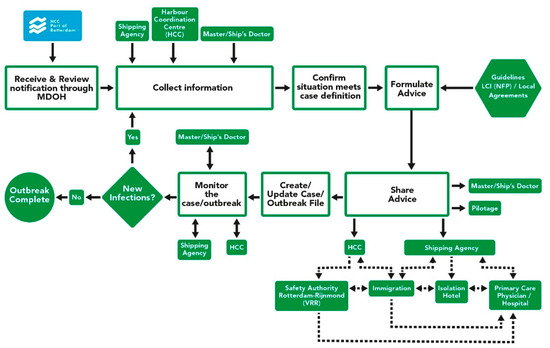
Figure 1.
SARS-CoV-2 case and outbreak management by PHS: process for managing a notification. White boxes: the process itself; small green rectangular boxes: partners within the Port of Rotterdam; green hexagon: input received from the national focal point; green diamond: decisive moment in flowchart; green circle: endpoint of flowchart.
3. Results
84 SARS-CoV-2 events involving 622 cases were notified among 45,030 port arrivals, a NR of 173/100,000 arrivals, on 1% of vessels. The median cases per event was 4 (interquartile range: 1–8, maximum 106). Events per week peaked in April 2021 and again in July 2021, when the AR was also highest. Workship events accounted for 50% of cases, occurring earlier and more frequently than on other vessels (Figure 2).
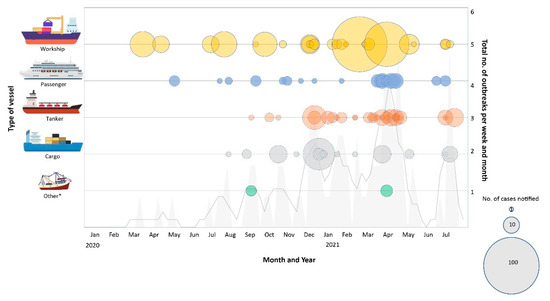
Figure 2.
Total number or cases notified on board each ship reporting SARS-CoV-2 by month and year, and vessel type, Port of Rotterdam, from 1 January 2020 to 31 July 2021. Vessel type “other” was comprised of fishing ships and naval vessels.
4. Discussion and Conclusions
Notification of SARS-CoV-2 events on ships occurred infrequently, though case under-ascertainment was likely. PH access to specimens for sequencing and environmental sampling would give greater insight into viral spread on ships. Pre-agreed protocols for data sharing and communication between stakeholders would facilitate more efficient pandemic response.
Actions taken by the PHS are in white boxes. On receipt of a notification of suspected SARS-CoV-2, the circumstances on board the vessel are reviewed, and information collected by the PHS as available from the harbour coordination centre (HCC) or the ship/ship’s agent. If SARS-CoV-2 is confirmed on board, advice on appropriate outbreak control measures is formulated by PHS, per protocol. Advice on outbreak management is then shared with involved stakeholders, as illustrated.
The shaded grey area represents the total number of notifications of SARS-CoV-2 events experienced on board the ship, received per week during each calendar month. The solid grey line is the 4 week moving average summarizing the weekly data. The size of the circle indicates how many cases were ultimately confirmed per arrival reporting any case of SARS-CoV-2. In the ‘passenger’ ship category notifying a SARS-CoV-2 event, there were 6 cruise ships, 5 ferries, and 2 yachts. Cruise liner operations were not subject to a ‘No Sail Order’ in Europe as in the US, but cruise ships stopped transporting passengers from March 2020 to August 2020 when they gradually resumed normal operations. The earliest outbreak on board a cruise ship was reported on 4 September 2020.
Between 14 December 2020 and 24 July 2021, and 19 December 2021 and 26 January 2022, all ports in the Netherlands were again temporarily closed to cruise ships during nation-wide lockdowns. Notably, for ships used to transit passengers (and vehicles) on short-distance routes (e.g., ferries), passengers from England were temporarily blocked from arriving at the port in December 2020. The vessels continued to access the port, however, and cases among crew members were routinely recorded. Tracking of passengers on board ferries by the PHS is generally not feasible as passengers (dis)embark at regular, short intervals. Cases among crew members are routinely recorded. No cases among passengers were identified for this study.
Author Contributions
Conceptualization: E.F., E.G. and J.W.; methodology, J.W. and E.G.; software, J.W.; validation, J.W., R.S., B.V. and E.G.; formal analysis, J.W.; investigation, E.G., B.V. and J.W.; resources, J.W. and R.S.; data curation, E.G., B.V., R.S. and J.W.; writing—original draft preparation, J.W. and E.G.; writing—review and editing, all authors; visualization, B.V. and J.W.; supervision scientifically, E.F.; supervision medically, A.d.R. and S.v.L.-V.; supervision Port of Rotterdam, S.W., B.v.D. and R.d.V.; project administration, J.W. and E.G.; funding acquisition, non-applicable. All authors have read and agreed to the published version of the manuscript.
Funding
No external funding was received for the research project.
Institutional Review Board Statement
Ethical review and approval were waived for this study due to the use of routinely collected data which could not be traced back to individual persons.
Informed Consent Statement
Not applicable since no individual information was either obtained or used in the study.
Data Availability Statement
The data presented in this study are available on request from the corresponding author. The data are not publicly available due to proprietary reasons.
Conflicts of Interest
The authors declare no conflict of interest.
Publisher’s Note: MDPI stays neutral with regard to jurisdictional claims in published maps and institutional affiliations. |
© 2022 by the authors. Licensee MDPI, Basel, Switzerland. This article is an open access article distributed under the terms and conditions of the Creative Commons Attribution (CC BY) license (https://creativecommons.org/licenses/by/4.0/).