


Abstract
Wheat is an important cereal crop that often suffers from osmotic stress under various growing conditions. The objective of this study was to investigate the effects of PEG-induced osmotic stress at the phytomer level on root growth and root hair morphology of 22 hydroponically grown wheat varieties. Two treatments, 0% and 10% PEG, were imposed on 20-day old wheat seedlings for a duration of 15 days. PEG stress significantly reduced plant height, number of live leaves per tiller, chlorophyll content, shoot dry weights, number of root bearing phytomers and roots per tiller. By contrast, PEG stress significantly increased leaf injury scores, root dry weight, main axis length and diameter of developed roots, length and diameter and density of both first and second order lateral roots, and the density and length of root hairs. An increase in root dry weight in PEG stress tolerant wheat genotypes was achieved through an increase in the length and diameter of main axis and lateral roots.
1. Introduction
Wheat is one of the major cereal crops grown in the winter season in Bangladesh [1]. Wheat crops in Bangladesh face a moisture deficit in water sensitive stages such as booting and flowering [2]. Deficit irrigation may increase wheat production by 11% to 136% [2]. However, a number of traits related to the yield of wheat shows an adaptive mechanism under drought stress [3]. In a recent study, wheat cultivars showed variability in tolerance level based on leaf morphological traits [4]. In earlier studies, different sets of wheat genotypes showed genetic diversity based on days to maturity and yield contributing traits in Bangladesh [5,6]. None of those studies involved measuring root traits, although tolerant crop plants exhibited root adaptive traits under various abiotic stress conditions [7,8]. The present study was therefore planned to investigate detailed root traits of wheat genotypes under osmotic stress.
2. Experiments
A total of 22 wheat genotypes, including landraces, obsolete varieties, and high-yielding cultivars, were selected to impose osmotic stress. Plants were hydroponically cultured following Robin et al. [9,10] for 20 days before imposing 10% PEG-induced osmotic stress along with control (Figure 1a). Plants were exposed to 15 days under a stressed condition to allow the plants to reach the sufficient stress necessary to record the morphological difference in root growth (Figure 1b). The chlorophyll content of leaves under control and osmotic stress was recorded (Figure 1c) and leaf injury scores were scored (Figure 1d). A number of root traits, including length, diameter and density of root axes, lateral roots and root hairs were measured under a light microscope (Figure 1e,f, [9,10]). In addition, a number of live leaves and roots per tiller were recorded at the destructive harvest.
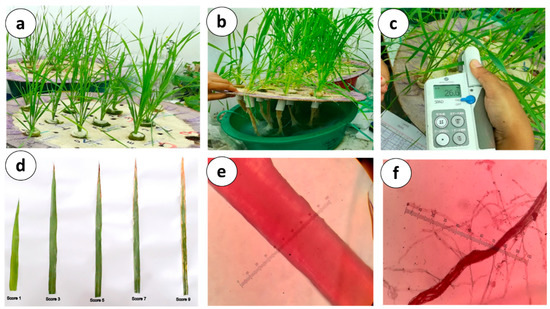
Figure 1.
Hydroponic culture of wheat genotypes and relevant measurements. (a) two weeks old wheat plants ready for treatment imposition; (b) Root growth of what plants under 10% PEG-induced osmotic stress; (c) Measurements of chlorophyll content using SPAD meter; (d) scoring of damaged leaves under osmotic stress; (e) diameter of a root axis and (f) length of a root hair.
3. Results
3.1. Effect of PEG Stress
PEG-induced osmotic stress significantly reduced plant height, number of live leaves per tiller, and chlorophyll content in the leaf tissues (Table 1). Leaf injury scores increased at the 5th live leaves (Table 1). Osmotic stress also reduced shoot dry weight per tiller but strikingly root dry weight per tiller increased (Table 1). Despite an increase in root dry weight per tiller, the number of root bearing phytomers and the total number of root per tiller decreased (Table 1). Osmotic stress reduced the number of seminal roots per tiller, but the length of individual seminal roots increased. With the increase in root dry weight per tiller the length, diameter and density of lateral roots and root hairs also increased (Table 1).

Table 1.
Difference between control and 10% PEG-induced osmotic stress among wheat genotypes. Pr, phytomer; MA, main axis; FLR, first order lateral roots; SLR, second order lateral roots; RH, root hairs; d, diameter; Dn, density; L, length.
3.2. Correlation among Selected Root Traits
In spite of the increasing trend of all root traits upon PEG-induced osmotic stress, only the main axis length showed a significant association with root dry weight (Table 2). The number of root bearing phytomers, number of roots per tiller and the number of seminal roots per tiller showed a strong positive association among each other (Table 2). The total number of roots per tiller showed a negative association with the density of primary lateral roots per unit main axis length (Table 2).
Table 2.
Correlation among root dry weight (RDW), total number of root bearing phytomers (TPr) and total number of roots (TR) per tiller and with other root morphological traits of wheat genotypes under PEG-induced osmotic stress.
Thus, the genotypes produced higher root dry weight and the main axis length were more tolerant to osmotic stress compared to contrasting genotypes.
4. Discussion
The production of a large root system associated with the elongation of main axis and lateral branches under drought stress conditions is believed to be a characteristic feature of drought tolerant plants [8]. Similar to this study, one previous study reported that all fescue plants produce extensive root hairs under drought stress, but that the root dry weight per plant was decreased under stress condition [11]. In corn, a kind of genotypic diversity was observed where increasing root dry weight in the tolerant genotypes was associated with yield [12] and these results are consistent with our observations. However, unlike this study, none of the previous studies have observed root traits at the phytomer level in detail.
5. Conclusions
This study explored the effects of PEG-induced osmotic stress on root development at the phytomer level. A strong positive association between root dry weight and main axis length was observed. The results indicated that tolerant wheat genotypes increase the length and density of main axis and lateral branches as an adaptive mechanism to cope with osmotic stress.
Supplementary Materials
The poster presentation is available online.
Author Contributions
A.H.K.R. and S.G. conceived and designed the experiments; S.G. performed the experiments; S.G. and M.A.S. analyzed the data and prepared tables and figures. A.H.K.R. wrote the paper. All authors have read and agreed to the published version of the manuscript.
Funding
This research was funded by the University Grants Commission of Bangladesh (Grant No. 2019/829/UGC).
Institutional Review Board Statement
Not applicable.
Informed Consent Statement
Not applicable.
Data Availability Statement
Data available on request.
Conflicts of Interest
The authors declare no conflict of interest.
References
- Timsina, J.; Wolf, J.; Guilpart, N.; Van Bussel, L.G.J.; Grassini, P.; Van Wart, J.; Van Ittersum, M.K. Can Bangladesh produce enough cereals to meet future demand? Agric. Syst. 2018, 163, 36–44. [Google Scholar] [CrossRef] [PubMed]
- Mustafa, S.M.T.; Vanuytrecht, E.; Huysmans, M. Combined deficit irrigation and soil fertility management on different soil textures to improve wheat yield in drought-prone Bangladesh. Agric. Water Manag. 2017, 191, 124–137. [Google Scholar] [CrossRef]
- Pireivatlou, A.S.; Masjedlou, B.D.; Aliyev, R.T. Evaluation of yield potential and stress adaptive trait in wheat genotypes under post anthesis drought stress conditions. Afric. J. Agric. Res. 2010, 5, 2829–2836. [Google Scholar]
- Haque, M.S.; Saha, N.R.; Islam, M.T.; Islam, M.M.; Kwon, S.J.; Roy, S.K.; Woo, S.H. Screening for drought tolerance in wheat genotypes by morphological and SSR markers. J. Crop Sci. Biotechnol. 2020, 1–13. [Google Scholar] [CrossRef]
- Hossain, M.M.; Hossain, A.; Alam, M.A.; Sabagh, A.E.L.; Murad, K.F.I.; Haque, M.M.; Das, S. Evaluation of fifty irrigated spring wheat genotypes grown under late sown heat stress condition in multiple environments of Bangladesh. Fresen. Environ. Bull 2018, 27, 5993–6004. [Google Scholar]
- Rahman, M.M.; Rahman, J.; Azad, M.A.K.; Barma, N.C.D.; Biswash, B.K. Genetic diversity in spring wheat genotypes under drought stress in Bangladesh. Bangladesh J. Plant Breed. Genet. 2010, 26, 1–10. [Google Scholar] [CrossRef]
- Hannan, A.; Hoque, M.N.; Hassan, L.; Robin, A.H.K. Adaptive Mechanisms of Root System of Rice for Withstanding Osmotic Stress. In Recent Advances in Rice Research; IntechOpen: London, UK, 2020. [Google Scholar]
- Palta, J.A.; Chen, X.; Milroy, S.P.; Rebetzke, G.J.; Dreccer, M.F.; Watt, M. Large root systems: Are they useful in adapting wheat to dry environments? Funct. Plant Biol. 2011, 38, 347–354. [Google Scholar] [CrossRef] [PubMed] [Green Version]
- Robin, A.H.K.; Uddin, M.; Bayazid, K.N. Polyethylene Glycol (PEG)-treated hydroponic culture reduces length and diameter of root hairs of wheat varieties. Agronomy 2015, 5, 506–518. [Google Scholar] [CrossRef] [Green Version]
- Robin, A.H.K.; Uddin, M.J.; Afrin, S.; Paul, P.R. Genotypic variations in root traits of wheat varieties at phytomer level. J. Bangladesh Agric. Uni. 2014, 12, 45–54. [Google Scholar] [CrossRef] [Green Version]
- Huang, B.; Fry, J.D. Root anatomical, physiological, and morphological responses to drought stress for tall fescue cultivars. Crop Sci. 1998, 38, 1017–1022. [Google Scholar] [CrossRef]
- Eghball, B.; Maranville, J.W. Root development and nitrogen influx of corn genotypes grown under combined drought and nitrogen stresses. Agron. J. 1993, 85, 147–152. [Google Scholar] [CrossRef]
Publisher’s Note: MDPI stays neutral with regard to jurisdictional claims in published maps and institutional affiliations. |
© 2020 by the authors. Licensee MDPI, Basel, Switzerland. This article is an open access article distributed under the terms and conditions of the Creative Commons Attribution (CC BY) license (https://creativecommons.org/licenses/by/4.0/).