1. Introduction
Grit, defined as the combination of passion and perseverance for long-term goals, is widely recognized as a key factor in achievement and success.
A. Duckworth (
2016) conceptualize grit as sustained effort and interest maintained over years despite setbacks. In traditional accounts, grit is often portrayed as an internal trait, maintained largely by the individual. However, recent perspectives suggest that grit can also develop through external influences. For example, sustained involvement in organized sports has been linked to greater grit: one longitudinal study found that adults who persevered in youth sports scored higher on grit measures later in life than those who quit early. Such findings imply that grit development is dynamic and context-sensitive, with external structures (training, mentorship, social support) eventually internalizing into personal motivation. Within youth sport, grit is often celebrated as a desirable quality that predicts persistence, retention, and long-term achievement—sometimes more so than innate talent (
A. Duckworth, 2016). Sports such as powerlifting, which demand years of incremental progress and extraordinary commitment, provide a useful context for studying perseverance. The influence of coaches in such environments is particularly significant: they set challenges, frame setbacks as learning opportunities, and model persistence, potentially “seeding” grit in their athletes (
Davidson & Foster, 2024).
Larson’s (
2000) theory of “structured voluntary activities” also emphasizes that organized, challenging programs often yield positive developmental outcomes in youth.
Building on these perspectives, this article introduces a Dual Pathway Model of Grit Development in youth sport. The model distinguishes between two developmental trajectories: (1) the Outside-In pathway, in which external influences such as coaching, structured programs, and relational support spark perseverance (
Camiré et al., 2011); and (2) the Inside-Out pathway, in which young athletes’ intrinsic motivation and autonomy drive their long-term commitment. These pathways are not mutually exclusive, athletes may begin with one trajectory and later transition to, or integrate with, the other.
Despite growing scholarly attention, much of the grit literature continues to treat grit as a fixed internal trait rather than as a relationally cultivated process. There remains limited understanding of how grit is shaped by the interaction of external scaffolding (e.g., coaching and structured adversity) and internal ownership (e.g., autonomy and self-motivation) in youth sport contexts. Furthermore, little is known about how personal and social backgrounds influence the trajectory of grit development across athletes.
Therefore, this study aims to examine how grit develops among youth powerlifters through both Outside-In and Inside-Out pathways and to identify the contextual, relational, and motivational factors that shape these trajectories. By grounding our analysis in lived experience, we aim to deepen Duckworth’s grit theory in the sports context, demonstrating how grit can be cultivated through outside-in coaching strategies (e.g., structured adversity, encouragement, mentorship) and how, over time, this grit must be claimed inside-out by the youth themselves (through intrinsic commitment and self-regulation). This relational–developmental perspective aligns with positive youth development frameworks and offers practical insights for coaches and mentors. Ultimately, we suggest that grit is not strictly a personal trait one is “born with” but often a flame lit by others that young athletes eventually take ownership of.
2. Methodology
2.1. Research Design and Approach
This study employed analytical autoethnography within a qualitative case study framework. Autoethnography, broadly, is a qualitative approach that combines personal narrative with cultural analysis, using the researcher’s lived experience as a lens for understanding broader social phenomena (
Ellis et al., 2011). It emphasizes the integration of autobiographical reflection with ethnographic interpretation, situating the personal within the sociocultural.
As
Anderson (
2006) proposed, analytical autoethnography extends beyond evocative personal storytelling by requiring theoretical engagement and systematic analysis. It is defined by five key features: (1) the researcher’s complete member status in the setting; (2) analytic reflexivity; (3) narrative visibility of the researcher’s self; (4) dialogue with others beyond the self; and (5) a commitment to theoretical contribution. This distinguishes analytical autoethnography from more purely evocative or literary forms, as it seeks to produce transferable insights relevant to academic and applied fields.
The theoretical foundation of this approach rests on the idea that identity, motivation, and development are shaped by the interplay between individual experience and social context. By positioning the researcher as both insider and analyst, analytical autoethnography makes it possible to interrogate how personal experience reflects and interacts with wider cultural structures. In sport research, this dual role is increasingly recognized as valuable because it reveals dimensions of practice, emotion, and meaning that are often inaccessible to external observers (
Gearity, 2014).
In this study, the first author functioned as both coach and researcher, offering an insider’s view into youth athlete development. Such dual positioning aligns with the epistemological stance of autoethnography, which views the researcher’s subjectivity not as a limitation but as a resource for inquiry (
Ellis et al., 2011). Autoethnographic methods are especially appropriate for exploring personal and contextual influences on identity and motivation in sports, as they allow the integration of subjective insight with sociocultural analysis (
Allen-Collinson, 2012).
Ethical standards were upheld through university Institutional Review Board approval and informed consent processes, including parental consent for minors. All identifying information has been pseudonymized for participant protection.
2.2. Participants and Context
Our study illustrates this model through a qualitative case study of a youth powerlifting program. The focal case is “Dane”, a 15-year-old boy from an underserved community who initially lacked direction and confidence. Dane’s journey exemplifies an outside-in to inside-out transformation: he started as a disengaged teen motivated by the coach’s support and structure and evolved into a self-driven national-caliber athlete with his own passion and purpose. We contrast Dane’s story with those of three other lifters to highlight different pathways: “Chan”, a 19-year-old Chinese male from an affluent, highly supportive family, initially had trouble with independent motivation despite plentiful external support. In fact, Chan admitted he had “nothing to worry about at home,” where his parents “took care of everything for him”— he was unaccustomed to making his own decisions or sustaining motivation without direction. “Hailey” and “May”, both 16-year-old girls from stable middle-class families, joined the program with strong intrinsic enthusiasm. Quiet and self-motivated, they needed minimal external prodding and largely drove their own training from the start. Their grit was already high upon arrival and primarily required encouragement and technical support from the coach.
The four adolescent powerlifters participated in 20 weeks of preparation for competitions. These cases reflected a range of socioeconomic backgrounds and motivational profiles, offering diverse insights into grit development. Such purposive sampling aligns with case study norms, aiming for information-rich participants relevant to the research focus (
Gebhardt, 2023).
Dane, central case: A 15-year-old male from a low-income urban community. Initially shy and disengaged, he had low confidence and no clear future goals. He described himself as having “never imagined a life beyond Angsana…struggling to make ends meet” (Angsana is a local neighborhood school). He joined powerlifting in 2021 with no prior experience and assumed he would simply work after school.
Chan, contrast case 1: A 19-year-old male from an upper-middle-class family. His parents were highly involved and affluent, so Chan admitted having “nothing to worry about” at home—others “took care of everything for him”. He enthusiastically joined powerlifting, but he had rarely had to motivate himself independently. He often doubted himself in training and felt anxious about competition, needing direction on what goals to set. His situation highlighted a contrast: despite many outside advantages, he lacked internal drive.
Hailey, contrast case 2: A 16-year-old female from a middle-upper-income, educated family. Quiet and introspective, Hailey joined in mid-2024 with a disciplined history in other activities and supportive parents. She approached powerlifting with self-driven dedication: punctual, diligent, and motivated by personal challenge rather than external rewards. Her perseverance was intrinsic from the start, exemplifying the Inside-Out pathway.
May, contrast case 3: A 16-year-old female training alongside Hailey. Like Hailey, May came from a stable middle-class background with involved parents and prior structured activities. Gentle and cheerful, she nonetheless had high intrinsic motivation for powerlifting. Both girls “knew what they wanted” and committed to training largely for personal enjoyment. They rarely needed external prompting to persist.
All four athletes trained together in the same community gym under the coach’s guidance, typically 3–4 times per week. The program emphasized not only physical training (strength and technique) but also character development (aligned with positive youth development principles). Sessions often included goal setting, mental skills discussion, and reflection on effort and sportsmanship. Competitions during this period were a national qualifier (January 2025) and a state meet (October 2024).
2.3. Data Collection
We triangulated multiple qualitative sources to capture the developmental process of grit in youth powerlifters. Each type of data served a distinct purpose in building the analysis:
Coach’s Autoethnographic Journal: The first author maintained a detailed reflexive journal throughout the 20-week program, typically writing 1–2 pages after each training session or event. These entries recorded both external observations (athletes’ behaviors, dialogue, lift results) and internal reflections on coaching decisions and emotions. The journal provided longitudinal insight into the evolving coach–athlete relationships and the researcher’s reflexive positioning (
Carter, 2016).
Interviews and Conversations: Informal interviews and organic conversations occurred during training, car rides, and breaks. Additionally, a small number of semi-structured interviews were conducted at key milestones (mid-season and post-competition). These elicited athletes’ perspectives on motivation, challenges, and the role of coaching support. Verbatim quotations from these sources are presented in the Results to preserve the youths’ authentic voices.
Athlete Journals and Writings: Athletes were encouraged to write short reflections during the program. For example, Chan’s personal training journal contained goal-setting notes and candid expressions of self-doubt and perseverance. These writings illuminated self-talk processes, motivational shifts, and personal goal trajectories.
Field Observations: As both coach and researcher, the first author noted significant moments during training and competition. Brief observations were made during practice, while competition days included more structured field notes about athletes’ performance, confidence, and emotional states under pressure.
Each data type served a distinct function in the analysis. The coach’s autoethnographic journal provided longitudinal insight into coaching decisions and reflexive interpretations. Informal conversations and semi-structured interviews captured the youths’ lived experiences in their own words, offering direct quotations used in the
Section 3. Athlete journals and writings illuminated their self-talk and goal-setting processes, while field observations provided contextual evidence of behavior and emotional responses during training and competition. Taken together, these sources enabled both within-case depth and cross-case comparison, forming the empirical basis for the thematic coding and conceptual framework.
2.4. Data Analysis
Data analysis followed a thematic narrative approach. The first author immersed himself in the dataset (journals, interviews, athlete writings, and field notes) and conducted a process of theory-driven and inductive coding. Analysis was supported by qualitative software (NVivo 15) and an AI-assisted tool (ChatGPT-4o, GPT 5.0) to surface repeated patterns, keywords, and emerging categories. Initial coding combined deductive themes (e.g., “perseverance,” “coach support,” “autonomy”) with inductive phrases arising from the data (e.g., “finding his own fire,” “structured adversity”).
To address the potential for bias inherent in the dual role of coach and researcher, several strategies were adopted. First, triangulation across multiple data sources prevented over-reliance on any single perspective. Second, member checking was conducted: participants reviewed excerpts of their narratives (e.g., Dane confirmed that his transformation “felt right”), ensuring the accuracy of representation. Third, peer debriefing was undertaken with a coaching colleague who reviewed anonymized cases and confirmed resonance with the first author’s observations. Finally, the first author maintained a reflexive journal to document potential biases, regularly questioning whether coaching actions were empowering athletes or fostering dependency.
Through these steps, the analysis balanced the strengths of insider knowledge with safeguards that enhanced credibility, confirmability, and transparency.
3. Results
3.1. Outside-In: Building Grit Through External Structure and Support
Early in the program, grit in these youths was largely an outside-in phenomenon, sparked and shaped by external forces, especially the coach–athlete relationship and structured challenges. Most athletes did not start with an innate passion for powerlifting; rather, their perseverance was cultivated by the environment. This was most striking in Dane’s case. When Dane first entered the gym, he was a shy 15-year-old lacking confidence and direction.
“I used to not even care about doing my homework,” Dane admitted, “and now I do. And now I am on time. More punctual.”
This change had not come from within at first, but from the new structure around him. As Dane’s coach, I deliberately created a challenging but supportive training regimen to build his grit. Dane “needed a structured adversity to push him beyond his limited belief system.” His first major challenge was agreeing to compete in a powerlifting meet. Initially, Dane was apprehensive: competition was far outside his comfort zone, and his low self-esteem made him fear failure. Our decision to enter him in a meet was the first structured adversity he faced.
Dane eventually agreed to compete, saying it was “due to our coach–athlete relationship that is built on trust.” He did not want to let his coach down. He was motivated extrinsically by our expectations and encouragement.
As he later said:
“Coach, you taught me to be mature and independent… to make decisions even when friends pressure me.”
In these early stages, Dane’s grit was coach-driven. I set the goals, and he worked hard to meet them, developing good habits along the way. His attendance and punctuality improved dramatically. He went from an indifferent student to someone who “now does” his homework and manages his time, as he proudly noted. Showing up to training consistently became non-negotiable, and that discipline spilled over into other areas of his life. Teachers observed that within two years he had transformed from a shy, disengaged boy into an active student with leadership qualities.
Dane later reflected: “I never envisioned becoming a national athlete, but Coach, you taught me to be mature and independent.”
Other participants exhibited similar outside-in beginnings, albeit in different forms. Chan, for example, had plenty of external support, perhaps too much. His parents and family created a comfortable cushion around him, which led to a kind of complacency. When he joined powerlifting, Chan was enthusiastic but easily demoralized by difficulties. He often “struggled with self-doubt and anxiety,” finding it hard to push himself without external direction. In Chan’s early training, I had to play the role of motivator and mentor, guiding him through confidence issues.
In summary, during the early stage, each youth’s grit was largely built from the outside-in. The coach’s structured programs, the challenges of competition, and the supportive relationship provided the spark of perseverance.
3.2. Inside-Out: Internalizing Passion and Ownership of Grit
As the season progressed, it became evident that long-term success would require a shift from external to internal motivation. The ultimate goal was for each athlete to own their grit, to persevere because they wanted to, not just because others wanted them to.
3.2.1. Dane’s Turning Point
Dane reached a pivotal moment during a candid conversation after practice. Sensing that I had been driving his goals, I bluntly asked him:
“Who do you think wants success more—you or me?”
This question hit home. Dane realized that I could not carry his motivation indefinitely. Reflecting on his quitting friends, he said:
“They just didn’t want it even a little bit… I’m not like that; I do want it.”
The breakthrough came when Dane declared his own dream out loud:
“I want to carry Malaysia’s name to the world stage.”
He said this with genuine conviction. I could see that his perspective had changed—it was now his dream, not mine. That evening, I wrote in my journal that I felt both joy and anxiety: joy that Dane had finally said it was his dream, and concern because I knew I now needed to step back.
In the next training session, I consciously ceded control. Instead of dictating Dane’s warm-up and accessory lifts, I asked him to plan the warm-up himself and choose additional exercises. Dane structured an excellent warm-up and identified that his lower back was a weakness to address. Over subsequent weeks, he started to set new personal goals, aiming for regional and Asian championships, and began monitoring aspects like nutrition and recovery without being prompted.
A telling quote from Dane captures the change:
“I still feel like I am failing sometimes… I have a lot of homework… I keep on pushing… I do feel like mentally breaking down sometimes, but I keep on going… I want to carry Malaysia’s name… This is my dream and ambition.”
3.2.2. May and Hailey: Inside-Out from the Start
In contrast to Dane and Chan, May and Hailey largely exemplified the Inside-Out pathway from the beginning. They joined with strong internal passion for the sport and needed almost no external prodding. For instance, in one training session, I mentioned, “If you keep going in this direction, you both would definitely break national records in January.” I only had to say it once; they immediately asked for the exact record figures and then “kept their heads in the training,” mentally rehearsing to achieve those targets.
Unlike the boys, the girls did not need frequent reminders or threats of missing goals, they enjoyed the training itself.
As I noted in my journal, “the competition and records were all secondary to them; they enjoyed being in the gym and that was satisfying already.”
Of course, they still faced challenges. When Hailey encountered a mishap in competition (a disqualified lift on a technicality), we deliberately withheld the bad news until after her final attempt to protect her confidence. Hailey stayed focused and succeeded on her next attempt, then calmly expressed gratitude upon learning of the earlier failure. As observed, she had the confidence and courage to continue pursuing the national record without fear. Similarly, May handled tough training with a quiet determination that suggested a growth mindset.
Coaching May and Hailey required mostly support and refinement rather than driving motivation. They even self-corrected before I could point out errors, and they set ambitious goals on their own.
3.2.3. Chan’s Inside-Out Shift
Chan’s case was interesting because he started with less obvious internal passion and more anxiety than the girls. But by the end of the season, he had undergone a significant shift. Through consistent reinforcement and gradually increased responsibility, Chan began to show initiative. He started, for instance, to research nutrition on his own and proudly shared a diet plan he created. He even volunteered to assist me in coaching newcomers after his competition. He said he “wanted to help others find their confidence like he did.”
At one point, Chan recorded in his journal a self-challenge:
“I hope to hit a 100 kg bench and a 160 kg squat… I don’t want to go down without a fight… even if I lose, I want to at least make it close.”
This indicated a growing determination to set and meet his own standards. By the end of the season, Chan had shifted from being largely externally driven to finding personal reasons to persevere.
3.3. Dual Pathways in Perspective: Integrating Outside-In and Inside-Out
Our case comparisons suggest that Outside-In and Inside-Out are useful conceptual pathways but deeply interconnected in practice. We observed a general progression from outside-in motivation toward inside-out over time, yet personal and contextual factors shaped each athlete’s journey.
For example, Dane (low SES, little prior support) responded strongly to outside-in structure, whereas Chan (high SES, over-supportive parents) had to peel back external dependence to find his own drive. May and Hailey, by contrast, entered with substantial inside-out drive from the start, which the coach’s support further nourished.
We also identified three mechanisms that underpinned grit development across the cases:
A strong coach–athlete relationship that provided emotional safety and accountability.
Effective coaching strategies, including goal-setting, feedback, and mental skills.
Structured adversity, in the form of intentional but manageable challenges.
Early in the process, these elements functioned as outside-in supports. Over time, however, the athletes translated them into internal outcomes: greater confidence, improved skills, and intrinsic resolve.
Ultimately, all four athletes experienced growth beyond physical outcomes. They showed increases in confidence, independence, and leadership alongside their enhanced perseverance. Dane’s evolving confidence and leadership, Chan’s willingness to mentor peers, and Hailey’s and May’s self-driven pursuit of excellence all illustrated holistic development.
When Dane said,
“This is my dream and ambition,”
He was articulating a broader purpose that extended beyond sport. These integrative themes illustrate how Outside-In and Inside-Out pathways coalesce in practice.
3.4. Conceptual Framework and Key Outcomes
The findings reveal two distinct but occasionally intersecting pathways through which grit was cultivated among youth powerlifters—namely, the Outside-In and In-side-Out trajectories. As outlined in
Table 1, each athlete’s developmental path was shaped by their socioeconomic background, motivational starting point, and the nature of coach interventions. Those with lower autonomy or fewer structural advantages (e.g., Dane, Chan) initially relied on coach-driven discipline, progressing through adversity via scaffolded support and eventually internalizing grit. In contrast, athletes such as Hailey and May exhibited more self-determined motivations from the outset, with coaching focused on refinement rather than direction.
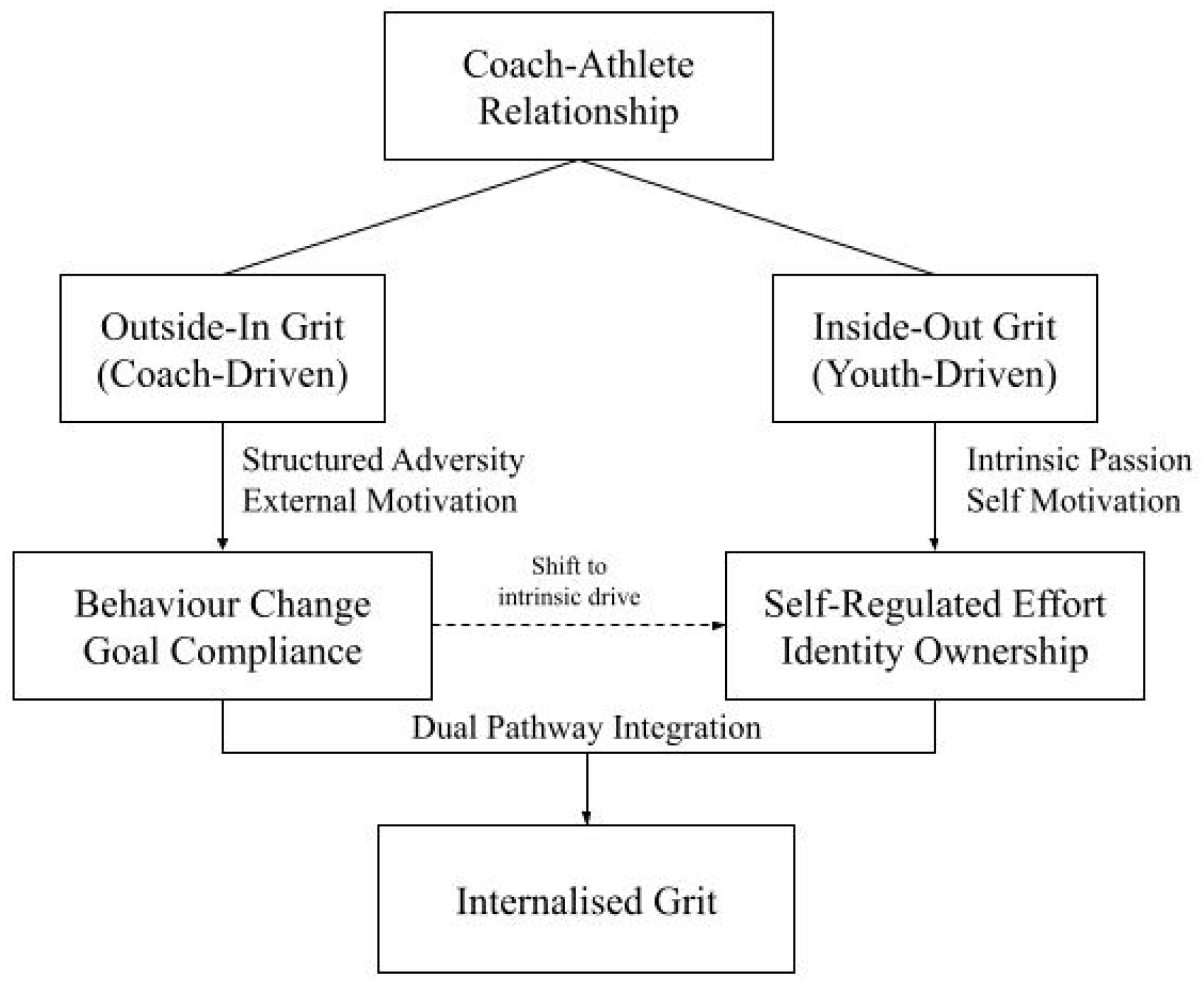
Figure 1 presents the Dual Pathway Model of Grit Development in Youth Coaching. Rooted in the coach–athlete relationship, this framework illustrates two primary developmental trajectories: outside-in grit, which is coach-driven and shaped by structured adversity and external motivation, and inside-out grit, which is youth-driven and fueled by intrinsic passion and self-motivation. Youth who begin with external compliance and behavior change often experience a shift toward self-regulated effort and identity ownership, marking the transition from outside-in to inside-out grit. This internalization process is depicted by the dashed arrow labeled “Shift to intrinsic drive.” Ultimately, both pathways converge in the “Dual Pathway Integration” phase, culminating in Internalized Grit—a sustained, autonomous perseverance that reflects a mature developmental outcome. This framework integrates findings from this study and aligns with both Self-Determination Theory and Positive Youth Development principles.
In closing this Results section, we note that each youth not only developed deeper grit but turned it outward in positive ways. Dane became an independent athlete and even aspired to mentor others from his hometown. Chan overcame personal barriers and sought to help peers build confidence. May and Hailey challenged gender stereotypes and encouraged other girls to try strength sports. When youth develop grit through the coming together of external support and internal commitment, they often “turn outward and uplift others,” as the final coach note observed. This ripple effect hints at a broader social value of cultivating grit—a phenomenon echoed in recent findings on Positive Youth Development’s ripple effects (
Vierimaa et al., 2018).
The narratives of Dane, Chan, Hailey, and May illustrate that individual differences (background, personality, gender) shape how grit pathways unfold, but the developmental pattern holds: when properly supported, youth can transform their initial motivations into enduring grit. All four demonstrated remarkable growth in both perseverance and passion over the 20-week period. Each overcame initial hurdles: Dane overcame apathy and became passionately ambitious; Chan overcame self-doubt and found motivation; Hailey and May confirmed that intrinsic zeal, when supported, leads to achievement and leadership.
One of the most compelling illustrations of this shift is embodied in Dane’s words:
“I want to carry Malaysia’s name into the international arena and make Malaysia proud. This is my dream and ambition.”
This statement—from a boy who once “never imagined a life beyond Angsana”—epitomizes the move from Outside-In to Inside-Out.
We acknowledge that our analytic autoethnographic approach, while offering deep insight, has limitations (e.g., potential researcher bias). Future research could incorporate independent interviews or quantitative measures to see if athletes articulate their development similarly. Nevertheless, the consistency of multiple data sources, member checks, and colleague reviews supports the credibility of our findings.
4. Discussion
This study reconceptualizes grit not as a fixed individual trait but as a dynamic, relational, and context-sensitive capacity. Our findings show that grit in youth sport can be seeded through external guidance, structured challenges, and close relationships and, over time, internalized by athletes as their own drive. This complements
A. L. Duckworth et al.’s (
2007) emphasis on perseverance as individual passion by demonstrating how coaches and environments act as “grit catalysts” that can spark persistence even in youths who begin without strong intrinsic motivation. For example,
Robertson-Kraft and Duckworth (
2014) found that supportive conditions in schools were linked to greater persistence in challenging settings; our study provides a mechanism for this effect in sport, showing how mentors can actively transfer a gritty mindset (
Jung & Kwon, 2023).
4.1. Grit as Relationally Cultivated
Our cases illustrate that perseverance often begins outside the individual. Dane’s improved attendance and academic engagement, for instance, first arose from externally imposed structure rather than inner passion. Through coaching routines, feedback, and accountability, the athletes were able to persist beyond what they might have achieved alone. This pattern reflects a scaffolding process where mentors temporarily provide drive and structure until athletes internalize perseverance. Prior studies in youth sport have shown that coach–athlete relationships are foundational in fostering motivation and persistence, with supportive coaching acting as a key driver of engagement and skill acquisition (
Jowett & Cockerill, 2003;
Vella et al., 2013;
Gould et al., 2007).
4.2. Transition from Outside-In to Inside-Out
Over time, all four athletes demonstrated that external support alone was not enough. Long-term grit only became sustainable when the athletes claimed it for themselves. Dane’s declaration, “This is my dream and ambition”, signaled the critical turning point where perseverance shifted from being coach-driven to self-owned. Chan’s gradual self-reflection and eventual mentoring of others also illustrated this transition. By contrast, Hailey and May exemplified inside-out grit from the beginning, requiring less external prompting. (
Zhang et al., 2024) This suggests that outside-in support is necessary but insufficient. It creates conditions for persistence but must ultimately give way to athlete-driven commitment if grit is to endure. This mirrors findings in Self-Determination Theory, which emphasizes that autonomy is essential for long-term motivation (
Deci & Ryan, 2000;
Vansteenkiste et al., 2010). Research in sport has similarly highlighted that athletes thrive when they internalize values and goals rather than relying solely on external control (
Hollembeak & Amorose, 2005;
Gagné et al., 2003).
4.3. Cross-Case Contrasts and Contextual Nuance
Comparing across cases revealed how personal background and context shaped grit pathways. Dane, from a low-income background, thrived with structured adversity and close mentorship, progressing from Outside-In to Inside-Out. Chan, from an affluent family, initially struggled with initiative, showing that over-supportive contexts may hinder grit. Hailey and May, both middle-class girls with high intrinsic enthusiasm, pursued grit inside-out from the start.
These contrasts underscore that grit development is not uniform. It is deeply influenced by socioeconomic factors, personal history, and available support. This resonates with findings that socioeconomic context shapes access to developmental resources, with structured adversity often playing a compensatory role for under-supported youth (
Fraser-Thomas et al., 2005;
Holt et al., 2017). Prior work has also suggested that youth from higher-resource backgrounds may sometimes lack exposure to “productive struggle”, which can delay the internalization of resilience and perseverance (
Luthar, 2015;
Tough, 2016).
4.4. Gendered Pathways and Socialization
The smoother inside-out trajectories of Hailey and May may also reflect gendered expectations. In their families, discipline, conscientiousness, and responsibility were emphasized from early on, which likely predisposed them to self-directed motivation in sport (
Zhang et al., 2024). While our sample is small, this suggests that cultural and gendered norms may shape the form grit takes, warranting further exploration in future studies. Literature on youth socialization supports this interpretation: adolescent girls are often encouraged toward self-regulation and responsibility earlier than boys (
Eccles et al., 1990). Studies in sport have also shown that female athletes frequently exhibit high levels of conscientiousness and self-discipline, traits that predict persistence and performance (
Roberts et al., 2007;
Weiss, 2016).
4.5. Grit, Resilience, and Positive Youth Development
Grit and resilience developed together. Early outside-in supports reframed failures, creating a safe environment to persist through adversity. Over time, this reframing was adopted by the athletes themselves: Hailey’s calm response to a near-disqualification, or Dane’s persistence despite academic and training pressures, showed that coping strategies became internalized.
Alongside grit, the athletes also demonstrated gains in the 5Cs of Positive Youth Development (competence, confidence, character, connection, and contribution) (
Holt, 2007). Dane’s leadership in school, Chan’s initiative in helping peers, and the girls’ encouragement of other lifters illustrate how perseverance grew into broader developmental outcomes (
Lerner et al., 2005;
Camiré et al., 2011;
Holt et al., 2017).
4.6. Practical Implications
From a practical standpoint, our study offers a model for coaches and youth programs. To cultivate gritty, resilient youth, mentors should actively provide initial support and structure, then gradually transfer responsibility.
In practice, this means
Provide Grit: At the outset, set clear schedules, goals, and challenges and serve as a steadfast source of belief. For example, we entered beginners in age-appropriate competitions to create structured adversity under supervision. Teach mental skills like positive self-talk and goal setting so that youth learn to endure hardship (
Camiré et al., 2011).
Develop Grit: As athletes engage, continue supporting them but also encourage their input. Provide feedback and allow athletes to make some decisions. Invite them to set personal targets and reflect on progress (as we did with Hailey and May by asking, “What can you improve next time?”). Maintain mentorship but cede some control (
Hwang & Nam, 2021).
Transfer Ownership: Finally, step back and let the youth steer their own journey. Gradually hand over tasks like planning workouts, tracking nutrition, or leading warm-ups (as with Dane and Chan). Continue to encourage and guide but resist over-coaching. This nurtures the athlete’s autonomy and intrinsic motivation. (
Santos & Martinek, 2018).
The timing of this transition is crucial. For example, we initially took a structured approach with all newcomers, but we quickly realized that Hailey and May could handle more independence sooner, whereas Dane and Chan benefited from extended guidance. Coaches should continually assess each athlete’s drive and readiness for autonomy rather than applying a one-size-fits-all approach. This phased approach, much like educational scaffolding, aligns with best practices in teaching and coaching.
Consistent with recent arguments, we also caution against treating grit as a fixed trait to screen for. Instead, programs should intentionally cultivate grit by focusing on supportive relationships and positive youth development practices. In other words, rather than selecting only “gritty” youths, coaches and educators can foster grit in many youths through intentional design of their environments and mentorship.
4.7. Limitations and Future Directions
While analytic autoethnography provides rich, situated insights, it also carries risks of bias due to the dual role of the coach–researcher. To address this, we used triangulation, member checks, and peer debriefing. Nevertheless, future research should incorporate independent interviews, larger samples, and quantitative measures to test how grit pathways unfold across diverse contexts and sports.
4.8. Summary
The narratives of Dane, Chan, Hailey, and May demonstrate that grit is not a fixed trait but a relationally cultivated process. Structured adversity, supportive coaching, and gradual autonomy combined to foster perseverance that eventually became self-owned. The Outside-In and Inside-Out pathways, when understood as interconnected and iterative, provide a framework for how mentors can cultivate perseverance that endures beyond sport.
5. Conclusions
This study demonstrates that grit in youth sport is not solely an internal trait to be discovered but a quality that can be actively developed through the dynamic interplay of external guidance and internal growth (
Major, 2013). The Outside-In and Inside-Out dual pathways provide a framework for understanding how passion and perseverance co-evolve. We introduced these concepts through a detailed autoethnographic case study, finding that the pathways often operate sequentially. In the Outside-In phase, athletes relied on external discipline, vision, and encouragement; in the Inside-Out phase, they cultivated personal commitment and autonomy (
Buenconsejo et al., 2024). For example, Dane initially trained for his coach’s goals and later pursued his own dream, while May and Hailey started with strong intrinsic motivation and flourished further under guidance.
Our findings challenged the original portrayal of grit as an individual disposition. We showed that grit can be “grown” via relational scaffolding. A caring coach–athlete relationship incubated grit: training sessions and setbacks were reframed as lessons in perseverance. Grit, in this view, is context-sensitive and emerges from social interactions over time.
In practice, coaches and educators can adopt a phased approach: first provide grit (structured challenges and strong support) and then transfer ownership to the youth (gradually increasing autonomy and encouraging their own goals). This approach aligns with scaffolding and gradual-release methods in teaching. If consistently applied, it not only leads to high performance in sport but also contributes to holistic youth development (
Nothnagle & Knoester, 2022).
Ultimately, grit in youth is best understood as the outcome of a developmental journey, one that often begins outside-in and ultimately flourishes inside-out. Coaches, mentors, parents, and educators all play vital roles in igniting and guiding this journey. They provide sparks and the fuel, creating a safe environment in which the flame of grit can catch fire and burn on its own. Each athlete’s transformation shows that perseverance and passion can indeed be cultivated, be carried outward, and become a lasting part of a young person’s life.