
You are currently viewing a new version of our website. To view the old version click .
AppliedMath
  • Article
  • Open Access

7 December 2025

Effect of Fear and Time Delay on Predator–Prey Interaction
,
and
1
Department of Mathematics, College of Science, Sultan Qaboos University, Muscat P.O. Box 36, Oman
2
Mathematics and Computing Skills Unit, University of Technology and Applied Sciences, Ibri P.O. Box 466, Oman
3
Department of Applied Mathematics and Science, National University of Science and Technology, Muscat P.O. Box 2322, Oman
*
Author to whom correspondence should be addressed.

Abstract

In this paper, we incorporate a new type of fear effect into a predator–prey time-delay model to study their combined impact on the system’s dynamics. Without time delay, our results show that the prey-only and coexistence equilibrium points are globally asymptotically stable under certain conditions. We also find that a transcritical bifurcation occurs near the prey-only equilibrium, while a Hopf bifurcation arises near the coexistence equilibrium. The fear effect plays a crucial role in the system’s behavior, as it can lead to predator extinction or near-extinction of the prey. Moreover, the inclusion of time delay influences the coexistence equilibrium, potentially destabilizing it and giving rise to a stable limit cycle.

1. Introduction

Anti-predator behavior is known to reduce the direct killing of prey populations and thereby decrease prey mortality, which may ultimately lead the predator population to extinction. One such behavior is seeking refuge from predation, which has been shown to help prey populations survive; see, for example, [1,2,3,4,5]. However, there are other behavioral responses to predation that can lead to a negative impact on the prey population, one of which is fear. Fear of predation has been shown to significantly reduce offspring production. For instance, Zanette et al. [6] experimentally demonstrated that there is a 40% reduction in offspring production of song sparrows (Melospiza melodia) due to the fear from predators. This finding motivated Wang et al. [7] to incorporate the cost of fear into prey reproduction and investigate the following predator–prey model:
d u d t = a u F ( k , v ) d u b u 2 m u v d v d t = n m u v e v
where a is the birth rate of prey; d is the natural death rate of prey; b is the density-dependent coefficient; m is the capture rate; n is the conversion efficiency; e is the death rate of the predator; k is the level of fear; and the function F ( k , v ) is the cost of anti-predator defense due to fear. It is assumed that the function F ( k , v ) will affect the production of the prey population. Several studies have considered this idea to examine the combined effects of fear and time delay on the dynamics of predator–prey models; for instance, see [8,9,10,11,12]. However, all these studies considered the form of fear cost described in (1) either directly or with a small modification as in [10].
Other studies use this same concept and assume that the function F ( k , v ) takes the form F ( k , v ) = 1 1 + k v , where k represents the cost of fear [7]. Sasmal [13] studied a predator–prey model with the Allee effect in prey and cost of fear from the predator as follows:
d u d t = r u 1 u k ( u θ ) 1 1 + f v a u v d v d t = α a u v m v
where r is the intrinsic growth rate; k is the carrying capacity of the environment; a represents the predation rate; α is the conversion efficiency of the predator by consuming prey; m is the predator’s natural mortality rate; θ is the Allee threshold, with 0 < θ < k , below which the population goes extinct; and f represents the cost of fear. In 2020, Huang et al. [14], motivated by Sasmal [13], developed a model incorporating fear, the Allee effect, and prey refuge. Their model took the form
d u d t = r u 1 u k ( u θ ) 1 1 + f v a ( 1 η ) u v d v d t = α a ( 1 η ) u v m v
where 0 < η < 1 is the prey refuge constant; η u ( t ) is the capacity of a refuge at time t; and all other parameters have the same meaning as in System (2).
Time delays of one type or another have been incorporated into biological models by many researchers [15]; we refer to the monographs of Cushing [16,17] and Kuang [18] for general delayed biological systems and to Beretta and Gopalsamy [19,20], Hastings [21], Ruan [22], and the references cited therein for studies on delayed predator–prey systems. In general, delay differential equations exhibit much more complicated dynamics than ordinary differential equations since a time delay could cause a stable equilibrium to become unstable and cause the populations to fluctuate.
Motivated by the above discussions, we develop a model based on System (3), incorporating a Holling type II functional response into the predator–prey interaction and introducing a time delay in the predation and conversion terms. This paper is organized as follows: In Section 2, we present the model without delay and analyze the stability of its equilibrium points as well as the occurrence of transcritical and Hopf bifurcations. Section 3 extends the model by including a time delay and investigates its impact on the stability of the equilibria. Section 4 provides numerical simulations to illustrate and support the theoretical findings. Finally, Section 5 concludes the paper with a summary of the main results.

2. Model Building and Analysis

Huang et al. [14] studied a predator–prey model with combined Allee and fear effects, adopting the following particular form for the fear effect: f ( e ; P ) = 1 1 + e P . This model assumed that the prey population grows with a growth rate equal to r, with this growth regulated by the carrying capacity κ , and reduced due to the fear effect of the described form, and the predator–prey interaction (i.e., the predation) is assumed to follow Holling type 2 functional response with a predation term equal to b and a conversion rate equal to ϵ ; it is also assumed that the predator’s natural death rate is c, and its handling time is α . Hence, we have the following model:
d N d t = r N 1 N κ 1 1 + e P b N P 1 + α N d P d t = c P + ϵ b N P 1 + α N
where N represents the prey population and P represents the predator population, and the definition of model parameters is given in Table 1.
Table 1. Definition of model parameters.

2.1. Equilibrium Points

System (4) has the following equilibrium points:
(i)
E 0 ( 0 , 0 ) , the trivial equilibrium point, where both populations are extinct.
(ii)
E 1 ( κ , 0 ) , which represents the existence of prey only.
(iii)
E 2 ( N * , P * ) , which represents the coexistence of prey and predator, where N * = c ϵ b α c , provided that ϵ b α c > 0 to ensure the positivity of the equilibrium, and P * is the solution of the second-order equation
1 ϵ b α c ( H 2 X 2 + H 1 X + H 0 ) = 0
where
H 0 = ( κ ( b ϵ α c ) c ) ϵ r H 1 = κ r ( ϵ b α c ) H 2 = e κ
To get a unique positive solution, we need to take κ ( b ϵ α c ) c > 0 . If we take κ ( b ϵ α c ) c < 0 , we will get two negative solutions or imaginary solutions. When κ ( b ϵ α c ) c > 0 , the solution is given by
P * = κ r ( ϵ b α c ) + ( κ r ( ϵ b α c ) ) 2 + 4 ϵ r e κ ( ( b ϵ α c ) c ) 2 e κ

2.2. Local Stability of the Equilibrium Points

Theorem 1. 
The stability of System (4) is given by the following:
(i) 
E 0 ( 0 , 0 ) is unstable; i.e., the system will never allow for both populations to go extinct, regardless of their initial sizes.
(ii) 
E 1 ( κ , 0 ) is locally asymptotically stable if κ ( ϵ b α c ) c < 0 ; i.e., under this condition, the predator might go extinct if its initial population size was very small.
(iii) 
E 2 ( N * , P * ) is locally asymptotically stable if κ α b P * ( 1 + e P * ) α r N * ( 1 + α N * ) r < 0 and e b κ P * ( 2 + e P * ) + e r ( κ N * ) ( 1 + α N * ) + b κ > 0 ; i.e., under these conditions, both populations will coexist.
Proof. 
From Equation (4), the Jacobian matrix of the system is given by
J ( E i ) = [ r ( 1 N κ ) 1 1 + e P r N κ ( 1 + e P ) b P ( 1 + α N ) 2 r e N ( 1 N κ ) 1 ( 1 + e P ) 2 b N ( 1 + α N ) ϵ b P ( 1 + α N ) 2 c + ϵ b N 1 + α N ] .
By evaluating the Jacobian matrix at each equilibrium point, we get the following:
(i)
The Jacobian matrix at E 0 ( 0 , 0 ) is given by
J ( E 0 ) = [ r 0 0 c ] ,
Clearly, the eigenvalues of the matrix are r and −c, and hence, it is obvious that E0(0,0) is unstable.
(ii)
The Jacobian matrix at E 1 ( κ , 0 ) is given by
J ( E 1 ) = [ r b κ 1 + α κ 0 κ ( ϵ b α c ) c 1 + α κ ] ,
which is an upper triangular matrix whose eigenvalues are r and κ ( ϵ b α c ) c 1 + α κ . This implies that E 1 ( κ , 0 ) is asymptotically stable if κ ( ϵ b α c ) c < 0 .
(iii)
The Jacobian matrix at E 2 ( N * , P * ) is given by
[ r N * κ ( 1 + e P * ) + b α N * P * ( 1 + α N * ) 2 r e N * ( 1 N * κ ) 1 ( 1 + e P * ) 2 b N * 1 + α N * ϵ b P * ( 1 + α N * ) 2 0 ] .
and hence the characteristic polynomial is given by
P ( λ ) = λ 2 κ α b P * ( 1 + e P * ) α r N * ( 1 + α N * ) r κ ( 1 + α N * ) 2 ( 1 + e P * ) N * λ + ϵ b N * P * e b κ P * ( 2 + e P * ) + e r ( κ N * ) ( 1 + α N * ) + b κ ( 1 + α N * ) 3 ( 1 + e P * ) 2 .
Clearly, this point is locally asymptotically stable if κ α b P * ( 1 + e P * ) α r N * ( 1 + α N * ) r < 0 and e b κ P * ( 2 + e P * ) + e r ( κ N * ) ( 1 + α N * ) + b κ > 0 .

2.3. Bifurcation Analysis of the Model

2.3.1. Transcritical Bifurcation Analysis

Theorem 2. 
System (4) undergoes a transcritical bifurcation at the positive equilibrium E 1 ( N * , 0 ) = ( κ , 0 ) when c = ϵ b κ ( 1 + α κ ) .
This theorem shows that when the parameter c has a certain value, the system will move from the state with the existence of the prey population only to the state with the coexistence of both populations.
Proof. 
The Jacobian matrix of the linearized system around the equilibrium point E 1 is
J ( E 1 ) = [ r b κ ( 1 + α κ ) 0 c + ϵ b κ ( 1 + α κ ) ] .
J ( E 1 , c 0 ) = [ r b κ ( 1 + α κ ) 0 0 ] .
Let us define v = ( v 1 , v 2 ) T and w = ( w 1 , w 2 ) T to be the right and left eigenvectors of λ 2 = 0 . From (7) and J ( E 1 , c 0 ) v = 0 as well as J T ( E 1 , c 0 ) w = 0 , r v 1 , b κ ( 1 + α κ ) v 2 T = ( 0 , 0 , 0 ) T and r w 1 , b κ ( 1 + α κ ) w 1 T = ( 0 , 0 , 0 ) T .
So the left eigenvector is w = ( 0 , w 2 ) T and the right eigenvector is v = v 1 , r ϵ c v 1 T . Here, w 2 and v 1 are any non-zero real numbers. Now, System (4) can be rewritten in the following vector form:
X ˙ = f ( X ) ,
where X = ( N , P ) T and f ( X ) = ( N ( 1 N κ ) 1 1 + e P b N P 1 + α N c P + ϵ b N P 1 + α N ) .
Taking the derivative on f ( X ) with respect to c, we get
f c ( X ) = ( 0 P ) ,   then   f E 1 , c 0 ( X ) = 0 0 .
Hence, w T f E 1 , c 0 ( X ) = 0 .
Next, taking the derivative on f c ( X ) with respect to X = ( N , P ) T , we get
D f c ( X ) = 0 0 0 1 .
Then,
D f E 1 , c 0 ( X ) = 0 0 0 1 .
We have w T D f E 1 , c 0 ( X ) · v = r ϵ c v 1 w 2 0 .
Furthermore,
D 2 f ( X ) = [ 2 r κ e r ( 1 N κ ) + e r N κ b ( 1 + α N ) 2 e r ( 1 N κ ) + e r N κ b ( 1 + α N ) 2 2 r e 2 N ( 1 N κ ) 0 ϵ b ( 1 + α N ) 2 0 ϵ b ( 1 + α N ) 2 ] .
D 2 f E 1 , c 0 ( X ) ( v , v ) = ( 2 r ( 1 + α N ) 2 ( e N v 2 v 1 ) ( κ e v 2 e N v 2 + v 1 ) 2 b κ v 1 v 2 ( 1 + α N ) 2 2 ϵ b ( 1 + α N ) 2 v 1 v 2 ) , w T [ D 2 f E c , c 0 ( X ) ( v , v ) ] = 2 ϵ b ( 1 + α N ) 2 v 1 v 2 w 1 0 ,
where ( v , v ) is a Kronecker product of ( v 1 , v 2 ) T . Therefore, according to Sotomayor’s theorem for local bifurcation [23], System (4) has a transcritical bifurcation at steady state E 1 when the parameter c passes through the bifurcation value c 0 . □

2.3.2. Hopf Bifurcation Analysis

Theorem 3. 
System (4) undergoes a Hopf bifurcation at the positive equilibrium E 2 ( N * , P * ) when κ = κ 0 = r α N * ( 2 + α N * ) + 1 α b P * ( 1 + e P * ) .
This theorem illustrates that for a certain value of the parameter κ , the system will move from the coexistence of both populations where each population has a constant size, to a state where both populations oscillate between some constant values for their sizes. This latter state is called a limit-cycle state.
Proof. 
The eigenvalues of the linearized system around the equilibrium point E 2 are
μ 1 , 2 = α ( κ ) ± i β ( κ )
where
α ( κ ) = 1 2 t r a c ( J ) β ( κ ) = d e t ( J ) ( α ( κ ) ) 2
and J is the Jacobian of the linearized system at the equilibrium point E 2 . From (6),
t r a c ( J ( E 2 ) ) = r N * κ ( 1 + e P * ) + b α N * P * ( 1 + α N * ) 2 ,
and determinant
J ( E 2 ) = ϵ b P * ( 1 + α N * ) 2 r e N * ( 1 N * κ ) 1 ( 1 + e P * ) 2 + b N * 1 + α N * ,
Now, at κ 0 ,
β ( κ 0 ) = ϵ b N * P * e 2 b P * 2 + e r + 2 b P * + α N * ( 2 r + b P * ) + r α N * 2 + b ( 1 + α N * ) ( 1 + e P * ) 2 ( 1 + α N * ) 4 ,
α ( κ 0 ) = 0 , and d α d κ | κ = κ 0 = r N * κ 2 ( 1 + e P * ) 0 .
Therefore, the proof is concluded. □
The numerical illustration of these theorems is presented in Section 4 using MatCont [24].

2.4. Global Stability of the Prey-Only Steady States

In this sub-section, the global stability of the prey-only equilibrium point will be analyzed.
Theorem 4. 
The prey-only equilibrium point E 1 ( N * , 0 ) = ( κ , 0 ) is globally asymptotically stable.
Proof. 
Let B ( N , P ) = 1 1 + e P , which is C on the whole quadrant and, in particular, is non-singular at P = 0 , be a Dulac weight function. Then define Dulac–Bedixon divergence as follows:
D B ( N , P ) = N B f 1 + P B f 2 .
where f 1 and f 2 are the right-hand sides of System (4).
Now the divergence is given by
D B ( N , P ) = r 1 2 N κ c + ε b N 1 + α N ( 1 + e P ) 2 b P ( 1 + α N ) 2 ( 1 + e P ) .
Hence D B ( κ , 0 ) = r 1 2 κ κ c + ε b κ 1 + α κ = r c + ε b κ 1 + α κ . Using the local stability condition κ ( ϵ b α c ) c < 0 , one will have D B ( κ , 0 ) < 0 . Therefore, and by continuity of D B ( N , P ) , there exists a small open neighborhood U of ( κ , 0 ) (intersected with the positive quadrant) on which D B ( N , P ) < 0 . Therefore, no closed orbits lie entirely inside U. This fact, along with the proven local stability, proves the global stability of the prey-only equilibrium point. □

3. The Model with the Time Delay

We build a model by including a time delay in the predation and conversion terms in model (4). Then we have the following new model:
d N d t = r N 1 N κ 1 1 + e P b N τ P τ 1 + α N τ d P d t = c P + ϵ b N τ P τ 1 + α N τ
where N τ and P τ refer to N ( t τ ) and P ( t τ ) , respectively.

Local Stability of the Equilibrium Points with Time Delay

For the stability of the equilibrium points of the system with time delay, we have the following theorem:
Theorem 5. 
The time delay does not affect the stability of the equilibrium points E 0 = ( 0 , 0 ) and E 1 = ( κ , 0 ) ; however, there is a value for the time-delay parameter, τ, such that when it crosses that value, the equilibrium point E 2 = ( N * , P * ) loses its stability and some oscillations come into existence; i.e., the time delay derives the system away from the coexistence state into a limit-cycle state.
Proof. 
The Jacobian of the system with time delay has the form
J 1 ( E i ) = [ r ( 1 N κ ) 1 1 + e P r N κ ( 1 + e P ) r e N ( 1 N κ ) 1 ( 1 + e P ) 2 0 c ] .
and
J 2 ( E i ) = [ b P τ ( 1 + α N τ ) 2 b N τ 1 + α N τ ϵ b P τ ( 1 + α N τ ) 2 ϵ b N τ 1 + α N τ ] .
By evaluating the Jacobian matrix at each equilibrium point, we have the following:
(i)
The Jacobian matrix at E 0 ( 0 , 0 ) is given by
J 1 ( E 0 ) = [ r 0 0 c ] ,
and
J 2 ( E 0 ) = [ 0 0 0 0 ] ,
Clearly, there is no change in stability; i.e., the time delay does not affect this point.
(ii)
The Jacobian matrix at E 1 ( κ , 0 ) is given by J ( E ) = J 1 ( E 1 ) + e λ τ J 2 ( E 1 ) where
J 1 ( E 1 ) = [ r 1 + e P 0 0 c ] ,
and
J 2 ( E 1 ) = [ 0 b κ 1 + α κ 0 ϵ b κ 1 + α κ ] ,
Now,
J ( E 1 ) = [ r 1 + e P e λ τ b κ 1 + α κ 0 c + e λ τ ϵ b κ 1 + α κ ] ,
The characteristic equation is given by
P ( λ ) = ( e λ P + λ + r ) ( κ α c + κ α λ + c + λ ϵ b κ e λ τ ) = 0 ,
so that ( e λ P + λ + r ) = 0 implies λ = r 1 + e P , or ( κ α c + κ α λ + c + λ ϵ b κ e λ τ ) = 0 .
Now, substituting λ = i w , w > 0 implies
c o s ( ω τ ) ϵ b κ + κ α c + c + I ( s i n ( ω τ ) ϵ b κ + κ α ω + ω ) = 0
Then we have
c o s ( ω τ ) ϵ b κ = κ α c + c s i n ( ω τ ) ϵ b κ = ( κ α ω + ω )
Hence,
ϵ 2 b 2 κ 2 = ( c 2 + ω 2 ) ( 1 + α κ ) 2 ,
which implies
ω 2 = ϵ 2 b 2 κ 2 ( 1 + α κ ) 2 c 2 .
Hence,
ω 2 = ϵ b κ ( 1 + α κ ) c ϵ b κ ( 1 + α κ ) + c .
as we assume that without time delay, the equilibrium point must be stable, we must have ϵ b κ ( 1 + α κ ) c < 0 . Hence it is not possible to get a positive solution for ω , and hence there is no change in stability due to the time delay.
(iii)
The Jacobian matrix at E 2 ( N * , P * ) is given by J ( E 2 ) = J 1 ( E 2 ) + e λ τ J 2 ( E 2 ) , where
J 1 ( E 2 ) = [ r ( 1 N * κ ) 1 1 + e P * r N * κ ( 1 + e P * ) r e N * ( 1 N * κ ) 1 ( 1 + e P * ) 2 0 c ] .
and
J 2 ( E 2 ) = [ b P τ * ( 1 + α N τ * ) 2 b N τ * 1 + α N τ * ϵ b P τ * ( 1 + α N τ * ) 2 ϵ b N τ * 1 + α N τ * ] .
Similarly,
J ( E 2 ) = [ r ( 1 N * κ ) 1 1 + e P * r N * κ ( 1 + e P * ) e λ τ b P τ * ( 1 + α N τ * ) 2 r e N * ( 1 N * κ ) 1 ( 1 + e P * ) 2 e λ τ b N τ * 1 + α N τ * e λ τ ϵ b P τ * ( 1 + α N τ * ) 2 c + e λ τ ϵ b N τ * 1 + α N τ * ] .
Hence, the characteristic polynomial is given by
P ( λ ) = λ 2 + ( u 1 + u 2 exp ( λ τ ) ) λ + ( u 3 + u 4 exp ( λ τ ) = 0 ,
where
u 1 = c ( ( 1 + e P * ) r ) κ + 2 r N * κ ( 1 + e P * ) u 2 = b P * ϵ N * ( 1 + α N * ) ( 1 + α N * ) 2 u 3 = c r ( 2 N * κ ) κ ( 1 + e P * ) u 4 = ( ( ( 2 P * α e 2 α ) N * 2 + ( α ( 1 + e P * ) κ 3 e P * 2 ) N * + κ ( 1 + 2 e P * ) ) r N * ϵ κ ( 1 + e P * ) 2 ( 1 + α N * ) 2 + c κ P * ( 1 + e P * ) 2 ) b κ ( 1 + e P * ) 2 ( 1 + α N * ) 2
Substituting λ = i w , w > 0 implies
ω 2 I ( u 1 + u 2 exp ( I ω τ ) ) ω + u 3 + u 4 exp ( I ω τ ) = 0 .
Then we have
ω 2 + u 2 s i n ( ω τ ) ω + u 3 + u 4 c o s ( ω τ ) = 0 ( u 1 + u 2 c o s ( ω τ ) ) ω u 4 s i n ( ω τ ) = 0
or
u 4 c o s ( ω τ ) + u 2 s i n ( ω τ ) ω = ω 2 u 3 ω u 2 c o s ( ω τ ) u 4 s i n ( ω τ ) = u 1 ω
which, after some mathematical simplification, could be written as
ω 4 + ( u 1 2 u 2 2 2 u 3 ) ω 2 + u 3 2 u 4 2 = 0
Clearly, it is possible to have a positive solution for the last equation, and hence the time delay will affect the stability of the coexistence equilibrium point; i.e., there is a critical value τ * for τ after which the coexistence equilibrium becomes unstable and exhibits some oscillations.
To find this value τ * , we solve (10) to get
c o s ( ω τ ) = ( u 4 u 1 u 2 ) ω 2 u 3 u 4 u 4 2 + u 2 2 ω 2 ,
which implies
τ * = 1 ω c o s 1 ( u 4 u 1 u 2 ) ω 2 u 3 u 4 u 4 2 + u 2 2 ω 2
An illustration of this theorem is given in Section 4.

4. Numerical Simulation

In this section, we provide some numerical simulations to verify our theoretical results and investigate the behavior of our models. The values of model parameters used for the simulation purposes are given in Table 2. Note that the values of some parameters will be varied to show their significance; also, different initial conditions will be used to show all possible scenarios. The initial conditions used are ( N 0 = 50 , P 0 = 50 ) .
Table 2. Parameters’ values used for simulations.
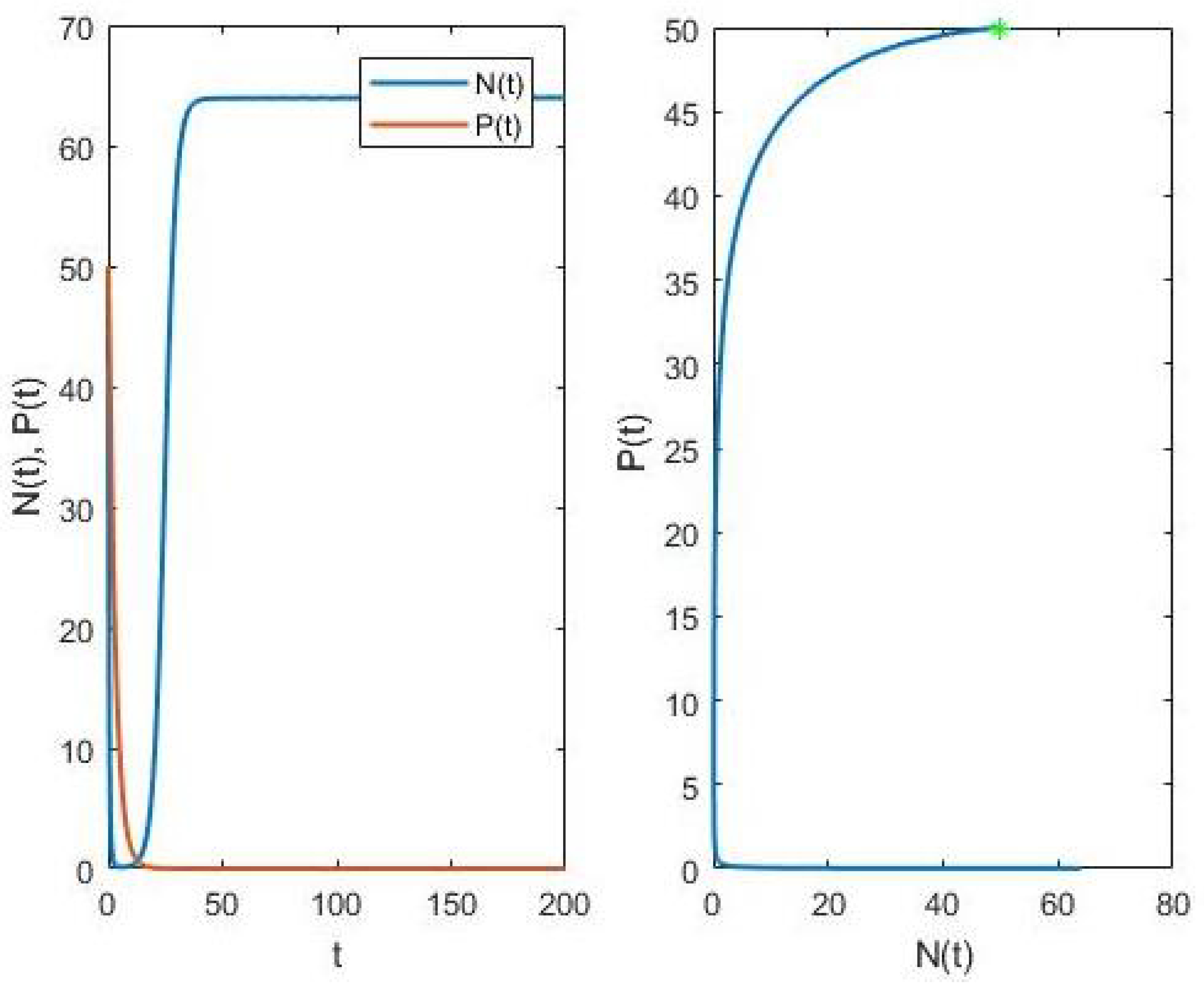
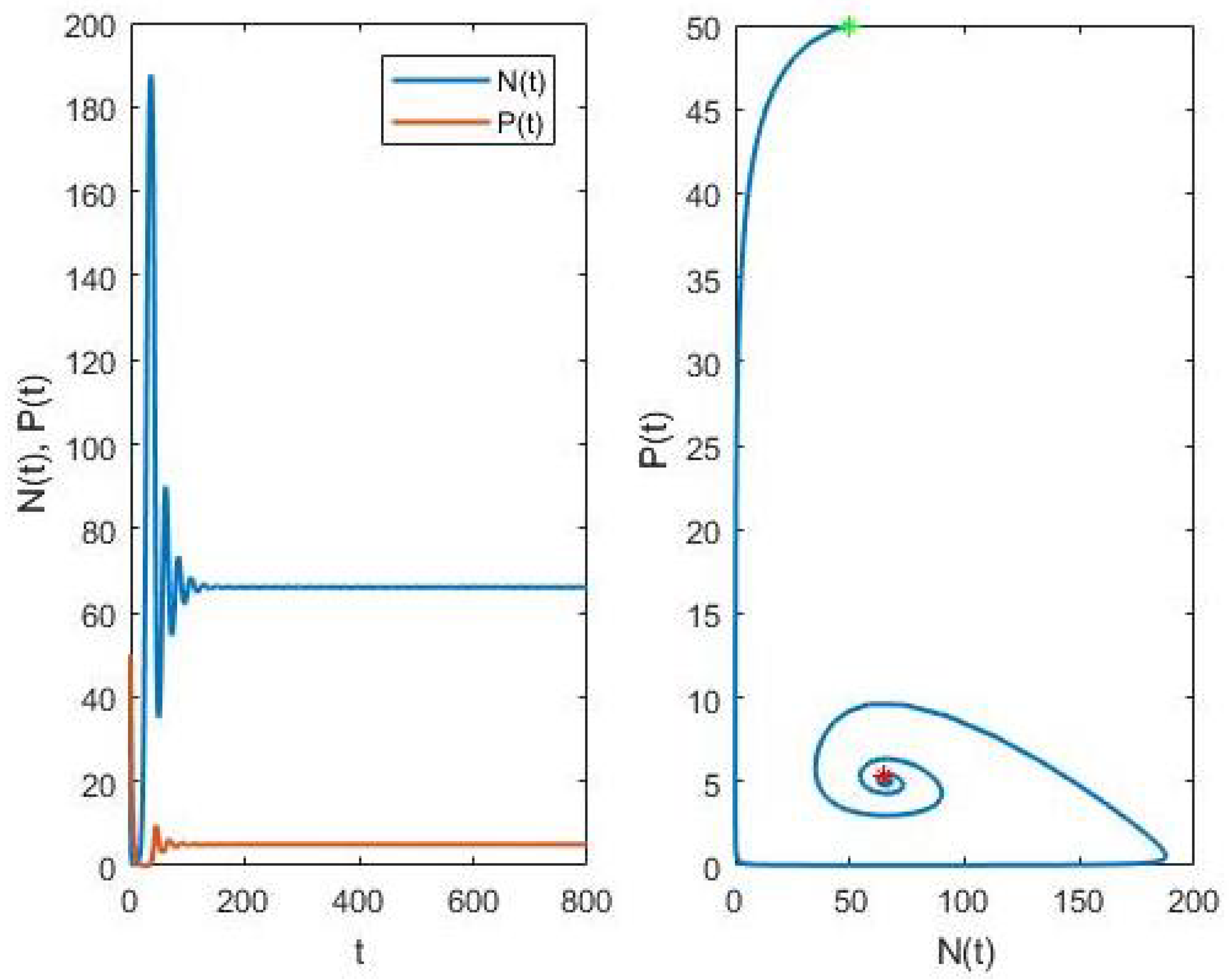
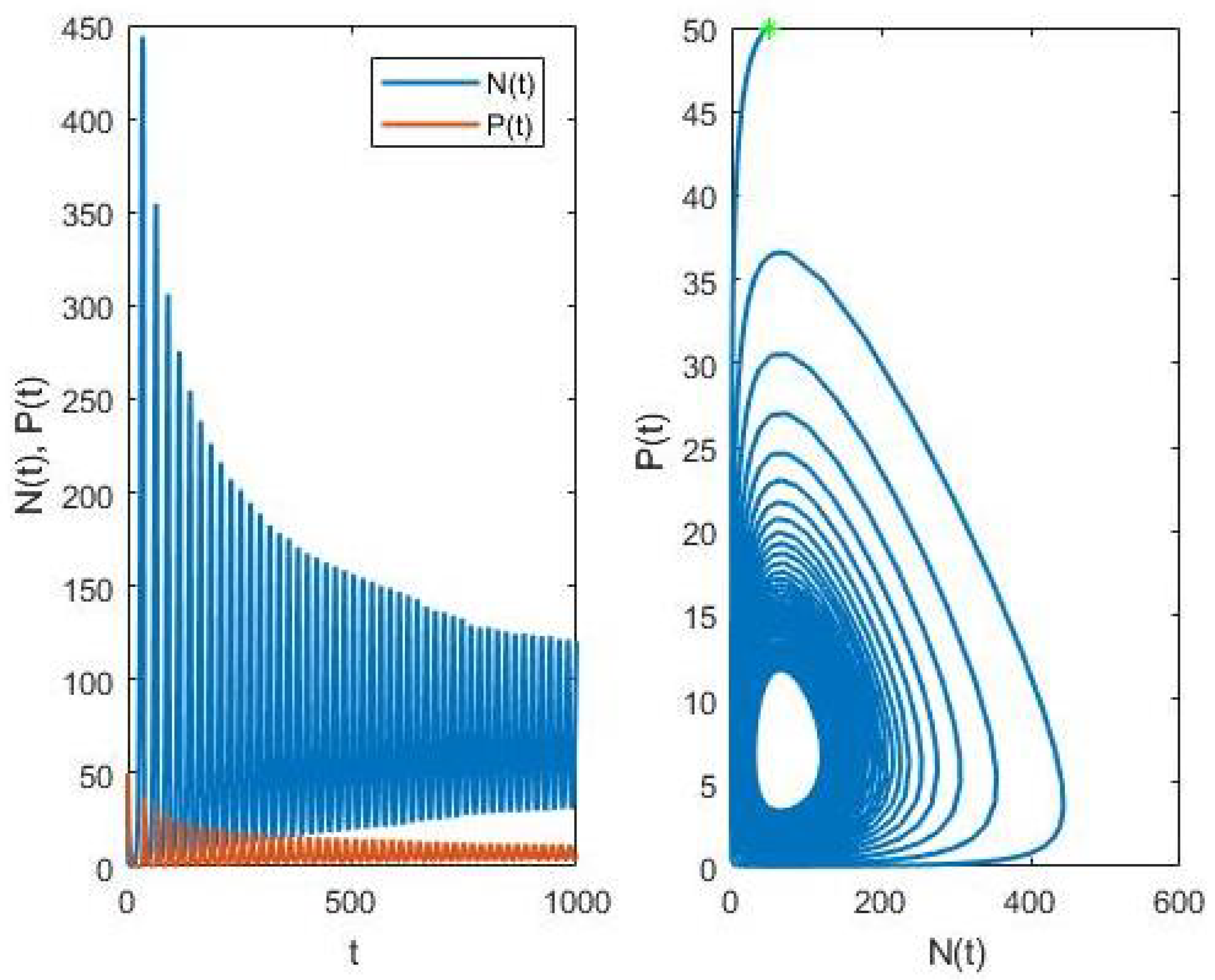
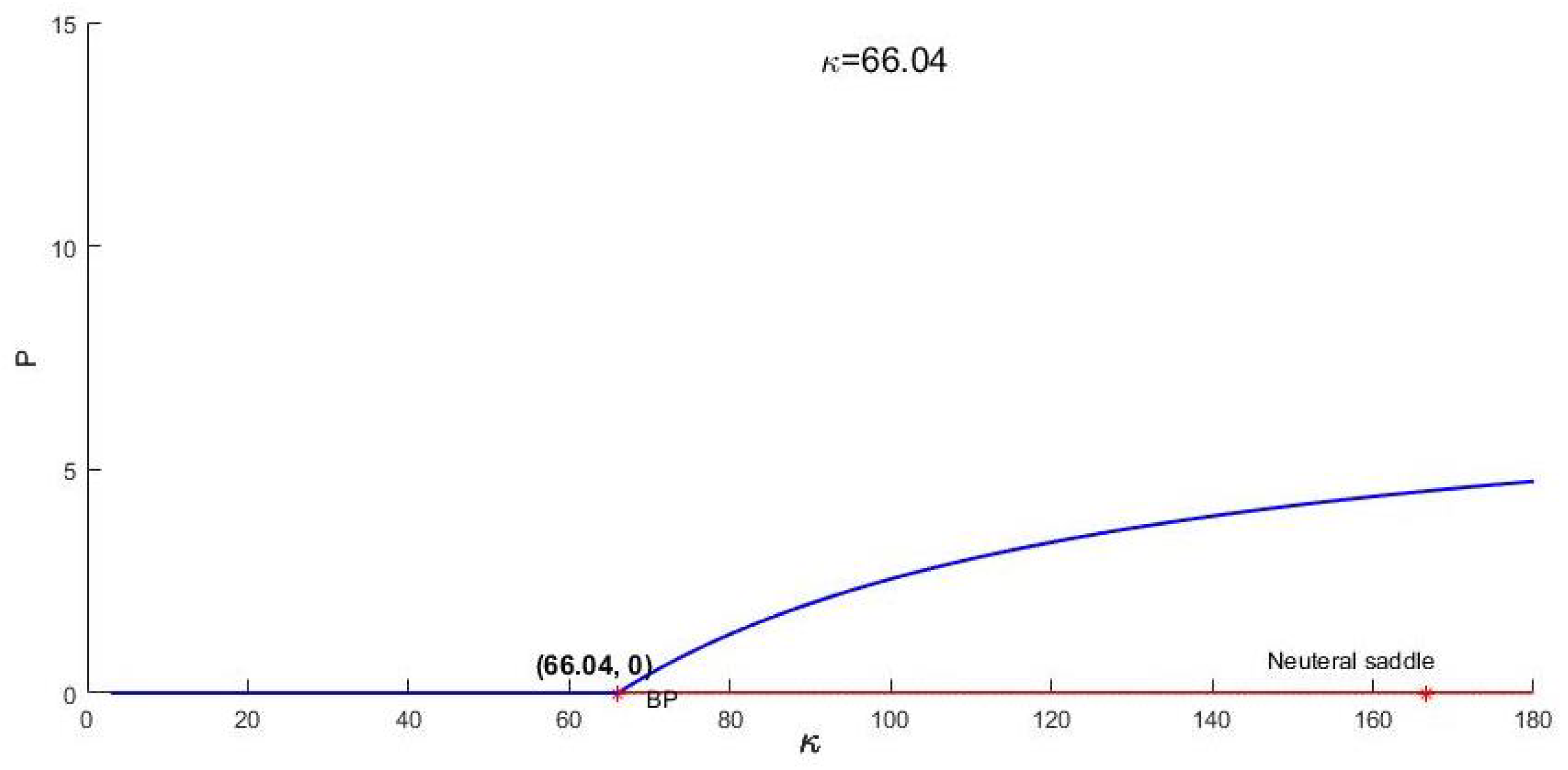
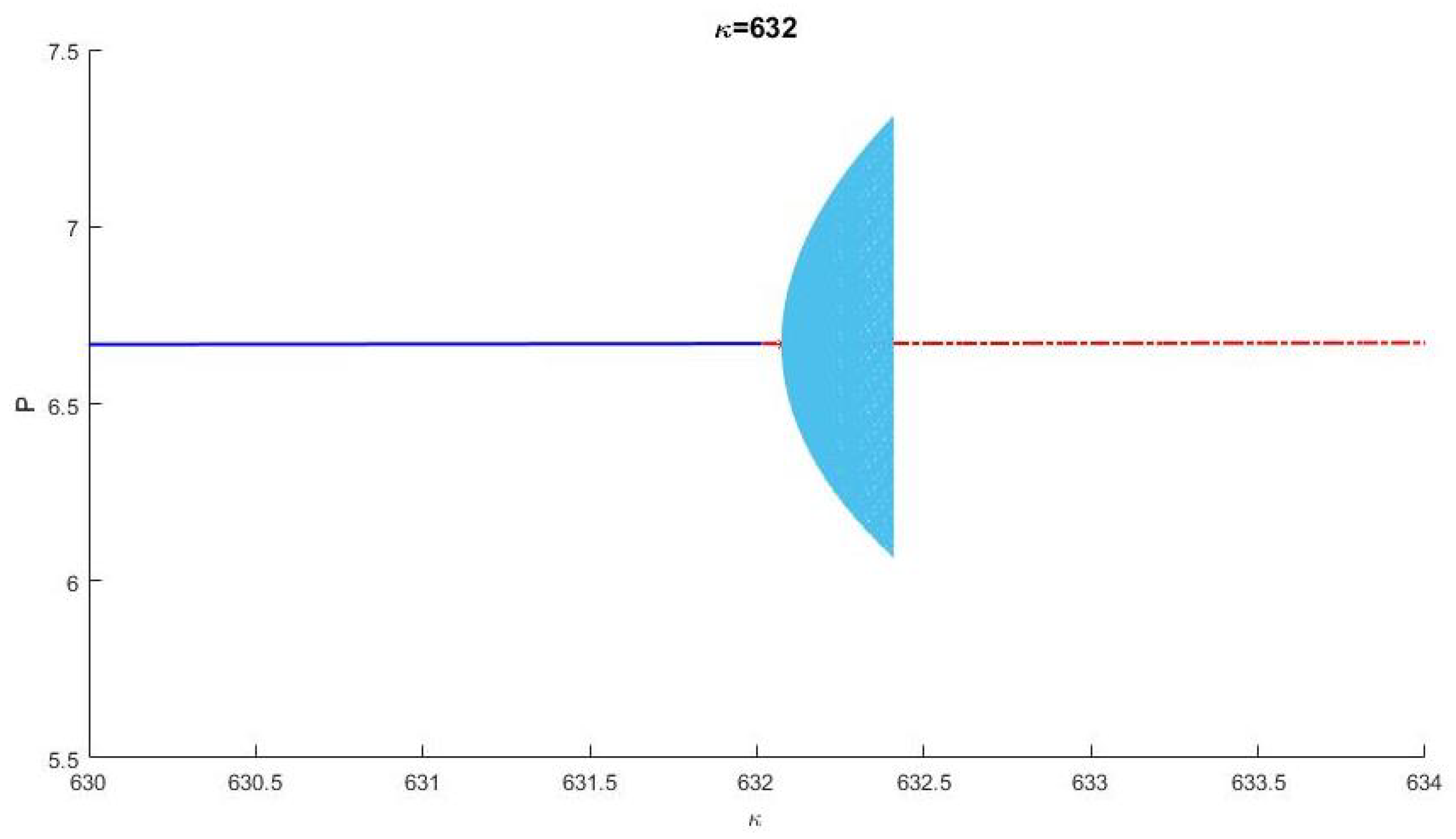
As stated earlier, the carrying capacity, κ , plays an important role in the dynamics of the model without delay, as it is the parameter that is responsible for the existence of Hopf bifurcation, and it could also lead to transcritical bifurcation. These ideas are illustrated in Figure 1, Figure 2 and Figure 3. It is clear that when κ is relatively small (i.e., κ = 64 ), the solution of the model tends to the prey-only equilibrium point; when the value of κ increases (i.e., κ = 200 ), the solution tends toward the coexistence equilibrium point, and hence the system exhibits a transcritical bifurcation, which is illustrated in Figure 4; and when the value of κ further increases (i.e., κ = 635 ), the solution tends toward a stable limit cycle where the system exhibits the phenomenon of Hopf bifurcation, which could be seen in Figure 5. These numerical simulations also serve to illustrate the bifurcation results derived in Section 2.3.
Figure 1. The stability of the existence of prey-only equilibrium, where N 0 = P 0 = 50 , r = 0.4 , b = 0.06 , e = α = 0.002 , c = 0.35 , ϵ = 0.1 , and κ = 64 .
Figure 2. The stability of the coexistence point, where N 0 = P 0 = 50 , r = 0.4 , b = 0.06 , e = α = 0.002 , c = 0.35 , ϵ = 0.1 , and κ = 200 .
Figure 3. The existence of a limit cycle around the coexistence point, where N 0 = P 0 = 50 , r = 0.4 , b = 0.06 , e = α = 0.002 , c = 0.35 , ϵ = 0.1 , and κ = 635 .
Figure 4. The transcritical bifurcation of interaction of the prey–predator model, where N 0 = P 0 = 50 , r = 0.4 , b = 0.06 , e = α = 0.002 , c = 0.35 , and ϵ = 0.1 .
Figure 5. The Hopf bifurcation of the interaction of the prey–predator model, where N 0 = P 0 = 50 , r = 0.4 , b = 0.06 , e = α = 0.002 , c = 0.35 , and ϵ = 0.1 .
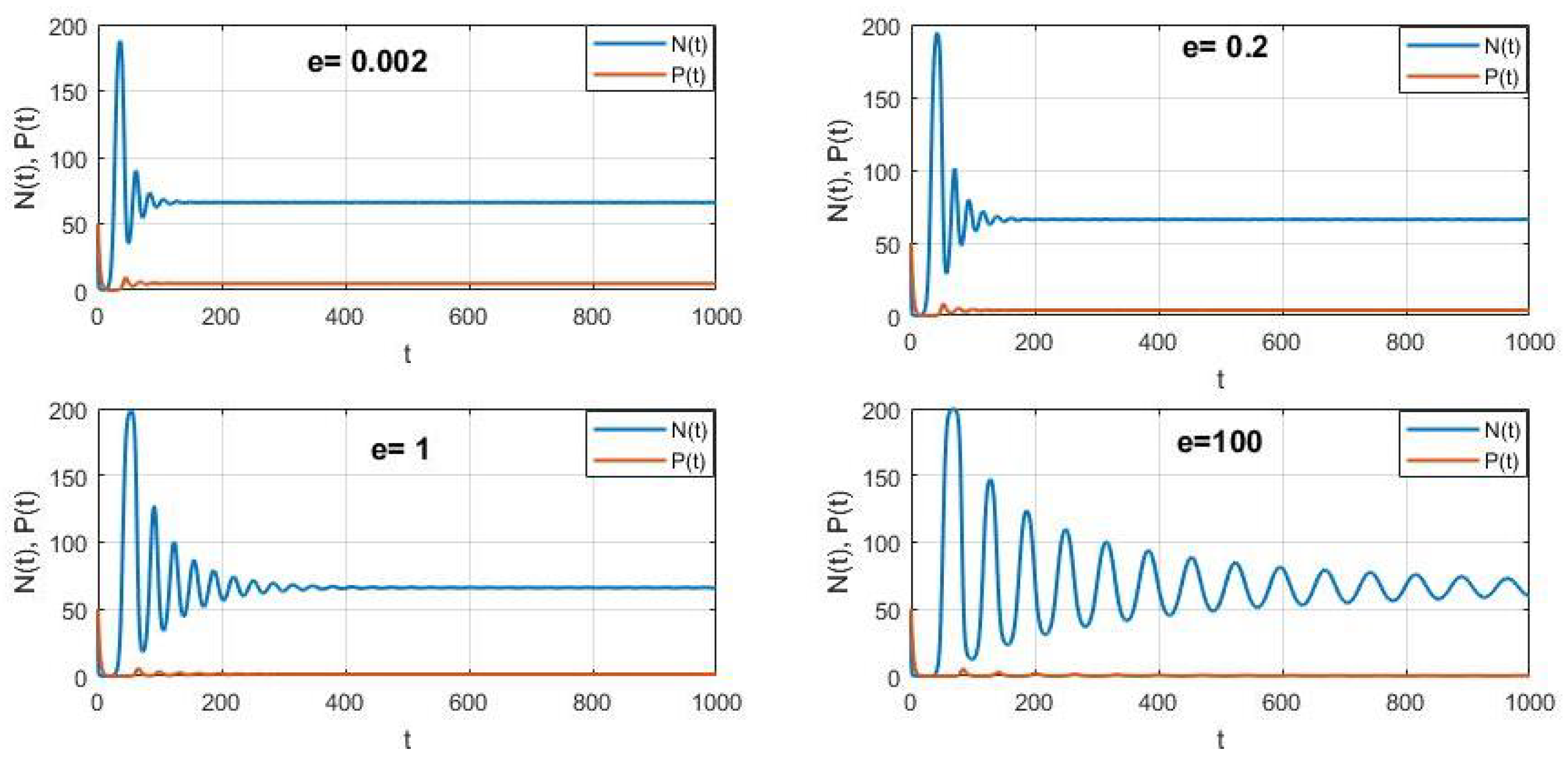
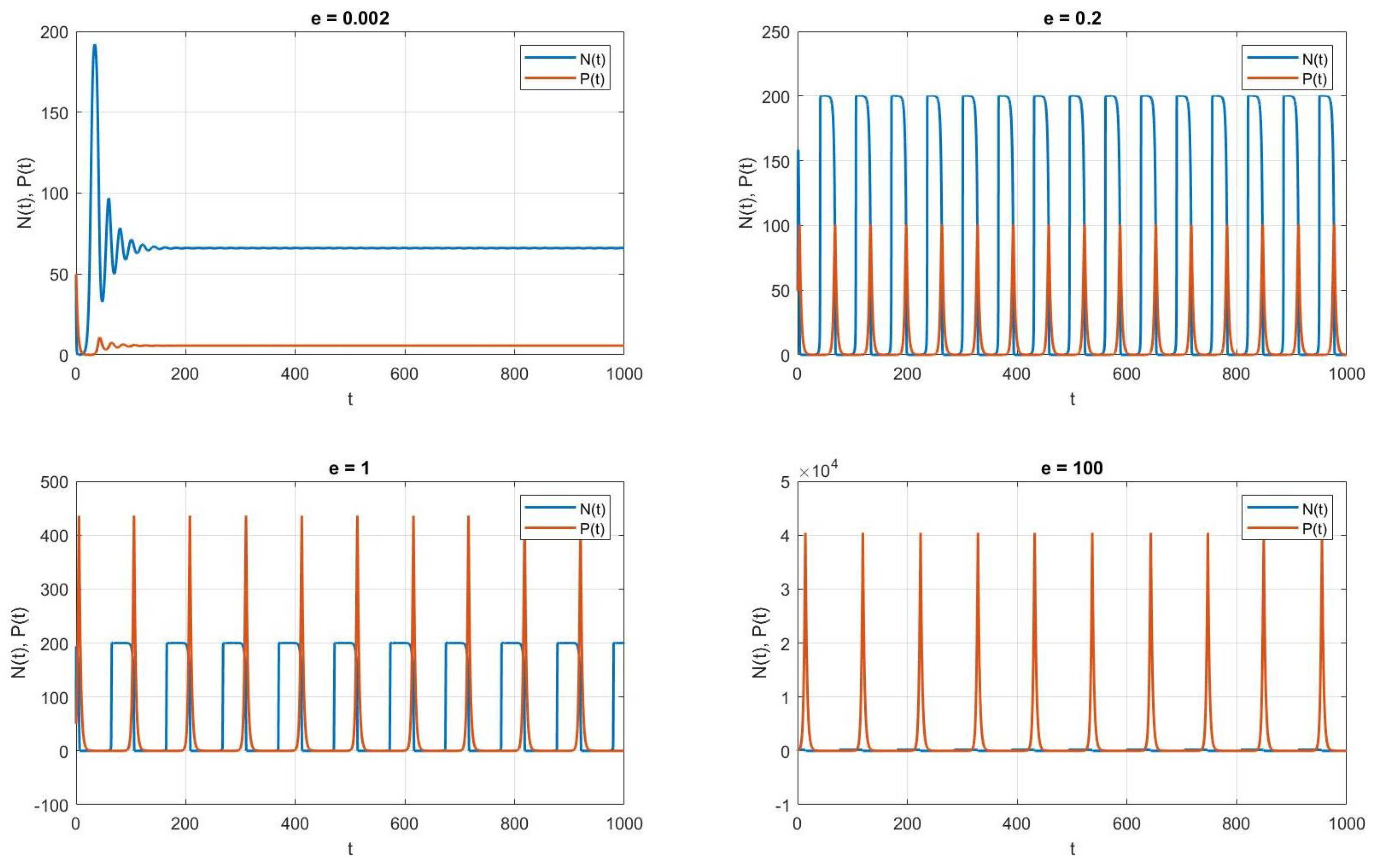
Fear also plays an important role in the predator–prey interaction, as it could help in the survival of the prey population and lead the predator population to extinction, if the carrying capacity is relatively small. In other words, the reduction in the reproduction of the prey population due to fear, even with small values of the cost-of-fear parameter, along with low carrying capacity will result in the predator population not having enough food to survive, and hence it goes extinct. As a result, the fear effect disappears, allowing the prey population to recover from its low densities and to grow until it reaches its carrying capacity. These predator–prey dynamics are illustrated in Figure 6. However, for high carrying capacity, the reduction in the reproduction of the prey population due to fear will not be enough to drive the predator population to extinction. It will lead either to the coexistence of prey and predator populations when the cost of fear is small or to a stable limit cycle with a very small prey population when the cost of fear is high. In this case, the predator population shows rapid growth, as illustrated in Figure 7.
Figure 6. The effect of fear on the model when the carrying capacity is low, where N 0 = P 0 = 50 , r = 0.4 , b = 0.06 , α = 0.002 , c = 0.35 , ϵ = 0.1 , and κ = 64 .
Figure 7. The effect of fear on the model when the carrying capacity is high, where N 0 = P 0 = 50 , r = 0.4 , b = 0.06 , α = 0.002 , c = 0.35 , ϵ = 0.1 , and κ = 200 .
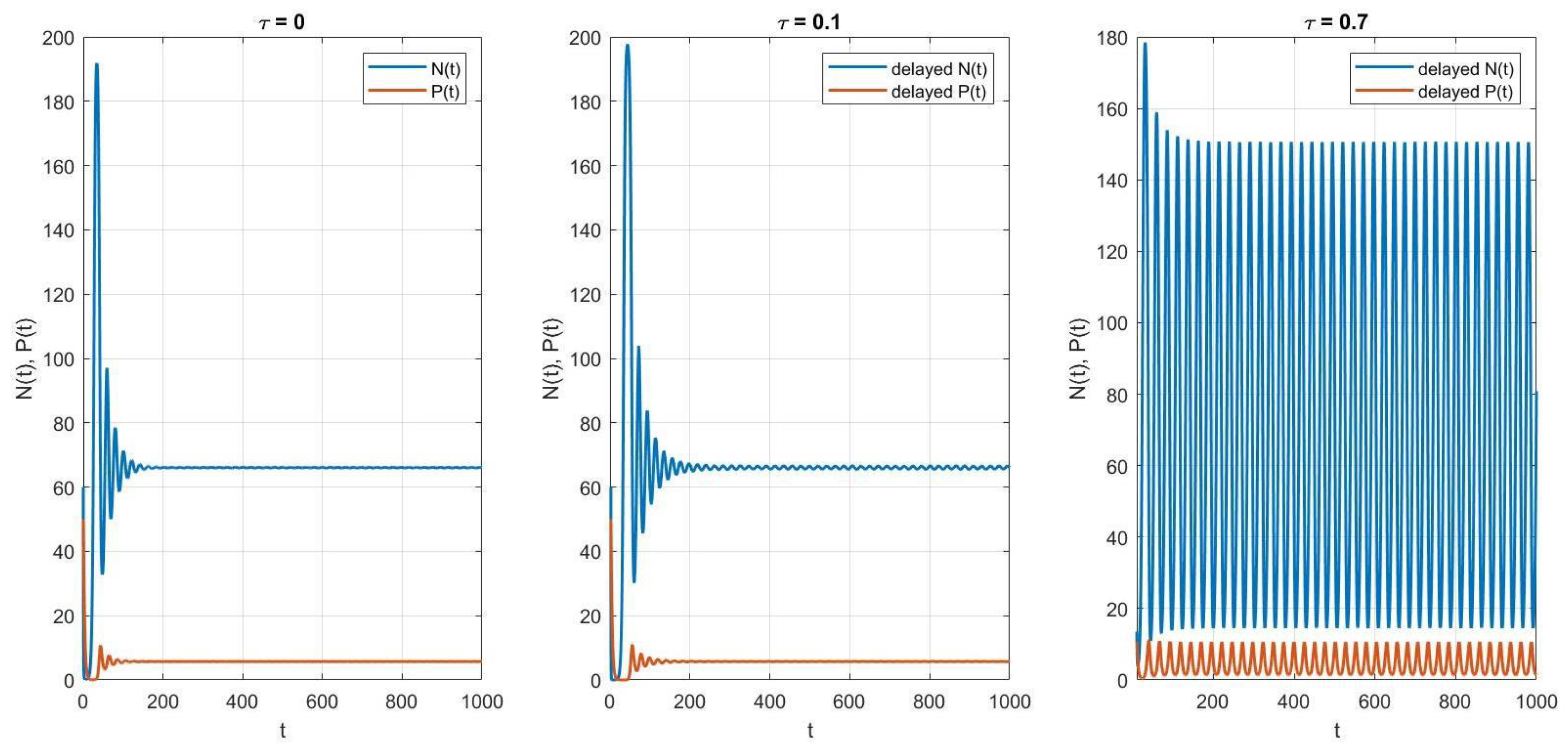
The effect of the time delay on the predator–prey interaction is illustrated in Figure 8, which shows that there is a critical value for the time delay ( τ * = 0.63988 in this case). When τ < τ * , there is no effect of the time delay on the stability of all equilibrium points; however, if τ > τ * , then the coexistence equilibrium point loses its stability and the systems reach a stable limit as derived in Section 3.
Figure 8. The effect of delay on the model, where N 0 = 60 , P 0 = 50 , r = 0.4 , b = 0.06 , e = α = 0.002 , c = 0.35 , and ϵ = 0.1 .

5. Conclusions

In this paper, we have formulated and analyzed a mathematical model for the interaction between prey and predator populations, incorporating fear effects and time delays. We have used Holling type II functional response in the interaction terms. We have mathematically proven the local stability of the prey-only and coexistence equilibrium points and global stability of the prey-only, under certain conditions. The asymptotic behavior of the system has been illustrated numerically. We have also shown that the system exhibits a transcritical bifurcation where the prey-only equilibrium point loses its stability and the coexistence equilibrium becomes stable. Also, the system has been found to exhibit a Hopf bifurcation where the coexistence equilibrium point loses its stability and the system reaches a stable limit cycle around this equilibrium point. These bifurcation results have been confirmed by numerical simulation.
Our results also show that if the carrying capacity is small, then the fear could lead to the extinction of the predator population, while the prey population oscillates for some time and then reaches its stable point. However, for high carrying capacity, the system reaches a stable coexistence equilibrium point when the fear factor is small. Moreover, increasing the cost of fear on the prey population moves the system from a stable coexistence equilibrium point to a stable limit cycle with a very small prey population and a rapid growth in the predator population.
Numerical simulation also shows that when the time-delay parameter passes through a certain critical value, the system moves away from the coexistence state to a stable limit-cycle state. Note that in ecology, a limit-cycle state is more desirable than a coexistence state, as in a limit-cycle state, the dynamics are richer and closer to reality, and hence the time delay has the effect of making the model more realistic.

Author Contributions

Conceptualization, M.A.-M., I.E., and N.A.-S.; validation, M.A.-M., I.E., and N.A.-S.; formal analysis, M.A.-M. and I.E.; writing—original draft preparation, M.A.-M.; writing—review and editing, M.A.-M., I.E., and N.A.-S. All authors have read and agreed to the published version of the manuscript.

Funding

This research received no external funding.

Data Availability Statement

No new data were created or analyzed in this study. Data sharing is not applicable to this article.

Conflicts of Interest

The authors declare no conflicts of interest.

References

  1. Ghosh, J.; Sahoo, P.; Poria, S. Prey-predator dynamics with prey refuge providing additional food to predator. Chaos Solitons Fractals 2017, 96, 110–119. [Google Scholar] [CrossRef]
  2. Jana, D. Stabilizing Effect of Prey Refuge and Predator’s Interference on the Dynamics of Prey with Delayed Growth and Generalist Predator with Delayed Gestation. Int. J. Ecol. 2014, 2014, 429086. [Google Scholar] [CrossRef][Green Version]
  3. Sih, A. Prey refuges and predator-prey stability. Theo. Pop. Biol. 1987, 31, 1–12. [Google Scholar] [CrossRef]
  4. Wang, X. Studying Both Direct and Indirect Effects in Predator-Prey Interaction. Master’s Thesis, The University of Western Ontario, London, ON, Canada, 2016. [Google Scholar]
  5. Zhang, H.; Cai, Y.; Fu, S.; Wang, W. Impact of the fear effect in a prey-predator model incorporating a prey refuge. App. Math. Comp. 2019, 356, 328–337. [Google Scholar] [CrossRef]
  6. Zanette, L.Y.; White, A.F.; Allen, M.C. Perceived predation risk reduces the number of offspring songbirds produce per year. Science 2011, 334, 1398–1401. [Google Scholar] [CrossRef] [PubMed]
  7. Wang, X.; Zanette, L.Y.; Zou, X. Modeling the fear effect in predator–prey interactions. J. Math. Biol. 2016, 73, 1179–1204. [Google Scholar] [CrossRef] [PubMed]
  8. Qi, C.; Guotai, C.; Wensheng, Y. The impact of fear effect on the dynamics of a delayed predator–prey model with stage structure. Int. J. Biomath. 2023, 16, 2250139. [Google Scholar] [CrossRef]
  9. Weili, K.; Yuanfu, S. The effects of fear and delay on a predator-prey model with Crowley-Martin functional response and stage structure for predator. AIMS Math. 2023, 8, 29260–29289. [Google Scholar]
  10. Das Bijoy, K.; Debgopal, S.; Samanta, G.P. Impact of fear in a delay-induced predator–prey system with intraspecific competition within predator species. Math. Comp. Simu. 2022, 191, 134–156. [Google Scholar]
  11. Lavanya, R.; Vinoth, S.; Sathiyanathan, K.; Zeric, N.T.; Hammachukiattikul, P.; Vadivel, R. Dynamical Behavior of a Delayed Holling Type-II Predator-Prey Model with Predator Cannibalism. J. Math. 2022, 4071375. [Google Scholar] [CrossRef]
  12. Liu, J.; Lv, P.; Liu, B.; Zhang, T. Dynamics of a Predator-Prey Model with Fear Effect and Time Delay. Complexity 2021, 1, 9184193. [Google Scholar] [CrossRef]
  13. Sasmal, S.K. Population dynamics with multiple Allee effects induced by fear factors—A mathematical study on prey-predator interactions. Appl. Math. Model. 2018, 64, 1–14. [Google Scholar] [CrossRef]
  14. Huang, Y.; Zhu, Z.; Li, Z. Modeling the Allee effect and fear effect in system incorporating a prey refuge. Adv. Differ. Equ. 2020, 2020, 321. [Google Scholar] [CrossRef]
  15. Martin, A.; Ruan, S. Predator-prey models with delay and prey harvesting. J. Math. Biol. 2001, 43, 247–267. [Google Scholar] [CrossRef] [PubMed]
  16. Cushing, J.M. Integrodifferential Equations and Delay Models. In Population Dynamics; Springer: Berlin/Heidelberg, Germany, 1977. [Google Scholar]
  17. Cushing, J.M. Predator Prey Interactions with Time Delays. J. Math. Biol. 1976, 3, 369–380. [Google Scholar] [CrossRef] [PubMed]
  18. Kuang, Y. Delay Differential Equations with Applications in Population Dynamics; Academic Press: New York, NY, USA, 1993. [Google Scholar]
  19. Gopalsamy, K. Harmless delay in model systems. Bull. Math. Biol. 1983, 45, 295–309. [Google Scholar] [CrossRef]
  20. Gopalsamy, K. Delayed responses and stability in two-species systems. J. Austral. Math. Soc. Ser. B 1984, 25, 473–500. [Google Scholar] [CrossRef]
  21. Hastings, A. Delays in recruitment at different trophic levels: Effects on stability. J. Math. Biol. 1984, 21, 35–44. [Google Scholar] [CrossRef] [PubMed]
  22. Ruan, S. Absolute stability, conditional stability and bifurcation in Kolmogorov-type predator-prey systems with discrete delays. Quart. Appl. Math. 2001, 59, 159–173. [Google Scholar] [CrossRef]
  23. Perko, L. Differential Equations and Dynamical Systems, 3rd ed.; Springer: Berlin/Heidelberg, Germany, 2000. [Google Scholar]
  24. Local Perturbation Analysis in MatCont. Available online: https://personal.math.ubc.ca/~keshet/Papers/LPA_BJTools_Supp2.pdf (accessed on 16 September 2025).
Disclaimer/Publisher’s Note: The statements, opinions and data contained in all publications are solely those of the individual author(s) and contributor(s) and not of MDPI and/or the editor(s). MDPI and/or the editor(s) disclaim responsibility for any injury to people or property resulting from any ideas, methods, instructions or products referred to in the content.

Article Metrics

Citations

Article Access Statistics

Multiple requests from the same IP address are counted as one view.