


Abstract
In this paper, we scrutinize a generalized (2+1)-dimensional nonlinear wave equation (NWE) which describes the waves propagation in plasma physics by utilizing Lie group analysis, Lie point symmetry are obtained and thereafter symmetry reductions are performed which lead to nonlinear ordinary differential equations (NODEs). These NODEs are then solved using various methods that includes the direct integration method. This then leads us to explicit exact solutions of NWE. Graphical representation of the achieved results is given to have a good understanding of the nature of solutions obtained. In conclusion, we construct conserved vectors of the NWE by invoking Ibragimov’s theorem.
1. Introduction
Nonlinear partial differential equations are an important branch of modern mathematics and are used to describe nonlinear physical phenomena in the fields of mechanics, communication engineering, ocean engineering, chemistry, chemical circulation systems, plasma physics, solid state physics and so on [1,2,3,4,5,6]. Solving these nonlinear partial differential equations are often tough and time consuming with the already known conventional methods. In order to understand the dynamics of the systems described by the concerned equation, numerous technical approaches have been introduced by various researchers in mathematics and physics by which one can obtain the exact solutions of nonlinear partial differential equations, such as extended simplest equation method [7], homotopy perturbation technique [8], the sine-cosine method [9], Bäcklund transformation [10], variation of parameters approach [11], Hirota’s technique [12], Lie group analysis [13], Darboux transformation [14], F-expansion technique [15], bifurcation technique [16], Kudryashov’s technique [17], sine-Gordon expanded equation approach [18], multi-exponential function technique [19] homogeneous balance approach [20], the expansion method [21], as well as the inverse scattering transform [22], to mention but a few.
Lie group analysis, initiated by the Norwegian mathematician Marius Sophus Lie (1842–1899), is a mathematical technique that can be employed to solve differential equations, which depend on first finding symmetries of the equation. These symmetries may help in simplifying the equation and eventually finding its special solutions [23,24,25,26,27].
Conservation laws are basic rules in physics which state that certain quantifiable properties of a closed system remain unchanged over time, no matter what is happening within the system. These laws contemplate deep symmetries in nature and play a vital role in the comprehension of the physical systems. Conservation laws are crucial for exploring integrability and for initiating existence and uniqueness of solutions. They are also utilized in stability and global aspects of solutions. Furthermore, they play a pivotal role in the evolution of numerical methods [28,29,30,31,32,33,34,35,36].
In [37], the authors worked on the interplay behaviour connected to a generalized (2+1)-dimensional Hirota bilinear equation
which is associated with
via the transformation , with , being constants. Two kinds of interaction solutions were derived for Equation (2) that included the lump-kink and lump-soliton solutions. Later on the authors of [38], utilized the simplified Hirota’s method along with various ansatz methods and retrieved a class of rational wave structures like multiple soliton solutions, breather, rational, and complexiton solutions. In order to generalize (2) and investigate the model with more complex dynamical behaviour, the authors Zhao and He of [39] introduced the generalized (2+1)-dimensional nonlinear wave (2DNW) equation
with being an arbitrary constant. For the details of physics of the 2DNW Equation (3) the reader is refereed to the reference [39]. Zhao and He obtained N-soliton solutions. M-Lump solutions were investigated by applying the long wave limit to the N-soliton solutions. High-order breather and the dynamical behaviour of the hybrid solutions were systematically analyzed via numerical simulations [39].
Zhao et al. investigated the integrability and various solutions of the 2DNW Equation (3) in [40]. Mixed rogue-periodic and rogue-solitary wave solutions were achieved. Also, interconnections between the solitary waves and rogue waves, and interplays between the periodic waves and rogue waves were investigated [40].
He et al. studied the 2DNW Equation (3) and investigated the resonance Y-type solutions and interaction between different types of resonance soliton solutions. The hybrid solutions containing resonance Y-type solitons, breathers and lumps were explored. Furthermore, one- and two-period wave solutions were derived. The relationship between soliton solutions and the quasi-periodic wave solutions were analyzed [41].
In [42], the authors presented the solution of the 2DNW Equation (3) by analyzing the eigenfunctions and Green’s functions of their Lax representations as well as the inverse spectral transformations.
Li et al. studied the generalized (2+1)-dimensional nonlinear wave (g2DNW) equation [43]
with , and , , , , , being arbitrary constants. Equation (4) has similar physical significance to the KdV equation and represents non-linear waves in plasma physics, fluid dynamics, and weakly dispersion media. Modified hyperbolic function expansion method was successfully invoked to obtain the trigonometric function solutions, the positive hyperbolic function solutions and the hyperbolic trigonometric function solutions in [43].
In this paper, we study the g2DNW Equation (4) from the Lie symmetry standpoint. We first eliminate the integral sign in the equation by introducing the transformation . This transforms Equation (4) into the nonlinear fifth-order wave equation
The paper is organized as follows. In Section 2, we construct new exact solutions of Equation (5) by implementing Lie group analysis along with certain other techniques. Conservation laws are derived in Section 3 using the theorem due to Ibragimov. Finally, concluding remarks are presented in Section 4.
2. Exact Solutions of Equation (5)
We work out Lie symmetries and perform symmetry reductions of the NWE Equation (5). On top of that, we construct travelling wave solution of (5) through integration.
2.1. Lie Point Symmetries of (5)
Lie symmetries of (5) will be acquired by the use of vector field
where , , and are infinitesimals to be determined. The vector field X generates all Lie point symmetries of (5) if
where , and is the fifth extension of X. For details, see Appendix A.
Expanding (7) and splitting on derivatives of q, we obtain an overdetermined system of linear partial differential equations, which on solving yields the following seven Lie point symmetries:
with the respective group actions
in terms of a parameter a. Accordingly, if is the solution of nonlinear wave Equation (5), then so are
2.2. Symmetry Reductions and Invariant Solutions of (5)
We derive multiple group-invariant solutions of (5) in this section by carrying out Lie symmetry reductions via the characteristic equations.
2.2.1. Solution Using Translation Symmetries , and
In this subsection, we construct the travelling wave solution of (5) using the translation symmetries , and . Thus, we take , where with and c being arbitrary constants. Substituting in (5), one gets
To integrate the above equation we take , and get
which we rewrite as
where and . Integrating (10) we get
where is a constant. To integrate further, we take . Thus, integrating we get
where is an arbitrary constant. Multiplying the above equation by and integrating it once, we get
where is a constant of integration. Let , then the above equation becomes
If the algebraic equation
has real roots such that , then Equation (11) becomes
whose solution is [44,45]
where cn represents the cosine elliptic function. Since we integrate the above expression with respect to . Thereafter, reverting to the original variables, we obtain the solution of Equation (5) as
where , is a constant, and
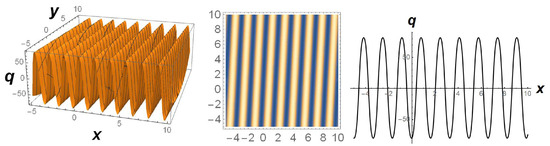
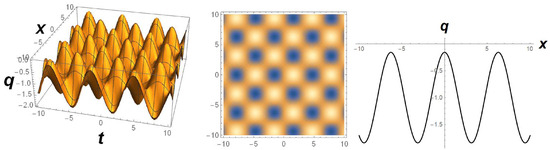
is the incomplete elliptic integral [45]. The profile of the solution (13) is depicted in Figure 1.
Figure 1.
Periodic wave profile of solution (13) in -axis with , , , , , , , and .
2.2.2. Invariant Solution of Equation (5) Using
In this subsection, we construct an invariant solution of (5) using Lie point symmetry . This symmetry gives us three invariants
which implies that
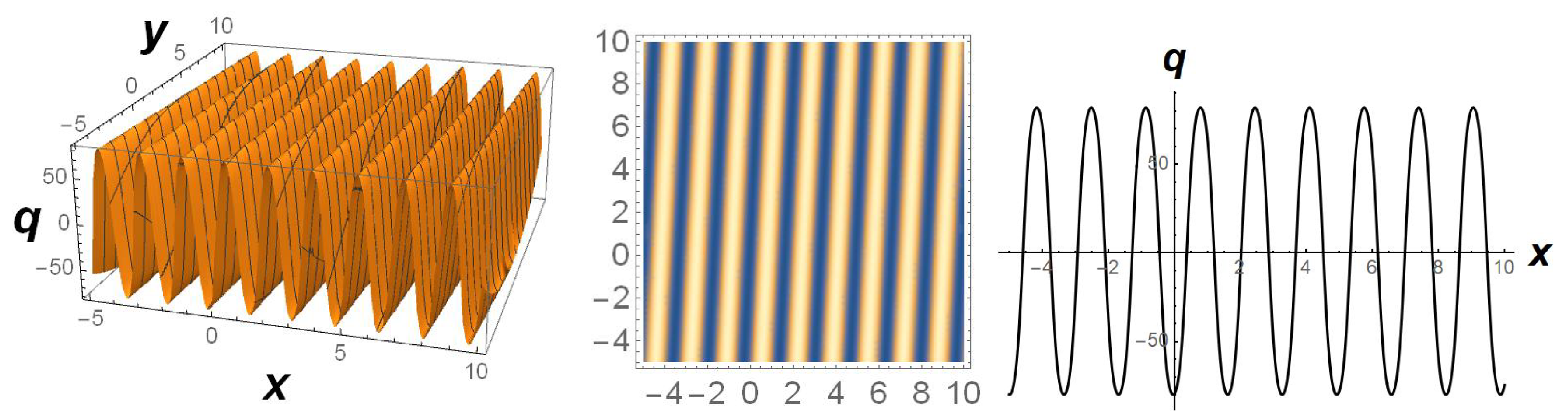
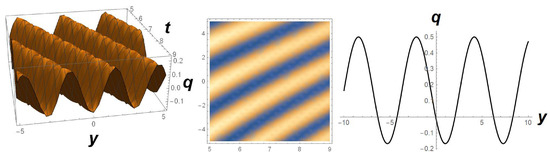
is the solution of the Equation (5) under . Here ia an arbitrary function of t and y. The profile of the solution (15) is presented in Figure 2.
Figure 2.
Exhibition of periodic wave profile of solution (15) in -axis with the choice of , , , using and .
2.2.3. Invariant Solution of Equation (5) Using
The symmetry gives three invariants, namely
Using these invariants Equation (5) leads to the nonlinear partial differential equation
The above equation has three Lie point symmetries, viz.,
Using the symmetry , we get two invariants , , and we see that Equation (17) is satisfied for arbitrary H. Hence, going back to original variables, the invariant solution of Equation (5) under the symmetry is
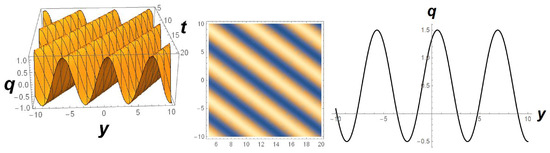
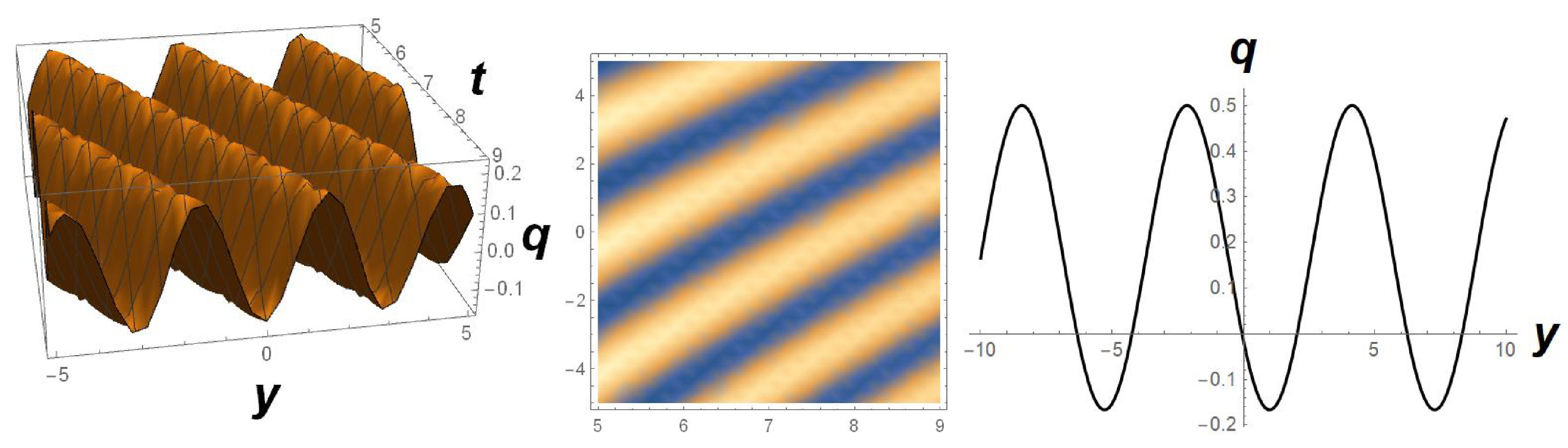
where H is an arbitrary function of its argument. The profile of the solution (18) is depicted in Figure 3.
Figure 3.
Periodic wave profile representing solution (18) with in -axis with , , and .
Similarly, symmetry gives us two invariants and , satisfied the Equation (17) for arbitrary M. Hence, going back to original variables, one can get the invariant solution of Equation (5) stated as
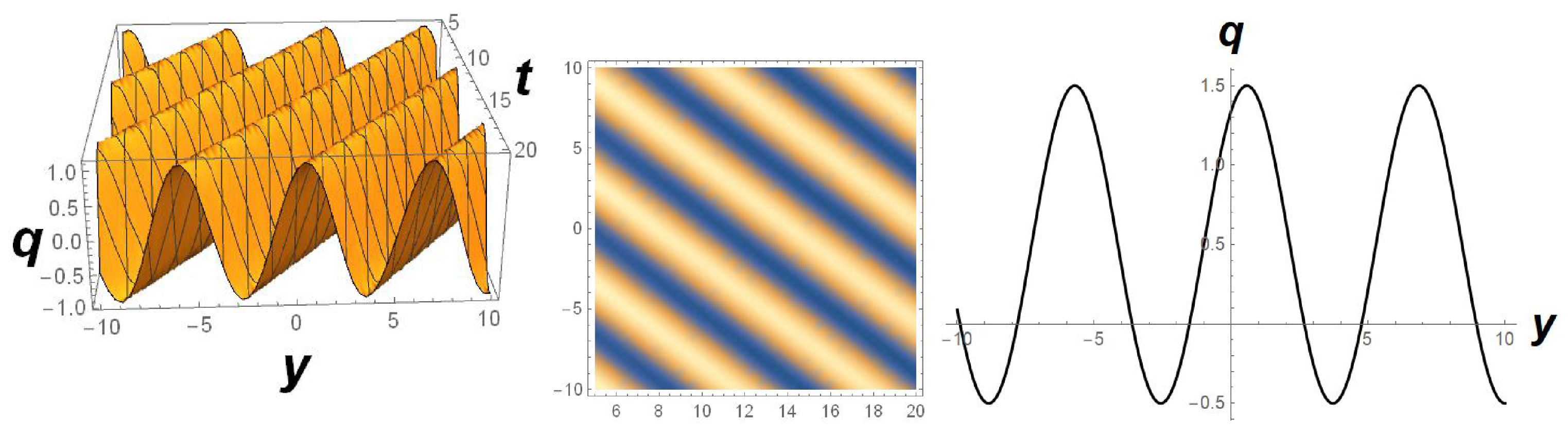
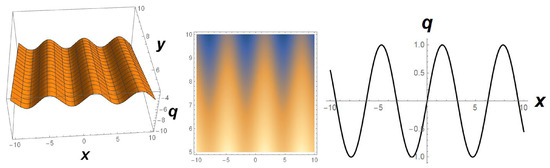
where M is an arbitrary function of its argument. The profile of the solution (19) is exhibited in Figure 4.
Figure 4.
Exhibition of periodic wave solution of (19) in -axis, with the choice of , , , and .
2.2.4. Invariant Solution of Equation (5) Using
Symmetry gives us three invariants, namely
which provide the solution of Equation (5) as
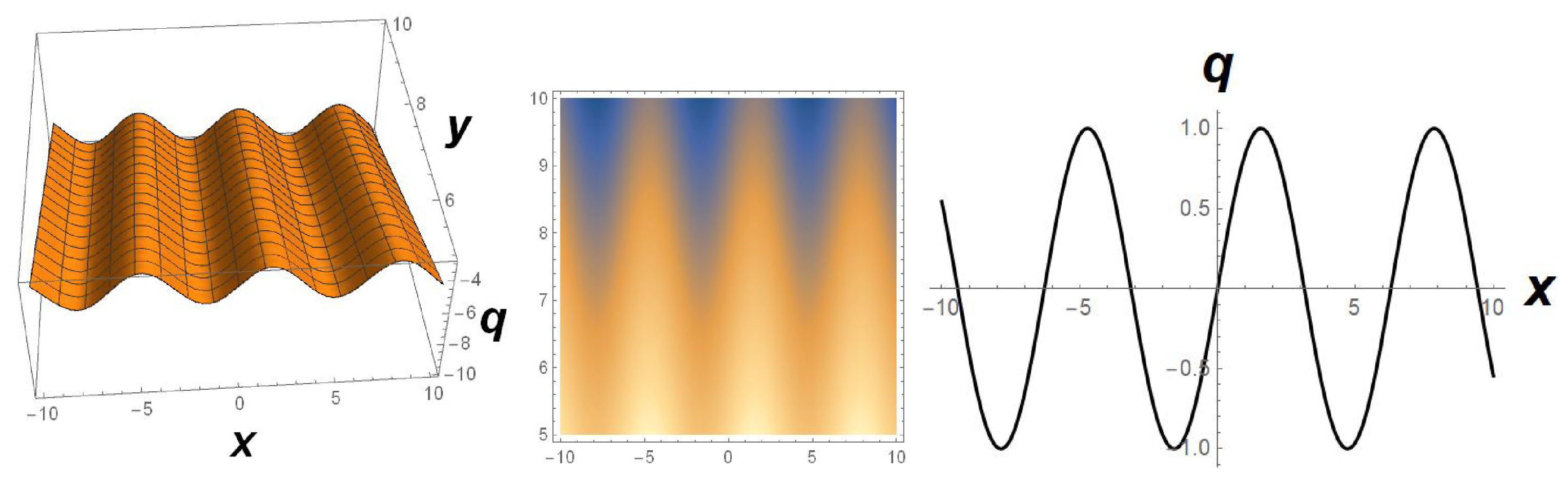
where is an arbitrary function of t and x. The profile of the solution (21) is depicted in Figure 5.
Figure 5.
Periodic wave profile of solution (21) in -axis with the choice of , , using and .
3. Conserved Vectors via Ibragimov’s Theorem
In this section, we compute conserved vectors of Equation (5) using Ibragimov’s theorem [36]. We first gain the adjoint equation of (5) stated as
with a new introduced variable and Euler operator
The expansion of adjoint Equation (22) gives the adjoint as
According to [36], Equation (5) considered alongside its adjoint possesses the Lagrangian represented by and expressed as
4. Concluding Remarks
In this paper, we studied the (2+1)-dimensional nonlinear wave equation by utilizing Lie group analysis. We first computed the Lie point symmetries and by employing the Lie equations with initial conditions, we obtain one-parameter group of transformations. Travelling wave solution was obtained by using the three translation symmetries and the solution (13) was presented in terms of an incomplete elliptic integral. Furthermore, various other exact solutions were obtained under the Lie symmetries of the equation. Graphical presentation for each obtained solution was provided to understand the behaviour of the solutions. Finally, we constructed seven conserved vectors for the Equation (5) by invoking the theorem due to Ibragimov. These included the conservation of energy and momentum.
Author Contributions
Conceptualization, C.M.K. and A.M.; methodology, A.M.; software, A.M.; validation, C.M.K. and A.M.; formal analysis, A.M.; investigation, A.M.; resources, C.M.K.; data curation, C.M.K.; writing—original draft preparation, A.M.; writing—review and editing, C.M.K.; visualization, A.M.; supervision, C.M.K.; project administration, C.M.K. All authors have read and agreed to the published version of the manuscript.
Funding
This research received no external funding.
Data Availability Statement
No new data are associated with this work.
Acknowledgments
The authors would like to thank Oke Davies Adeyemo for fruitful discussions.
Conflicts of Interest
The authors declare no conflicts of interest.
Appendix A
The vector field X generates all Lie point symmetries of (5) if
where , and is the fifth extension of X defined by
and and are determined as follows:
with and being the total derivatives formulated as
respectively.
References
- Yadav, S. QPDE: Quantum Neural Network Based Stabilization Parameter Prediction for Numerical Solvers for Partial Differential Equations. AppliedMath 2023, 3, 552–562. [Google Scholar] [CrossRef] [Scilit]
- Monyayi, V.T.; Goufo, E.F.D.; Toudjeu, I.T. Mathematical Analysis of a Navier–Stokes Model with a Mittag–Leffler Kernel. AppliedMath 2024, 4, 1230–1244. [Google Scholar] [CrossRef] [Scilit]
- Saheli, A.E.; Zogheib, B. Symmetry Analysis of the 3D Boundary-Layer Flow of a Non-Newtonian Fluid. AppliedMath 2024, 4, 1588–1599. [Google Scholar] [CrossRef] [Scilit]
- Sekhesa, T.M.; Nchejane, N.J.; Poka, W.D.; Kalebe, K.M. Exact solutions of the (1+1)-dissipative Westervelt equation using an optimal system of Lie sub-algebras and modified simple equation method. Partial Differ. Equ. Appl. Math. 2025, 14, 101178. [Google Scholar] [CrossRef] [Scilit]
- Chatziafratis, A.; Fokas, A.S.; Kalimeris, K. The Fokas method for evolution partial differential equations. Partial Differ. Equ. Appl. Math. 2025, 14, 101144. [Google Scholar] [CrossRef] [Scilit]
- Ahmed, D.M.; Mahmood, B.A.; Alalyani, A. On the solution of the coupled Whitham–Broer–Kaup problem using a hybrid technique for improved accuracy. Partial Differ. Equ. Appl. Math. 2025, 14, 101184. [Google Scholar] [CrossRef] [Scilit]
- Kudryashov, N.A.; Loguinova, N.B. Extended simplest equation method for nonlinear differential equations. Appl. Math. Comput. 2008, 205, 396–402. [Google Scholar] [CrossRef] [Scilit]
- Shqair, M. Solution of different geometries reflected reactors neutron diffusion equation using the homotopy perturbation method. Results Phys. 2019, 12, 61–66. [Google Scholar] [CrossRef] [Scilit]
- Wazwaz, A.M. The Tanh and Sine-Cosine Method for Compact and Noncompact Solutions of Nonlinear Klein Gordon Equation. Appl. Math. Comput. 2005, 167, 1179–1195. [Google Scholar] [CrossRef] [Scilit]
- Gu, C.H. Soliton Theory and Its Application; Zhejiang Science and Technology Press: Hangzhou, China, 1990. [Google Scholar]
- Feng, Z. A note on “explicit exact solutions to the compound Burgers-Korteweg-de Vries equation”. Phy. Lett. 2003, 312, 396–402. [Google Scholar] [CrossRef] [Scilit]
- Hirota, R. The Direct Method in Soliton Theory; Cambridge University Press: Cambridge, UK, 2004. [Google Scholar]
- Lie, S. Vorlesungen Über Differentialgleichungen mit Bekannten Infinitesimalen Transformation; Scheffers, G., Ed.; Teubner: Leipzig, Germany, 1891; reprint; Chelsea: New York, NY, USA, 1967. [Google Scholar]
- Matveev, V.B.; Salle, M.A. Darboux Transformations and Solitons; Springer: New York, NY, USA, 1991. [Google Scholar]
- Zhou, Y.; Wang, M.; Wang, Y. Periodic wave solutions to a coupled KdV equations with variable coefficients. Phys. Lett. A 2003, 308, 31–36. [Google Scholar] [CrossRef] [Scilit]
- Zhang, L.; Khalique, C.M. Classification and bifurcation of a class of second-order ODEs and its application to nonlinear PDEs. Discret. Contin. Dyn. Syst. Ser. S 2018, 11, 777–790. [Google Scholar] [CrossRef] [Scilit]
- Kudryashov, N.A. Simplest equation method to look for exact solutions of nonlinear differential equations. Chaos Solitons Fractals 2005, 24, 1217–1231. [Google Scholar] [CrossRef] [Scilit]
- Chen, Y.; Yan, Z. New exact solutions of (2+1)-dimensional Gardner equation via the new sine-Gordon equation expansion method. Chaos Solitons Fractals 2005, 26, 399–406. [Google Scholar] [CrossRef] [Scilit]
- Ma, M.A.; Abdeljabbar, A. Solving the (3+1)-dimensional generalized KP and BKP equations by the multi expfunction algorithm. Appl. Math. Comput. 2012, 218, 11871–11879. [Google Scholar]
- Wang, M. Exact solutions for a compound KdV-Burgers equation. Phy. Lett. 1996, 213, 279–287. [Google Scholar] [CrossRef] [Scilit]
- Wang, M.; Li, X.; Zhang, J. The (G′/G)—Expansion method and travelling wave solutions for linear evolution equations in mathematical physics. Phys. Lett. A 2005, 24, 1257–1268. [Google Scholar]
- Ablowitz, M.J.; Clarkson, P.A. Solitons, Nonlinear Evolution Equations and Inverse Scattering; Cambridge University Press: Cambridge, UK, 1991. [Google Scholar]
- Ovsiannikov, L.V. Group Analysis of Differential Equations; Academic Press: New York, NY, USA, 1982. [Google Scholar]
- Bluman, G.W.; Kumei, S. Symmetries and Differential Equations; Springer: New York, NY, USA, 1989. [Google Scholar]
- Olver, P.J. Applications of Lie Groups to Differential Equations, 2nd ed.; Springer: Berlin/Heidelberg, Germany, 1993. [Google Scholar]
- Ibragimov, N.H. CRC Handbook of Lie Group Analysis of Differential Equations; CRC Press: Boca Raton, FL, USA, 1993; Volume 1–3. [Google Scholar]
- Ibragimov, N.H. Elementary Lie Group Analysis and Ordinary Differential Equations; John Wiley & Sons: Chichester, NY, USA, 1999. [Google Scholar]
- Noether, E. Invariante Variationsprobleme, Nachrichten der Königlichen Gesellschaft der Wissenschaften zu Göttingen, Mathematisch-Physikalische Klasse, S. 235–257; English Translation. Transp. Theory Statist. Phys. 1971, 1, 186–207. [Google Scholar] [CrossRef] [Scilit]
- Leveque, R.J. Numerical Methods for Conservation Laws, 2nd ed.; Birkhäuser: Basel, Switzerland, 1992. [Google Scholar]
- Sarlet, W. Comment on ‘Conservation laws of higher order nonlinear PDEs and the variational conservation laws in the class with mixed derivatives’. J. Phys. A Math. Theor. 2010, 43, 458001. [Google Scholar] [CrossRef] [Scilit]
- Kopcasız, B.; Yasar, E. Inquisition of optical soliton structure and qualitative analysis for the complex-coupled Kuralay system. Mod. Phys. Lett. B 2025, 39, 2450512. [Google Scholar] [CrossRef] [Scilit]
- Yasar, E.; Yasar, E. Exact wave solutions and local conservation laws of a third-order Boussinesq system. Discrete Contin. Dyn. Syst.-S 2025, 18, 1075–1092. [Google Scholar] [CrossRef] [Scilit]
- Naz, R.; Hereman, W. Lie symmetries, closed-form solutions, and conservation laws of a constitutive equation modeling stress in elastic materials. Partial Differ. Equ. Appl. Math. 2025, 13, 101054. [Google Scholar] [CrossRef] [Scilit]
- Gandarias, M.L.; Raza, N.; Umair, M.; Almalki, Y. Dynamical visualization and qualitative analysis of the (4+1)-dimensional KdV-CBS equation using Lie symmetry analysis. Mathematics 2024, 13, 89. [Google Scholar] [CrossRef] [Scilit]
- Márquez, A.P.; Recio, E.; Gandarias, M.L. Conservation laws and exact solutions of a nonlinear acoustics equation by classical symmetry reduction. Chaos Solitons Fractals 2025, 191, 115925. [Google Scholar] [CrossRef] [Scilit]
- Ibragimov, N.H. A new conservation theorem. J. Math. Anal. Appl. 2007, 333, 311–328. [Google Scholar] [CrossRef] [Scilit]
- Hua, Y.F.; Guo, B.L.; Ma, W.X.; Lü, X. Interaction behavior associated with a generalized (2+1)-dimensional Hirota bilinear equation for nonlinear waves. Appl. Math. Model. 2019, 74, 184–198. [Google Scholar] [CrossRef] [Scilit]
- Hosseini, K.; Mirzazadeh, M.; Aligoli, M.; Eslami, M.; Liu, J.G. Rational wave solutions to a generalized (2+1)-dimensional Hirota bilinear equation. Math. Model. Nat. Phenom. 2020, 15, 61. [Google Scholar] [CrossRef] [Scilit]
- Zhao, Z.; He, L. M-lump, high-order breather solutions and interaction dynamics of a generalized (2+1)-dimensional nonlinear wave equation. Nonlinear Dyn. 2020, 100, 2753–2765. [Google Scholar] [CrossRef] [Scilit]
- Zhao, X.; Tian, B.; Tian, H.Y.; Yang, D.Y. Bilinear Bäcklund transformation, Lax pair and interactions of nonlinear waves for a generalized (2+1)-dimensional nonlinear wave equation in nonlinear optics/fluid mechanics/plasma physics. Nonlinear Dyn. 2021, 103, 1785–1794. [Google Scholar] [CrossRef] [Scilit]
- He, L.; Zhang, J.; Zhao, Z. Resonance Y-type soliton, hybrid and quasi-periodic wave solutions of a generalized (2+1)-dimensional nonlinear wave equation. Nonlinear Dyn. 2021, 106, 2515–2535. [Google Scholar] [CrossRef] [Scilit]
- Chai, X.; Zhang, Y. The ∂¯-dressing method for (2+1)-dimensional equation and combinatorics. arXiv 2023, arXiv:2311.07196. [Google Scholar] [CrossRef] [Scilit]
- Li, J.; Xu, C.; Lu, J. The exact solutions to the generalized (2+1)-dimensional nonlinear wave equation. Results Phys. 2024, 58, 107506. [Google Scholar] [CrossRef] [Scilit]
- Kudryashov, N.A. Analytical Theory of Nonlinear Differential Equations; Institute of Computer Investigations: Moskow/Igevsk, Russia, 2004. [Google Scholar]
- Gradshteyn, I.S.; Ryzhik, I.M. Table of Integrals, Series, and Products, 7th ed.; Academic Press: New York, NY, USA, 2007. [Google Scholar]
Disclaimer/Publisher’s Note: The statements, opinions and data contained in all publications are solely those of the individual author(s) and contributor(s) and not of MDPI and/or the editor(s). MDPI and/or the editor(s) disclaim responsibility for any injury to people or property resulting from any ideas, methods, instructions or products referred to in the content. |
© 2025 by the authors. Licensee MDPI, Basel, Switzerland. This article is an open access article distributed under the terms and conditions of the Creative Commons Attribution (CC BY) license (https://creativecommons.org/licenses/by/4.0/).