


Abstract
This systematic review aims to summarize the effects of wearing different types of wetsuits and swimsuits in front crawl swimming performance and physiological- and biomechanical-related variables. The Web of Science, PubMed, Scopus and the Proceedings of the International Symposium on Biomechanics and Medicine in Swimming databases were searched from inception to 25th March 2022. From the 1398 studies initially found, 26 studies were included in the review. The quality assessment and inter-rater reliability between researchers were conducted. The full body was the most studied wetsuit, with its use allowing 3.2–12.9% velocity increments in distances ranging from 25 to 1500 m, in incremental tests, in 5 and 30 min continuous swimming and in open water events. The sleeveless long vs. the full-body wetsuit led to a 400–800 m performance enhancement. Higher stroke rate, stroke length and stroke index were observed while using three different covered body part wetsuits vs. a regular swimsuit, with a lower energy cost being observed when swimming with the full-body wetsuit compared to a swimsuit. These findings provide useful information for coaches, swimmers and triathletes about the full-body and sleeveless long/short wetsuit use, since these three wetsuits allow improving swimming performance in different distances in diverse aquatic environments.
1. Introduction
The wetsuit was originally implemented in open water swimming to prevent hypothermia [1]. Depending on the water temperature and aiming to ensure swimmers’ safety, both the International Swimming Federation and the International Triathlon Union oblige the use of wetsuits to maintain a stable body temperature [2,3,4,5]. These regulations determine a maximal thickness of 5 mm during open water and triathlon competitions to guarantee a level playing field [3,4]. The permitted wetsuit is composed of neoprene fabrics with small gas bubbles contained in synthetic rubber that produces thermal insulation due to the reduction in convective heat loss. Some wetsuits are not composed only of rubber, but also of single jersey knitted fabrics. The thickness composition can be uniform or non-uniform along the wetsuit, guaranteeing the thermal properties [6].
In addition to the thickness differences, wetsuits can also be distinguished according to the covered body part, i.e., full body (covering both upper and lower limbs up to the wrists and ankles but not the head), sleeveless long (covering the lower limbs up to the ankles but not the head nor the upper limbs) and sleeveless short (covering the torso and lower limbs up to the knees but not the head nor the upper limbs). These three wetsuit types have been analyzed because they are frequently used at competitive events and were already validated by the above-referred sport federations [3,4,7].
In swimming, both for training and competition, the selection of a wetsuit should not be only determined by the textile properties [6] but also considering the comfort, frequency of use and utilization in daily training. The comfort perception is usually assessed using ratings of perceived exertion [8] and is related to the ease of performing the swimming technical movements [9,10,11]. For instance, a swimmer’s greater upper limb muscle mass (compared to triathletes) might be a reason for the popular use of sleeveless long wetsuits in that specific population [9,10]. Meanwhile, it was observed that the fastest swimming performances are related to the use of full-body and sleeveless long wetsuits [10]. Hence, the specific effects of wearing a wetsuit by open water swimmers and triathletes should be considered through the assessment of the possible swimming performance enhancements.
The impact of the wetsuit use on swimming performance, physiology and biomechanics is related to buoyancy and propelling efficiency increases, as well as to drag and energy cost (C) reductions [12,13]. Although using a wetsuit improves front crawl 5–30 min performances [9,14,15,16], it is still a matter of discussion which specific biophysical changes occur when using a wetsuit (in training and competition contexts). Likewise, an updated literature analysis should discern between different wetsuits, competitive levels and open water swimmers vs. triathletes. The purpose of the current systematic review was two-fold: (i) to summarize the effects of wearing different wetsuits in front crawl swimming performance to observe how it changes in different distances and aquatic environments (swimming pool, flume and open water) and (ii) to identify the key physiological- and biomechanical-related variables that sustain the use of a wetsuit in open water swimming events.
2. Material and Methods
2.1. Search Strategy
The current systematic review was conducted following the Preferred Reporting Items for Systematic Reviews and Meta-analysis (PRISMA) [17,18]. The Web of Science, PubMed and Scopus databases as well as the Conference Proceedings of the International Symposium on Biomechanics and Medicine in Swimming were searched, encompassing peer review studies from inception to 25th March 2022. The key terms used to search the appropriate publications were the following: ‘swimming’ and ‘wetsuit’, ‘swimming’ and ‘wet suit’, ‘swimming’ and ‘wet-suit’, ‘swimming’ and ‘neoprene’, ‘swimming’ and ‘thermal swimsuit’ and ‘swimming’ and ‘floating swimsuit’. The search strategy was adapted to the four databases and was conducted in titles, abstracts and keywords (Table S1). Moreover, references in relevant reviews and in published eligible studies were screened, and those which were not identified in the initial search were included as additional records (see Figure 1 and Table S1).
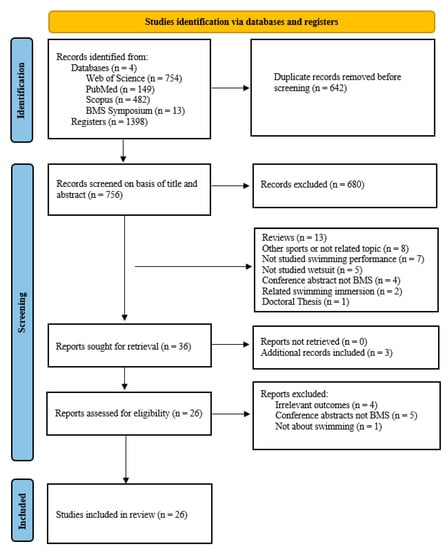
Figure 1.
Preferred Reporting Items for Systematic Reviews and Meta-analysis (PRISMA) flow diagram of the selected studies. Proceedings of the International Symposium Biomechanics and Medicine in Swimming (BMS).
2.2. Eligibility Criteria
According to PRISMA guidelines, P.I.C.O.S. was established as follows [17,18]: participants—swimmers, open water swimmers and triathletes; interventions—any methodology that aims to study swimming performance, physiology and biomechanics; comparisons—any wetsuit type and swimsuit; outcomes—performance, physiology and biomechanics variables related to the wetsuit use in swimming; and study design—cross-sectional and/or longitudinal studies. Inclusion criteria were defined as follows: (i) studies assessing front crawl swimming performance while wearing a wetsuit in swimmers and/or triathletes, (ii) studies conducted in 25 or 50 m swimming pools, swimming flume and open water environment (lake, river, water channel or sea) at any water temperature and (iii) studies where the used wetsuits were full body and long or short sleeveless. Exclusion criteria were defined as follows: (i) review studies (qualitative and systematic reviews and meta-analysis), (ii) conference proceedings, with the exception of the Proceedings of the International Symposium on Biomechanics and Medicine in Swimming peer review studies, (iii) studies that evaluated the effects of wearing a wetsuit in water immersions or in the subsequent cycling or running triathlon efforts and (iv) studies that used wetsuits in other exercise modes or fields (non-swimming or triathlon).
2.3. Study Selection
The review process was conducted by two independent researchers in two different stages. During the first stage, duplicate records were identified and removed from those obtained in the initial search, with titles and abstracts being screened afterwards. The above-referred eligibility criteria were applied by the two researchers and disagreements were discussed until consensus was reached. During the second stage, the same procedure was conducted after screening the remaining full-text records for the final decision about inclusion or exclusion.
2.4. Data Extraction
The extraction process was conducted by one researcher and then checked by the second expert. The items extracted were defined as follows: (i) study reference, (ii) sample characteristics (age, gender, swimming level and swimmer specializations—open water swimmer or triathlete), (iii) procedures, (iv) swimming and water temperature, (v) wetsuit type used and (vi) performance, physiological and biomechanical outcomes (Table 1). The studies that compared two vs. three wetsuit types and open water swimmers vs. triathletes were also identified. Disagreements regarding the data extracted were solved in a consensus meeting.

Table 1.
General characteristics of studies examining age, swimming level, performance assessment, aquatic environment, water temperature and wetsuit information.
2.5. Quality Assessment
The quality assessment was conducted using the Joanna Briggs Institute Critical Appraisal Tool for Systematic Reviews [36]. This is a tool specifically designed to assess the quality of cross-sectional studies. It gathers eight items related to sample characteristics, methods and outcomes [37,38]. The possible answers to each question were ‘yes’, ‘no’ or ‘not applicable’, and studies were considered as high (≥0.75) or low (<0.75) quality when the final score was obtained [39]. To provide an overview of how the included literature rate each criterion, a summary classification was calculated by dividing the number of positively scored by the total number of included studies. Two independent reviewers conducted this process and disagreements were discussed until consensus was reached. Inter-rater reliability for the initial agreement between researchers was assessed using Cohen’s Kappa coefficient statistical analysis with the following criteria: < 0.00 poor; 0.00–0.20 slight; 0.21–0.40 fair; 0.41–0.60 moderate; 0.61–0.80 substantial and 0.81–1.00 almost perfect [40].
3. Results
3.1. Study Identification
From the initial search, 1398 studies were identified in the four databases and, after the duplicates were removed, 756 studies remained for the identification phase. Subsequently, 36 records were included after the screening (based on the title and abstract) and a total of 23 studies were finally included in the current systematic review. We may point out that three additional records were added at the discretion of the authors because, even if not included on the database, they fit within the background of the current systematic review. In the final stage, 26 studies were included for eligibility (the study selection process is described in Figure 1).
3.2. Quality Assessment
The agreement between both researchers was categorized as substantial (0.61) [40]. From the 26 studies included, 39 and 61% were categorized as high and low quality (respectively) [39]. The agreement between the researchers in the assessment of studies is displayed as Supplementary Material in Table S2.
3.3. Sample Characteristics
The current study contains 26 research papers published between 1986–2021 (Table 1) from which 18 [7,8,9,10,12,14,15,16,19,26,28,29,30,31,32,33,34,35] and 17 [1,9,10,12,15,16,20,21,22,23,24,25,27,30,31,32,34] included swimmers and triathletes (respectively). Participants’ mean age ranged from 13→50 years old, particularly > 18 years (n = 24) [1,7,8,9,10,12,14,15,16,19,20,21,22,23,24,25,26,27,28,29,30,31,32,34], <18 years (n = 11) [8,9,10,14,15,16,23,26,27,28,30] and > 50 years (n = 1) [1], with one study not presenting any age-related information [33]. Regarding the swimming proficiency, participants were from elite (n = 2) [1,19], international (n = 8) [1,9,20,21,22,23,24,25], national (n = 11) [1,10,14,15,20,21,22,23,24,26,27], regional (n = 6) [1,10,15,16,26,28], beginner (n = 1) [29], club (n = 1) [25], amateur (n = 3) [30,31,32] and student (n = 2) [8,33] levels, with four studies not presenting detailed information on the topic [7,12,34,35].
The included studies used full-body (n = 18) [7,8,9,10,14,15,16,19,20,21,23,24,26,27,28,30,32,33], sleeveless long (n = 10) [1,7,8,10,12,14,15,25,26,31] and sleeveless short (n = 1) [7] wetsuits, with three papers not giving any information about suit typology [29,34,35]. The wetsuit details and thickness are displayed in Table 2 and a summary of the wetsuits related to the sample can be observed in the Supplementary Material (Table S3). The experimental set-ups of the studies took place in 25 m (n = 17, two in 25 yards) [10,12,14,15,16,19,20,22,23,25,26,27,29,30,31,32,33] and 50 m swimming pools (n = 6, one in 50 yards) [1,8,9,15,21,25], in swimming flumes (n = 7) [7,16,22,23,24,28,29] and in natural aquatic environments (n = 2) [34,35]. From the 26 included studies, 14 presented a combination of physiological and biomechanical data and 17 and 22 focused on physiological or biomechanical variables (respectively). The water temperature ranged from 17–30 °C [25,29].
Table 2.
Wetsuits details and thicknesses.
3.4. Wetsuit Use and Physiological Reports
The studies that reported physiological data are shown in Table 3. Regarding oxygen consumption (), lower values were determined for the following: (i) in the 400 m when using a full-body wetsuit vs. swimsuit [9]; (ii) at different velocities (0.90–1.31 m⋅s−1) when comparing full-body vs. sleeveless long and short wetsuits [7]; (iii) at 0.40 and 0.60 m⋅s−1 with wetsuit vs. swimsuit, but values were similar when swimming at 1.00 and 1.10 m⋅s−1 [29] and (iv) concurrently with lower values of ventilation at 400 m with the use of a full-body wetsuit vs. swimsuit in a swimming flume [28].
Table 3.
Physiological variables related to the improvement in different experimental conditions when using a wetsuit.
Studies showed contradictory results regarding peak blood lactate concentrations ([La−]). Lower values were shown in distances of 2 × 25, 2 × 75 and 400 m [9,22,28,30,32] and higher values in 2 × 25 and 400 m [22]. The existent data were displayed for full-body wetsuit vs. swimsuit. Regarding heart rate (HR), lower values were observed when swimming 400 m wearing a full-body wetsuit vs. swimsuit [28,29,30] and higher values appeared during 1500 m using a sleeveless long wetsuit vs. swimsuit [25]. In addition, when swimming 400 m in the swimming flume, C was lower while wearing a full-body wetsuit vs. swimsuit [9,24], and simultaneously lower energy expenditure when using a full-body wetsuit vs. swimsuit [28]. Finally, during a 30 min swim in water temperatures ranging from 17–29.5°, trunk and rectal temperatures showed higher values with the sleeveless long wetsuit vs. swimsuit [25,31], and after swimming 75 min a higher core temperature with the use of a full-body wetsuit vs. swimsuit was observed [32].
3.5. Wetsuit Use and Biomechanical Reports
Results showed a performance improvement when comparing full-body wetsuits vs. swimsuit and sleeveless long/short wetsuits. Performance enhancement ranged from 3.2–12.9% in 25–1500 m, incremental tests, 5 and 30 min, and open water swimming performances. On the other hand, the use of a sleeveless long wetsuit allowed an enhancement in 400 and 800 m performance compared to the full-body wetsuit and swimsuit (Table 4) [8,10,26]. Regarding biomechanical variables, stroke rate (SR) [22,23,24], stroke length (SL) [16,20,21,22,23,27,28,30] and stroke index (SI) were higher with a full-body wetsuit vs. swimsuit [16,20,21,28,30], with SR and SL being also higher while using a sleeveless long wetsuit vs. swimsuit [31]. No differences were found between suits in propelling efficiency while swimming 400 and 25 m in a swimming flume [19,28]. In addition, one study reported lower active drag and drag–swimming velocity relationship while using sleeveless long vs. full-body wetsuits [12].
Table 4.
Biomechanical variables related to the improvement in different experimental conditions when using a wetsuit.
3.6. Wetsuit Use Effect in Swimmers and Triathletes
From the total sample, only two studies compared swimmers vs. triathletes and reported physiological and biomechanical variables (Table 5 and Table 6) [9,10]. Swimmers performed lower times in 400 m with full-body wetsuits than triathletes [9]. In addition, swimmers’ performance was lower while using a full-body wetsuit vs. swimsuit and triathletes were faster with a full-body wetsuit vs. swimsuit. However, no differences were found between swimmers and triathletes in Borg rating of perceived exertion, peak [La−] and SR [9]. In addition, results showed higher values in speed, SR and SL with sleeveless long wetsuits for swimmers and triathletes compared to full-body wetsuits and swimsuits [10] (Table 6).
Table 5.
Physiological variable comparison for swimmers and triathletes.
Table 6.
Biomechanical variable comparison for swimmers and triathletes.
4. Discussion
Research about wetsuit use in swimming dates back to 1986 [1]. Thus, the aim of the current systematic review was to summarize the effects of wearing different types of wetsuits and swimsuits in front crawl swimming performance and physiological- and biomechanical-related variables. The use of a full-body wetsuit produces an enhancement of 3.2–12.9% in 25–1500 m front crawl swimming performance, swimming incremental tests, 5 and 30 min continuous swimming and open water swimming events. Furthermore, the sleeveless long wetsuit also produces performance advantages in comparison with a full-body wetsuit [8,10,26].
4.1. Wetsuit Use on Swimming Performance Related to the Body Cover
The wetsuit thermal insulation depends on its composition and textile properties, showing higher thicknesses (>4 mm) and presenting better hydrophobic properties than those with lower thicknesses [6]. When more body area is covered by, i.e., full-body wetsuits, the thermal properties are improved [6], also producing greater biomechanical changes [8,10]. The full-body wetsuit produces changes in most of the physiological and biomechanical variables compared to swimsuits such as lower [La−], maximal HR and C and higher SR, SL and SI values. Together, those findings help to justify the performance enhancement when using that type of suit [20,24,27,28,32].
The information about the sleeveless short wetsuit is scarce, with only one study reporting higher values of and ventilation compared to sleeveless long and full-body wetsuits in a swimming flume (four velocities ranged from 0.90–1.31 m⋅s−1) [7]. Due to a sleeveless short wetsuit covering less body area, the advantages arising from buoyancy are minor, leading to a greater drag and higher energy demands than using the other two wetsuits. Additionally, studies showed that the sleeveless long wetsuit benefited the swimmers more than triathletes [8,10], probably due to superior swimming skills in swimmers, as is discussed later [10]. Nevertheless, the sleeveless long wetsuit type is gaining popularity in open water swimming and triathlon competitions due to the comfort provided in the shoulder joint movements [8].
4.2. Wetsuit Use and Physiological Reports
A crucial variable to analyze in open water swimmers and triathletes is , since it has been considered a determinant of the maximal aerobic performance capability [41]. Similar , values were found for swimmers and triathletes while using full-body wetsuits in 400 m swimming [9], while lower and ventilation values were observed with full-body, sleeveless long and short wetsuits compared to swimsuits when swimming in a swimming flume for 5 [7] and 7 min [29] (Table 3). These results suggest that using three wetsuit types reduces the energy requirements in these trials (i.e., 400 m and 5 and 7 min swims), as cardiorespiratory responses are small. Furthermore, the swimming velocity reached when wearing a full-body wetsuit was higher at equal values of , adding another reason that proves the advantage of using a wetsuit on swimming performance [22]. In addition, although different suits were used and at different velocities, C was reduced in open water swimming while using a full-body wetsuit for 5 km vs. swimming in the pool with a swimsuit [42]. This might suggest that using a full-body wetsuit might also affect the hydrodynamic position in long distances; thus, an increase in buoyancy should occur, reducing C.
Mixed findings of [La−] were reported while using wetsuits vs. swimsuits in 400 m front crawl swimming (Table 3) [22,23,30]. Similar results were found for maximal HR [25,29,30], with higher values for 1500 m swimming [25] but lower for 400 m swimming in the swimming pool and flume compared to swimsuits [28,29]. These conflicting results might be a consequence of the body compression caused by the wetsuit [43]. Although lower [La−] and HR values were expected while using wetsuits due to their reduced energy requirements, this fact remains unclear since the body temperature is affected both by the suit and the water temperature. This might trigger a higher physiological response at higher water temperatures, changing the results easily.
Comparing sleeveless long wetsuits vs. swimsuits, triathletes swam 10 and 7% faster at 17 and 18 °C (respectively) [1,25]. The explanation can rely on a lower maximal HR at 17 °C compared to warmer temperatures (21.3 and 29.5 °C). The same happened for core, trunk and rectal temperatures being lower at 17 °C while wearing a sleeveless long wetsuit compared to a swimsuit using skin thermistors [25]. These results suggest that this wetsuit increases trunk and rectal temperature as the water temperature increases, requiring maximal HR increments [25]. This explains why, in those cases, the immersion does not produce a cold-shock response, where lower HR is observed [44]. In addition, higher core temperature values were found when swimmers were wearing full-body wetsuits compared to swimsuits after 75 m swimming using a thermistor inserted through the anal sphincter and recorded every min [32]. It is also important to highlight that tight wetsuits increase the compression forces, consequently increasing the venous return and considered a risk factor for swimming performance [43]. For that reason, higher temperatures (>20 °C in open water swimming and ≥24.6 °C in triathlon events) probably should not be considered in studies with practical applications in training and/or competitive purposes.
Likewise, recent research stated that swimming 400 m with a full-body wetsuit at 18 °C allows better technique and economy of effort than when using a swimsuit. The use of a full-body wetsuit might increase performances at 18 °C water temperature, and its use is recommended in open water swimming competitions [28]. However, more studies are needed (i.e., regarding water temperatures where the use of a wetsuit is optional according to International Swimming Federation rules). In a short study where the full-body wetsuit Speedo Thinswim® was studied at 18 °C [45], the rating of perceived exertion showed lower values with this full-body wetsuit compared to a swimsuit. This can be related to the reduction in cardiorespiratory responses at similar velocities with the use of wetsuit vs. swimsuit [7,28,29,30]. In addition, it also shows useful information regarding the personal comfort of the swimmer while using the wetsuit and its usefulness for training purposes.
4.3. Wetsuit Use and Biomechanical Reports
The reduction in drag force yield decreases in C, in addition to that higher swimming speeds can be sustained with elevated propelling efficiency and low hydrodynamic drag (i.e., low C) [46], as observed while using wetsuits. Indeed, lower passive drag and C were found in triathletes while swimming with a full-body wetsuit vs. swimsuit [9]. This can be explained by the increased buoyancy provided by the full-body wetsuit (higher body are covered compared to sleeveless long wetsuits). Another key aspect playing here is the higher frequency of full-body wetsuit use by less experienced swimmers vs. more experienced swimmers, resulting in the better performance of the latter with sleeveless long wetsuits in the 400 m front crawl [9,10]. The lower values found on active drag and in the drag–swimming velocity relationship with full-body wetsuits compared to swimsuits in short trials (23 m front crawl) also confirms the swimming efficiency improvements, probably due to the increased propelling efficiency [12]. However, the method used to analyze the active drag was different in the studies included in the present review; the velocity perturbation method was used in two cases, and thus it may influence the data [15,22]. In addition, in the measurement of active drag, it is important to consider that this system yields an increase in stroke efficiency (reduction in SR and an increase in SL). Moreover, this measurement is limited to the arm pull forces, and it requires mechanical adaptations because of the paddle placement [19,47].
Another predictor of C is the intracyclic velocity variation, as it describes the speed fluctuations resulting from changes in drag throughout the swimming cycles [13]. However, it was not used in any of the selected studies as a biomechanical measure. Considering that swimming speed variations produce drag modifications (i.e., form, friction and wave) and, consequently, energy expenditure changes [13], it would be interesting to compare intracyclic velocity variation with and without wetsuits. In addition, the taller the swimmer, the lower the wave drag, whereby the speed might increase and thus, leg sinking torque and C values can be reduced [13,48]. In addition, the full-body wetsuit use might reduce the local fatigue, which is associated with speed maintenance, resulting in lower C [19]. This is another advantage of the use of wetsuits which should be considered for open water swimming competitions.
Higher SR, SL and SI have been observed when wearing full-body wetsuits compared to swimsuits [9,16,22,23,27,30]. Swimmers who generally swim with higher SL would benefit more using a sleeveless long than full-body wetsuit, indicating that they are less adapted to wetsuits use than triathletes [10]. On the contrary, a better horizontal position evoked by the higher buoyancy provided while wearing a full-body wetsuit [20] reduces the hydrodynamic drag and leads to more efficient swimming [13]. This could be related to the wetsuit thickness. The wetsuits included in this review had a 3.15 mm average thickness (Table 2), which facilitates their adaptation, especially for more skilled swimmers (as discussed above).
Regarding swimming efficiency, no differences were found in propelling efficiency between full-body wetsuits and swimsuits both in the swimming pool and flume [16,28]. Nevertheless, some reports showed higher values in SL and SI using full-body wetsuits, which might be responsible for the higher velocity reached in 400 m swimming [16,28]. As one of the C determinants, propelling efficiency has been little studied despite having been used to determine the wetsuit type that fits the swimmer or triathlete better [13]. Complementarily, the index of coordination (another indicator of swimming efficiency quantified by the arm coordination [13,49]) has been studied, showing lower values in catch-up coordination mode when comparing full-body wetsuits vs. swimsuits in the 800 m front crawl [20], despite no changes being reported in 1500 m swimming nor in incremental trials [19,21]. These results suggested that some kind of adaptation to the wetsuit exists, but more data are necessary to conclude which one is the most useful for training purposes.
4.4. Wetsuit Use Effect in Swimmers and Triathletes
The first study that compared swimming performance between international swimmers and triathletes reported that the full-body wetsuit improves performance in triathletes compared to using a swimsuit [9]. In addition, this full-body wetsuit generates more benefits in triathletes than in swimmers [9]. In addition, [La−] and SR were higher, and C and passive drag were lower while using swimsuits in swimmers compared to triathletes [9]. Concerning these results, the lower hydrodynamic lift shown in triathletes compared to swimmers would justify the swimming technical abilities (i.e., poor horizontal position in triathletes), resulting in lower buoyancy and, therefore, higher hydrodynamic drag [12,13]. Moreover, the increased buoyancy caused by the neoprene synthetic rubber composition [6] could justify why the wetsuit seems to benefit triathletes more than swimmers (which already have better hydrodynamic position due to their higher technical ability).
A few years later, the previous data were confirmed by showing that regional-level swimmers improved swimming performance with the use of sleeveless long wetsuits compared to swimsuits [10]. It appears that when using a sleeveless long wetsuit, the more experienced swimmers will reach better performance compared to a full-body wetsuit, which may be explained by the discomfort and limitation of movements while wearing full-body wetsuits in the shoulder joint. A performance improvement was associated with the increase in swimming speed (7.1 and 11.3%) and SL (6.4 and 8.4%) when using a full-body wetsuit by regional-level swimmers and national-level triathletes, respectively. Nevertheless, using a sleeveless long wetsuit seems to increase swimming speed by 11.8% compared to swimsuits in swimmers [10]. In short, future research might consider further analysis comparing swimmers and triathletes due to their swimming technical differences and practical abilities which might determine different effects on swimming performance.
4.5. Current Study Limitations
Regarding the data extraction of the studies included, some limitations were observed. Three studies did not identify the wetsuit type nor the thickness, which is determinant to understanding the performance, physiological and/or biomechanical changes in swimming compared to swimsuits and therefore its application in swimming training and competition. Based on the quality assessment (Table S2), future studies should perform the following: (i) define the inclusion and exclusion criteria of the sample included and (ii) identify the confounding factors and detail the strategies to deal with them. Regarding these issues, the results reported should be focused on the sample and the swimming level to enhance the understanding and its application in swimming performance.
Related to the data collection environment, an important constraint is the lack of studies performed in colder water temperatures where the use of wetsuits is optional according to International Swimming Federation and International Triathlon Union rules (i.e., 18–20° and 16–22 °C, respectively) [3,4]. While it is consistently found that the wetsuit use improves swimming performance when the water temperature is about 25–29 °C, this seems not to be valuable practical information for training or competition purposes, because swimmers will be only allowed to use wetsuits when the water temperature is lower. Future studies about using wetsuits should focus primarily on simulating real competition temperatures and not only be conducted in indoor pools, where the normal water temperature is ~26 °C (an unreal scenario in open water swimming events). Finally, most of the studies were conducted on short- or long-course pools and in swimming flumes, which are not competition environments. Researchers should put more effort into measuring both physiological and biomechanical variables in open water scenarios.
5. Conclusions
According to the results observed in the current systematic review, the physiological and biomechanical changes produced by wetsuit use lead to an increase in swimming speed when wearing the full-body, sleeveless long and short wetsuits compared to swimsuits. This enhancement is mainly obtained due to higher buoyancy and hydrodynamic drag reduction. Plus, the technical adaptations seem to also contribute to swimming, with less energy requirements while using wetsuits. The findings of the current systematic review provide useful information for coaches, swimmers and triathletes about the use of full-body, sleeveless long and short wetsuits. The three suit types improve swimming performance compared to swimsuits in different swimming distances and aquatic environments. As a result, coaches, swimmers and triathletes could design their training routines with different wetsuits and strategies for open water swimming competitions.
Supplementary Materials
The following supporting information can be downloaded at: https://www.mdpi.com/article/10.3390/physiologia2040016/s1, Table S1: Search terms used in Web of Science, PubMed, Scopus and in the Conference Proceedings of the International Symposium on Biomechanics and Medicine in Swimming (BMS) databases. In addition, the sources where the additional records were found are detailed; Table S2: Quality assessment of the selected studies after researcher consensus; Table S3: Summary of the studies using different wetsuit types and swimmers or triathletes.
Author Contributions
Conceptualization: A.G.; methodology: A.G. and J.J.R.-N.; data extraction/data curation: A.G. and J.J.R.-N.; writing—original draft preparation: A.G.; writing—review and editing: A.G., R.J.F., J.J.R.-N., F.C.-F., Ó.L.-B., J.A.A. and R.A.; visualization: A.G., R.J.F., J.J.R.-N., F.C.-F., Ó.L.-B., J.A.A. and R.A; supervision: R.J.F. and R.A.; project administration: R.A.; funding acquisition: R.A. All authors have read and agreed to the published version of the manuscript.
Funding
This study was supported by grants awarded by the Ministry of Economy, Industry and Competitiveness (Spanish Agency of Research) and the European Regional Development Fund (ERDF), PGC2018-102116-B-100 ‘SWIM II: Specific Water Innovative Measurements: Applied to the performance improvement’ and the Spanish Ministry of Education, Culture and Sport: FPU16/02629, FPU17/02761 and FPU19/02477 grants. The current study was developed in the University of Granada, Granada (Spain).
Institutional Review Board Statement
Not applicable.
Informed Consent Statement
Not applicable.
Data Availability Statement
The data presented in this study are available on request from the corresponding author.
Acknowledgments
To all the co-authors who have kindly collaborated in the development of the current study.
Conflicts of Interest
The authors declare no conflict of interest.
References
- Parsons, L.; Day, S. Do wet suits affect swimming speed? Br. J. Sports Med. 1986, 20, 129–131. [Google Scholar] [CrossRef] [PubMed]
- Fédération Internationale de Natation/Marculescu, C. Swimwear for Open Water Swimming Events; FINA Rules Memorandum: Lausanne, Switzerland, 2017; Available online: https://www.fina.org/swimming/approved-swimwear (accessed on 25 February 2020).
- Fédération Internationale de Natation. 2016. Available online: http://www.fina.org/content/fina-rules (accessed on 25 February 2020).
- International Triatlon Union. ITU Competition Rules. 2019. Available online: https://www.triathlon.org/uploads/docs/itusport_competition-rules_2019.pdf (accessed on 25 February 2020).
- Saycell, J.; Lomax, M.; Massey, H.; Tipton, M. Scientific rationale for changing lower water temperature limits for triathlon racing to 12 degrees C with wetsuits and 16 degrees C without wetsuits. Br. J. Sports Med. 2018, 52, 702–708. [Google Scholar] [CrossRef] [PubMed]
- Naebe, M.; Robins, N.; Wang, X.; Collins, P. Assessment of performance properties of wetsuits. Proceedings of the Institution of Mechanical Engineers. J. Sports Eng. Technol. 2013, 227, 255–264. [Google Scholar] [CrossRef]
- Trappe, T.A.; Pease, D.L.; Trappe, S.W.; Troup, J.P.; Burke, E.R. Physiological responses to swimming while wearing a wet suit. Int. J. Sports Med. 1996, 17, 111–114. [Google Scholar] [CrossRef]
- Nicolaou, K.D.; Kozusko, J.M.; Bishop, P.A. The Effect of wetsuits on swim performance. J. Swim. Res. 2001, 15, 20–26. [Google Scholar]
- Chatard, J.C.; Senegas, X.; Selles, M.; Dreanot, P.; Geyssant, A. Wet suit effect—A comparison between competitive swimmers and triathletes. Med. Sci. Sports Exerc. 1995, 27, 580–586. [Google Scholar] [CrossRef]
- Perrier, D.; Monteil, K. Wetsuits and performance: Influence of technical abilities. J. Hum. Mov. Stud. 2001, 41, 191–207. [Google Scholar]
- Chatard, J.C.; Millet, G. Effects of wetsuit use in swimming events. Sports Med. 1996, 22, 70–75. [Google Scholar] [CrossRef]
- Toussaint, H.M.; Bruinink, L.; Coster, R.; De Looze, M.I.; Van Rossem, B.; Van Veenen, R.U.; De Groot, G.E. Effect of a triathlon wet suit on drag during swimming. Med. Sci. Sports Exerc. 1989, 21, 325–328. [Google Scholar] [CrossRef]
- Zamparo, P.; Cortesi, M.; Gatta, G. The energy cost of swimming and its determinants. Eur. J. Appl. Physiol. 2020, 12, 41–66. [Google Scholar] [CrossRef]
- Cordain, L.; Kopriva, R. Wetsuits, body density and swimming performance. Br. J. Sports Med. 1991, 25, 31–33. [Google Scholar] [CrossRef]
- De Lucas, R.D.; Balikian, P.; Neiva, C.M.; Greco, C.C.; Denadai, B.S. The effects of wet suits on physiological and biomechanical indices during swimming. J. Sci. Med. Sports 2000, 3, 1–8. [Google Scholar] [CrossRef]
- Gay, A.; López-Contreras, G.; Fernandes, R.J.; Arellano, R. Is swimmers’ performance influenced by wetsuit use? Int. J. Sports Physiol. Perform. 2020, 15, 46–51. [Google Scholar] [CrossRef]
- Page, M.J.; McKenzie, J.E.; Bossuyt, P.M.; Boutron, I.; Hoffmann, T.C.; Mulrow, C.D.; Shamseer, L.; Tetzlaff, J.M.; Akl, E.A.; Brennan, S.E.; et al. The PRISMA 2020 statement: An updated guideline for reporting systematic reviews. Int. J. Surg. 2021, 88, 89. [Google Scholar] [CrossRef]
- Page, M.J.; McKenzie, J.E.; Bossuyt, P.M.; Boutron, I.; Hoffmann, T.C.; Mulrow, C.D.; Shamseer, L.; Tetzlaff, J.M.; Moher, D. Updating guidance for reporting systematic reviews: Development of the PRISMA 2020 statement. J. Clin. Epidemiol. 2021, 134, 103–112. [Google Scholar] [CrossRef]
- Zacca, R.; Mezencio, B.; Castro, F.A.; Yuzo, F.; Pyne, D.; Vilas-Boas, J.P.; Fernandes, R.J. Case Study: Comparison of swimsuits and wetsuits through biomechanics and energetics in elite female open water swimmers. Int. J. Sports Physiol. Perform. 2021, 17, 130–136. [Google Scholar] [CrossRef]
- Hue, O.; Benavente, H.; Chollet, D. The effect of wet suit use by triathletes: An analysis of the different phases of arm movement. J. Sports Sci. 2003, 21, 1025–1030. [Google Scholar] [CrossRef]
- Perrier, D.; Monteil, K. Triathlon wet suit and technical parameters at the start and end of a 1500-m swim. J. Appl. Biomech. 2004, 20, 3–13. [Google Scholar] [CrossRef]
- Tomikawa, M.; Nomura, T. Relationships between swim performance, maximal oxygen uptake and peak power output when wearing a wetsuit. J. Sci. Med. Sports 2009, 12, 317–322. [Google Scholar] [CrossRef]
- Tomikawa, M.; Shimoyama, Y.; Ichikawa, H.; Nomura, T. The effects of triathlon wet suits on stroke parameters, physiological parameters and performance during swimming. In Biomechanics and Medicine in Swimming IX; University of Saint-Etienne: Saint-Etienne, France, 2003. [Google Scholar]
- Tomikawa, M.; Shimoyama, Y.; Nomura, T. Factors related to the advantageous effects of wearing a wetsuit during swimming at different submaximal velocity in triathletes. J. Sci. Med. Sports 2008, 11, 417–423. [Google Scholar] [CrossRef]
- Lowden, B.J.; McKenzie, D.; Ridge, B.R. Effects of clothing and water temperature on swim performance. Aust. J. Sci. Med. Sports 1992, 24, 33. [Google Scholar]
- Perrier, D.; Monteil, K.M. Swimming speed in triathlon: Comparative study of the stroke parameters with complete and sleeveless suit. Sci. Sports 2002, 17, 117–121. [Google Scholar] [CrossRef]
- Hutteau, M.; Beitucci, W.; Lodini, A. Effect of using a complete wetsuit and a tri function on swimming speed and amplitude in triathlon. Sci. Sports 2007, 22, 60–62. [Google Scholar] [CrossRef]
- Gay, A.; Zacca, R.; Arturo, A.; Morales-Ortiz, E.; López-Contreras, G.; Fernandes, R.J.; Arellano, R. Swimming with swimsuit and wetsuit at typical vs cold-water temperatures (26 vs. 18 °C). Int. J. Sports Med. 2021, 42, 1305–1312. [Google Scholar] [CrossRef]
- Yamamoto, K.; Miyachi, M.; Hara, S.; Yamaguchi, H.; Onodera, S. Effects of a floating swimsuit on oxygen uptake and heart rate during swimming. In Biomechanics and Medicine in Swimming VIII; University of Jyväskylä: Jyväskylä, Finland, 1999. [Google Scholar]
- Santos, K.B.; Bento, P.C.B.; Rodacki, A.L.F. Efeito do uso do traje de neoprene sobre variáveis técnicas, fisiológicas e perceptivas de nadadores. Rev. Bras. Educ. Fís. Esporte 2011, 25, 189–195. [Google Scholar] [CrossRef]
- Trappe, T.A.; Starling, R.D.; Jozsi, A.C.; Goodpaster, B.H.; Trappe, S.W.; Nomura, T.E.; Obara, S.H.; Costill, D.L. Thermal responses to swimming in three water temperatures: Influence of a wet suit. Med. Sci. Sports Exerc. 1995, 27, 1014–1021. [Google Scholar] [CrossRef] [PubMed]
- Rois, S.; Zacharakis, E.; Kounalakis, S.; Soultanakis, H.N. Thermoregulatory responses during prolonged swimming with a Wetsuit at 25 °C. Int. J. Perform. Anal. Sports 2021, 21, 831–844. [Google Scholar] [CrossRef]
- Pavlik, J.; Pupiš, M.; Pavlović, R. Variability of swimming performance depending on the use of wetsuit. Res. Phys. Educ. Sport Health 2015, 4, 51–55. [Google Scholar]
- Nikolaidis, P.T.; Sousa, C.V.; Knechtle, B. The relationship of wearing a wetsuit in long-distance open-water swimming with sex, age, calendar year, performance, and nationality-crossing the “Strait of Gibraltar”. Open Access J. Sports Med. 2018, 9, 27–36. [Google Scholar] [CrossRef]
- Ulsamer, S.; Rust, C.A.; Rosemann, T.; Lepers, R.; Knechtle, B. Swimming performances in long distance open-water events with and without wetsuit. BMC Sports Sci. Med. Rehabil. 2014, 6, 20. [Google Scholar] [CrossRef]
- Moola, S.; Munn, Z.; Tufanaru, C.; Aromataris, E.; Sears, K.; Sfetcu, R.; Currie, M.; Qureshi, R.; Mattis, P.; Lisy, K.; et al. Chapter 7: Systematic reviews of etiology and risk. Joanna Briggs Inst. Rev. Man. 2017, 17, 5. [Google Scholar]
- Ruiz-Navarro, J.J.; Cuenca-Fernández, F.; Sanders, R.; Arellano, R. The determinant factors of undulatory underwater swimming performance: A systematic review. J. Sports Sci. 2022, 40, 1243–1254. [Google Scholar] [CrossRef] [PubMed]
- Molina-Garcia, P.; Migueles, J.H.; Cadenas-Sanchez, C.; Esteban-Cornejo, I.; Mora-Gonzalez, J.; Rodriguez-Ayllon, M.; Plaza-Florido, A.; Vanrenterghem, J.; Ortega, F.B. A systematic review on bio- mechanical characteristics of walking in children and adolescents with overweight/obesity: Possible implications for the development of mus- culoskeletal disorders. Obes. Rev. 2019, 7, 1033–1044. [Google Scholar] [CrossRef] [PubMed]
- Van Ekris, E.; Altenburg, T.M.; Singh, A.S.; Proper, K.I.; Heymans, M.W.; Chinapaw, M.J. An evidence-update on the prospective relationship between childhood sedentary behaviour and biomedical health indicators: A systematic review and meta-analysis. Obes. Rev. 2016, 17, 833–849. [Google Scholar] [CrossRef] [PubMed]
- Landis, J.R.; Koch, G.G. The measurement of observer agreement for categorical data. Biometrics 1977, 1, 159–174. [Google Scholar] [CrossRef]
- Fernandes, R.J.; Vilas-Boas, J.P. Time to exhaustion at the velocity in swimming: A review. J. Hum. Kinet. 2012, 32, 121–134. [Google Scholar] [CrossRef]
- Zacca, R.; Neves, V.; da Silva Oliveira, T.; Soares, S.; Rama, L.M.; de Souza Castro, F.A.; Vilas-Boas, J.P.; Pyne, D.B.; Fernandes, R.J. 5 km front crawl in pool and open water swimming: Breath-by-breath energy expenditure and kinematic analysis. Eur. J. Appl. Physiol. 2020, 120, 2005–2018. [Google Scholar] [CrossRef]
- Grant, A.J.; Kanwal, A.; Shah, A.B. Swimming: What the sports cardiologist should know. Curr. Treat. Options Cardiovasc. Med. 2020, 22, 70. [Google Scholar] [CrossRef]
- Stocks, J.M.; Taylor, N.A.; Tipton, M.J.; Greenleaf, J.E. Human physiological responses to cold exposure. Aviat. Space Environ. Med. 2004, 75, 444–457. [Google Scholar] [CrossRef]
- Gay, A.; Zacca, R.; Abraldes, A.; Morales-Ortiz, E.; López-Contreras, G.; Cuenca-Fernández, F.; Fernandes, R.J.; Arellano, R. Physiology and Biomechanics to Determine the Effect of Wetsuit Speedo Thinswim® when Swimming in a Cold-Water Flume (Peer Review); Abstract presented at the XXV European College of Sport Sciences; Book of Abstracts; European College of Sport Sciences: Sevilla, Spain, 2020. [Google Scholar]
- Baldassarre, R.; Bonifazi, M.; Zamparo, P.; Piacentini, M.F. Characteristics and challenges of open-water swimming performance: A Review. Int. J. Sports Physiol. Perform. 2017, 12, 1275–1284. [Google Scholar] [CrossRef]
- Peterson Silveira, R.; Soares, S.M.; Zacca, R.; Alves, F.B.; Fernandes, R.J.; Castro, F.A.; Vilas-Boas, J.P. A Biophysical Analysis on the Arm Stroke Efficiency in Front Crawl Swimming: Comparing Methods and Determining the Main Performance Predictors. Int. J. Environ. Res. Public Health 2019, 16, 4715. [Google Scholar] [CrossRef] [PubMed]
- Stager, J.M.; Cordain, L. Relationship of body composition to swimming performance in female swimmers. J. Swim. Res. 1984, 1, 21–26. [Google Scholar]
- Chollet, D.; Chalies, S.; Chatard, J.C. A new index of coordination for the crawl: Description and usefulness. Int. J. Sports Med. 2000, 21, 54–59. [Google Scholar] [CrossRef] [PubMed]
Publisher’s Note: MDPI stays neutral with regard to jurisdictional claims in published maps and institutional affiliations. |
© 2022 by the authors. Licensee MDPI, Basel, Switzerland. This article is an open access article distributed under the terms and conditions of the Creative Commons Attribution (CC BY) license (https://creativecommons.org/licenses/by/4.0/).