


Definition
A data cooperative is a legally organized cooperative whose purpose is the collective collection, management, and use of data collected by its members. In contrast to other data pools, it can act as a democratic self-governing organization in which each member has a say in how data is collected, shared, and analyzed. The members retain control over the data they contribute. They collectively benefit from the resulting data services, for example, through new insights, innovative services, or economic advantages. As a forward-looking model, the data cooperative enables smaller players to access reliable data infrastructure and data resources that would otherwise remain inaccessible. It promotes data sovereignty and strengthens trust in data-driven cooperation. Here, the definition of data derives from the field of business informatics, which gives a scientifically sound typology of data, systematized on several levels. The following elaboration offers conceptual clarification and presentation of central data types. Depending on the context and processing purpose, their classification is essential for business informatics, as they form the raw material for information systems and business processes. Data cooperatives are gaining in importance as a cooperative form of organization enabling democratic co-determination, community benefit, and equal access to data for regional actors.
1. Introduction
This entry examines the challenge digital transformation means for municipalities in terms of using data as a central resource for innovation and efficiency. The state of this research is still young; in particular, there is a lack of empirical studies on the impact and scalability of data cooperatives in the GovTech context. Basically, data cooperatives can act as enablers for GovTech and regional development, provided that legal, technical, and cultural conditions are created. They transfer the classic cooperative principle to the digital world [1]. In combination with GovTech—digital technologies and services for public administration—data cooperatives offer the potential to accelerate the modernization of administration, promote data-driven innovation, and strengthen regional value creation. Data is the basis of all information processing and is typified according to different criteria to enable its use for operational, analytical, and strategic purposes [2]. Data are formalized representations of facts or observations that are available digitally for processing, storage, analysis, or communication [3]. Practice-related examples from Baden-Württemberg and Hesse show how new business models and smart solutions for municipalities can be created through the shared use of data. However, challenges include legal uncertainties, a lack of standards, and limited experience with cooperative data models in administration.
Typology of data by degree of structuring
- Structured data: Data that follows a predetermined format, usually in tables, databases, or standardized forms (e.g., customer database; “Structured data offers high accessibility for algorithmic processing” [3]).
- Unstructured data: Data that is not subject to a fixed scheme, such as text, images, audio, or video files. They are more difficult to evaluate automatically, but they make up a large part of the digital data volume (“Unstructured data such as emails and social media posts are less directly usable for classic analysis methods” [2]).
- Semi-structured data: Hybrid forms such as Extensible Markup Language (XML) and JavaScript Object Notation (JSON) files, in which data is in a certain format but is not fully tabulated (“Semi-structured data combines flexibility with machine readability” [4]).
Typology of data by source and origin
- Primary data: Data collected directly in the investigation process, e.g., through surveying, observation, or measurement (“Primary data are original data sets whose quality can be directly controlled” [4]).
- Secondary data: Pre-existing data that are reused for new analyses (e.g., statistics, research databases; “Secondary data are crucial for efficiency and availability but can pose quality risks” [2].
Typology of data by context of use
- Master data: Relatively stable data for the identification and description of business objects, e.g., customer, product, or supplier data (“Master data is indispensable for the integrity of operational processes” [3]).
- Transaction data: Data that depicts business processes and transactions, such as orders, invoices, or bookings (“Transaction data documents the operational dynamics in companies” [4]).
- Metadata: Data about data, e.g., information about the time of origin, source, format, or permissions of the actual data (“Metadata is essential for discoverability and governance of information resources” [2]).
Typology of data by processing and updating frequency
- Batch data: Data processed at periodic intervals, e.g., daily settlements [4].
- Streaming data: Data generated or transmitted continuously and in real time, such as sensor data in the Internet of Things (IoT) (“Streaming data enables real-time analysis of operational processes” [2]).
The differentiated typification of data is fundamental for the development and operation of digital business models and information systems. It determines architecture, governance, analysis procedures, and legal frameworks in the management of digital processes [3]. Business informatics systems must take these typologies into account both conceptually and technically to ensure data quality, data protection, and value creation.
2. The Cooperative Principle According to Raiffeisen and Schulze-Delitzsch—An Example from Germany
The 19th century, when cooperatives aimed to help farmers out of poverty and dependence through community self-help against the background of great economic hardship in, among others, Europe’s rural regions. Bringing together people with similar problems, interests, or objectives in a cooperative, enables them to look for economic solutions to their concerns together. These self-help communities were able to generate goods and services that were too expensive for the individual or generally too low, asked for or not, of high enough quality on the market. The goal of self-sufficiency was pursued based on the principle of mutual responsibility. Cooperatives were democratically structured; each cooperative member is both owner and customer of the cooperative and has equal voting rights. It is not about increasing capital but about the benefit for the members. For example, machines and seeds could be purchased together and crop yields could be offered jointly in larger quantities on the market.
In Germany, for example, the data cooperative is based on the cooperative principle described above founded by Friedrich Wilhelm Raiffeisen in the west in the 19th century, which Hermann Schulze-Delitzsch also pursued independently of Raiffeisen in the east, right up to the political enforcement of the associated cooperative law [5].
3. The Cooperative Law
The German Cooperative Act (GenG), which was brought into effect on 1 October 1889, last adjusted in 2006, regulates the establishment, organization, and supervision of cooperatives in Germany. Essential principles are voluntary and open membership, the principle of identity and promotion (members are users and owners, the focus is on the promotion of members), and democratic control according to the principle of “one member, one vote”. To form a registered cooperative (eG), at least three members and an approved statute are required. The cooperative becomes legally capable with an entry in the cooperative register. The organs of the cooperative are the board of directors, the supervisory board, and the general meeting. In addition, there is mandatory auditing and membership in a cooperative auditing association to ensure economic solidity and transparency [6]. Section 1 GenG defines the purpose of cooperatives as the acquisition or economy of their members or the promotion of their social and cultural interests through joint business operations.
4. Data Cooperatives in the Public Sector
Public administration must act in an economically and socially responsible manner. This is where public sector data cooperatives can come in. Cost-effectiveness means using public funds as sparingly and efficiently as possible, so that the best possible result is achieved with the least possible effort. At the same time, the administration must take social concerns into account providing fair, equitable, and inclusive services to all citizens, and securing the social foundations for the common good. Thus, public administration has the task of creating a balance between cost awareness and social justice to fulfil its tasks sustainably and in a trustworthy manner.
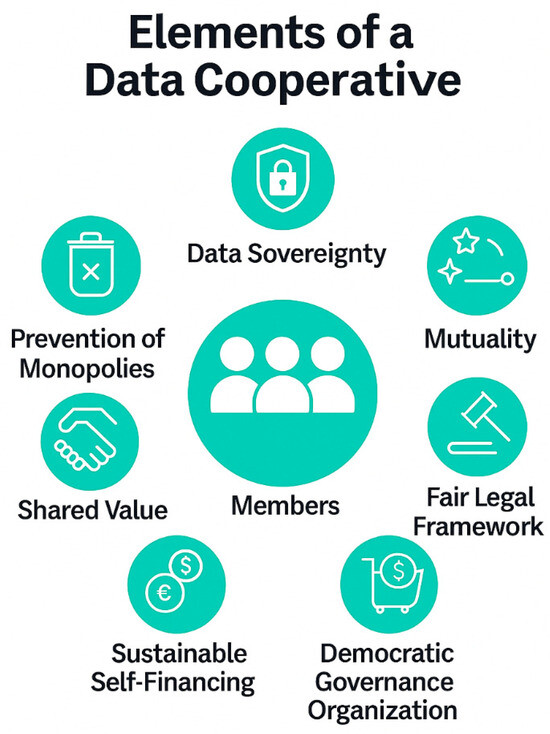
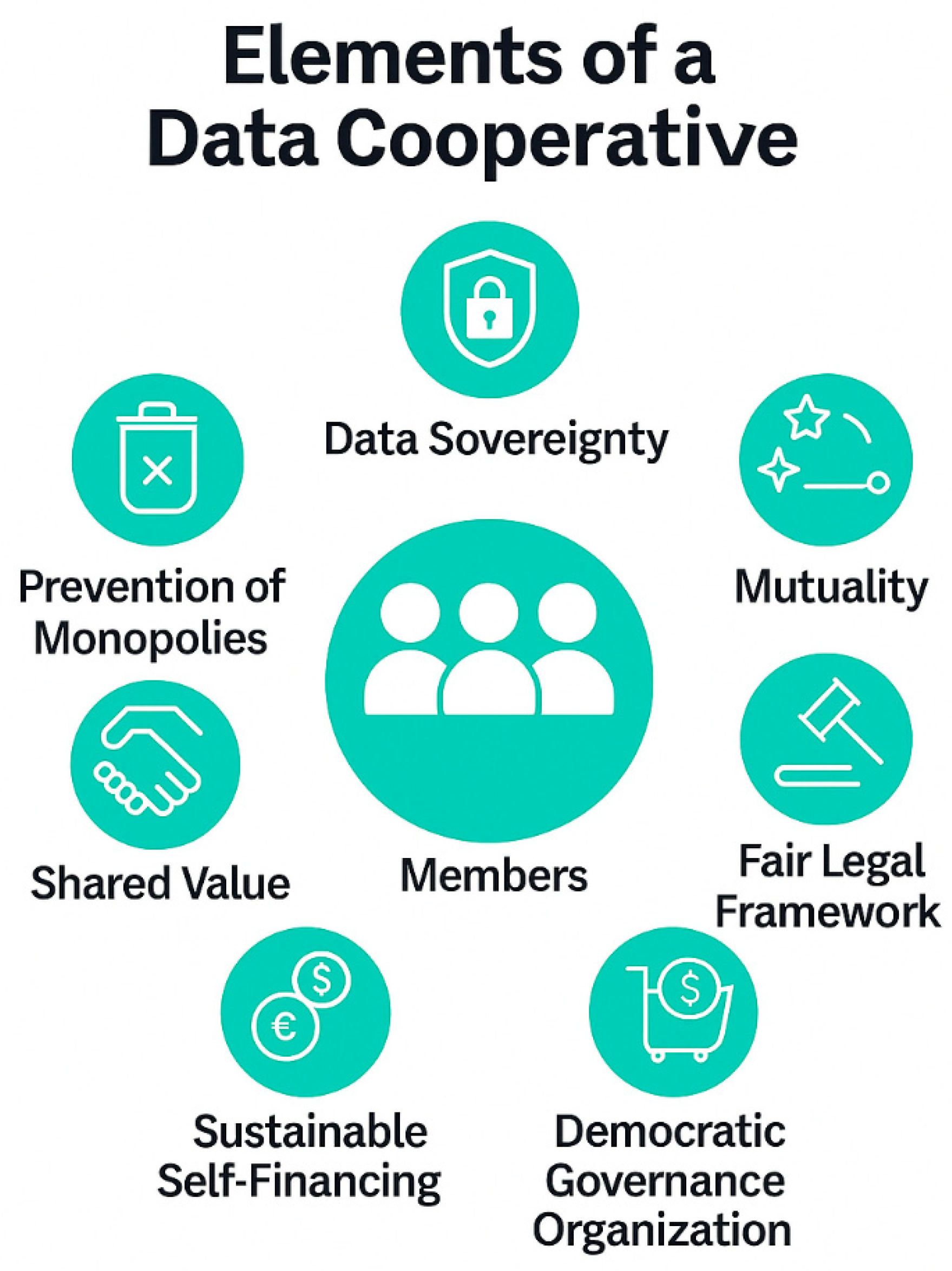
To do this, the data cooperative needs to be transferred into a principal model, depicted in Figure 1.
Figure 1.
Principles of data cooperatives.
This model of the “Elements of a Data Cooperative”, based on the relevant current literature on data cooperatives and public sector data cooperatives, describes central principles for the organization and sustainable design of data-driven forms of cooperation. The focus is on the community of members, who act as carriers and at the same time as main beneficiaries of the cooperative structures. A central element is data sovereignty, understood as the ability of members to determine for themselves how their data is collected, processed, and passed on (cf. [7]). This principle distinguishes data cooperatives from classic data economy models, as it is not the platform operators but the individuals who control the value creation. The principle of mutuality, i.e., the mutual obligation to take responsibility and support within the community, is closely linked, which reflects the core of the cooperative idea (cf. [8]).
In addition, the establishment of a fair legal framework is crucial, as it ensures transparency, fairness, and the enforceability of member rights. Within this framework, democratic governance structures are in place that enable collective decision-making, and thus secure legitimacy (cf. [9]). At the same time, data cooperatives need to develop a strategy for long-term self-financing to avoid external dependencies and maintain autonomy of action. The generation of shared added value forms the economic and social starting point: the resulting benefits are not skimmed off to third parties, but flow back into the community of members. Finally, the principle of monopoly avoidance aims to prevent concentrations of power within and outside the cooperative and to secure open, competition-promoting structures (cf. [10]).
The model thus offers a conceptual blueprint to establish data-based cooperation that combines economic sustainability, legal fairness, and social participation. In its entirety, it represents a design framework that focuses on a normative foundation of digital commons beyond regulatory and technical issues.
The model follows the example of data cooperatives in the private sector, especially of small and medium-sized enterprises (SMEs), which would not be able to generate and analyze the data they need on their own to use it to optimize profitability [2,11]. If, for example, companies in the wood industry join forces along the value chain, component manufacturers, sawmills, dealers, and risk managers can work together within the framework of a data cooperative on the joint management of condition data on production plants or raw materials to increase the operational readiness of machines and optimize supply chains. All members contribute their know-how, for example, on markets or technology. The shared data enables risk management, e.g., about machine failures, or enables individually tailored insurance premiums. Through cooperation in the form of a data cooperative, business models can be realized that would not be achievable for a single company. For example, regarding certificates for the employers’ liability insurance association or load and production peaks. In a jointly drawn up set of rules, the cooperative partners commit themselves to contribute relevant data and supplementary knowledge. The legal form of the cooperative ensures that all members have the same influence and protection, for example, in the use and evaluation of data and the confidential handling of sensitive data. The aim of such a data cooperative is to benefit all members through a better database and innovative services that can be used to tap into new value creation potential that would be denied to the individual alone [2,11].
Public data cooperatives have a significant connection to municipal and regional development, acting as community-governed organizations that treat data as a public asset. They enable local authorities, employees, and citizens to collectively govern and decide how data about their communities is used, fostering more equitable and participatory governance. This cooperative structure allows communities to better leverage data for practical local benefits, such as improving public services (childcare, utilities), enhancing policy advocacy, and addressing local challenges through data-driven solutions.
The following models of data cooperatives are possible to democratize control over data and distribute value from data more equitably [12]:
- Citizen data cooperatives as associations of private individuals who jointly determine the use of their personal data.
- Corporate data cooperatives as collaborations of companies that share data to promote innovation or balance market power.
- Public–private data cooperatives as partnerships between public institutions and private actors for the sharing of data for the common good [1].
Which cooperative model to choose depends on the data collected or needed and the public purpose pursued. As research on public data collectives in Germany is only just beginning, further exploration on this subject is needed.
A data cooperative in the public sector can consist in various authorities and public bodies that jointly collect data, manage it in a legally compliant manner, and use it for analyses for the efficient performance of public tasks. Here, too, the data cooperative is an independent organization in the form of a registered cooperative in which several state and/or municipal corporations participate under public law. Each member has an equal say in the purposes for which the data is used [2,11]. In the public sector, for example, these can be social planning, traffic analysis, and urban development. In line with the cooperative principle and law, the members jointly define rules on what data is provided and which analysis activities are permissible. Transparency and democratic control are in the foreground. Data cooperatives also support the public sector in terms of creating synergies and enabling data-based innovations. This promotes the common good-oriented, legally compliant handling of sensitive administrative data and directly implements democracy through the joint control and co-determination of all participants in the use of data. At the same time, the data cooperative contributes to the digitalization of the public sector, strengthens the data sovereignty of the state, and opens new potential for intelligent, efficient administration.
Fields of shared and analyzed data in the public sector can be:
- Social and health data: Statistics on social services, demographics, health care, and public health can contribute to targeted social planning and the targeted adoption of preventive measures.
- Geodata and infrastructure data: Digital maps, development plans, data from building, water, energy, and sewer networks can be used in urban development and urban land use planning but also against the background of disaster control.
- Environmental and climate data: Weather and climate data, air quality measurements, and green space information can be used for sustainable urban and environmental planning.
- Traffic and mobility data: Surveys to analyze public transport use, or cycle paths, or traffic volumes can be the basis for smart city applications and traffic control.
However, the establishment of data cooperatives in the public sector is associated with challenges that not only affect the content of the data to be collected and used. It starts with membership—i.e., the involvement of citizens alongside the state and authorities. The General Data Protection Regulation (GDPR) and IT security guidelines, bodies of public administrations, the IT landscape of the federal, state, and local governments and thus their authorities as well as the field of GovTech solutions, and the transformation of public administration in Germany, especially municipalities with up to 20,000 inhabitants and regions with less than 150,000 inhabitants (Nuts 3 level), against the background of digitalization, are associated with this. These challenges are considered from a scientific yet practical field-related perspective in the following sections.
The perspective is a result of two workshops on public topics on the backdrop of digitalization and digital transformation until now, with about 40 experts out of the D-A-CH region (Germany, Austria, Switzerland). Their expertise ranges from academia (public sector field of expertise) to senior executives and decision-makers as well as operational staff in the public sector and political decision-makers. Public data cooperatives repeatedly emerged as a desideratum, and therefore were—and will be—pursued further.
The following chapter builds on this. As the subject ‘public data cooperatives’ needs further exploration, particularly in Germany, the following chapter depicts examples and insights from the neighbouring country Switzerland as models.
5. Digital Transformation as a Multi-Layered Process
At the municipal level, digital transformation is a multi-layered process. This is not only about the introduction of new technology, but also about fundamental questions of public services, democratic participation, and sustainable development. Data serves as a strategic resource for this. However, its collection, processing, and use not only entail opportunities but also risks. Data must be organized in such a way that it enables innovation without jeopardizing citizens’ self-determination, protection against discrimination or municipal sovereignty [13].
Many municipalities are dependent on private-sector platform companies that exclusively commercialize municipal data as central infrastructure providers. If private companies take on tasks that were reserved for the authorities, this contrasts with the regulatory and protective responsibility of the municipalities (ibid.). In addition, the unlocking of the value of municipal data is hampered by a lack of financial resources and technical know-how. At the same time, the data-processing technologies used are often short-lived and resource-intensive, which increases environmental risks and a high dependence on external service providers. In addition, the legal framework in Germany and in the European context exacerbates the complexity and high demands are placed on data processing and use. This not only leads to compliance challenges but also limits the flexibility and innovative capacity of municipal actors [14]. In addition, there are regulations of procurement procedures and a lack of experience in dealing with start-ups. Integrating new solutions into often outdated IT infrastructures also makes it difficult to develop and implement innovative digital services [15].
This raises the question of alternative data governance models. Schachtner [16] discusses the development of a data-based governance model for public institutions in Switzerland. He argues that digitalization in administration can only lead to sustainable innovation and employee identification through consistent and targeted use of data. Schachtner highlights four central areas of empowerment: the promotion of data literacy, the implementation of participatory innovation methods, the establishment of responsible data governance, and the development of collaborative ecosystems. According to Schachtner, these fields are crucial to transform traditional administration into a learning, data-driven organization. Here, data is understood as a socio-economic control instrument. The challenge is to break up existing administrative structures and to create new opportunities for employees to identify and act through meaningful data work and inter-organizational cooperation. Overall, the article combines classic administrative approaches with modern innovation strategies and positions empowerment, and data literacy as key factors for the sustainable governance of public institutions in Switzerland [16].
Data cooperatives can help to strengthen the digital sovereignty of municipalities and create a counterweight to dominant platform companies, as they rely on transparency, co-determination, and community benefit to leverage the potential of digitalization in the sense of sustainable regional development oriented towards the common good [17]. The key challenge is to create the right political, legal, and organizational frameworks for data cooperatives to become effective as an innovative approach to digital transformation at the local level [13].
To this end, it is necessary to start with a clear, overarching strategy in digitalization strategies, also regarding data cooperatives. Otherwise, data cooperatives will emerge as isolated solutions that have only limited benefits because they are not embedded in a comprehensive digital vision. A lack of strategic alignment also makes it difficult to prioritize investments and develop sustainable business models for data cooperatives [18].
In addition to strategic and organizational challenges, there is a lack of digital skills and resources to use data strategically and generate added value from data cooperatives. The development and operation of shared data platforms require know-how in the areas of data management, AI, and IT security [19].
The outdated IT infrastructures and lack of data compatibility mentioned above mean a challenge in terms of collaboration. Standardized interfaces and open APIs are necessary to ensure interoperability [20].
In addition, concrete value creation scenarios need to be developed that make the benefits of data clear for all parties involved. Jointly defined goals and the design of attractive digital services support this. The mere existence of data is not sufficient [19].
In addition, data cooperatives can only create trust if high standards of data quality, data protection, and data security are guaranteed. Compliance with GDPR guidelines and protection against cyberattacks must be ensured, as well as responsibilities in this regard [18].
A realistic cost–benefit analysis and viable business model are essential, as building and operating a data cooperative involves significant investment. Miscalculations, inefficient use of resources, and unclear expectations regarding the return on investment (ROI) can jeopardize sustainability (ibid.).
The establishment of a data cooperative means a change within the participating organizations. Their success also depends on an open, cooperative organizational culture. Any resistance, lack of acceptance, and lack of understanding of new ways of working and of the value of data collaborations are significant hurdles that need to be addressed through targeted change management and employee training [21].
Against the background of hierarchical organizational cultures, silo structures exist within organizations but also between regions, which hinder the exchange and the sharing of data. Data cooperatives are to be designed as platforms to overcome such silos to enable a holistic data strategy (ibid.).
Related to this is the need for a foundation of trust for data sharing, transparent governance structures, clear rules for access to and use of data, and fair co-determination rights to gain and maintain the trust of all stakeholders [19].
So far, data cooperatives have led to a niche existence. Scaling to larger regions is often associated with organizational and economic risks. In addition, there is a risk that large platform providers will crowd out local initiatives due to their market power. Furthermore, the innovative power of data cooperatives depends heavily on the active participation of their members. A lack of willingness to innovate or too much focus on short-term advantages can inhibit development [22,23].
It also must be mentioned that the EU pursues a values-based innovation model focused on privacy, data sovereignty, regulation, and sustainability. This leads to stringent data governance standards that municipalities must comply with, emphasizing ethical data use and citizen rights. The USA emphasizes market-driven innovation powered by substantial private-sector research and development, fostering breakthrough technologies and commercialization. This approach tends to encourage rapid technological advancement and industrial reshoring but often has more flexible and less restrictive data regulations compared to the EU. US and Chinese data policies influence municipalities when dependent on providers out of these countries; a situation that Germany wants to gradually move away from.
In summary, data cooperatives can act as key players in digital transformation with democratizing access to data, building trust, and enabling new value creation. However, their success depends largely on how well they succeed in addressing the challenges mentioned strategically, culturally, technologically, and organizationally.
The development of uniform standards for data management and interfaces as well as political initiatives to promote an open culture of innovation and to create a clear legal framework are also helpful in this regard, in addition to the already mentioned empirical research on success factors, governance models, and the impact of data cooperatives on regional development [24].
6. Data Cooperatives and GovTech Solutions
Municipalities and regions face new challenges due to the digital transformation. Questions such as how data can be used as a central resource for innovation, efficiency, and participation. GovTech solutions address the modernization of public administration and the strengthening of regional developments. They include digital technologies, products, and services that are developed specifically for public administration. The goals are to optimize processes, strengthen citizen orientation, and increase the innovative power of the public administration [25,26]. In the context of GovTech solutions, data cooperatives become increasingly important as a cooperative form of organization. They support managing and using data cooperatively, which can lead to the emergence of new data-based business models and services. At the same time, digital sovereignty is promoted and regional innovation capacity is strengthened through networking local actors with equal access to data [1]. In addition, local data ecosystems emerge which strengthen regional resilience. Citizens can participate in digital value creation; municipalities can make data-based decisions (ibid.).
On the one hand, the integration of data cooperatives into GovTech strategies can accelerate the modernization of administration and the development of smart cities and regions. On the other hand, data cooperatives can act as an enabling element for GovTech [25].
- Data cooperatives democratize data access and thus counteract the monopoly position of large platforms.
- Transparent governance structures strengthen trust in data use.
- Data and its use remain in the region, which increases regional value creation.
- Innovation spaces are created for start-ups and administrations that jointly develop new solutions.
Despite this potential, there are limits to data cooperatives in the public sector. These include legal uncertainties and a lack of uniform standards that make their scaling and interoperability difficult; the research desideratum of empirical values in public administration and start-ups about cooperative data models; and complex governance issues regarding data security, data protection, and co-determination [26].
As already mentioned, the state of research on data cooperatives in the context of GovTech is still low, empirical studies on impact and scalability are not yet available, also regarding international comparisons. Future research should deepen the success factors, governance models, and integration into existing administrative structures [26].
In summary, cooperative data infrastructures, with their potential for digital transformation, can act as a catalyst for GovTech innovation and strengthen regional development. However, successful implementation depends on a clear legal framework, interoperable standards, and an open culture of innovation in public administration and business.
7. Data Cooperatives and Regional Development
The potential of cooperative data structures for regional development shows in strengthened regional value creation and an increased ability to innovate. Regional bundling and sharing of data can create new business models and value chains. Pooling resources encourages the development of innovative services and products tailored to regional needs [27].
As a concept for the implementation of joint projects, data cooperatives are more likely to strengthen trust in data-based cooperation than centralized platform models due to the cooperative principle, which puts the interests of the members in the foreground (ibid.).
Cooperatives are particularly resilient to external shocks and market fluctuations because they are geared towards long-term stability and community benefit. They can strengthen regional actors, and thus regional self-determination, and reduce dependence on international platform giants [28].
In addition, regional supply and infrastructure can be improved through making them more efficient and better coordinated (e.g., optimization of supply chains, better coordination of services, promotion of sustainable circular economy). Innovative technology and cooperation become a location factor [23]. Data cooperatives can also support the cultural identity of a region and activate endogenous potential through networking, transparency, and mutual trust between organizations, producers, service providers, and citizens [22].
8. Perspectives of Data Cooperatives: Research Desiderata
To ensure that data cooperatives in the public sector do not remain niche projects, the following aspects from the fields of technology, socio-culture, economics, and law need further empirical research to be able to provide the state and administration with a scientific basis for decision-making concerning the foundation of data cooperatives.
For example, it is important to further research the technical infrastructure of data cooperatives about decentralized or federated approaches [29].
Open standards, interoperable interfaces, and transparent mechanisms for the distribution of rights and interests need to be created (ibid.). There is also the question of how technical solutions in which algorithms are brought to the data (algorithm to data), not the other way around, can be scaled in practice and how acceptance can be established (ibid.). The fragmentation of the data landscape makes it difficult to form network effects and to develop common standards. Different technical and organizational prerequisites of the members lead to integration problems; solutions need to be found for this. Research should also focus on the development, testing, and standardization of decentralized and interoperable infrastructures. The integration of privacy-by-design and security-by-design principles is essential.
In addition to possibilities for resilient scaling and interoperability, possibilities for standardization must be examined and worked out against the background of legal framework conditions [30].
Furthermore, business models and sustainable financing concepts for data cooperatives need to be created and tested so that the design of monetary and non-monetary incentives for data providers can be clearly worked out [29].
Research on the acceptance of data cooperatives among different stakeholders and on the transferability of successful pilot projects also needs to be expanded (ibid.).
Additionally, it is important to further empirically investigate the role of the cooperative principles of trust and co-determination as well as governance structures [11]. Governance mechanisms must be developed that combine democratic co-determination, transparency, and efficiency. The willingness to cooperate and the building of trust between the members are central but little-researched success factors; different interests and power relations within the cooperative can lead to conflicts.
It also remains to be examined to what extent a central institution (national data institute) could bundle horizontal cross-coordination problems to avoid regional data silos and inefficient data exchange [30].
Many pilot projects remain in the experimental stage, and a transfer to larger, heterogeneous contexts has also been less researched so far [29]. In this context, it should also be investigated whether and why data-holding companies weigh the risks of data sharing more heavily than the potential benefits (ibid.). This is a reason which slows down and makes it more difficult to establish data cooperatives. Models for the equitable distribution of added value from shared data pools need to be developed and tested.
9. Conclusions
A data cooperative is a legally organized cooperative whose purpose is the collective collection, management, and use of data of its members. It acts as a democratic self-governing organization in which each member can have a say in the collection, sharing, and analysis of data. Members retain control over their data assets and collectively benefit from data services, for example, through new insights, innovative services, or economic benefits. This model transfers the classic cooperative principle to the digital world and gives smaller players in particular access to reliable data infrastructure and resources, promotes data sovereignty, and strengthens trust in data-driven cooperation.
Data cooperatives are based on the cooperative principle, which was founded in the 19th century. Cooperatives are democratically organized, i.e., each member is owner and customer at the same time and has equal voting rights, whereby the benefit for the members is in the foreground, not the increase in capital. The Cooperative Act (GenG), as an example, regulates the establishment, organization, and supervision in Germany. Important principles are voluntary and open membership, the identity and funding principle (members are users and owners, whose promotion is the focus), and democratic control according to the principle of ‘one member, one vote’.
There are various models of data cooperatives that are intended to democratize control over data and distribute value creation more equitably: citizen data cooperatives, corporate data cooperatives, and public–private data cooperatives.
In the public sector, data cooperatives can be founded by different authorities and public bodies that jointly collect data, manage it in a legally compliant manner, and use it for analysis to efficiently fulfil public tasks. Each member has an equal say for the purposes for which the data is used. They support the public sector creating synergies, enabling data-based innovations, and promoting the common good-oriented, legally compliant handling of sensitive administrative data. At the same time, they contribute to digitalization, strengthen the state’s data sovereignty, and tap into potential for intelligent, efficient administration.
Data cooperatives gain traction in the context of GovTech solutions as they enable data to be managed and used collaboratively, which can lead to the emergence of new data-based business models and services. They promote digital sovereignty, strengthen regional innovation capacity, and network local actors. With integrating data cooperatives into GovTech strategies, the modernization of government and the development of smart cities and smart regions can be accelerated. They democratize access to data and counteract the monopoly position of large platforms, strengthen trust through transparent governance structures, and promote regional value creation through keeping data and its use in the region. This creates innovation spaces for start-ups and administration.
Cooperative data structures can strengthen regional value creation and innovative capacity. Through pooling resources and data, new business models, services, and products tailored to regional needs can be created. Cooperatives are considered to be resilient to external shocks, to strengthen regional self-determination, and to reduce dependency on international platform giants. They can also improve regional supply and infrastructure and support a region’s cultural identity by promoting networking, transparency, and trust. Legal, IT infrastructure, competence-related, financial, strategic, and organizational cultural aspects must be considered as well as value creation scenarios, scaling, market monopolies, willingness to innovate, business models, risk assessment, the idea of central coordination, acceptance, as well as governance and trust.
These points need to be examined more closely and further researched on the backdrop of data cooperatives in the public sector because there is currently a lack of empirical studies on success factors, governance models, the effect of data cooperatives on regional development, and international comparisons.
In summary, data cooperatives can act as key players in digital transformation, in democratizing access to data, building trust, and enabling new value creation. Their success depends largely on how well the strategic, cultural, technological, and organizational challenges mentioned are addressed. The development of uniform standards, political initiatives to promote an open culture of innovation, and clear legal frameworks are also helpful in this regard.
Author Contributions
Conceptualization, C.S. and N.B.; Methodology, C.S. and N.B.; Validation, C.S. and N.B.; Formal analysis, N.B.; Investigation, N.B.; Resources, C.S. and N.B.; Writing—original draft, C.S. and N.B.; Writing—review & editing, C.S. and N.B.; Visualization, C.S. and N.B.; Supervision, C.S.; Project administration, C.S. All authors have read and agreed to the published version of the manuscript.
Funding
This research received no external funding.
Institutional Review Board Statement
Not applicable.
Informed Consent Statement
Not applicable.
Data Availability Statement
No new data were created or analyzed in this study. Data sharing is not applicable to this article.
Conflicts of Interest
The authors declare no conflicts of interest.
References
- Baden-Württemberg Ministry of Economic Affairs. Ministry of Economic Affairs Is Funding Pilot Projects on Data Cooperatives of Companies with 1.4 Million Euros. 2020. Available online: https://wm.baden-wuerttemberg.de/de/service/presse-und-oeffentlichkeitsarbeit/pressemitteilung/pid/wirtschaftsministerium-foerdert-pilotprojekt-zu-datengenossenschaften-von-unternehmen-mit-14-million (accessed on 12 December 2025).
- Weber, P.; Groß, N.; Grieser, F. Cooperatives as a Legal Framework for IoT Ecosystems. Data Cooperative. In Hohenheimer Genossenschaftsforschung; Hess, S., Ed.; Universität Hohenheim: Stuttgart, Germany, 2021. [Google Scholar]
- Krcmar, H. Information MANAGEMENT. In Information Management; Springer: Berlin/Heidelberg, Germany, 2015; pp. 85–111. [Google Scholar]
- Otto, B.; Österle, H. Corporate Data Quality: Prerequisite for Successful Business Models; Springer Nature: Berlin/Heidelberg, Germany, 2016; p. 205. [Google Scholar]
- Schaffhauser-Linzatti, M. Economic Participation and Democracy: The Successful Model of Cooperatives as a Form of Cooperative Economy. In Participation: The Interaction of the Many for Democracy, Economy and the Environment; Fritz, J., Tomaschek, N., Eds.; Waxmann: Münster, Germany, 2023; pp. 105–116. [Google Scholar]
- DGRV—German Cooperative and Raiffeisen Association: 130 Years of the Cooperative Act. 2019. Available online: https://www.dgrv.de/news/130-jahre-genossenschaftsgesetz/ (accessed on 12 December 2025).
- Pentland, A.; Lipton, A.; Hardjono, T. Building the New Economy: Data as Capital; MIT Press: Cambridge, MA, USA, 2021. [Google Scholar]
- Birchall, J. People-Centred Businesses. In People-Centred Businesses: Co-Operatives, Mutuals and the Idea of Membership; Palgrave Macmillan: London, UK, 2011; pp. 1–19. [Google Scholar]
- Ostrom, E. Governing the Commons: The Evolution of Institutions for Collective Action; Cambridge University Press: Cambridge, UK, 1990. [Google Scholar]
- Beck, R.; Müller-Bloch, C.; King, J.L. Governance in the Blockchain Economy: A Framework and Research Agenda. J. Assoc. Inf. Syst. 2018, 19, 1020–1034. [Google Scholar] [CrossRef] [Scilit]
- Werling, M.; Weber, P.; Renken, S. Data Cooperatives—An Opportunity for AI in German SMEs. In Steinbeis Transfer-Magazine; Steinbeis Press: Stuttgart, Germany, 2020. [Google Scholar]
- Batchelder, W.S. Data Governance Handbook: A practical Approach to Building Trust in Data; Packt Publishing Ltd.: Birmingham, UK, 2024. [Google Scholar]
- Piétron, D.; Gailhofer, P.; Sommer, F.; Beer, F. Sustainable Data Governance in Services of General Interest: Measures and Strategies for a Sustainable Municipal Economy Short Study in the Research Line “Future-Proof Services of General Interest”. 2023. Available online: https://mediatum.ub.tum.de/node?id=1772559&change_language=en (accessed on 12 December 2025).
- Galbraith, A. Digital Sovereignty: How Companies Should Position Themselves for the Future. 2024. Available online: https://www.it-daily.net/it-management/digitalisierung/digitale-souveraenitaet-wie-sich-unternehmen-fuer-die-zukunft-positionieren-sollten (accessed on 12 December 2025).
- Senate Department for Economics, Energy and Public Enterprises. (Ed.) Berlin as a Location of Enablement for GovTech and CivicTech Startups. 2025. Available online: https://www.berlin.de/sen/web/presse/pressemitteilungen/2025/berlinstartupreport_ermoeglichung_250114.pdf (accessed on 12 December 2025).
- Schachtner, C. On the Way to a Data-Based Governance Model for Swiss Public Institutions—Focus Fields for Empowerment in Innovation and Identification. Jahrb. Schweiz. Verwaltungswissenschaften 2024, 15, 25–38. [Google Scholar] [CrossRef] [Scilit]
- Lanier, J. Data Cooperatives Instead of Data Ownership. 2021. Available online: https://background.tagesspiegel.de/digitalisierung-und-ki/briefing/daten-genossenschaften-statt-daten-eigentum (accessed on 12 December 2025).
- Taylor & Francis Group. Costly Business Overhauls Are Not Needed to Embrace New Digital Technologies, According to Specialist. 2024. Available online: https://newsroom.taylorandfrancisgroup.com/costly-business-overhauls-are-not-needed-to-embrace-new-digital-technologies-according-to-specialist/ (accessed on 12 December 2025).
- Werling, M. Goal and Value Creation Scenario of a Data Cooperative. 2024. Available online: https://www.datengenossenschaft.com/ziel-und-wertschoepfungsszenario-einer-datengenossenschaft/ (accessed on 12 December 2025).
- Univo. The 10 Biggest Challenges of Digital Transformation. 2024. Available online: https://www.univio.com/de/blog/die-10-groessten-herausforderungen-der-digitalen-transformation/ (accessed on 12 December 2025).
- Buzinkay, M. 11 Challenges of Digital Transformation and How to Overcome Them. 2023. Available online: https://www.identecsolutions.com/de/news/11-digitale-transformation-herausforderungen (accessed on 12 December 2025).
- Kögl, H.; Tietze, J.; Möller, C. Regional Production, Processing and Marketing of Food; Federal Office for Agriculture and Food: Bonn-Mehlem, Germany; University of Rostock: Rostock, Germany, 2009; Available online: https://www.ifeu.de/fileadmin/uploads/Gesamtbericht_FKZ05HS023.pdf (accessed on 12 December 2025).
- Hanisch, M.; Sagebiel, J. Cooperatives Shaping the Future: Analysis and Evaluation of Cooperatives in Regional Development; Raiffeisen: Vienna, Austria, 2013; Available online: https://www.raiffeisen.de/wp-content/uploads/downloads/2016/01/Hanisch2.pdf (accessed on 2 December 2025).
- Niehaves, B.; Bauer, L.T.; Klassen, G. Forschungsagenda GovTech. NEGZ Short Study 35. 2025. Available online: https://negz.org/publikation/forschungsagenda-govtech/ (accessed on 12 December 2025).
- Dieke, A. Digitalization in Municipalities and GovTech Companies; Report on the 9th Federal State Workshop of the Stadt.Land.Digital Initiative; Federal Ministry for Economic Affairs and Climate Action: Berlin, Germany, 2022; Available online: https://www.de.digital/DIGITAL/Redaktion/DE/Publikation/220505-bericht-zum-9-bundeslanderworkshop-der-initiative-stadtlanddigital.pdf (accessed on 12 December 2025).
- Public Governance. Innovation and in Public Administration. 2025. Available online: https://publicgovernance.de/media/PG_Fruehjahr_2025_Innovation_und_Digitalisierung_in_oeffentlicher_Verwaltung.pdf (accessed on 12 December 2025).
- Werling, M.; Weber, P.; Lasi, H. Participation in the Field of Tension Between Platform Giants, State Data Trusts and Cooperative-Cooperative Approaches. Arbeitsbericht Datengenossenschaften: Stuttgart, Germany, 2020; Available online: https://www.datengenossenschaft.com/wp-content/uploads/2021/04/20-09-15-Arbeitsbericht_Datengenossenschaften.pdf (accessed on 12 December 2025).
- Edel, F.; Schuster, A.; Stork, W. The Importance of Cooperatives for the Design of Resilient Responsibility Societies. 2023. Available online: https://www.econstor.eu/bitstream/10419/278750/1/1860858228.pdf (accessed on 12 December 2025).
- Technopolis Group. BMBF Data Trust Models Accompanying Research: Barriers to Implementation. 2024. Available online: https://technopolis-group.com/wp-content/uploads/2024/04/BMBF-Datentreuhandmodelle-Begleitforschung-Umsetzungshemmnisse-1.pdf (accessed on 12 December 2025).
- Efroni, Z.; Gärfe, H.-C.; von Hagen, P.; Mack, L.; Peter, R.; Schimmler, S. A Data Institute for Germany—Statement on the Planned Data Institute; Weizenbaum Institute: Berlin, Germany, 2023; Available online: https://www.weizenbaum-institut.de/media/Publikationen/Weizenbaum_Policy_Paper/WPP5_Dateninstitut_after_final.pdf (accessed on 12 December 2025).
Disclaimer/Publisher’s Note: The statements, opinions and data contained in all publications are solely those of the individual author(s) and contributor(s) and not of MDPI and/or the editor(s). MDPI and/or the editor(s) disclaim responsibility for any injury to people or property resulting from any ideas, methods, instructions or products referred to in the content. |
© 2025 by the authors. Licensee MDPI, Basel, Switzerland. This article is an open access article distributed under the terms and conditions of the Creative Commons Attribution (CC BY) license.