
You are currently viewing a new version of our website. To view the old version click .
Encyclopedia
  • Entry
  • Open Access

4 November 2021

Alphonse II of Aragon (1164–1196)

Department of History and Art History, Universitat Rovira i Virgili, 43003 Tarragona, Spain
This article belongs to the Collection Encyclopedia of Medieval Royal Iconography

Definition

Alphonse II King of Aragon (1164–1196). He was the first king of the Crown of Aragon and son of the Queen Petronila of Aragon (1157–1164) and the count of Barcelona, Ramon Berenguer IV (1137–1162). Aware of the new political reality that he embodied as King of Aragon and Count of Barcelona, Alphonse II made significant changes to his iconography. Among the most important of these is the binomial that he incorporated to his pendent seals; that is, a portrayal of Alphonse enthroned as king on the obverse and Alphonse as count and mounted on a horse on the reverse. As a known bibliophile and as a result of his desire to reorganise his chancellery following the union of various political entities, he ordered the compilation of the Liber Feudorum Maior, the folios of which demonstrate his potestas regia through their lavish iconography. He was no less innovative in his coinage, on which he included, for the first time, the image of his head wearing the crown.

1. The Creation of the So-Called Crown of Aragon

Ramon Berenguer IV, Count of Barcelona and Prince of Aragon, died on 6 August 1162. He had been the de facto ruler of the kingdom following the agreement signed with King Ramiro II on 11 August 1137, which led to his marriage to Princess Petronila.
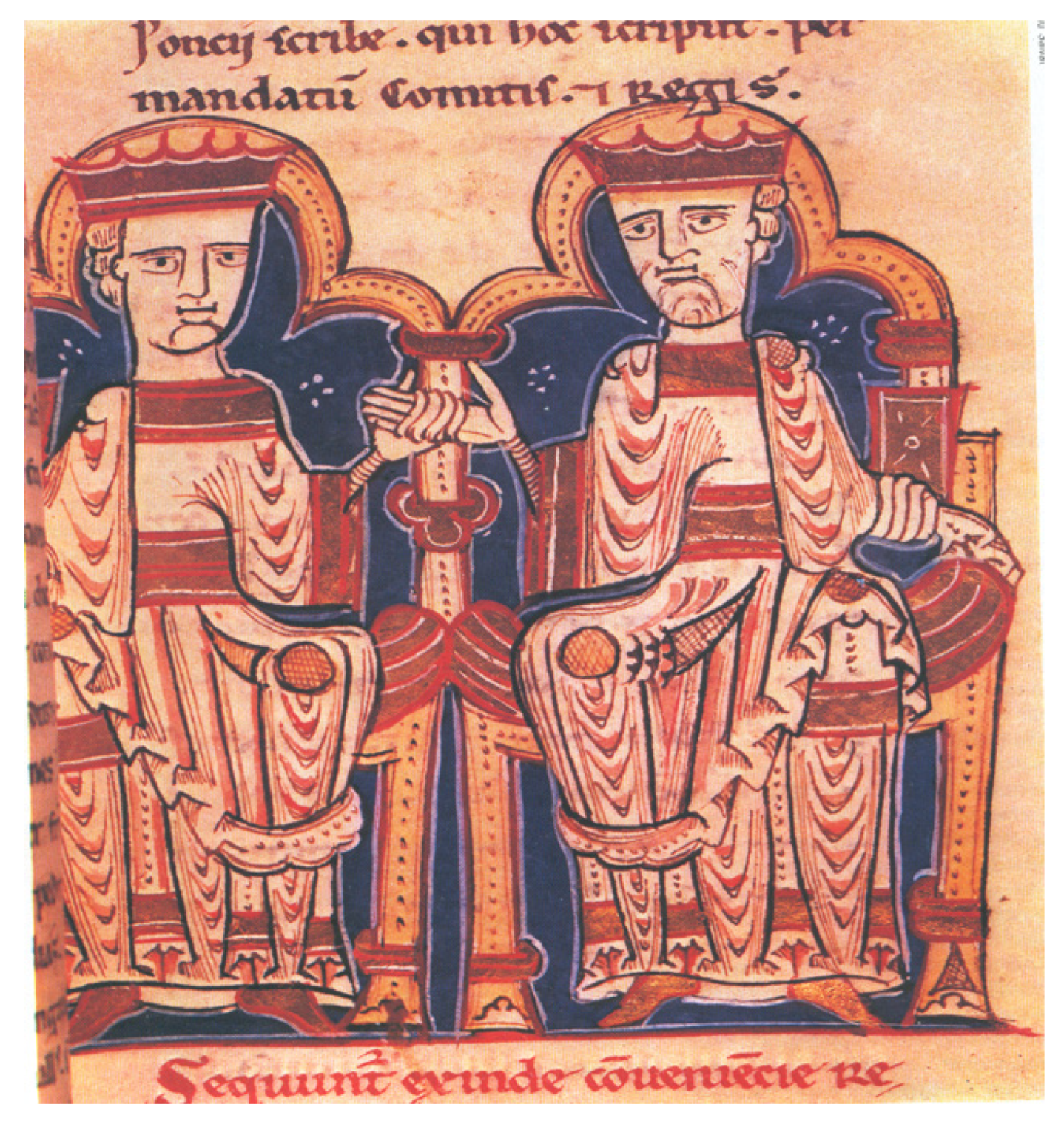
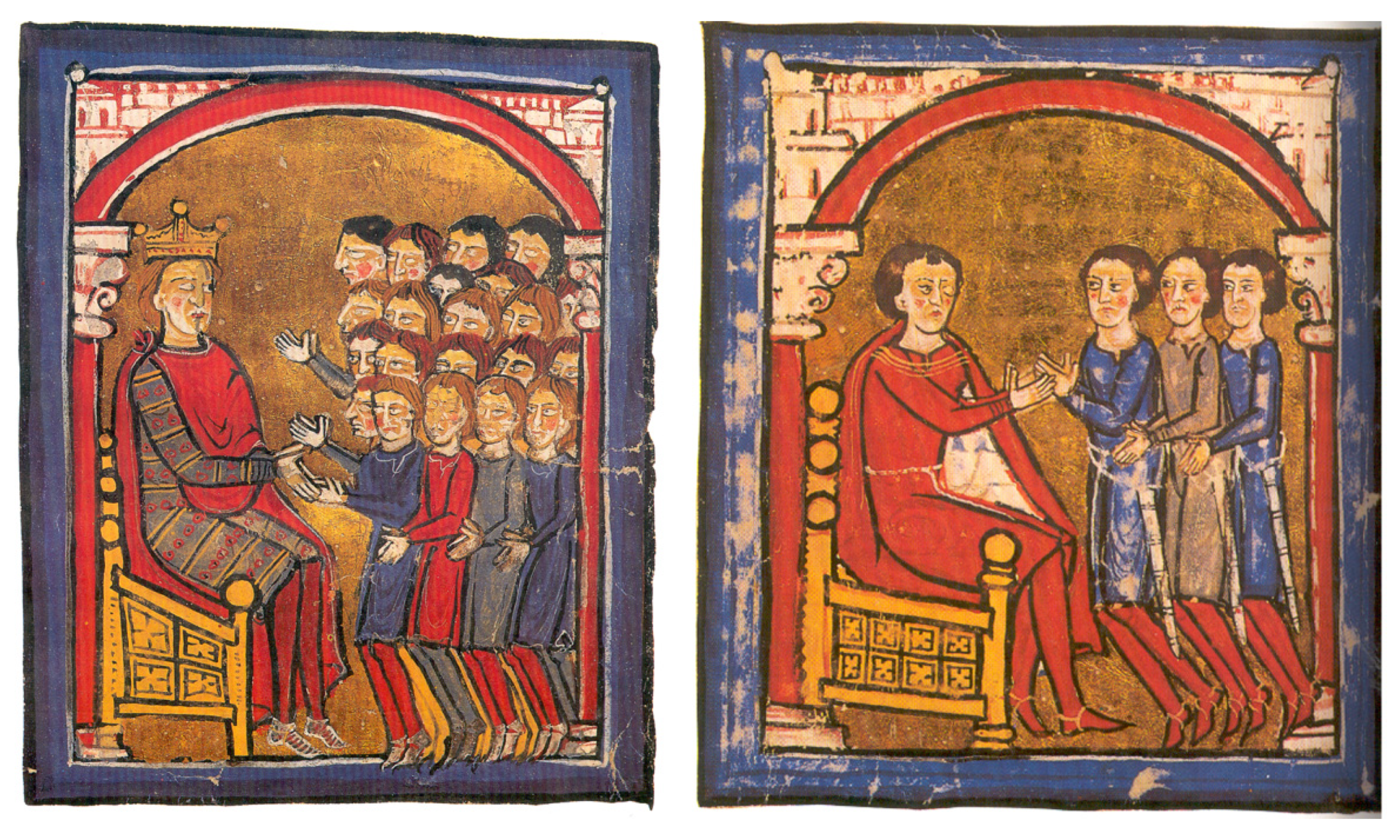
In 1164, Petronila made a de jure donation of the kingdom of Aragon (of which there is a miniature in the Liber Feudorum Maior) to her first son in an event of paramount importance for the kingdom of Aragon and for the county of Barcelona insofar as it united both political entities in a confederate system under the rule of the same sovereign, Alphonse II, nicknamed the Chaste or, because of his predilection for the arts, the Troubadour. For the first time, the count was also king, a legal combination that was resolved by giving pre-eminence to the royal title. Well aware of the relevance and significance of his person as the latest link in the royal chain, and in order to make visible the continuity of the regia stirps that he represented, he revived the name and, to great effect, the signum regis used by Alphonse I, the last and legendary de facto king of Aragon (about Alphonse II, see: [1,2,3,4,5,6]).

2. Appearance and Cultural Interests

After a minority of eleven years, the young king, whom the documents define as thoughtful and meticulous, reached the age of majority. At the age of 16 he was involved in two important ceremonies: his investiture as a knight and his marriage, the latter a matter of the first order for the interests of the dynasty. Although engaged to the Portuguese Infanta Mafalda, on 18 January 1174 he married the Infanta Sancha, sister and aunt of the kings of Leon and Castile respectively. Soon, the best Occitan and Catalan troubadours became part of life at court, where they were magnificently welcomed and influenced the king’s education. The fragments of songs and poems preserved, written by supporters and opponents of the king, present him as a man whose behaviour does not merit the nickname of chaste, with the only reason for such a title perhaps being that he was not known to have had any bastard children. Nevertheless, he did put his amorous skills into practice and recorded them in manuscripts that show a simple and clear style, typical of the trobar leu [7]. These compositions also reveal some of the physical features of the king, who is described as tall and slender and, by his opponents, as lazy, cowardly, impolite and disloyal or, by his supporters, as courteous, noble, benign, liberal and faithful.
He promoted various initiatives, many of them of a religious nature. He encouraged the military orders, supported the veneration of various saints (such as Saint Valerius and Saint Raymond), and commissioned buildings, such as the imposing cathedral of Tarragona and the Carthusian monastery of Scala Dei, the first of this order to be established in the Iberian Peninsula. He was buried in the monastery of Santa Maria de Poblet (Tarragona), where one of his sons was a monk and a member of the Cistercian Order, which Alphonse protected so well, turning the monastery into the repository of his body and his memory, and to which he bequeathed, among other possessions, his royal crown.

3. Iconography on Coins and Seals

3.1. Coins: Survival and Innovation

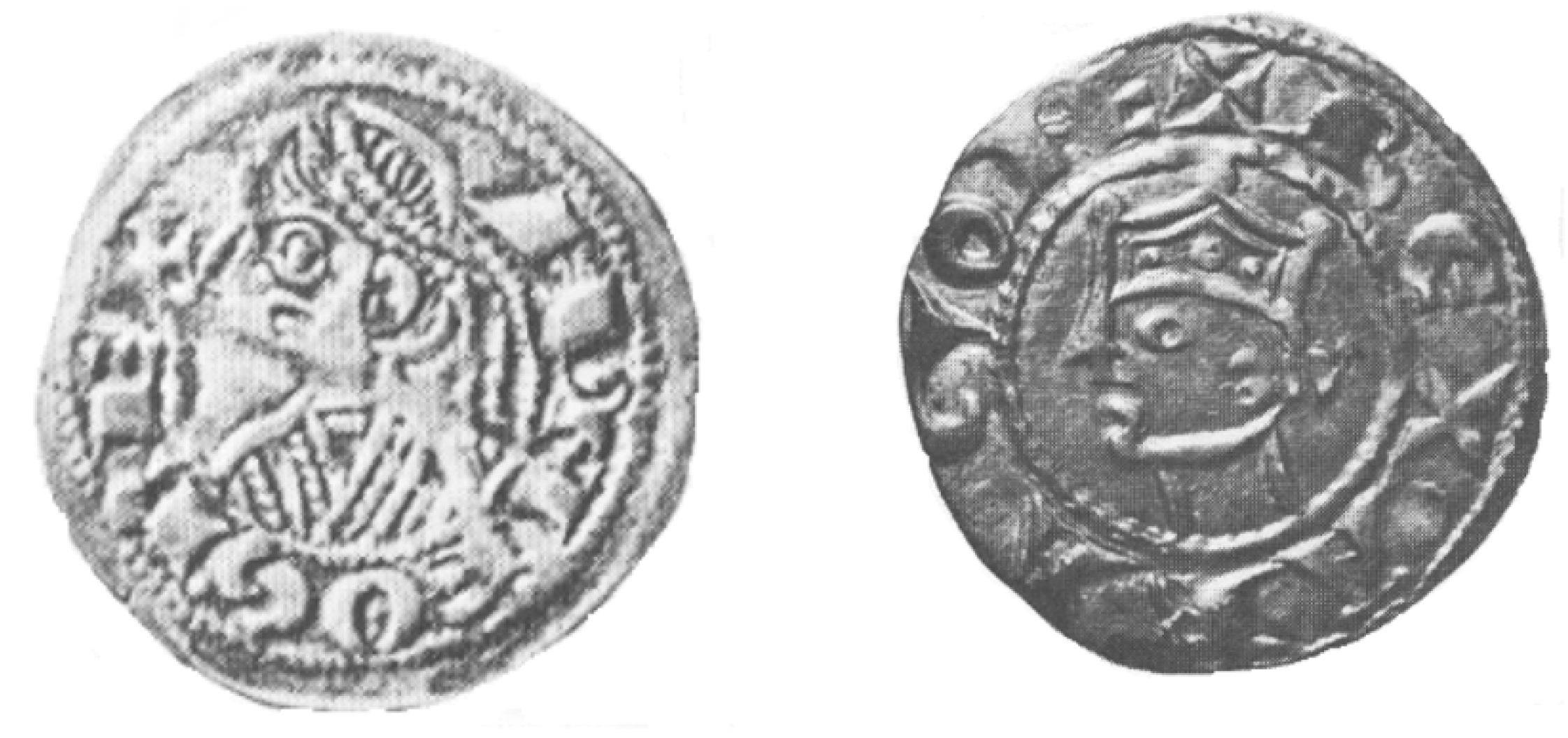
Alphonse II was the first to hold the title of King of Aragon and Count of Barcelona in his own right and began by quickly issuing low-grade coins that continued to feature the diademed profile bust/processional cross type. The fact that his dominion extended over different territories meant that his coinage diverged and increased at the same time as his territories expanded: he minted coins in Barcelona, Aragon and Provence, where he had defeated the Counts of Toulouse (Figure 1).
Figure 1. Dineros of Alphonse II. Aragon and Provence. Obverse. Published by Crusafont, Acuñaciones de la Corona Catalano-Aragonesa y de los reinos de Aragón y Navarra, Vico: Madrid, Spain, 1992, p. 211, nums. 141 and 139.
In 1186, he introduced a new type at the Marseilles mint for circulation in Provence known as the royal diner, the obverse of which showed a bust of the king in profile wearing, for the first time, a splendid crown. The innovation may be due to the fact that he wanted to mint his own iconography to replace the mitre, the only symbol on the obverse of the coin until then shared by the Count of Provence and the Archbishop of Arles: traditionally, the sovereign of Provence was depicted with the obverse legend REX ARAGONE, which surrounded the episcopal symbol of the mitre. On the reverse, a large cross was surrounded by PRO-VI-NC-IA [8]. This type, which remained unchanged until James I, was the profile bust, which was well known to Alphonse II as it had been used by him and his predecessors in the territories of kingdom, and was now supplemented with a crown, the insignia par excellence of the royal title of Aragon. Perhaps the choice was also due to his relations with his counterparts in Castile and Leon, who minted coins of the same type, perhaps having imported the custom from England [9].
Thus, both in Aragon and Provence, Alphonse is frequently seen with the type of bust in profile on the left, although in Aragon he wore a diadem and headdress with a topknot, as did Peter I and Alphonse I in some of their pieces [10] (and, for more on the hairstyle, see [11]), whereas in Provence he wore a crown richly decorated with precious stones and large pearls. Their reverses maintained the traditional regional types: in Aragon, a processional cross, and in the territories belonging to the Count of Barcelona, a large cross across the surface.

3.2. New Pendant Seal with Dual Entitlement

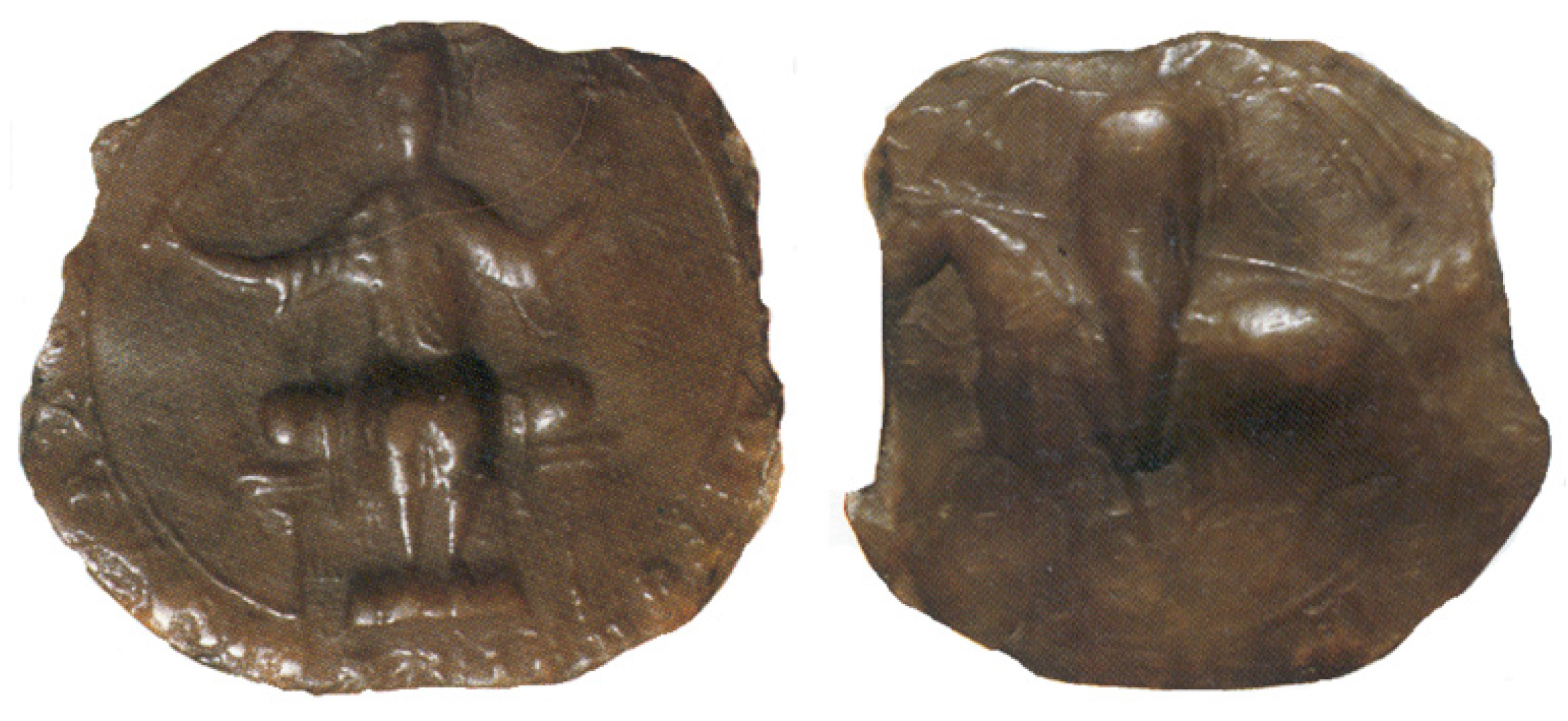
Alphonse II introduced the pendant seal with the king enthroned on the obverse and in equestrian pose on the reverse (Figure 2), a type that was to endure until Alphonse V (1416–1458), if we do not count the seal of Peter II in which the iconographies are inverted, although he absence of this typology with the names of Ferdinand I or Johan II does not mean that they did not issue them. On the obverse, framed by + SIGILLVM ILDEFONSI REGIS ARA...NENSIS, the king, on a throne and seated on one cushion and with his feet on another cushion, wears a short tunic covered by a cloak tied around his right shoulder, which is uncovered. He wears a crown with three fleurons, a lily on his left and a sword raised in his right hand. On the reverse, the equestrian image is surrounded by the lettering COMITIS BARCHINONENSIS MARCHIONIS ...VINCIE [12] and is similar to that of his father Ramon Berenguer IV, although he is now shown wearing lambrequins.
Figure 2. Wax seal of Alphonse II (no date). Obverse and reverse. Published by Reyes de Aragón; Centellas R. (coord.), Ed., p. 69.
The seal’s peculiarity with respect to those of the rest of the Peninsula is that its two faces offer different iconographies. It was a type already used by foreign kings, who had devised it to reflect their possession of more than one title, a reality personified by Alphonse II, king and count at the same time. William the Conqueror had used such a strategy in 1069 in order to demonstrate his own double title: on one side he was shown equestrian as Duke of Normandy and vassal of the King of France, and on the other he was shown on the throne as King of England [13]. Although Alphonse II may have benefitted from another almost contemporary and closer model with the same iconography, namely that of Louis VII the Younger (little used: see Dalas, M. Les sceaux royaux et princiers. Étude iconographique. In [13], pp. 49–337, n. 67, p. 147), the iconographic concomitances between the English and the Aragonese models suggest the influence of the former, which would be reinforced by the links between the Plantagenets and the Aragonese in the territories of southern France [14].

5. Images after His Reign

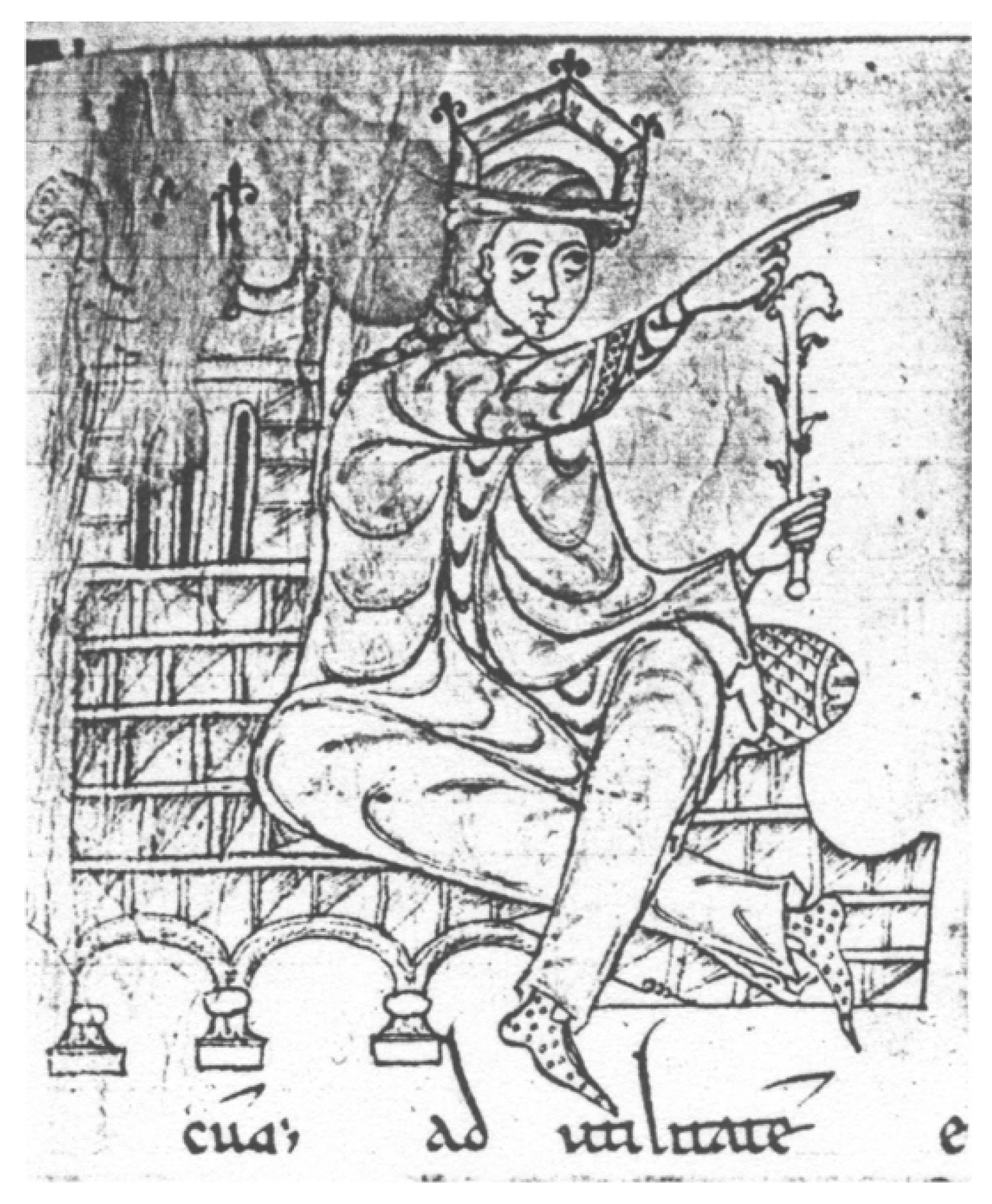
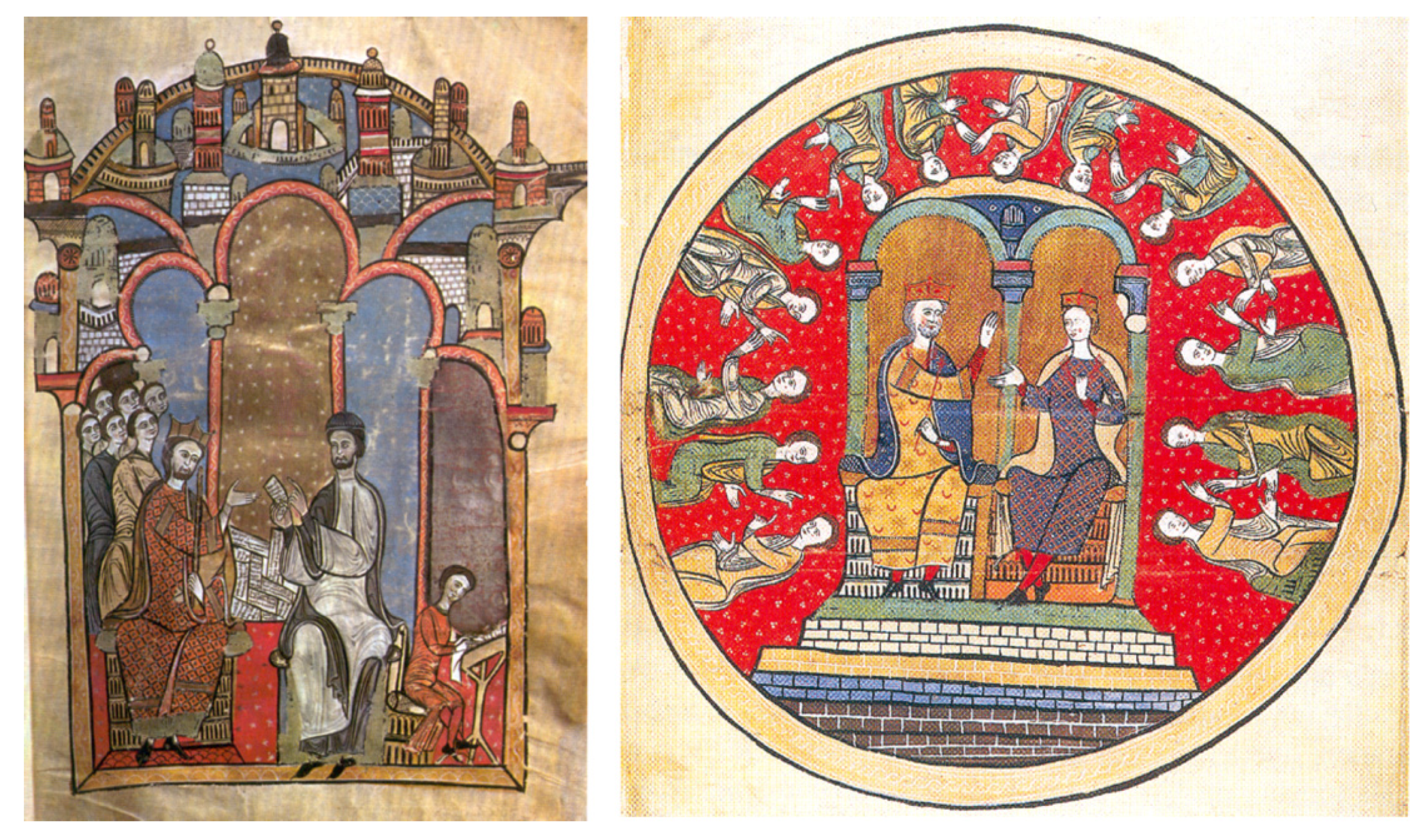
Other images of Alphonse II can be found throughout the Middle Ages in the Crown of Aragon, such as in the copies of the Fuero Latino de Teruel, from the mid-13th century and preserved in Biblioteca Nacional, Madrid, ms. 690, D-44 and Archivo Municipal, Teruel: see [11], pp. 135–137), which show images of the king as an author; some of the folios of the Usatges i constitucions de Catalunya from the Arxiu Municipal de la Paeria, in Lleida (ms. 1345) [31,32], dated to the 1320s, on whose fol. 25r the king presides over the Courts of Peace and Truce, or folio 75r, in one of whose initials he appears as author at the approval of the Courts of Monzón. He also appears in the Primer Llibre Verd, from around 1333–1343 (Arxiu Històric de la Ciutat, Barcelona, L.8) (see [23], p. 73, and [33]), whose fol. 88r shows his bust with formal French characteristics; in the Tercer Llibre Verd, from around 1342–1348 (Riera puts it back to 1343, see [34]), where the participation of Ferrer Bassa and his workshop or collaborators is evident [35,36,37,38], and on folio 49v which features an extraordinary scene of homage; in the Llibre de privilegis de Cervera (Arxiu Històric de la Ciutat, Cervera) which was decorated around 1360 and whose first numbered folio presents Alphonse II and James I as the promulgators of the laws they head [39]; and the well-known Rotlle genealògic de Poblet, before 1409, one of whose portrait miniatures features Alphonse II, the first offspring to emerge from the double portrait representing his primogenitors, Ramon Berenguer IV and Petronila (study of its illuminations in [40,41]). Of particular note in the field of sculpture is his recumbent (now restored) in the monastery of Poblet, commissioned around 1370 at the behest of Pedro IV. In reality, it was originally sculpted for the tomb of James I [42], which shows the scant value that was given to this type of portrait figure at the time, at least in the Crown of Aragon.

6. Conclusions

Alphonse II, aware of the reality he embodied in the same person as both the King of Aragon and the Count of Barcelona, initiated important changes in the way he was represented. Among the most significant, and linked to his dual status, he incorporated for the first time the binomial on his two-faced stamps that would be accepted by all his successors; that is, on the obverse he was the enthroned king, and on the reverse he was an equestrian figure, albeit with the horse concealed. As a result of his desire to reorganise his chancellery, he ordered the illustration of the exceptional Liber Feudorum Maior, whose folios demonstrate his potestas regia. He was no less innovative in his coinage, where he included the crown on his head for the first time, a measure that highlights the seeming lack of importance given to symbols of sovereignty in the kingdom of Aragon, at least until then. His wife, Sancha, also had an impact in terms of artistic patronage and royal iconography by founding the monastery of Sigena, which was to become a pantheon, and by preserving a possible bifacial wreath inspired by characteristic male models, thus expressing her relationship with power, a practice relatively frequent elsewhere in Europe but which was exceptional in the Iberian Peninsula.

Funding

This research was funded by Edificis i Escenaris religiosos medievals a la Corona d’Aragó, [2017 SGR 1724]. Generalitat de Catalunya-AGAUR.

Conflicts of Interest

The author declares no conflict of interest.

Entry Link on the Encyclopedia Platform

References

  1. Caruana, J. Itinerario de Alfonso II de Aragón. Estudios de Edad Media de la Corona de Aragón 1961, 7, 73–298. [Google Scholar]
  2. Lacarra, J.M. Alfonso II el Casto, rey de Aragón y Conde de Barcelona. In VII Congreso de Historia de la Corona de Aragón; Universitat de Barcelona: Barcelona, Spain, 1962; Volume I, pp. 95–120. [Google Scholar]
  3. Garballo, A.J. Alfonso II. In Los Reyes de Aragón; Centellas, R., Ed.; Caja de Ahorros de la Inmaculada: Zaragoza, Spain, 1993; pp. 67–72. [Google Scholar]
  4. Sánchez, A.I. Alfonso II Rey de Aragón, Conde de Barcelona y Marqués de Provenza. Documentos (1162–1196); Institución Fernando el Católico: Zaragoza, Spain, 1995. [Google Scholar]
  5. Ruiz, J.E. A propósito de Alfonso, rey de Aragón, conde de Barcelona y marqués de Provenza; Real Academia de Buenas Letras: Barcelona, Spain, 1996. [Google Scholar]
  6. Jenkins, E. The Mediterranean world of Alfonso II and Peter II of Aragon (1162–1213); AIAA: New York, NY, USA, 2012. [Google Scholar]
  7. Riquer, M. La poesia d’Alfons, dit el Cast. In VII Congreso de Historia de la Corona de Aragón; Institución Fernando el Católico: Zaragoza, Spain, 1963–1964; pp. 123–140. [Google Scholar]
  8. Engel, A.; Serrure, R. Traité de Numismatique du Moyen Age, 2nd ed.; Arnaldo Forni: Paris, France, 1890; Volume 2, p. 177. [Google Scholar]
  9. Mateu, F. Les relacions del Principat de Catalunya i els Regnes de València i Mallorca amb Anglaterra i el paral·lelisme monetari d’aquests països durant els segles XIII, XIV i XV; Societat Castellonenca de Cultura: Castelló, Spain, 1934; pp. 14, 51. [Google Scholar]
  10. Gil, O. Estudio crítico de las primitivas acuñaciones navarras y aragonesas. Numisma 1955, 31–96, 42. [Google Scholar]
  11. Serrano, M. Effigies Regis Aragonum. La imagen figurativa del rey de Aragón en la Edad Media; Institución Fernando el Católico: Zaragoza, Spain, 2015; p. 30. [Google Scholar]
  12. De Sagarra, F. Sigil·lografia catalana. Inventari, descripció i estudi dels segells de Catalunya; Estampa d’Henrich: Barcelona, Spain, 1916–1932; Volume I, num. 7; p. 201. [Google Scholar]
  13. Bautier, R.H. Échanges d’influences dans les chancelleries souveraines du Moyen Age d’après les types des sceaux de Majesté. In Chartes, sceaux et chancelleries. Études de diplomatique et de sigillographie médiévale; Droz: Paris, France, 1990; pp. 192–220, 575. [Google Scholar]
  14. Conde, R. Sello de plomo de Jaime I. In Cataluña Medieval; Lunwerg: Barcelona, Spain, 1992; p. 114. [Google Scholar]
  15. Durán, A. Colección diplomática de la catedral de Huesca; Instituto de Estudios Pirenaicos: Zaragoza, Spain, 1965; Volume 1, p. 299. [Google Scholar]
  16. Grabar, A. La iconoclastia bizantina. Dossier arqueológico; Akal: Madrid, Spain, 1998 (1994); p. 68. [Google Scholar]
  17. Serrano, M. La imagen como instrumento: El rey al servicio del códice, el códice al servicio del rey. In Libros con arte, arte con libros; Universidad de Extremadura: Cáceres, Spain, 2007; pp. 659–667. [Google Scholar]
  18. Mundó, M. El pacte de Cazorla del 1197 i el Liber Feudorum Maior. Notes paleogràfiques i diplomàtiques. In X Congreso de Historia de la Corona de Aragón; Institución Fernando el Católico: Zaragoza, Spain, 1980; pp. 123–126. [Google Scholar]
  19. Ibarburu, M.E. Los cartularios reales del Archivo de la Corona de Aragón. Lambard 1994, 6, 198. [Google Scholar]
  20. Ibarburu, M.E. De capitibus litterarum et aliis figuris; Universitat de Barcelona: Barcelona, Spain, 1999; p. 348. [Google Scholar]
  21. Kosto, A.J. The Liber Feudorum Maior of the counts of Barcelona: The cartulary as an expression of power. J. Mediev. Hist. 2001, 27, 2. [Google Scholar] [CrossRef]
  22. Wearing, S. The death of the patron: Agency, style and the making of the Liber Feudorum Maior of Barcelona. In Romanesque Patrons and Processes; Camps, J., Castiñeiras, M., McNeill, J., Plant, R., Eds.; Routledge: London, UK, 2018; pp. 327–336. [Google Scholar]
  23. Bohigas, P. La ilustración y la decoración del libro manuscrito en Cataluña. Contribución al estudio de la miniatura catalana; Asociación de Bibliófilos: Barcelona, Spain, 1960; pp. 102–103. [Google Scholar]
  24. Garnier, F. Le langage de l’image au Moyen Age. Signification et symbolique, 2nd ed.; Léopard d’Or: Paris, France, 1982; p. 174. [Google Scholar]
  25. Martínez, J.E. Baixa Edat Mitjana. S. XII.-XV. In Història dels Catalans, 2nd ed.; Soldevila, F., Ed.; Ariel: Barcelona, Spain, 1970; p. 1006. [Google Scholar]
  26. Alcoy, R. Ilustrador de la Pasión o Maestro de la Pasión. Viga de la Pasión. In Prefiguración del Museu Nacional d’Art de Catalunya; Barral, X., Ed.; Museu Nacional d’Art de Catalunya and Lunwerg: Barcelona, Spain, 1992; pp. 168–171. [Google Scholar]
  27. Yarza, J. Arte y Arquitectura en España. 500–1250, 7th ed.; Cátedra: Madrid, Spain, 1994; p. 307. [Google Scholar]
  28. Martínez, J.E. Hallazgo de miniaturas románicas en el Archivo de la Corona de Aragón; Asociación de Bibliófilos: Barcelona, Spain, 1944; p. 5. [Google Scholar]
  29. Fernández Pozzo, S. The king’s dashing attire at the turn of the thirteenth century. Alfonso II and Pedro II of the Crown of Aragón in the Liber Feudorum Maior and Liber Feudorum Ceritaniae. In The Ruler’s Image and Its Multiple Functions in the Medieval Mediterranean; Bacci., M., Studer-Karlen, M., Vagnoni, M., Eds.; in press.
  30. Kauffmann, C.M. Romanesque manuscripts. 1066–1190. A survey of manuscripts illuminated in the British Isles; Harvey Miller: London, England, 1975; num. 34, figs. 79–83 and 90. [Google Scholar]
  31. Coll, G. Els Usatges de la catedral de Lleida: Un manuscrit il·luminat autòcton de la pròpia Seu datat entre 1333 i 1336. In La Seu Vella de Lleida. La catedral, els promotors, els artistes, s. XII a s. XV; Generalitat de Catalunya: Barcelona, Spain, 1991; pp. 147–152. [Google Scholar]
  32. Alcoy, R. La il·lustració de manuscrits a Catalunya. In Ars Cataloniae, Art de Catalunya; Barral, X., Ed.; L’Isard: Barcelona, Spain, 2000; Volume I, p. 72. [Google Scholar]
  33. Coll, G. Manuscrits jurídics i il·luminació. Estudi d’alguns còdex dels usatges i constitucions de Catalunya i del decret de Gracià; Abadia de Montserrat: Barcelona, Spain, 1995; p. 225. [Google Scholar]
  34. Riera, S. Les fonts municipals del període 1249–1714. Guia d’investigació. Quaderns d’Història 2000, 4, 239–271. [Google Scholar]
  35. Alcoy, R. La introducció i derivacions de l’italianisme a la pintura gòtica catalana. 1325–1350 (PhD); Universitat de Barcelona: Barcelona, Spain, 1988; pp. 552–553. [Google Scholar]
  36. Escandell, I. Llibre Verd. In Cataluña medieval; Lunwerg: Barcelona, Spain, 1992; p. 304. [Google Scholar]
  37. Coll, G. El “Decretum Gratiani” de la British Library. Lambard 1991–1993, 278–290, 284. [Google Scholar]
  38. Yarza, J. La il·lustració. In El Primer volum del Llibre Verd de Barcelona; Base: Barcelona, Spain, 2005; pp. 141–156. [Google Scholar]
  39. Llibre de Privilegis de Cervera. 1182–1456; Turull, M. (Ed.) Noguera: Barcelona, Spain, 1991. [Google Scholar]
  40. Planas, J. El esplendor del gótico catalán. La miniatura a comienzos del siglo XV; Universitat de Lleida: Lleida, Spain, 1998; p. 192. [Google Scholar]
  41. Gimeno, F.; Serra, A. Representar la dinastía: El manuscrito genealógico del monasterio de Poblet. In Genealogia dels Comtes de Barcelona i Reis d’Aragó; Patrimonio: Valencia, Spain, 1997. [Google Scholar]
  42. Marés, F. Las tumbas reales de los monarcas de Cataluña y Aragón del monasterio de Santa María de Poblet; Asociación de Bibliófilos: Barcelona, Spain, 1952; doc. 35; pp. 183–185. [Google Scholar]
Publisher’s Note: MDPI stays neutral with regard to jurisdictional claims in published maps and institutional affiliations.

Article Metrics

Citations

Article Access Statistics

Multiple requests from the same IP address are counted as one view.