
Article

Sdr as a Key Roughness Parameter for Monitoring the Temporal Stability of Measuring Instruments: Short- and Extended-Time Uncertainties

by
Clément Moreau
1,2,
Julie Lemesle
3,
François Berkmans
1,4,5,
David Páez Margarit
6,
Thomas Carlier
7,
François Blateyron
2 and
Maxence Bigerelle
1,*
1
Univ. Polytechnique Hauts-de-France, CNRS UMR 8201—LAMIH—Laboratoire d’Automatique, de Mécanique et d’Informatique Industrielles et Humaines, F-59313 Valenciennes, France
2
Digital Surf, 25000 Besançon, France
3
Valutec, Univ. Polytechnique Hauts-de-France, 59314 Valenciennes Cedex 9, France
4
Institute of Mechanical Technology, Poznan University of Technology, Plac Marii Sklodowskiej-Curie 5, 60-965 Poznan, Poland
5
Univ. Polytechnique Hauts-de-France, INSA Hauts-de-France, LARSH—Laboratoire de Recherche Sociétés & Humanites, F-59313 Valenciennes, France
6
Sensofar Metrology, 08225 Terrassa, Barcelona, Spain
7
Bruker Nano Surfaces and Metrology, 91120 Palaiseau, France
*
Author to whom correspondence should be addressed.
Metrology 2026, 6(1), 10; https://doi.org/10.3390/metrology6010010
Submission received: 19 November 2025 / Revised: 16 January 2026 / Accepted: 26 January 2026 / Published: 9 February 2026

Abstract

This study investigates two measurement campaigns: extended time and short time, to determine the stability of roughness measurements, focusing on the Sdr parameter. Extended-time measurements were conducted using the most sensitive instrument available to follow metrological fluctuations. The results revealed that Sdr exhibits the clearest trend and the highest dispersion among all roughness parameters, making it the most relevant indicator for tracking temporal deviations. Other parameters, such as Sa, Sq, and Sds, also emerged as potential candidates. These results were validated through a stability analysis (SI), showing that Sdr is the worst stable roughness parameter. To ensure the robustness of the findings and be closer to the real conditions, a short-time assessment was performed using a dedicated measurement plan performed on multiple instruments. The results confirmed that measurement fluctuations are instrument-dependent, but similar results are found across the same technologies (CSI(S) and CSI(B)). The short-time study included a quality inspection, a drift/stability analysis employing AR (2) models on the time series data systematically and a relevance measurement assessment using ANOVA. The study was conducted using a full-scale roughness analysis and could potentially be applied to a multiscale approach. These findings highlight the ability of Sdr to monitor metrological fluctuation during a long-time acquisition and according to a dedicated measurement plan.

1. Introduction

1.1. On Surface Topography

Surface metrology is a specialized branch of metrology dedicated to the characterization and quantification of surface micro-geometry. It plays a crucial role in understanding the physical properties of surfaces, such as roughness, texture, waviness, and form, which are critical in a wide range of industrial applications, from manufacturing to material science. Quality control, manufacturing monitoring, and research investigations are particularly concerned with the field of surface metrology. It is crucial to determine how generated surfaces will interact with their environment from a physicochemical perspective, including factors such as wear from other surfaces and mechanical stresses. These interactions can significantly influence the reliability and performance of the final manufactured product [1,2].
Surface metrology focuses solely on surface texture and does not address larger scales, such as the overall nominal shape of the object. For this reason, this discipline employs specific technical methods to collect 3D surface topographies, analyze them with dedicated software, and derive results as roughness parameters and statistical analyses. Since the micro-geometry of surfaces is linked to one or more functionalities, metrologists have developed a classification based on the visual appearance of surfaces [3]. Thus, we have structured surfaces [4,5] with a deterministic pattern, which can, for example, provide surfaces with hydrophobic properties [6,7]. In this paper, the term areal surface texture is used in accordance with ISO 25178 [8] to designate the standardized characterization of surface features through areal parameters. The expression 3D topographic measurement refers solely to the data acquisition process itself, i.e., the capture of an areal height field. This distinction is essential: performing a 3D measurement does not automatically provide a standardized set of areal texture parameters, as proper filtering, calibration, and parameter computation are required to comply with ISO standards. But, most surfaces studied are considered rough surfaces, and their micro-geometry can be described in a quantitative way using parameters [8,9,10,11] (i.e., ISO and ASME). As introduced below, surfaces are generated by a multitude of manufacturing processes, such as EDM (electrical discharge machining), sandblasting, and shot peening, among others [12]. It is also possible to choose the right parameter [13,14] to characterize a manufacturing process according to its setting parameters or to follow its time evolutions [15].
To calculate these parameters, it is essential to obtain a surface topography represented by a height point map, measured using a dedicated 3D profilometer. The choice of measurement depends on what needs to be observed and on what scale, as certain phenomena are only visible at specific scales. Historically, 2D methods dominated until the 1980s [16], but 3D profilometers have gained prominence over the past decade due to their significant advantages, such as speed and areal measurement capabilities. Most engineering surface interactions, especially those involving contact phenomena, are inherently areal. As a result, the data needed to accurately describe their behavior must also be areal.

1.2. About Uncertainties

The transition from 2D to 3D brought about a paradigm shift in the field of surface metrology research, and the issues related to measurement uncertainties also evolved [17]. It is noteworthy that while 3D profilometers offer several advantages over their 2D counterparts, they rely on more complex technologies and their uncertainties are less well-controlled [18]. The VIM III [19] defines uncertainty as a non-negative parameter that characterizes the dispersion of values attributed to a measurand. Simply put, the true value of the measurand lies within a range defined by this uncertainty parameter. When selecting a 3D measurement instrument, its ability to accurately measure a given surface topography must be considered. This includes factors such as acquisition technology, lateral and vertical resolution, numerical aperture, magnification, and the associated field of view (FOV). This non-exhaustive list comprises uncertainty parameters as shown in [20]. These characteristics can be summarized by the instrument’s bandwidth capacity, referred to as the transfer function [21], which can also be considered an uncertainty parameter.
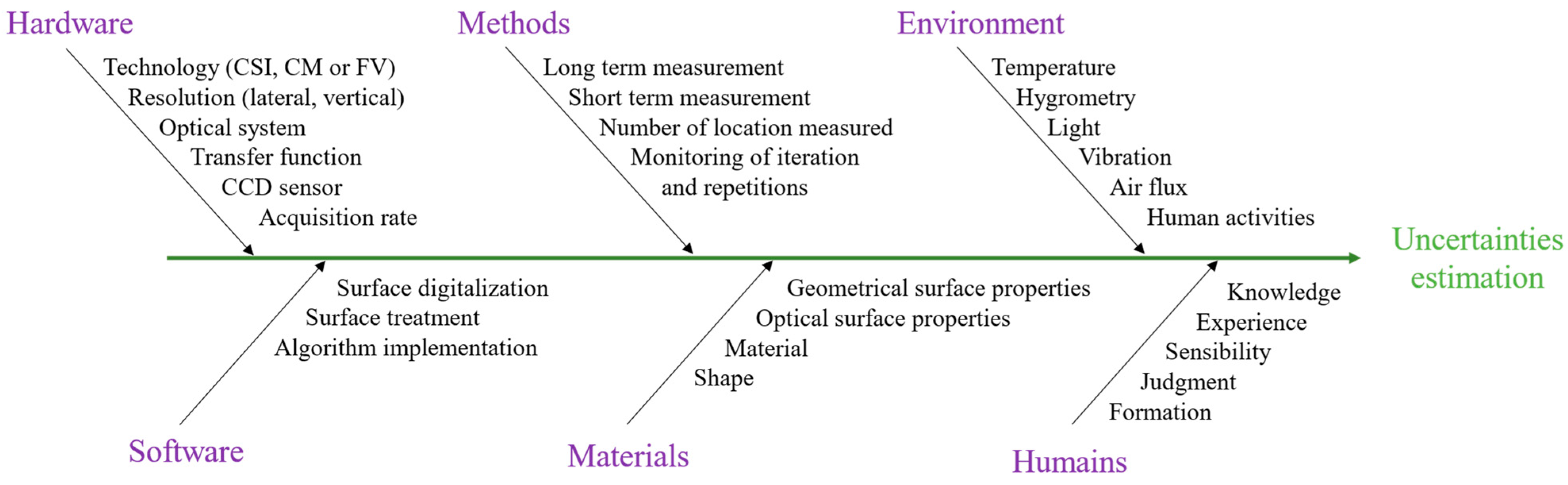
However, instruments can be sensitive to external factors, such as environmental variations (thermal, humidity, or light changes), which can introduce measurement fluctuations, another source of uncertainty, as shown in Figure 1. To follow these deviations, regular calibration of the device is essential, as outlined in [22,23,24]. Data processing can also be a source of uncertainty, due to the implementation of parameter calculation and analysis methods in the treatment software. Incorrect application of filters or improper data processing can lead to misinterpretation of rough surface topographies in the software. Therefore, the signal-processing strategy must be carefully tailored to the study field and the type of surface being measured, and it should remain consistent throughout the study.
Based on previous observations, it is essential to develop a robust methodology for determining measurement uncertainties. In the literature, many studies focus on fluctuations in height maps. Given that uncertainty determination is a critical challenge, various methodologies have emerged, each requiring a rigorous approach. The most democratized methods, as explained in GUM Supplement 1 [25], provide a standardized perspective, focusing on the propagation of uncertainties and mainly supported by A-type uncertainties. This principle acknowledges that the measurand is affected by several external factors [19] called parameters, each contributing its own uncertainty to the final measurand. The measurement noise is one of these parameters, and an uncertainty can be computed in two ways: the direct method or the Monte Carlo noise simulation [26]. The direct method consists of directly measuring the noise from a dataset of surfaces, and the Monte Carlo method uses the simulation of noise according to the magnitude order of the standard deviation of noise present on the surface. But, the direct method takes the hypothesis that X,Y surface displacements are sufficiently low to follow Z fluctuations, and the Monte Carlo method takes the hypothesis that uncertainties are homogeneous, whatever the map’s height or even the surface local gradients [27]. It is known in the literature that this is debatable and open to question. Other methods exist, such as the indirect method, including B- and C-type uncertainties, but they are not used in the field of surface topographies.
In essence, the characterization methods of uncertainties described below are possible only if a metrological framework is applied as instrument calibration, environment control, monitoring specimen drifts, and temporal deviation. In addition, a strong hypothesis is often taken because each uncertainty parameter (i.e., factor) cannot be distinguished directly. For these reasons, it is necessary to change the method of observation and adopt a holistic point of view. Global descriptors, such as roughness parameters, are suitable and allow us to determine uncertainties using a new approach. Roughness parameters are well-known, interpretable tools for metrologists, making it relevant to consider measuring variability based on these parameters. Since the parameters describe different features to best understand the surface microgeometry, it is necessary to have a holistic parameter that considers both height differences and point spacing. The candidate parameter for this is Sdr from the ISO 25178 standard. A study on measurement variabilities based on the Sa parameter has already been conducted [28]. However, the Sa parameter could be good, but it averages the total roughness of the surface, which can be difficult to interpret and lacks sensitivity to complexity.
In this paper, the objective is not to adopt a conventional approach to measurement uncertainty based on the norms, even if these approaches are fundamental in the metrology field. Traditional methods often rely on generic models or idealized experimental conditions, which are difficult to generalize across different instruments or surface types. However, in the field of surface topography, each experimental configuration exhibits specific behaviors. Therefore, uncertainty must be addressed in a contextual manner, through a case-by-case analysis that accounts for the particularities of the measurement system and the nature of the analyzed surfaces.

2. Material and Method

2.1. Surface Generation Process

The TA6V material was selected for its intrinsic properties, such as non-oxidation and biocompatibility, making it suitable for use in the aeronautic and medical fields. These properties ensure the preservation of the surface during the study. The specimens were produced through a dedicated machining process. Initially, a diamond disc was employed to cut rods with a thickness of 10 mm and a diameter of 30 mm. This cutting process induces residual stress on the surface of the specimens, necessitating a preliminary rounding step using FEPA #320 Silicon Carbide (SiC) paper to create a clean base for subsequent polishing. Next, a progressive polishing procedure was carried out, starting with SiC paper grit #080 and advancing to #1200, to establish a uniform base across all specimens. During each polishing stage, the SiC paper was applied for 2 min at a rotational speed of 300 rpm, with a force of 30 N exerted on the specimens. To achieve the desired grit-level surfaces, #080 and #120 SiC paper were used for 15 min at 300 rpm with water lubrication.

2.2. Measurement Instruments

The measurements were performed on two devices: Bruker ContourGT® (San Jose, CA, USA) and Sensofar® Sneox™ (Barcelona, Spain). The ContourGT® device is an interferometer used with a vertical scanning interferometer mode, called in this study CSI(B), and the Sneox™, including three different measurement modes: an interferometer, a confocal microscope, and a focus variation, respectively, called CSI(S), CM(S), and FV(S). The instrument’s principles and the settings used to carry out the measurements are available in Appendix A.

2.3. Measurement Strategy

Our objective is to observe variations over a medium-term period rather than sporadically each day or week over the course of a year. It is indeed necessary, as a first step, to analyse the medium-term and continuous evolution of the measurements in order to understand the fluctuations, before moving on to a systematic and regular long-term study.
The adopted approach includes a dual vision of measurement fluctuation observation: short-time and extended-time strategies. The fluctuations are described through the computed roughness parameters and not directly on the map’s heights. The short-time strategy uses a specific measurement plan, allowing us to take into account the surface representativeness through different measured zones and the measurement deviation at a given position thanks to an iterative cycle. This strategy is coupled with statistical indices describing the quality, drift, stability, and relevance of measurements. The second strategy, extended time, is performed on several days on several instruments. A cycled measurement is performed at a given position on a defined specimen.

2.3.1. The Extended-Time Strategy

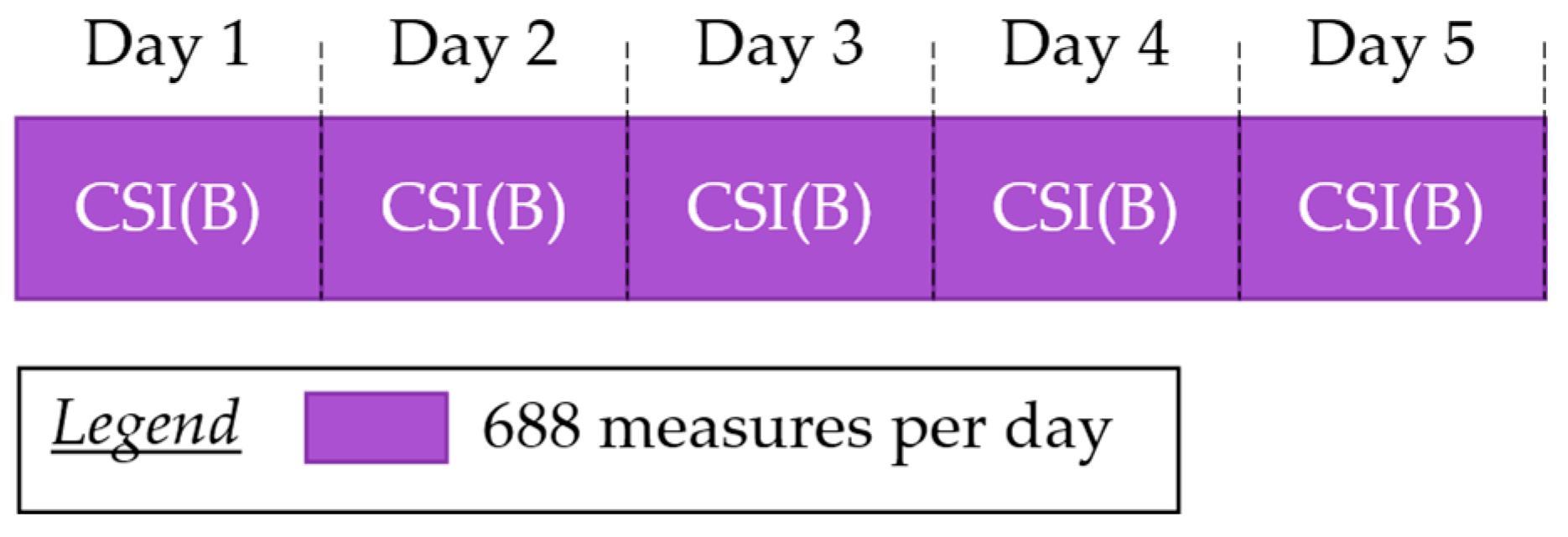
Extended-time measurements are only performed with Bruker ContourGT® over 5 days (Figure 2) on only one zone of the #120 surface. The same settings as those used for short-time measurements are applied in this measurement campaign. Regarding file encoding, particularly for repetitions and iterations, each acquisition day is defined as a given repetition, while successive measurements performed on the same day are defined as iterations. In summary, 688 measurements are performed each day over 5 days, giving a total of 3440 measurements. Unlike the short-time strategy, here the repetition does not represent a change in position but rather a change in day.

2.3.2. The Short-Time Strategy

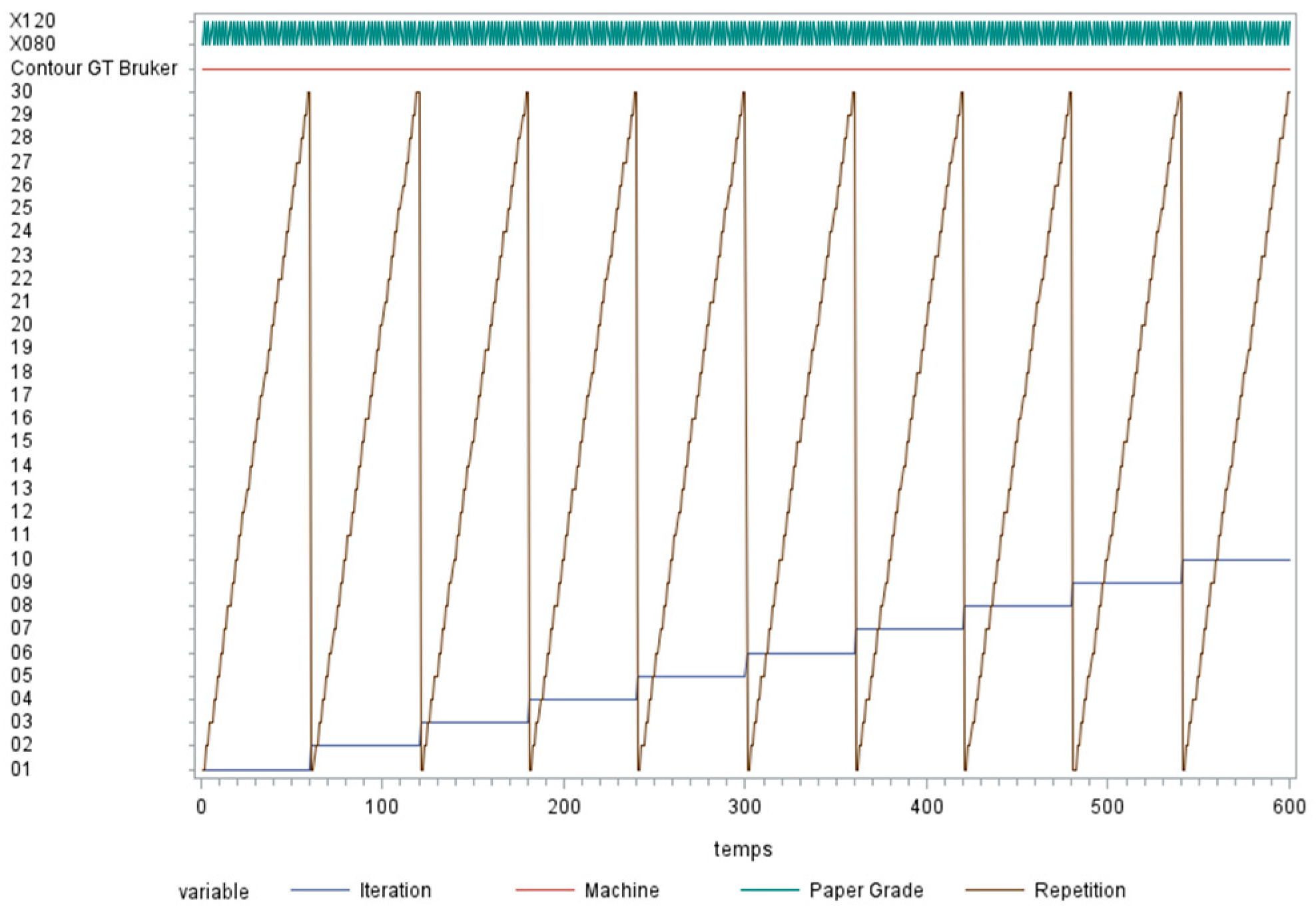
The measurement strategy associated with the short time, presented in Figure 3, has already been described in precedent paper [28]. As introduced below, this measurement plan is composed of iterations (blue line) and repetitions (brown line), i.e., at given positions, performed regarding a specific order and reproduced for each instrument (red line) in the following order: CSI(S), CM(S), FV(S), and CSI(B). The measurement plan includes a grit-level alteration (green line) at each measurement (30 repetitions per specimen). After all repetitions are carried out, a new cycle is started, allowing us to perform 10 cycles of 30 zones per specimen. In total, the measurement contains a set of 600 measurements (10 iterations, 30 repetitions, and 2 grits) carried out with 4 instruments.
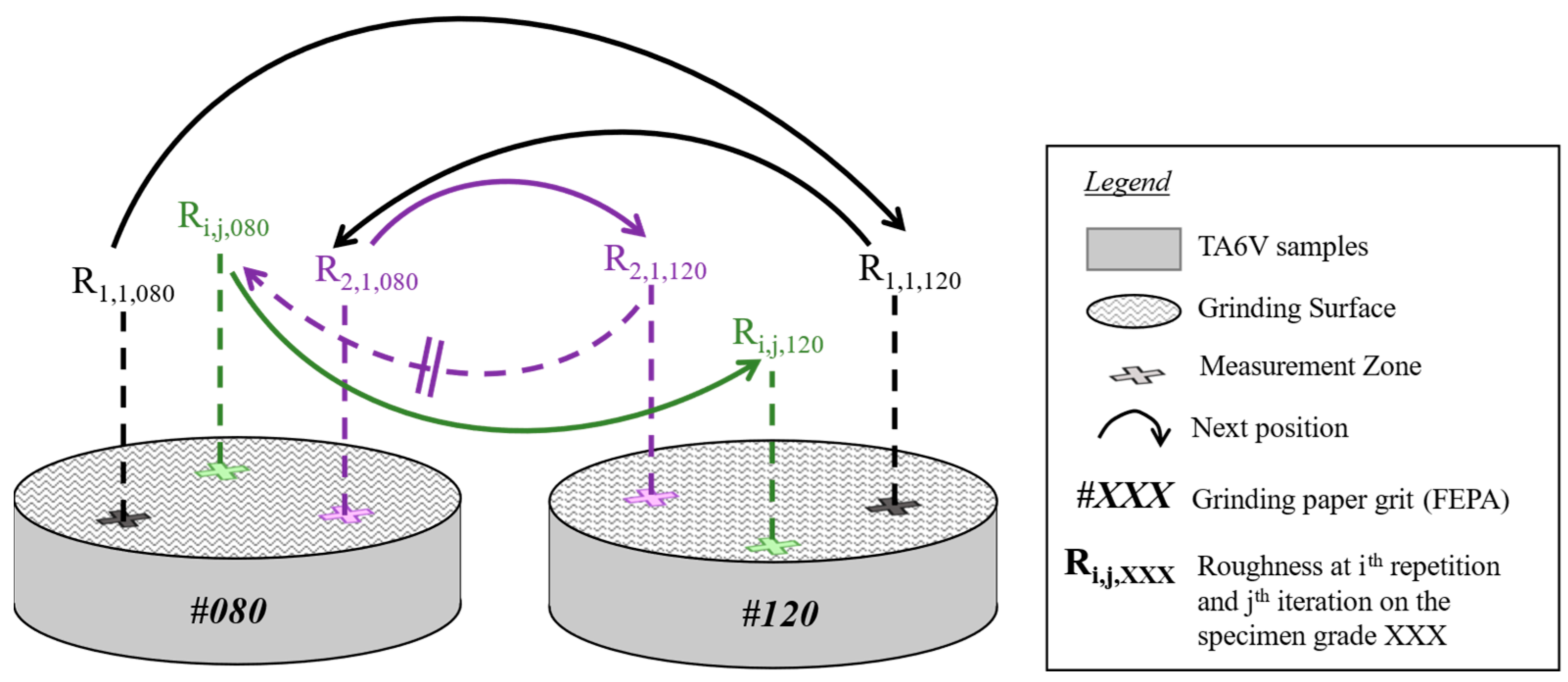
Figure 4 shows one iteration cycle corresponding to the strategy described in Figure 3. It could be noted that the measurement specimens and measurement area are the same between the ContourGT® and Sneox™ devices.
The measurement process starts with the #080 specimen at the first position, then proceeds to the #120 specimen at the same position. Measurements then return to the #080 specimen at the second position, and this sequence continues until all 30 positions have been measured, completing 10 iteration cycles.

2.4. Method

In this paper, two perspectives are investigated: short-time and extended-time analysis. In the extended-time case, we aim to identify the roughness parameter capable of tracking temporal drifts, using measurements exclusively on Bruker ContourGT®. In the short-time case, with the “Morphomeca monitoring” strategy, we apply and validate the identified parameter to characterize temporal fluctuations across all measuring instruments, including a more complete measurement plan.
As presented above, the extended-time campaign is conducted first to determine the most suitable parameter for monitoring metrological fluctuations. Our hypothesis is that if a given roughness parameter effectively describes fluctuations during extended-time measurements, it would also be a good candidate for short-time measurements. A large panel of roughness parameters (height, hybrid, functional, and feature roughness parameters) is used to assess surface topographies. The roughness parameters are computed on unfiltered surfaces, with only a first-order form removed.
It is observed that extended-time and short-time measurements differ significantly. The extended-time analysis was designed to isolate pure noise by maintaining constant acquisition at a single location on the specimen, using the same settings, without table movements, and under stable environmental conditions. In contrast, the short-time analysis aims to simulate real measurement conditions, examining noise in relation to topographical fluctuations, identifying correlations and trends over iterations, and assessing the relevance of the roughness parameter when applied to measurements on neighboring surfaces.
In our previous work, we proposed an approach to determine the most suitable roughness parameter based on quality criteria [29]. To follow this approach of identifying the best roughness parameter based on the uncertainties studied, we aim to identify the best parameter for describing metrological fluctuations based on the stability of measurements. The stability index (SI), the key index in this paper, is used for this purpose because it is sensitive to time-dependent trends arising from surface topography variations at a given position, as defined in [28]. By comparing the stability index (SI) values of different roughness parameters from extended-time acquisitions, we aim to identify the parameter that most accurately follows temporal fluctuations, i.e., the parameter best suited to capture metrological variations. This parameter is then used for the short-time analysis.

2.5. Index Definitions

Table 1 presents the entire list of indices used in the results analysis. This description includes the name, equations, description, and key threshold of the indices. If more details are required, a full description is available in Appendix B.

2.6. Applicability of the Indices

In the case of the short-time measurement strategy, all indices can be computed because the dataset includes repetitions (measurements at different positions), iterations (successive measurements at the same position), and two specimens (intra- and 29inter-group variance). This strategy allows for a comprehensive analysis of both spatial and temporal sources of variability. In contrast, for the extended-time measurement campaign, the experimental design is more focused: measurements are performed repeatedly at a single fixed position over several days. As a result, only the standard deviation of the roughness parameter within the iterative measurements (reflecting repeatability in the iteration series) and the stability index (describing temporal evolution in the iteration series) can be evaluated. This distinction highlights the complementary nature of both measurement strategies: the short-time approach provides a complete view of measurement variability, while the extended-time campaign focuses on long-term temporal stability.

3. Results

3.1. Extended Time

It is certainly asked why the extended-time measurement results are presented first. This strategy is employed to highlight measurement fluctuations over several days, thereby identifying the roughness parameter that best captures temporal deviations. Similar to the short-time strategy (Morphomeca monitoring), the extended-time approach includes the following indices: the intra-position standard deviation (Intra-StD, σintra) and stability index (SI). However, it does not include the inter-position standard deviation, quality index (QI), drift index (DI), or relevance index (RI). The inter-position standard deviation (Inter-StD, σinter) cannot be computed because measurements are taken at the same position on the specimens. Consequently, since QI is derived from Inter-StD, it cannot be computed either. Additionally, as no true repetitions are performed, DI cannot be determined. The extended-time measurement campaign involves only one surface grit (#120), making it impossible to compute RI. Therefore, this analysis is carried out exclusively on Bruker ContourGT® and the grit #120 specimen.

3.1.1. Long-Time Raw Results

The raw values of roughness parameters computed from the surfaces acquired during the extended-time measurement campaign are plotted over time. Initially, these parameters are classified without statistical indicators to identify the most suitable parameter for monitoring metrological fluctuations. Parameters are categorized based on their trend and dispersion, as summarized in Table 2. Further details are provided in Appendix C regarding roughness parameter definitions (focus on Sdr) and Appendix D, where all timestamps of roughness parameters are plotted.
The analysis indicates that Sdr is the most suitable parameter for tracking metrological fluctuations, as it exhibits the clearest trend along with significant dispersion. Visual inspection further suggests that Sa, Sq, and Sds may also be good candidates to follow metrological fluctuations. But, the analysis of all graphs is complicated and requires finding a method to highlight an indicator, or more precisely, an index to find Sdr, which is a key parameter.
Among the hybrid areal parameters defined in ISO 25178 [8], the developed interfacial area ratio (Sdr) plays a distinctive role because it involves the numerical differentiation of the measured height field. As a result, Sdr is inherently sensitive to the amplification of high-frequency noise and to variations in lateral sampling and filtering. Whitehouse and Leach [2,30] have emphasized that derivative-based parameters are highly affected using bandwidth selection and by the propagation of measurement uncertainty through the differentiation process. Giusca and Leach [31] also highlight the importance of calibration and scale resolution in the computation of areal parameters like Sdr, showing that both filtering and instrument resolution strongly influence measurement repeatability. Jiang and Whitehouse [3] underline that technological shifts in surface metrology have made these sensitivity considerations even more critical with modern 3D profilometers. This sensitivity, often considered a limitation in functional surface characterization, can conversely be exploited as a diagnostic tool for instrument stability. Indeed, any subtle drift in focus, calibration, or vibration during acquisition may alter local slope distributions and thus modify Sdr, even when height-based parameters remain unchanged. Recent work by Berkmans et al. [15] has highlighted the relevance of Sdr in comparison with a fractal-based approach, the Richardson Patchwork method, for characterizing complex surfaces such as sandblasted TA6V. The study shows that both methods yield similar estimates of the developed surface area across multiple scales, but Sdr is particularly sensitive to small variations in the surface topography and to measurement conditions. This confirms that while Sdr may be sensitive to acquisition parameters, this very sensitivity can be leveraged to monitor instrument performance and temporal stability. From a metrological perspective, Sdr quantifies the ratio between the developed and projected surface areas, integrating the contribution of local slopes over the measurement field. Its computation can be expressed as follows: Sdr = 100 × (Adeveloped − Aprojected)/Aprojected, where Adeveloped is obtained through a discrete approximation of the true surface area derived from the gradient of the height map. The derivative nature of this formulation explains why Sdr reacts strongly to instrumental or environmental perturbations affecting short-wavelength components. To minimize numerical artefacts, all measurements in this study are performed under identical acquisition conditions and processed using a consistent areal bandwidth, as recommended in ISO 25178-600 [32]. In this controlled context, variations in Sdr can thus be interpreted as genuine manifestations of instrumental instability rather than computational bias. Consequently, Sdr is employed not as a robust morphological descriptor, but as a sensitive metrological indicator, whose responsiveness to micro-scale fluctuations makes it particularly suitable for assessing the temporal stability of areal surface measurements.

3.1.2. Stability of Extended-Time Measurements

As demonstrated in previous studies, a measurement stability analysis can be performed [28]. Here, the stability index (SI) was computed over 3440 iterations for each parameter. If a time series can be described by an autoregressive (AR) model, it implies that subsequent values can be predicted based on prior values. The more random the time series is, the closer SI approaches 1. This indicates a stable roughness parameter. If external factors influence the measurement process, the values of the iteration series become more dependent, and SI thus approaches 0.
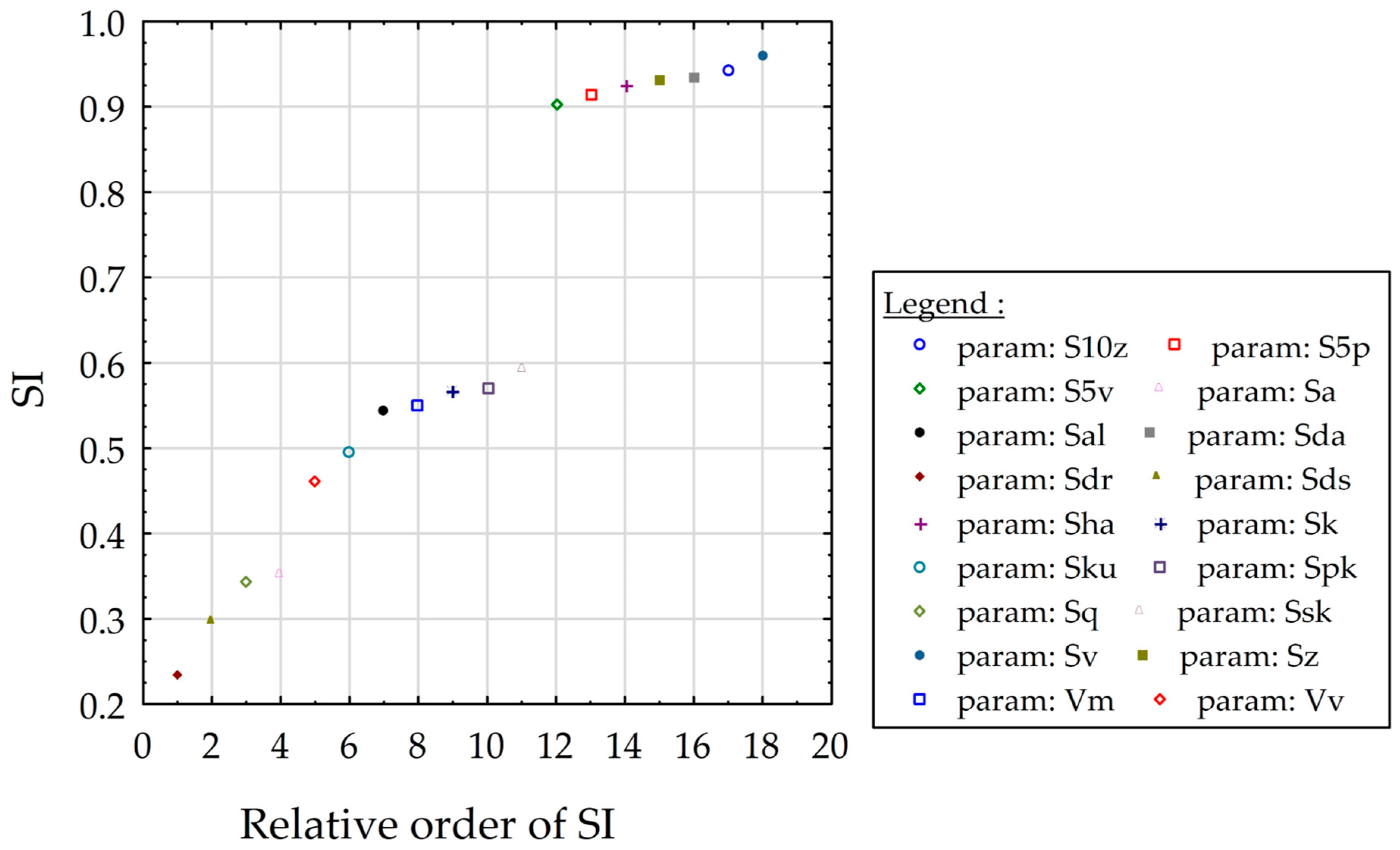
Figure 5 shows SI values for each roughness parameter sectioned for this study in ascending order. It is evident that Sdr is the least stable parameter regarding the previous results, with an SI value of 0.225. As previously noted, Sds, Sa, and Sq also exhibit instability. These findings validate the proposed approach and confirm that Sdr is a useful parameter for identifying metrological fluctuations in extended-time acquisitions. Sa, Sq, and Sds can thus be good candidates.
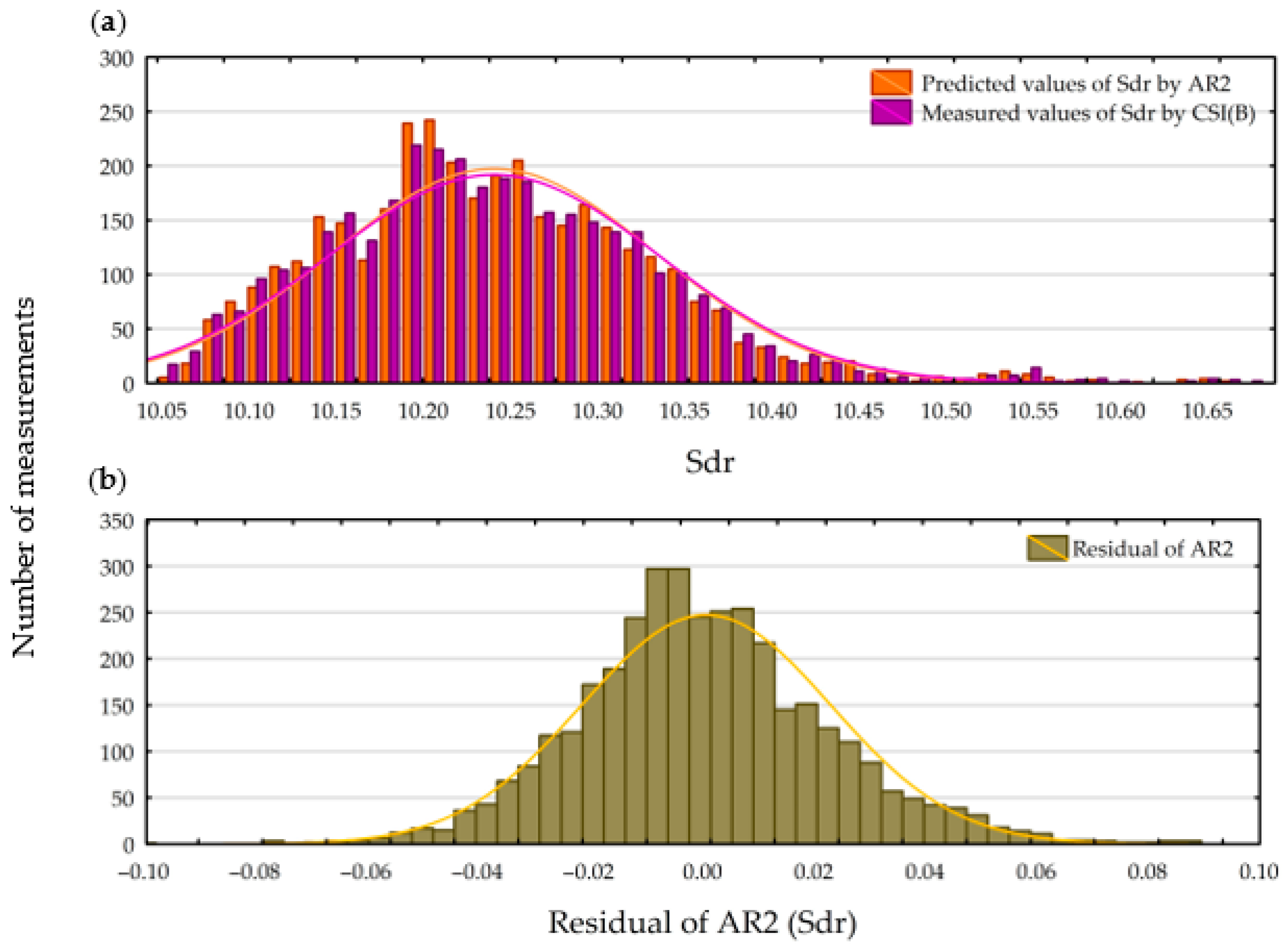
In more detail, Figure 6 illustrates histograms of Sdr values (the worst parameter) versus their predicted values, together with the associated residuals.
The temporal stability of Sdr measurements was assessed using autoregressive (AR) models, which capture correlations between successive iterations at a fixed measurement position. An AR(0) model assumes independent noise, providing a baseline for total amplitude but failing to account for correlated drift. A first-order model (AR(1)) captured correlations at a lag of one; however, residual analysis revealed that significant autocorrelation remained, indicating that AR(1) could not fully describe the temporal structure of the data. In contrast, a second-order autoregressive model (AR(2)) considered correlations at lags one and two, effectively modeling short-term dependencies and capturing subtle temporal trends in Sdr caused by instrumental drift or environmental fluctuations. The autoregressive model of order two (AR(2)) was selected as a compromise between descriptive capability and statistical robustness. Preliminary analyses showed that an AR(1) model was insufficient to capture the short-term temporal dependencies observed in the monitored roughness parameters, while higher-order models did not significantly improve the quality of the fit and tended to increase parameter uncertainty. The AR(2) formulation, therefore, provided a minimal yet sufficient representation of the temporal dynamics, allowing stable estimation of the regression coefficients while avoiding overfitting. This choice is particularly suited to metrological monitoring, where robustness and interpretability of the model are prioritized over purely predictive performance.
By comparing the amplitudes predicted by the AR(2) model with those from AR(0), the stability index (SI) quantifies the proportion of uncorrelated versus correlated variability, providing a robust metric of temporal stability. This approach ensures that the SI accurately reflects genuine instrument-induced fluctuations rather than residual autocorrelation artefacts, making AR(2) the optimal choice for evaluating the stability of derivative-sensitive parameters such as Sdr.
The predicted values, based on an AR(2) model, fit the Sdr values very well across all classes and follow a Gaussian distribution exhibiting minimal residuals. The Sdr values exhibit strong temporal correlation. Notably, the residuals are centered around zero, with a standard deviation of approximately 0.027. These observations substantiate the conclusion that Sdr is the most effective parameter for monitoring metrological fluctuations, as it accurately describes the temporal behavior of the measurement instrument.

3.2. Short Time (Morphomeca Monitoring)

3.2.1. Short-Time Raw Results

As shown in the previous section, Sdr is the most relevant parameter to exhibit fluctuations. Even if the physical causes are not linked with this work, it can be interesting to determine a method to know if the concerned measurement instrument undergoes environmental solicitations.
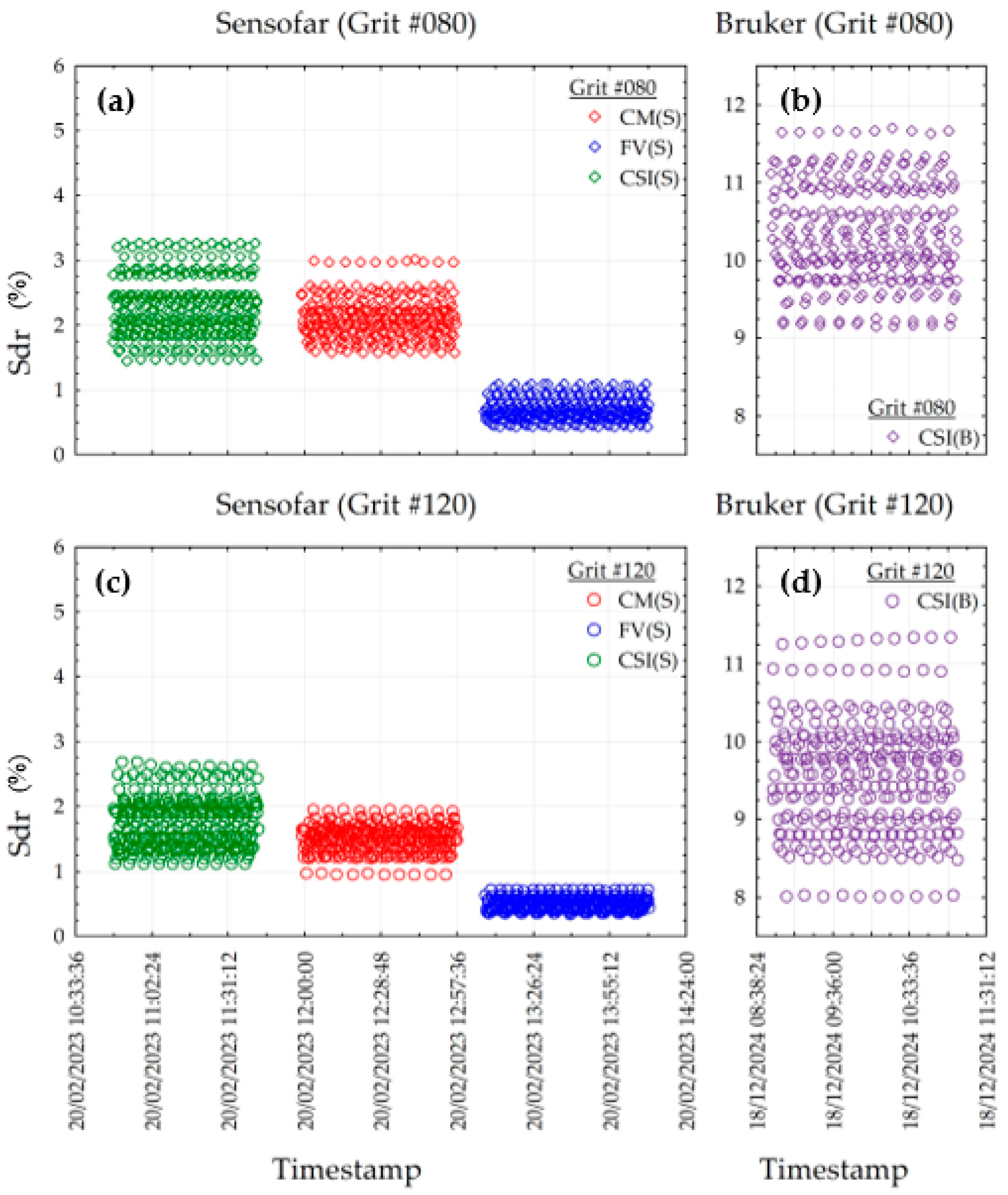
In first time, it is interesting to observe the raw values of Sdr. Based on the “Morphomeca monitoring” strategy (short time), Figure 7 shows the time representation of Sdr for each instrument without extreme values (outliers). The method to remove outliers is explained in our previous paper [29], and this method is based on the interquartile range. It should be noted that iterations are shown in rows in Figure 7, while repetitions are shown in columns. Globally, it directly appears that a significant difference exists between the two devices. The Sdr values are five times higher in mean if the two CSI devices are compared (Sensofar and Bruker). The values of Sdr are 20 times higher if the Sensofar FV mode (FV(S)) and Bruker CSI (CSI(B)) are compared. It indicates that CSI(B) is more sensitive to height variations than CSI(S), whatever the used mode. This could be explained by the transfer function of the instruments and the topography reconstruction algorithms. The acquired information is simply different in each case, and the visual discrimination between the grits #080 and #120 is possible for all modes of the Sensofar instrument and for Bruker CSI. It is nevertheless observed that the FV mode exhibits significantly lower sensitivity than the other modes.

3.2.2. Analysis Through Uncertainty Indices

(a) Quality assessment
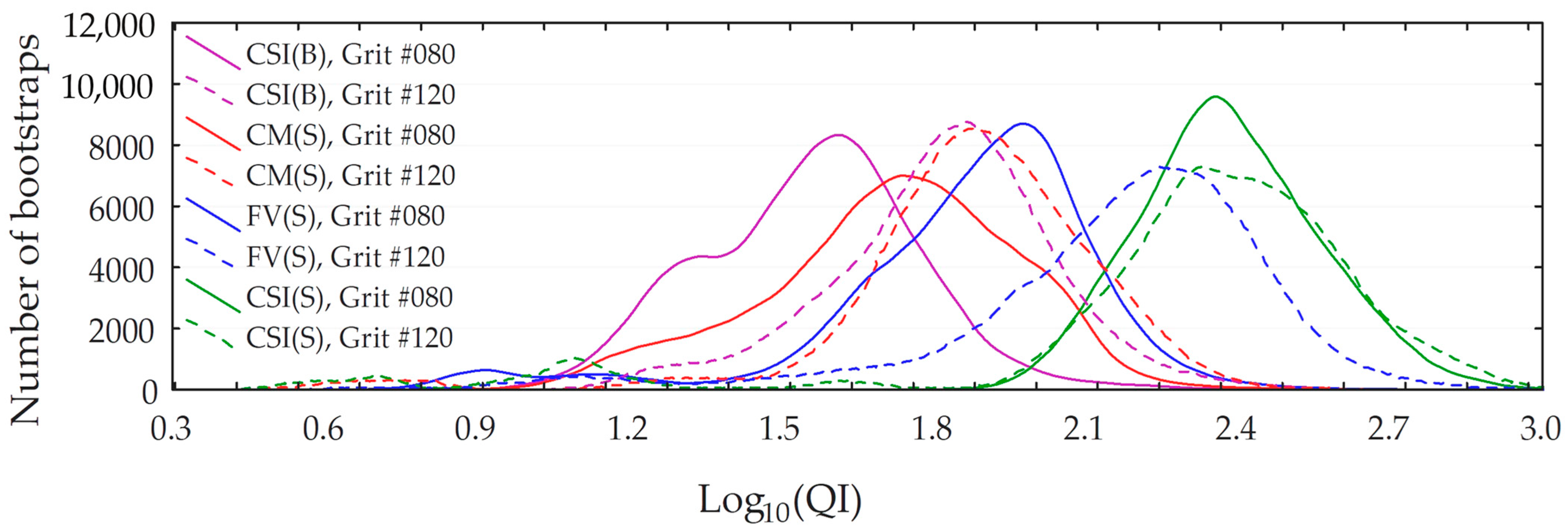
Figure 8 shows the quality assessment presented in our previous study [28]. These graphics represent the ratio between topographic representativeness and measurement noise, as presented in Appendix E (the ratio between the Sdr-inter and Sdr-intra positions). The values used to compute these graphics are obtained by a bootstrap technique [33].
Based on QI observations, the best-performing instruments are CSI(S) and FV(S) due to their low Sdr-intra position standard deviation. In contrast, CSI(B) and CM(S) exhibit the lowest QI values, particularly CSI(B) with grit #120. However, when considering the raw Sdr values of CSI(B), it is shown that the level of acquired surface topographic detail is significantly higher for CSI(B). Consequently, it is also expected that fluctuations will become more pronounced when using CSI(B). It is necessary to be careful to compare this to the device and take into account that the Bruker has a different transfer function and reconstruction algorithm.
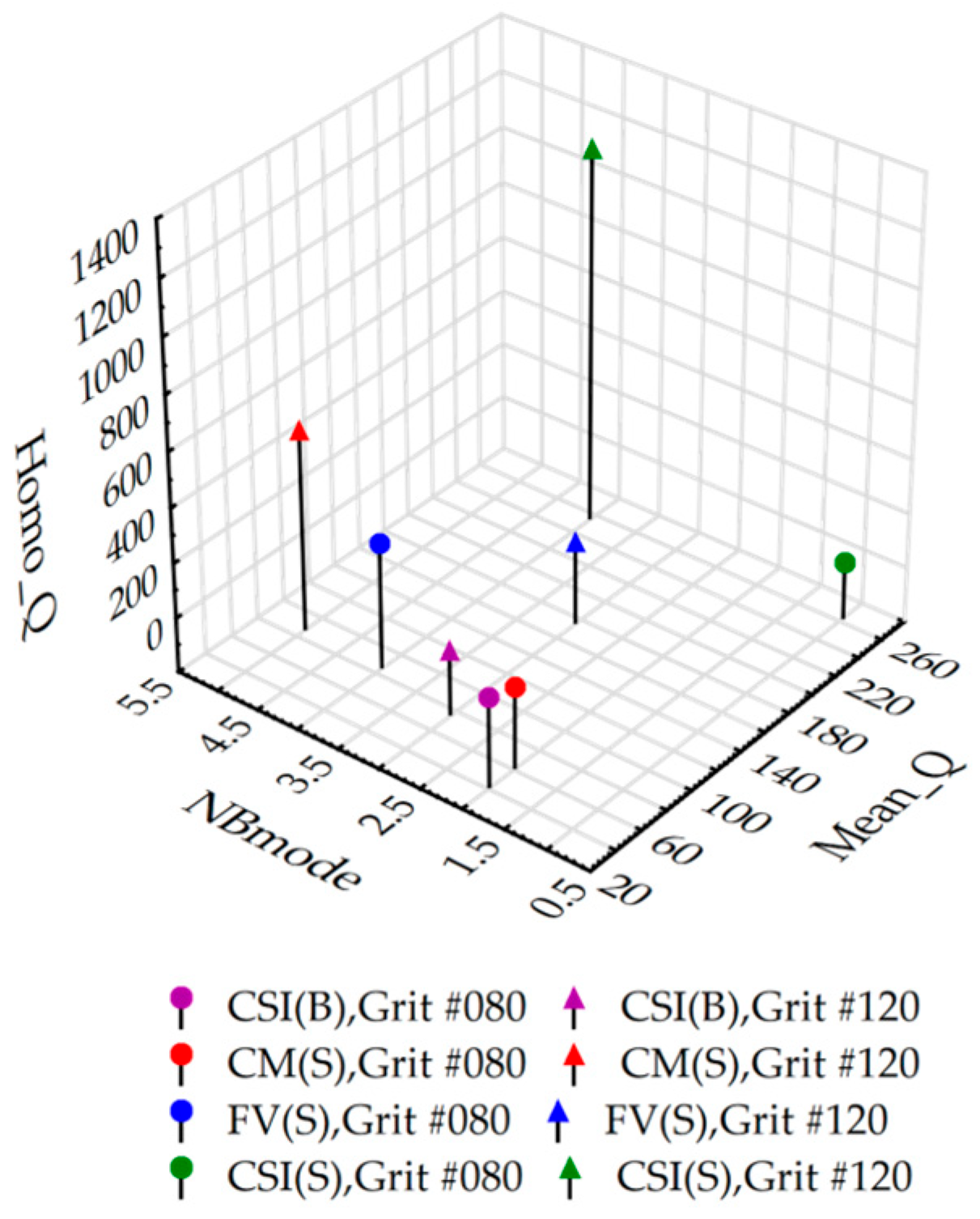
In addition to the QI, other quality indicators are computed. These indicators include Mean_Q, Homo_Q, and NBmode, which describe the mean measurement quality (mean QI), the homogeneity of QI histograms based on Johnson-SU fitting, and the number of populations obtained by counting kernels of QI distribution, respectively. The complete methodology is detailed in a previous study [29].
Figure 9 presents a 3D visualization of these three indicators based on the instruments used and the grits. Compared to the previously computed Homo_Q values, based on Sdr, under similar conditions in [29], the values presented in Figure 9 are generally high, except for CSI(S) measuring grit #080. The analysis of Mean_Q follows the same approach as QI, but these results must be carefully considered for interpretation. The evolution of all indicators provides deeper insight into measurement quality: the higher Homo_Q, the worse the fit of the QI histogram; the higher NBmode, the more unstable QI becomes.
Based solely on QI, CSI(S) appears to be the best-performing instrument. However, when considering Homo_Q and NBmode, only grit #080 can be regarded as providing a high-quality and stable measurement. In contrast, grit #120 exhibits the worst Homo_Q and the previously lowest NBmode compared to other instruments. Among all indicators, CSI(S) measuring grit #080 remains the best overall.
Regarding other instrument modes, CM(S) measuring grit #120 also performs poorly, as it has an NBmode of 5, the second-worst Homo_Q, and, despite CM(S) measuring grit #080 having a low Mean_Q, it maintains a stable QI. Similarly, when considering only Homo_Q and NBmode, CSI(B) provides the most stable QI for both grits. As for FV(S), its markers are positioned in the middle of the graph, indicating a reasonably high NBmode and a suboptimal Homo_Q. In conclusion, FV(S) cannot be classified as either good or bad instruments.
(b) Drift and stability of the measurement
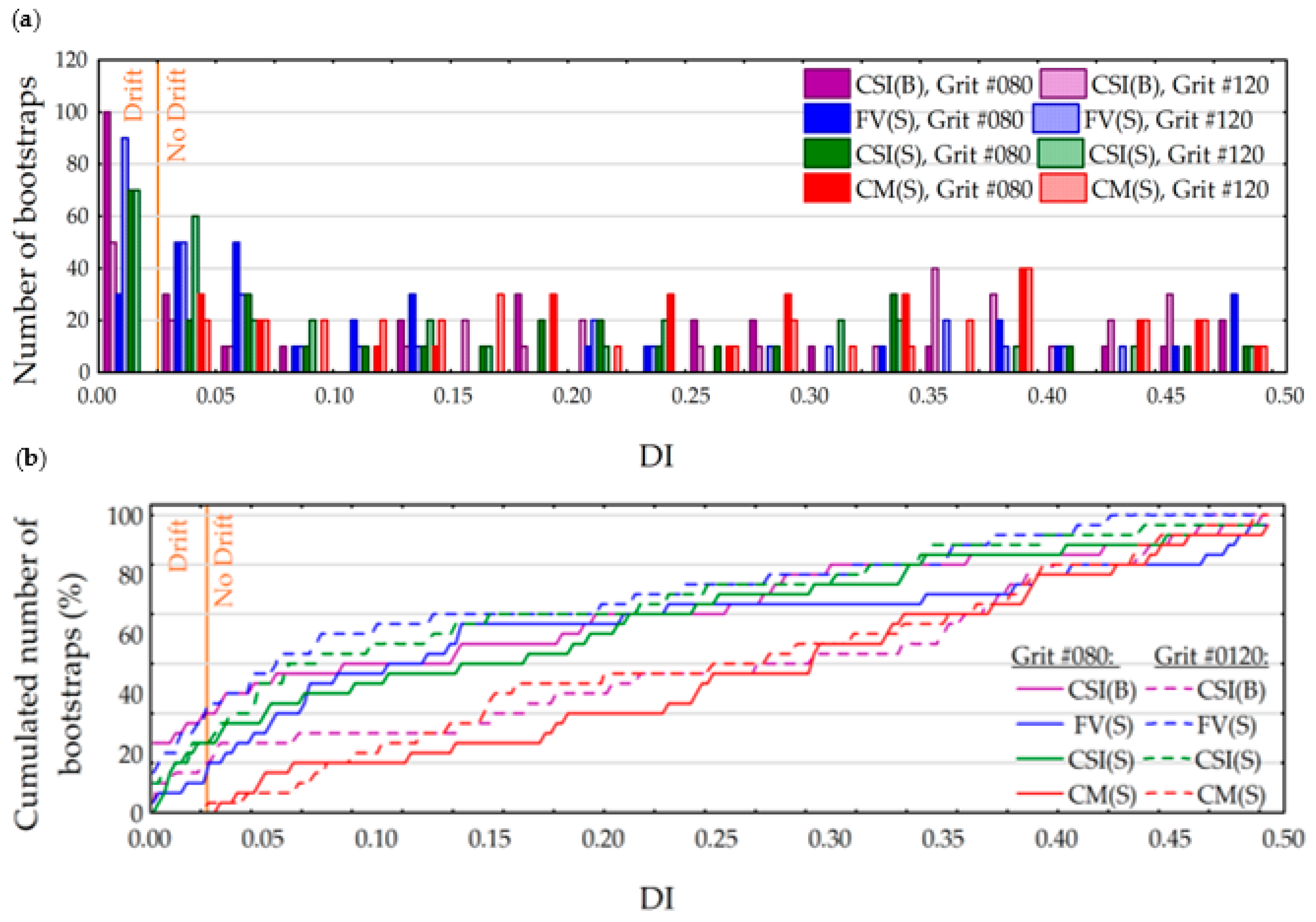
The Drift Index (DI) is an index used to characterize the chronological fluctuation of Sdr values in each series of iterations. In more detail, the goal is to detect if an autocorrelation exists (negative or positive). If DI overpasses the threshold of 0.025 defined in [28], the measurements are not considered time-dependent. Figure 10 shows the drift in integration series for each instrument and grit. As raw values are bootstrapped 104 times, the number of iterations in the series was multiplied by 10. To have comparable values regarding the original measurement plan, the number of bootstrap needs to be divided by 10 to obtain the “real” number.
Below the threshold in Figure 10a, CSI(B) measuring grit #080 and the FV(S) measuring grit #120 exhibit the highest number of cases. Additionally, CSI(S) shows a relatively high number of cases for both measured grits. Notably, only CM(S) remains above the 0.025 threshold, indicating no iteration series with drift. More generally, in Figure 10b, CM(S) remains below all other measuring conditions. CSI(B) measuring grit #120 decreases immediately after the threshold, following the CM(S) cumulative histograms, which indicates a slightly lower drift. Finally, it can be observed that FV(S), CSI(S), and CSI(B) (i.e., grit #080) exhibit similar overall behavior in the drift histograms.
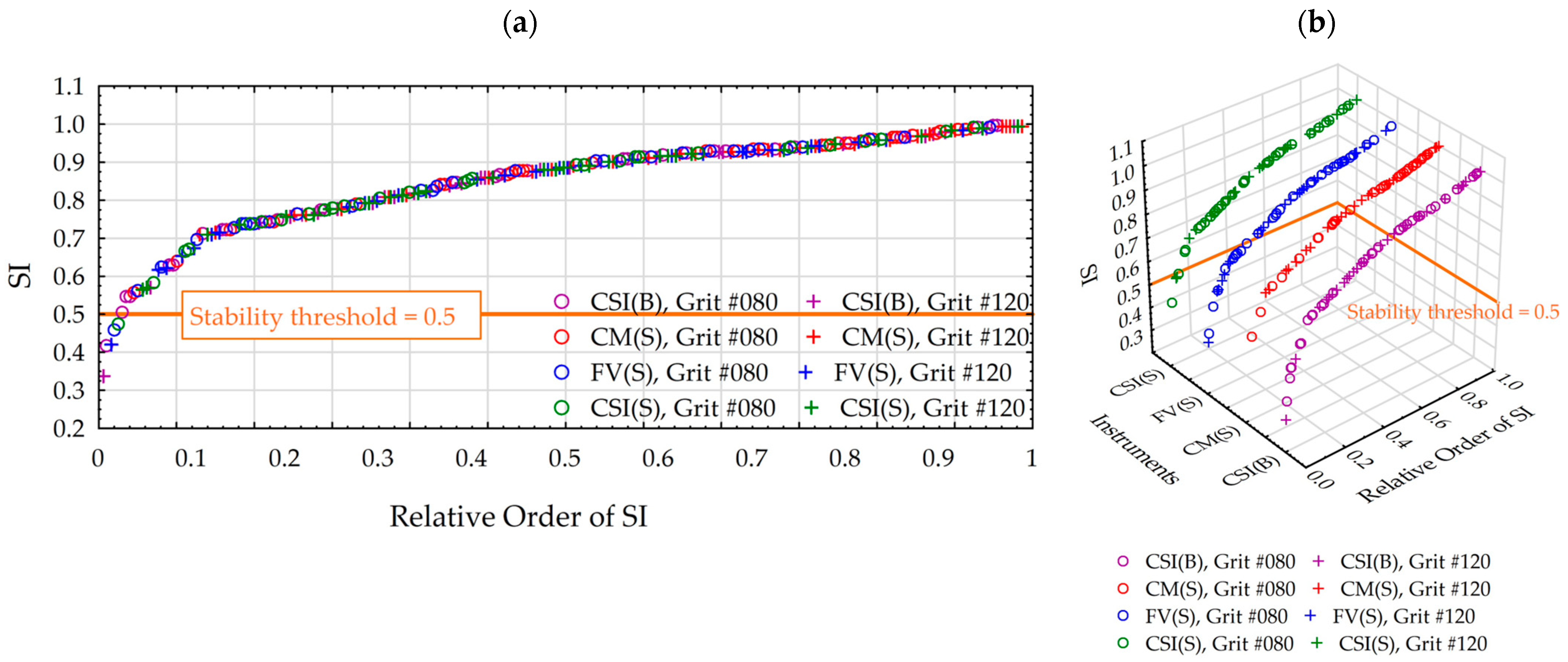
Near DI, SI characterizes noise into the iteration series and determines the presence of noise autocorrelation. It quantifies this by comparing the standard deviation of residuals from two autoregressive models using a ratio. A zero-order autoregressive model (AR0) is used to describe deviations from the mean, while a second-order autoregressive model (AR2) accounts for trends by incorporating two previous values in the iteration series.
SI is defined as the ratio of the standard deviations of the residuals from AR2 and AR0. An SI value below 0.5 indicates that the residuals of AR2 are significantly smaller than those of AR0, suggesting that AR2 provides a better fit to the data than AR0. This implies that the data exhibit time dependence.
Figure 11 presents the SI values for each measuring configuration. The abscissa represents the SI positions, ordered increasingly from 0 to 1, while the ordinate indicates the corresponding SI values for each measuring condition.
Overall, the majority of values exceed the stability threshold; however, five iteration series exhibit characteristics of correlated noise: (CSI(B), grit#120), (CSI(B), grit#080), (FV(S), grit#120), (FV(S), grit#080), and (CSI(S), grit#080).
Except for these cases, noise can generally be considered non-correlated across most iteration series. However, point density provides additional insight into the tendency of instruments to exhibit correlated noise. For instance, Figure 11b shows that CM(S) has a high density of points near SI = 1, whereas FV(S) has a greater concentration of points around SI = 0.5. In contrast, for both CSI configurations, points are more homogeneously distributed. As shown by the DI, the CM(S) is characterized as stable by the SI. Regarding the measured grit, the stability does not depend on the instrument because no clear predominance of #080 or #120 is constated near SI = 1 or SI = 0.5.
(c) Relevance of the instruments and the method
The relevance index is obtained by an ANOVA computation. The objectives of this analysis are as follows:
(1) To show the instrument with the best discrimination between grit #080 and #120 for a given roughness parameter;
(2) To show which is the stronger measuring parameter (grit, instrument, and [grit × instrument]) with an influence on the roughness parameter results.
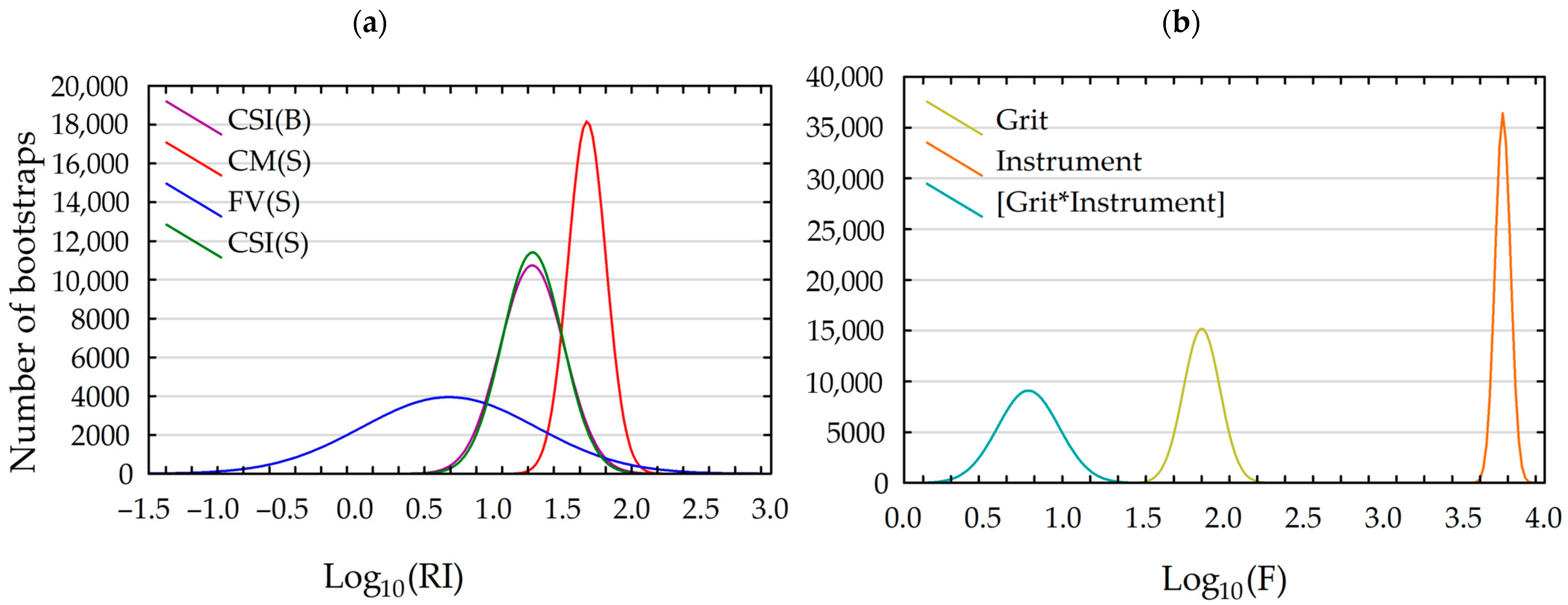
According to the bootstrap technique explained previously, a set of F-values is obtained to constitute histograms. Figure 12a highlights that the best discrimination between the grits is made by the CM(S) instrument. In second place, both CSI(S) and CSI(B) instruments have the same discrimination level. FV(S) is the last instrument regarding the relevance index. CM(S) is probably the best (RI around 50) due to its fine lateral resolution of this technology; CSIs are good too (RI around 20), but the FV(S) histogram is especially low in mean (RI around 4). It can be noted that the histogram of FV(S) is particularly wide, showing that this instrument does not always show the difference between grit #080 and #120. The smoothing of surface topographies explains this effect. It can be observed that FV technology is highly effective for measuring huge textures but faces challenges when assessing roughness in the strictest sense.
Figure 12a illustrates that not all instruments can measure a given surface, and the selected roughness parameter is not universally relevant for every surface or instrument. This highlights the need to examine the influence of each measurement condition. Figure 12b identifies the most influential factor, whether it is the grit, the instrument, or their interaction. F-value histograms reveal that the instrument used is the primary factor affecting the measurement, followed by grit, though its impact is significantly lower. No noticeable interaction between the two factors is observed because its histogram is centered near 1 in log10.

4. Discussion

The extended-time measurement campaign was conducted using two different physical instruments (Sensofar Sneox™ and Bruker ContourGT®), but Sensofar includes three measurement modes. In a nutshell, one of them is clearly highlighted as the most sensitive instrument. This difference mainly arises from the transfer function and the reconstruction algorithms used by Bruker and Sensofar. The technical choices result in any metrological fluctuations being more easily detectable, allowing us to determine which roughness parameter is more sensitive to fluctuations. On the other hand, the short-time assessment was conducted to show that the results are instrument-dependent because different results are found regarding each technology, even if CSI(S) and CSI(B) provide similar results. The results are also surface-dependent regarding the two intensities of processes measured.
While the short-time analysis provides rapid insight into the immediate stability of the measuring instrument, it is inherently subject to several limitations. Due to the reduced number of observations, the associated uncertainty estimates are more sensitive to transient fluctuations and isolated disturbances. As a result, short-time indicators may overestimate instability when sporadic deviations occur or conversely fail to capture slow temporal drifts. These limitations do not invalidate the short-time approach but rather define its scope of applicability. In the present framework, short-time analysis is primarily intended as an early warning tool, enabling the detection of abrupt changes in measurement behavior. It is, therefore, complementary to the extended-time strategy, which provides a more reliable assessment of long-term stability by integrating a broader temporal context.
During the analysis of the extended-time campaign, attention was not paid to local extreme values in the roughness parameter time series, and it needs to be investigated in future studies. Rather than exploring multiple options, the study concentrated on AR(2) models to provide a structured characterization of the temporal behavior of roughness parameters. This choice makes it possible to ensure that the variations observed are statistically significant rather than the result of isolated fluctuations. A second methodological decision was to conduct a full-scale analysis of roughness instead of adopting a multi-scale perspective. The purpose was to establish a link between the relevant scale and the transfer function of the instrument. Although a multi-scale analysis might yield additional insights into the scale-dependent behavior of roughness parameters, such an investigation was outside the scope of the present work. Finally, it is necessary to consider the issue of non-measured points in the context of this study. Indeed, this topic represents a challenge in its own right. Although a detailed analysis is beyond the scope of this work, this aspect has nevertheless been taken into account in our analysis. Optical topographic measurements include non-measured points (NaN) that arise from the internal criteria of reconstruction algorithms rather than from actual surface features. Therefore, their occurrence is instrument- and algorithm-dependent and cannot be considered an intrinsic surface property. In the context of the present study, the proportion of non-measured points remains, on average, below 4%.

5. Conclusions

This study demonstrates the relevance of extended-time metrological monitoring to assess roughness parameter stability. The extended-time campaign, conducted with the most sensitive instrument (Bruker ContourGT®), highlighted Sdr as the most suitable parameter for tracking metrological fluctuations, with Sa, Sq, and Sds also potential candidates. Short-time monitoring confirmed the consistency of these results across different instruments, reinforcing the robustness of Sdr in detecting variations. The use of AR(2) model enabled an analysis of time-dependent behaviors; isolated extreme values were not taken into account. A future extension of this work could include a multi-scale analysis to refine the understanding of scale-dependent roughness variations.
In this comparison, several points stand out. The interferometric mode of Bruker ContourGT®, CSI(B), provided much higher Sdr values than Sensofar Sneox™, while CSI(S) produced the best-quality measurements (QI). Most of the other instruments performed at a lower but similar level, except for Focus Variation of Sneox™, FV(S), which was slightly better for grit #0120. This seems to be linked to the higher MeanQ values measured with CSI(S) and FV(S). As for drift (DI), CSI(B) showed the highest level, which was still under the 0.025 threshold, followed closely by CSI(S). This shows that CSI technology is quite sensitive to drift. FV(S) was also affected, while the confocal system, CM(S), was more stable. Overall, FV(S) showed the best stability. In terms of relevance (RI), CM(S) was the most effective in separating the two grinding intensities (#0080 and #0120). CSI(B) and CSI(S) provided very similar results, while FV(S) ranked last. Still, with an F-value around 3, it was able to detect a difference between the two grit levels. To sum up, all instruments were able to distinguish between the #080 and #120 surfaces, but their performance differed in terms of sensitivity, stability, and measurement quality. Table 3 summarizes the performance of each instrument with respect to the results presented. This performance is only meaningful within the context of this study, given the ground specimens analyzed through the Sdr roughness parameter. The results could be different in other conditions. For instance, if a more textured specimen is used or if another roughness parameter is chosen to compute the indices.
To conclude, it should be pointed out that very few bibliographic references exist regarding the Sdr roughness parameter. Although this parameter has shown itself to be effective in detecting metrological fluctuations, its interpretation is still not well documented. More work will be required to confirm its sensitivity, robustness, and practical value for extended-time metrological monitoring. Therefore, additional research is required to clarify its sensitivity, robustness, and relevance in the context of extended-time metrological monitoring.
The proposed method is statistically robust and enables the application of uncertainty-related statistical indices, providing them with physical meaning through their correlation with the measurement protocol. However, the implementation of the measurement protocol requires a thorough understanding of the instrumentation, the possibility of automation, and solid knowledge of statistical methods. From this perspective, the development of a pedagogical interface could be envisaged to guide users in the selection of appropriate instruments, roughness parameters, measurement protocols, and the computation of indices.
Furthermore, the Sdr parameter is inherently multiscale. Future work will, therefore, be required to investigate the behavior of roughness parameters across multiple scales in order to further refine the metrological assessment and potentially establish a link with the transfer functions of the instruments.

Author Contributions

Conceptualization, M.B.; methodology, M.B. and C.M.; software, F.B. (François Blateyron) and M.B.; validation, J.L., D.P.M., T.C. and F.B. (François Berkmans); formal analysis, M.B. and C.M.; investigation, M.B.; resources, D.P.M. and T.C.; writing—original draft preparation, C.M.; writing—review and editing, C.M., M.B., J.L. and F.B. (François Blateyron).; visualization, J.L.; supervision, M.B. and F.B. (François Blateyron). All authors have read and agreed to the published version of the manuscript.

Funding

This research was conducted within the framework of a PhD program funded by UPHF (Valenciennes), INSA Hauts-de-France (Valenciennes), and Digital Surf (Besançon).

Data Availability Statement

The raw data supporting the conclusions of this article will be made available by the authors on request.

Acknowledgments

The authors thank Sensofar and Bruker for the measurement campaign carried out on TAV6 specimens, Digital Surf for the software MountainsMap® (version 9), and Jose Gregorio La Barbera Sosa and Rudy Dubois for machining the samples and ground surfaces.

Conflicts of Interest

Authors David Páez Margarit, Thomas Carlier, and François Blateyron were employed by the companies Sensofar Metrology, Bruker Nano Surfaces and Metrology, and Digital Surf, respectively. The remaining authors declare that the research was conducted in the absence of any commercial or financial relationships that could be construed as a potential conflict of interest.

Appendix A. Measurement Instruments

Appendix A.1. The Instrument’s Principles

The most commonly used technologies are FV, CM, and CSI 3D profilometers for surface topography measurements. The majority of instruments are accompanied by standards and guidelines that allow users to understand their operating principles, biases, specifications, and applicable domains. This is the case for the ISO 25178-60X series, which provides a comprehensive framework for these aspects across various optical surface topography measurement technologies. In particular, ISO 25178-604 [34] specifies the characteristics and performance of coherence scanning interferometry systems, ISO 25178-606 [35] addresses focus variation instruments, and ISO 25178-607 [36] covers confocal microscopy. It should also be noted that other reference documents exist, such as the NPL good practice guides [22,23,24], which are widely used in the scientific community for surface topography measurements. More recently, the TRACOPTIC [37] report has been published, providing additional recommendations for measurements with 3D optical instruments.
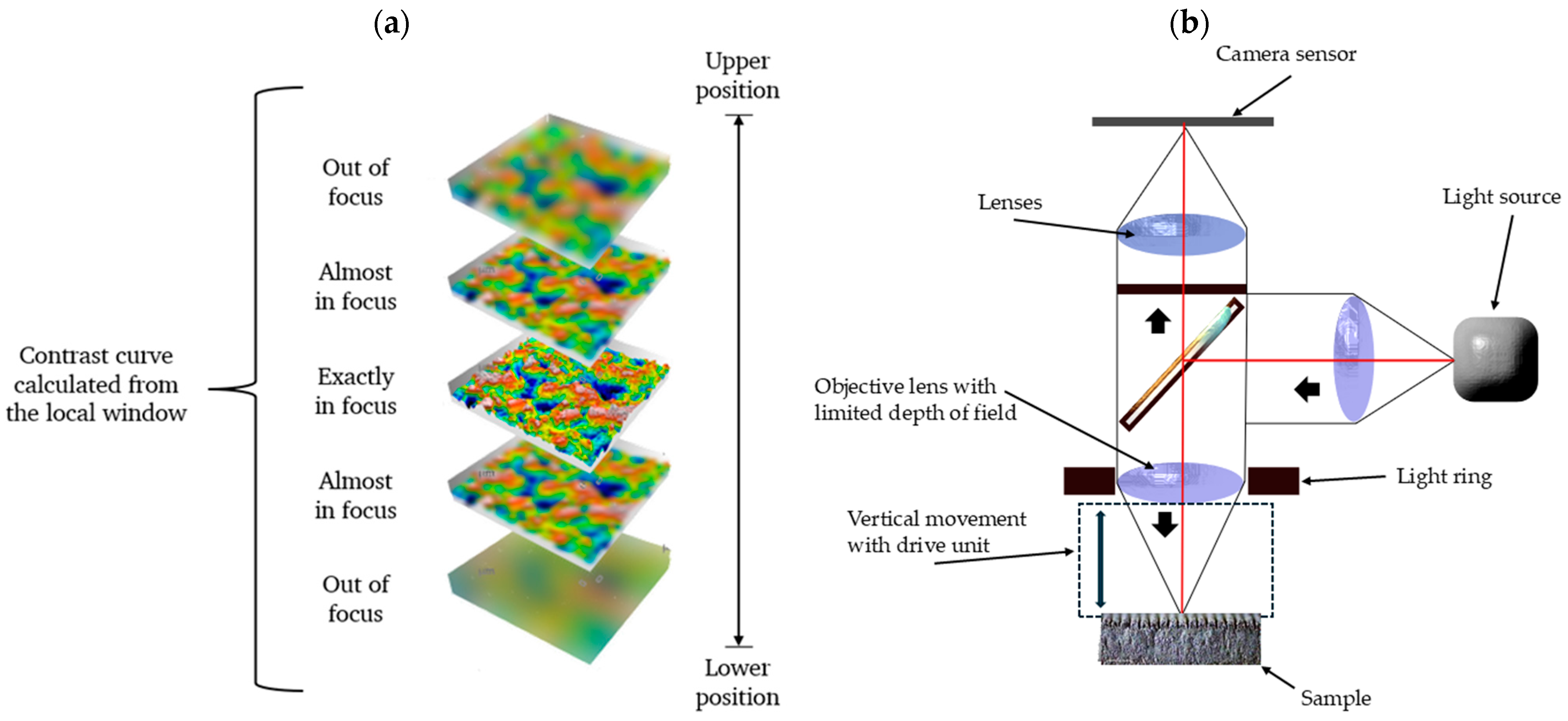
As in Figure A1, FV instruments [16,38,39] work by measuring an image’s gray level to determine if pixels are in focus or not. By vertically shifting the sample and capturing successive images, this technique reconstructs a map with the associated coordinates to build a 2.5D map assimilated to 3D measurements. Supported by certain assumptions, several focusing criteria exist, such as the gradient, entropy, or standard deviation of gray levels [40]. The standard deviation criterion is the most widely used, taking into account a given pixel and its N-neighbors (determined by the lateral resolution setting). This method calculates the standard deviation (StD) of the gray levels in a zone of interest set from the lateral resolution. The StD values are recorded for each pixel (X,Y) at every Z-step to identify the maximum StD, which corresponds to the Z-height where the pixel is in focus. From then on, the Z heights can be assembled regarding the X,Y coordinates to create topography maps. It is particularly well-suited for form measurements or textured surfaces [41].
Figure A1. (a) Contrast curve located from the local window is related to the vertical movement of the microscope during data acquisition, and the focal range depends on the nature of the surface. (b) Schematic representation of a focus variation microscope.
Metrology 06 00010 g0a1
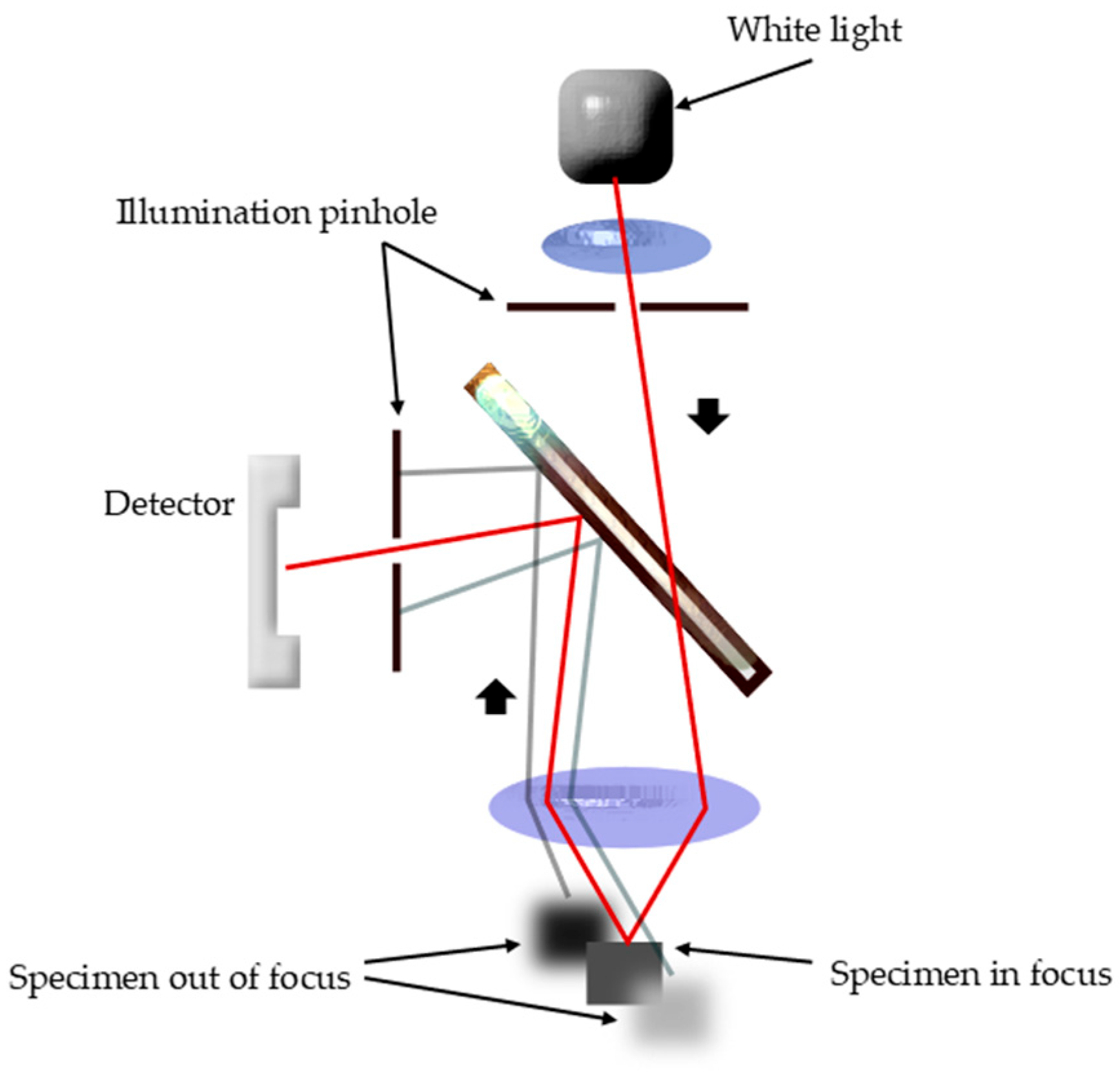
On the other hand, the confocal microscope, presented in Figure A2, uses two pin-holes as optical apertures to eliminate out-of-focus information, allowing it to capture images with improved depth resolution. By scanning the light beam point by point or line by line, it creates a three-dimensional image with excellent spatial resolution, making it a preferred tool for analyzing complex structures in depth, including biological or transparent samples [7,42].
Figure A2. Schematic representation of a confocal microscope.
Metrology 06 00010 g0a2
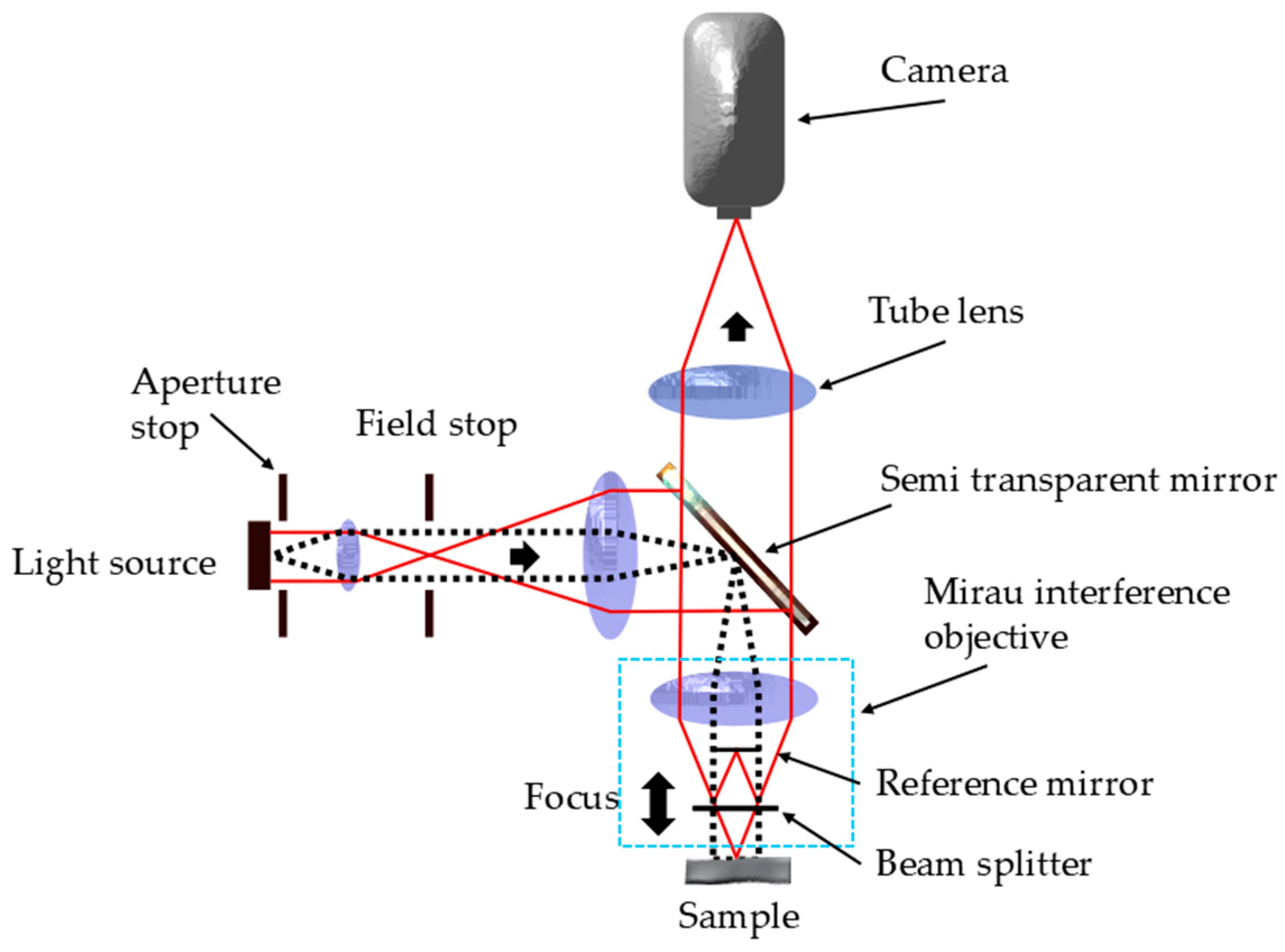
Finally, the Mirau interferometer, explained in Figure A3, operates on the principle of light interference. A light beam is split into two, one reflecting off the sample surface and the other off a fixed reference. When the two beams recombine, they produce interference fringes directly related to the sample’s topography. This type of interferometric microscopy is extremely precise for measuring nanometric deviations on smooth surfaces and is often used for high-precision roughness and profile measurements. Each of these technologies offers specific advantages depending on the required measurement type, sample nature, and desired accuracy [16,43].
Figure A3. Schematic representation of a CSI (coherence scanning interferometer) microscope.
Metrology 06 00010 g0a3

Appendix A.2. Instrument Specifications and Settings

The measurements made with the CSI(B) instrument are performed with a 20× mirau, having a numerical aperture of 0.4 and an associated lateral resolution of 0.7 µm. The instrument is equipped with a 5-megapixel camera exploiting a smaller area given a pixel matrix of 1200 × 1000 (1.2-megapixel). The VSI mode is chosen with white light. The displacement table of the CSI(B) has a displacement resolution of 0.5 µm and is equipped with an encoder, allowing us to check the position in real time.
As the ContourGT® device, measurements on the SneoxTM device are performed with a 20× EPI Nikon lens with a green LED light for the CM(S) and FV(S) instruments and a 20× DI mirau lens for the CSI(S) instrument. The instrument is equipped with a 5-megapixel camera, exploiting 1.2 megapixels and having pixel size of 0.69 µm. The vertical resolution for the CM(S) and FV(S) instruments is 8 nm and 1 nm for the CSI(S) instrument. The chosen vertical scan range is 128 µm for the FV(S) and CM(S) instruments and 30 µm for the CSI(S) instrument.

Appendix B. Uncertainty Indices: Definitions and Explanations

In this study, we apply four indices based on statistics. Here, we provide the equations of these indices and if more details are needed, they can be found in [28]. The originality of the method is as follows: these indices are computed on the roughness parameter and not directly on the heights of the maps. The first index is about the quality; it is assimilated to a signal-to-noise ratio. Here, the signal is the topographic representativeness between the repeated measurements at different positions, and the noise is the fluctuations in the iterated measurements at the same position. As explained previously, a measurement plan called “Morphomeca monitoring” is used to perform iterations and repetitions on the specimens. It constitutes a key foundation of our method regarding all statistical indices developed. The quality index ( Q I ) is provided by the Equation (A1).
Q I = σ i n t e r σ i n t r a ,
with
  • σ i n t r a as the standard deviation of a roughness parameter in iterated measurements at the same position;
  • σ i n t e r as the standard deviation of a roughness parameter in repeated measurements at different positions.
The second index of uncertainty is the drift index. This index is used to model the trend in the iterated measurement at the same position. The main aim of this indicator is to determine if a time correlation exists between intra-position measurements. This indicator is based on the Durbin–Watson (DW) test [44], as described in Equation (A2):
D W = t = 2 n ( e ^ t e ^ t 1 ) 2 t = 2 n e ^ t 2
where
  • e ^ t is the difference between the real value a i and the predicted value a ^ i of the regression model;
  • e ^ t 1 is the difference between the real value a i 1 and the predicted value a ^ i 1 ;
  • n is the number of values in the iteration series (n = 10).
The drift index computation involves calculating the significance levels ( p v a l u e ) for the Durbin–Watson (DW) test using the Farebrother approach [45]. This test assesses the presence of autocorrelation in the values. A two-way procedure is applied: the first test computes the p-value for detecting a positive correlation ( p v a l u e - D W - P o s ), while the second computes the p-value for a negative correlation ( p v a l u e - D W - N e g ). Finally, the lower of these two p-values ( p v a l u e - D W ) is selected to determine the overall significance of the autocorrelation. The drift index formulation is provided by Equation (A3).
D I = p v a l u e - D W = M I N   ( p v a l u e - D W - N e g , p v a l u e - D W - P o s )
The third index is built to characterize whether the noise in the iteration series can be defined as a correlated noise or an uncorrelated noise. The stability index (SI) is provided by Equation (A4).
S I = σ r e s i d u a l s   A R ( 2 ) σ r e s i d u a l s   A R ( 0 )
The amplitude without drift is modeled using a second-order autoregressive model, AR(2), which is capable of capturing temporal evolutions. The total amplitude, on the other hand, is represented by an AR(0) model, which only reflects the deviation of each value from the mean of the series. When the iteration series contains uncorrelated noise, both AR(2) and AR(0) yield similar values, and the stability index (SI) tends toward 1. Conversely, when correlated noise is present, the AR(2) model captures this correlation while the AR(0) model produces higher values, causing the SI to approach 0.
The fourth index relies on a bootstrap-based analysis of variance (ANOVA) to statistically evaluate the capability of the measurement instrument to discriminate between specimens. In more detail, the purpose of applying ANOVA in this study is to evaluate the discriminative capability of the measurement system across specimens and measurement positions. Specifically, we are interested in whether the observed variability in Sdr reflects true surface differences rather than measurement noise. The ANOVA compares inter-group variance (differences between specimens or surface zones) with intra-group variance (repetitions at the same position). When inter-group variance is significantly larger than intra-group variance, the instrument can reliably distinguish between surfaces, confirming the relevance of Sdr as a monitoring parameter. The bootstrap-based ANOVA approach is employed rather than classical ANOVA to address the limited number of measurements and provide empirical distributions of F-values. This allows a statistically robust assessment of the probability density functions (PDFs) of inter-group versus intra-group variance, helping to quantify the likelihood that observed differences are significant. Substantial overlap between PDFs indicated poor discrimination, while minimal overlap confirms that Sdr can resolve genuine surface differences.
When the mean F-value exceeds 1, the differences between specimens are greater than the variations within a specimen. The corresponding probability density functions (PDFs) of the F-values are then compared; substantial overlap between them indicates similar discrimination performance. The F-value, referred to as the relevance index (RI), is defined in Equation (A5).
R I = V a r I n t e r - g r o u p V a r I n t r a - g r o u p .
To strengthen the statistical robustness of our findings, all the indicators proposed in this study (QI, DI, SI, and RI) were computed using a fully programmed bootstrap resampling procedure. This approach allows the empirical estimation of probability distributions for each indicator rather than relying on single deterministic values. By generating thousands of random resamples from the measured data, the bootstrap directly provides estimates of dispersion, bias, and confidence intervals, thereby validating the statistical significance of the observed trends. This method considerably enhances the reliability of the analysis since it does not rely on normality assumptions or analytical formulations of uncertainty propagation. Consequently, the robustness of the conclusions regarding measurement stability and parameter relevance is intrinsically supported by the data itself, making the proposed framework both self-consistent and metrologically sound.

Appendix C. Roughness Parameter Definitions

Appendix C.1. Sdr Parameter

The Sdr parameter, described in ISO 25178-2 [8], is a hybrid parameter. Height parameters measure roughness, symmetry, and the distribution of surface heights, including the maximum height. Spatial parameters focus on the directionality and isotropy of the surface topography, as well as the rate of decay in the surface’s autocorrelation. Finally, hybrid parameters capture both the height and spatial characteristics of the surface, reflecting a combination of these properties [46]. The hybrid parameters are influenced by both the scale of observation and the resolution of the measurement [47,48].
Sdr reflects the complexity of a surface by calculating the ratio between the developed surface area and the sampled surface area, as shown in Figure A4. This parameter is particularly sensitive to scale and data resolution, making it useful for applications like wettability [49], coating [50,51], and conductivity analysis [52]. This parameter is effective for tracking surface changes during processing and is particularly beneficial for adhesion-related applications. However, it assumes that surfaces are differentiable everywhere, which might not hold true for fractal surfaces that exhibit singularities or abrupt variations. Equation (A6) describes the calculus of Sdr:
S d r = 1 A [ A (   [ 1 + ( δ z ( x , y ) δ x ) 2 + ( δ z ( x , y ) δ y ) 2 ] 1 ) d x d y ]
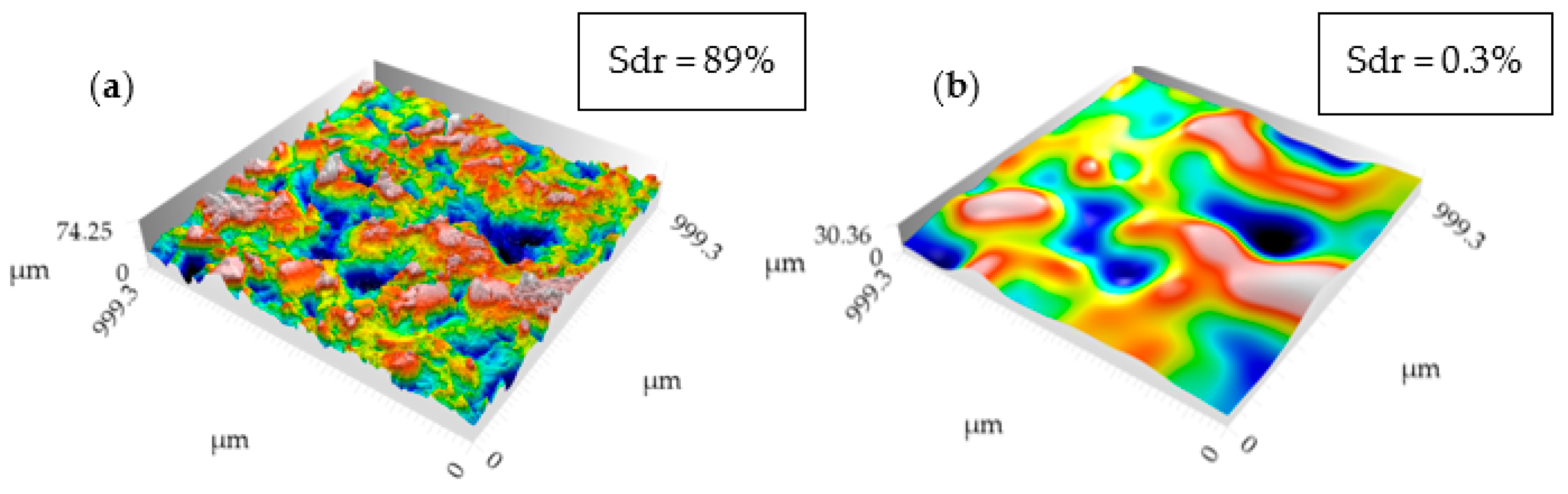
The Sdr parameter represents a consistent choice for capturing measurement variability for several reasons. Its sensitivity to micro-relief makes it responsive to subtle changes in topography; however, it can be challenging considering its sensitivity to high-frequency noise [16], as shown in Figure A4. Additionally, it is a global parameter that accounts for all points on the surface. The publication by Pawlus et al. also shows that the Sdr parameter is sensitive to spikes on peaks and stitching, tends to have a higher value on optical devices compared to tactile ones, and is affected by sampling interval and filtering [53].
Figure A4. Same surface from a blasted TA6V surface, before (a) and after (b) being filtered by a low-pass Gaussian filter with a cut-off of 250 µm. It is possible to observe that the valleys remain the same, but the details have completely disappeared, making the geometry far less complex; therefore, it has an Sdr value of 0.3% compared to the full surface, which has a ratio of 89%.
Metrology 06 00010 g0a4

Appendix C.2. Other Used Parameters

Table A1. List of roughness parameters used in the stability analysis: definition and description.
Roughness
Parameter
DefinitionDescriptionClassification and Standards
SkuKurtosis of height distributionDescribes the sharpness of the surface height distribution. High Sku indicates a surface with more frequent high peaks or deep valleys.Height parameters (ISO 25178)
SaArithmetical mean heightThe average absolute deviation of the surface from the mean plane. It is the 3D equivalent of Ra.Height parameters (ISO 25178)
SqRoot mean square heightThe root mean square of surface departures from the mean plane. It is more sensitive to large deviations than Sa.Height parameters (ISO 25178)
SvMaximum pit heightThe largest depth below the mean plane.Height parameters (ISO 25178)
SzMaximum heightThe vertical distance between the highest peak and the deepest valley.Height parameters (ISO 25178)
SskSkewness of height distributionMeasures the asymmetry of the surface height distribution. A positive value indicates more peaks, a negative value indicates more valleys.Height parameters (ISO 25178)
SdsDensity of summitsNumber of summits (peaks) per unit area on the surface.Feature parameters (EUR 15178N)
ShaArithmetic mean summit heightAverage height of the summits above the mean plane.Feature parameters (ISO 25178)
SdaAverage dale areaAverage area of dales (valleys) detected on the surface.Feature parameters (ISO 25178)
S10zTen-point heightThe sum of the average of the five highest peaks and the five deepest valleys over the evaluation area.Feature parameters (ISO 25178)
S5pFive-point peak heightMean height of the five highest peaks above the mean plane.Feature parameters (ISO 25178)
S5vFive-point pit depthMean depth of the five deepest valleys below the mean plane.Feature parameters (ISO 25178)
VvVoid volumeThe volume of voids below the mean plane is usually used in tribological applications.Functional volume parameters (ISO 25178)
VmMaterial volumeThe volume of the material above the mean plane per unit area.Functional volume parameters (ISO 25178)
SkCore roughness depthThe height difference between two points at 40% and 80% of the bearing area curve (material ratio curve).Functional parameters (stratified surfaces) (ISO 25178)
SpkReduced peak heightHeight of the peaks above the core roughness (Sk), representing the protruding peaks.Functional parameters (stratified surfaces) (ISO 25178)
SdrDeveloped Interfacial Area RatioQuantifies the relative increase in surface area induced by surface topography and is sensitive to local slopes and spatial complexityHybrid parameters (ISO 25178)

Appendix D. Time Representation of the Roughness Parameter Used to Build the Classification Table

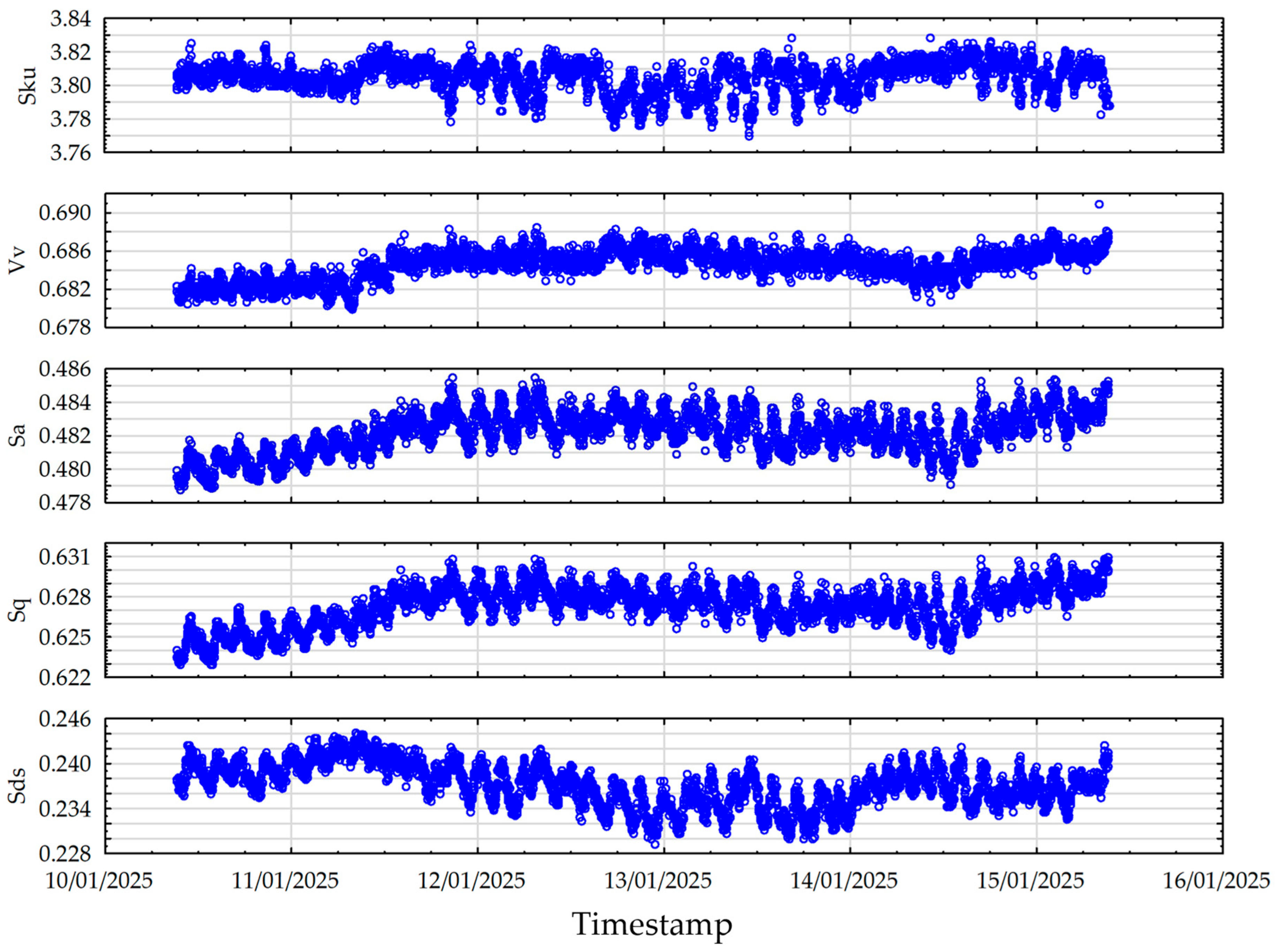
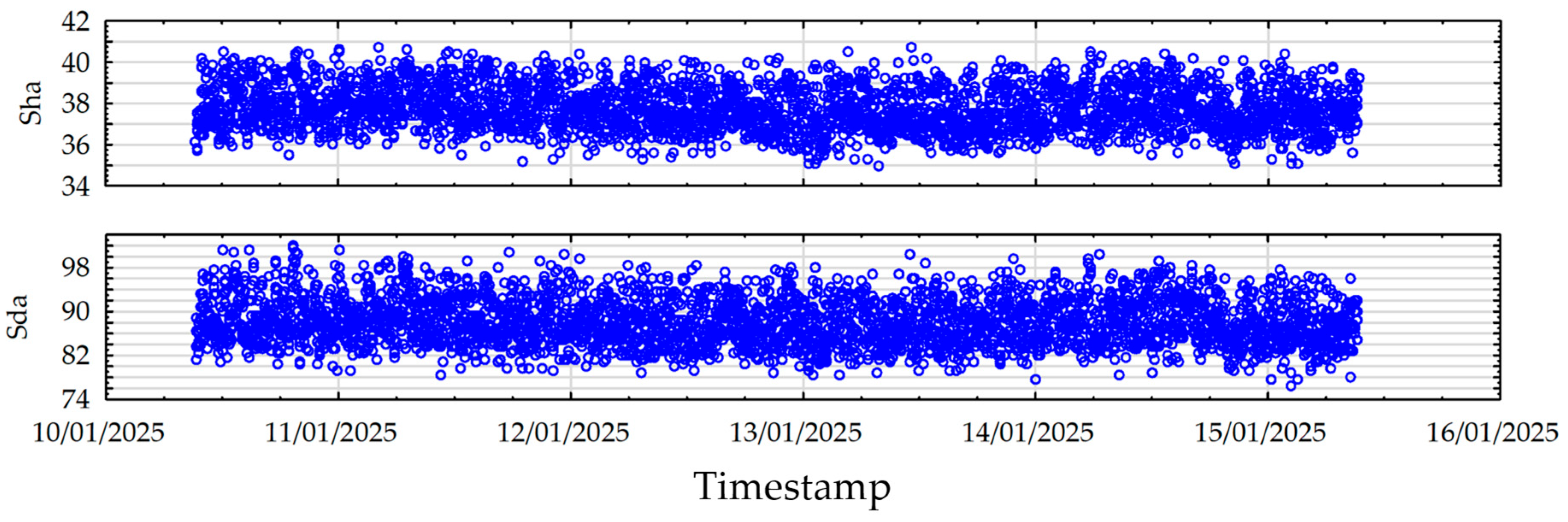
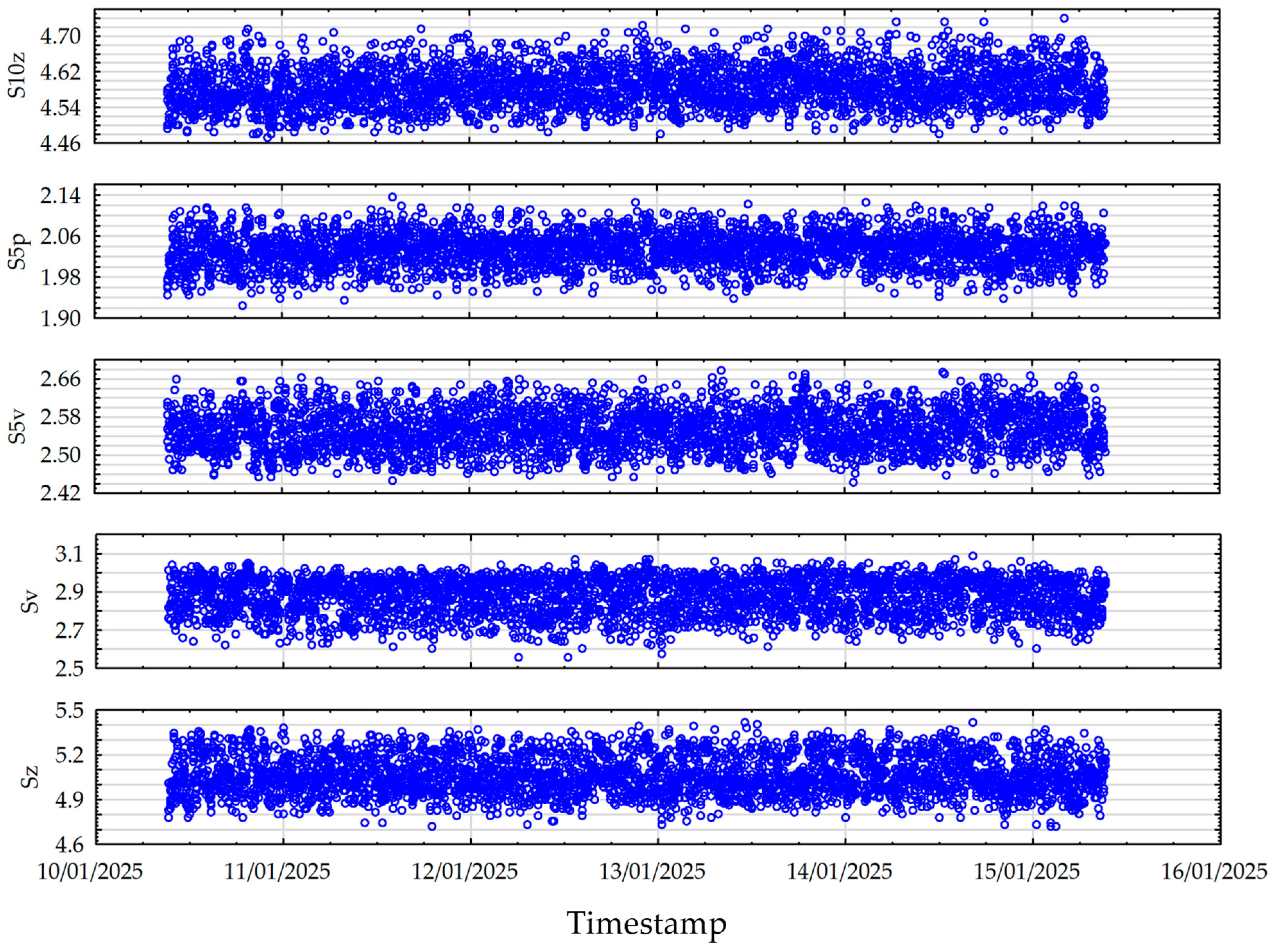
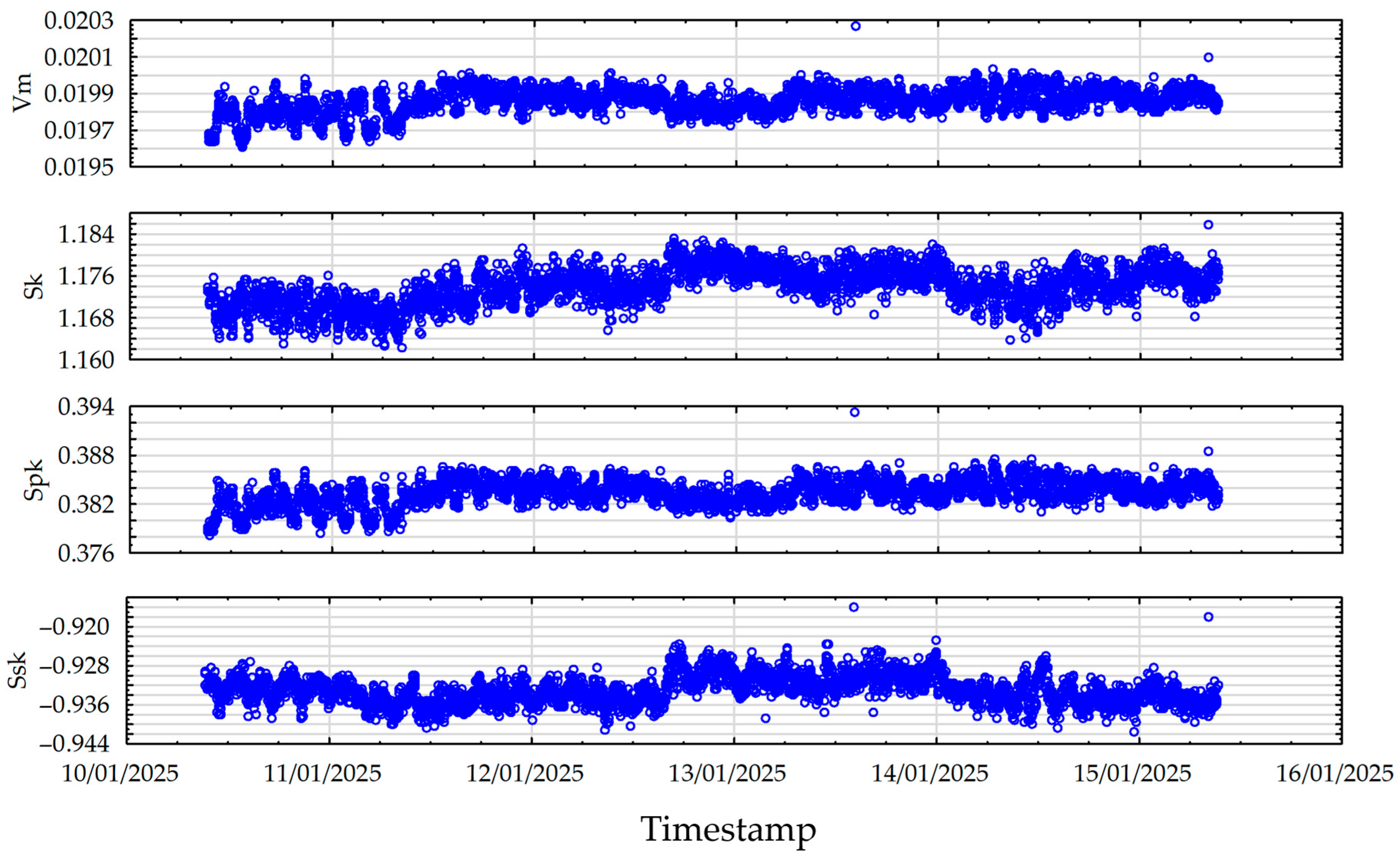
This appendix presents the raw values of roughness parameters during an extended-time acquisition (Figure A5, Figure A6, Figure A7, Figure A8 and Figure A9). The time series plots illustrate the evolution of roughness parameters over the extended-time measurement campaign. The analysis confirms that Sdr (Case A) is the most adequate parameter for detecting metrological fluctuations, as it exhibits both a clear trend and significant dispersion. This makes it highly sensitive to environmental variations and instrumental instabilities. Case B parameters (Sku, Vv, Sa, Sq, and Sds) also display a discernible trend but with lower dispersion, making them useful for supplementary monitoring. In contrast, Case C parameters (Sha and Sda) show high dispersion but lack a clear trend, limiting their reliability for tracking fluctuations. Case D parameters (S10z, S5p, S5v, Sv, and Sz) exhibit neither trend nor significant dispersion, rendering them unsuitable for metrological analysis. Lastly, Case E parameters (Vm, Sk, Spk, and Ssk) demonstrate moderate trends but very low dispersion, indicating limited sensitivity to external variations. Overall, this analysis confirms that Sdr is the best parameter for monitoring metrological fluctuations, with Sa, Sq, and Sds emerging as potential alternatives.
Figure A5. Time plot of Sdr, which is considered in case A.
Metrology 06 00010 g0a5
Figure A6. Time plots of Sku, Vv, Sa, Sq, and Sds, which are considered in case B.
Metrology 06 00010 g0a6
Figure A7. Time plots of Sha and Sda, which are considered in case C.
Metrology 06 00010 g0a7
Figure A8. Time plots of S10z, S5p, S5v, Sv, and Sz, which are considered in case D.
Metrology 06 00010 g0a8
Figure A9. Time plots of Vm, Sk, Spk, and Ssk, which are considered in case E.
Metrology 06 00010 g0a9

Appendix E. Details on the Quality Index Computed Results: The Intra- and Inter-Position Fluctuations of Measurements

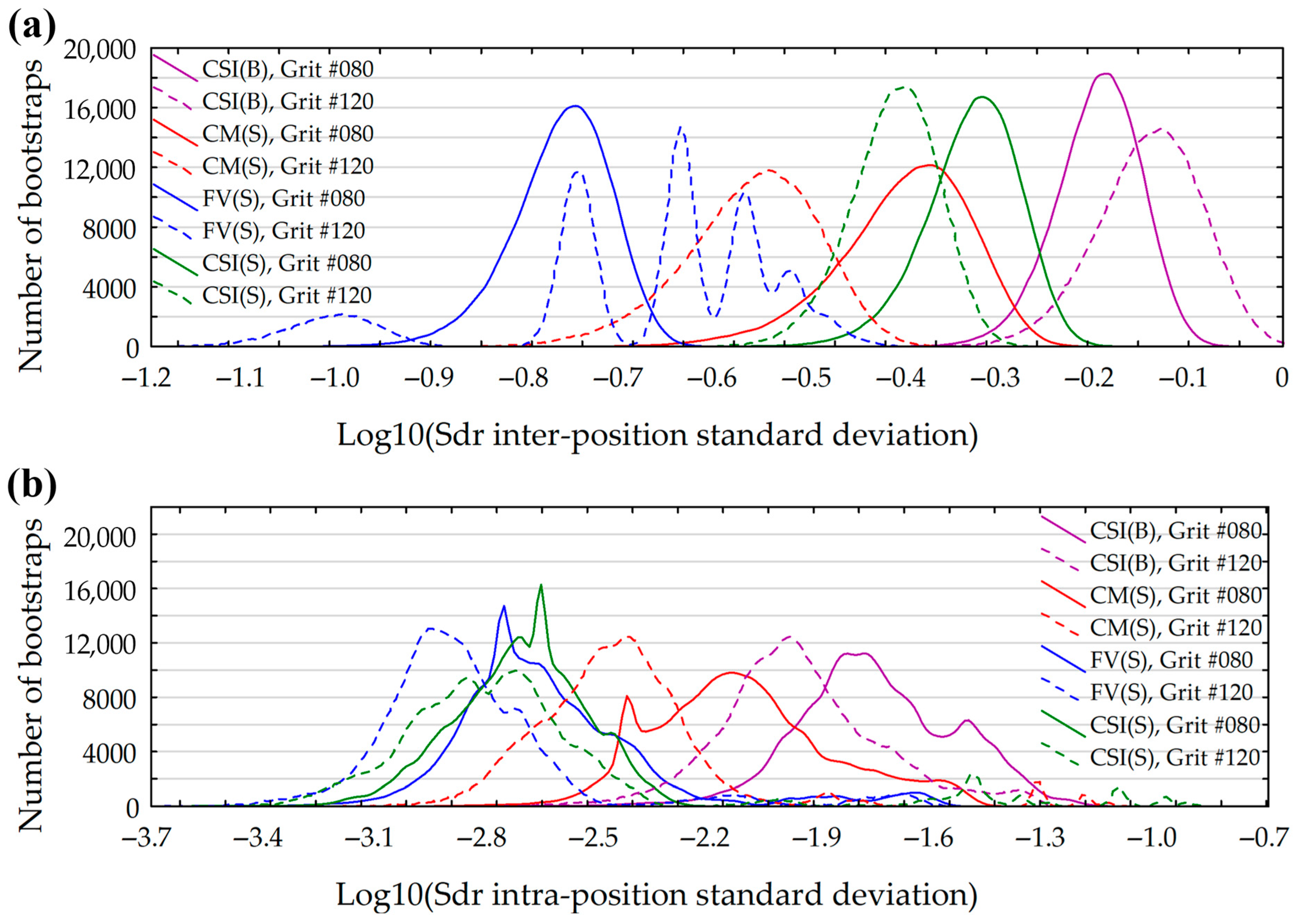
The distributions of the quality index (QI) were estimated using a bootstrap procedure. In each simulation, the ratio of inter-position to intra-position standard deviations was computed across the complete QI dataset. This appendix reports the probability density functions of both inter- and intra-position standard deviations.
Firstly, the inter-position standard deviation is presented in Figure A10a. This sub-index represents topographic representativeness, providing insight into the variation between randomly selected areas on a specimen’s surface. A higher value of this index indicates a broader range of roughness parameter values. It can suggest whether the surface-generation process is performed homogeneously or if the topographic surface is sufficiently large to encompass a representative number of motifs. The analysis of histograms for the Sdr inter-position standard deviation suggests that most measurement modes follow a Gaussian distribution. However, in the case of FV(S) for #120, multiple kernels are observed, indicating the presence of multiple topographic signatures on the surface or a high discrepancy between the random surface measured. On a broader scale, the FV(S) mode exhibits the lowest Sdr variation across measured positions, while the CSI(B) mode shows the highest variation. The CSI(S) mode is close to CSI(B) in terms of topographic representativeness, while the CM(S) mode falls between FV(S) and CSI(S). Regarding grit, no clear trend can be established. In some cases, #080 shows higher values than #120 (e.g., CSI(S) and CM(S)), while in other cases, #080 is lower than #120 (e.g., CSI(B) and FV(S)). Overall, topographic representativeness is primarily influenced by the instrument mode used for measurement.
Secondly, the intra-position standard deviation is analyzed in Figure A10b. This sub-index reflects the measurement noise within a series of measurements, i.e., the fluctuations observed over 10 repeated measurements at the same position across different measured locations. The histograms appear to follow a Gaussian distribution in each case. A similar observation can be made for FV(S) and CSI(B): the FV(S) mode exhibits the lowest Sdr variation within the iteration series, whereas the CSI(B) mode shows the highest fluctuation, suggesting that the CSI(B) instrument is more sensitive due to its underlying technology. Notably, the CSI(S) mode exhibits particularly low intra-position standard deviation, indicating that the measured Sdr values remain stable within the iteration series. The CM(S) mode has values slightly higher than those of CSI(B). Regarding grit, #080 consistently exhibits higher measurement fluctuations than #120 across all cases. This suggests that measurement noise within the series is primarily governed by both the instrument and the grit size.
Figure A10. Representation in log10 of (a) the Sdr inter-position standard deviation and (b) the Sdr intra-position standard deviation.
Metrology 06 00010 g0a10

References

  1. Thomas, T.R. Rough Surfaces, 2nd ed.; World Scientific: Singapore, 1998; ISBN 978-1-78326-236-6. [Google Scholar]
  2. Whitehouse, D.J. Handbook of Surface Metrology; Routledge: New York, NY, USA, 2023; ISBN 978-0-203-75260-9. [Google Scholar]
  3. Jiang, X.J.; Whitehouse, D.J. Technological Shifts in Surface Metrology. CIRP Ann. 2012, 61, 815–836. [Google Scholar] [CrossRef]
  4. Evans, C.J.; Bryan, J.B. “Structured”, “Textured” or “Engineered” Surfaces. CIRP Ann. 1999, 48, 541–556. [Google Scholar] [CrossRef]
  5. Bhushan, B. Bioinspired Structured Surfaces. Langmuir 2012, 28, 1698–1714. [Google Scholar] [CrossRef] [PubMed]
  6. Shen, Y.; Tao, J.; Tao, H.; Chen, S.; Pan, L.; Wang, T. Nanostructures in Superhydrophobic Ti6Al4V Hierarchical Surfaces Control Wetting State Transitions. Soft Matter 2015, 11, 3806–3811. [Google Scholar] [CrossRef] [PubMed]
  7. Tsigarida, A.; Tsampali, E.; Konstantinidis, A.A.; Stefanidou, M. On the Use of Confocal Microscopy for Calculating the Surface Microroughness and the Respective Hydrophobic Properties of Marble Specimens. J. Build. Eng. 2021, 33, 101876. [Google Scholar] [CrossRef]
  8. ISO 25178-2; Geometrical Product Specifications (GPS)—Surface Texture: Areal—Part 2: Terms, Definitions and Surface Texture Parameters. ISO: Geneva, Switzerland, 2021.
  9. Gadelmawla, E.S.; Koura, M.M.; Maksoud, T.M.A.; Elewa, I.M.; Soliman, H.H. Roughness Parameters. J. Mater. Process. Technol. 2002, 123, 133–145. [Google Scholar] [CrossRef]
  10. Nowicki, B. Multiparameter Representation of Surface Roughness. Wear 1985, 102, 161–176. [Google Scholar] [CrossRef]
  11. ASME B46.1; Surface Texture (Roughness, Waviness, Lay). ASME: New York, NY, USA, 2019.
  12. Goïc, G.L.; Bigerelle, M.; Samper, S.; Favrelière, H.; Pillet, M. Multiscale Roughness Analysis of Engineering Surfaces: A Comparison of Methods for the Investigation of Functional Correlations. Mech. Syst. Signal Process. 2016, 66, 437–457. [Google Scholar] [CrossRef]
  13. Deltombe, R.; Kubiak, K.J.; Bigerelle, M. How to Select the Most Relevant 3D Roughness Parameters of a Surface. Scanning 2014, 36, 150–160. [Google Scholar] [CrossRef]
  14. Tchoundjeu, S.; Bigerelle, M.; Robbe-Valloire, F.; Da Silva Botelho, T.; Jarnias, F. How to Select 2D and 3D Roughness Parameters at Their Relevant Scales by the Analysis of Covariance. Materials 2020, 13, 1526. [Google Scholar] [CrossRef]
  15. Berkmans, F.; Lemesle, J.; Guibert, R.; Wieczorowski, M.; Brown, C.; Bigerelle, M. Two 3D Fractal-Based Approaches for Topographical Characterization: Richardson Patchwork versus Sdr. Materials 2024, 17, 2386. [Google Scholar] [CrossRef]
  16. Whitehouse, D.J. Handbook of Surface and Nanometrology, 2nd ed.; CRC Press: Boca Raton, FL, USA, 2010; ISBN 978-0-429-14069-3. [Google Scholar]
  17. Jiang, X.; Scott, P.J.; Whitehouse, D.J.; Blunt, L. Paradigm Shifts in Surface Metrology. Part II. The Current Shift. Proc. R. Soc. A Math. Phys. Eng. Sci. 2007, 463, 2071–2099. [Google Scholar] [CrossRef]
  18. Pawlus, P.; Wieczorowski, M.; Mathia, T. The Errors of Stylus Methods in Surface Topography Measurements; ZAPOL Sobczyk Sp. j.: Warszawa, Poland, 2014. [Google Scholar]
  19. JCGM 200; International Vocabulary of Metrology—Basic and General Concepts and Associated Terms (VIM). 3rd ed. BIPM: Sèvres, France, 2012.
  20. MacAulay, G.D.; Giusca, C.L. Assessment of Uncertainty in Structured Surfaces Using Metrological Characteristics. CIRP Ann. 2016, 65, 533–536. [Google Scholar] [CrossRef]
  21. Foreman, M.R.; Giusca, C.L.; Coupland, J.M.; Török, P.; Leach, R.K. Determination of the Transfer Function for Optical Surface Topography Measuring Instruments—A Review. Meas. Sci. Technol. 2013, 24, 052001. [Google Scholar] [CrossRef]
  22. Petzing, J.; Coupland, J.; Leach, R. Measurement Good Practice Guide No. 116. The Measurement of Rough Surface Topography Using Coherence Scanning Interferometry; NPL: Teddington, UK, 2010. [Google Scholar]
  23. Giusca, C.L.; Leach, R.K. Measurement Good Practice Guide No. 127: Calibration of the Metrological Characteristics of Coherence Scanning Interferometers (CSI) and Phase Shifting Interferometers (PSI); NPL: Teddington, UK, 2013. [Google Scholar]
  24. Giusca, C.L.; Leach, R.K. Measurement Good Practice Guide No. 128: Calibration of the Metrological Characteristics of Imaging Confocal Microscopes (ICMs); NPL: Teddington, UK, 2012. [Google Scholar]
  25. JCGM 102; Evaluation of Measurement Data—Supplement 2 to the “Guide to the Expression of Uncertainty in Measurement”—Extension to Any Number of Output Quantities. BIPM: Sèvres, France, 2011.
  26. Désenfant, M.; Fischer, N.; Blanquart, B.; Bédiat, N. Evaluation de l’incertitudes en utilisant des simulations de Monte Carlo. In Proceedings of the 13ème Congrès International De Métrologie, Lille, France, 18–21 June 2007; Volume 66, p. 3. [Google Scholar]
  27. Liu, M.; Cheung, C.F.; Ren, M.; Cheng, C.-H. Estimation of Measurement Uncertainty Caused by Surface Gradient for a White Light Interferometer. Appl. Opt. 2015, 54, 8670. [Google Scholar] [CrossRef]
  28. Moreau, C.; Bigerelle, M.; Marteau, J.; Lemesle, J.; Paez, D.; Guibert, R.; Blateyron, F.; Brown, C.A. A Novel Methodology to Assess Optical Profilometer Stability to Discriminate Surface Roughness. Surf. Topogr. Metrol. Prop. 2024, 12, 025018. [Google Scholar] [CrossRef]
  29. Moreau, C.; Lemesle, J.; Páez Margarit, D.; Blateyron, F.; Bigerelle, M. A Statistical Approach for Characterizing the Behaviour of Roughness Parameters Measured by a Multi-Physics Instrument on Ground Surface Topographies: Four Novel Indicators. Metrology 2024, 4, 640–672. [Google Scholar] [CrossRef]
  30. Leach, R. (Ed.) Characterisation of Areal Surface Texture; Springer: Berlin/Heidelberg, Germany, 2013; ISBN 978-3-642-36457-0. [Google Scholar]
  31. Giusca, C.L.; Leach, R.K. Calibration of the Scales of Areal Surface Topography Measuring Instruments: Part 3. Resolution. Meas. Sci. Technol. 2013, 24, 105010. [Google Scholar] [CrossRef]
  32. ISO 25178-600; Geometrical Product Specifications (GPS)—Surface Texture: Areal—Part 600: Metrological Characteristics for Areal Topography Measuring Methods. ISO: Geneva, Switzerland, 2019.
  33. Efron, B.; Tibshirani, R. Statistical Data Analysis in the Computer Age. Science 1991, 253, 390–395. [Google Scholar] [CrossRef]
  34. ISO 25178-604; Geometrical Product Specifications (GPS)—Surface Texture: Areal Nominal Characteristics of Non-Contact (Coherence Scanning Interferometry) Instruments. ISO: Geneva, Switzerland, 2013.
  35. ISO 25178-606; Geometrical Product Specification (GPS)—Surface Texture: Areal Nominal Characteristics of Non-Contact (Focus Variation) Instruments. ISO: Geneva, Switzerland, 2015.
  36. ISO 25178-607; Geometrical Product Specifications (GPS)—Surface Texture: Areal Nominal Characteristics of Non-Contact (Confocal Microscopy) Instruments. ISO: Geneva, Switzerland, 2019.
  37. Ville, H. Traceable Industrial 3D Roughness and Dimensional Measurement Using Optical 3D Microscopy and Optical Distance Sensors; EU Project: Brussels, Belgium, 2024. [Google Scholar]
  38. Helmli, F. Focus Variation Instruments. In Optical Measurement of Surface Topography; Springer: Berlin/Heidelberg, Germany, 2011; pp. 131–166. [Google Scholar]
  39. Leach, R. Optical Measurement of Surface Topography; Springer: Berlin/Heidelberg, Germany, 2011; Volume 8. [Google Scholar]
  40. Leach, R. Advances in Optical Surface Texture Metrology; IOP Publishing Ltd.: Bristol, UK, 2020; ISBN 978-0-7503-2528-8. [Google Scholar]
  41. Danzl, R.; Helmli, F.; Scherer, S. Focus Variation—A Robust Technology for High Resolution Optical 3D Surface Metrology. SV-JME 2011, 2011, 245–256. [Google Scholar] [CrossRef]
  42. Lange, D.A.; Jennings, H.M.; Shah, S.P. Analysis of Surface Roughness Using Confocal Microscopy. J. Mater. Sci. 1993, 28, 3879–3884. [Google Scholar] [CrossRef]
  43. Ekberg, P.; Su, R.; Leach, R. High-Precision Lateral Distortion Measurement and Correction in Coherence Scanning Interferometry Using an Arbitrary Surface. Opt. Express 2017, 25, 18703–18712. [Google Scholar] [CrossRef]
  44. Durbin, J.; Watson, G.S. Testing for Serial Correlation in Least Squares Regression: I. Biometrika 1950, 37, 409–428. [Google Scholar] [CrossRef]
  45. Farebrother, R.W. Algorithm AS 153: Pan’s Procedure for the Tail Probabilities of the Durbin-Watson Statistic. J. R. Stat. Soc. Ser. C (Appl. Stat.) 1980, 29, 224–227. [Google Scholar] [CrossRef]
  46. Lu, W.; Zhang, G.; Liu, X.; Zhou, L.; Chen, L.; Jiang, X. Prediction of Surface Topography at the End of Sliding Running-In Wear Based on Areal Surface Parameters. Tribol. Trans. 2014, 57, 553–560. [Google Scholar] [CrossRef]
  47. Lonardo, P.M.; Trumpold, H.; De Chiffre, L. Progress in 3D Surface Microtopography Characterization. CIRP Ann. 1996, 45, 589–598. [Google Scholar] [CrossRef]
  48. Blunt, L.; Jiang, X. Advanced Techniques for Assessment Surface Topography: Development of a Basis for 3D Surface Texture Standards" Surfstand"; Elsevier: Amsterdam, The Netherlands, 2003. [Google Scholar]
  49. Werb, M.; Falcón García, C.; Bach, N.C.; Grumbein, S.; Sieber, S.A.; Opitz, M.; Lieleg, O. Surface Topology Affects Wetting Behavior of Bacillus Subtilis Biofilms. npj Biofilms Microbiomes 2017, 3, 11. [Google Scholar] [CrossRef]
  50. Zhang, Y.; Fu, T.; Zhu, J.; Zhang, X. Microstructure Evolution, Growth Kinetics and Formation Mechanisms of Silicon-Rich NbSi2 Coatings on Nb Substrate. J. Mater. Res. Technol. 2023, 24, 6076–6087. [Google Scholar] [CrossRef]
  51. Winkeljann, B.; Leipold, P.-M.A.; Lieleg, O. Macromolecular Coatings Enhance the Tribological Performance of Polymer-Based Lubricants. Adv. Mater. Interfaces 2019, 6, 1900366. [Google Scholar] [CrossRef]
  52. Patois, T.; Lakard, B.; Monney, S.; Roizard, X.; Fievet, P. Characterization of the Surface Properties of Polypyrrole Films: Influence of Electrodeposition Parameters. Synth. Met. 2011, 161, 2498–2505. [Google Scholar] [CrossRef]
  53. Pawlus, P.; Reizer, R.; Wieczorowski, M.; Krolczyk, G.M. Study of Surface Texture Measurement Errors. Measurement 2023, 210, 112568. [Google Scholar] [CrossRef]
Figure 1. Ichikawa chart showing the uncertainty parameters organized into categories.
Metrology 06 00010 g001
Figure 2. Measurement plan applied for measuring one zone of the #120 surface for 5 days (long term) with Bruker ContourGT, CSI(B).
Metrology 06 00010 g002
Figure 3. Morphomeca monitoring highlighting the measurement strategy regarding the paper grit levels (#080 and #120), measurement instrument CSI(B) (ContourGT® Bruker), iterations (10), and repetitions (30).
Metrology 06 00010 g003
Figure 4. Simplified explanation of the Morphomeca monitoring measurement plan.
Metrology 06 00010 g004
Figure 5. Stability index (SI) in relative order for each roughness parameter computed on the long-time measurement series measured by CSI(B).
Metrology 06 00010 g005
Figure 6. Application of the AR2 model on the Sdr roughness parameter values: (a) the real versus predicted values and (b) the AR2 residuals of Sdr.
Metrology 06 00010 g006
Figure 7. Time representation of Sdr for each instrument: (a) Sensofar Sneox (CSI, CM, and FV) grit #080, (b) Bruker ContourGT (CSI) grit #080, (c) Sensofar Sneox (CSI, CM, and FV) grit #120, and (d) Bruker ContourGT (CSI) grit #120.
Metrology 06 00010 g007
Figure 8. Representation of the quality index for the four studied instruments and two grits.
Metrology 06 00010 g008
Figure 9. Three-dimensional quality representation of the measurement for the used measurement instruments (CSI(S), FV(S), CM(S), and CSI(B)) and the two grinding levels (#080 and #120).
Metrology 06 00010 g009
Figure 10. Drift values of the measurement series with values bootstrapped 106 times, computed with Sdr parameter values, highlighting the instruments associated with the measured grit that exhibit the most cases of drift (a) in a histogram view and (b) in a cumulated view.
Metrology 06 00010 g010
Figure 11. Stability index computed on the iteration series based on the Sdr roughness parameter from measurements performed with the CSI(S), CM(S), FV(S), and CSI(B) modes on grit #080 and #120 (a) in 2D and (b) 3D.
Metrology 06 00010 g011
Figure 12. Two-way ANOVA representing (a) the relevance index for each instrument (CSI(S), CM(S), FV(S), and CSI(B)) and (b) the F-value histograms showing the influence of grit, instrument, and [grit × instrument] computed from Sdr values.
Metrology 06 00010 g012
Table 1. Summary of the indices used to carry out the analysis.
Name (Acronym)Mathematical EquationDescriptionValidity Thresholds
Quality Index (QI) QI = σ inter σ intra Represents a signal-to-noise ratio, where measurement noise is associated with intra-position fluctuations, while the signal reflects inter-position topographical representativeness.Good quality: QI ≥ 6
Poor quality: QI < 6
Drift Index (DI) DI = p value - DW = MIN ( p value - DW - Neg , p value - DW - Pos ) Models and detects intra-position time correlations -based on Durbin–Watson and p-value statistics.No drift: DI ≥ 0.025
Drift: DI < 0.025
Stability Index (SI) SI = σ residuals   AR ( 2 ) σ residuals   AR ( 0 ) Assesses whether intra-position measurement noise is correlated or uncorrelated, reflecting measurement stability.Stable: SI ≥ 0.5
Not stable: SI < 0.5
Relevance Index (RI) RI = Var Inter - group Var Intra - group Evaluates whether a significant difference exists between abrasion grades across a selected variable: multiple instruments, process settings, or roughness parameters.Significant difference between groups: log(RI) ≥ 0
No significant difference between groups: log(RI) < 0
Table 2. Classification of observed cases, taking into account the trend and dispersion of roughness parameters.
CasesTrendDispersionRoughness Parameters
A (best)++Sdr
B+Sku, Vv, Sa, Sq, Sds
C+Sha, Sda
D (worst)S10z, S5p, S5v, Sv, Sz
E+/−Vm, Sk, Spk, Ssk
Table 3. Overview of instrument performances.
Instruments Mean Value of Sdr Best Quality Lower Drift Stability Relevance
CSI(B)+++++
CSI(S)++++
CM(S)+++++++
FV(S)++
Disclaimer/Publisher’s Note: The statements, opinions and data contained in all publications are solely those of the individual author(s) and contributor(s) and not of MDPI and/or the editor(s). MDPI and/or the editor(s) disclaim responsibility for any injury to people or property resulting from any ideas, methods, instructions or products referred to in the content.