
You are currently viewing a new version of our website. To view the old version click .

COVID, Volume 3, Issue 1

January 2023 - 6 articles

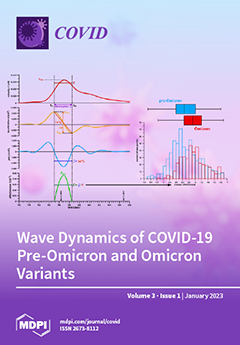
Cover Story: Omicron, the latest variant of SARS-CoV-2 of concern, behaves differently from previous variants in terms of epidemiological dynamics. Analyzing 1000 COVID-19 waves worldwide from the start of the pandemic to August 28, 2022, the average number of Omicron waves per month (42.78) was greater than that of pre-Omicron waves (25.62). Omicron waves steepen and flatten the curve significantly faster than pre-Omicron waves and were managed significantly more effectively, in a significantly shorter time, and with significantly sharper peaks. Comparing the behavior of each wave's peak daily case data, the pre-Omicron trend showed increasing daily case numbers over time, while the Omicron trend showed decreasing numbers. View this paper
  • Issues are regarded as officially published after their release is announced to the table of contents alert mailing list .
  • You may sign up for email alerts to receive table of contents of newly released issues.
  • PDF is the official format for papers published in both, html and pdf forms. To view the papers in pdf format, click on the "PDF Full-text" link, and use the free Adobe Reader to open them.

Articles (6)

  • Review
  • Open Access
13 Citations
9,863 Views
34 Pages

16 January 2023

In the ongoing COVID-19 pandemic, digital technologies have played a vital role to minimize the spread of COVID-19, and to control its pitfalls for the general public. Without such technologies, bringing the pandemic under control would have been tri...

  • Article
  • Open Access
4 Citations
2,953 Views
8 Pages

Spatial Mapping of Genes Implicated in SARS-CoV-2 Neuroinvasion to Dorsolateral Prefrontal Cortex Gray Matter

  • Sai Batchu,
  • Michael Joseph Diaz,
  • Jasmine Thuy Tran,
  • Angela Fadil,
  • Kamil Taneja,
  • Karan Patel and
  • Brandon Lucke-Wold

6 January 2023

Introduction: SARS-CoV-2 is the newest beta coronavirus family member to demonstrate neuroinvasive capability in severe cases of infection. Despite much research activity in the SARS-CoV-2/COVID-19 space, the gene-level biology of this phenomenon rem...

  • Article
  • Open Access
2,263 Views
17 Pages

Mitigation of Socio-Economical Inequalities on the Profile of Healthcare Workers Infected with SARS-CoV-2 upon Vaccination: The Experience of a Brazilian Public Healthcare Institution during the Omicron Wave

  • Maria Celia Chaves Zuma,
  • Roberta Soares Faccion,
  • Ana Carolina Carioca da Costa,
  • Leonardo Henrique Ferreira Gomes,
  • Daniella Campelo Batalha Cox Moore,
  • Saint Clair Gomes Junior,
  • Adriana Cesar Bonomo,
  • Wilson Savino,
  • Sotiris Missailidis and
  • Zilton Farias Meira Vasconcelos

5 January 2023

Background: COVID-19 increased health inequalities worldwide. Even among healthcare workers, social-economical features enhanced the risk of infection (having positive serology) during the first outbreak. The Omicron variant changed the pandemic cour...

  • Article
  • Open Access
4 Citations
3,465 Views
14 Pages

Repeat-Dose Toxicity of Candidate Omicron COVID-19 Vaccine in Sprague-Dawley Rats

  • Yuxiu Zhao,
  • Zhenyu He,
  • Zhanhui Wang,
  • Yao He,
  • Xue Zhao,
  • Hongyang Liang,
  • Yancen Guo,
  • Yichuan Wang,
  • Xiaonan Zhang and
  • Huiqin Zhu
  • + 9 authors

27 December 2022

Due to a large number of mutations in the spike protein and immune escape, the Omicron variant (B.1.1.529) has become a predominant variant of concern (VOC) strain. To prevent the disease, we developed a candidate inactivated vaccine (Omicron COVID-1...

  • Article
  • Open Access
2 Citations
4,954 Views
23 Pages

26 December 2022

Compared to previous SARS-CoV-2 variants, the Omicron variant exhibited different epidemiological features. The purpose of this study was to assess the wave dynamics of pre-Omicron and Omicron waves in terms of differences and similarities. We invest...

  • Review
  • Open Access
11 Citations
15,360 Views
27 Pages

23 December 2022

Industries worldwide have faced continuous burdens since the beginning of the COVID-19 pandemic, while adjusting to rapidly changing rules and regulations. Industries need to be prepared to remain operational and productive in the face of current and...

Get Alerted

Add your email address to receive forthcoming issues of this journal.

XFacebookLinkedIn
COVID - ISSN 2673-8112