
Article

Popcorn-like Particles from an Amino Acid, Poly(L-Cysteine) as Drug Delivery System with Blood-Compatible, Bio-Compatible, Antibacterial, and Antioxidant Properties


1
Department of Chemical Engineering, Faculty of Engineering, Canakkale Onsekiz Mart University, Canakkale 17100, Turkey
2
Department of Bioengineering, U. A. Whitaker College of Engineering, Florida Gulf Coast University, Fort Myers, FL 33965, USA
3
Department of Food Engineering, Faculty of Engineering, Istanbul Aydin University, Florya Halit Aydin Campus, Istanbul 34153, Turkey
4
Department of Chemistry, Faculty of Sciences, Canakkale Onsekiz Mart University, Terzioglu Campus, Canakkale 17100, Turkey
5
Department of Bioengineering, Faculty of Engineering, Canakkale Onsekiz Mart University, Terzioglu Campus, Canakkale 17100, Turkey
6
Department of Chemistry, Faculty of Sciences, Hacettepe University, Beytepe Campus, Ankara 06800, Turkey
*
Author to whom correspondence should be addressed.
Submission received: 21 November 2025 / Revised: 23 December 2025 / Accepted: 9 January 2026 / Published: 13 January 2026

Abstract

A facile and single-step synthesis of poly(L-Cysteine) (p(L-Cys)) particles through microemulsion polymerization using tetrakis(hydroxymethyl) phosphonium chloride (THPC) as crosslinker is accomplished for the first time. The L-Cys:THPC ratio in p(L-Cys) particles was calculated as 80:20% (by weight) with elemental analyses, and the generation of p(L-Cys) particles was confirmed. SEM imaging revealed a popcorn-like morphology of the p(L-Cys) particles with a 1–20 µm particle size range. The isoelectric point of p(L-Cys) particles was determined at pH 1.15 via zeta potential measurements. The hydrolytic degradation of p(L-Cys) particles was determined as about 85% within 3 h (by weight). The p(L-Cys) particles displayed excellent blood compatibility with a hemolysis % ratio of <2.3% and a blood clotting index of 95% at 1 mg/mL concentration. Moreover, cell compatibility tests up to 50 mg/mL against L929 fibroblast cells exhibited about 90% cell viability for p(L-Cys) particles versus 58% for L-Cys molecule. The antimicrobial efficacy of the L-Cys molecules was notably enhanced in p(L-Cys) particles, exhibiting a 5-fold reduction in minimal bactericidal concentration (MBC) values against E. coli (Gram-negative, ATCC 8739) and a 2-fold reduction against S. aureus (Gram-positive, ATCC 6538). Additionally, the antioxidant capacity of p(L-Cys) particles was retained somewhat, measured as 0.14 ± 0.01 µM versus 2.25 ± 0.03 µM Trolox equivalent/g for L-Cys. Therefore, p(L-Cys) particles are versatile and offer a unique avenue for immense biomedical use.

1. Introduction

Biopolymer-derived particles and nanogels, commonly known as bio-particles and bio-nanogels, have attracted considerable attention in tissue engineering and drug delivery systems [1,2,3]. These types of materials combine the beneficial attributes of synthetic polymers with the advantages of being biodegradable, widely available, renewable, non-toxic, and relatively economical [4,5,6]. Additionally, bio-micro/nanogels are characterized by a rich array of functional groups, including hydroxyl, amino, thiol, and carboxylic acid groups [4,7]. This diverse functionalization not only promotes effective cross-linking with various functional cross-linkers but also allows for enhanced bioconjugation with agents that target specific cells [8,9].
Beyond their structural and chemical advantages, the antibacterial and antioxidant functionalities of bio-particles have gained mounting importance in biomedical applications [10]. Bacterial infections remain one of the primary complications associated with implanted biomaterials and wound dressings, often leading to inflammation, delayed tissue regeneration, and implant failure [11,12]. Materials exhibiting intrinsic antibacterial activity can inhibit microbial adhesion and proliferation without relying on external antibiotics, thereby minimizing the risk of antibiotic resistance and associated adverse effects [13,14,15].
Similarly, oxidative stress caused by excessive production of reactive oxygen species (ROS) plays a key role in cellular damage and impaired healing processes [16,17]. Biomaterials with antioxidant properties can scavenge free radicals, reduce oxidative stress, and promote cell survival and tissue regeneration [18]. Notably, the degradation products of certain bio-particles may consist of biologically active molecules possessing inherent antibacterial and antioxidant activities, allowing these systems to function not only as drug carriers but also as bioactive therapeutic agents that enhance therapeutic efficacy and patient outcomes.
Recent studies have emphasized the incorporation of amino acid components into polymeric structures as a promising strategy, owing to their responsiveness to stimuli, exceptional biocompatibility, solubility in water, and ability to facilitate both intra- and inter-chain interactions through non-covalent bonds [19,20,21,22,23]. Various methodologies have been investigated to integrate amino acids into polymer frameworks, including their positioning along the polymer backbone, as terminal functionalities, and within side chains [22,24,25]. Polymers that incorporate amino acids in the backbone, commonly referred to as polypeptides, have been synthesized from cyclic monomers derived from amino acids, particularly N-carboxy anhydrides (NCA), via the process of ring-opening polymerization (ROP) [26,27]. Additionally, the utilization of amino acid-based initiators or chain transfer agents has proven essential for the incorporation of amino acid units at the terminal ends of these polymers [28,29]. Moreover, polymers featuring amino acids in their side chains have been produced through free radical polymerization (FRP) [30] or controlled radical polymerization (CRP) [31] techniques, utilizing vinylic monomers modified at the C-terminal (-COOH) or N-terminal (-NH2) positions.
In the literature, various studies have reported the synthesis of poly(L-cysteine) (p(L-Cys)) micro/nano gel/particles [32,33,34,35,36,37]. These p(L-Cys) particles are noted for their benefits, including degradability [32,33], stability, and efficacy in drug delivery [34]; responsiveness to stimuli such as pH and redox reactions [35]; size controllability through initiators and surfactants [36]; and their role as effective antioxidant carriers [37]. Nonetheless, the synthesis of these particles is not without its drawbacks, as it necessitates the use of NCA monomers [32,33], a UV deprotection step, polymer usage, a methacrylate monomer [36] and meticulous emulsion control [35,36]. Thus, these methods cannot be classified as straightforward one-step processes. This study highlights that p(L-Cys) particles exhibiting degradable, antioxidant, and antibacterial characteristics similar to the reported ones, along with the ability to be synthesized directly from L-Cys in a single step, which represents a distinguished advantage from other research reported in the literature. Here, poly(L-Cysteine) (p(L-Cys)) particles were synthesized by chemical crosslinking utilizing a single-step reverse-micelle microemulsion polymerization technique. This method was previously employed by our research group to produce p(L-Lysine) and p(L-Arginine) particles [38,39]. Evaluation of the blood compatibility of the synthesized p(L-Cys) particles was conducted by examining the hemolysis ratio and blood clotting indices. The cytotoxicity of these particles on L929 fibroblast cells was evaluated using the MTT assay. Moreover, the antibacterial and antioxidant properties of L-Cys molecules and p(L-Cys) particles were compared. The antibacterial efficacy was assessed using disk diffusion and microdilution techniques against Escherichia coli (E. coli, ATCC 8739), Pseudomonas aeruginosa (P. aeruginosa, ATCC 10145), Staphylococcus aureus (S. aureus, ATCC 6538), and Bacillus subtilis (B. subtilis) ATCC 6633, in addition to the yeast strain Candida albicans (C. albicans, ATCC 10231). The Trolox Equivalent Antioxidant Capacity (TEAC) assay was employed to evaluate the antioxidant properties of the p(L-Cys) particles.

2. Materials and Methods

2.1. Materials

L-Cysteine (L-Cys, 98%, Sigma Aldrich, Germany) served as the monomer, while tetrakis (hydroxymethyl) phosphonium chloride (THPC, 80% solution in H2O, Aldrich, Milwaukee, WI, USA) was utilized as the crosslinking agent, both being used as received forms. The formulation of the microemulsion system incorporated dioctyl sulfosuccinate sodium salt (AOT, >97%, Aldrich, St. Louis, MI, USA) and unleaded gasoline (TOTAL, local vender, Canakkale, Turkey). To facilitate the dissolution of L-Cys, sodium hydroxide (NaOH, 98–100.5%, Sigma Aldrich, St. Louis, MI, USA) was utilized. For the purification of p(L-Cys) particles, acetone (Technical grade, 96%, BIRPA, Istanbul, Turkey) and ethanol (Technical grade, 96%, BILKIM, Izmir, Turkey) were employed as solvents. The antioxidant assay involved the use of 2,2′-Azino-bis-(3-ethylbenzothioazoline-6-sulfonic acid) diammonium salt (ABTS, Aldrich, Oakville, ON, Canada) and potassium persulfate (KPS, 99%, Aldrich, Darmstadt, Germany). In the hemolysis and clotting assays, sodium chloride (NaCl, 99%, MilliPore, West Point, PA, USA) and calcium chloride (CaCl2, 99%, Merck, Molsheim, France) were utilized, respectively. Microbial growth media included nutrient agar, potato dextrose agar, and nutrient broth, all sourced from Merck. The microbial strains Escherichia coli ATCC 8739, Pseudomonas aeruginosa ATCC 10145, Bacillus subtilis ATCC 6633, Staphylococcus aureus ATCC 6538, and Candida albicans ATCC 10231 were obtained from the Microbiology Department of the School of Medicine, Canakkale Onsekiz Mart University. Gentamicin (Genta 120 mg, I.E. Ulagay) was employed as a reference in the assessment of antimicrobial activity. Throughout the experiments, ultra-pure distilled water (18.2 MΩ.cm, Millipore Direct-Q3, Molsheim, France) was utilized for the preparation of all aqueous solutions.

2.2. Synthesis of Popcorn-like P(L-Cys) Particles

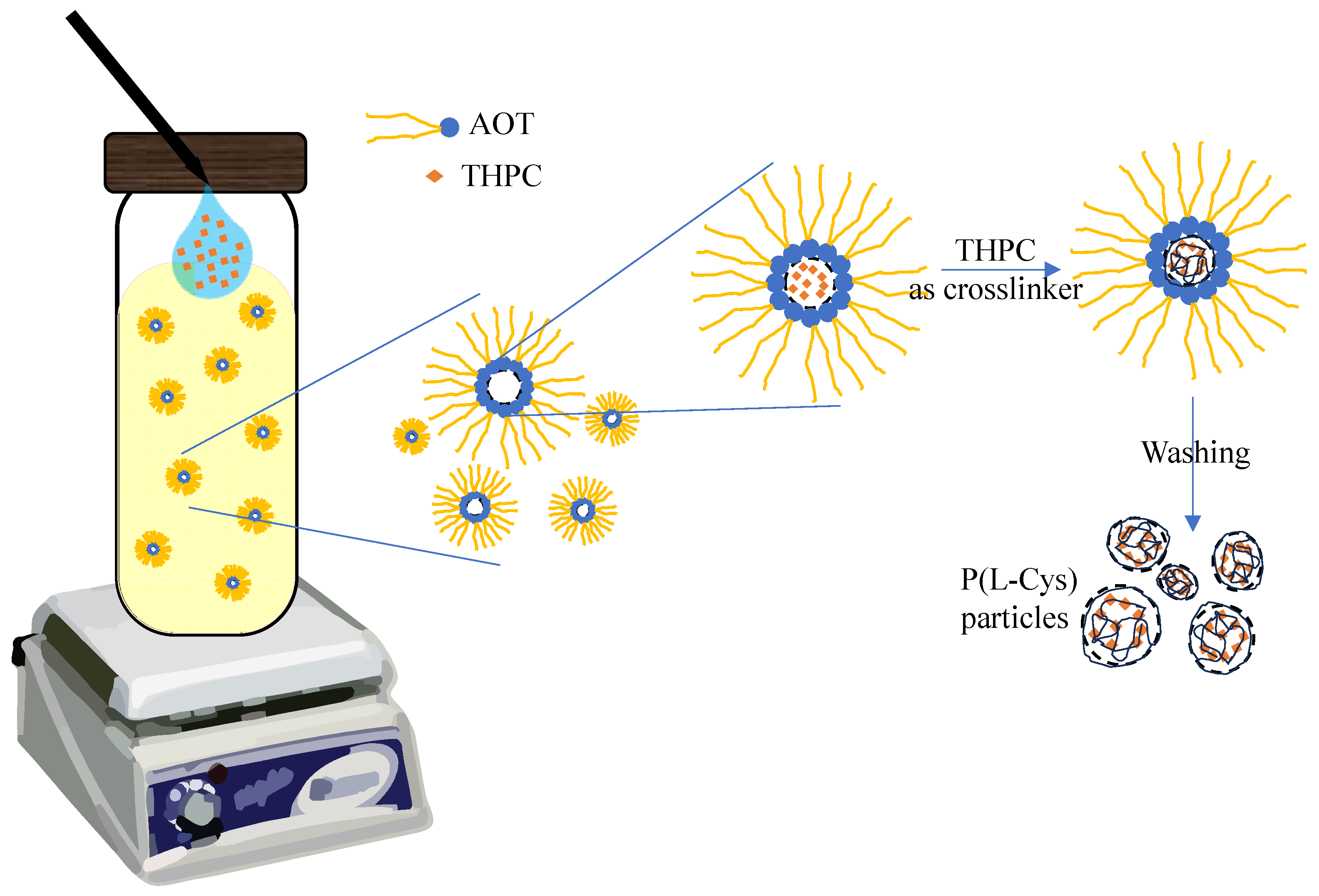
The synthesis of popcorn-like p(L-Cys) particles was conducted according to the established literature, incorporating several modifications to enhance the process [38,39], and schematic presentation is given in Scheme 1.
Considering this procedure, a solution was prepared by introducing 0.625 g of L-Cys together with 0.2 g of NaOH pellets, subsequently adding 1.25 mL of water to the mixture. Following total dissolution, 125 μL of the alkaline L-Cys solution was pipetted dropwise into a 30 mL of 0.1 M AOT/gasoline solution, and the microemulsion was homogenized for five minutes by stirring at 1000 rpm. After that, the polymerization reaction was completed by adding 91 μL of the cross-linker THPC to the medium and stirring at 1000 rpm for an additional hour. The p(L-Cys) particles obtained were precipitated using excess acetone and isolated through a two-step centrifugation process conducted at 10,000 rpm for ten minutes each. The purification of p(L-Cys) particles was achieved through a series of centrifugation and resuspension steps utilizing various solvents, including acetone, a mixture of acetone and water in a 90:10 volume ratio, a combination of ethanol and water also in a 90:10 volume ratio, pure ethanol, and acetone, respectively. The particles were then dried using a heat gun and kept in sealed tubes for further experiments.

2.3. Characterization of P(L-Cys) Particles

The p(L-Cys) particles underwent scanning electron microscopy (SEM, Jeol JSM-5600 LV, Tokyo, Japan) analysis at an acceleration voltage of 20 kV, following the application of gold coating under high vacuum conditions. The Fourier Transform Infrared (FT-IR, Thermo Fisher Scientific iS10 spectrometer) spectra of pristine L-Cys and p(L-Cys) particles were recorded in the attenuated total reflection (ATR) mode in the wavenumber range of 4000 to 650 cm−1, with a spectral resolution of 4 cm−1. Elemental analysis of the p(L-Cys) particles was performed by using an elemental analyzer (Thermo Scientific Flash 2000, Waltham, MA, USA.), operating at 950 °C in nitrogen atmosphere. This analysis enabled quantification of the weight% of carbon (C), sulfur (S), hydrogen (H), and nitrogen (N) present in the samples. The thermal properties of L-Cys molecules and p(L-Cys) particles were evaluated by utilizing a thermogravimetric analyzer (TGA, SII TG/DTA 6300, Exstar, Tokyo, Japan), with sample weights varying between 3 and 5 mg. Prior to the main analysis, the samples were subjected to heating at 100 °C to eliminate any moisture content. Subsequently, thermograms were generated between 90 and 800 °C with a continuous flow of nitrogen gas at a rate of 200 mL/min. The zeta potential of the p(L-Cys) particles was measured using a zeta potential analyzer (Brookhaven Instruments (90+)) in 25 mL 0.01 M NaCl solution at a concentration of 1 mg/mL, across pH values varying from 2 to 10, with adjustments made using 0.1 M aqueous NaOH and HCl solutions. Each measurement in zeta potential analyses was performed in triplicates, and the average values and the corresponding standard deviations were reported. The isoelectric point was determined as the pH value at which the zeta potential of the particles was equal to zero, as obtained from the zeta potential versus pH graphs.

2.4. Hydrolytic Degradation of P(L-Cys) Particles

In phosphate-buffered solution (PBS), three distinct pH values were selected to investigate the effects of pH on the hydrolytic degradation of p(L-Cys) particles: pH 5.4, which corresponds to about body skin conditions; pH 7.4, corresponds to physiological conditions; and pH 9, which simulates the alkaline intestinal environment. To analyze the hydrolytic degradation of p(L-Cys) particles using UV-Vis spectroscopy, the dialysis cell setup was used. For this purpose, 25 mg of p(L-Cys) particles were placed in dialysis membrane (molecular weight cutoff of at least 12,000 Da, Aldrich, Saint Louis, MO, USA) with 1 mL of PBS and closed tightly with plastic cables from both ends. After that, this particle suspension containing dialysis membrane was placed into closed tubes which contain 40 mL of PBS. Finally, the tubes were placed into shaking water bath at 37.5 °C. The concentration of L-Cys in the elution solution was assessed at specific wavelengths: 252, 286 and 282 nm for the pH values of 5.4, 7.4, and 9.0, respectively. Before conducting these measurements, calibration curves for L-Cys had already been established at the corresponding wavelengths. Three repeats of hydrolytic degradation tests were performed, and the results were shown as mean values plus standard deviations.

2.5. Bioactive Properties of P(L-Cys) Particles

2.5.1. Blood-Compatibility

The procedures followed in this research received approval from the Human Research Ethics Committee at Canakkale Onsekiz Mart University (KAEK-2015-13). Blood samples were obtained from healthy volunteers, and fresh blood was placed into hemogram tubes containing EDTA and the tubes were gently inverted. The compatibility of the p(L-Cys) particles with human blood was assessed using hemolysis and blood clotting techniques.
A fresh blood sample consisting of 2 mL of EDTA was diluted with 2.5 mL of 0.9% saline solution. Subsequently, a certain amount of p(L-Cys) particles in the range of about 2.5 to 20 mg was added to 10 mL of saline solution, and then heated to 37.5 °C. Next, 0.2 mL of diluted blood solution was introduced into the particle-loaded medium and incubated in a shaking bath at 37.5 °C for one hour. The resulting particle suspensions were subjected to centrifugation at 100× g for 5 min, after which the absorbance of the supernatant was assessed with a UV-Vis spectrophotometer at the wavelength of 542 nm to quantify the absorbance of the released hemoglobin. The hemolysis ratio was calculated using the following Equation (1):
H e m o l y s i s % = A s a m p l e A n e g a t i v e ( A p o s i t i v e A n e g a t i v e ) × 100
where Asample represents the absorbance of the blood sample solution, while Apositive and Anegative denote the absorbances of 0.2 mL diluted blood in 10 mL deionized water or 0.2 mL diluted blood in 10 mL saline solution, respectively.
On the other hand, to assess the clotting potential of p(L-Cys) particles, 0.24 mL of 0.2 M calcium chloride solution was added to 3 mL of fresh blood containing EDTA, followed by gentle inversion of the mixture. Next, 0.27 mL of this blood solution was applied to varying quantities of p(L-Cys) particle surfaces until full coverage was achieved. The tubes containing the p(L-Cys) particles and blood solution were then incubated in a shaking incubator at 37.5 °C for 10 min. Following this incubation, 10 mL of deionized water was incrementally added, and the mixture was centrifuged at 100× g for 30 s. The resulting supernatant was combined with 40 mL of deionized water and incubated at 37.5 °C for one hour. The absorbance of this final solution was recorded using a UV-Vis spectrophotometer at 542 nm. The blood clotting index was calculated using Equation (2):
B l o o d   C l o t t i n g   I n d e x = A s a m p l e ( A b l o o d ) × 100
where Asample denotes the absorbance of the blood solution in contact with the sample, and Ablood indicates the absorbance of the blood solution diluted in 50 mL of deionized water.

2.5.2. Cell Toxicity of L-Cys and P(L-Cys) Particles

The MTT assay was used to evaluate the cytotoxic effects of L-Cys molecules and p(L-Cys) particles on L929 fibroblast cells. The fibroblast cells were maintained in DMEM enriched with 10% (v/v) fetal bovine serum (FBS) and 1% antibiotics and incubated at 37 °C in 5% CO2 environment. First, 100 μL of cell suspension prepared at a concentration of 5 × 10⁴ cells/mL in the culture medium was poured into each well of a 96-well plate. The plate was then incubated for the whole day using the same setup. After incubation, 100 μL of suspensions or solutions containing L-Cys molecules and p(L-Cys) particles at different concentrations from 10 to 250 μg/mL were added to the adherent cells in the wells. An additional 24 h were spent for incubating the plate at 37 °C in 5% CO2 atmosphere. The solutions were then removed from the wells, and the cells were treated with 100 μL MTT solution (0.5 mg/mL) prepared in the culture medium after being purified with PBS. The MTT solution was removed after a 2 h incubation period and 200 μL of DMSO was added to each well. The cell viability% values of the control group were calculated based on the absorbance measured at 590 nm with a plate reader (Thermo, Multiskan Sky, Waltham, MA, USA). Three duplicates of each experiment were performed, and the results were expressed using standard deviations. Statistical differences were calculated using the Microsoft Office Excel software (Analysis ToolPak Add-ins) according to a one-way ANOVA test, and are given as * p < 0.05 and ** p < 0.001 compared with the control group.

2.5.3. Antibacterial Activity

Two methods were used to determine and compare the antimicrobial ability of L-Cys molecules and p(Cys) particles: disk diffusion assay and microdilution assay for Gram-negative and Gram-positive bacterial strains, including E. coli (ATCC 8739), P. aeruginosa (ATCC 10145), S. aureus (ATCC 6538) and B. subtilis (ATCC 6633), as well as the yeast strain C. albicans (ATCC 10231). E. coli (ATCC 8739) and B. subtilis (ATCC 6633) were both used in the microdilution method. Disk diffusion tests were used to examine the above-mentioned yeasts and bacteria. Stock cultures were revived and allowed to grow in nutrient broth at 35 °C for 24 h. L-Cys molecules and p(L-Cys) particles were sterilized by UV irradiation (420 nm) for five minutes before antimicrobial testing.
Disk diffusion method: 10 mg of sterilized L-Cys molecules and p(L-Cys) particles were added onto 9 mm sterile disks placed on an agar plate containing 100 µL of a bacterial/yeast suspension adjusted with McFarland 0.5 standard at 108 CFU/mL (colony forming unit). An additional 18 to 24 h were spent incubating the plate at 35 °C. The clean zone diameter around the disks for the growth of yeast or bacteria was used to calculate the zones of inhibition. A gentamicin solution containing 80 mg/mL in 10 μL was utilized as the reference. All bacterial and yeast strains underwent three iterations of the tests.
Microdilution method: L-Cys molecule and p(L-Cys) particles was dissolved/suspended in 0.9% NaCl aqueous solution at 100 mg/mL concentration and sterilized in a UV reactor for 2 min illumination before the analysis. In a 96-well plate, 100 μL of liquid growth medium of nutrient broth was added in each well. Then, 100 mg/mL, 100 μL of L-Cys molecule and p(L-Cys) particle solution/suspension was serially diluted to 50, 25, 10, 5, 2.5, 1.25, and 0.625 mg/mL in 100 μL growth medium. After that, 5 µL of a 108 CFU/mL (colony forming units) bacteria solution (calibrated to the McFarland 0.5 standard) of E. coli (ATCC 8739) or B. subtilis (ATCC 6633) was added into each well. As a control, only 5 µL of bacteria stock was added in 100 μL of growth medium. For the analysis of bacterial killing rate of L-Cys molecule and p(L-Cys) particles, this plate was incubated at 35 °C and the bacterial viability% was calculated by measuring in a plate reader at 590 nm at 3, 6, 12, and 24 h incubation times. Bacterial viability % for L-Cys molecule and p(L-Cys) particle treatments was evaluated by comparison with the control group. The concentration dependent bacterial viability % from 0.625 to 10 mg/mL for 24 h and incubation and time dependent bacterial viability % from 3 h to 24 h for 10 mg/mL concentration was graphed. The minimum inhibitory concentration (MIC) for both L-Cys molecules and p(L-Cys) particles was identified as the lowest concentration at which no visible microbial growth was detected. For L-Cys molecules and p(L-Cys) particles in the nutrient medium, the minimum concentration of the antimicrobial substance that can inhibit 99.9% of germs, the so-called minimum bactericidal concentration (MBC), was determined. Each bacterial strain was subjected to three repeated tests.

2.5.4. Antioxidant Activity of L-Cys and P(L-Cys) Particles

As described in the literature [38], the TEAC assay was used to evaluate the antioxidant properties of L-Cys, THPC, and p(L-Cys) particles. Briefly, a mixture of 10 mL of 7 mM ABTS and 3.3 mL of 2.45 mM KPS solution was used to prepare the stock solution of ABTS+ in a foil-lined amber vial and stored at +4 °C for 12–16 h incubation. The UV–vis absorption at 734 nm was then adjusted to 0.7 ± 0.05 by diluting the stock solution with PBS at pH 7.4. After adding L-Cys molecules, THPC and/or p(L-Cys) particle solutions in PBS at pH 7.4 in concentrations of 5 mg/mL to 3 mL of ABTS+ radical solution, the decrease in absorbance was recorded after 6 min of incubation. Since they reduce or inhibit the initial absorption of ABTS+, the sample volumes were selected to be in the linear range of the radical solution between 20 and 80% at 734 nm. The following Equation (3) was used to determine the percent inhibition of the samples.
I n h i b i t i o n   % = A b l a n k A s a m p l e A b l a n k × 100
where Ablank is the absorbance of bare ABTS + solution, and Asample is the absorbance of L-Cys of p(L-Cys) solution containing ABTS + solution measured at 734 nm after 6 min.

3. Results and Discussion

3.1. Synthesis and Characterization of P(L-Cys) Particles

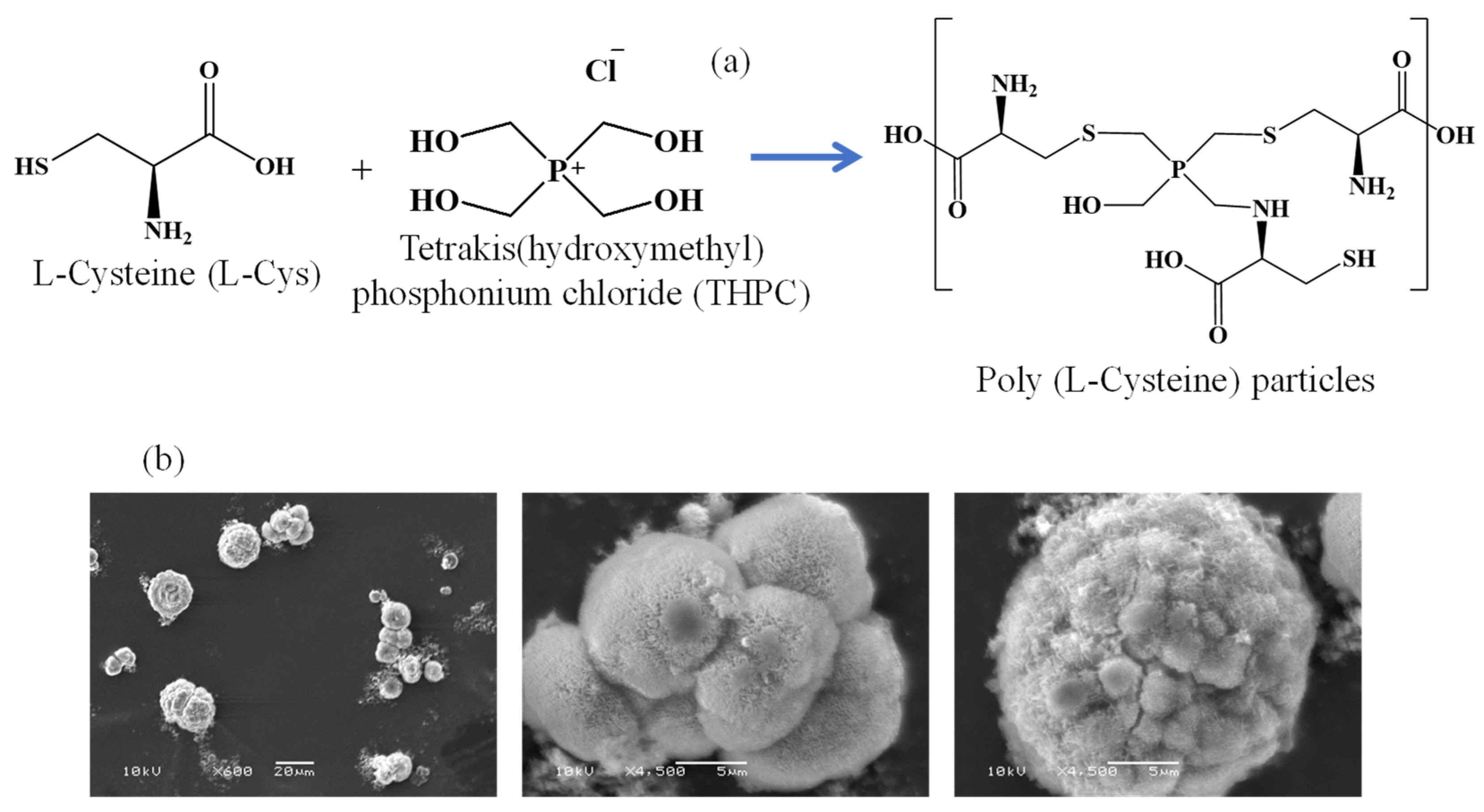
The reverse micelle microemulsion systems provide an aqueous phase that facilitates the synthesis of popcorn-like p(L-Cys) particles. In this context, water droplets are surrounded by inward-facing polar groups of surfactant molecules, which create a micro reactor environment for particle formation. Figure 1a illustrates the polymerization reaction that occurred during the synthesis of the p(L-Cys) particles in a schematic format. The synthesis of p(L-Cys) particles is fundamentally a result of the reaction between THPC and the primary amine groups of the L-Cys molecules. The literature has revealed several potential mechanisms for the interaction between amine groups and THPC [40,41]. The process starts with the generation of formaldehyde molecules, which are crucial for the hydroxymethyl exchange. This is followed by a Mannich reaction, where immonium ions are formed through the reaction of amines with formaldehyde. Ultimately, the phosphorus atoms react with these immonium ions, completing the amine coupling reaction between L-Cys molecules and THPC, thereby producing popcorn-like p(L-Cys) particles [40,41].
In addition, SEM and optical microscopy images of the synthesized p(L-Cys) particles were shown in Figure 1b. The observations indicate that the particles in their dry state are approximately 20 μm in diameter and exhibit a popcorn-like morphology. Notably, the SEM images suggest that the p(L-Cys) particles are composed of clusters of smaller particles.
The reaction resulted in the production of p(L-Cys) particles and attained a gravimetric yield of nearly 70%. This reaction was carried out utilizing a theoretical mixture of L-Cys molecules and THPC in equal 50:50 mol%. To confirm the amounts of precursors included in the particles and to verify the formation of p(L-Cys), elemental analysis was performed. The outcomes of the experiments were summarized in Table 1, which compares the experimental data with the theoretically derived elemental contents of the p(L-Cys) particles.
The mass fraction of L-Cys molecules within the p(L-Cys) particle structure can be readily assessed through the quantification of nitrogen (N) and sulfur (S) contents, as these elements are exclusively derived from L-Cys molecules. If L-Cys molecules and THPC were to react in a 50:50 ratio, one would expect to find 4.5% N and 10.3% S in the composition of the p(L-Cys) particles. However, experimental measurements revealed N and S percentages of 10.3% and 28.4%, respectively, indicating that the anticipated 50:50 ratio was not achieved in the reaction. Calculations based on the N% value suggested that the proportions of L-Cys molecules and THPC in the p(L-Cys) particles were approximately 78.2% and 21.8%, respectively. Conversely, the L-Cys molecules and THPC ratio in p(L-Cys) particles was calculated as 81.9% for L-Cys molecules and 18.1% for THPC based on calculated S% values. In summary, the average ratios of L-Cys and THPC in the p(L-Cys) particle structure were determined to be around 80% and 20%, respectively. Additionally, theoretically, the C% and H% values, which should be 27.0% and 6.1%, respectively, were found to be 29.5% C and 5.0% H from the experimental elemental analysis. By applying the same L-Cys to THPC ratio, the P% of the particles could also be estimated, yielding a theoretical P% of 9.9%, while the experimental P% was found to be only 1.9%. It can be explained with the calculated THPC ratio in p(L-Cys) particles, which is around 20%, the ratio of P% in p(L-Cys) particles is about 20% of what it should be theoretically.
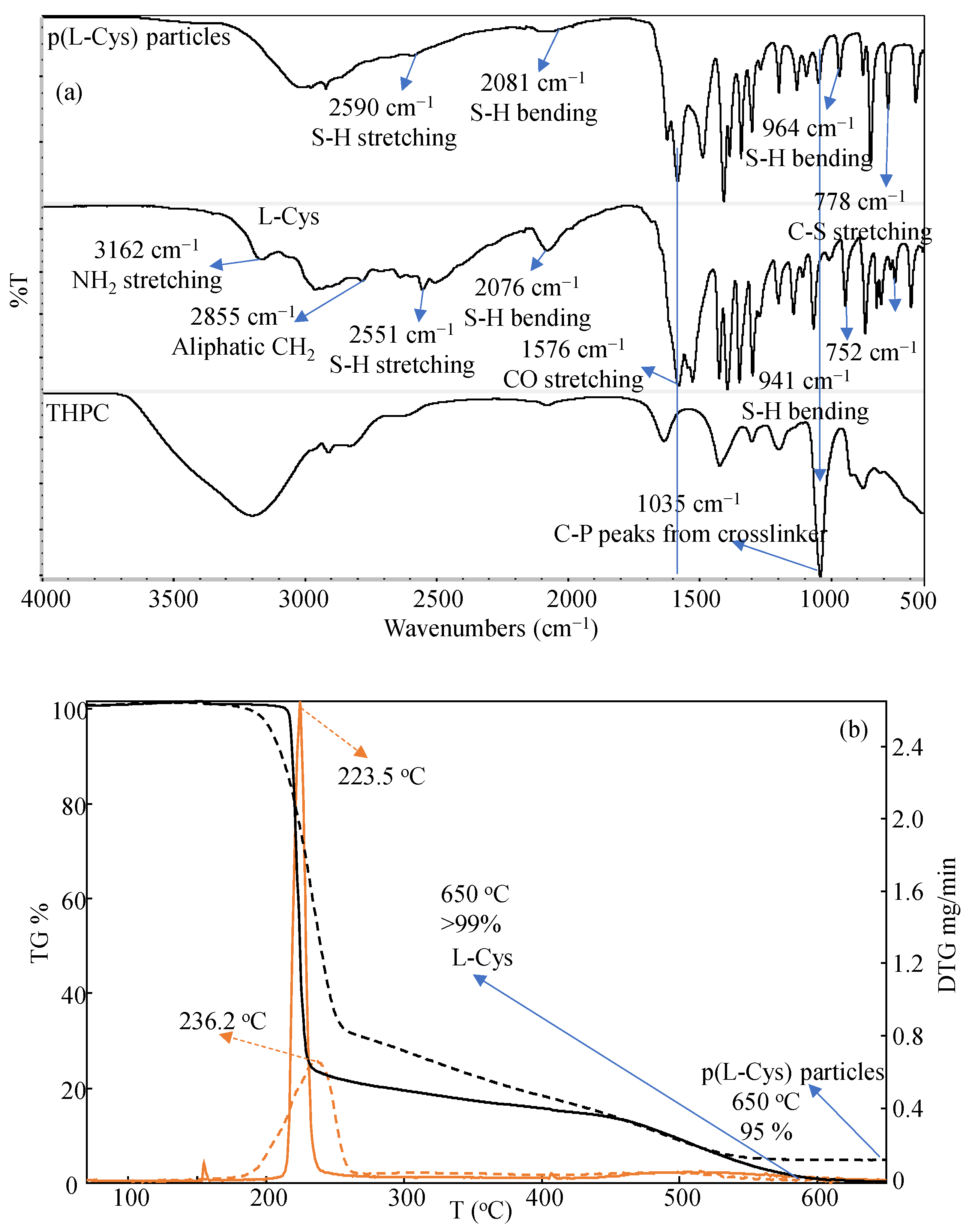
Figure 2a illustrates a comparative analysis of the FT-IR spectra of THPC, L-Cys molecules, and p(L-Cys) particles, aimed at confirming the successful synthesis of the particles. The FT-IR spectrum of THPC exhibited distinct sharp peaks at 1035 cm−1, which can be attributed to the presence of C-P bonds in THPC [38,39]. In contrast, the FT-IR spectrum of L-Cys molecules displayed characteristic peaks, including N-H stretching at 3162 cm−1, S-H stretching and bending at 2551 and 2076 cm−1, C=O stretching vibrations at 1576 cm−1, and C-S stretching at 752 cm−1, respectively [42]. Based on these observations, the analysis of the FT-IR spectrum of p(L-Cys) particles indicated that the NH2 stretching peak at 3162 cm−1 disappeared following the crosslinking of L-Cys molecules via THPC. Additionally, the S-H stretching and bending peaks shifted to 2590 cm−1 and 2081 cm−1, respectively. The newly discovered C-P peak at 1035 cm−1 further supports the findings from the elemental analysis, thereby validating the integration of THPC within the framework of p(L-Cys) particles.
In addition, comparative examinations of the thermal degradation characteristics of L-Cys molecules and p(L-Cys) particles via TG thermograms and DTG graph are also illustrated in Figure 2b. The findings reveal no significant disparities in the thermal degradation profiles of these two substances. For L-Cys molecules, the initial degradation temperature is noted to range from 210 °C to 230 °C, resulting in a weight loss of 76.2%. The main degradation temperature was determined as 223.5 °C for L-Cys molecules from the DTG graph. This is followed by a further degradation phase occurring between 445 °C and 595 °C, which leads to an overall weight loss exceeding 99%. In contrast, the p(L-Cys) particles begin their thermal degradation at approximately 180 °C, with a recorded weight loss of 67.6% up to 260 °C. The main degradation temperature for p(L-Cys) particles was determined to be slightly higher than L-Cys molecule as 236.2 °C from the DTG graph. The degradation process persists slightly until reaching 540 °C, ultimately resulting in a cumulative weight loss of 93.2%. The reason why the onset temperature decreases upon particle formation can be explained by the fact that polymeric structure can possess a large number of chain ends, defects, and irregularities (head-tail defects, residual initiator fragments) [43] or the polymer’s own thermal degradation is catalyzed by acid/base pathways due to the presence of repeating polar groups (-COOH, -OH, -NH2, -SH or newly formed phosphonium groups) [44]. The observed broad full width at half maximum (FWHM) peak in DTG graph for p(L-Cys) particles can be explained with the structural heterogeneity introduced by crosslinking [45].
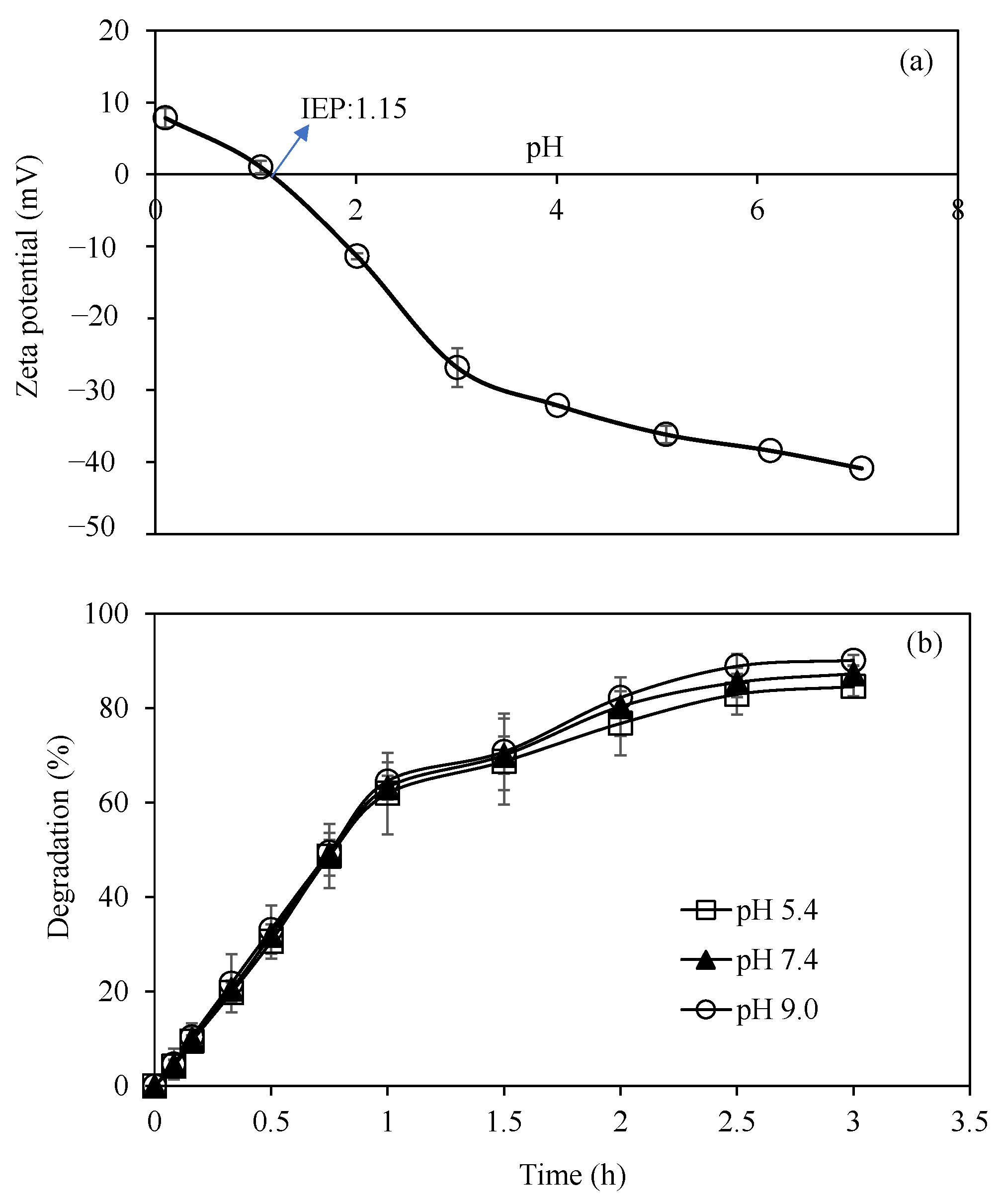
The zeta potential of p(L-Cys) particles was evaluated at their natural pH, which was determined to be 3.01 in 0.01 M NaCl solution at a concentration of 1 mg/mL, resulting with a value of −26.9 ± 3.1 mV. Figure 3a presents the zeta potential values of the p(L-Cys) particles across a range of pH levels. The isoelectric point for these particles was established through zeta potential assessments conducted within a pH range of 1 to 7, revealing a value of pH 1.15. This pH represents the critical point for colloidal stability of p(L-Cys) particles, as they achieve a zeta potential of zero at this particular pH. Interestingly, even at pH 1, the p(L-Cys) particles displayed a minimal positive charge of +1.0 ± 0.3 mV, which can be explained by the insufficient number of protonable amine groups on the particles. In contrast, at pH above 1.15, the p(L-Cys) particles exhibited significantly negative zeta potential values, reaching −40.9 mV at pH 7. These results indicate that p(L-Cys) particles maintain substantial colloidal stability in both physiological and alkaline pH conditions, highlighting their potential utility as effective colloidal drug carriers in biomedical contexts.
The hydrolytic breakdown of p(L-Cys) particles was studied at three pH levels, revealing nearly complete degradation (~90%) within 3 h across pH 5.4, 7.4, and 9.0. Analysis showed that 60% degraded linearly within 1 h, with an additional 30% decomposing between 1 and 3 h. Since 80% of the particles are composed of L-Cys molecules, 1 g of p(L-Cys) releases approximately 480 mg of L-Cys molecules in 1 h and cumulatively 720 mg after 3 h. L-Cys molecules have various medical applications, including treatments for eye disorders, corneal issues, digestive problems, and cancer [46,47,48,49,50,51]; thus, p(L-Cys) particles are promising for various direct drug delivery applications.

3.2. Blood Compatibility and Cytotoxicity of L-Cys and P(L-Cys) Particles

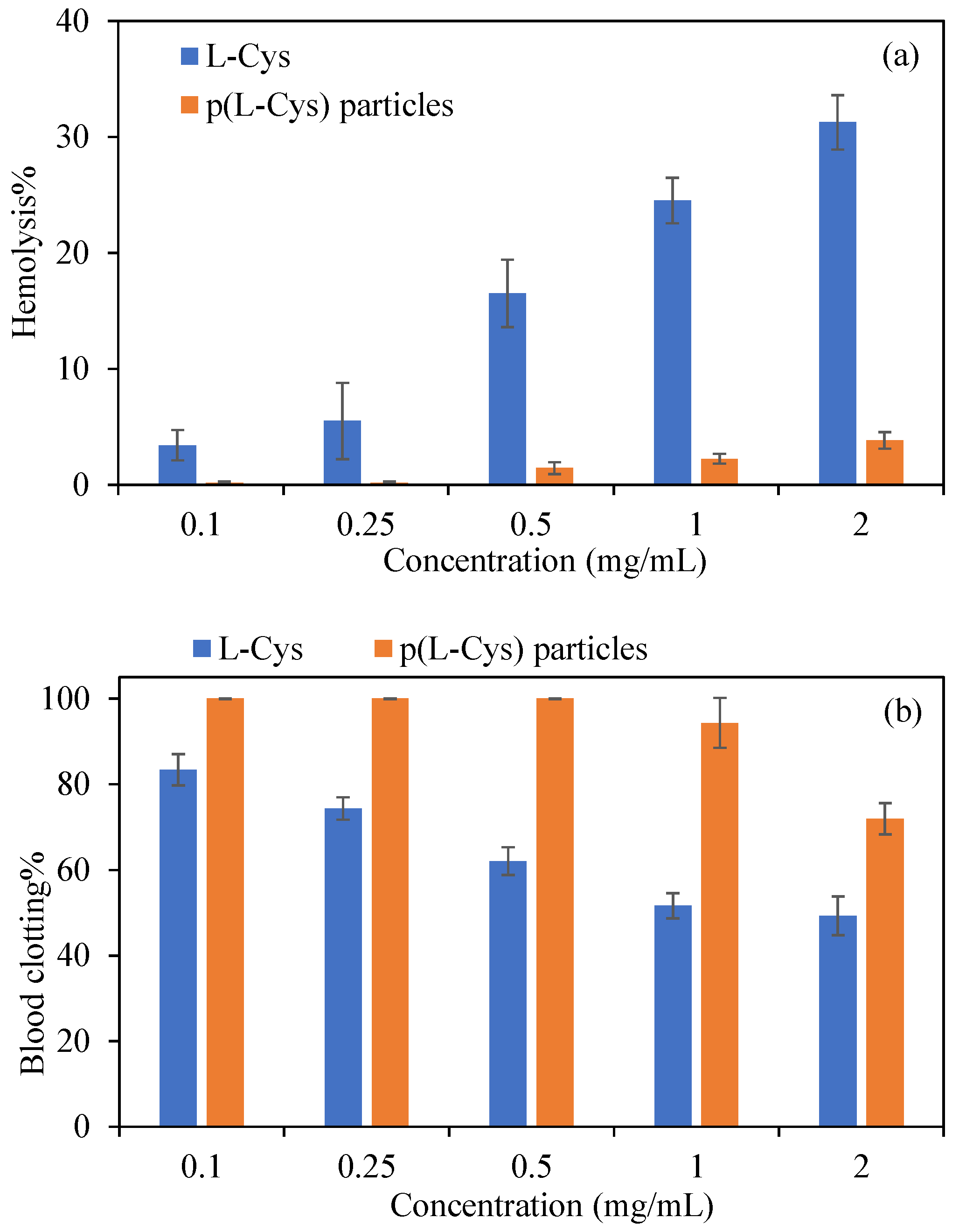
Understanding the limitations of materials in biomedical contexts is crucial, particularly regarding their interactions with blood and their overall biocompatibility when used in living organisms. The assessment of blood compatibility and cytotoxicity of p(L-Cys) particles on L929 fibroblast cells was therefore considered to provide a comparative analysis with L-Cys molecules to elucidate their respective properties. The evaluation of L-Cys molecules and p(L-Cys) particles for hemolysis and blood clotting is illustrated in Figure 4. Blood compatibility assessments were conducted at concentrations reaching up to 2 mg/mL. On the other hand, the p(L-Cys) particles used in the hemolysis test are suspended in 0.9% saline solution, so they can be considered as swollen samples, while the p(L-Cys) particles used in the blood clotting test are in direct contact with blood, so they can be considered wet samples. As mentioned in the SEM images in Figure 1, the size of the dry samples is about 20 μm. Therefore, particles size (sample size) used in blood compatibility tests is about >20 μm. Hemolysis, defined as the lysis of erythrocytes, is deemed acceptable for hemocompatible materials at a maximum threshold of 5% [52,53]. Additionally, the blood clotting mechanism is of paramount importance for biomedical materials that come into contact with blood; such materials must not interfere with the clotting process and should exhibit a high blood clotting index. As depicted in Figure 4a, the hemolysis percentages for L-Cys molecules and p(L-Cys) particles were compared. It was found that L-Cys molecules exhibited nonhemolytic properties at a concentration of 0.1 mg/mL (3.4 ± 1.3%), showed slight hemolysis at 0.25 mg/mL (5.5 ± 3.3%), and became significantly hemolytic at concentrations exceeding 0.25 mg/mL (>16.5 ± 2.9%). Conversely, p(L-Cys) demonstrated a hemolysis ratio of 3.8 ± 0.7% at 2 mg/mL, which decreased with lower concentrations. The low hemolysis rates associated with p(L-Cys) particles at a concentration of 2 mg/mL suggest that these particles are safe for use in blood, as they do not induce significant hemolysis. This evidence supports the viability of utilizing biomolecule-derived carriers, particularly p(L-Cys) particles, in intravenous delivery systems.
An alternative method for assessing the hemocompatibility of carriers is to examine their impact on blood clotting, the physiological transformation of liquid blood into a gel or solid-state, initiated by intrinsic or extrinsic signaling pathways [54,55,56]. In this study, a blood clotting assay was utilized to quantitatively assess the blood clotting index of the materials in comparison to a reference blood sample, serving as the control group. A blood clotting index of 100% signifies that the test material does not induce any clotting activity, whereas values below this threshold indicate a corresponding impact on the activation of clotting pathways [54,55,56]. The assessment of blood clotting indices in relation to concentration was conducted for both L-Cys molecules and p(L-Cys) particles across a range of concentrations, specifically 0.1, 0.25, 0.5, 1, and 2 mg/mL. The results of this evaluation are depicted in Figure 4b. The results reveal that the blood clotting index for L-Cys molecules fell below 80% at concentrations greater than 0.1 mg/mL, reaching approximately 50% at 2 mg/mL. Conversely, the blood clotting index for p(L-Cys) particles remained above 94% even at a concentration of 1 mg/mL, decreasing to nearly 70% at 2 mg/mL. Collectively, the hemolysis and clotting assays conducted on L-Cys molecules and p(L-Cys) suggest that the interactions between blood and p(L-Cys) particles are comparatively safer than those involving L-Cys molecules at concentrations up to 2 mg/mL. Nonetheless, further comprehensive investigations are required to determine suitable dosage regimens before proceeding with in vivo applications. Excessive levels of L-cysteine can lead to hemolytic and cytotoxic consequences due to its capacity to function as an oxidant in biological fluids [57,58]. Cysteine demonstrates reactive oxygen species (ROS) activity through auto-oxidation, especially in the presence of transition metal catalysts like Cu2+ and Fe3+, resulting in the formation of hydrogen peroxide and thiyl radicals [59,60,61,62]. The ROS activity produced by these entities can also trigger membrane lipid peroxidation and oxidative alterations of membrane and cytoskeletal proteins, culminating in both hemolytic and cytotoxic outcomes [63,64,65,66]. Moreover, while cysteine serves as a precursor to glutathione, it has the potential to disturb the balance between reduced glutathione and oxidized glutathione (GSH/GSSG) under oxidative circumstances or surpass antioxidant capacity, thereby compromising cellular defenses against ROS and consequently amplifying hemolytic and cytotoxic effects [67,68,69]. Conversely, the chemical cross-linking of cysteine through processes such as oxidation, polymerization, or integration into larger molecular frameworks significantly mitigates its hemolytic properties by neutralizing reactive thiols, restricting redox cycling, and obstructing direct interaction with membranes [70,71,72,73]. This concept is extensively applied in the design of biomaterials, the synthesis of nanoparticles, and the development of drug delivery systems. Materials derived from cysteine typically demonstrate favorable hemocompatibility, despite the prooxidant characteristics inherent to cysteine.
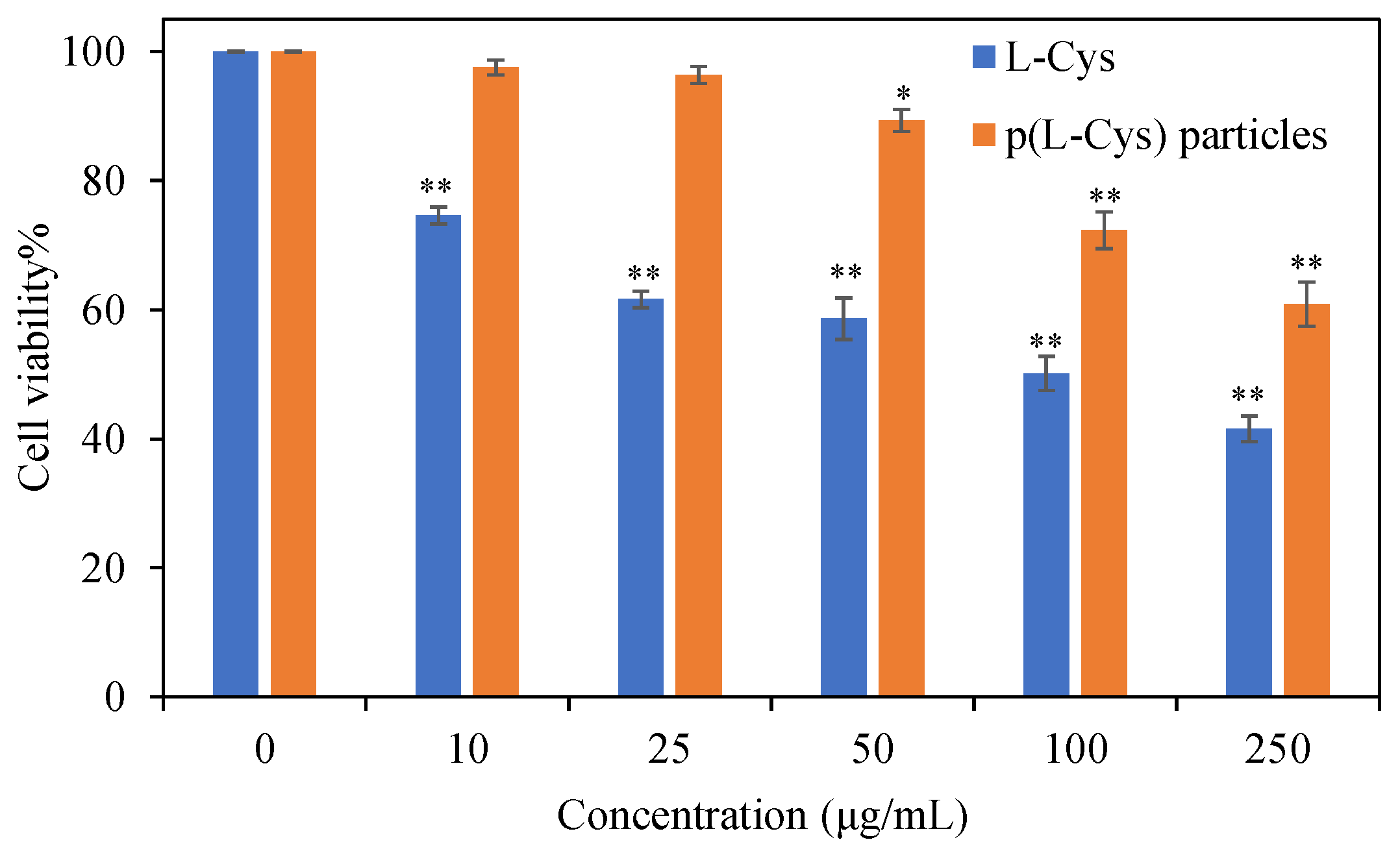
Moreover, the cell viability of L-Cys molecules and prepared p(L-Cys) particles were also investigated on L929 fibroblast cells at different concentrations and compared in Figure 5.
The evaluation of cell viability% for L929 fibroblast cells subjected to a concentration of 10 µg/mL of L-Cys revealed a viability rate of 74.6 ± 1.3%. This observation aligns with previously documented studies in literature [74]. In contrast, an increase in L-Cys concentration resulted in a noticeable decrease in the percentage of viable cells, with recorded values of 61.6 ± 1.3%, 56.8 ± 3.2%, 50.2 ± 2.6%, and 41.5 ± 1.9% for concentrations of 25, 50, 100, and 250 µg/mL, respectively. In contrast to the L-Cys molecule, the synthesized p(L-Cys) particles demonstrated a lower level of cytotoxicity towards L929 fibroblast cells. IC50 value of L-Cys and p(L-Cys) particles was found to be 101 and 397 μg/mL, respectively. The average size of swollen p(L-Cys) particles was measured as approximately 50 μm in an aqueous solution. As particles with size >100 nm could not pass through the cell membrane of L929 fibroblast cells, it could be said that p(L-Cys) particles are inert in comparison to nanosized particles on the cells because of their bigger size. Remarkably, even at a concentration of 50 µg/mL, cell viability exceeded 90%. As the concentration of p(L-Cys) particles was raised to 100 and 250 µg/mL, the viability% were recorded at 72.3 ± 2.8% and 60.9 ± 3.4%, respectively. These low cell viability values at high concentration could be due to the released L-Cys molecule via degrading from the p(L-Cys) particles.
Even with the relatively bad L929 fibroblast cell compatibility of L-Cys, L-Cys is categorized as a macronutrient and is primarily sourced from various protein-rich foods. A comprehensive safety evaluation of its use in food products has revealed no significant risks associated with its role as a flavoring agent. This conclusion is largely based on the observation that the levels of dietary exposure to L-Cys are expected to be considerably greater than those resulting from its use as a flavoring component. As a result, L-Cys has been certified for use as a flavoring agent by the Joint FAO/WHO Expert Committee on Food Additives (JECFA) [75], Generally Recognized As Safe (GRAS) by the Flavor and Extract Manufacturers Association (FEMA, No. 3263) [76], and The U.S. Food and Drug Administration (FDA) [77]. In Japan, L-Cys monohydrochloride is recognized as a designated additive by the Ministry of Health, Labor and Welfare, where it serves as an antioxidant in natural juices and as a food manufacturing agent in bread products [78]. The enhanced biocompatibility of the synthesized p(L-Cys) particles, due to the chemical cross-linking of cysteine through processes such as oxidation, polymerization, or integration into larger molecular frameworks, significantly reduces the cytotoxic effects by neutralizing reactive thiols, restricting redox cycling, and averting direct membrane interactions. This enhancement, in contrast to the L-Cys molecule, holds significant relevance for assessing their potential uses in biomedicine, food technology, and the cosmetic sectors. This improved compatibility indicates that these particles may be more appropriate for incorporation into a range of products and therapeutic interventions, thereby broadening their applicability across diverse sectors.

3.3. Antibacterial and Antioxidant Activity of P(L-Cys) Particles

L-Cys is recognized for its significant reactivity and has been the subject of extensive research regarding its effects on various enzymatic processes in vitro, as well as its interactions with a diverse array of microorganisms engaged in different metabolic pathways [79,80]. Studies indicate that L-Cys interacts with bacterial membranes, resulting in a substantial reduction in both enzymatic activity and overall bacterial metabolism [81]. Although these interactions are recognized to enhance the antimicrobial properties of L-Cys, the specific mechanisms underlying these effects remain to be fully elucidated [82,83]. Here, the antibacterial activity of L-Cys molecules and p(L-Cys) particles against various microorganisms, including Gram-negative bacteria E. coli (ATCC 8739) and P. aeruginosa (ATCC 10145), Gram-positive bacteria S. aureus (ATCC 6538) and B. subtilis (ATCC 6633), and the yeast strain C. albicans (ATCC 10231) was investigated. These organisms are among the most prevalent pathogens associated with wound infections [84]. The assessment was conducted using the disk diffusion method, and inhibition zone diameters are summarized in Table 2 and their images was also shown in Figure S1.
The gentamicin administered at a concentration of 80 mg/mL in a volume of 10 µL as standard, demonstrated inhibition zone diameters of 25 ± 0 mm, 30 ± 0 mm, 35 ± 0 mm, and 28 ± 0 mm against the bacterial strains E. coli ATCC 8739, P. aeruginosa ATCC 10145, S. aureus ATCC 6538, and B. subtilis ATCC 6633, respectively. In contrast, no inhibitory effect was observed against the C. albicans ATCC 10231, which exhibited an inhibition zone diameter of 0.0 ± 0 mm. The absence of an observed inhibition zone diameter suggests that the 10 mg concentration of L-Cys did not demonstrate any antibacterial activity against the Gram-negative bacteria E. coli and P. aeruginosa. In contrast, when 10 mg of L-Cys was applied, it produced inhibition zone diameters of 12 ± 1 mm and 31 ± 1 mm against the Gram-positive bacteria S. aureus and B. subtilis, respectively. Furthermore, under the same conditions as L-Cys, an inhibition zone diameter of 10 ± 1 mm was also noted for C. albicans. Antimicrobial activity of L-Cys was significantly increased in the particle form crosslinked L-Cys, p(L-Cys) on the microorganisms except for B. subtilis. As seen in Table 2 and Figure S1, the inhibition zone of p(L-Cys) particle was found as 19 ± 1, 10 ± 1, 19 ± 1, 20 ± 2, 23 ± 2, and 18 ± 1 mm against E. coli, P. aeruginosa, S. aureus, B. subtilis, and C. albicans, respectively. These results show that p(L-Cys) particles are more potent materials on Gram-positive bacteria species than Gram-negative bacteria and show wide spectrum antibacterial/antifungal susceptibility against most common pathogenic microorganisms.
The determination of the MIC and MBC for L-Cys molecules and p(L-Cys) particles was performed using a macro-dilution assay, targeting the Gram-negative bacterium E. coli and the Gram-positive bacterium S. aureus. The results of this evaluation are detailed in Table S1. In our previous study, the MIC values of gentamicin for both E. coli and B. subtilis have been reported as 0.003 mg/mL [39] and 0.001 mg/mL [85], respectively. The MIC and MBC values of p(L-Cys) particles against E. coli were determined to be 5 mg/mL and 25 mg/mL, respectively, indicating a two-fold improvement compared to L-Cys molecules. Furthermore, L-Cys and p(L-Cys) particles demonstrated almost the same antibacterial activity, with MIC and MBC values of about 1.25–2.5 mg/mL and 10 mg/mL, respectively, against B. subtilis. Time dependent bacterial inhibition was also investigated against E. coli and B. subtilis at different concentrations of L-Cys and p(L-Cys) particles. Bacterial viability % in the presence of different concentration of L-Cys and p(L-Cys) particles for 24 h incubation time and treatment with a 10 mg/mL of L-Cys and/or p(L-Cys) particles at different incubation times were indicated in Figure S2. As seen in Figure S2a, L-Cys and p(L-Cys) particles show the same bacterial inhibition on E. coli and more than 50% bacteria could be inhibited even at a 2.5 mg/mL concentration of L-Cys and p(L-Cys) particles for 24 h. The bacteria killing rate is also demonstrated in Figure S2b, where 10 mg/mL of L-Cys and p(L-Cys) particles started to destroy bacteria cells within 3 h and bacteria killing rate was significantly increased by the time up to 12 h. These results show that 10 mg/mL of p(L-Cys) particles quickly eradicated the E. coli colony when compared with L-Cys. Furthermore, the viability of Gram-positive B. subtilis was below 26 ± 9% even at 0.625 mg/mL concentration for 24 h as depicted in Figure S2c. However, p(L-Cys) particles have an antibacterial activity at 2.5 mg/mL concentration (as the MIC value) against B. subtilis and totally killed B. subtilis at 10 mg/concentration (as its MBC value) after 24 h of incubation. Time dependent B. subtilis killing in the presence of 10 mg/mL concentration of L-Cys and p(L-Cys) particles was demonstrated in Figure S2d. It can be clearly seen that approximately 50% of B. subtilis was inhibited within 3–12 h by L-Cys treatment and all bacterial colonies were removed by 24 h. During the treatment of B. subtilis with p(L-Cys) particles, no bacteria killing was determined after 3 h, but more than 80% of the B. subtilis colony was destroyed at 6 h.
Moreover, amino acid residues demonstrate considerable differences in their oxidative stability, which plays a crucial role in their interaction with lipid-derived free radicals and hydroperoxides, thereby affecting the overall antioxidant capacity of proteins at the emulsion interface [86,87]. It was quantified that the pseudo-first-order rate constants for the oxidation of amino acid side chains by hydroxyl radicals established a relative reactivity hierarchy of Cys > Trp, Tyr > Met > Phe > His > Ile > Leu > Pro [88]. Sulfur-containing amino acids, in particular, are known for their ability to scavenge reactive oxygen species (ROS), suggesting their potential utility in reducing cellular damage associated with oxidative stress [89,90]. Additionally, the ability of L-Cys to form conjugates with free radicals or trace elements further enhances its potential antioxidant properties [81,91], which could be beneficial in various applications. The antioxidant potential of L-Cys molecules, THPC, and p(L-Cys) particles was assessed through Trolox Equivalent Antioxidant Capacity (TEAC) assays, with the results presented in Table 3.
The analysis revealed that L-Cys displayed a superior inhibitory effect against the ABTS+ radical, quantified at 2.25 ± 0.03 µM Trolox equivalent/g. In comparison, the crosslinker THPC exhibited a TEAC value of 0.06 ± 0.01 µM Trolox equivalent/g [38]. Additionally, the synthesized p(L-Cys) particles maintained the antioxidant properties of their precursor, demonstrating a TEAC measurement of 0.14 ± 0.01 µM Trolox equivalent/g. Although there was a decrease in the antioxidant properties of L-Cys after particle preparation, the significance of these properties following particle synthesis is heightened due to enhanced blood compatibility, biocompatibility, and antibacterial characteristics.

4. Conclusions

The popcorn-like p(L-Cys) particles, with dry sizes ranging from 1 to 20 μm, were successfully synthesized for the first time utilizing a single-step microemulsion crosslinking technique. The formation of these particles was confirmed through various analytical methods, including Fourier-transform infrared (FT-IR) spectroscopy, elemental analysis, thermogravimetric analysis (TGA), scanning electron microscopy (SEM), and optical microscopy. The isoelectric point of the p(L-Cys) particles was found to be pH 1.15, indicating remarkable colloidal stability that can be ascribed to the presence of significantly negative surface charges in both acidic physiological and alkaline pH environments. An evaluation of essential characteristics pertinent to biomaterials intended for biomedical applications was conducted, focusing on factors such as degradability, compatibility with blood, biocompatibility, antimicrobial properties, and antioxidant effects, in order to determine their potential for use in the biomedical field. Notably, the p(L-Cys) particles exhibited hydrolytic degradability across acidic, physiological, and alkaline pH environments, alongside excellent blood compatibility, as evidenced by less than 4% hemolysis induction at concentrations as high as 2 mg/mL and a clotting index exceeding 90% even at 1 mg/mL concentrations. Given the observed hydrolytic degradation exceeding 90%, it can be concluded that the synthesized p(L-Cys) particles possess significant potential for application as a stand-alone drug delivery system. This assertion is further supported by the fact that the L-Cys amino acid is recognized as an active pharmaceutical ingredient within the biomedical field [46,47,48,49,50,51]. Furthermore, the p(L-Cys) particles demonstrated significant antimicrobial activity against common microbial strains and displayed remarkable antioxidant properties, with a Trolox equivalent antioxidant capacity (TEAC) value of 0.14 ± 0.01 μM Trolox equivalent/g. The distinctive characteristics of p(L-Cys) particles, which encompass biocompatibility, biodegradability, antioxidant properties, antimicrobial effects, and customizable carrier functionalities, confer significant adaptability for a range of biomedical applications. Unlike nanoparticles and gels, particles or microgels exceeding micron size demonstrate restricted clearance and inadequate tissue penetration, hence limiting their systemic effectiveness in biological domains [92]. To address these challenges, various materials engineering strategies have been suggested, including controlled size distribution (which involves changes in the cross-linking ratio, (micro)emulsion use, etc.), PEGylation, and ligand-mediated targeting [93,94,95,96,97]. Consequently, although particle size can be controlled to obtain a narrow size distribution, surface modifications such as PEGylation and ligand-mediated targeting can mitigate non-specific protein adsorption and immune recognition, prolong circulation time, and enhance accumulation in pathological regions [93,94,95,96,97]. Alternatively, by mitigating systemic size constraints by localized or regional application techniques, microgels/particles can be engineered as efficient reservoirs for sustained and targeted drug delivery [98,99,100]. Nonetheless, the 20–50 µm p(L-Cys) particles produced in this study are degradable, enabling them to fragment into smaller pieces or release their payloads, suggest that they may serve as very useful biomaterials [101,102,103]. Consequently, the exceptional attributes of p(L-Cys) particles render them highly versatile, making them appropriate for a wide variety of uses within the biomedical domain. Their capacity to integrate multiple advantageous traits further amplifies their potential in the development of innovative therapeutic and diagnostic strategies.

Supplementary Materials

The following supporting information can be downloaded at: https://www.mdpi.com/article/10.3390/micro6010006/s1.

Author Contributions

Conceptualization, N.S.; methodology, S.D., B.A., S.S.S., M.S. and N.S.; validation, S.D., B.A., S.S.S., M.S., O.G. and N.S.; formal analysis, S.D., B.A., S.S.S., M.S., O.G. and N.S.; investigation, S.D., B.A., S.S.S., M.S. and N.S.; resources, N.S.; writing—original draft preparation, S.D., B.A., S.S.S. and M.S.; writing—review and editing, O.G. and N.S.; visualization, N.S.; supervision, N.S.; project administration, N.S.; funding acquisition, N.S. All authors have read and agreed to the published version of the manuscript.

Funding

This research received no external funding.

Data Availability Statement

All data generated in this research are contained within this article.

Conflicts of Interest

The authors declare no conflicts of interest.

References

  1. Dou, X.; Feng, C. Amino Acids and Peptide-Based Supramolecular Hydrogels for Three-Dimensional Cell Culture. Adv. Mater. 2017, 29, 1604062. [Google Scholar] [CrossRef]
  2. Jiang, Y.; Chen, J.; Deng, C.; Suuronen, E.J.; Zhong, Z. Click Hydrogels, Microgels and Nanogels: Emerging Platforms for Drug Delivery and Tissue Engineering. Biomaterials 2014, 35, 4969–4985. [Google Scholar] [CrossRef]
  3. Xuan, L.; Hou, Y.; Liang, L.; Wu, J.; Fan, K.; Lian, L.; Qiu, J.; Miao, Y.; Ravanbakhsh, H.; Xu, M.; et al. Microgels for Cell Delivery in Tissue Engineering and Regenerative Medicine. Nano-Micro Lett. 2024, 16, 218. [Google Scholar] [CrossRef]
  4. Oh, J.K.; Lee, D.I.; Park, J.M. Biopolymer-Based Microgels/Nanogels for Drug Delivery Applications. Prog. Polym. Sci. 2009, 34, 1261–1282. [Google Scholar] [CrossRef]
  5. Martins, J.T.; Ramos, Ó.L.; Pinheiro, A.C.; Bourbon, A.I.; Silva, H.D.; Rivera, M.C.; Cerqueira, M.A.; Pastrana, L.; Malcata, F.X.; González-Fernández, Á.; et al. Edible Bio-Based Nanostructures: Delivery, Absorption and Potential Toxicity. Food Eng. Rev. 2015, 7, 491–513. [Google Scholar] [CrossRef]
  6. Yang, S.; Wang, F.; Han, H.; Santos, H.A.; Zhang, Y.; Zhang, H.; Wei, J.; Cai, Z. Fabricated Technology of Biomedical Micro-Nano Hydrogel. Biomed. Technol. 2023, 2, 31–48. [Google Scholar] [CrossRef]
  7. Narayanan, K.; Bhaskar, R.; Han, S. Recent Advances in the Biomedical Applications of Functionalized Nanogels. Pharmaceutics 2022, 14, 2832. [Google Scholar] [CrossRef]
  8. Maspes, A.; Pizzetti, F.; Rossetti, A.; Makvandi, P.; Sitia, G.; Rossi, F. Advances in Bio-Based Polymers for Colorectal Cancer Treatment: Hydrogels and Nanoplatforms. Gels 2021, 7, 6. [Google Scholar] [CrossRef] [PubMed]
  9. Li, Y.; Zheng, X.; Chu, Q. Bio-Based Nanomaterials for Cancer Therapy. Nano Today 2021, 38, 101134. [Google Scholar] [CrossRef]
  10. Sivakanthan, S.; Rajendran, S.; Gamage, A.; Madhujith, T.; Mani, S. Antioxidant and Antimicrobial Applications of Biopolymers: A Review. Food Res. Int. 2020, 136, 109327. [Google Scholar] [CrossRef]
  11. Dong, J.; Wang, W.; Zhou, W.; Zhang, S.; Li, M.; Li, N.; Pan, G.; Zhang, X.; Bai, J.; Zhu, C. Immunomodulatory Biomaterials for Implant-Associated Infections: From Conventional to Advanced Therapeutic Strategies. Biomater. Res. 2022, 26. [Google Scholar] [CrossRef]
  12. Kadirvelu, L.; Sivaramalingam, S.S.; Jothivel, D.; Chithiraiselvan, D.D.; Karaiyagowder Govindarajan, D.; Kandaswamy, K. A Review on Antimicrobial Strategies in Mitigating Biofilm-Associated Infections on Medical Implants. Curr. Res. Microb. Sci. 2024, 6, 100231. [Google Scholar] [CrossRef]
  13. Osman, A.I.; Zhang, Y.; Farghali, M.; Rashwan, A.K.; Eltaweil, A.S.; Abd El-Monaem, E.M.; Mohamed, I.M.A.; Badr, M.M.; Ihara, I.; Rooney, D.W.; et al. Synthesis of Green Nanoparticles for Energy, Biomedical, Environmental, Agricultural, and Food Applications: A Review. Environ. Chem. Lett. 2024, 22, 841–887. [Google Scholar] [CrossRef]
  14. Kuperkar, K.; Atanase, L.; Bahadur, A.; Crivei, I.; Bahadur, P. Degradable Polymeric Bio(Nano)Materials and Their Biomedical Applications: A Comprehensive Overview and Recent Updates. Polymers 2024, 16, 206. [Google Scholar] [CrossRef]
  15. Anooj, E.; Charumathy, M.; Sharma, V.; Vibala, B.V.; Gopukumar, S.T.; Jainab, S.I.B.; Vallinayagam, S. Nanogels: An Overview of Properties, Biomedical Applications, Future Research Trends and Developments. J. Mol. Struct. 2021, 1239, 130446. [Google Scholar] [CrossRef]
  16. Pizzino, G.; Irrera, N.; Cucinotta, M.; Pallio, G.; Mannino, F.; Arcoraci, V.; Squadrito, F.; Altavilla, D.; Bitto, A. Oxidative Stress: Harms and Benefits for Human Health. Oxid. Med. Cell. Longev. 2017, 2017, 8416763. [Google Scholar] [CrossRef] [PubMed]
  17. Wang, G.; Yang, F.; Zhou, W.; Xiao, N.; Luo, M.; Tang, Z. The Initiation of Oxidative Stress and Therapeutic Strategies in Wound Healing. Biomed. Pharmacother. 2023, 157, 114004. [Google Scholar] [CrossRef]
  18. Mohite, P.; Puri, A.; Munde, S.; Ade, N.; Budar, A.; Singh, A.K.; Datta, D.; Mangmool, S.; Singh, S.; Chittasupho, C. Bioactive Compound-Fortified Nanomedicine in the Modulation of Reactive Oxygen Species and Enhancement of the Wound Healing Process: A Review. Pharmaceutics 2025, 17, 855. [Google Scholar] [CrossRef] [PubMed]
  19. Roy, S.G.; Haldar, U.; De, P. Remarkable Swelling Capability of Amino Acid Based Cross-Linked Polymer Networks in Organic and Aqueous Medium. ACS Appl. Mater. Interfaces 2014, 6, 4233–4241. [Google Scholar] [CrossRef] [PubMed]
  20. Ke, W.-C.; Lin, J.-W.; Busireddy, M.R.; Lee, Y.-H.; Chen, J.-T.; Hsu, C.-S. Enhancing the Mechanical and Dielectric Properties of High Thermally Stable Polyimides via a Crosslinkable Bicyclo[2.2.2]Oct-7-Ene-2,3,5,6-Tetracarboxylic Dianhydride Monomer. Polymer 2024, 290, 126495. [Google Scholar] [CrossRef]
  21. O’Reilly, R.K. Using Controlled Radical Polymerisation Techniques for the Synthesis of Functional Polymers Containing Amino Acid Moieties. Polym. Int. 2010, 59, 568–573. [Google Scholar] [CrossRef]
  22. Ghosh, D.; Roy, S.G.; De, P. Amino Acid-Based Polymeric Gel Network and Its Application in Different Fields. J. Indian. Chem. Soc. 2022, 99, 100366. [Google Scholar] [CrossRef]
  23. Mallakpour, S.; Soltanian, S. Synthesis and Properties of Optically Active Nanostructured Polymers Bearing Amino Acid Moieties by Direct Polycondensation of 4,4′-Thiobis(2-Tert-Butyl-5-Methylphenol) with Chiral Diacids. Amino Acids 2012, 42, 2187–2194. [Google Scholar] [CrossRef] [PubMed]
  24. Abdolmaleki, A.; Mallakpour, S.; Borandeh, S.; Sabzalian, M.R. Fabrication of Biodegradable Poly(Ester-Amide)s Based on Tyrosine Natural Amino Acid. Amino Acids 2012, 42, 1997–2007. [Google Scholar] [CrossRef]
  25. Mallakpour, S.; Dinari, M. Novel Nanostructure Amino Acid-Based Poly(Amide–Imide)s Enclosing Benzimidazole Pendant Group in Green Medium: Fabrication and Characterization. Amino Acids 2012, 43, 1605–1613. [Google Scholar] [CrossRef]
  26. Hadjichristidis, N.; Iatrou, H.; Pitsikalis, M.; Sakellariou, G. Synthesis of Well-Defined Polypeptide-Based Materials via the Ring-Opening Polymerization of α-Amino Acid N -Carboxyanhydrides. Chem. Rev. 2009, 109, 5528–5578. [Google Scholar] [CrossRef]
  27. Tinajero-Díaz, E.; Kimmins, S.D.; García-Carvajal, Z.-Y.; Martínez de Ilarduya, A. Polypeptide-Based Materials Prepared by Ring-Opening Polymerisation of Anionic-Based α-Amino Acid N-Carboxyanhydrides: A Platform for Delivery of Bioactive-Compounds. React. Funct. Polym. 2021, 168, 105040. [Google Scholar] [CrossRef]
  28. Messina, M.S.; Messina, K.M.M.; Bhattacharya, A.; Montgomery, H.R.; Maynard, H.D. Preparation of Biomolecule-Polymer Conjugates by Grafting-from Using ATRP, RAFT, or ROMP. Prog. Polym. Sci. 2020, 100, 101186. [Google Scholar] [CrossRef]
  29. Bauri, K.; Roy, S.G.; Pant, S.; De, P. Controlled Synthesis of Amino Acid-Based PH-Responsive Chiral Polymers and Self-Assembly of Their Block Copolymers. Langmuir 2013, 29, 2764–2774. [Google Scholar] [CrossRef]
  30. Russell, K.E. Free Radical Graft Polymerization and Copolymerization at Higher Temperatures. Prog. Polym. Sci. 2002, 27, 1007–1038. [Google Scholar] [CrossRef]
  31. Zhang, Q.; Yan, K.; Zheng, X.; Liu, Q.; Han, Y.; Liu, Z. Research Progress of Photo-Crosslink Hydrogels in Ophthalmology: A Comprehensive Review Focus on the Applications. Mater. Today Bio 2024, 26, 101082. [Google Scholar] [CrossRef]
  32. Jacobs, J.; Pavlović, D.; Prydderch, H.; Moradi, M.-A.; Ibarboure, E.; Heuts, J.P.A.; Lecommandoux, S.; Heise, A. Polypeptide Nanoparticles Obtained from Emulsion Polymerization of Amino Acid N-Carboxyanhydrides. J. Am. Chem. Soc. 2019, 141, 12522–12526. [Google Scholar] [CrossRef]
  33. Vlakh, E.G.; Grachova, E.V.; Zhukovsky, D.D.; Hubina, A.V.; Mikhailova, A.S.; Shakirova, J.R.; Sharoyko, V.V.; Tunik, S.P.; Tennikova, T.B. Self-Assemble Nanoparticles Based on Polypeptides Containing C-Terminal Luminescent Pt-Cysteine Complex. Sci. Rep. 2017, 7, 41991. [Google Scholar] [CrossRef]
  34. Koda, Y.; Nagasaki, Y. Design of Cysteine-Based Self-Assembling Polymer Drugs for Anticancer Chemotherapy. Colloids Surf. B Biointerfaces 2022, 220, 112909. [Google Scholar] [CrossRef]
  35. Stavroulaki, D.; Kyroglou, I.; Skourtis, D.; Athanasiou, V.; Thimi, P.; Sofianopoulou, S.; Kazaryan, D.; Fragouli, P.G.; Labrianidou, A.; Dimas, K.; et al. Influence of the Topology of Poly(L-Cysteine) on the Self-Assembly, Encapsulation and Release Profile of Doxorubicin on Dual-Responsive Hybrid Polypeptides. Pharmaceutics 2023, 15, 790. [Google Scholar] [CrossRef]
  36. Kareem, Y.G.; Rachid, S.; Al-Jaf, O. Synthesis and Characterization of Novel Poly Cysteine Methacrylate Nanoparticles and Their Morphology and Size Studies. RSC Adv. 2024, 14, 13474–13481. [Google Scholar] [CrossRef]
  37. Ulkoski, D.; Scholz, C. Synthesis and Application of Aurophilic Poly(Cysteine) and Poly(Cysteine)-Containing Copolymers. Polymers 2017, 9, 500. [Google Scholar] [CrossRef]
  38. Sahiner, N. One Step Synthesis of an Amino Acid Derived Particles, Poly(L-Arginine) and Its Biomedical Application. Polym. Adv. Technol. 2022, 33, 831–842. [Google Scholar] [CrossRef]
  39. Sahiner, N. Amino Acid-derived Poly(L-Lysine) (p(LL)) Microgel as a Versatile Biomaterial: Hydrolytically Degradable, Drug Carrying, Chemically Modifiable and Antimicrobial Material. Polym. Adv. Technol. 2020, 31, 2152–2160. [Google Scholar] [CrossRef]
  40. Chung, C.; Lampe, K.J.; Heilshorn, S.C. Tetrakis(Hydroxymethyl) Phosphonium Chloride as a Covalent Cross-Linking Agent for Cell Encapsulation Within Protein-Based Hydrogels. Biomacromolecules 2012, 13, 3912–3916. [Google Scholar] [CrossRef] [PubMed]
  41. Jirasek, A.; Hilts, M.; Shaw, C.; Baxter, P. Investigation of Tetrakis Hydroxymethyl Phosphonium Chloride as an Antioxidant for Use in X-Ray Computed Tomography Polyacrylamide Gel Dosimetry. Phys. Med. Biol. 2006, 51, 1891–1906. [Google Scholar] [CrossRef]
  42. Li, L.; Liao, L.; Ding, Y.; Zeng, H. Dithizone-Etched CdTe Nanoparticles-Based Fluorescence Sensor for the off–on Detection of Cadmium Ion in Aqueous Media. RSC Adv. 2017, 7, 10361–10368. [Google Scholar] [CrossRef]
  43. Kashiwagi, T.; Inabi, A.; Hamins, A. Behavior of Primary Radicals During Thermal Degradation of Poly(Methyl Methacrylate). Polym. Degrad. Stab. 1989, 26, 161–184. [Google Scholar] [CrossRef]
  44. Kost, B.; Basko, M.; Bednarek, M.; Socka, M.; Kopka, B.; Łapienis, G.; Biela, T.; Kubisa, P.; Brzeziński, M. The Influence of the Functional End Groups on the Properties of Polylactide-Based Materials. Prog. Polym. Sci. 2022, 130, 101556. [Google Scholar] [CrossRef]
  45. Sarsenbekova, A.Z.; Tuleuov, U.B.; Kazhmuratova, A.T.; Bolatbay, A.N.; Zhaparova, L.Z.; Tazhbayev, Y.M. Thermal Stability and Decomposition Mechanisms of PVA/PEGDA–PEGMA IPN-Hydrogels: A Multimethod Kinetic Approach. Polymers 2025, 17, 2805. [Google Scholar] [CrossRef] [PubMed]
  46. Wang, W.; Ling, Y.; Deng, L.; Yao, S.; Zeng, K. Effect of L-Cysteine Treatment to Induce Postharvest Disease Resistance of Monilinia Fructicola in Plum Fruits and the Possible Mechanisms Involved. Pestic. Biochem. Physiol. 2023, 191, 105367. [Google Scholar] [CrossRef] [PubMed]
  47. Li, S.; Lu, Z.; Jiao, L.; Zhang, R.; Hong, Y.; Aa, J.; Wang, G. Quantitative Determination of D4-Cystine in Mice Using LC-MS/MS and Its Application to the Assessment of Pharmacokinetics and Bioavailability. J. Pharm. Anal. 2021, 11, 580–587. [Google Scholar] [CrossRef]
  48. Salaspuro, V.; Hietala, J.; Kaihovaara, P.; Pihlajarinne, L.; Marvola, M.; Salaspuro, M. Removal of Acetaldehyde from Saliva by a Slow-Release Buccal Tablet of L-Cysteine. Int. J. Cancer 2002, 97, 361–364. [Google Scholar] [CrossRef]
  49. Linderborg, K.; Marvola, T.; Marvola, M.; Salaspuro, M.; Färkkilä, M.; Väkeväinen, S. Reducing Carcinogenic Acetaldehyde Exposure in the Achlorhydric Stomach with Cysteine. Alcohol. Clin. Exp. Res. 2011, 35, 516–522. [Google Scholar] [CrossRef]
  50. Meduri, A.; Grenga, P.L.; Scorolli, L.; Ceruti, P.; Ferreri, G. Role of Cysteine in Corneal Wound Healing After Photorefractive Keratectomy. Ophthalmic Res. 2009, 41, 76–82. [Google Scholar] [CrossRef]
  51. Clemente Plaza, N.; Reig García-Galbis, M.; Martínez-Espinosa, R.M. Effects of the Usage of L-Cysteine (l-Cys) on Human Health. Molecules 2018, 23, 575. [Google Scholar] [CrossRef]
  52. Luna-Vázquez-Gómez, R.; Arellano-García, M.E.; García-Ramos, J.C.; Radilla-Chávez, P.; Salas-Vargas, D.S.; Casillas-Figueroa, F.; Ruiz-Ruiz, B.; Bogdanchikova, N.; Pestryakov, A. Hemolysis of Human Erythrocytes by ArgovitTM AgNPs from Healthy and Diabetic Donors: An In Vitro Study. Materials 2021, 14, 2792. [Google Scholar] [CrossRef]
  53. Mesdaghinia, A.; Pourpak, Z.; Naddafi, K.; Nodehi, R.N.; Alizadeh, Z.; Rezaei, S.; Mohammadi, A.; Faraji, M. An in Vitro Method to Evaluate Hemolysis of Human Red Blood Cells (RBCs) Treated by Airborne Particulate Matter (PM10). MethodsX 2019, 6, 156–161. [Google Scholar] [CrossRef] [PubMed]
  54. Ke, X.; Jin, B.; You, W.; Chen, Y.; Xu, H.; Zhao, H.; Lu, X.; Sang, X.; Zhong, S.; Yang, H.; et al. Comprehensive Analysis of Coagulation Indices for Predicting Survival in Patients with Biliary Tract Cancer. BMC Cancer 2021, 21, 953. [Google Scholar] [CrossRef] [PubMed]
  55. Mohammadi Aria, M.; Erten, A.; Yalcin, O. Technology Advancements in Blood Coagulation Measurements for Point-of-Care Diagnostic Testing. Front. Bioeng. Biotechnol. 2019, 7, 395. [Google Scholar] [CrossRef]
  56. Han, L.; Liu, X.; Li, H.; Zou, J.; Yang, Z.; Han, J.; Huang, W.; Yu, L.; Zheng, Y.; Li, L. Blood Coagulation Parameters and Platelet Indices: Changes in Normal and Preeclamptic Pregnancies and Predictive Values for Preeclampsia. PLoS ONE 2014, 9, e114488. [Google Scholar] [CrossRef]
  57. Korshunov, S.; Imlay, K.R.C.; Imlay, J.A. Cystine Import Is a Valuable but Risky Process Whose Hazards Escherichia coli Minimizes by Inducing a Cysteine Exporter. Mol. Microbiol. 2020, 113, 22–39. [Google Scholar] [CrossRef] [PubMed]
  58. Park, S.; Imlay, J.A. High Levels of Intracellular Cysteine Promote Oxidative DNA Damage by Driving the Fenton Reaction. J. Bacteriol. 2003, 185, 1942–1950. [Google Scholar] [CrossRef]
  59. Yang, M.; Silverstein, R.L. Targeting Cysteine Oxidation in Thrombotic Disorders. Antioxidants 2024, 13, 83. [Google Scholar] [CrossRef]
  60. Sharma, P.; Jha, A.B.; Dubey, R.S.; Pessarakli, M. Reactive Oxygen Species, Oxidative Damage, and Antioxidative Defense Mechanism in Plants under Stressful Conditions. J. Bot. 2012, 2012, 217037. [Google Scholar] [CrossRef]
  61. Ząbek-Adamska, A.; Drożdż, R.; Naskalski, J.W. Dynamics of Reactive Oxygen Species Generation in the Presence of Copper(II)-Histidine Complex and Cysteine. Acta Biochim. Pol. 2013, 60, 565–571. [Google Scholar] [CrossRef]
  62. Poole, L.B.; Nelson, K.J. Discovering Mechanisms of Signaling-Mediated Cysteine Oxidation. Curr. Opin. Chem. Biol. 2008, 12, 18–24. [Google Scholar] [CrossRef]
  63. Hong, Y.; Boiti, A.; Vallone, D.; Foulkes, N.S. Reactive Oxygen Species Signaling and Oxidative Stress: Transcriptional Regulation and Evolution. Antioxidants 2024, 13, 312. [Google Scholar] [CrossRef]
  64. Endale, H.T.; Tesfaye, W.; Mengstie, T.A. ROS Induced Lipid Peroxidation and Their Role in Ferroptosis. Front. Cell Dev. Biol. 2023, 11, 1226044. [Google Scholar] [CrossRef]
  65. An, X.; Yu, W.; Liu, J.; Tang, D.; Yang, L.; Chen, X. Oxidative Cell Death in Cancer: Mechanisms and Therapeutic Opportunities. Cell Death Dis. 2024, 15, 556. [Google Scholar] [CrossRef]
  66. Juan, C.A.; de la Lastra, J.M.P.; Plou, F.J.; Pérez-Lebeña, E. The Chemistry of Reactive Oxygen Species (ROS) Revisited: Outlining Their Role in Biological Macromolecules (DNA, Lipids and Proteins) and Induced Pathologies. Int. J. Mol. Sci. 2021, 22, 4642. [Google Scholar] [CrossRef]
  67. Mannery, Y.O.; Ziegler, T.R.; Park, Y.; Jones, D.P. Oxidation of Plasma Cysteine/Cystine and GSH/GSSG Redox Potentials by Acetaminophen and Sulfur Amino Acid Insufficiency in Humans. J. Pharmacol. Exp. Ther. 2010, 333, 939–947. [Google Scholar] [CrossRef]
  68. Chiang, F.-F.; Chao, T.-H.; Huang, S.-C.; Cheng, C.-H.; Tseng, Y.-Y.; Huang, Y.-C. Cysteine Regulates Oxidative Stress and Glutathione-Related Antioxidative Capacity Before and After Colorectal Tumor Resection. Int. J. Mol. Sci. 2022, 23, 9581. [Google Scholar] [CrossRef]
  69. Kabadayi Sahin, E.; Senat, A.; Sogut, I.; Duymaz, T.; Erel, O. Erythrocytic Reduced/Oxidized Glutathione and Serum Thiol/Disulfide Homeostasis in Patients with Opioid Use Disorder. Psychiatry Clin. Psychopharmacol. 2023, 33, 170. [Google Scholar] [CrossRef]
  70. Min, Q.; Tan, R.; Zhang, Y.; Wang, C.; Wan, Y.; Li, J. Multi-Crosslinked Strong and Elastic Bioglass/Chitosan-Cysteine Hydrogels with Controlled Quercetin Delivery for Bone Tissue Engineering. Pharmaceutics 2022, 14, 2048. [Google Scholar] [CrossRef]
  71. Blöhbaum, J.; Paulus, I.; Pöppler, A.-C.; Tessmar, J.; Groll, J. Influence of Charged Groups on the Cross-Linking Efficiency and Release of Guest Molecules from Thiol–Ene Cross-Linked Poly(2-Oxazoline) Hydrogels. J. Mater. Chem. B 2019, 7, 1782–1794. [Google Scholar] [CrossRef]
  72. Thasneem, Y.M.; Sajeesh, S.; Sharma, C.P. Effect of Thiol Functionalization on the Hemo-compatibility of PLGA Nanoparticles. J. Biomed. Mater. Res. Part A 2011, 99A, 607–617. [Google Scholar] [CrossRef]
  73. Chrószcz-Porębska, M.; Gadomska-Gajadhur, A. Cysteine Conjugation: An Approach to Obtain Polymers with Enhanced Muco- and Tissue Adhesion. Int. J. Mol. Sci. 2024, 25, 12177. [Google Scholar] [CrossRef]
  74. Schmitz, W.; Ries, E.; Koderer, C.; Völter, M.F.; Wünsch, A.C.; El-Mesery, M.; Frackmann, K.; Kübler, A.C.; Linz, C.; Seher, A. Cysteine Restriction in Murine L929 Fibroblasts as an Alternative Strategy to Methionine Restriction in Cancer Therapy. Int. J. Mol. Sci. 2021, 22, 1630. [Google Scholar] [CrossRef]
  75. JECFA. L-Cysteine. 2025. Available online: https://apps.who.int/food-additives-contaminants-jecfa-database/home/chemical/4381 (accessed on 23 December 2025).
  76. Oser, B.L.; Hall, R.L. Recent Progress in the Consideration of Flavoring Ingredients Under the Food Additives Amendment. 5. GRAS Substances. Food Technol. 1972, 25, 35–42. [Google Scholar]
  77. Substances Added to Food. 2025. Available online: https://hfpappexternal.fda.gov/Scripts/Fdcc/Index.Cfm?Set=FoodSubstances&id=CYSTEINE (accessed on 20 November 2025).
  78. The Japan Food Chemical Research Foundation List of Designated Additives. Form December 2025. Available online: https://www.ffcr.or.jp/en/tenka/list-of-designated-additives/list-of-designated-additives.html (accessed on 20 November 2025).
  79. Nogueira, F.; Vaz, J.; Mouro, C.; Piskin, E.; Gouveia, I. Covalent Modification of Cellulosic-Based Textiles: A New Strategy to Obtain Antimicrobial Properties. Biotechnol. Bioprocess Eng. 2014, 19, 526–533. [Google Scholar] [CrossRef]
  80. Caldeira, E.; Piskin, E.; Granadeiro, L.; Silva, F.; Gouveia, I.C. Biofunctionalization of Cellulosic Fibres with L-Cysteine: Assessment of Antibacterial Properties and Mechanism of Action Against Staphylococcus Aureus and Klebsiella Pneumoniae. J. Biotechnol. 2013, 168, 426–435. [Google Scholar] [CrossRef]
  81. Nogueira, F.; Granadeiro, L.; Mouro, C.; Gouveia, I.C. Antimicrobial and Antioxidant Surface Modification toward a New Silk-Fibroin (SF)-l-Cysteine Material for Skin Disease Management. Appl. Surf. Sci. 2016, 364, 552–559. [Google Scholar] [CrossRef]
  82. Kari, C.; Nagy, Z.; Kovacs, P.; Hernadi, F. Mechanism of the Growth Inhibitory Effect of Cysteine on Escherichia coli. J. Gen. Microbiol. 1971, 68, 349–356. [Google Scholar] [CrossRef]
  83. Ankri, S.; Mirelman, D. Antimicrobial Properties of Allicin from Garlic. Microbes Infect. 1999, 1, 125–129. [Google Scholar] [CrossRef]
  84. Wang, C.-C.; Shih, T.-Y.; Hsieh, Y.-T.; Huang, J.-L.; Wang, J. L-Arginine Grafted Poly(Glycerol Sebacate) Materials: An Antimicrobial Material for Wound Dressing. Polymers 2020, 12, 1457. [Google Scholar] [CrossRef]
  85. Mosselhy, D.; Ge, Y.; Gasik, M.; Nordström, K.; Natri, O.; Hannula, S.-P. Silica-Gentamicin Nanohybrids: Synthesis and Antimicrobial Action. Materials 2016, 9, 170. [Google Scholar] [CrossRef]
  86. Elias, R.J.; McClements, D.J.; Decker, E.A. Antioxidant Activity of Cysteine, Tryptophan, and Methionine Residues in Continuous Phase β-Lactoglobulin in Oil-in-Water Emulsions. J. Agric. Food Chem. 2005, 53, 10248–10253. [Google Scholar] [CrossRef]
  87. Viljanen, K.; Kylli, P.; Hubbermann, E.-M.; Schwarz, K.; Heinonen, M. Anthocyanin Antioxidant Activity and Partition Behavior in Whey Protein Emulsion. J. Agric. Food Chem. 2005, 53, 2022–2027. [Google Scholar] [CrossRef]
  88. Dalsgaard, T.K.; Triquigneaux, M.; Deterding, L.; Summers, F.; Ranguelova, K.; Mortensen, G.; Mason, R.P. Site-Specific Detection of Radicals on α-Lactalbumin after a Riboflavin-Sensitized Reaction, Detected by Immuno-Spin Trapping, ESR, and MS. J. Agric. Food Chem. 2013, 61, 418–426. [Google Scholar] [CrossRef]
  89. Kim, J.-H.; Jang, H.-J.; Cho, W.-Y.; Yeon, S.-J.; Lee, C.-H. In Vitro Antioxidant Actions of Sulfur-Containing Amino Acids. Arab. J. Chem. 2020, 13, 1678–1684. [Google Scholar] [CrossRef]
  90. Moskovitz, J. Methionine Sulfoxide Reductases: Ubiquitous Enzymes Involved in Antioxidant Defense, Protein Regulation, and Prevention of Aging-Associated Diseases. Biochim. Biophys. Acta (BBA)—Proteins Proteom. 2005, 1703, 213–219. [Google Scholar] [CrossRef]
  91. Haslekås, C.; Viken, M.K.; Grini, P.E.; Nygaard, V.; Nordgard, S.H.; Meza, T.J.; Aalen, R.B. Seed 1-Cysteine Peroxiredoxin Antioxidants Are Not Involved in Dormancy, But Contribute to Inhibition of Germination during Stress. Plant Physiol. 2003, 133, 1148–1157. [Google Scholar] [CrossRef]
  92. Kabanov, A.V.; Vinogradov, S.V. Nanogels as Pharmaceutical Carriers: Finite Networks of Infinite Capabilities. Angew. Chem. Int. Ed. 2009, 48, 5418–5429. [Google Scholar] [CrossRef]
  93. Pan, C.; Yue, H.; Zhu, L.; Ma, G.; Wang, H. Prophylactic Vaccine Delivery Systems Against Epidemic Infectious Diseases. Adv. Drug Deliv. Rev. 2021, 176, 113867. [Google Scholar] [CrossRef]
  94. Soo Choi, H.; Liu, W.; Misra, P.; Tanaka, E.; Zimmer, J.P.; Itty Ipe, B.; Bawendi, M.G.; Frangioni, J.V. Renal Clearance of Quantum Dots. Nat. Biotechnol. 2007, 25, 1165–1170. [Google Scholar] [CrossRef]
  95. Oh, J.K.; Drumright, R.; Siegwart, D.J.; Matyjaszewski, K. The Development of Microgels/Nanogels for Drug Delivery Applications. Prog. Polym. Sci. 2008, 33, 448–477. [Google Scholar] [CrossRef]
  96. Jarvis, M.; Arnold, M.; Ott, J.; Pant, K.; Prabhakarpandian, B.; Mitragotri, S. Microfluidic Co-culture Devices to Assess Penetration of Nanoparticles into Cancer Cell Mass. Bioeng. Transl. Med. 2017, 2, 268–277. [Google Scholar] [CrossRef]
  97. Iida, H.; Tang, Z.; Yashima, E. Synthesis and Bifunctional Asymmetric Organocatalysis of Helical Poly(Phenylacetylene)s Bearing Cinchona Alkaloid Pendants via a Sulfonamide Linkage. J. Polym. Sci. A Polym. Chem. 2013, 51, 2869–2879. [Google Scholar] [CrossRef]
  98. Sivakumaran, D.; Maitland, D.; Hoare, T. Injectable Microgel-Hydrogel Composites for Prolonged Small-Molecule Drug Delivery. Biomacromolecules 2011, 12, 4112–4120. [Google Scholar] [CrossRef]
  99. Gao, W.; Zhang, Y.; Zhang, Q.; Zhang, L. Nanoparticle-Hydrogel: A Hybrid Biomaterial System for Localized Drug Delivery. Ann. Biomed. Eng. 2016, 44, 2049–2061. [Google Scholar] [CrossRef] [PubMed]
  100. Lee, Y.; Kim, M.; Kim, N.; Byun, S.; Seo, S.; Han, J.Y. Injectable Hydrogel Systems for Targeted Drug Delivery: From Site-Specific Application to Design Strategy. Appl. Sci. 2025, 15, 11599. [Google Scholar] [CrossRef]
  101. Li, H.; Mergel, O.; Jain, P.; Li, X.; Peng, H.; Rahimi, K.; Singh, S.; Plamper, F.A.; Pich, A. Electroactive and Degradable Supramolecular Microgels. Soft Matter 2019, 15, 8589–8602. [Google Scholar] [CrossRef]
  102. Dagdelen, S.; Mackiewicz, M.; Osial, M.; Waleka-Bargiel, E.; Romanski, J.; Krysinski, P.; Karbarz, M. Redox-Responsive Degradable Microgel Modified with Superparamagnetic Nanoparticles Exhibiting Controlled, Hyperthermia-Enhanced Drug Release. J. Mater. Sci. 2023, 58, 4094–4114. [Google Scholar] [CrossRef]
  103. Lan, W.; Guo, C.; Liu, Y.; Ma, F.; Zhang, W.; Yao, D.; Wang, Y.; Kong, Q. A PH/ROS Dual Responsive Smart Microgel MiRNA Delivery System for Repair of Intervertebral Disc Degeneration. J. Mater. Chem. B 2025, 13, 11454–11469. [Google Scholar] [CrossRef] [PubMed]
Scheme 1. Schematic presentation of experimental process.
Micro 06 00006 sch001
Figure 1. (a) Schematic representation, and (b) scanning electron microscope (SEM) images of the popcorn-like p(L-Cys) particles. [The scale bars and magnifications in SEM images from left to right are 20 µm (600X), 5 µm (4500X), and 5 µm (4500X)].
Micro 06 00006 g001
Figure 2. The comparison of (a) FT-IR spectra and (b) TGA and corresponding derivative thermograms-in red- of L-Cys molecules and p(L-Cys) particles.
Micro 06 00006 g002
Figure 3. (a) Zeta potential values and (b) hydrolytic degradation profiles of p(L-Cys) particles under varying pH conditions.
Micro 06 00006 g003
Figure 4. The concentration-dependent effects on (a) hemolysis% and (b) blood clotting indices of native L-Cys molecules and p(L-Cys) particles. [p(L-Cys) particle size > 20 µm].
Micro 06 00006 g004
Figure 5. Cell viability of L929 fibroblast cells in the presence of L-Cys and p(L-Cys) particles for 24 h incubation time. Statistical differences were given as * p < 0.05, ** p < 0.001 compared with control group.
Micro 06 00006 g005
Table 1. The comparison of theoretical and experimental elemental analysis of p(L-Cys) particles.
Elements
%
TheoreticalExperimental%
L-CysTHPCP(L-Cys)L-CysP(L-Cys)L-CysTHPC
C29.725.227.029.729.578.2 *
81.9 **
21.8 *
18.1 **
H5.86.36.15.85.0
N11.6-4.511.610.3
O26.433.630.826.4-
S26.5-10.326.528.4
P-16.39.9--
Cl-18.611.4--
* Based on N%. ** Based on S%.
Table 2. Inhibition zone diameter (mm) for 10 mg L-Cys and p(L-Cys) particles against Gram-negative E. coli ATCC 8739, P. aeruginosa ATCC 10145, Gram-positive S. aureus ATCC 6538, B. subtilis ATCC 6633 bacteria strains, and C. albicans ATCC 10231 yeast strain determined by disk diffusion test.
MaterialsE. coli
(Gram −)
P. aeruginosa
(Gram −)
S. aureus
(Gram +)
B. subtilis
(Gram +)
C. albicans
(Yeast)
L-Cys0 ± 00 ± 012 ± 131 ± 110 ± 1
P(L-Cys)19 ± 110 ± 120 ± 223 ± 218 ± 1
Gentamicin25 ± 030 ± 035 ± 028 ± 00 ± 0
Table 3. The antioxidant capacity of the L-Cys molecule, the crosslinker, THPC, and p(L-Cys) particles.
MaterialsTEAC
(µm Trolox Equivalent/g)
L-Cys molecule2.25 ± 0.03
THPC0.06 + 0.001
p(L-Cys) particles0.14 ± 0.01
Disclaimer/Publisher’s Note: The statements, opinions and data contained in all publications are solely those of the individual author(s) and contributor(s) and not of MDPI and/or the editor(s). MDPI and/or the editor(s) disclaim responsibility for any injury to people or property resulting from any ideas, methods, instructions or products referred to in the content.