


Abstract
Classical instrumental technologies still remain important among the geodetic methods of dam monitoring, but periodic observations are often insufficient for timely detection of hazardous deformations. Therefore, the integration of continuous and remote sensing technologies into a multi-level system of observation improves the assessment of a structural condition. This research work evaluates the integrated approach that combines the GNSS data, robotic total station measurements, and satellite radar data processed by the PSInSAR technique for detecting the cyclic thermal deformations of the Dniester HPP concrete dam. The dataset includes 185 ascending and 184 descending Sentinel-1A SAR images (2019–2025, 12-day repeat cycle). PSInSAR processing was performed using StaMPS, with validation through comparison of InSAR-derived vertical displacements and GNSS data from the stationary monitoring system of the dam. The GNSS and InSAR time series have revealed consistent seasonal patterns and a common long-term trend. Harmonic components with amplitudes of 4–5 mm, peaking in late summer and declining in winter, confirm the dominant influence of thermal processes. In order to reduce noise, Fourier-based filtering and approximation were applied, thus ensuring balance between accuracy and data retention. The combined use of GNSS, robotic total station, and InSAR has increased the density of reliable control points and improved the thermal deformation model. Maximum vertical displacements of 6–13 mm were observed on the horizontal sections most exposed to solar radiation.
1. Introduction
Hydroelectric power plants (HPPs) play a key role in ensuring energy security, the stability of electricity supply, and the regulation of river water regimes. Hydroelectric structures, particularly dams, are constantly operating under challenging conditions of exploitation. This is due to the influence of anthropogenic factors, intensive temperature fluctuations, seismic loads, filtration processes, and extreme hydrological regimes. As complex engineering structures, HPPs require continuous monitoring of their technical condition to timely detect any possible deformations, subsidence, landslides, and other geodynamic processes that may lead to accidents or decreased operational efficiency. In peacetime, this necessity arises from the long-term service life of such structures, the impact of natural factors, and the need to maintain a high level of safety. However, in the context of the war in Ukraine, the importance of monitoring is increasing to a much higher degree: hydropower facilities are turning into potential targets for shelling attacks and diversions, which not only threatens the country’s energy supply system, but also directly affects the technogenic and environmental safety of nearby territories.
Currently, Ukraine is gaining a unique experience related to ensuring the reliability and safe operation of a whole number of hydropower facilities in wartime conditions. It is becoming more possible, in particular, owing to the usage of highly accurate, efficient, remote methods for monitoring the condition of hydraulic structures. For example, the application of remote sensing techniques, such as satellite radar interferometry (InSAR), GNSS observations, along with the traditional geodetic and geotechnical measurements, enables a comprehensive assessment of hydraulic structure stability in a close-to real-time mode.
Classical instrumental technologies (geometric and trigonometric leveling, linear-angular and GNSS measurements) play a central role among the geodetic methods of dam monitoring, which ensures high-precision detection of spatial displacements at the control points of a structure [1,2]. The processing of long time series of GNSS observations enables the spatial analysis of deformations and the visualization of changes in structural health over time [3,4]. GNSS measurements provide reliable results for developing dynamic models of dam deformations, thereby making it possible to define the accurate relations between spatial displacements and exogenous environmental factors [5]. The reconstruction of 3D models of hydropower plants, based on UAV images, can improve the efficiency of dam monitoring and inspection in tough operating conditions with variable loads [6]. A number of hydroelectric power plants are located in seismically active areas with the risk of possible moderate earthquakes. Therefore, the regular monitoring of the spatial stability of a structure, improvements to procedures, and the development of seismic risk models are definitely of crucial importance [7].
Under such conditions, the classical methods of periodic instrumental measurements are not sufficient for timely detection of dangerous changes. The need for integration of continuous and remote geodetic technologies is really growing (such as GNSS, InSAR, fiber-optic sensors, UAV photogrammetry). These technologies allow us to build a multi-channel system of monitoring [8], which is capable of accounting for complex impacts and ensuring control in non-accessible areas, where the classical methods simply cannot be used.
In recent decades, remote sensing methods have been progressing quite significantly, particularly satellite radar interferometry (InSAR). The processing of long time series of SAR-images by PSInSAR and SBAS techniques enables the performance of a spatial densification in the network of control points within both the structure as a whole and its surrounding areas. Hereby, the monitoring of hydropower facilities is not limited solely to two interferometric approaches. According to the paper [9], the following methods are reviewed: differential radar interferometry (DInSAR), ground-based radar interferometry (GBInSAR), and quasi-persistent scatterers interferometry (QPSInSAR). The PSInSAR method has proven to be sufficiently accurate and sensitive for detecting dam body deformations [10,11], particularly caused by variations in reservoir water levels [12]. The use of ground-based GNSS stations makes it possible to verify the radar-based results and increase their accuracy in deformation detection [13]. Moreover, the integration of InSAR technology with ground-based measurements is of topical importance for long-term monitoring programs of dams and tailing storage facilities [14]. The combined application of GNSS and InSAR methods enables the definition of dam displacement rates within 1–4 mm/year. The Small Baseline Subset (SBAS) technique, implemented using Sentinel-1 data, has been successfully applied to study the deformation of the Dexing Copper Mine tailing dam—the second largest one in Asia. This confirms the effectiveness of SBAS technology for solving the practical safety problems in hydraulic structures [15]. In addition, the research into multi-temporal InSar (MTInSAR) capabilities has demonstrated the following: this approach can broaden the network of control points to a very wide range during the monitoring of earth dams. This, in turn, increases both the degree of details and the reliability of results, as shown in the paper [16].
Multi-sensor approaches are of particular importance, as integration of data from several radar missions therein (ERS-1/2, Envisat, ALOS/PALSAR and Sentinel-1) has led to creating one of the longest time series (1995–2019), meant for analyzing the deformations of the Hoover Dam and its surrounding reservoir area [17]. This inter-satellite integration opens up new opportunities for detecting both long-term trends and local anomalies in the condition of hydraulic structures.
Summarizing these findings, it may be concluded that satellite radar methods, for instance, PSInSAR, SBAS, and multisensor integration, are truly irreplaceable components of today’s systems for monitoring the dams and hydropower complexes. They ensure high accuracy, long-term observations, and broad territorial coverage, making them the key tool for ensuring the safety and reliability of critical infrastructure objects.
Up-to-date hydropower facility function in the environment is more and more characterized by unstable and extreme operating conditions. The rising frequency and intensity of climatic anomalies, such as heavy floods, long-term dry seasons, and drastic temperature fluctuations, expose the dams to additional loads. In most regions of the world, significant seasonal temperature amplitudes are observed, causing the appearance of thermal deformations in structures, formation of cracks, and development of filtration processes in a dam body. The study of thermal deformations of concrete dams is an important component for creating a dynamic model. In this respect, it is essential to take into account the uniqueness of each object’s structure, as well as the local natural and climatic conditions of its operation.
The adaptation of traditional methods for determining thermal deformations can be complicated under challenging operating conditions, such as high mountainous areas or regions with extreme temperature variations. Therefore, intelligent methods are being actively developed to assess the thermal deformations of dams by means of machine learning and neural networks [18]. Research on deformations in sections of a structure with high-temperature gradients, such as a water outlet zone, is an especially pressing issue today. When large volumes of water pass through a dam, the low water temperature can induce a “cold shock” effect by potentially contributing to crack formation in a concrete layer [19].
In the paper [20], a model was developed and analyzed to define the spatial deformations of the Dniester HPP based on water temperature and distance from the dam edge. This model enables us to predict and detect season-related spatial movements, and in cases where deformations deviate from the model, it signals the need to thoroughly monitor these sections of the structure. The interrelation between temperature variations and deformations of hydropower units of the Dnieper HPP and Dniester HPP cascades were studied through ground-based observations and automated monitoring systems (GNSSs) [21,22,23]. In order to obtain some additional control points in the structure and specify the temperature model, satellite radar data are widely applied [24].
The combination of ground-based and remote geodetic methods forms a multi-level monitoring system, which enhances the reliability of assessing the technical condition of hydropower facilities. It is especially useful in the conditions of climate change and rising frequency of extreme natural and anthropogenic events, where the early detection of even minor deformations can help prevent the development of emergency situations.
This research work aims at evaluating the effectiveness of an integrated approach for the joint processing of data obtained from the systematic monitoring of the Dniester HPP Dam by the combined methods of GNSS measurements, linear-angular surveys by robotic total stations (RTSs), and satellite radar monitoring using the PSInSAR method, in order to investigate the cyclic temperature-induced deformations of a concrete section of the dam.
The remainder of this paper is structured as follows. Section 2 describes the study area, data sources, and the applied methods for integrating GNSS, RTS, and InSAR observations. Section 3 presents the verification of InSAR data against GNSS observations and details the algorithm developed for time series analysis, which is based on optimizing the data filtering process. Section 4 discusses the results and assesses the effectiveness of the proposed integrated monitoring approach. Finally, Section 5 summarizes the key conclusions and outlines future research directions on the application of multi-source geodetic data for hydraulic structure monitoring.
2. Materials and Method
2.1. Study Area
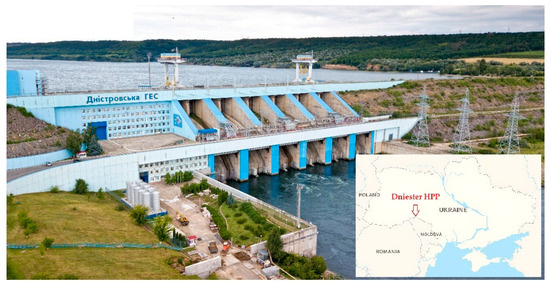
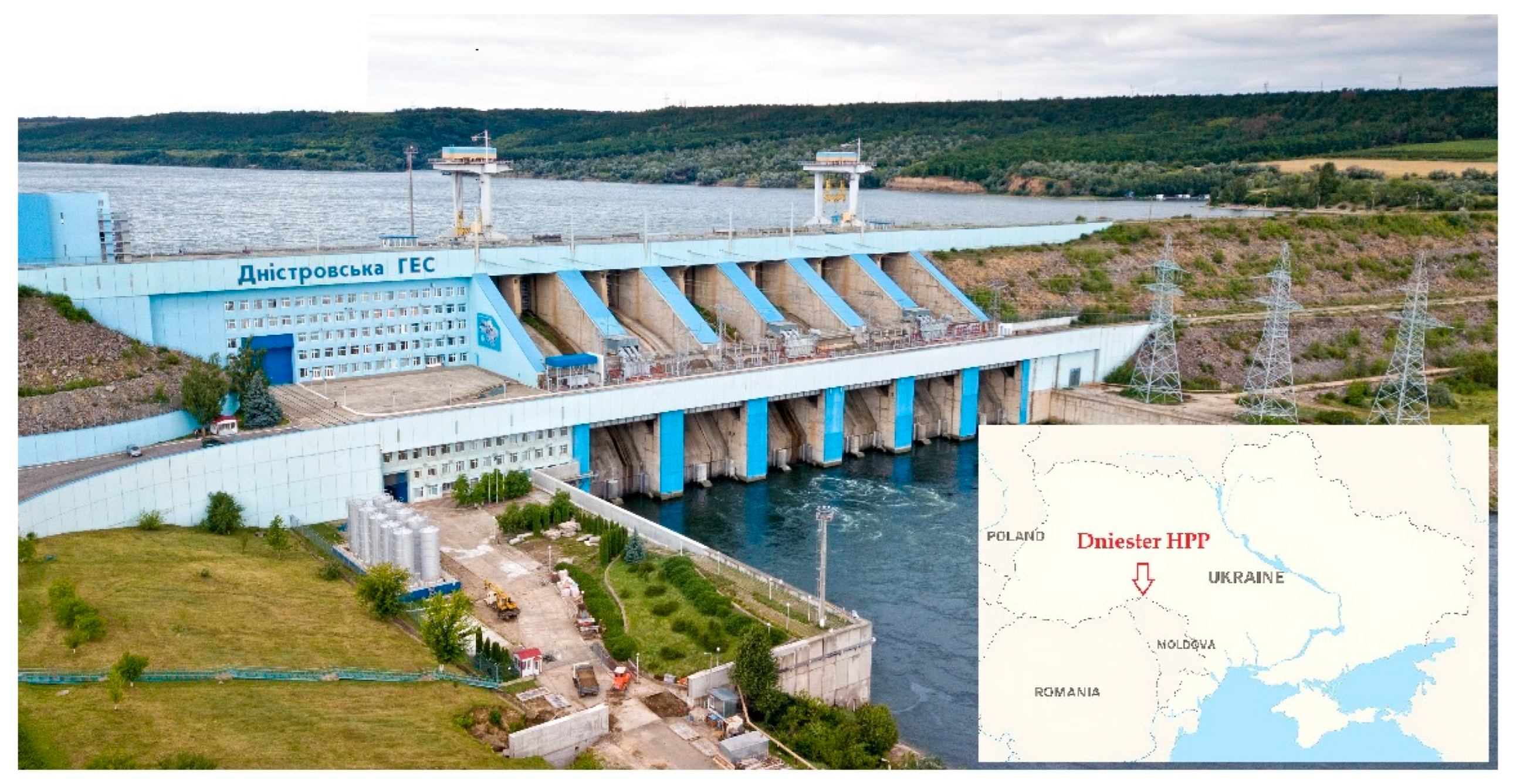
The Dniester Hydroelectric Power Plant Dam (Novodnistrovsk city, Chernivtsi region, Ukraine) is a composite hydraulic engineering structure located on the Dniester River, one of the country’s main waterways. The dam consists of a concrete gravity section and an earth-fill dam, with a maximum height of about 60 m, a crest length of approximately 750 m, and a crest width of up to 12 m (Figure 1). The facility includes a spillway section, water intakes, and a powerhouse with hydro units. The reservoir has a total capacity of about 3 km3 and a surface area of 142 km2.
Figure 1.
Overall view of the Dniester HPP-1 complex.
The construction of the dam started in 1973, and the water reservoir was filled for the first time along with commissioning of the hydroelectric power station in 1981. Several million cubic meters of concrete, rock materials, and soil were used to build this structure. The dam serves multiple purposes: electricity generation, river flow regulation, anti-flood protection, as well as water supply and irrigation in the lower reaches of the Dniester.
The spatial displacement and deformation vectors of the Dniester HPP hydraulic structures are calculated on basis of processed GNSS data and linear-angular measurements obtained from the Stationary System for Monitoring Spatial Displacements of Structures (SSMSDS). The SSMSDS of the Dniester HPP-1 is a state-of-the-art complicated hardware and software complex that includes multi-system GNSS receivers, robotic total stations, high-precision inclinometers, and telecommunication modules. The measurement results are transmitted in real-time mode from different inter-controlled instruments to the central server for subsequent mathematical processing by Leica Geosystems software packages SPIDER and GEOMOS. This allows us to define the highly reliable parameters of the dam displacements and deformations. The SSMSDS installation at the Dniester HPP-1 was carried out by the Swiss company Leica Geosystems (St. Gallen, Switzerland). As an advanced technological system, the SSMSDS requires careful adaptation to the specific conditions of sensor placement on hydraulic structures to ensure the highest possible accuracy of the results. In the course of its operation, systematic monitoring and evaluation of the system performance are conducted to detect both gross and systematic errors caused by external influences such as optical refraction or structural vibrations. By today, the substantial scope of monitoring data has been accumulated, which forms the ground for continuous improvements in a refraction field model and a temperature model of the HPP dam.
2.2. Monitoring Methods
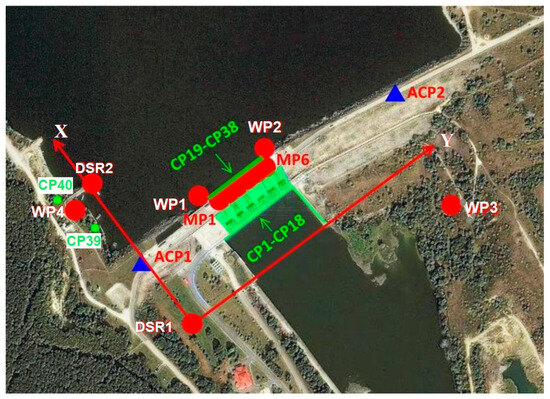
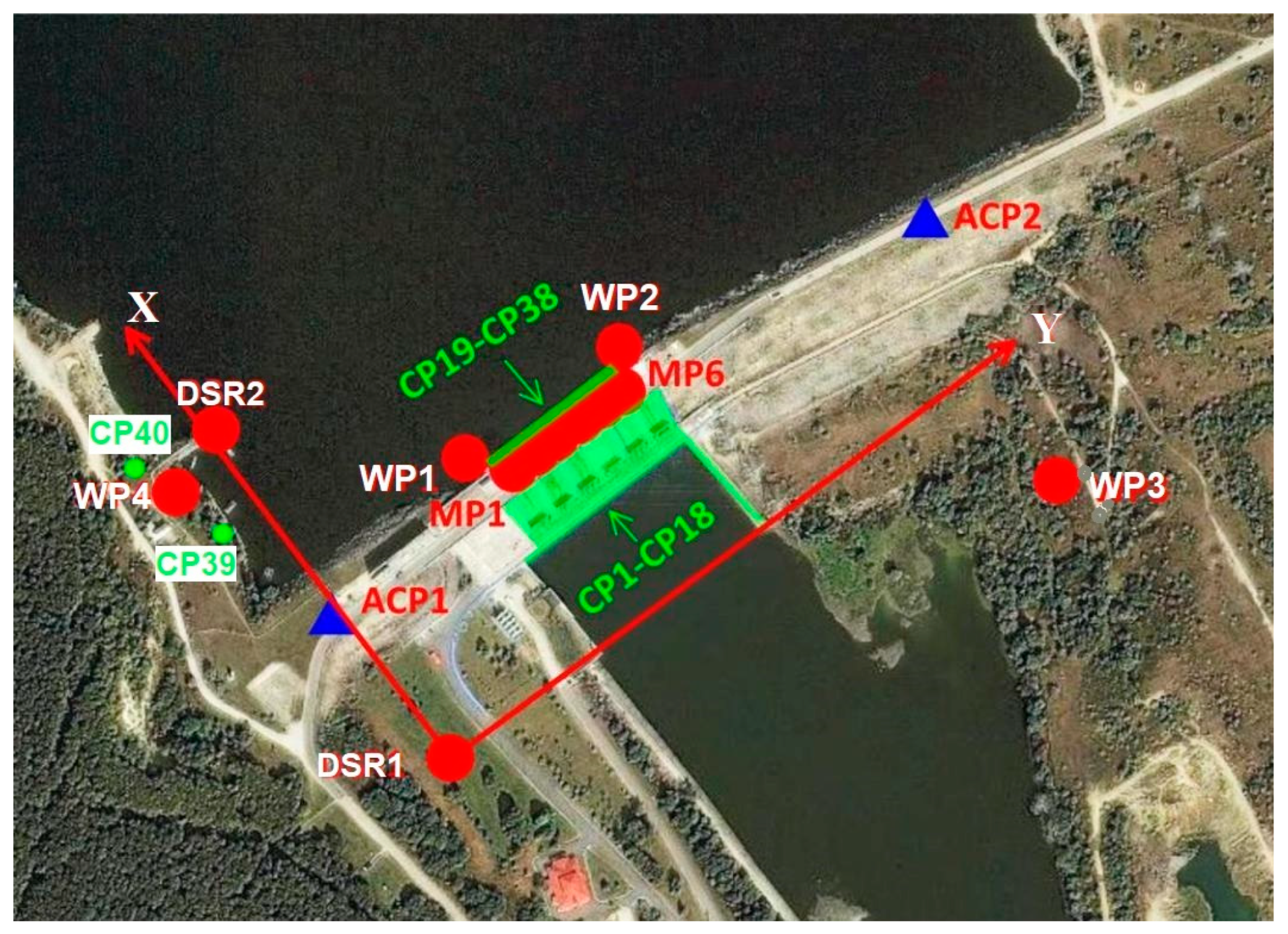
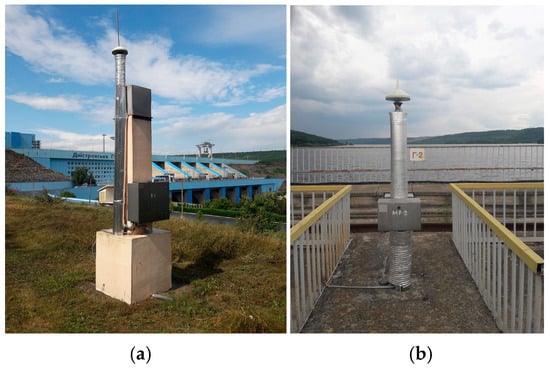
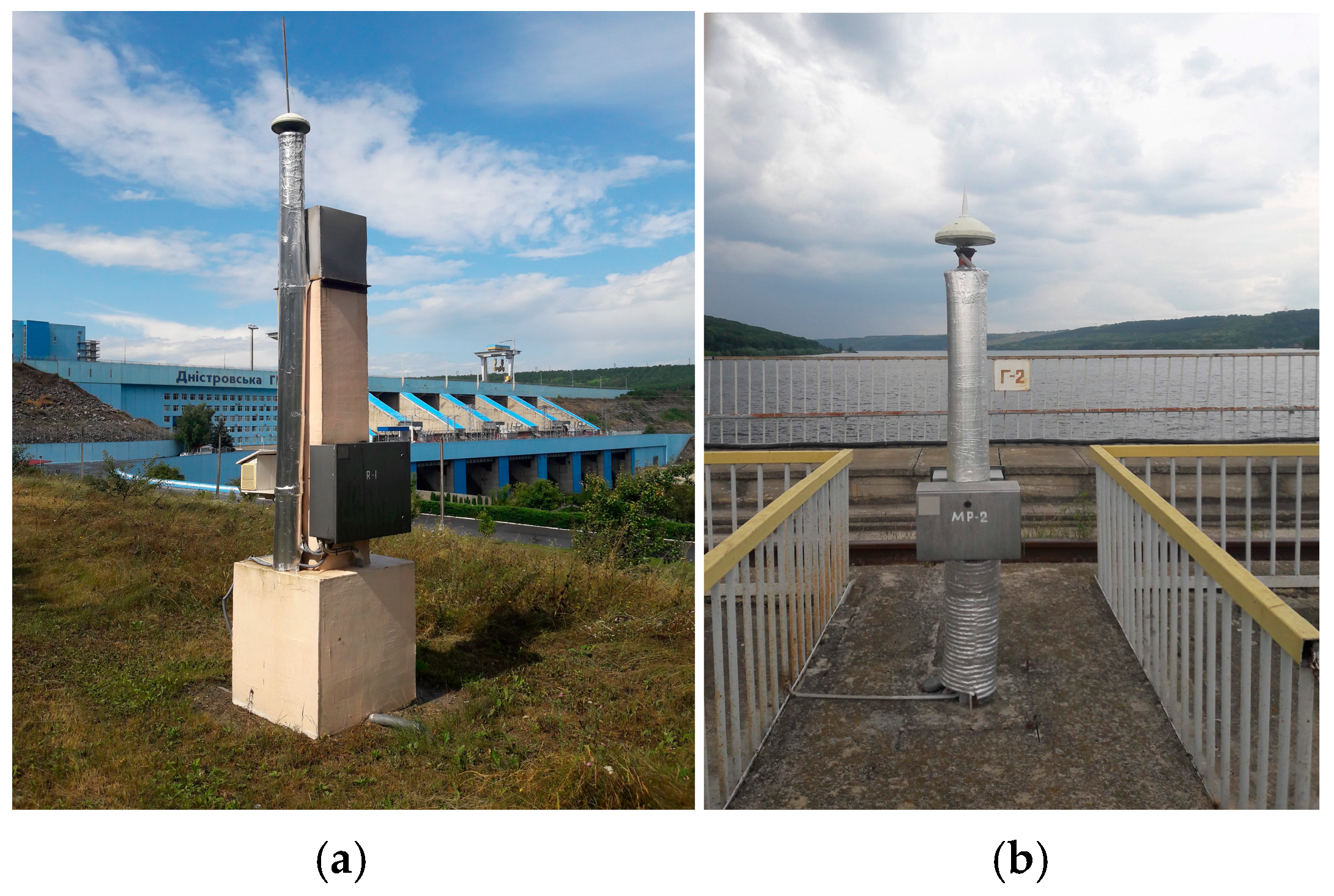
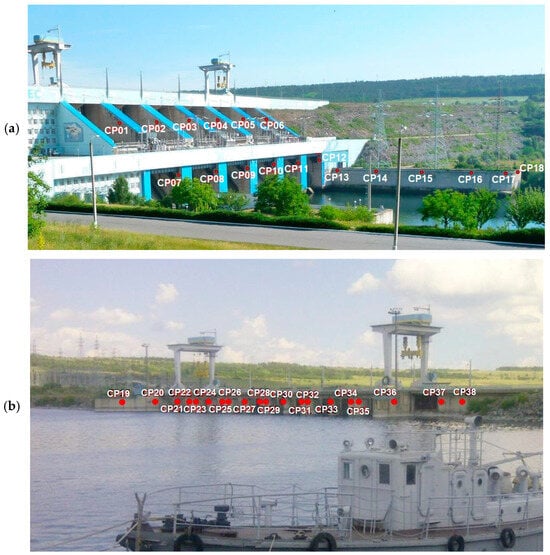
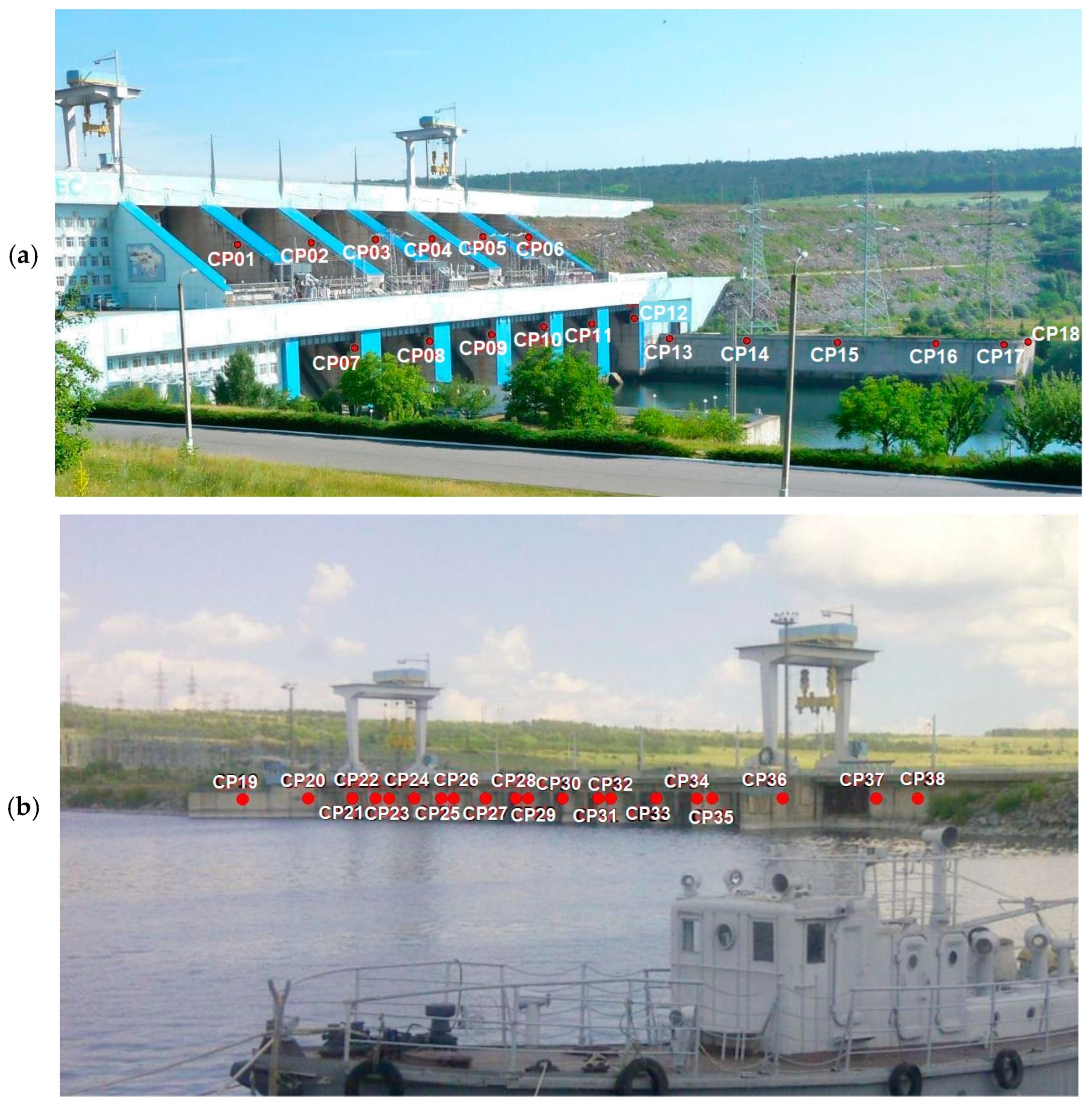
The spatial displacements of the Dniester HPP Dam are continuously and comprehensively monitored with the following measurement intervals: GNSS—6 h and daily solutions, linear-angular measurements—every 6 h, and InSAR—every 12 days. The SSMSDS of the Dniester HPP-1 comprises 54 control points distributed across the dam and the main hydraulic structures (Figure 2). The coordinates of points MP1-MP6, WP1-WP4, ACP1, ACP2, DSR1, and DSR2 (14 points in total) are defined using both satellite and linear-angular measurements. These points are equipped with GNSS receivers and 360° reflector prisms (Figure 3). Additionally, the DSR1 and DSR2 points are instrumented by robotic total stations for precise linear-angular measurements. The coordinates of the CP01-CP40 points (40 points) are determined exclusively by linear-angular measurements, with each point equipped with prism reflectors. The layout of 38 prism reflectors installed on the dam structure is illustrated in Figure 4.
Figure 2.
Scheme of the geodetic control point network of the SSMSDS at the Dniester HPP-1.
Figure 3.
General view of base points DSR1 and DSR2 (a), monitoring points on the concrete dam MP1–MP6 (b).
Figure 4.
(a) Spatial distribution of points CP01–CP18, the coordinates of which are determined by linear-angular methods (view from point DSR1); (b) spatial distribution of points CP19–CP38, the coordinates of which are determined by linear-angular methods (view from point DSR2).
The modern interferometric methods based on synthetic aperture radar (SAR) data enable high-precision monitoring of deformations of both the Earth’s surfaces and technogenically loaded territories. Among them, multi-temporal InSAR (MT-InSAR) methods, particularly the Permanent Scatterer Interferometry (PSI) method, have proven to be highly effective for long-term monitoring of hydropower facilities [9,25,26].
MT-InSAR is a general term that includes a set of interferometric techniques that exploit time series of SAR images obtained at different epochs. Its primary objective is to detect the surface deformations with high accuracy by mitigating atmospheric effects and minimizing errors related to orbital inaccuracies and signal decorrelation.
MT-InSAR involves the generation of multiple interferograms of the researched area, enabling the reconstruction of the temporal evolution of displacements. This approach is especially effective in infrastructure-dense regions, where both local and regional deformations can be monitored, including soil subsidence, as well as deformations of tunnels, dams, bridges, and other objects of critical infrastructure.
PSI is one of the most precise implementations of MT-InSAR, based on detection and analysis of persistent scatterers (PSs), which are points on the surface that maintain high coherence throughout the entire observation period.
One of the fundamental characteristics of radar interferometry is that displacement measurements are performed along the radar line of sight (LOS), i.e., in the direction from the satellite to the point observed on the Earth’s surface. Since the SAR systems operate in a side-view mode, the incidence angle (visual angle) to the surface typically ranges between 25° and 45° from the vertical line. Consequently, SAR is most sensitive to vertical and east–west components of displacement, while north–south motions are poorly detected or remain entirely undetected.
As a result, single-channel satellite measurements give only a projection of deformations in the LOS direction. This imposes a certain limitation on interpreting the deformations, as it does not allow us to directly differentiate between the vertical and horizontal components of displacement.
To overcome this limitation, the approach based on the decomposition of data from ascending and descending SAR satellite orbits (multi-geometry) [27] is widely applied in the monitoring of engineering structures. These orbits have opposite directions of platform motion (approximately from south-west to north-east for ascending, and vice versa for descending) and slightly different incidence angles. By combining the data from both orbits, the measured LOS deformations can be divided into two principal components: vertical (up) and horizontal in the east–west direction (east–west).
Such a vector distribution is critically important for engineering analysis, since vertical subsidence, uplifts, or horizontal displacements may have a different nature and pose varying levels of risk to objects of infrastructure. Moreover, for full three-dimensional reconstruction of displacement vectors, including the north–south component, it is necessary to involve some additional sources of information, such as observations from other satellites with different viewing geometries, or independent ground-based measurements, in particular, GNSS data, which allow for verification and supplementation of InSAR results [28].
The multi-geometry approach of processing the radar data from the Sentinel-1 satellite was used to study the spatial displacements of the Dniester Hydroelectric Power Plant. For monitoring and analysis of such an engineering structure, it is important to make a decomposition of deformation vectors, since both vertical and horizontal displacements are present here.
2.3. InSAR Data
The input data used in this research consisted of 185 radar images acquired by the Sentinel-1A satellite in an ascending orbit (Path 58/Frame 154) and 184 images obtained in a descending orbit (Path 109/Frame 431). The time series spans the period from 1 January 2019 to 5 February 2025, with a temporal resolution of 12 days. All radar scenes were collected in the Interferometric Wide (IW) swath mode with a spatial resolution of 5 × 14 m per pixel; the images were downloaded from the Alaska Satellite Facility archive: https://search.asf.alaska.edu/ (accessed on 18 November 2025). These data were processed separately for ascending and descending orbits using the Persistent Scatterer Interferometry (PSI) technique. The analysis was implemented according to the StaMPS algorithm (Stanford Method for Persistent Scatterers) in MATLAB R2021a (MathWorks, Natick, MA, USA).
Based on the processing of two datasets of radar images (for ascending and descending orbits) by the PSI method, the deformation time series along the satellite line of sight were received for the points identified as persistent scatterers.
To obtain a vertical component of the deformations, the two datasets were jointly processed using a custom script developed in Python 3.10 (Python Software Foundation, Wilmington, DE, USA). The script is based on an algorithm for decomposition line-of-sight (LOS) displacements into three-dimensional motion components (east, north, and vertical) using a formula [29].
where PLOS = [sinθsinα, sinθcosα, cosθ] is the LOS unit vector; dENU = [dE, dN, dU]T are the components of the displacement vector in the east, north, and vertical (up) directions, respectively; θ is the incidence angle; α is the azimuth of the LOS. The input parameters for the deformation vector decomposition included displacement time series of persistent scatterers from both orbits, satellite orbit azimuths, and radar incidence angles.
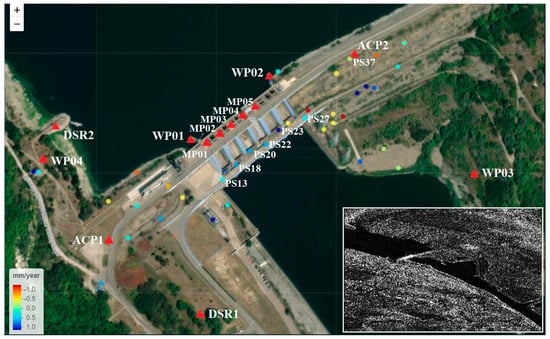
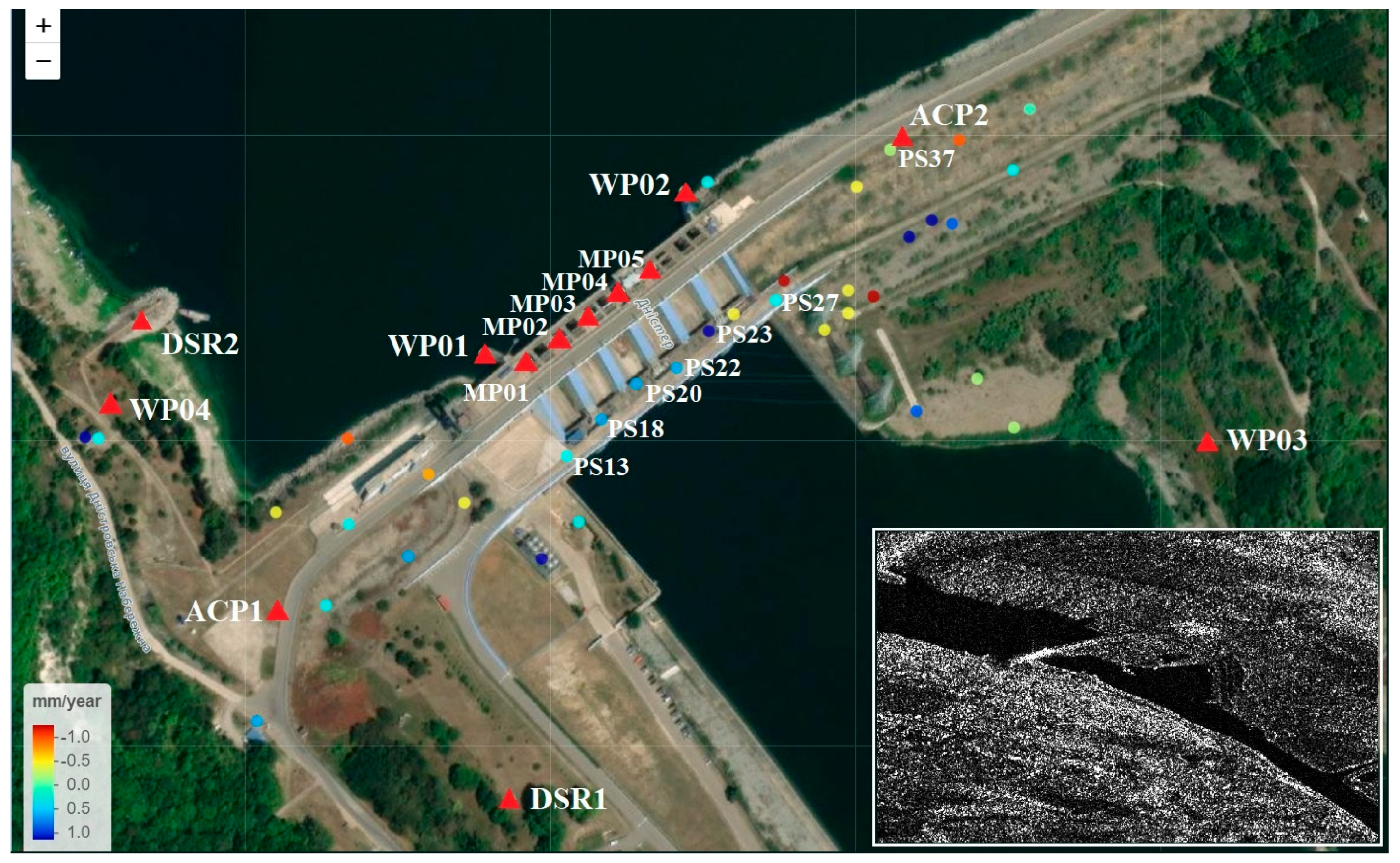
As a result, a map of vertical deformation velocities was generated for the common points (persistent scatterers) identified in both ascending and descending orbits (Figure 5). The maximum distance threshold used to identify persistent scatterers from ascending and descending orbits as common points was approximately 22 m.
Figure 5.
Vertical deformation velocity map of the Dniester HPP dam for the period 2019–2025, obtained using the InSAR technique, and fragment of an SAR image for the area of interest. The map illustrates the relative locations of the GNSS network points ( ) and the InSAR persistent scatterers (colored circles). The time series of the selected persistent scatterers (PS13–PS37) were used for comparison with the corresponding GNSS measurement time series.
) and the InSAR persistent scatterers (colored circles). The time series of the selected persistent scatterers (PS13–PS37) were used for comparison with the corresponding GNSS measurement time series.
3. Results
3.1. InSAR Validation
To confirm the reliability of the results of satellite radar monitoring, the InSAR-derived data were compared with the GNSS measurements at SSMSDS points located on the dam. Among all the persistent scatterers identified on the velocity map (Figure 5), only one of them spatially coincides with the GNSS station. In particular, the proximity of the GNSS network point ACP2 to the persistent scatterer PS37 (Figure 5) enables a direct comparison and verification of the interferometric radar measurements.
The integration of radar interferometry into the system of geodetic observations at this hydropower facility and others requires a larger number of points with collocated ground-based and remote sensing measurements. For the combined application of InSAR and GNSS methods, this can be achieved by installing ground-based corner reflectors for radar monitoring at GNSS network sites [30,31]. Thus, GNSS network points will be reflected as persistent scatterers on the deformation velocity map derived from radar images, thereby enabling reliable confirmation of InSAR results.
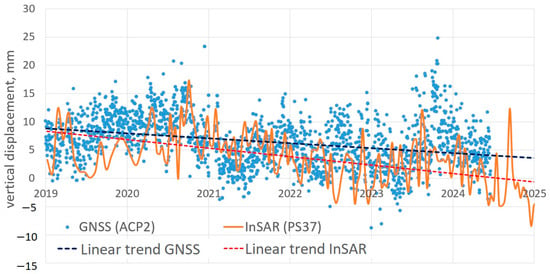
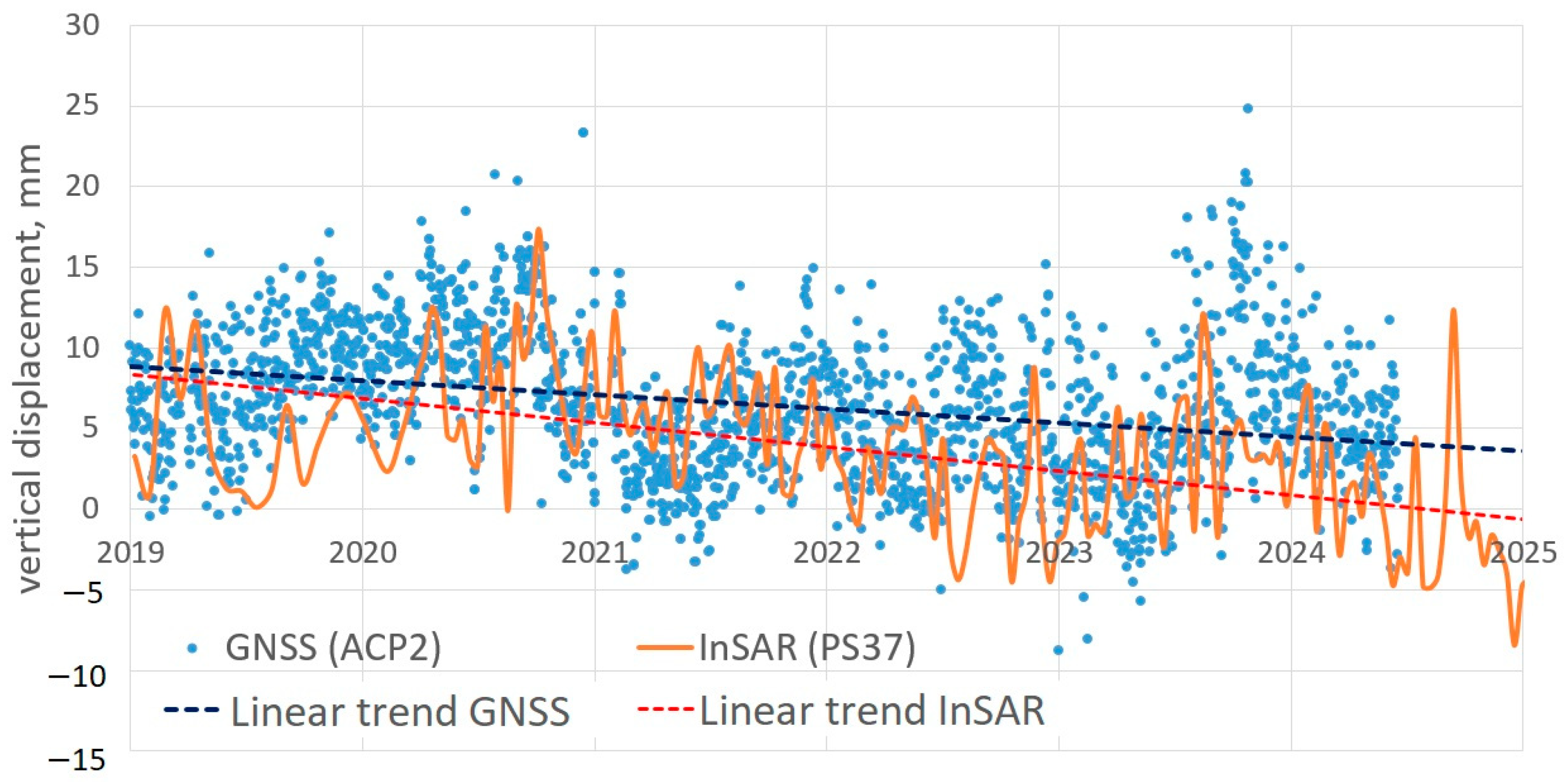
Figure 6 presents a comparison between the height change time series of the GNSS point ACP2 and the nearby InSAR persistent scatterer PS37 for the period 2019–2025.
Figure 6.
Time series of vertical displacements at the earth-fill dam, comparing InSAR-derived (12-day interval) and GNSS-measured (daily) data.
The vertical displacement time series obtained from GNSS and InSAR (Figure 6) show a similar overall long-term trend. The InSAR-derived curve obviously looks smoother as compared with the discrete GNSS measurements; however, a small height dislocation is observed, that is, InSAR gives lower values (~3 mm), which is likely due to differences in defining the vertical component and residual atmospheric effects. Local discrepancies in amplitude or peak values do not affect the overall conclusion regarding the consistency of the two methods in reflecting both seasonal and slow deformation components.
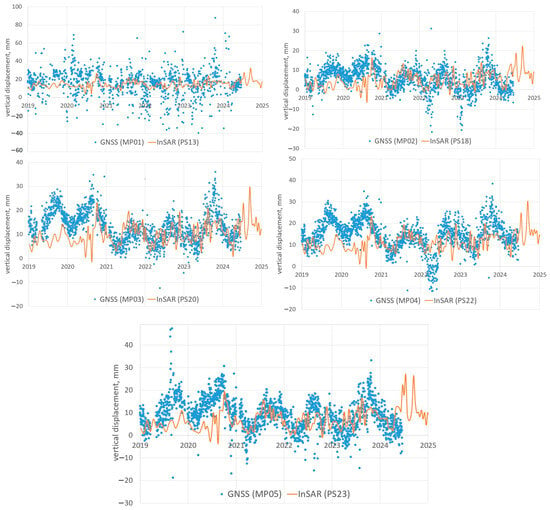
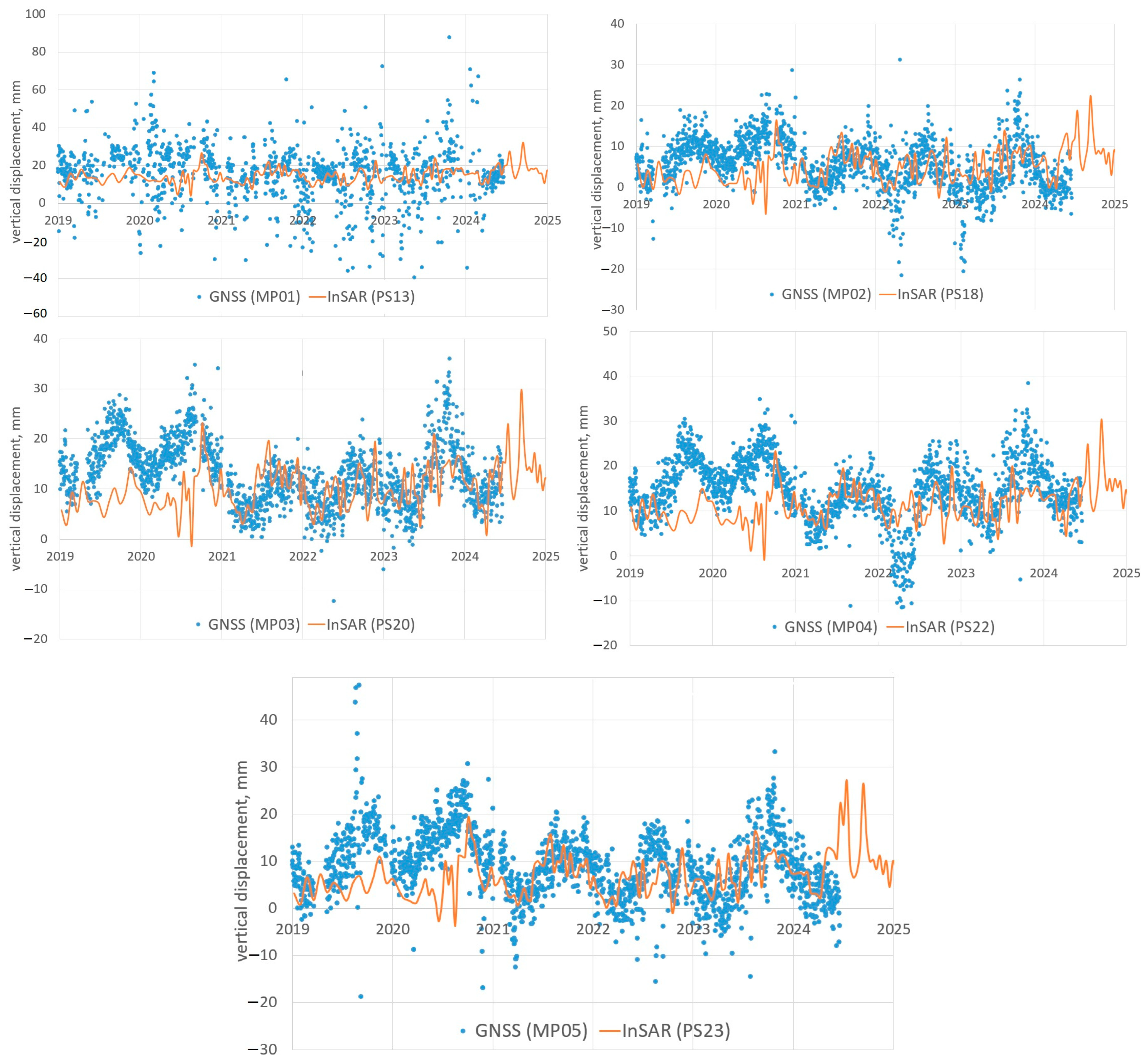
Unlike the point ACP2, the positions of the GNSS stations (MP01–MP05) and the InSAR persistent scatterers on the concrete dam do not coincide (see Figure 5). Nevertheless, the comparison of the GNSS and InSAR time series for the points located on the crest and downstream face reveals a consistent pattern of seasonal vertical movements across both the upper and lower parts of the dam (Figure 7).
Figure 7.
Time series of vertical movements of GNSS network points MP01–MP06 and the corresponding InSAR persistent scatterers on the downstream face of the dam.
The verification of InSAR results by the observations at GNSS network points enables the use of all other data obtained for the dam surface, in order to densify the network of points with reliably determined deformation values, and to perform further analyses.
The obtained time series of datasets are significantly affected by components of measurement noise, which is typical for all the methods applied. Therefore, for subsequent joint processing and analysis, the datasets were subjected to filtering and optimization using mathematical methods.
3.2. Filtering and Optimization of Time Series Data
The time series obtained from persistent scatterers on a concrete section of the dam using the InSAR method show an expressly harmonic pattern, with an amplitude of at least 4–5 mm, reaching an annual maximum around August–September and a minimum in February. By contrast, the time series, derived from persistent scatterers on the earth-fill section of the dam, show only minor oscillations, resembling statistical noise, without any clearly defined maxima or minima of the function.
The harmonic nature of the displacement time series indicates that deformations of concrete structures are primarily dominant due to periodic processes that are closely associated with environmental temperature fluctuations. These periodic signals are well consistent with the physical nature of thermal expansion and contraction in concrete, which is manifested as cyclic daily and seasonal deformations. These characteristics enable the use of radar interferometry (InSAR) methods, which, due to their high sensitivity to small vertical and horizontal displacements, can accurately reflect these patterns. The previous studies support this interpretation. In particular, the paper [32] demonstrated the effectiveness of InSAR technology for assessing temperature-induced deformations in concrete structures, where distinct harmonic components were observed in the displacement time series. Furthermore, the research work [33] applied the spectral analysis using the fast Fourier transform method to single out periodic effects and confirm their correlation with temperature cycles. Thus, the presence of harmonic components in the displacement time series not only reflects the influence of thermal processes but also validates the use of InSAR as an effective tool for their detection and quantitative analysis.
To automatically identify the characteristics of a reflective surface from time series of satellite radar data, the following analysis will be performed using Fourier transform techniques.
Time series of deformation measurements exhibit significant deviations from an ideal harmonic function. The application of filtering procedures reduces the influence of gross errors and improves the accuracy of approximation by the harmonic model. However, excessive filtering may result in the loss of statistically significant observations that reflect the true dynamics of the system rather than errors, thereby creating a risk of misinterpreting the underlying physical processes.
When approximating the InSAR time series using a Fourier series, the model accuracy naturally grows with an increasing number of harmonics. However, this approach has inherent limitations: the use of a small number of harmonics captures only the dominant factors that determine seasonal and periodic variations, whereas including an excessive number of harmonics may reproduce random fluctuations that lack significant physical meaning. Thus, there appears to be a need to find a compromise between the complexity of the model and its interpretative value.
The optimization of the number of harmonics and the level of data filtering can be formulated as a nonlinear programming problem. In this context, the objective function is defined as the dependence of the mean square approximation error m on two key parameters: the number of filtered time series points n and the number of Fourier series harmonics k. This approach enables us to determine the optimal balance between time series reconstruction accuracy, preservation of statistically significant information, and minimization of random noise effects. To build up an objective function, the concept of entropy volume is applied, which is frequently used in optimization problems involving multiple parameters where an optimal balance between accuracy and model complexity is required [34].
The entropy interpretation represents a function that estimates the overall complexity of the model when selecting the parameters n and k, as well as the corresponding values of the objective function. In the initial approximation, the objective function takes the following form:
where n is the number of removed (filtered) points; N is the allowable number of filtered points; K is the allowable number of Fourier series harmonics; k is the actual number of Fourier series harmonics. The terms m0, mn, mN represent the mean square error of the time series approximation without removing the measurements, in the case of removing n measurements, and after removing the permissible number of measurements N, respectively.
To determine the value of N, the application of the 3σ rule (the standard 99.7% rule) is recommended. This is an a priori estimate that corresponds to a realistic level of noise and gross errors in field GNSS measurements or sensor-based time series. Typical ranges of the “acceptable” percentage of rejected data under the 3σ criterion are as follows:
- Approximately 0.3% under ideal conditions,
- But in practice (due to multipath effects, signal disruptions, or atmospheric influences), only 1–5%.
However, studies have shown that for GNSS measurements, these ranges can be extended. Based on an analysis of eight years of GNSS satellite clock correction data, the percentage of discarded observations was reported as approximately 3.4% for GPS, 3.7% for GLONASS, 2.7% for BeiDou, and about 20% for Galileo [35]. Based on our experience in processing GNSS measurements obtained under normal conditions, we recommend a maximum data rejection threshold of 5%. Under challenging conditions, such as limited satellite visibility or the presence of electromagnetic interference, this threshold may be increased up to 10%. For InSAR PSI/SBAS data, a filtering level of 20–40% is typical, while values exceeding 50% are considered critical [36,37]. From our experience, the maximum number of harmonics (K) depends on the amount of data and the presence of noise. In general, the optimal number of harmonics does not exceed 12, while the upper limit of 20 is rarely justified.
The first term of Equation (2) reflects a relative reduction in error after removing the points; the second term represents the proportion of retained data; and the third term corresponds to model simplification (a smaller number of harmonics relative to the maximum possible). Together, these three components define the “information volume” of the model, which has to be optimized. For calculation purposes, it is convenient to express the ratios in each term of Equation (2) as percentages. This objective function enables us to determine an optimal balance between the approximation accuracy, number of filtered points, and number of harmonics in the time series.
The algorithm of time series optimization by the Fourier method is implemented as a cyclic procedure that is based on the balance between the number of extracted observations, number of harmonics applied, and accuracy of approximation.
- Input Data. The algorithm requires the time series of measurements as input data (e.g., InSAR observations), the threshold values for the allowable number of extracted points N, and the maximum number of harmonics K.
- Initialization. The zero-point iteration is performed without filtering (n = 0) and with a single harmonic (k = 1). A basic approximation model is constructed, and the approximation error m0 is determined together with the initial value of the objective function f (m, n, k)0.
- Model Estimation. For each iteration of the cyclic procedure, where n ∈ [1, N], k ∈ [1, K], the time series is approximated using a Fourier series for the current parameter set (n, k), and the corresponding root mean square error mn is calculated. Subsequently, the value of the objective function f(m, n, k) is determined according to Equation (2). The results of the objective function evaluation are stored in a matrix representing its variation with respect to f(m, n, k).
- Determination of Optimal Approximation Parameters. For each point within the ranges for n ∈ [n0 + 1, N − 1], k ∈ [k0 + 1, K − 1], the following differences are computed:
f(m, n, k) − f(m, n − 1, k), f(m, n, k) − f(m, n + 1, k),
f(m, n, k) − f(m, n, k − 1), f(m, n, k) − f(m, n, k + 1),
f(m, n, k) − f(m, n − 1, k − 1), f(m, n, k) − f(m, n + 1, k + 1),
f(m, n, k) − f(m, n − 1, k + 1), f(m, n, k) − f(m, n + 1, k − 1).
Since the function f(m, n, k) is unimodal, the point, at which all of these differences are positive, corresponds to the extremum of the objective function, and its parameters n and k are therefore considered optimal. Finally, the approximation error m is calculated using these optimal parameters.
Table 1 presents a fragment of the matrix of calculated values of the objective function (2) for the corresponding combinations of n and k, derived from the time series of the permanent scatterer PS27 located on the concrete dam.
Table 1.
Fragment of the objective function matrix (2) derived from the time series of the permanent scatterer PS27 on the concrete dam.
Table 1 clearly shows the maximum of the objective function (1) for PS27, when filtering 31 points of the time series and applying two Fourier harmonics. The fact that the maximum is reached when two harmonics are available suggests that the time series of the permanent scatterer signal on the concrete section of the dam does not provoke significant ambient noise components, and these variations can be adequately described by low-order harmonic components. For comparison, the function maximum for the permanent scatterer on the soil section of the dam is achieved, when filtering 40 points and applying five harmonics. This reflects a more complex spectral structure, indicating the influence of a larger number of random or local factors on the deformations of an earth-fill foundation, if compared to a concrete section of the structure.
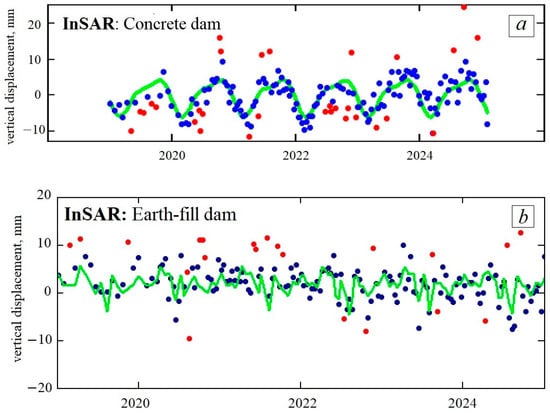
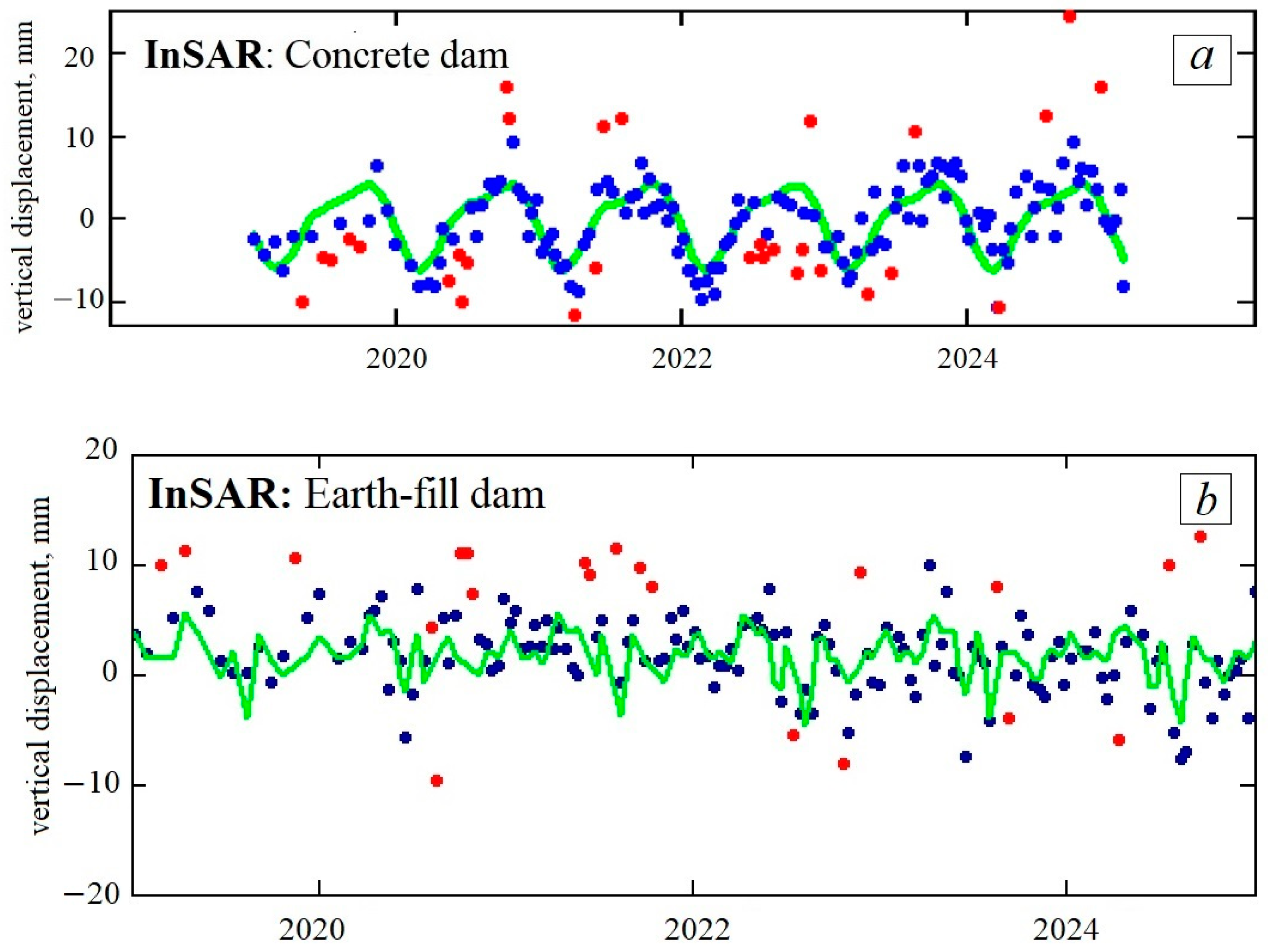
Figure 8 shows the time series of radar monitoring data for the points located on the concrete dam (PS27) and the earth-fill dam (PS21), along with their approximations by a Fourier series using the optimal number of harmonics:
where n is the optimal number of Fourier series harmonics; a0, ci, si are constant coefficients determined by the approximation method; f = ΔT/2π, (ΔT is the time interval between the first and last measurements expressed in fractions of a year).
Figure 8.
Time series of vertical displacements from radar monitoring and their approximation curves: (a) permanent scatterer PS27 on the concrete dam (total number of data points: 163; number of filtered points: n = 31; filtration percentage: 19%); (b) permanent scatterer PS21 on the earth-fill dam (total number of data points: 163; number of filtered points: n = 21; filtration percentage: 13%). ●●●—data removed during filtering; ●●●—data remaining after complete filtering;  —approximation curve.
—approximation curve.
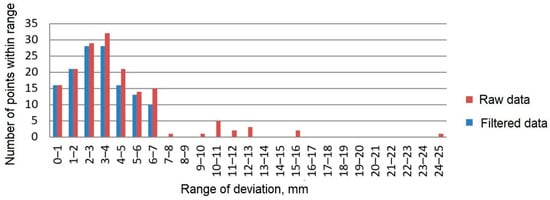
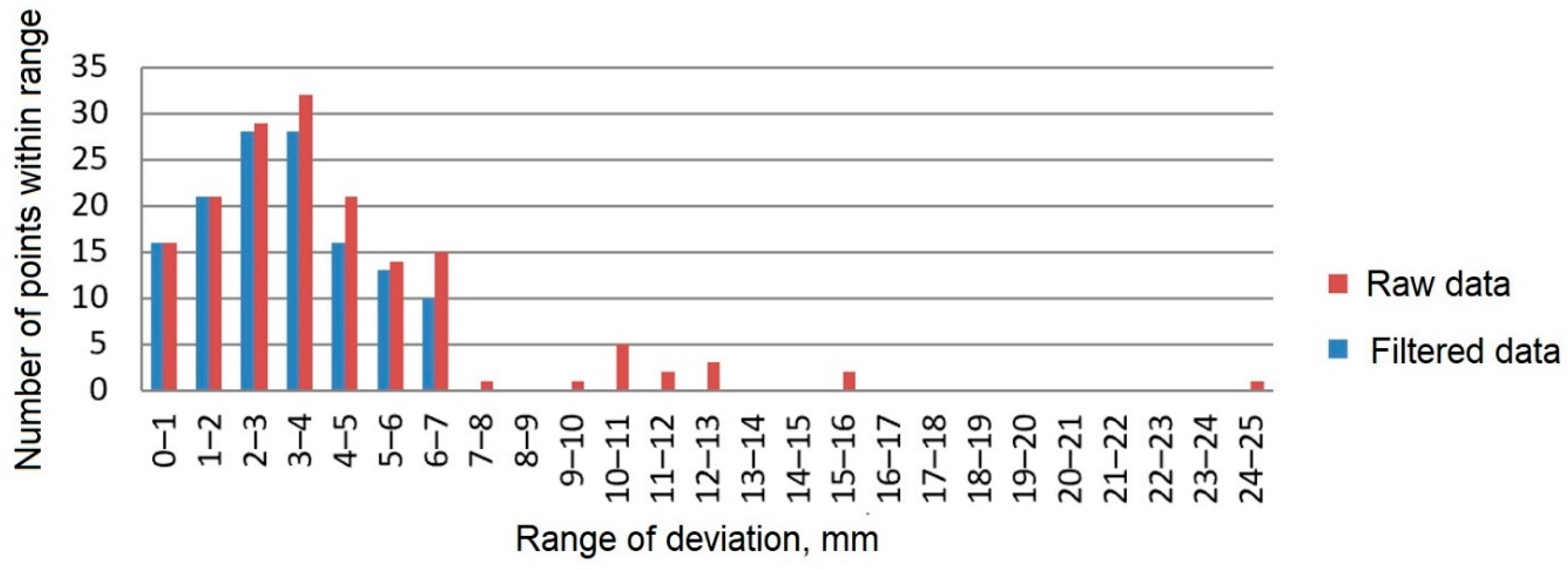
Figure 9 presents a histogram showing the number of time series values for the PS27 persistent scatterer that deviate from the approximation curve within a specified range, before and after data filtering.
Figure 9.
Histogram of deviations in time series values from approximation curves before and after data filtering for the PS27 persistent scatterer.
The histogram shows that prior to data filtering (raw data), the deviations from the optimal approximating curve reach 25 mm, whereas after filtering they do not exceed 7 mm. These results demonstrate the effectiveness of applying the approach of time series data filtering.
As a result of approximating the InSAR time series for a concrete dam, the smooth curves are obtained by clearly capturing the seasonal maxima and minima of functions. The consistent annual periodicity of series, together with the minimal number of harmonics required for their description (k = 2 for PS27), confirms the possibility of using the InSAR results to study systematic temperature-induced deformations of structural elements in a concrete dam. In contrast, the approximation of time series for permanent scatterers on an earth-fill dam indicates the absence of a seasonal component in vertical displacements. Therefore, this algorithm may be applied for assessing the cyclic seasonal and temperature deformations by the data of radar monitoring and differentiation of reflecting surfaces (permanent scatterers), such as concrete, soil, and roofs, etc.
Table 2 presents a fragment of the matrix of calculated values of mean square error (m) for the time series approximation of the PS27 permanent scatterer on a concrete dam. The mean square error of time series approximation was calculated as m0 = 4.67 mm without filtering the measurements.
Table 2.
Fragment of the matrix of mean square error m (mm) values for the time series approximation.
Based on the previously obtained values of n = 31 and k = 2, the mean square error of the optimal time series approximation for point PS27 was determined as m = 2.66 mm, corresponding to the maximum of the objective function (2). It shall be noted that in the case of increasing the number of filtered points and increasing the number of approximation harmonics, this does not significantly improve the network accuracy with respect to an optimal solution of the problem.
The applied algorithm allows us to simultaneously consider both the approximation accuracy and the model complexity, thus ensuring an optimal balance between the number of filtered observations and the number of harmonic components.
The algorithm described above was used to process the time series of vertical displacements derived from the SSMSDS data of the Dniester HPP-1. Similarly to the InSAR results, the approximation curves were obtained from the time series of GNSS stations and linear-angular measurements of RTS network points by capturing the seasonal maxima and minima related to temperature-induced deformations of a concrete dam [20,21,22,23].
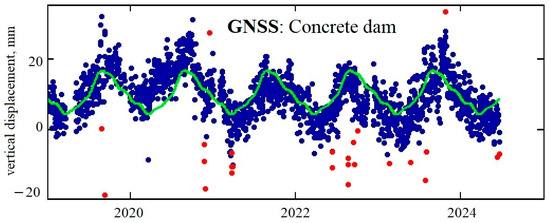
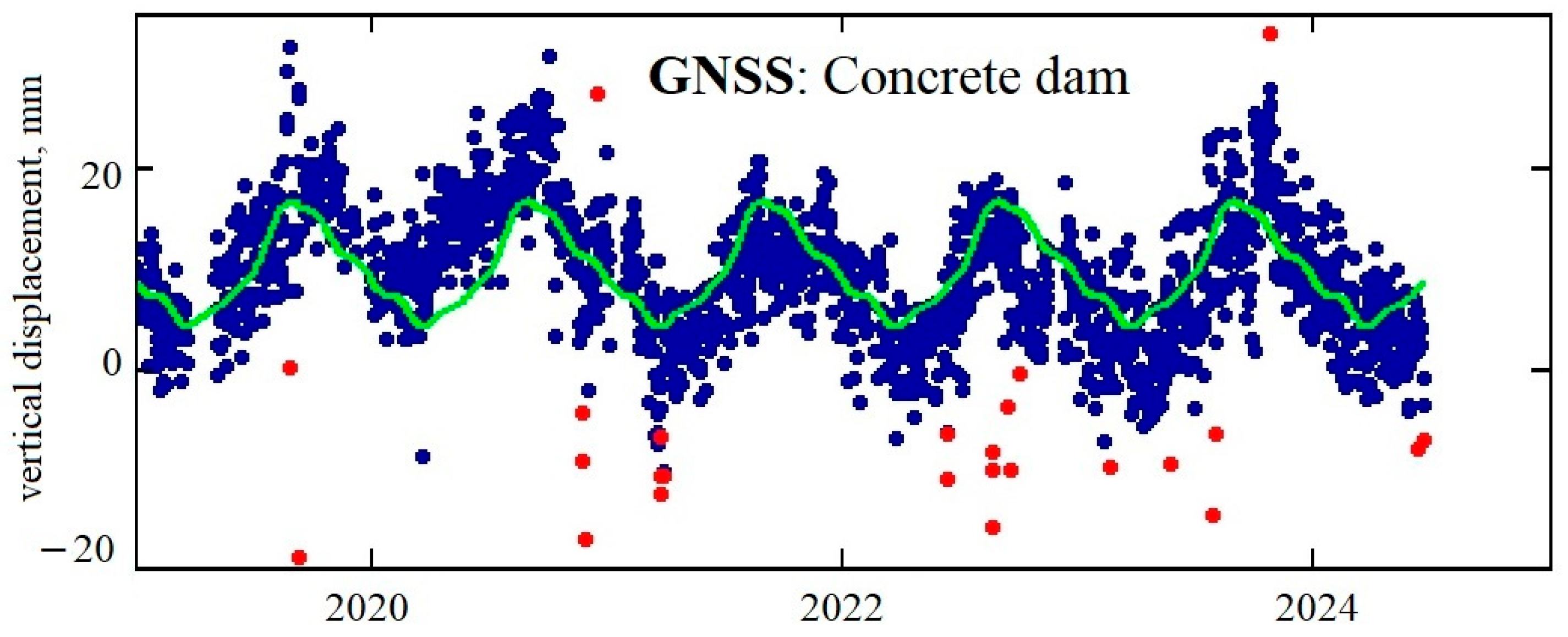
Figure 10 and Figure 11 present the time series of vertical GNSS displacements for points MP05 and CP08 of the linear-angular network (see the position of points at Figure 4a), which are installed on a concrete dam, along with the optimal curves of Fourier series approximation. The maximum of the objective function for the MP05 time series was achieved by filtering the points n = 31 and applying the Fourier harmonics k = 6. For point CP08 of the linear-angular network, the corresponding values are n = 47 and k = 5.
Figure 10.
Time series of vertical displacements of GNSS station MP05, located on the dam crest, and its approximation curve (total number of data points: 3056; number of filtered points: n = 31; filtration percentage: 1.0%); ●●●—data removed during filtering; ●●●—data remaining after complete filtering; —approximation curve.
—approximation curve.
Figure 11.
Time series of vertical displacements of linear-angular network point CP08, located near the downstream face of the dam, and its approximation curve (total number of data points: 4596; number of filtered points: n = 47; filtration percentage: 1.0%); +++—data removed during filtering; +++—data remaining after complete filtering; —approximation curve.
—approximation curve.
The unified approach to processing the three datasets enables us to present consistent results for determining the seasonal vertical displacements of a concrete dam at the Dniester HPP-1, referring to the GNSS measurements, linear-angular measurements of the RTS network, and InSAR data.
4. Discussion
According to the results of previous studies [20] carried out at the Dniester Hydroelectric Power Station dam, variations in the reservoir water level (Figure 12) have been shown to have no significant effect on the spatial displacements of the GNSS monitoring points. This finding is confirmed by the low correlation coefficients, which vary between 0.17 and 0.19. In contrast, a stable and clearly defined relationship was observed between the recorded displacements and temperature variations. Therefore, it can be inferred that the dominant factor influencing the vertical movements of the control points is the thermal expansion of the dam’s concrete structures [26].
Figure 12.
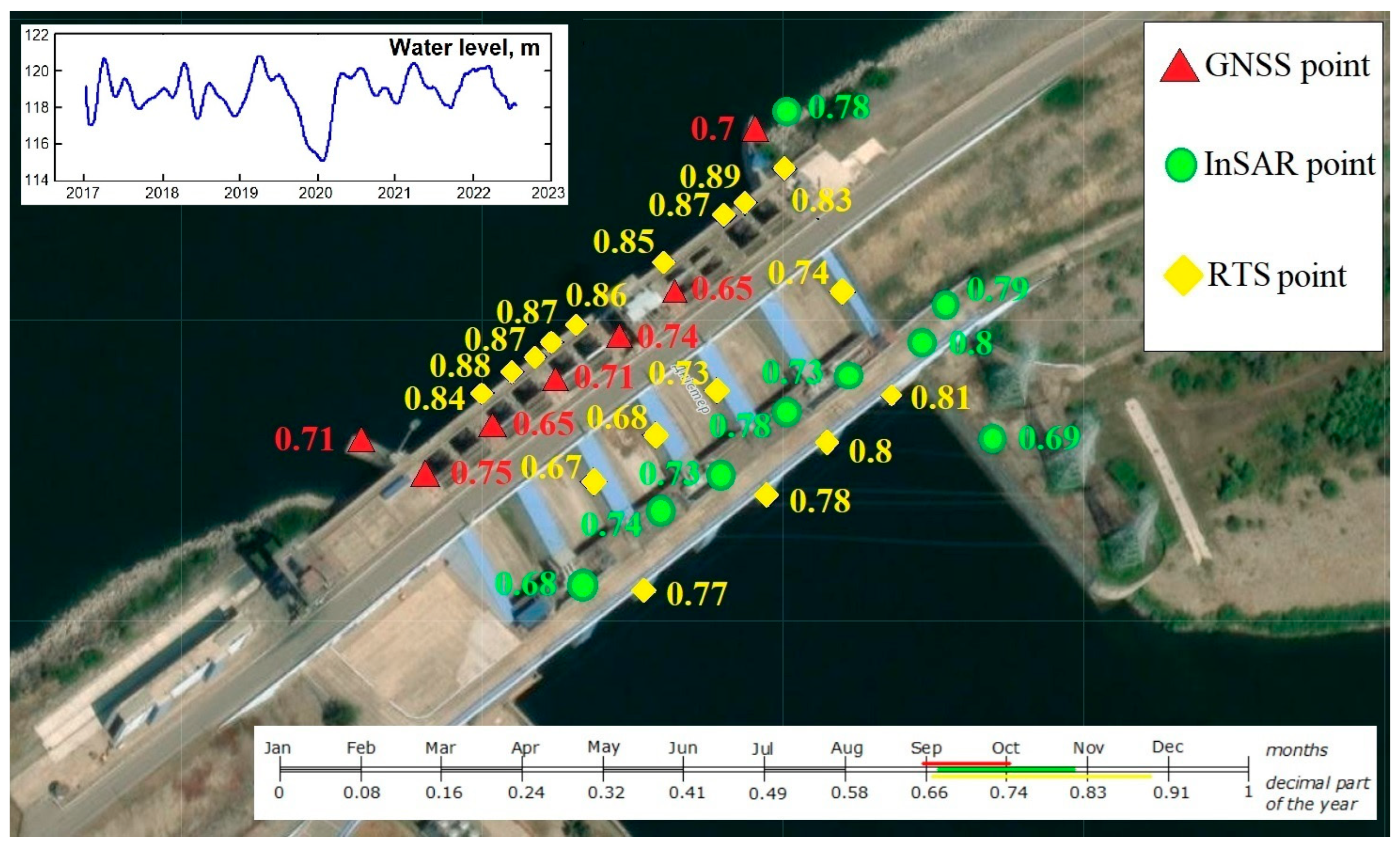
Spatio-temporal distribution of the maximum vertical uplift of concrete dam control points determined by the GNSS, RTS, and InSAR methods.
The results of satellite radar monitoring, along with the suggested algorithm for processing the time series of vertical displacements, made it possible to increase the number of control points on the concrete section of the Dniester HPP-1 dam, and to specify the model of temperature-induced deformations. The approximation of vertical displacement time series based on the GNSS, RTS, and InSAR measurements has enabled us to determine the epochs of maximum uplifts and subsidence of control points, as well as the amplitudes of their oscillations.
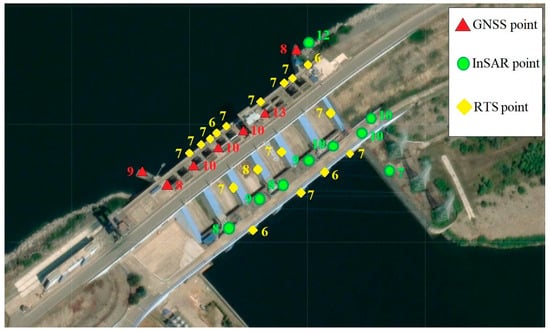
Figure 12 shows a schematic map of the epochs corresponding to the maximum vertical uplift of control points on the concrete dam. The points on the map indicate the respective epochs expressed as fractions of a year.
The presented map of the spatial distribution of the epochs of maximum vertical uplift of the dam shows that these moments occurred between the second half of August and the end of November. The maximum timing depends on the location of a control point on the structure. The dam crest, where the GNSS receivers are located, is a horizontal area fully exposed to solar radiation. Therefore, the maximum uplift occurs here at the earliest and lasts from August to September. On the buttresses of the downstream face, where the RTS network points are located, the maximum uplift occurs from early September to early October. The downstream face is a constantly illuminated horizontal section of the concrete dam. Here the data on vertical displacements are obtained from InSAR points. The epoch of reaching the maximum amplitude occurs from early September to late October. At the spillway pillars, where the control points of RTS network are located, the maximum uplift is observed later—from mid-October to late November. The latest maximum uplift is recorded on the upstream face of the dam (between the upper reservoir level and the crest), which is explained by the proximity of concrete structures to the water surface. The influence of water temperature leads to an additional inertial delay of the system.
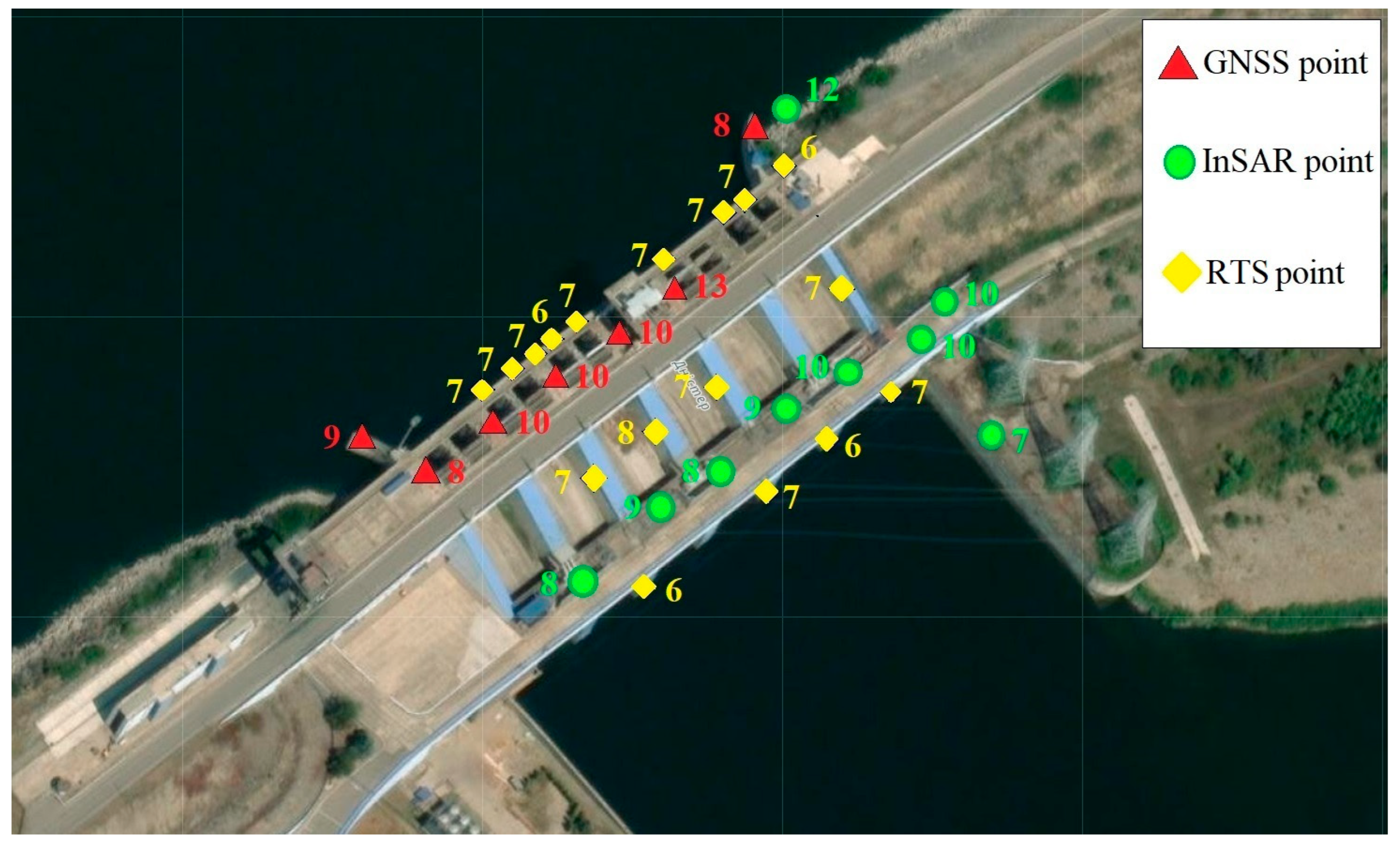
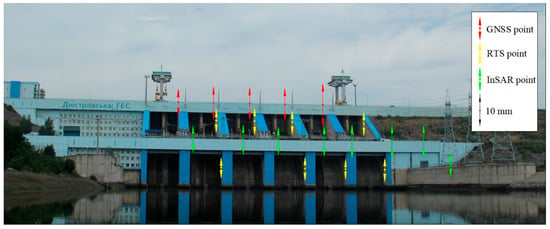
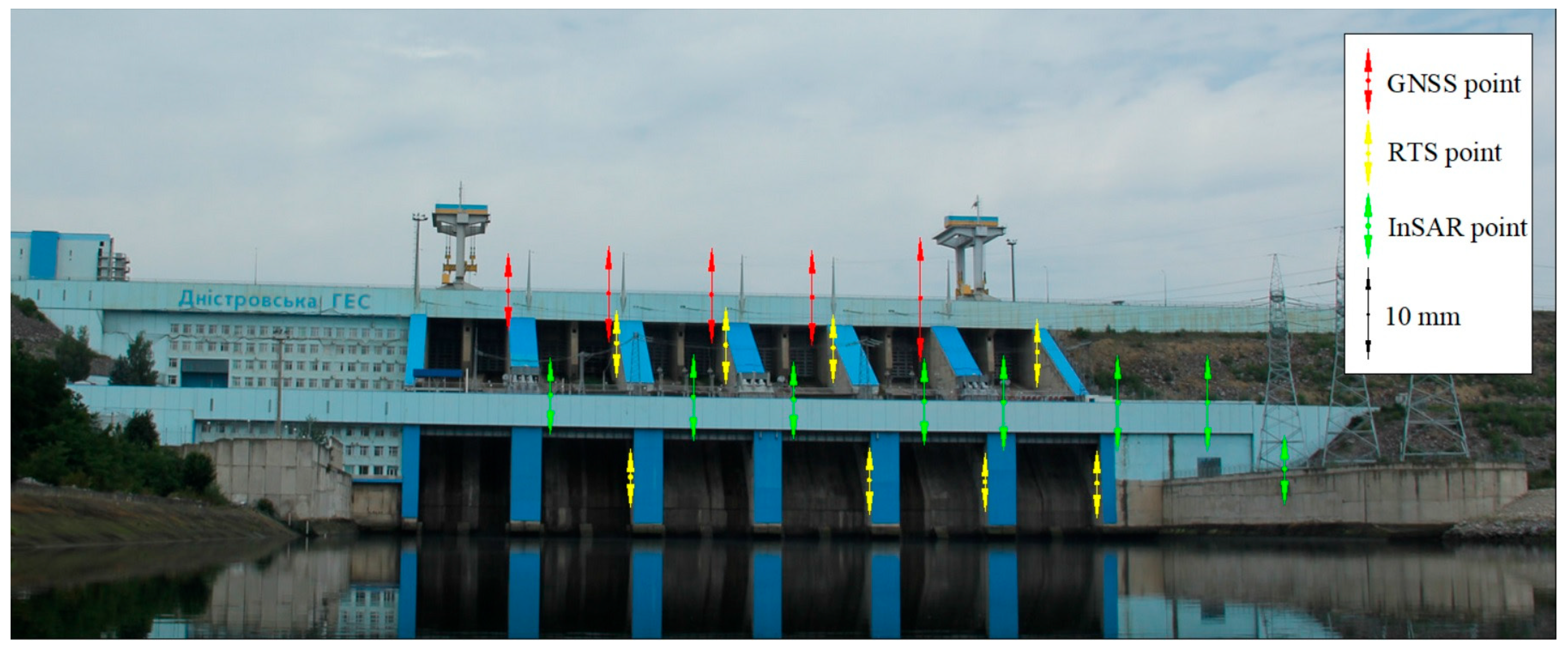
Figure 13 presents a schematic map of the spatial distribution of the amplitudes (mm) of vertical displacements at the control points, while Figure 14 shows their vector representation.
Figure 13.
Spatial distribution of the amplitudes of vertical displacements of control points on a concrete dam, determined by the GNSS, RTS, and InSAR methods. The number next to the point position indicates the amplitude value in mm.
Figure 14.
Spatial distribution of the amplitudes of vertical displacements of control points on a concrete dam, determined by the GNSS, RTS, and InSAR methods, presented in a vector form.
The joint processing of the data of vertical displacement monitoring from the concrete dam using GNSS, RTS, and InSAR methods has enabled us to create a dense network of control points for developing a temperature model and estimating the magnitude of seasonal deformations. The calculated amplitudes of vertical displacements fall within the range from 6 to 13 mm, and their values clearly correlate with the environmental conditions at the place of the control points.
The GNSS and InSAR points that are located on open structures are exposed to intense solar radiation, which results in significant temperature-induced deformations. Accordingly, the horizontal sections on the dam crest, where GNSS network points are located, are fixing the vertical displacement amplitudes of 8–13 mm throughout a year. Similarly, the InSAR points on the horizontal section of downstream face, that are also located on open sites, show the amplitudes of 8–10 mm.
In contrast, the RTS points are installed on shaded structures, primarily on the spillway pillars and the upstream face from the side of a water reservoir. This position reduces the influence of solar radiation, whereas the additional cooling effect from water in the upstream and downstream sections restricts the temperature-induced deformations from further formation. Consequently, the smallest amplitudes of vertical displacements are observed at RTS points, ranging from 6 to 7 mm.
Referring to the above, the comparative analysis of these three methods demonstrates the spatial dependence of temperature-induced deformations in a concrete dam: the maximum amplitudes are typical for open areas exposed to direct solar radiation, while the minimum ones are observed in shaded areas close to water.
5. Conclusions
- The comprehensive geodetic monitoring, conducted using the GNSS, linear-angular measurements, and InSAR remote sensing, has confirmed the consistency in determining both the seasonal component and long-term trend of deformations. The time series of vertical displacements demonstrate the synchronicity of the phases of seasonal oscillations and a common trend of development with well-matching amplitudes, proving the equal reproduction of the displacement scale by the ground-based and remote methods.
- The reliability of InSAR monitoring has been confirmed by comparing the results of ground-based observations and remote sensing at common points of the geodetic network. Therefore, it is reasonable to expand the network of complex geodetic points, which structurally integrate the corner reflectors for radar signal reflection, a GNSS antenna, and a prism reflector for linear-angular measurements.
- The algorithm of InSAR time series filtering, used along with the Fourier transform device, enables us to differentiate the characteristics of reflecting surfaces and to detect the cyclic temperature-induced deformations in concrete dam structures. This approach allows us to achieve an optimal balance between the accuracy of time series reproduction, preservation of statistically significant information, and minimization of random noise effects. It has been concluded that the used filtering procedures make it possible to reduce the impact of gross errors, as well as to improve the accuracy of approximation by a harmonic model. Hereby, the mean square error of approximation changes from 4.7 mm to 2.7 mm.
- The joint processing of GNSS measurements, linear-angular observations, and radar data provides a comprehensive and well-substantiated model of temperature-induced deformations in a concrete section of the Dniester HPP Dam. The presented scheme of the spatial distribution of the epochs of maximum vertical uplift indicates that these events occur during the period from the second half of August to late November. The maximum timing depends on the location of a control point in the structure. The largest amplitudes of vertical displacements are recorded in the horizontal sections of the dam, which are exposed to the highest levels of solar radiation. The calculated amplitudes of vertical displacements in the concrete dam range from 6 to 13 mm. At this facility, temperature is the dominant factor influencing the observed vertical displacements. The effect of hydrological loading is evidently present; however, due to the low correlation between the spatial displacements of the control points and the variations in the reservoir water level, it cannot be distinguished from the overall deformation trend.
- The verified InSAR monitoring results, being consistent with the ground-based measurements (GNSS and RTS), have enabled us to significantly densify the network of control points and improve the temperature model of the Dniester HPP. This has provided additional information on the condition of both concrete and earth-fill sections of the hydroelectric complex.
- The integrated use of GNSS, RTS, and InSAR not only increases the spatial resolution of observations, but also reveals the regularities of temperature-induced deformations caused by varying microclimatic conditions. Such an approach creates a solid foundation for more accurate predictions regarding long-term dynamics of structures under changeable climatic conditions.
Author Contributions
Conceptualization, K.T. and D.K.; methodology, K.T.; software, D.K.; investigation, D.K.; resources, K.T.; writing—original draft preparation, D.K.; writing—review and editing, K.T. and D.K.; visualization, K.T. and D.K. All authors have read and agreed to the published version of the manuscript.
Funding
This research received no external funding.
Data Availability Statement
The raw data supporting the conclusions of this article will be made available by the authors on request.
Conflicts of Interest
The authors declare no conflicts of interest.
Abbreviations
The following abbreviations are used in this manuscript:
| LOS | Line of Sight |
| RTS | Robotic Total Station |
| SSMSDS | Stationary System for Monitoring Spatial Displacements of Structures |
References
- Scaioni, M.; Marsella, M.; Crosetto, M.; Tornatore, V.; Wang, J. Geodetic and Remote-Sensing Sensors for Dam Deformation Monitoring. Sensors 2018, 18, 3682. [Google Scholar] [CrossRef] [Scilit]
- Zolfaghari, M. Using Geodetic Method to Monitor Dam Deformation: Case Study. J. Prog. Civ. Eng. 2022, 4, 31–36. [Google Scholar] [CrossRef] [Scilit]
- Agapie (Mereuță), I.; Luca, M.; Gherasim, P.-M.; Dominte (Croitoru), V. Design of GNSS networks for monitoring earth dams deformations. J. Appl. Life Sci. Environ. 2021, 54, 354–369. [Google Scholar] [CrossRef] [Scilit]
- Reguzzoni, M.; Rossi, L.; De Gaetani, C.I.; Caldera, S.; Barzaghi, R. GNSS-Based Dam Monitoring: The Application of a Statistical Approach for Time Series Analysis to a Case Study. Appl. Sci. 2022, 12, 9981. [Google Scholar] [CrossRef] [Scilit]
- Konakoglu, B. Deformation Analysis Using Static, Kinematic and Dynamic Geodetic Deformation Models with GNSS: Deriner Dam, Artvin, Turkey. Exp. Tech. 2021, 45, 645–660. [Google Scholar] [CrossRef] [Scilit]
- Zhao, S.; Kang, F.; Li, J.; Ma, C. Structural health monitoring and inspection of dams based on UAV photogrammetry with image 3D reconstruction. Autom. Constr. 2021, 130, 103832. [Google Scholar] [CrossRef] [Scilit]
- Sevieri, G.; Falco, A.; Andreini, M.; Matthies, H.G. Hierarchical Bayesian framework for uncertainty reduction in the seismic fragility analysis of concrete gravity dams. Eng. Struct. 2021, 246, 113001. [Google Scholar] [CrossRef] [Scilit]
- Bolzon, G.; Frigerio, A.; Hajjar, M.; Nogara, C.; Zappa, E. Structural health assessment of existing dams based on non-destructive testing, physics-based models and machine learning tools. NDT E Int. 2025, 150, 103271. [Google Scholar] [CrossRef] [Scilit]
- Aswathi, J.; Binoj Kumar, R.B.; Oommen, T.; Bouali, E.H.; Sajinkumar, K.S. InSAR as a tool for monitoring hydropower projects: A review. Energy Geosci. 2022, 3, 160–171, ISSN 2666-7592. [Google Scholar] [CrossRef] [Scilit]
- Milillo, P.; Perissin, D.; Salzer, J.T.; Lundgren, P.; Lacava, G.; Milillo, G.; Serio, C. Monitoring dam structural health from space: Insights from novel InSAR techniques and multi-parametric modeling applied to the Pertusillo dam Basilicata, Italy. Int. J. Appl. Earth Obs. Geoinf. 2016, 52, 221–229. [Google Scholar] [CrossRef] [Scilit]
- Milillo, P.; Bürgmann, R.; Lundgren, P.; Salzer, J.; Perissin, D.; Fielding, E.; Biondi, F.; Milillo, G. Space geodetic monitoring of engineered structures: The ongoing destabilization of the Mosul dam, Iraq. Sci. Rep. 2016, 6, 37408. [Google Scholar] [CrossRef] [Scilit]
- Wang, Q.; Gao, Y.; Gong, T.; Liu, T.; Sui, Z.; Fan, J.; Wang, Z. Dam Surface Deformation Monitoring and Analysis Based on PS-InSAR Technology: A Case Study of Xiaolangdi Reservoir Dam in China. Water 2023, 15, 3298. [Google Scholar] [CrossRef] [Scilit]
- Pang, Z.; Jin, Q.; Fan, P.; Jiang, W.; Lv, J.; Zhang, P.; Cui, X.; Zhao, C.; Zhang, Z. Deformation Monitoring and Analysis of Reservoir Dams Based on SBAS-InSAR Technology—Banqiao Reservoir. Remote Sens. 2023, 15, 3062. [Google Scholar] [CrossRef] [Scilit]
- Rana, N.M.; Delaney, K.B.; Evans, S.G.; Deane, E.; Small, A.; Adria, D.A.; McDougall, S.; Ghahramani, N.; Take, W.A. Application of Sentinel-1 InSAR to monitor tailings dams and predict geotechnical instability: Practical considerations based on case study insights. Bull. Eng. Geol. Environ. 2024, 83, 204. [Google Scholar] [CrossRef] [Scilit]
- Xie, W.; Wu, J.; Gao, H.; Chen, J.; He, Y. SBAS-InSAR Based Deformation Monitoring of Tailings Dam: The Case Study of the Dexing Copper Mine No.4 Tailings Dam. Sensors 2023, 23, 9707. [Google Scholar] [CrossRef] [Scilit]
- Ruiz-Armenteros, A.M.; Delgado Blasco, J.M.; Bakoň, M.; Lamas-Fernández, F.; Marchamalo, M.; Gil, A.J.; Papčo, J.; González-Rodrigo, B.; Lazecký, M.; Perissin, D.; et al. Monitoring embankment dams from space using satellite radarinterferometry: Case studies from RemoDams project. In Proceedings of the 5th Joint International Symposium on Deformation Monitoring (JISDM), Valencia, Spain, 22 June 2022; pp. 397–404. [Google Scholar] [CrossRef] [Scilit]
- Darvishi, M.; Destouni, G.; Aminjafari, S.; Jaramillo, F. Multi-Sensor InSAR Assessment of Ground Deformations around Lake Mead and Its Relation to Water Level Changes. Remote Sens. 2021, 13, 406. [Google Scholar] [CrossRef] [Scilit]
- Yang, J.; Wang, J.; Pan, J. An intelligent method for temperature load of arch dams. Eng. Struct. 2024, 321, 118918. [Google Scholar] [CrossRef] [Scilit]
- Yu, H.; Wang, F.; Mao, D.; Chen, J.; Xiong, X.; Song, R.; Liu, J. Temperature monitoring and simulation analysis of the bottom orifices of Baihetan arch dam when outflowing. Int. Commun. Heat Mass Transfer. 2024, 150, 107200. [Google Scholar] [CrossRef] [Scilit]
- Tretyak, K.; Serant, O.; Bisovetskyi, Y. Modeling of temperature deformations on the Dnister HPP dam (Ukraine). J. Appl. Geod. 2024, 19, 247–264. [Google Scholar] [CrossRef] [Scilit]
- Tretyak, K.; Palianytsia, B. Research of seasonal deformations of the Dnipro HPP dam according to GNSS measurements. Geodynamics 2021, 1, 5–16. [Google Scholar] [CrossRef] [Scilit]
- Tretyak, K.; Palianytsia, B. Research of the environmental temperature influence on the horizontal displacements of the Dnieper hydroelectric station dam (according to GNSS measurements). Rep. Geodesy. Geoinf. 2022, 113, 1–10. [Google Scholar] [CrossRef] [Scilit]
- Tretyak, K.; Palianytsia, B. Dam Spatial Temperature Deformations Model Development Based on GNSS Data. J. Perform. Constr. Facil. 2023, 37, 04023028. [Google Scholar] [CrossRef] [Scilit]
- Ruiz-Armenteros, A.M.; Marchamalo-Sacrsitán, M.; Bakoň, M.; Lamas-Fernández, F.; Delgado, J.M.; Sánchez-Ballesteros, V.; Papco, J.; González-Rodrigo, B.; Lazecky, M.; Perissin, D.; et al. Monitoring of an embankment dam in southern Spain based on Sentinel-1 Time-series InSAR. Procedia Comput. Sci. 2021, 181, 353–359. [Google Scholar] [CrossRef] [Scilit]
- Zhou, W.; Zhang, L.; Lu, Z. Monitoring dam deformations using time-series InSAR technique: A review. Earth-Sci. Rev. 2020, 208, 103267. [Google Scholar] [CrossRef] [Scilit]
- Ziemer, J.; Jänichen, J.; Stein, G.; Liedel, N.; Wicker, C.; Last, K.; Denzler, J.; Schmullius, C.; Shadaydeh, M.; Dubois, C. Identifying Deformation Drivers in Dam Segments Using Combined X- and C-Band PS Time Series. Remote Sens. 2025, 17, 2629. [Google Scholar] [CrossRef] [Scilit]
- Calò, M.; Ruggieri, S.; Nettis, A.; Giuseppina, U. A MTInSAR-Based Early Warning System to Appraise Deformations in Simply Supported Concrete Girder Bridges. Struct. Control Health Monit. 2024, 1, 8978782. [Google Scholar] [CrossRef] [Scilit]
- Zhou, C.; Tang, Q.; Zhao, Y.; Warner, T.A.; Liu, H.; Clague, J.J. Reduction of Subsidence and Large-Scale Rebound in the Beijing Plain after Anthropogenic Water Transfer and Ecological Recharge of Groundwater: Evidence from Long Time-Series Satellites InSAR. Remote Sens. 2024, 16, 1528. [Google Scholar] [CrossRef] [Scilit]
- Brouwer, W.S.; Hanssen, R.F. A Treatise on InSAR Geometry and 3-D Displacement Estimation. IEEE Trans. Geosci. Remote Sens. 2023, 61, 1–11. [Google Scholar] [CrossRef] [Scilit]
- Tretyak, K.; Kukhtar, D.; Prykhodko, M.; Yatsyk, V. Deployment Technique of Radar Corner Reflector for SAR Observations. In Proceedings of the International Conference of Young Professionals «GeoTerrace-2023», Lviv, Ukraine, 2–4 October 2023; pp. 2023–2038. [Google Scholar] [CrossRef] [Scilit]
- Czikhardt, R.; van der Marel, H.; Papco, J. GECORIS: An Open-Source Toolbox for Analyzing Time Series of Corner Reflectors in InSAR Geodesy. Remote Sens. 2021, 13, 926. [Google Scholar] [CrossRef] [Scilit]
- Lorenz, R.; Petryna, Y.; Lubitz, C.; Lang, O.; Wegener, V. Thermal deformation monitoring of a highway bridge: Combined analysis of geodetic and satellite-based InSAR measurements with structural simulations. J. Civ. Struct. Health Monit. 2024, 14, 1237–1255. [Google Scholar] [CrossRef] [Scilit]
- Hastaoglu, K.O.; Poyraz, F.; Erdogan, H.; Tiryakioglu, I.; Ozkaymak, C.; Duman, H.; Gül, Y.; Guler, S.; Dogan, A.; Gul, Y. Determination of periodic deformation from InSAR results using the FFT time series analysis method in Gediz Graben. Nat. Hazards 2023, 117, 491–517. [Google Scholar] [CrossRef] [Scilit]
- Tretyak, K. Generalized criterion for optimization of geodetic networks. Geod. Cartogr. Aer. Photogr. 1993, 55, 93–102. (In Ukrainian) [Google Scholar]
- Maciuk, K.; Varna, I.; Krzykowska-Piotrowska, K. A Study of Outliers in GNSS Clock Products. Sensors 2024, 24, 799. [Google Scholar] [CrossRef] [Scilit] [PubMed]
- Crosetto, M.; Monserrat, O.; Cuevas-González, M.; Devanthéry, N.; Crippa, B. Persistent Scatterer Interferometry: A review. ISPRS J. Photogramm. Remote Sens. 2016, 115, 78–89. [Google Scholar] [CrossRef] [Scilit]
- Manunta, M.; De Luca, C.; Zinno, I.; Casu, F.; Manzo, M.; Bonano, M.; Fusco, A.; Pepe, A.; Onorato, G.; Berardino, P.; et al. The Parallel SBAS approach for Sentinel-1 Interferometric Wide Swath Deformation Time-Series Generation. IEEE Trans. Geosci. Remote Sens. 2019, 57, 6259–6281. [Google Scholar] [CrossRef] [Scilit]

Disclaimer/Publisher’s Note: The statements, opinions and data contained in all publications are solely those of the individual author(s) and contributor(s) and not of MDPI and/or the editor(s). MDPI and/or the editor(s) disclaim responsibility for any injury to people or property resulting from any ideas, methods, instructions or products referred to in the content. |
© 2025 by the authors. Licensee MDPI, Basel, Switzerland. This article is an open access article distributed under the terms and conditions of the Creative Commons Attribution (CC BY) license (https://creativecommons.org/licenses/by/4.0/).