1. Introduction
A manual wheelchair is a device that allows individuals with limited walking ability to move using wheels while supporting their bodies. It can be propelled either by the user or with the assistance of a caregiver. A standard manual wheelchair is designed for users to move by pushing the wheels or hand rims with both hands, and it includes wheelchairs that are propelled by either the front or rear wheels [
1]. Individuals with spinal cord injury (SCI) experience extensive functional impairments after injury onset and typically rely on wheelchairs throughout their lifetime [
2]. Manual wheelchairs account for 15.2% of assistive devices used by individuals with physical or brain-related disabilities, making them the second most commonly used mobility aid in this group [
3]. Thus, wheelchairs are one of the most frequently used assistive devices for enhancing mobility among individuals with disabilities. However, people with SCI rely heavily on upper limb function for various essential activities such as mobility and pressure relief to prevent pressure ulcers [
4]. To move independently, they must continuously use their upper limbs while operating a manual wheelchair [
5]. As a result, they experience repetitive weight-bearing on the upper extremities, often leading to pain and musculoskeletal issues [
6]. During manual wheelchair propulsion, impaired neuromuscular control of the trunk forces trunk stability and movement to be compensated through the upper arms, resulting in overuse of the shoulder’s soft tissues during daily activities [
7]. Additionally, the repetitive mechanical load from manual wheelchair propulsion leads to excessive strain on a limited set of muscles, contributing to localized overuse injuries [
8]. When shoulder pain persists for more than three months, it increases the likelihood of developing chronic shoulder pain, which can restrict functional movement, reduce participation in leisure and work activities, and negatively impact quality of life due to increased anxiety and depression [
9,
10,
11,
12]. For individuals with SCI, the shoulder is crucial for functional health, independent living, and long-term physical activity [
13]. Therefore, from the early stages post-injury, developing manual wheelchairs or related interventions that reduce upper limb load during propulsion is strongly recommended to prevent and manage shoulder pain [
7,
14,
15,
16,
17]. Alternative propulsion strategies such as rowing-style (pull-back) mechanisms, lever-driven wheelchairs, and handle-based propulsion systems have been explored to alleviate upper-limb overuse during manual wheelchair propulsion [
18,
19,
20]. These systems allow users to apply force in a pulling motion or via lever mechanisms rather than relying solely on repetitive forward pushing. Biomechanical simulation studies have demonstrated that such propulsion strategies can redistribute muscular demands across shoulder flexor and extensor muscle groups, potentially reducing joint stress and improving propulsion efficiency [
21]. Nevertheless, real-world adoption of these alternative designs remains limited. Primary barriers include increased system weight (typically an additional 2–4 kg per side), the need to replace the entire wheel or frame, and the lack of intuitive switching back to conventional push-rim mode. Moreover, most existing studies have focused on mechanical performance or joint kinetics in laboratory settings, and no study to date has offered a multi-domain usability evaluation of such systems among long-term manual wheelchair users. Against this background, we developed a clip-on bidirectional (push–pull) propulsion module that enables forward movement through backward pulling via an internal ratchet–gear mechanism and supports instantaneous push ↔ pull switching using a thumb-operated clip [
21]. Crucially, the system preserves the user’s original wheelchair frame and geometry. This manuscript presents the first quantitative assessment of learnability, safety, effectiveness, user satisfaction, and overall user acceptance for a detachable push–pull propulsion system in individuals with SCI. Building upon the gaps identified in prior research, our detachable dual-propulsion module was designed to overcome real-world limitations of earlier alternative propulsion concepts and better accommodate the needs of experienced manual wheelchair users. In this paper, we describe a mixed-methods protocol to evaluate the usability of the novel push–pull wheelchair propulsion device, combining standardized questionnaire scores, task-based functional performance indicators (e.g., course completion time, error rate, lever strokes), and in-depth qualitative interviews as proxies for biomechanical demand in real-world use. We hypothesize that the detachable dual-propulsion device will demonstrate acceptable usability, defined a priori as achieving mean domain scores ≥4.0 on the validated 45-item scale. We further expect that qualitative interviews will identify user-reported facilitators and barriers relevant to iterative device refinement.
2. Materials and Methods
2.1. Participants
This study will recruit 30 adult manual wheelchair users with spinal cord injury (SCI) to evaluate the usability of a novel detachable dual-propulsion device. Participants will be identified through outpatient rehabilitation clinics and community-based disability support organizations. The target population consists of individuals who rely on manual wheelchairs as their primary mode of mobility and possess sufficient upper limb function to operate both push-rim and lever-based propulsion systems.
Eligible participants will include adults aged 20 years or older with a confirmed diagnosis of traumatic or non-traumatic SCI at any neurological level. All participants must have at least six months of independent experience using a manual wheelchair, ensuring familiarity with conventional propulsion methods and the ability to compare the trial device meaningfully. Furthermore, participants must exhibit adequate shoulder, elbow, and wrist mobility and strength to safely perform propulsion tasks, which generally corresponds to individuals with paraplegia or tetraplegia at or below the C7 level who retain functional elbow extension and shoulder control. The study will require participants to have sufficient cognitive and language abilities to comprehend the study procedures, provide informed consent, and participate fully in structured interviews.
Participants will be excluded if they present with upper limb pathologies unrelated to SCI (such as recent fractures, severe arthritis, or rotator cuff injuries) that may impair safe use of the propulsion system or bias usability assessment. Individuals with pronounced spasticity, joint contractures, or neuromuscular limitations of the upper limbs that restrict lever use will also be excluded. Other exclusion criteria include exclusive reliance on powered wheelchairs, significant cognitive or psychiatric impairments that limit communication or comprehension, and any medical condition that contraindicates moderate upper-body exertion, such as unstable cardiac or respiratory conditions.
All prospective participants will be pre-screened for eligibility and provided with detailed verbal and written information about the study. Those who meet the criteria and voluntarily consent will complete a signed informed consent form approved by the institutional review board (IRB). The research team will document each participant’s age, sex, level and completeness of injury, time since SCI, and wheelchair usage history to allow appropriate sample characterization and subgroup comparisons in the analysis.
Participants will be recruited via clinician referral at collaborating outpatient clinics, flyers, online postings at community disability organizations, and registry screening, where available. We will use consecutive sampling of eligible volunteers, including a brief telephone pre-screen to verify inclusion/exclusion criteria before the on-site consent visit. Study materials emphasize voluntariness and withdrawal rights; travel reimbursement will be provided according to institutional policy.
At enrollment, we will record age, sex, neurological level, and American Spinal Injury Association Impairment Scale (AIS) grade, time since injury, dominant hand, years of manual wheelchair use, average daily propulsion (time/distance), shoulder pain intensity (0–10), and history, comorbidities, wheelchair type/configuration, and screening of upper-limb range of motion and strength. These prespecified variables will be summarized in the subsequent results manuscript; a template of variables is provided in
Table 1.
2.2. Study Design
This study is designed as a prospective mixed-methods usability evaluation. It will use a single-group observational approach in which all participants trial the assistive device and provide feedback; there is no control group. The study integrates quantitative and qualitative methods: a structured questionnaire will yield quantitative usability metrics, and semi-structured interviews will yield qualitative insights. This convergent mixed-methods design allows for data triangulation, meaning that quantitative and qualitative results will be analyzed separately and then integrated to provide a comprehensive understanding of the device’s usability [
22]. Following the previous study [
22], the quantitative and qualitative strands will be analyzed independently and then integrated in a joint display to compare, corroborate, or contrast domain-level scores with interview-derived themes.
Rationale for a single-arm design. Early-phase usability research prioritizes learnability, safety, efficiency, comfort, integration, and acceptance under controlled exposure. A single-arm design reduces between-group confounds from heterogeneous injury levels and wheelchair configurations and minimizes training carryover effects between propulsion modes. Causal efficacy is outside the scope of this protocol; comparative effectiveness will be addressed in a subsequent controlled trial.
The study protocol builds on prior frameworks used in usability research for assistive technologies [
22], emphasizing user-centered outcomes and adherence to ethical standards. Ethical approval has been obtained from the Institutional Review Board of the investigators’ institution (Approval Number NRCIRB-018042024), and the study will be conducted following the Declaration of Helsinki. All participants will provide informed consent before participation and retain the right to withdraw. No identifying personal information will be disclosed in any reports, and data will be stored securely to ensure participant confidentiality.
As a pilot mixed-methods protocol, the target sample size is approximately 30, striking a balance between feasibility and the need to capture heterogeneity in injury level, wheelchair experience, and daily environments. Quantitatively, this sample supports stable descriptive estimates of domain-level usability scores without formal hypothesis testing. Qualitatively, ~30 interviews are expected to achieve thematic sufficiency, enabling recurring patterns to be identified while allowing for variation. The study is not powered for comparative efficacy; instead, it is designed to characterize usability and inform iterative refinement.
In addition to self-reported usability ratings and qualitative feedback, the design incorporates a standardized task course to generate objective, task-based performance metrics as secondary outcomes. During this course—comprising doorway navigation, ramp ascent, threshold traversal, and 50 m level propulsion—we will record task completion time, task success or failure and number of errors (e.g., cone contacts, deviations requiring assistance), number of lever strokes, and self-selected propulsion speed. These indicators are intended to capture functional performance and serve as pragmatic proxies for biomechanical demand under controlled yet ecologically relevant conditions.
Prespecified Research Questions and Endpoints
This protocol defines all primary and secondary research questions and endpoints a priori to ensure transparency and prevent post hoc interpretation. The primary research question is whether the detachable dual-propulsion device demonstrates acceptable usability after a single standardized exposure session, operationalized as achieving a mean domain score of 4.0 or higher on the validated 45-item usability scale. Secondary research questions include identifying which specific usability domains (ease of use, efficiency, safety, comfort, integration, psychosocial impact) exceed the predefined threshold; determining the qualitative themes that describe facilitators and barriers to real-world adoption; and examining whether usability differs across predefined subgroups (injury level, wheelchair experience, and chronic shoulder-pain status). The primary endpoint for the quantitative analysis is the domain-level score of the “Ease of Use & Operation” subscale. Secondary endpoints include domain-level scores for efficiency, safety, comfort, integration, psychosocial impact, and overall satisfaction. To account for multiple comparisons in domain-level subgroup analyses, the Benjamini–Hochberg false discovery rate (FDR) procedure will be applied.
In addition to questionnaire-based endpoints, a secondary set of functional performance endpoints will be derived from the standardized task course. These include (1) task completion time (seconds) for each course segment (doorway, ramp, threshold, and 50 m level propulsion); (2) task success versus failure and number of observable errors (e.g., cone hits, loss of line, need for physical assistance); (3) the number of lever strokes required to complete each segment; and (4) self-selected propulsion speed (m/s) over the 50 m level segment. These metrics will be analyzed descriptively and, where available, compared within subjects between dual-propulsion and push-rim propulsion trials to provide functional proxies of biomechanical demand and efficiency. All performance endpoints are pre-specified to avoid post hoc selection.
2.3. Dual-Propulsion Device Description
The detachable dual-propulsion device evaluated in this study is a novel assistive technology designed to reduce upper limb strain and enhance propulsion efficiency for manual wheelchair users. Developed through a user-centered engineering approach, the system enables conventional push-rim propulsion and an alternative push–pull mechanism via detachable lever arms, offering biomechanical variation and improved ergonomic outcomes [
21].
In traditional wheelchairs, propulsion is achieved by pushing on circular handrims, repetitively engaging the anterior shoulder muscles and increasing the risk of overuse injuries. The dual-propulsion device mitigates this issue by enabling bidirectional lever movement—users can push or pull using both arms simultaneously, thus engaging a broader range of muscle groups, including posterior musculature. This redistribution of effort may reduce cumulative joint stress, fatigue, and long-term musculoskeletal complications [
21].
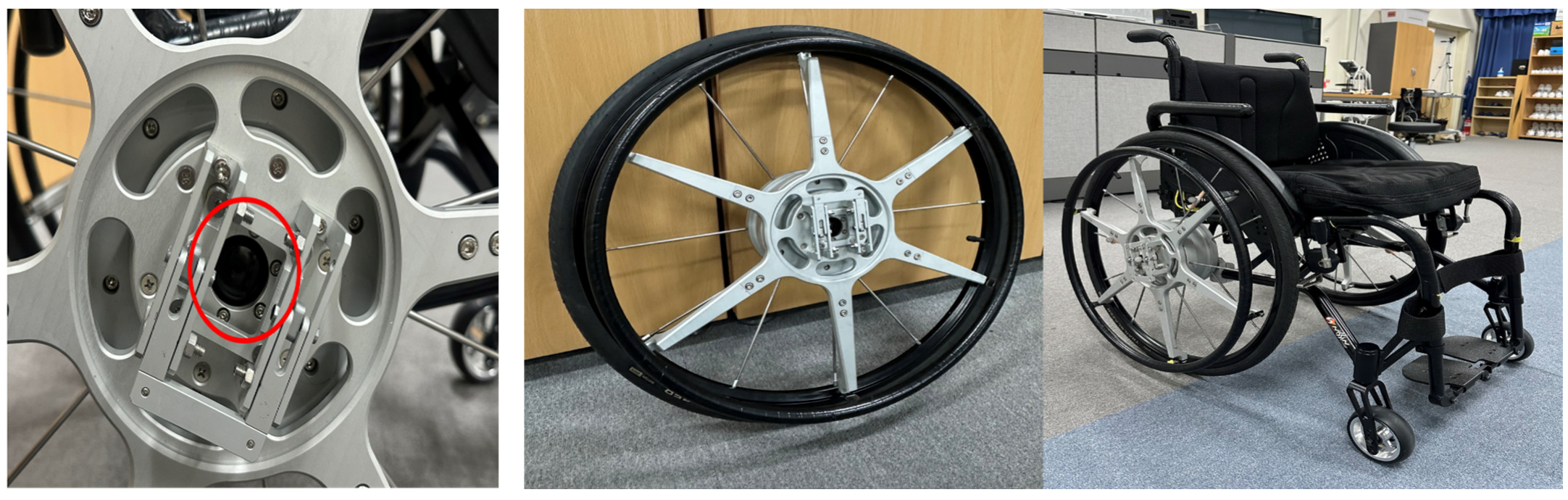
The device consists of two key components: (1) a centrally mounted drive module with integrated gear transmission and (2) detachable lever arms that connect to the rear wheels. The modular system clamps securely to most active-type wheelchair frames and includes a quick-release mechanism for rapid attachment or removal without modifying the wheelchair. The propulsion system uses a gear-based linkage to transmit force from the lever arms to the wheels, allowing users to move efficiently on flat surfaces, ramps, or uneven terrain (
Figure 1).
The device incorporates several practical features to enhance functionality and user convenience. The length of the lever arms is adjustable to accommodate users of varying body sizes and upper limb reach. The integrated gear ratios are designed to facilitate propulsion on inclined surfaces, reducing the physical effort required for uphill movement. A mechanical locking system is included to ensure safety when the wheelchair is stationary or during transport. The device has a foldable structure that enables easy storage and portability when not in use. The ratchet–gear-assisted, lever-driven bidirectional propulsion follows established alternative propulsion principles reported in prior lever/handle-based systems and simulation studies and builds upon our earlier prototype work [
21]; the switching mechanism and clutching strategy are also documented in a Korean patent (Registration No. 10-2724784-0000).
The total system weight is approximately 4 kg, ensuring that its addition does not compromise the wheelchair’s overall width or maneuverability during everyday use. Safety validation tests have been conducted in controlled environments to confirm mechanical integrity and operational reliability.
During the evaluation, a trained researcher will temporarily fit the device into each participant’s wheelchair. Participants will then receive brief instruction and hands-on practice to familiarize themselves with the push–pull motion and control interface. Observational data will be collected throughout the usability session to identify any mechanical issues or user-reported concerns.
This dual-mode propulsion concept and the device’s detachable nature aim to support independent mobility, reduce physical strain, and offer a flexible alternative for users navigating long distances or challenging environments [
21].
While the total system weight is ~4 kg, we will explicitly evaluate its portability implications via caregiver-assisted transfers and vehicle stowage procedures, leveraging the quick-release and foldable features to mitigate burden.
Previous lever- or pull-based wheelchairs often required full wheel replacement, imposed an additional 6–8 kg of weight, or altered the wheelchair frame geometry. The present module differs in that it is fully detachable, lightweight (~4 kg total), compatible with existing wheelchairs without altering their geometry, and capable of rapid push ↔ pull switching without the need for tools. These features address real-world barriers identified in prior systematic reviews, supporting the need for a structured usability evaluation.
2.4. Experimental Procedure
2.4.1. Orientation and Practice
At the beginning of the session, each participant will receive a standardized orientation to the detachable dual-propulsion device. A trained researcher will explain the study’s purpose, demonstrate how to attach and detach the device, and guide the participant through the basic operating principles, including lever control, braking, and propulsion technique. Participants will then engage in a brief practice session (15–30 min) to become familiar with the device. During this time, they will perform simple maneuvers such as forward motion, turning, and stopping under supervision. This familiarization phase is designed to ensure safety and to allow participants to develop a baseline level of confidence and competence before beginning the structured tasks.
2.4.2. Task Trial
Following the orientation, participants will complete a series of standardized mobility tasks designed to simulate real-world wheelchair use. The task course will comprise (1) navigating through a 90 cm doorway with a turn; (2) ascending a 5 m ramp with a mild incline (approximately 5–6°); (3) traversing a 2 cm door threshold; and (4) propelling 50 m on level indoor flooring at a self-selected comfortable pace. All tasks will initially be performed using the dual-propulsion device.
During each segment, a trained assessor will record predefined objective performance indicators. For each task, task completion time (seconds) will be measured using a stopwatch from the start cue to segment completion. Task success or failure and the number of errors (e.g., cone contacts, veering outside the designated path, or the need for physical assistance or safety intervention) will be documented using a standardized checklist. For the ramp and 50 m level segments, the assessor will additionally count the number of lever strokes required to complete the task. For the 50 m segment, self-selected propulsion speed (m/s) will be calculated by dividing the known distance by the recorded time.
Where appropriate and feasible, a subset of participants will repeat key course segments (ramp ascent and 50 m level propulsion) using their regular push-rim propulsion. In these within-subject trials, the same performance indicators (completion time, errors, lever strokes or push strokes, and speed) will be recorded to allow exploratory comparisons between dual-propulsion and conventional propulsion under comparable conditions.
Throughout all tasks, researchers will also observe for signs of user strain, difficulty, or mechanical issues to complement quantitative data and to seed interview probes (e.g., asking participants to elaborate on segments where they appeared fatigued or encountered difficulties). Objective performance metrics are defined a priori as secondary outcomes and will be analyzed quantitatively as described in
Section 2.5.2, whereas qualitative impressions from observations will be used to contextualize both performance and questionnaire findings.
2.4.3. Usability Questionnaire Administration
To quantitatively assess usability, participants will complete a 45-item questionnaire that was specifically developed and validated for the detachable dual-propulsion wheelchair device [
23]. The questionnaire was constructed through a comprehensive literature review of usability standards, including ISO 9241-11, as well as existing instruments in assistive technology such as QUEST 2.0 and the System Usability Scale (SUS). A multidisciplinary expert panel comprising 11 specialists from rehabilitation research, clinical practice, engineering, and industry reviewed the initial item pool to assess clarity, relevance, and redundancy. Based on iterative feedback, items were refined and tailored to reflect the practical context of manual wheelchair use with a dual-propulsion mechanism. The 45-item instrument was selected to provide device-specific, diagnostically actionable granularity across seven usability domains, which is essential for guiding iterative design of a novel propulsion mechanism.
The final version comprised 45 items organized into seven domains: ease of learning and operation, efficiency and physical effort, safety and stability, comfort and physical fit, integration and practicality, psychosocial impact, and overall satisfaction. Each item is rated on a 5-point Likert scale ranging from 1 (strongly disagree) to 5 (strongly agree). Representative examples include statements such as “Attaching the device to my wheelchair is straightforward,” “Using the device requires less effort on ramps or long distances,” and “I felt stable and balanced while using the device.”
Content validity was confirmed through expert review, and pilot testing with wheelchair users ensured comprehensibility and feasibility. Psychometric evaluation demonstrated excellent internal consistency (Cronbach’s α = 0.927), indicating strong reliability of the scale. In this protocol, the questionnaire will be administered immediately after the task trials, with participants completing it independently while a researcher is available to provide clarification if necessary. To mitigate the response burden, the questionnaire is administered once, immediately after the tasks, with optional brief breaks and on-demand researcher clarification. Scores across the seven domains will constitute the primary quantitative measure of usability. A summary of the domains is presented in
Supplementary Table S1, while the complete development and validation procedures are detailed in the published article on scale development [
23].
2.4.4. Semi-Structured Interview
Following the survey, a 30–45 min semi-structured interview will be conducted to gather in-depth qualitative feedback. The interview will follow a predefined guide covering usability domains, device strengths and weaknesses, perceived safety, comfort, and suggestions for improvement. Interviewers will be trained to use probing techniques to explore responses further and to allow new themes to emerge. All interviews will be audio-recorded with consent and later transcribed for thematic analysis. The interviews are intended to contextualize and deepen understanding of the quantitative survey data by uncovering user experiences that may not be fully captured through structured ratings. The semi-structured interview guide is summarized here; the complete prompt set appears in
Supplementary Table S2. Interview data will be analyzed using thematic analysis following Braun and Clarke [
24].
2.4.5. Overview of Experimental Procedure
The study follows a standardized five-step protocol, summarized in
Supplementary Table S3, to ensure consistency across all participants. This structured flow guides each participant from orientation to post-use evaluation. The process includes informed consent, familiarization with the device, execution of standardized mobility tasks, quantitative usability rating via a questionnaire, and a qualitative interview to capture user perspectives in depth. The standardized five-step procedure is briefly described in the text; the whole table is provided as
Supplementary Table S3.
Although this protocol focuses on a single-session usability evaluation, a 6-week longitudinal follow-up study has been pre-planned to assess long-term comfort, durability, maintenance requirements, daily-life integration, and sustained use patterns. This prospective field study is intended to address inherent limitations of short-term protocols and provide complementary ecological validity.
2.5. Data Analysis
2.5.1. Sample Size Justification
This study adopts a pragmatic target sample size of N = 30. Based on distribution-based estimates from scale development data, the minimal clinically important difference (MCID) was defined as 0.5 points on the 5-point scale. Expected standard deviation ranged from 0.6 to 0.8. With α = 0.05 and 80% power, the required sample size for detecting a 0.5-point difference was estimated at 26–28 participants. Therefore, a target of 30 participants provides adequate precision for estimating domain-level usability scores and for exploratory subgroup comparisons.
In addition to questionnaire-based considerations, the planned sample size of 30 participants is also reasonable for exploratory analyses of task-based performance metrics. For example, assuming a within-subject standard deviation of 8–10 s for ramp completion time based on pilot observations in similar wheelchair tasks, a sample of 30 provides approximately 80% power (α = 0.05, two-sided) to detect a moderate within-subject difference of about 0.5–0.6 SD (i.e., roughly 5–6 s) between dual-propulsion and push-rim propulsion in the subset of participants who perform both conditions. While the study is not powered to definitively establish comparative efficacy, it is adequately sized to produce stable descriptive estimates and to detect clinically meaningful, moderate effect sizes in key performance indicators, which is appropriate for an early-phase usability protocol.
2.5.2. Quantitative Analysis
The responses from the 45-item usability questionnaire will be analyzed using descriptive and inferential statistical methods. Each item will be rated on a five-point Likert scale, and scores will be numerically coded from 1 (strongly disagree or very dissatisfied) to 5 (strongly agree or very satisfied). Negatively worded items will be reverse-coded before analysis. For each participant, subscale scores will be calculated by averaging the responses within each usability domain (e.g., Ease of Use, Safety, Efficiency, Comfort, Psychosocial Impact, Integration, and Overall Satisfaction). Domain-level means and standard deviations will be reported. In addition, overall usability scores will be computed for each participant and presented as the mean across all items. The internal consistency of the questionnaire will be examined using Cronbach’s alpha to assess the reliability of each domain. Spearman’s rank correlation coefficients will be calculated to explore relationships between domains (e.g., the correlation between efficiency and satisfaction). Due to the expected sample size (N = 30), exploratory subgroup comparisons may be conducted—for example, by injury level or user experience—using non-parametric tests, such as the Mann–Whitney U test.
2.5.3. Qualitative Analysis
To prevent post hoc interpretation, a prespecified integration matrix was developed to guide the interpretation of convergent, divergent, or complementary findings across quantitative and qualitative strands.
The interview transcripts will be analyzed using thematic analysis following Braun and Clarke [
24]. Analysis will proceed through six steps: (1) familiarization with transcripts; (2) initial coding by two independent coders; (3) searching for themes by clustering related codes; (4) reviewing themes against the dataset; (5) defining and naming themes; and (6) reporting with representative quotations. A codebook will be iteratively refined during steps (2)–(4), with analyst triangulation and consensus meetings to resolve discrepancies; a third reviewer will adjudicate if needed. We will maintain memos and an audit trail (decision log, codebook versions) and note reflexive considerations throughout. NVivo qualitative data analysis software (Version 14; Qualitative Solutions and Research (QSR) International, Melbourne, Australia) will support data management and coding. Representative quotations will be selected to illustrate major themes, maintaining participant anonymity (e.g., “P3”, “P17”). Frequency of recurring issues will be noted, but emphasis will be placed on thematic richness and variation across participants.
In addition to questionnaire responses, the predefined objective performance metrics obtained from the standardized task course will be analyzed. For each task segment, completion time, number of errors, number of lever strokes, and self-selected speed (for the 50 m level segment) will be summarized using means, standard deviations, medians, and interquartile ranges, as appropriate. The proportion of successful task completions without safety interventions will also be reported.
For participants who complete selected segments with both the dual-propulsion device and their usual push-rim propulsion, within-subject comparisons will be conducted using paired t-tests or Wilcoxon signed-rank tests, depending on normality assumptions. Effect sizes (e.g., Cohen’s d for paired data or matched-pairs rank-biserial correlation) will be reported to facilitate interpretation of the magnitude of differences in performance. Exploratory subgroup analyses (e.g., by injury level, years of wheelchair use, or presence of chronic shoulder pain) may be undertaken for key metrics, but these will be interpreted cautiously due to limited power.
Finally, associations between objective performance metrics and questionnaire-based usability domains (e.g., efficiency, comfort, overall satisfaction) will be explored using Spearman’s rank correlation coefficients. This will allow us to examine whether better task performance (e.g., shorter completion times or fewer errors) is consistently associated with higher perceived usability, thereby providing convergent validity between functional and self-reported usability indicators.
2.5.4. Data Integration
Quantitative and qualitative data will be integrated at the interpretation stage using triangulation. Questionnaire scores will be compared with corresponding interview feedback for each usability domain to validate, elaborate, or contrast findings. A joint display (table or matrix) will be used to visually align survey scores with qualitative themes, helping to identify converging or diverging results. This process is expected to enhance the interpretive depth and support evidence-based conclusions regarding the device’s real-world usability. For participants who repeat tasks with push-rim propulsion, within-subject observational notes (e.g., perceived effort, maneuvering ease) will be aligned with interview narratives to triangulate users’ perceived added value of the dual-propulsion device without formal hypothesis testing. Contextual observations (e.g., lever strokes, task time, visible fatigue) will seed interview probes, flag safety or feasibility issues, and be summarized descriptively to inform future task refinement; they will not be used for inferential statistics in this protocol.
3. Discussion
The mixed-methods approach adopted in this study provides complementary forms of evidence. The 45-item questionnaire offers structured, domain-specific quantitative scores, whereas the semi-structured interviews provide in-depth explanations that illuminate why specific strengths or barriers may occur. Integrating these two strands within a triangulated framework enables the identification of convergences, such as high efficiency ratings accompanied by reports of reduced exertion, as well as the detection of discrepancies, including acceptable scores contrasted with concerns about portability. This integrated, user-centered evaluation is particularly suitable for a pilot protocol and yields insights that can inform the iterative refinement of the device directly.
This protocol does not claim mechanical novelty in propulsion mechanics, as these have established precedents. Instead, its contribution lies in advancing methodological rigor in early-phase assistive-device evaluation by providing a transparent, mixed-methods, user-centered usability assessment for a detachable propulsion module designed to preserve the original wheelchair geometry. By pre-specifying research questions, endpoints, MCID thresholds, and integration rules, this protocol strengthens the methodological foundation for evaluating assistive technologies in realistic user contexts.
From a broader perspective, the study design holds significance for advancing rehabilitation technology research methodologies. The heterogeneity in how assistive devices are evaluated has been identified as a barrier to comparability and evidence-based practice [
25]. By presenting a structured yet flexible protocol, we contribute to the field’s understanding of systematically evaluating a device that does not fit into a purely clinical outcome (like a drug trial) but requires user experience evaluation. We integrate elements from engineering (performance tasks), health sciences (patient-reported outcome measures), and social sciences (qualitative interviews), reflecting an interdisciplinary approach. This is important because assistive devices lie at the intersection of technology and user behavior; only a multifaceted evaluation can adequately cover that intersection. The discussion gleaned from our approach will likely underscore the importance of context: a device might perform well in lab tests, but user feedback in a realistic context is the ultimate test of its success. For instance, even if the device reduces physical effort (a lab-measured outcome), users might still reject it if it is inconvenient or socially uncomfortable to use—a dimension only user-centered evaluation can reveal.
One potential limitation of our study is the relatively small sample size and specific population (SCI wheelchair users in one country). While 30 participants can provide rich qualitative data and reasonable consistency checks for quantitative trends, it may not capture the full diversity of wheelchair users (e.g., people with other disabilities or those in different environments). Additionally, the sample is drawn from a single national setting, which may limit its generalizability across regions and usage scenarios. To address this, we plan a multi-site follow-up with broader demographic and environmental diversity (e.g., varied terrain, community mobility contexts) to test external validity.
Thus, generalizability might be limited. We mitigate this by ensuring our participants vary in age, injury level, and experience, but future research could expand on this with larger or more diverse samples. Another limitation is that our evaluation is short-term–participants are using the device within a single session. Beyond the objective performance metrics already embedded in this protocol—such as task completion time, error counts, lever strokes, and self-selected propulsion speed—future studies will further expand the multi-modal evaluation framework by incorporating physiological and biomechanical measurements. These may include wheel-based propulsion sensors, heart-rate monitoring, upper-limb EMG, and kinematic analysis to capture joint loading and muscular demand more directly. Integrating these additional layers of data will allow subsequent studies to build on the functional performance indicators collected here and provide a more comprehensive assessment of biomechanical load and long-term usability.
This multi-modal approach will provide stronger converging evidence for the device’s real-world benefits. Usability issues that might appear over longer-term use (such as durability concerns, long-term comfort, or the device’s impact on daily routines over weeks) will not be directly observed. We rely on participants’ projections in interviews for some of that (“Would you use this long-term?”), but those remain hypothetical. Therefore, one recommendation for future research is a longitudinal field trial, where users take the device home for an extended period. That could reveal additional insights on real-life integration, maintenance, and adherence (who continues to use it and who does not, and why). The present protocol incorporates both self-reported usability outcomes and predefined objective performance metrics—including task completion time, error counts, lever strokes, and self-selected propulsion speed—collected during a standardized mobility task course. These functional indicators serve as pragmatic proxies for biomechanical demand. Future studies may further expand this framework by adding physiological or kinematic measurements (e.g., heart rate, sensor-based propulsion force, or EMG) to provide deeper insights into musculoskeletal loading. Our protocol lays the groundwork by thoroughly examining the user perspective; a logical next step is to correlate user satisfaction with objective performance metrics to see how they interrelate. The planned longitudinal field study will track device-on/off patterns, adherence, adverse events, maintenance needs, and long-term comfort during typical daily use over several weeks.
The future directions for technology development arising from this study will depend on the specific findings, but generally, we anticipate guiding improvements in the device design. For example, if multiple users point out difficulty attaching the device, developers might invest in a more ergonomic clamp design or a powered attachment mechanism. If transport or weight is an issue, material changes or modular designs might be explored to make the device lighter or foldable. User feedback might inspire new features—participants might suggest adding a feature like an electric assist option or a different handle grip shape. Engaging with these suggestions will be crucial for the iterative design process. This usability evaluation becomes part of the device development cycle: feedback → redesign → improved prototype → re-evaluation. Such iterative refinement is a cornerstone of human-centered design and has been shown to lead to more successful assistive devices in the market.
Another broader impact of our discussion is on clinical practice and policy. Suppose our evaluation demonstrates clear benefits of the dual-propulsion device (e.g., significantly improved user satisfaction and reduced fatigue). In that case, it can support the case for adopting this technology in rehabilitation programs and for reimbursement by healthcare systems. Clinicians may gain evidence to justify prescribing such devices to appropriate candidates (for instance, an individual with an SCI starting to develop shoulder pain might benefit from using this device part-time to offload stress). Conversely, if the study finds only marginal benefits or specific barriers, that can caution stakeholders and direct efforts to those areas. The comprehensive methodology also models how clinics or rehabilitation centers might internally evaluate new assistive products before recommending them. It encourages a more structured trial and feedback process with patients rather than ad hoc impressions. In line with international trends, demonstrating usability and user acceptance is increasingly recognized as important as demonstrating clinical efficacy for assistive technologies [
25]. Our protocol reinforces the idea that structured usability evaluation is an essential component of assistive device research and development, ensuring that innovations truly enhance users’ lives rather than being underutilized due to unforeseen usability flaws. Because this is a single-arm protocol, causal inference regarding efficacy is not possible. The present study is intended to characterize usability and acceptability; a future controlled or randomized study is planned to evaluate comparative effectiveness.
As a single-session pilot protocol, our study cannot capture long-term comfort, durability, maintenance needs, or sustained adoption. We therefore plan a longitudinal field study in which participants take the device home for several weeks to monitor real-world integration, adherence, device-on/off patterns, adverse events, and maintenance. Such a follow-up will complement the present protocol by addressing long-term usability and durability under typical daily conditions.
A fundamental limitation of this study is its single-session design, which prevents the assessment of long-term usability, durability, maintenance burden, or daily integration patterns. These limitations are inherent to early usability studies and do not imply long-term performance. To overcome this constraint, a multi-week longitudinal field study has been planned to capture real-world usage, adherence, and device-on/off patterns over extended periods.
In summary, the discussion of this protocol highlights that by using a rigorous, multi-method approach, we will obtain a valid, reliable, and rich understanding of the detachable dual-propulsion device’s performance in the hands of end-users. It bridges the gap between engineering performance and human experience—a gap often present in assistive device development [
25]. By validating our approach and discussing its outcomes, we aim to contribute to better design, adoption, and quality of life for wheelchair users through improved technology.
4. Conclusions
This study protocol is expected to yield valuable insights into the usability and user experience of a novel detachable dual-propulsion device for manual wheelchairs. Through a structured combination of quantitative and qualitative assessments, we will comprehensively evaluate how the device performs in real-world use from the perspective of those who matter most—the wheelchair users themselves. The anticipated outcome is a multi-dimensional validation of the device’s ease of use, safety, efficiency, and user satisfaction, identifying its strengths and areas needing improvement. Such findings will guide refinements to this specific device (making it more user-friendly and practical) and demonstrate the broader benefits of a structured usability evaluation approach in rehabilitation technology.
By engaging users in detailed surveys and open-ended interviews, the protocol embodies a user-centered approach crucial for the success of assistive innovations. We expect this approach will confirm the device’s potential to reduce physical strain and enhance mobility for people with SCI while uncovering any practical challenges that must be addressed to facilitate its adoption. For example, the study may verify that users will experience less fatigue on inclines and report greater confidence in daily activities when using the device, outcomes that underline the psychosocial and functional benefits an assistive device can provide. At the same time, if the study finds issues like attachment difficulty or portability concerns, those will become key targets for improvement, ensuring that the final product is well-tailored to user needs.
The implications of this protocol extend beyond a single device. In rehabilitation and assistive technology, it showcases the importance of systematically evaluating new interventions for clinical outcomes, real-world usability, and user satisfaction. A structured usability evaluation, as presented here, offers a replicable model for researchers and developers: it is a methodical way to gather evidence on how technology interacts with users’ daily lives. This is especially important given the diversity of user preferences and environments. The knowledge gained from such evaluations contributes to evidence-based practice—for instance, informing clinicians which device is most suitable for which user profile—and to the iterative design of technology with the end-user in mind.
In conclusion, this protocol is poised to provide a robust assessment of the detachable dual-propulsion wheelchair device, and in doing so, to validate an approach to assistive device evaluation that is thorough, user-centric, and aligned with international best practices. The expected positive outcomes (if realized) will support the case for this device as a beneficial rehabilitation aid to improve the mobility and quality of life of manual wheelchair users. Equally importantly, the evaluation process underscores a message: structured usability assessment is critical in translating rehabilitation technology from the lab to the real world. Embracing such structured, multifaceted evaluations will ultimately lead to better-designed assistive devices and, consequently, better empowerment and satisfaction for individuals who rely on these technologies in their daily lives [
25]. The research community and industry stakeholders are encouraged to adopt similar comprehensive evaluation frameworks, ensuring that assistive technology innovation consistently meets users’ practical needs and expectations worldwide.