


Perceptions of National Cancer Prevention Policies in Europe: A Survey of Organisations Supporting People with Intellectual Disabilities

 ,
,  , and
, and
Abstract
1. Introduction
2. Materials and Methods
2.1. Study Design and Participants
2.2. Ethical Approval and Considerations
2.3. Statistical Analyses
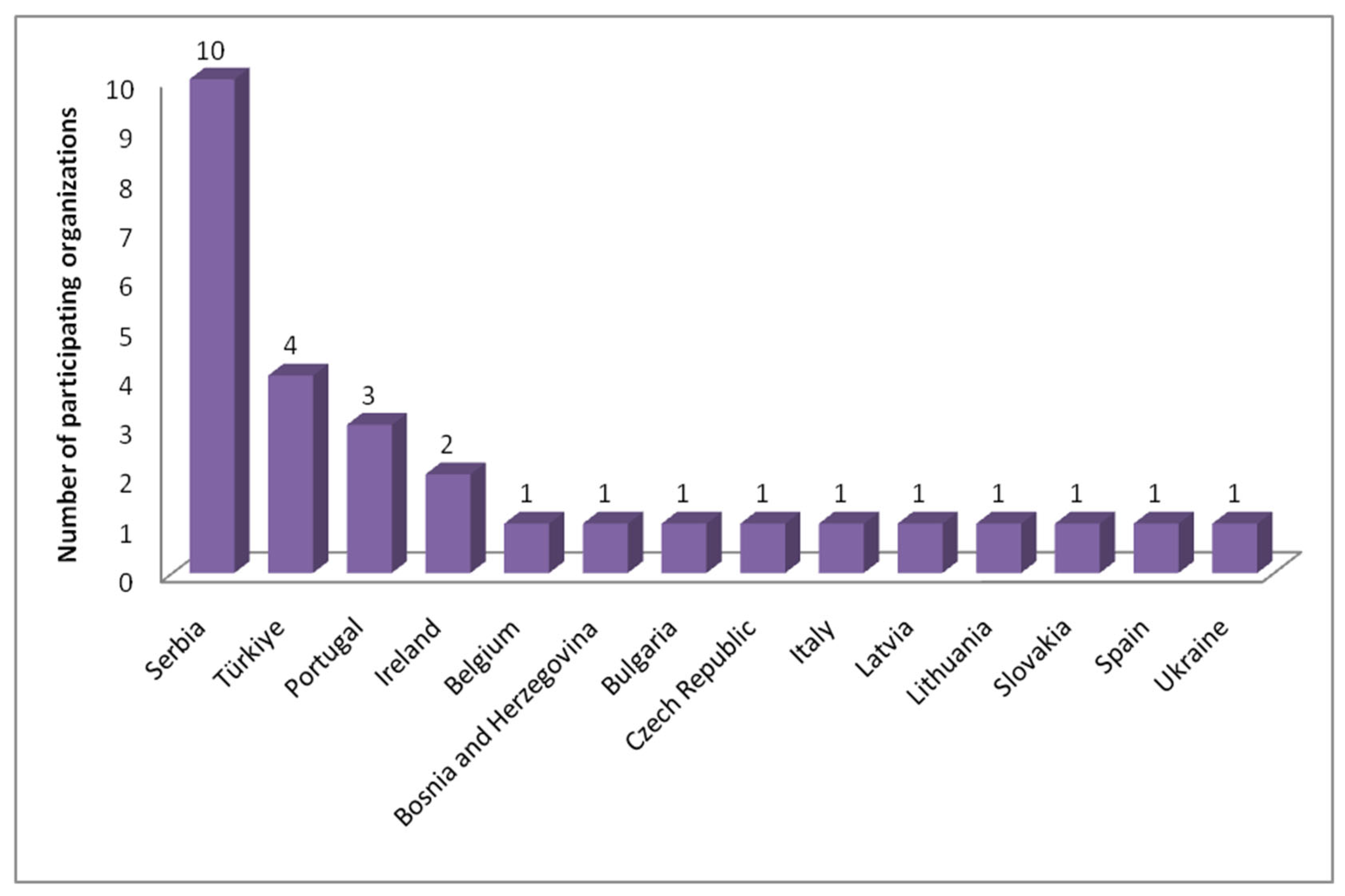
3. Results
4. Discussion
4.1. Organisational Consensus and Regional Variations
4.2. Policy Responsibility and Stakeholder Engagement
4.3. Training and Implementation Priorities
4.4. Policy–Practice Gap and Strategic Implications
4.5. Study Limitations
5. Conclusions
Supplementary Materials
Author Contributions
Funding
Institutional Review Board Statement
Informed Consent Statement
Data Availability Statement
Acknowledgments
Conflicts of Interest
Disability Language/Terminology Positionality Statement
References
- European Commission. Cancer. Available online: https://health.ec.europa.eu/non-communicable-diseases/cancer_en#policy-framework (accessed on 5 August 2025).
- Eurostat Cancer Statistics. Statistics Explained; Eurostat: Luxembourg, 2024; Available online: https://ec.europa.eu/eurostat/statistics-explained/index.php?title=Cancer_statistics (accessed on 5 August 2025).
- OECD: Organisation for Economic Cooperation and Development. Beating Cancer Inequalities in the EU; OECD Health Policy Studies; OECD: Paris, France, 2024; ISBN 9789264961425. [Google Scholar]
- Eurostat. Main Cause of Death for People Under 65 Years: Cancer—News Articles; Eurostat: Luxembourg, 2024; Available online: https://ec.europa.eu/eurostat/web/products-eurostat-news/w/ddn-20240507-1 (accessed on 5 August 2025).
- European Commission. Staff Working Document: Review of Europe’s Beating Cancer Plan; European Commission: Brussels, Belgium, 2025. [Google Scholar]
- Manzano, A.; Svedman, C.; Hofmarcher, T.; Wilking, N. Comparator Report on Cancer in Europe 2025—Disease Burden, Costs and Access to Medicines and Molecular Diagnostics; IHE: Lund, Sweden, 2025. [Google Scholar]
- World Health Organization. Cancer Screening in the European Union. Available online: https://www.who.int (accessed on 5 August 2025).
- Arbyn, M.; Rousta, P.; Bruni, L.; Schollin Ask, L.; Basu, P. Linkage of Individual-Patient Data Confirm Protection of Prophylactic Human Papillomavirus Vaccination against Invasive Cervical Cancer. JNCI J. Natl. Cancer Inst. 2024, 116, 775–778. [Google Scholar] [CrossRef] [PubMed]
- Lei, J.; Ploner, A.; Elfström, K.M.; Wang, J.; Roth, A.; Fang, F.; Sundström, K.; Dillner, J.; Sparén, P. HPV Vaccination and the Risk of Invasive Cervical Cancer. N. Engl. J. Med. 2020, 383, 1340–1348. [Google Scholar] [CrossRef] [PubMed]
- Palmer, T.J.; Kavanagh, K.; Cuschieri, K.; Cameron, R.; Graham, C.; Wilson, A.; Roy, K. Invasive Cervical Cancer Incidence Following Bivalent Human Papillomavirus Vaccination: A Population-Based Observational Study of Age at Immunization, Dose, and Deprivation. JNCI J. Natl. Cancer Inst. 2024, 116, 857–865. [Google Scholar] [CrossRef] [PubMed]
- International Agency for Research on Cancer (IARC). World Code Against Cancer Framework. Available online: https://cancer-code-world.iarc.who.int/ (accessed on 5 August 2025).
- Chapman, H.M.; McMahon, M.; Kaley, A.; Mafuba, K.; O’Donovan, M. Editorial: The Case for More Action and More Research into Healthcare Provision and Health Inequalities for People with Intellectual Disabilities. Br. J. Learn. Disabil. 2024, 52, 437–442. [Google Scholar] [CrossRef]
- McMahon, M.; Hatton, C.; Bowring, D.L.; Hardy, C.; Preston, N.J. The Prevalence of Potential Drug–Drug Interactions in Adults with Intellectual Disability. J. Intellect. Disabil. Res. 2021, 65, 930–940. [Google Scholar] [CrossRef]
- Banda, A.; Naaldenberg, J.; Timen, A.; van Eeghen, A.; Leusink, G.; Cuypers, M. Cancer Risks Related to Intellectual Disabilities: A Systematic Review. Cancer Med. 2024, 13, e7210. [Google Scholar] [CrossRef]
- Glover, G.; Williams, R.; Heslop, P.; Oyinlola, J.; Grey, J. Mortality in People with Intellectual Disabilities in England. J. Intellect. Disabil. Res. 2017, 61, 62–74. [Google Scholar] [CrossRef]
- McMahon, M.J.; O’Connor, A.M.; Dunbar, P.; Delany, A.; Behan, L.; Grogan, C.; Keyes, L.M. Mortality in Residential Care Facilities for People with Disability: A Descriptive Cross-Sectional Analysis of Statutory Notifications in Ireland. BMJ Open 2023, 13, e065745. [Google Scholar] [CrossRef]
- Vukovic, V.; Banda, A.; Carneiro, L.; Dogan, S.; Knapp, P.; McMahon, M.; Milutinovic, D.; Soylar, P.; Sykes, K.; Tosun, B.; et al. The Importance of Cancer Prevention Policies to Inform and Guide Preventative and Screening Measures for People with Intellectual Disabilities: The COST Project “Cancer—Understanding Prevention in Intellectual Disabilities”. J. Intellect. Disabil. 2023, 1–14. [Google Scholar] [CrossRef]
- Heslop, P.; Cook, A.; Sullivan, B.; Calkin, R.; Pollard, J.; Byrne, V. Cancer in Deceased Adults with Intellectual Disabilities: English Population-Based Study Using Linked Data from Three Sources. BMJ Open 2022, 12, e056974. [Google Scholar] [CrossRef]
- Mahar, A.L.; Biggs, K.; Hansford, R.L.; Derksen, S.; Griffiths, R.; Enns, J.E.; Dawe, D.E.; Hallet, J.; Kristjanson, M.; Decker, K.; et al. Stage IV Breast, Colorectal, and Lung Cancer at Diagnosis in Adults Living with Intellectual or Developmental Disabilities: A Population-based Cross-sectional Study. Cancer 2024, 130, 740–749. [Google Scholar] [CrossRef] [PubMed]
- Cuypers, M.; Schalk, B.W.M.; Boonman, A.J.N.; Naaldenberg, J.; Leusink, G.L. Cancer-related Mortality among People with Intellectual Disabilities: A Nationwide Population-based Cohort Study. Cancer 2022, 128, 1267–1274. [Google Scholar] [CrossRef] [PubMed]
- Cuypers, M.; Naaldenberg, J.; Banda, A.; Oost, L.; Bloemendal, H.; Leusink, G. Cancer Incidence and Diagnostic Characteristics in People with Intellectual Disabilities in the Netherlands: A National Registry-Based Cohort Study. BMJ Oncol. 2025, 4, e000686. [Google Scholar] [CrossRef] [PubMed]
- Ward, L.M.; Cooper, S.-A.; Sosenko, F.; Morrison, D.; Fleming, M.; McCowan, C.; Robb, K.; Hanna, C.R.; Hughes-McCormack, L.; Dunn, K.; et al. Population-Based Cancer Incidence and Mortality Rates and Ratios among Adults with Intellectual Disabilities in Scotland: A Retrospective Cohort Study with Record Linkage. BMJ Open 2024, 14, e084421. [Google Scholar] [CrossRef]
- McMahon, M.; McCallion, P.; McCarron, M. An Invisible Population: Late-stage Cancer Diagnosis for People with Intellectual or Developmental Disability. Cancer 2024, 130, 668–670. [Google Scholar] [CrossRef]
- Kowalczyk, O.; Ambrocio, R.P.P.M.; Vuković, V.; Denieffe, S.; Denny, M. Analysis of the European Union’s National Cancer Control Programs: Meeting the Needs of People with Intellectual Disabilities. Healthcare 2025, 13, 456. [Google Scholar] [CrossRef]
- McMahon, M.; Asi, E.; Dimitrievska, V.; Gozum, S.; Ilgaz, A.; Martin, C.; O’Connor, M.; Sykes, K.; Knapp, P. Advancing a Universal European Cancer Prevention Methodology for People With Intellectual Disability: Findings From CUPID Workshops in Ireland and Türkiye. Br. J. Learn. Disabil. 2025, 53, 416–427. [Google Scholar] [CrossRef]
- Ali, A.; Scior, K.; Ratti, V.; Strydom, A.; King, M.; Hassiotis, A. Discrimination and Other Barriers to Accessing Health Care: Perspectives of Patients with Mild and Moderate Intellectual Disability and Their Carers. PLoS ONE 2013, 8, e70855. [Google Scholar] [CrossRef]
- Doherty, A.J.; Atherton, H.; Boland, P.; Hastings, R.; Hives, L.; Hood, K.; James-Jenkinson, L.; Leavey, R.; Randell, E.; Reed, J.; et al. Barriers and Facilitators to Primary Health Care for People with Intellectual Disabilities and/or Autism: An Integrative Review. BJGP Open 2020, 4, bjgpopen20X101030. [Google Scholar] [CrossRef]
- Chan, D.N.S.; Law, B.M.H.; Au, D.W.H.; So, W.K.W.; Fan, N. A Systematic Review of the Barriers and Facilitators Influencing the Cancer Screening Behaviour among People with Intellectual Disabilities. Cancer Epidemiol. 2022, 76, 102084. [Google Scholar] [CrossRef]
- Steele, C.B.; Townsend, J.S.; Courtney-Long, E.A.; Young, M. Prevalence of Cancer Screening Among Adults With Disabilities, United States, 2013. Prev. Chronic Dis. 2017, 14, 160312. [Google Scholar] [CrossRef]
- Salvador-Carulla, L.; Martínez-Leal, R.; Heyler, C.; Alvarez-Galvez, J.; Veenstra, M.Y.; García-Ibáñez, J.; Carpenter, S.; Bertelli, M.; Munir, K.; Torr, J.; et al. Training on Intellectual Disability in Health Sciences: The European Perspective. Int. J. Dev. Disabil. 2015, 61, 20–31. [Google Scholar] [CrossRef]
- Morin, D.; Valois, P.; Crocker, A.G.; Robitaille, C.; Lopes, T. Attitudes of Health Care Professionals toward People with Intellectual Disability: A Comparison with the General Population. J. Intellect. Disabil. Res. 2018, 62, 746–758. [Google Scholar] [CrossRef] [PubMed]
- Osborn, D.P.J.; Horsfall, L.; Hassiotis, A.; Petersen, I.; Walters, K.; Nazareth, I. Access to Cancer Screening in People with Learning Disabilities in the UK: Cohort Study in the Health Improvement Network, a Primary Care Research Database. PLoS ONE 2012, 7, e43841. [Google Scholar] [CrossRef] [PubMed]
- Heslop, P.; Blair, P.S.; Fleming, P.; Hoghton, M.; Marriott, A.; Russ, L. The Confidential Inquiry into Premature Deaths of People with Intellectual Disabilities in the UK: A Population-Based Study. Lancet 2014, 383, 889–895. [Google Scholar] [CrossRef] [PubMed]
- O’Donnell, J.; Randy Vogenberg, F. Policies and Procedures: Enhancing Pharmacy Practice and Limiting Risk. Pharm. Ther. 2012, 37, 341. [Google Scholar]
- Dunn, M.; Strnadová, I.; Scully, J.L.; Hansen, J.; Palmer, E.E. Exploring the Barriers and Enablers for the Equitable and Accessible Informed Healthcare Consent Process for People with Intellectual Disability: A Systematic Literature Review. medRxiv 2023. [Google Scholar] [CrossRef]
- Barrington, M.; Fisher, K.R.; Harris-Roxas, B.; Spooner, C.; Trollor, J.N.; Weise, J. Access to Healthcare for People with Intellectual Disability: A Scoping Review. Scand. J. Public Health 2025. [Google Scholar] [CrossRef]
- McConkey, R.; Taggart, L.; DuBois, L.; Shellard, A. Creating Inclusive Health Systems for People with Intellectual Disabilities: An International Study. J. Policy Pract. Intellect. Disabil. 2020, 17, 282–290. [Google Scholar] [CrossRef]
- House of Lords Library. Challenges Faced by People with Disabilities. Available online: https://lordslibrary.parliament.uk/challenges-faced-by-people-with-disabilities/ (accessed on 6 August 2025).
- CDC: Centers for Disease Control and Prevention. Definition of Policy. Available online: https://www.cdc.gov/polaris/php/policy-resources-trainings/definition-of-policy.html (accessed on 6 August 2025).
- von Elm, E.; Altman, D.G.; Egger, M.; Pocock, S.J.; Gøtzsche, P.C.; Vandenbroucke, J.P. STROBE Initiative The Strengthening the Reporting of Observational Studies in Epidemiology (STROBE) Statement: Guidelines for Reporting Observational Studies. J. Clin. Epidemiol. 2008, 61, 344–349. [Google Scholar] [CrossRef]
- The World Bank World Bank Country and Lending Groups. World Bank Data Help Desk. Available online: https://datahelpdesk.worldbank.org/knowledgebase/articles/906519-world-bank-country-and-lending-groups (accessed on 6 August 2025).
- United Nations Statistics Division Methodology. Standard Country or Area Codes for Statistical Use (M49). Available online: https://unstats.un.org/unsd/methodology/m49/ (accessed on 6 August 2025).
- COST CUPID CA21123. Cancer– Understanding Prevention in Intellectual Disabilities (CUPID). Available online: https://cupidproject.eu/ (accessed on 6 August 2025).
- European Commission. Europe’s Beating Cancer Plan Communication from the Commission to the European Parliament and the Council; European Commission: Brussels, Belgium, 2021. [Google Scholar]
- United Nations. Department of Economic and Social Affairs Social Inclusion Division for Inclusive Social Development (DISD) Convention on the Rights of Persons with Disabilities (CRPD). Available online: https://social.desa.un.org/issues/disability/crpd/convention-on-the-rights-of-persons-with-disabilities-crpd (accessed on 6 August 2025).
- European Commission. Union of Equality: Strategy for the Rights of Persons with Disabilities 2021–2030. Available online: https://commission.europa.eu/strategy-and-policy/policies/justice-and-fundamental-rights/disability/union-equality-strategy-rights-persons-disabilities-2021-2030_en (accessed on 6 August 2025).
- European Joint Action on Cancer Screening. Improving Cancer Screening for People with Intellectual Disabilities. Available online: https://www.dypede.gr/2025/07/11/defining-a-framework-for-risk-based-screening-2/ (accessed on 6 August 2025).
- Bonardi, A.; Abend, S.L.; Ne’eman, A. Healthcare Access and Delivery for People with Intellectual and Developmental Disability in the United States: Policy, Payment, and Practice Considerations. J. Policy Pract. Intellect. Disabil. 2024, 21, e12487. [Google Scholar] [CrossRef]
- Williamson, H.J.; Contreras, G.M.; Rodriguez, E.S.; Smith, J.M.; Perkins, E.A. Health Care Access for Adults With Intellectual and Developmental Disabilities: A Scoping Review. Occup. Ther. J. Res. 2017, 37, 227–236. [Google Scholar] [CrossRef] [PubMed]
- Hanna, L.M.; Taggart, L.; Cousins, W. Cancer Prevention and Health Promotion for People with Intellectual Disabilities: An Exploratory Study of Staff Knowledge. J. Intellect. Disabil. Res. 2011, 55, 281–291. [Google Scholar] [CrossRef] [PubMed]
- Horsbøl, T.A.; Michelsen, S.I.; Lassen, T.H.; Juel, K.; Bigaard, J.; Hoei-Hansen, C.E.; Vejborg, I.; Thygesen, L.C. Breast Cancer Screening Among Women With Intellectual Disability in Denmark. JAMA Netw. Open 2023, 6, e2248980. [Google Scholar] [CrossRef]
- Kuper, H.; Azizatunnisa’, L. Cancer Screening Inequities and People with Intellectual Disabilities—What Should We Do to Close the Gaps? Lancet Public Health 2025, 10, e166–e167. [Google Scholar] [CrossRef]
- Golubović, Š.; Simin, D.; Vuković, V.; Demirović, S.; Milutinović, D. Exploring Cancer Prevention Challenges for People with Intellectual Disabilities: Perspectives from Family Caregiver. Healthcare 2024, 12, 2463. [Google Scholar] [CrossRef]
- Shady, K.; Phillips, S.; Newman, S. Barriers and Facilitators to Healthcare Access in Adults with Intellectual and Developmental Disorders and Communication Difficulties: An Integrative Review. Rev. J. Autism Dev. Disord. 2024, 11, 39–51. [Google Scholar] [CrossRef]
- World Health Organization. Disability. Available online: https://www.who.int/news-room/fact-sheets/detail/disability-and-health (accessed on 6 August 2025).

| Total, n (%; 95% LCI, UCI) | UMIC, n (%; 95% LCI, UCI) | HIC, n (%; 95% LCI, UCI) | p-Value * | |
|---|---|---|---|---|
| Type of organisation | ||||
| Governmental | 8 (27.6; 13.5, 47.5) | 4 (25.0; 8.3, 52.6) | 4 (30.8; 10.36, 61.12) | 0.730 |
| Non-governmental (NGO) | 21 (72.4; 52.5, 86.6) | 12 (75.0; 47.4, 91.7) | 9 (69.2; 38.9, 89.6) | |
| Organisation was established (years ago) | ||||
| <20 | 10 (34.5; 18.6, 54.3) | 5 (31.3; 12.1, 58.5) | 5 (38.4; 15.1, 67.7) | 0.904 |
| 20–40 | 10 (34.5; 18.6, 54.3) | 6 (37.5; 16.3, 64.1) | 4 (30.8; 10.4, 61.1) | |
| >40 | 9 (31.0; 16.0, 51.0) | 5 (31.3; 12.1, 58.5) | 4 (30.8; 10.4, 61.1) | |
| Number of staff currently working in organisation | ||||
| <10 | 10 (34.5; 18.6, 54.3) | 9 (56.3; 30.6, 79.2) | 1 (7.7; 0.4, 37.9) | 0.032 |
| 10–100 | 10 (34.5; 18.6, 54.3) | 4 (25.0; 8.33, 52.6) | 6 (46.2; 20.4, 73.9) | |
| >100 | 8 (27.6; 13.4, 47.5) | 3 (18.7; 4.97, 46.3) | 5 (38.4; 15.1, 67.7) | |
| Missing | 1 (3.45; 0.18, 19.6) | 0 (0; 0, 24.1) | 1 (7.7; 0.4, 37.9) | |
| Approximate number of users with intellectual disability attending the organisation each month | ||||
| <100 | 16 (55.2; 36.0, 73.0) | 10 (62.5; 35.87, 83.7) | 6 (46.15; 20.4, 73.9) | 0.124 |
| 100–1000 | 9 (31.0; 16.0, 51.0) | 3 (18.75; 4.97, 46.3) | 6 (46.15; 20.4, 73.9) | |
| >1000 | 3 (10.3; 2.71, 28.5) | 3 (18.75; 4.97, 46.3) | 0 (0; 0, 28.34) | |
| Missing | 1 (3.5; 0.18,19.6) | 0 (0; 0, 24.07) | 1 (7.7; 0.4, 37.9) | |
| Main source of funding for the activities | ||||
| Fully government-funded | 14 (48.3; 29.9, 67.1) | 6 (37.5; 16.28, 64.13) | 8 (61.5; 32.28, 84.87) | 0.506 |
| Partially government-funded | 12 (41.4; 24.1, 60.9) | 8 (50.0; 25.51, 74.49) | 4 (30.8; 10.36, 61.12) | |
| Private funding | 1 (3.5; 0.18, 19.63) | 1 (6.3; 0.33, 32.29) | 0 (0; 0, 28.34) | |
| Charitable funding | 2 (6.9; 1.20, 24.21) | 1 (6.3; 0.33, 32.29) | 1 (7.7; 0.41, 37.91) | |
| Interaction of the organisation with national government representatives regarding any topic including health policy (per year) | ||||
| Never | 7 (24.1; 11.02, 43.93) | 6 (37.5; 16.28, 64.13) | 1 (7.7; 0.40, 37.91) | 0.116 |
| A few times per year | 18 (62.1; 42.36, 78.7) | 9 (56.3; 30.55, 79.25) | 9 (69.2; 38.88, 89.64) | |
| On a monthly basis | 4 (13.8; 4.51, 32.57) | 1 (6.3; 0.33, 32.29) | 3 (23.1; 6.16, 54.02) | |
| Approximate Number of Users with Intellectual Disabilities Attending Organisation Each Month | |||
|---|---|---|---|
| <100 Users, n (%; 95% LCI, UCI) | ≥100 Users, n (%; 95% LCI, UCI) | p-Value * | |
| Type of organisation | |||
| Governmental | 4 (25.0; 8.3, 52.59) | 4 (33.3; 11.27, 64.56) | 0.629 |
| Non-governmental (NGO) | 12 (75.0; 47.4, 91.7) | 8 (66.7; 35.44, 88.73) | |
| Organisation was established (years ago) | |||
| <20 | 8 (50.0; 25.51, 74.49) | 2 (16.7; 2.9, 49.1) | 0.031 |
| 20–40 | 6 (37.5; 16.28, 64.13) | 3 (25.0; 6.69, 57.16) | |
| >40 | 2 (12.5; 2.2, 39.59) | 7 (58.3; 28.6, 83.5) | |
| Number of staff currently working in organisation | |||
| <10 | 9 (56.3; 30.6, 79.3) | 1 (8.3; 0.4, 40.3) | 0.043 |
| 10–100 | 4 (25.0; 8.3, 52.59) | 5 (41.7; 16.5, 71.4) | |
| >100 | 3 (18.7; 4.97, 46.31) | 5 (41.7; 16.5, 71.4) | |
| Missing | 0 (0; 0, 24.1) | 1 (8.3; 0.4, 40.3) | |
| Primary source of funding for the activities | |||
| Fully government-funded | 6 (37.5; 16.28, 64.13) | 7 (58.3; 28.6, 83.5]) | 0.132 |
| Partially government-funded | 9 (56.3; 30.55, 79.25) | 3 (25.0; 6.7, 57.16) | |
| Private funding | 1 (6.3; 0.33, 32.29) | 0 (0; 0, 30.13) | |
| Charitable funding | 0 (0; 0, 24.07) | 2 (16.7; 2.9, 49.1) | |
| Interaction of the organisation with national government representatives regarding any topic including health policy (per year) | |||
| Never | 6 (37.5; 16.28, 64.13) | 1 (8.3; 0.44, 40.25) | 0.210 |
| A few times per year | 8 (50.0; 25.5, 74.5) | 9 (75.0; 42.84, 93.31) | |
| Every month | 2 (12.5; 2.2, 39.6) | 2 (16.7; 2.94, 49.12) | |
| Total, n (%; 95% LCI, UCI) | UMIC, n (%; 95% LCI, UCI) | HIC, n (%; 95% LCI, UCI) | p-Value * | |
|---|---|---|---|---|
| Is there any cancer prevention policy specifically tailored to the needs of people with intellectual disabilities in your country? | ||||
| Yes | 6 (20.7; 8.71, 40.26) | 3 (18.8; 4.97, 46.31) | 3 (23.1; 6.16, 54.02) | 0.047 |
| No | 17 (58.6; 39.13, 75.9) | 7 (43.8; 20.75, 69.45) | 10 (76.9; 45.98, 93.84) | |
| I am not aware | 6 (20.7; 8.71, 40.3) | 6 (37.5; 16.28, 64.13) | 0 (0; 0, 28.34) | |
| If yes, please list the types of national cancer prevention policies that exist for people with intellectual disabilities. (Select all that apply.) (n = 6) | ||||
| Screening (breast, cervical, colorectal, etc.) | 6 (100; 51.68, 100) | 3 (100; 31.0, 100) | 3 (100; 31.0, 100) | N/A |
| Lifestyle modifications (diet, physical activity, tobacco and alcohol cessation, sun protection, HPV (human papillomavirus) and Hepatitis B vaccination, etc.) | 3 (50.0; 13.95, 86.05) | 2 (66.7; 12.53, 98.23) | 1 (33.3; 1.77, 87.47) | 0.990 |
| Health education | 1 (16.7; 0.88, 63.5) | 1 (33.3; 1.765, 87.47) | 0 (0; 0, 69.0) | 0.990 |
| Genetic predisposition testing | 2 (33.3; 5.99, 75.89) | 2 (66.7; 12.53, 98.23) | 0 (0; 0, 69.0) | 0.400 |
| If yes, do you think it currently meets the needs of people with intellectual disabilities? n = 6 | ||||
| Yes | 1 (16.7; 0.88, 63.52) | 1 (33.3; 1.77, 87.47) | 0 (0; 0, 69.0) | 0.368 |
| No | 4 (66.7; 24.1, 94.0) | 2 (66.7; 12.53, 98.23) | 2 (66.7; 12.5, 98.2) | |
| I do not know | 1 (16.7; 0.88, 63.52) | 0 (0; 0, 69.0) | 1 (33.3; 1.8, 87.5) | |
| If no, are you aware of any national initiative to tailor policies for people with intellectual disabilities? n = 17 | ||||
| Yes | 5 (29.4; 11.4, 55.9) | 2 (28.6; 5.1, 69.7) | 3 (30.0; 8.1, 64.6) | 0.942 |
| No | 9 (52.9; 28.53, 76.14) | 4 (57.1; 20.24, 88.19) | 5 (50.0; 20.1, 79.9) | |
| I do not know | 3 (17.7; 4.67, 44.2) | 1 (14.3; 0.75, 57.99) | 2 (20.0; 3.5, 55.8) | |
| What are the main barriers to implementing effective cancer prevention policies for people with intellectual disabilities? (Select all that apply.) | ||||
| Lack of awareness among policymakers | 16 (55.2; 35.98, 73.05) | 9 (56.3; 30.55, 79.25) | 7 (53.9; 26.1, 79.6) | 0.897 |
| Insufficient funding | 13 (44.8; 26.95, 64.02) | 8 (50.0; 25.51, 74.49) | 5 (38.5; 15.13, 67.72) | 0.534 |
| Limited expertise | 14 (48.3; 29.89, 67.1) | 7 (43.8; 20.75, 69.45) | 7 (53.9; 26.12, 79.6) | 0.588 |
| Communication challenges | 14 (48.3; 29.89, 67.1) | 9 (56.3; 30.55, 79.25) | 5 (38.5; 15.13, 67.7) | 0.340 |
| Inadequate healthcare training | 16 (55.2; 35.98, 73.05) | 7 (43.8; 20.75, 69.45) | 9 (69.2; 38.88, 89.64) | 0.264 |
| Competing healthcare priorities | 8 (27.6; 13.45, 47.49) | 4 (25.0; 8.3, 52.6) | 4 (30.8; 10.36, 61.12) | 0.990 |
| Lack of coordination between disability and healthcare services | 27 (93.1; 75.79, 98.8) | 16 (100; 75.9, 100) | 11 (84.6; 53.66, 97.29) | 0.192 |
| Has your organisation been involved in policy-making regarding cancer prevention for people with intellectual disabilities? | ||||
| No | 21 (72.4; 52.51, 86.55) | 12 (75.0; 47.41, 91.67) | 9 (69.2; 38.88, 89.64) | 0.906 |
| Yes, by reviewing draft documents | 2 (6.9; 1.2, 24.2) | 1 (6.3; 0.33, 32.3) | 1 (7.7; 0.4, 37.9) | |
| Yes, by participating in surveys | 3 (10.3; 2.71, 28.5) | 2 (12.5; 2.2, 39.6) | 1 (7.7; 0.4, 37.9) | |
| Yes, by working in policy groups | 3 (10.3; 2.71, 28.5) | 1 (6.3; 0.33, 32.3) | 2 (15.4; 2.7, 46.3) | |
| Would your organisation be willing to become (more) involved in national policy development? | ||||
| Yes | 21 (72.4; 52.5, 86.6) | 11 (68.8; 41.5, 87.8) | 10 (76.9; 45.98, 93.84) | 0.515 |
| No | 1 (3.5; 0.18, 19.6) | 0 (0; 0, 24.1) | 1 (7.7; 0.4, 37.9) | |
| I do not know | 7 (24.1; 11.02, 43.93) | 5 (31.2; 12.1, 58.5) | 2 (15.4; 2.7, 46.3) | |
| Approximate Number of Users with Intellectual Disabilities Attending Organisation Each Month | |||
|---|---|---|---|
| <100 Users, n (%; 95% LCI, UCI) | ≥100 Users, n (%; 95% LCI, UCI) | p-Value * | |
| Is there any cancer prevention policy specifically tailored to the needs of people with intellectual disabilities in your country? | |||
| Yes | 5 (31.3; 12.13, 58.52) | 1 (8.3; 0.44, 40.25) | 0.268 |
| No | 9 (56.3; 30.55, 79.25) | 7 (58.3; 28.6, 83.5) | |
| I am not aware | 2 (12.5; 2.2, 39.6) | 4 (33.3; 11.3, 64.6) | |
| If yes, please list the types of national cancer prevention policies that exist for people with intellectual disabilities. (Select all that apply.) (n = 6) | |||
| Screening (breast, cervical, colorectal, etc.) | 5 (100; 46.3, 100) | 1 (100; 5.46, 100) | N/A |
| Lifestyle modifications (diet, physical activity, tobacco and alcohol cessation, sun protection, HPV and Hepatitis B vaccination, etc.) | 3 (60.0; 17.04, 92.74) | 0 (0; 0, 94.54) | 0.999 |
| Health education | 1 (20.0; 1.05, 70.12) | 0 (0; 0, 94.54) | 0.999 |
| Genetic predisposition testing | 2 (40.0; 7.26, 82.96) | 0 (0; 0, 94.54) | 0.999 |
| If yes, do you think it currently meets the needs of people with intellectual disabilities? | |||
| Yes | 1 (20; 1.05, 70.12) | 0 (0; 0, 94.54) | 0.999 |
| No | 3 (60; 17.04, 92.74) | 1 (100; 5.5, 100) | |
| I do not know | 1 (20; 1.05, 70.1) | 0 (0; 0, 94.54) | |
| If no, are you aware of any national initiative to tailor policies for people with intellectual disabilities? | |||
| Yes | 4 (44.4; 15.34, 77.35) | 1 (14.3; 0.75, 57.99) | 0.523 |
| No | 4 (44.4; 15.34, 77.35) | 4 (57.1; 20.24, 88.19) | |
| I do not know | 1 (11.1; 0.58, 49.33) | 2 (28.6; 5.1, 69.7) | |
| What are the main barriers to implementing effective cancer prevention policies for people with intellectual disabilities? (Select all that apply.) | |||
| Lack of awareness among policymakers | 10 (62.5; 35.87, 83.72) | 6 (50.0; 22.29, 77.71) | 0.561 |
| Insufficient funding | 6 (37.50; 16.28, 64.13) | 6 (50.0; 22.29, 77.71) | 0.561 |
| Limited expertise | 9 (56.25; 30.55, 79.25) | 5 (41.67; 16.5, 71.4) | 0.579 |
| Communication challenges | 9 (56.25; 30.55, 79.25) | 5 (41.67; 16.5, 71.4) | 0.579 |
| Inadequate healthcare training | 7 (43.75; 20.75, 69.45) | 8 (66.67; 35.44, 88.73) | 0.264 |
| Competing healthcare priorities | 3 (18.75; 4.97, 46.31) | 4 (33.3; 11.27, 64.56) | 0.179 |
| Lack of coordination between disability and healthcare services | 14 (87.5; 60.4, 97.8) | 12 (100; 69.87, 100) | 0.527 |
| Has your organisation been involved in policy-making regarding cancer prevention for people with intellectual disabilities? | |||
| No | 11 (68.75; 41.48, 87.87) | 9 (75.0; 42.84, 93.31) | 0.697 |
| Yes, by reviewing draft documents | 2 (12.5; 2.2, 39.6) | 0 (0; 0, 30.13) | |
| Yes, by participating in surveys | 2 (12.5; 2.2, 39.6) | 1 (8.3; 0.44, 40.25) | |
| Yes, by working in policy groups | 1 (6.25; 0.33, 32.3) | 2 (16.7; 2.9, 49.1) | |
| Would your organisation be willing to become (more) involved in national policy development? | |||
| Yes | 10 (62.50; 35.87, 83.72) | 10 (83.33; 50.9, 97.06) | 0.517 |
| No | 1 (6.25; 0.33, 32.3) | 0 (0; 0, 30.13) | |
| I do not know | 5 (31.25; 12.13, 58.52) | 2 (16.67; 2.94, 49.12) | |
| Total, n (%; 95% LCI, UCI) | UMIC, n (%; 95% LCI, UCI) | HIC, n (%; 95% LCI, UCI) | p-Value * | |
|---|---|---|---|---|
| How important is it to tailor cancer prevention policy for people with intellectual disabilities? | ||||
| Not important | 0 (0; 0, 14.6) | 0 (0; 0, 14.56) | 0 (0; 0, 28.34) | 0.606 |
| Minor importance | 0 (0; 0, 14.6) | 0 (0; 0, 14.56) | 0 (0; 0, 28.34) | |
| Medium importance | 4 (13.8; 4.5, 32.6) | 3 (18.7; 4.97, 46.31) | 1 (7.7; 0.40, 37.91) | |
| Major importance | 25 (86.2; 67.4, 95.5) | 13 (81.3; 53.69, 95.03) | 12 (92.3; 62.09, 99.6) | |
| Should cancer prevention policy for people with intellectual disabilities be a separate document or incorporated into general policy? | ||||
| A separate document | 9 (31.0; 15.98, 50.95) | 6 (37.5; 16.28, 64.13) | 3 (23.1; 6.16, 54.02) | 0.454 |
| Part of a general policy | 20 (69.0; 49.05, 84.02) | 10 (62.5; 35.87, 83.72) | 10 (76.9; 45.98, 93.8) | |
| No adjustments needed | 0 (0; 0, 14.56) | 0 (0; 0, 24.07) | 0 (0; 0, 28.34) | |
| Would a pan-European policy for cancer prevention for people with intellectual disabilities be useful? | ||||
| Yes | 27 (93.1; 75.79, 98.8) | 14 (87.5; 60.41, 97.8) | 13 (100; 71.66, 100) | 0.990 |
| No | 1 (3.5; 0.18, 19.63) | 1 (6.3; 0.33, 32.29) | 0 (0; 0, 28.34) | |
| I do not know | 1 (3.5; 0.18, 19.63) | 1 (6.3; 0.33, 32.29) | 0 (0; 0, 28.34) | |
| Is more research needed in this field? | ||||
| Yes | 27 (93.1; 75.79, 98.8) | 15 (93.8; 67.71, 99.67) | 12 (92.3; 62.1, 99.6) | 0.99 |
| No | 0 (0; 0, 14.56) | 0 (0; 0, 24.1) | 0 (0; 0, 28.34) | |
| I do not know | 2 (6.9; 1.2, 24.2) | 1 (6.2; 0.33, 32.3) | 1 (7.7; 0.40, 37.91) | |
| Should more funding be allocated for research on cancer prevention policies for people with intellectual disabilities? | ||||
| Yes | 26 (89.7; 71.5, 97.29) | 14 (87.5; 60.41, 97.8) | 12 (92.3; 62.1, 99.6) | 0.990 |
| No | 0 (0; 0, 14.56) | 0 (0; 0, 24.07) | 0 (0; 0, 28.34) | |
| I do not know | 3 (10.3; 2.71, 28.5) | 2 (12.5; 2.19, 39.59) | 1 (7.7; 0.40, 37.91) | |
| Who should be responsible for initiating policy changes at the national level? (Select all that apply.) | ||||
| Healthcare personnel | 22 (75.9; 56.07, 88.98) | 13 (81.3; 53.69, 95.03) | 9 (69.2; 38.88, 89.64) | 0.667 |
| Organisations for people with intellectual disabilities | 24 (82.8; 63.51, 93.47) | 14 (87.5; 60.41, 97.8) | 10 (76.9, 45.98, 93.8) | 0.632 |
| Local government | 17 (58.6; 39.13, 75.91) | 8 (50.0; 25.51, 74.49) | 9 (69.2; 38.88, 89.64) | 0.451 |
| National government/ministries | 26 (89.7; 71.5, 97.29) | 15 (93.8; 67.71, 99.67) | 11 (84.6; 53.66, 97.3) | 0.573 |
| EU government | 17 (58.6; 39.13, 75.91) | 8 (50.0; 25.51, 74.49) | 9 (69.2; 38.88, 89.64) | 0.451 |
| Research entities (universities, research centres) | 23 (79.3; 59.7, 91.3) | 13 (81.3; 53.69, 95.03) | 10 (76.9; 45.98, 93.8) | 0.990 |
| Should organisations for people with intellectual disabilities be more involved in policy-making? | ||||
| Yes | 28 (96.6; 80.4, 99.8) | 16 (100; 75.9, 100) | 12 (92.3; 62.1, 99.6) | 0.448 |
| No | 0 (0; 0, 14.6) | 0 (0; 0, 24.07) | 0 (0; 0, 28.34) | |
| I do not know | 1 (3.4; 0.18, 19.6) | 0 (0; 0, 24.07) | 1 (7.7; 0.40, 37.91) | |
| Is more training needed to implement cancer prevention policies for people with intellectual disabilities? | ||||
| Yes | 29 (100; 85.4, 100) | 16 (100; 75.9, 100) | 13 (100; 71.66, 100) | N/A |
| No | 0 (0; 0, 14.6) | 0 (0; 0, 24.07) | 0 (0; 0, 28.34) | |
| I do not know | 0 (0; 0, 14.6) | 0 (0; 0, 24.07) | 0 (0; 0, 28.34) | |
| Who should be primarily responsible for ensuring implementation of cancer prevention policy for people with intellectual disabilities? | ||||
| Healthcare personnel | 7 (24.1; 11.0, 43.9) | 4 (25.0; 8.3, 52.6) | 3 (23.1; 6.16, 54.02) | 0.960 |
| Organisations for people with intellectual disabilities | 4 (13.8; 4.5, 32.6) | 2 (12.5; 2.2, 39.6) | 2 (15.4; 2.71, 46.34) | |
| Local government | 2 (6.9; 1.2, 24.2) | 1 (6.3; 0.33, 32.29) | 1 (7.7; 0.40, 37.91) | |
| National government/ministries | 15 (51.7; 32.9, 70.11) | 9 (56.3; 30.55, 79.25) | 6 (46.2; 20.4, 73.88) | |
| Other (please specify) | 1 (3.45; 0.18, 19.63) | 0 (0; 0, 24.07) | 1 (7.7; 0.40, 37.91) | |
| Who should be primarily responsible for ensuring implementation of cancer prevention policy for people with intellectual disabilities? —Other (specify) | - | - | EU government | N/A |
| Future cancer prevention policies should focus on: | ||||
| Additional adaptation of screening programmes | 6 (20.7; 8.7, 40.26) | 3 (18.8; 4.97, 46.31) | 3 (23.1; 6.16, 54.02) | 0.990 |
| Creating specialised communication materials for people with intellectual disabilities | 4 (13.8; 4.5, 32.6) | 2 (12.5; 2.2, 39.6) | 2 (15.4; 2.71, 46.34) | |
| Integration of caregivers into cancer prevention | 5 (17.2; 6.5, 36.5) | 3 (18.8; 4.97, 46.31) | 2 (15.4; 2.71, 46.34) | |
| Specific training programmes for healthcare providers | 14 (48.3; 29.9, 67.1) | 8 (50.0; 25.5, 74.5) | 6 (46.1; 20.4, 73.88) | |
| Approximate Number of Users with Intellectual Disabilities Attending Organisation Each Month | |||
|---|---|---|---|
| <100 Users, n (%; 95% LCI, UCI) | ≥100 Users, n (%; 95% LCI, UCI) | p-Value * | |
| How important is it to tailor cancer prevention policy for people with intellectual disabilities? | |||
| Not important | 0 (0; 0, 24.07) | 0 (0; 0, 30.13) | 0.999 |
| Minor importance | 0 (0; 0, 24.07) | 0 (0; 0, 30.13) | |
| Medium importance | 2 (12.50; 2.2, 39.6) | 2 (16.67; 2.94, 49.12) | |
| Major importance | 14 (87.50; 60.41, 97.8) | 10 (83.33; 50.88, 97.06) | |
| Should cancer prevention policy for people with intellectual disabilities be a separate document or incorporated into general policy? | |||
| A separate document | 5 (31.25; 12.13, 58.52) | 4 (33.33; 11.27, 64.56) | 0.999 |
| Part of a general policy | 11 (68.75; 41.48, 87.87) | 8 (66.67; 35.44, 88.73) | |
| No adjustments needed | 0 (0; 0, 24.07) | 0 (0; 0, 30.13) | |
| Would a pan-European policy for cancer prevention for people with intellectual disabilities be useful? | |||
| Yes | 14 (87.50; 60.41, 97.8) | 12 (100; 69.87, 100) | 0.999 |
| No | 1 (6.25; 0.33, 32.29) | 0 (0; 0, 30.13) | |
| I do not know | 1 (6.25; 0.33, 32.29) | 0 (0; 0, 30.13) | |
| Is more research needed in this field? | |||
| Yes | 15 (93.75; 67.71, 99.67) | 11 (91.67; 59.75, 99.56) | 0.999 |
| No | 0 (0; 0, 24.07) | 0 (0; 0, 30.13) | |
| I do not know | 1 (6.25; 0.33, 32.29) | 1 (8.33; 0.44, 40.25) | |
| Should more funding be allocated for research on cancer prevention policies for people with intellectual disabilities? | |||
| Yes | 14 (87.50; 60.41, 97.8) | 11 (91.67; 59.75, 99.56) | 0.999 |
| No | 0 (0; 0, 24.07) | 0 (0; 0, 30.13) | |
| I do not know | 2 (12.50; 2.2, 39.6) | 1 (8.33; 0.44, 40.25) | |
| Who should be responsible for initiating policy changes at the national level? (Select all that apply.) | |||
| Healthcare personnel | 13 (81.25; 53.69, 95.03) | 8 (66.67; 35.44, 88.73) | 0.559 |
| Organisations for people with intellectual disabilities | 14 (87.50; 60.41, 97.8) | 9 (75.00; 42.84, 93.31) | 0.689 |
| Local government | 9 (56.25; 30.55, 79.25) | 7 (58.33; 28.6, 83.5) | 0.999 |
| National government/ministries | 15 (93.75; 67.71, 99.67) | 11 (91.67; 59.75, 99.56) | 0.103 |
| EU government | 7 (43.75; 20.75, 69.45) | 10 (83.33; 50.88, 97.06) | 0.036 |
| Research entities (universities, research centres) | 14 (87.50; 60.41, 97.8) | 9 (75.00; 42.84, 93.31) | 0.175 |
| Should organisations for people with intellectual disabilities be more involved in policy-making? | |||
| Yes | 15 (93.75; 67.7, 99.7) | 12 (100; 69.87, 100) | 0.999 |
| No | 0 (0; 0, 24.07) | 0 (0; 0, 30.13) | |
| I do not know | 1 (6.25; 0.33, 32.3) | 0 (0; 0, 30.13) | |
| Is more training needed to implement cancer prevention policies for people with intellectual disabilities? | |||
| Yes | 16 (100; 75.93, 100) | 12 (100; 69.87, 100) | N/A |
| No | 0 (0; 0, 24.07) | 0 (0; 0, 30.13) | |
| I do not know | 0 (0; 0, 24.07) | 0 (0; 0, 30.13) | |
| Who should be primarily responsible for ensuring implementation of cancer prevention policy for people with intellectual disabilities? | |||
| Healthcare personnel | 3 (18.75; 4.97, 46.31) | 3 (25.00; 6.69, 57.16) | 0.733 |
| Organisations for people with intellectual disabilities | 2 (12.50; 2.2, 39.6) | 2 (16.67; 2.94, 49.12) | |
| Local government | 2 (12.50; 2.2, 39.6) | 0 (0; 0, 30.13) | |
| National government/ministries | 9 (56.25; 30.55, 79.25) | 6 (50.00; 22.29, 77.71) | |
| Other (please specify) | 0 (0; 0, 24.07) | 1 (8.33; 0.44, 40.25) | |
| Who should be primarily responsible for ensuring implementation of cancer prevention policy for people with intellectual disabilities?— Other (specify) | - | EU government | N/A |
| Future cancer prevention policies should focus on: | |||
| Additional adaptation of screening programmes | 2 (12.50; 2.2, 39.59) | 4 (33.33; 11.27, 64.56) | 0.375 |
| Specific training programmes for healthcare providers | 9 (56.25; 30.55, 79.25) | 5 (41.67; 16.5, 71.4) | |
| Integration of caregivers into cancer prevention | 4 (25.00; 8.33, 52.59) | 1 (8.33; 0.44, 40.25) | |
| Creating specialised communication materials for people with intellectual disabilities | 1 (6.25; 0.33, 32.29) | 2 (16.67; 2.94, 49.12) | |
| OR | 95% CI | p-Value | |
|---|---|---|---|
| Type of organisation | |||
| Governmental | ref. | ||
| Non-governmental (NGO) | 0.86 | 0.08–9.69 | 0.901 |
| Economic classification of the organisation’s country | |||
| UMIC | 0.36 | 0.03–3.96 | 0.405 |
| HIC | ref. | ||
| UN Geoscheme localisation of the organisation’s country | |||
| Eastern Europe, n (%) | ref. | ||
| Northern Europe, n (%) | N/A | ||
| Southern Europe, n (%) | 1.89 | 0.14–24.79 | 0.628 |
| Western Europe, n (%) | N/A | ||
| Organisation was established (years ago) | |||
| <20 | N/A | ||
| 20–40 | 0.29 | 0.02–3.48 | 0.33 |
| >40 | ref. | ||
| Number of staff currently working in organisation | |||
| <10 | ref. | ||
| 10–100 | 1.00 | 0.11–8.95 | 0.999 |
| >100 | N/A | ||
| Approximate number of users with intellectual disability attending the organisation each month | |||
| <100 | ref. | ||
| 100–1000 | 1.14 | 0.09–14.68 | 0.918 |
| >1000 | 0.29 | 0.02–4.80 | 0.384 |
| Main source of funding for the activities | |||
| Fully/Partially government-funded | 7.67 | 0.37–157.36 | 0.186 |
| Private funding | N/A | ||
| Charitable funding | ref. | ||
| Interaction of the organisation with national government representatives regarding any topic, including health policy (per year) | |||
| Never | ref. | ||
| A few times per year | 0.83 | 0.07–9.69 | 0.884 |
| On a monthly basis | N/A | ||
Disclaimer/Publisher’s Note: The statements, opinions and data contained in all publications are solely those of the individual author(s) and contributor(s) and not of MDPI and/or the editor(s). MDPI and/or the editor(s) disclaim responsibility for any injury to people or property resulting from any ideas, methods, instructions or products referred to in the content. |
© 2025 by the authors. Licensee MDPI, Basel, Switzerland. This article is an open access article distributed under the terms and conditions of the Creative Commons Attribution (CC BY) license (https://creativecommons.org/licenses/by/4.0/).
Share and Cite
Vukovic, V.; Sykes, K.; Kowalczyk, O.; Denny, M.; Hickey, F.; Denieffe, S.; McMahon, M. Perceptions of National Cancer Prevention Policies in Europe: A Survey of Organisations Supporting People with Intellectual Disabilities. Disabilities 2025, 5, 114. https://doi.org/10.3390/disabilities5040114
Vukovic V, Sykes K, Kowalczyk O, Denny M, Hickey F, Denieffe S, McMahon M. Perceptions of National Cancer Prevention Policies in Europe: A Survey of Organisations Supporting People with Intellectual Disabilities. Disabilities. 2025; 5(4):114. https://doi.org/10.3390/disabilities5040114
Chicago/Turabian StyleVukovic, Vladimir, Kate Sykes, Oliwia Kowalczyk, Margaret Denny, Francoise Hickey, Suzanne Denieffe, and Martin McMahon. 2025. "Perceptions of National Cancer Prevention Policies in Europe: A Survey of Organisations Supporting People with Intellectual Disabilities" Disabilities 5, no. 4: 114. https://doi.org/10.3390/disabilities5040114
APA StyleVukovic, V., Sykes, K., Kowalczyk, O., Denny, M., Hickey, F., Denieffe, S., & McMahon, M. (2025). Perceptions of National Cancer Prevention Policies in Europe: A Survey of Organisations Supporting People with Intellectual Disabilities. Disabilities, 5(4), 114. https://doi.org/10.3390/disabilities5040114

