
Maladaptive Emotion Regulation and Alcohol Consumption During Adolescence: Examining Pathways Through Behavioral Problems and Drinking Motives


Abstract
1. Introduction
1.1. Theoretical and Empirical Background
1.2. Emotion Regulation and Alcohol Consumption
1.3. Associations with Behavior Problems
1.4. Associations with Drinking Motives
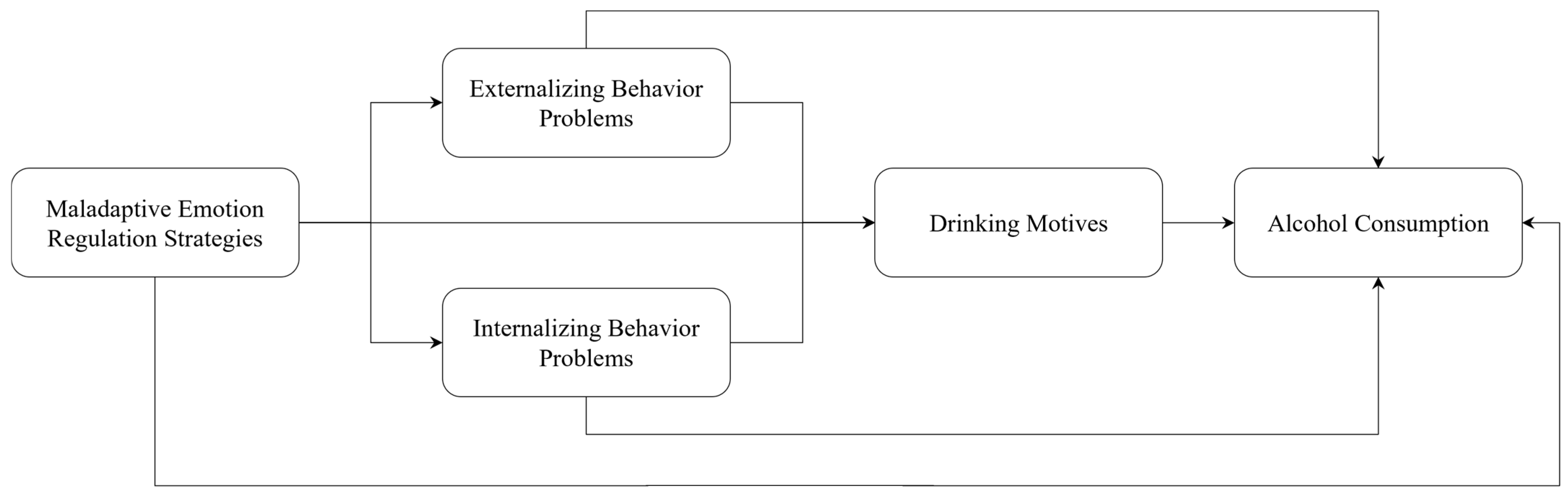
1.5. Current Investigation
2. Materials and Methods
2.1. Procedure and Participants
2.2. Instruments
2.3. Data Analysis
3. Results
3.1. Preliminary Analysis
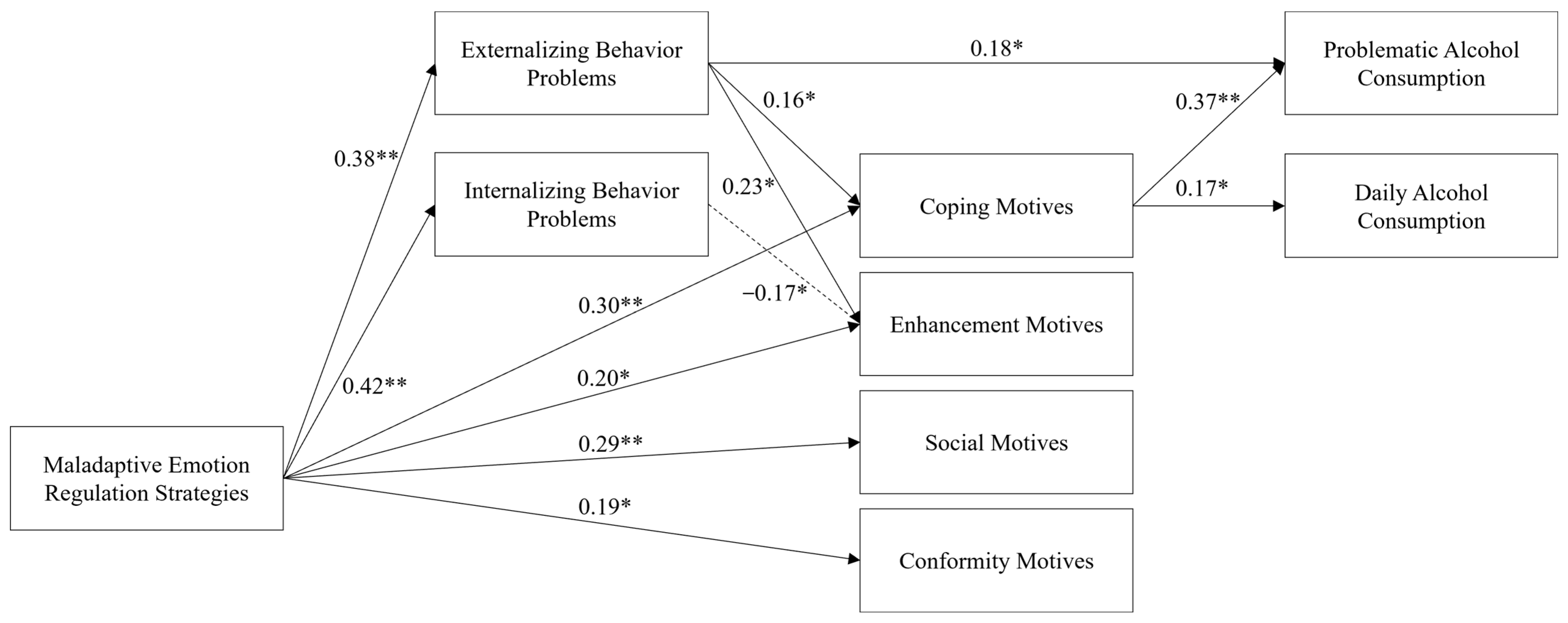
3.2. Path Analysis
4. Discussion
4.1. Practical Implications and Suggestions
4.2. Limitations and Future Research
5. Conclusions
Supplementary Materials
Author Contributions
Funding
Institutional Review Board Statement
Informed Consent Statement
Data Availability Statement
Conflicts of Interest
References
- Mokdad, A.; Forouzanfar, M.; Daoud, F.; Mokdad, A.; El Bcheraoui, C.; Moradi-Lakeh, M.; Kyu, H.; Barber, R.; Wagner, J.; Cercy, K.; et al. Global burden of diseases, injuries, and risk factors for young people’s health during 1990–2013: A systematic analysis for the Global Burden of Disease Study 2013. Lancet 2016, 387, 2383–2401. [Google Scholar] [CrossRef]
- Charrier, L.; van Dorsselaer, S.; Canale, N.; Baska, T.; Kilibarda, B.; Comoretto, R.; Galeotti, T.; Brown, J.; Vieno, A. A Focus on Adolescent Substance Use in Europe, Central Asia and Canada: Health Behaviour in School-Aged Children International Report from the 2021/2022 Survey; WHO Regional Office for Europe: Copenhagen, Denmark, 2022; Volume 3, Available online: https://www.who.int/europe/publications/i/item/9789289060936 (accessed on 26 June 2025).
- Romano, E.; Fell, J.; Li, K.; Simons-Morton, B.; Vaca, F. Alcohol-related deaths among young passengers: An analysis of national alcohol-related fatal crashes. J. Saf. Res. 2021, 79, 376–382. [Google Scholar] [CrossRef]
- Pedrelli, P.; Shapero, B.; Archibald, A.; Dale, C. Alcohol use and depression during adolescence and young adulthood: A summary and interpretation of mixed findings. Curr. Addict. Rep. 2016, 3, 91–97. [Google Scholar] [CrossRef]
- French, M.; Maclean, J. Underage alcohol use, delinquency, and criminal activity. Health Econ. 2006, 15, 1261–1281. [Google Scholar] [CrossRef]
- Hjarnaa, L.; Møller, S.; Curtis, A.; Becker, U.; Andersen, O.; Torvik, F.; Tolstrup, J. Alcohol intake and academic performance and dropout in high school: A prospective cohort study in 65,233 adolescents. J. Adolesc. Health 2023, 73, 1083–1092. [Google Scholar] [CrossRef]
- Schulenberg, J.; Maslowsky, J.; Patrick, M.; Martz, M. Substance Use in the Context of Adolescent Development. In The Oxford Handbook of Adolescent Substance Abuse; Zucker, R., Brown, S., Eds.; Oxford University Press: Oxford, UK, 2019; pp. 19–35. [Google Scholar]
- Silbereisen, R.; Reese, A. Substanzgebrauch Jugendlicher: Illegale Drogen und Alkohol [Adolescent substance use: Illegal drugs and alcohol]. In Risikoverhaltensweisen Jugendlicher. Formen, Erklärungen und Prävention [Risk Behaviors of Adolescents: Forms, Explanations, and Prevention]; Raithel, J., Ed.; Leske & Budrich: Leverkusen, Germany, 2001; pp. 131–153. [Google Scholar]
- Moffitt, T. Adolescence-limited and life-course-persistent antisocial behavior: A developmental taxonomy. Psychol. Rev. 1993, 100, 674–701. [Google Scholar] [CrossRef] [PubMed]
- Pedersen, M.; Thomsen, K.; Heradstveit, O.; Skogen, J.; Hesse, M.; Jones, S. Externalizing behavior problems are related to substance use in adolescents across six samples from Nordic countries. Eur. Child Adolesc. Psychiatry 2018, 27, 1551–1561. [Google Scholar] [CrossRef]
- Paul, S.; Baranger, D.; Johnson, E.; Jackson, J.; Gorelik, A.; Miller, A.; Hatoum, A.; Thompson, W.; Strube, M.; Dick, D.; et al. Alcohol milestones and internalizing, externalizing, and executive function: Longitudinal and polygenic score associations. Psychol. Med. 2024, 54, 2644–2657. [Google Scholar] [CrossRef] [PubMed]
- Valente, J.; Pietrobom, T.; Mihic, J.; Caetano, S.; Mari, J.; Sanchez, Z. Externalizing and internalizing problems as predictors of alcohol-related harm and binge drinking in early adolescence: The role of gender. J. Affect. Disord. 2023, 327, 167–174. [Google Scholar] [CrossRef] [PubMed]
- Thompson, R. Emotion regulation: A theme in search of definition. Monogr. Soc. Res. Child Dev. 1994, 59, 25–52. [Google Scholar] [CrossRef]
- Garnefski, N.; Kraaij, V.; Spinhoven, P. Negative life events, cognitive emotion regulation and emotional problems. Pers. Individ. Differ. 2001, 30, 1311–1327. [Google Scholar] [CrossRef]
- Thompson, R. Emotional regulation and emotional development. Educ. Psychol. Rev. 1991, 3, 269–307. [Google Scholar] [CrossRef]
- Loch, N.; Hiller, W.; Witthöft, M. Der Cognitive Emotion Regulation Questionnaire (CERQ): Erste teststatistische Überprüfung einer deutschen Adaptation [The Cognitive Emotion Regulation Questionnaire (CERQ): Psychometric evaluation of a German adaptation]. Z. Klin. Psychol. Psychother. 2011, 40, 94–106. [Google Scholar] [CrossRef]
- Brown, W.; Melas, M. A Narrative Review of Emotion Regulation Abilities, Strategy Use, and Their Relationship to Alcohol. Curr. Addict. Rep. 2024, 11, 199–209. [Google Scholar] [CrossRef]
- Weiss, N.; Kiefer, R.; Goncharenko, S.; Raudales, A.; Forkus, S.; Schick, M.; Contractor, A. Emotion regulation and substance use: A meta-analysis. Drug Alcohol Depend. 2022, 232, 109131. [Google Scholar] [CrossRef]
- King, S.; Hubbard, S.; Teeters, J.; Brausch, A. A longitudinal examination of alcohol use and emotion dysregulation in adolescence. Exp. Clin. Psychopharmacol. 2023, 31, 414–422. [Google Scholar] [CrossRef]
- Laghi, F.; Bianchi, D.; Lonigro, A.; Pompili, S.; Baiocco, R. Emotion regulation and alcohol abuse in second-generation immigrant adolescents: The protective role of cognitive reappraisal. J. Health Psychol. 2021, 26, 513–524. [Google Scholar] [CrossRef] [PubMed]
- Poon, J.; Turpyn, C.; Hansen, A.; Jacangelo, J.; Chaplin, T. Adolescent substance use & psychopathology: Interactive effects of cortisol reactivity and emotion regulation. Cogn. Ther. Res. 2016, 40, 368–380. [Google Scholar] [CrossRef]
- Wills, T.; Pokhrel, P.; Morehouse, E.; Fenster, B. Behavioral and emotional regulation and adolescent substance use problems: A test of moderation effects in a dual-process model. Psychol. Addict. Behav. 2011, 25, 279–292. [Google Scholar] [CrossRef]
- Beauchaine, T.; Hinshaw, S. (Eds.) Child and Adolescent Psychopathology, 2nd ed.; John Wiley & Sons: Hoboken, NJ, USA, 2013. [Google Scholar]
- Myschker, N.; Stein, R. Verhaltensstörungen bei Kindern und Jugendlichen: Erscheinungsformen—Ursachen—Hilfreiche Maßnahmen [Behavioral Disorders in Children and Adolescents: Forms—Causes—Helpful Measures], 8th ed.; Kohlhammer: Stuttgart, Germany, 2018. [Google Scholar] [CrossRef]
- Aldao, A.; Nolen-Hoeksema, S.; Schweizer, S. Emotion-regulation strategies across psychopathology: A meta-analytic review. Clin. Psychol. Rev. 2010, 30, 217–237. [Google Scholar] [CrossRef]
- Compas, B.; Jaser, S.; Bettis, A.; Watson, K.; Gruhn, M.; Dunbar, J.; Williams, E.; Thigpen, J. Coping, emotion regulation, and psychopathology in childhood and adolescence: A meta-analysis and narrative review. Psychol. Bull. 2017, 143, 939–991. [Google Scholar] [CrossRef]
- Mihic, J.; Novak, M. Importance of child emotion regulation for prevention of internalized and externalized problems. J. Early Child. Educ. Res. 2018, 7, 235–254. [Google Scholar]
- Wills, T.; Simons, J.; Sussman, S.; Knight, R. Emotional self-control and dysregulation: A dual-process analysis of pathways to externalizing/internalizing symptomatology and positive well-being in younger adolescents. Drug Alcohol Depend. 2016, 163, 37–45. [Google Scholar] [CrossRef]
- Cludius, B.; Mennin, D.; Ehring, T. Emotion regulation as a transdiagnostic process. Emotion 2020, 20, 37–42. [Google Scholar] [CrossRef] [PubMed]
- Najman, J.; Plotnikova, M.; Horwood, J.; Silins, E.; Fergusson, D.; Patton, G.; Olsson, C.; Hutchinson, D.; Degenhardt, L.; Tait, R.; et al. Does adolescent heavier alcohol use predict young adult aggression and delinquency? Parallel analyses from four Australasian cohort studies. Aggress. Behav. 2019, 45, 427–436. [Google Scholar] [CrossRef]
- Groenman, A.; Janssen, T.; Oosterlaan, J. Childhood psychiatric disorders as risk factor for subsequent substance abuse: A meta-analysis. J. Am. Acad. Child Adolesc. Psychiatry 2017, 56, 556–569. [Google Scholar] [CrossRef] [PubMed]
- Luderer, M.; Quiroga, J.R.; Faraone, S.; James, Y.Z.; Reif, A. Alcohol use disorders and ADHD. Neurosci. Biobehav. Rev. 2021, 128, 648–660. [Google Scholar] [CrossRef]
- Esmaeelzadeh, S.; Moraros, J.; Thorpe, L.; Bird, Y. Examining the association and directionality between mental health disorders and substance use among adolescents and young adults in the U.S. and Canada: A systematic review and meta-analysis. J. Clin. Med. 2018, 7, 543. [Google Scholar] [CrossRef]
- Schüürmann, A.; Goagoses, N. Perceived social support and alcohol consumption during adolescence: A path-analysis with internalizing and externalizing behaviour problems. Emot. Behav. Difficulties 2022, 27, 297–309. [Google Scholar] [CrossRef]
- Cooper, M.; Kuntsche, E.; Levitt, A.; Barber, L.; Wolf, S. A Motivational Perspective on Substance Use: Review of Theory and Research. In Oxford Handbook of Substance Use Disorders; Sher, K., Ed.; Oxford University Press: Oxford, UK, 2016; pp. 375–421. [Google Scholar]
- Bresin, K.; Mekawi, Y. The “why” of drinking matters: A meta-analysis of the association between drinking motives and drinking outcomes. Alcohol. Clin. Exp. Res. 2021, 45, 38–50. [Google Scholar] [CrossRef]
- Smit, K.; Voogt, C.; Otten, R.; Kleinjan, M.; Kuntsche, E. Why adolescents engage in early alcohol use: A study of drinking motives. Exp. Clin. Psychopharmacol. 2022, 30, 73–81. [Google Scholar] [CrossRef]
- Supke, M.; Schulz, W. Ansatzpunkte für die Prävention frühen jugendlichen Alkoholkonsums: Frühkindliche Risikofaktoren, Trinkmotive und Mutter-Jugendlichen-Übereinstimmung [Approaches to preventing early adolescent alcohol use: Early childhood risk factors, drinking motives, and mother-adolescent agreement]. Sucht 2021, 67, 245–253. [Google Scholar] [CrossRef]
- Savage, J.; Spit for Science Working Group; Dick, D. Drinking motives, alcohol misuse, and internalizing and externalizing psychopathology across college: Across-lagged panel study. Subst. Use Misuse 2023, 58, 1377–1387. [Google Scholar] [CrossRef]
- Ramarushton, B.; Blumenthal, H.; Slavish, D.; Kaminski, P.; Ramadan, T.; Lewis, S. Perceived psychological control relates to coping-related drinking motives via social anxiety among adolescents: A cross-sectional mediation analysis. Alcohol 2024, 118, 17–24. [Google Scholar] [CrossRef]
- Paulus, D.; Heggeness, L.; Raines, A.; Zvolensky, M. Difficulties regulating positive and negative emotions in relation to coping motives for alcohol use and alcohol problems among hazardous drinkers. Addict. Behav. 2021, 115, 106781. [Google Scholar] [CrossRef]
- Watkins, L.; Franz, M.; DiLillo, D.; Gratz, K.; Messman-Moore, T. Does drinking to cope explain links between emotion-driven impulse control difficulties and hazardous drinking? A longitudinal test. Psychol. Addict. Behav. 2015, 29, 875–884. [Google Scholar] [CrossRef]
- Aurora, P.; Klanecky, A. Drinking motives mediate emotion regulation difficulties and problem drinking in college students. Am. J. Drug Alcohol Abus. 2016, 42, 341–350. [Google Scholar] [CrossRef] [PubMed]
- Hartmann, S.; McLeish, A. Associations between transdiagnostic cognitive-affective vulnerability factors, negative reinforcement drinking motives, and problematic alcohol use among undergraduates. J. Dual Diagn. 2021, 17, 13–22. [Google Scholar] [CrossRef] [PubMed]
- Sjödin, L.; Larm, P.; Karlsson, P.; Livingston, M.; Raninen, J. Drinking motives and their associations with alcohol use among adolescents in Sweden. Nord. Alkohol Nark. 2021, 38, 256–269. [Google Scholar] [CrossRef]
- Weichold, K.; Bühler, A.; Silbereisen, R. Konsum von Alkohol und illegalen Drogen in der Adoleszenz [Consumption of alcohol and illegal drugs in adolescence]. In Entwicklungspsychologie des Jugendalters [Developmental Psychology of Adolescence]; Silbereisen, R., Hasselhorn, M., Eds.; Hogrefe: Göttingen, Germany, 2008; pp. 537–586. [Google Scholar]
- Garnefski, N.; Kraaij, V. The cognitive emotion regulation questionnaire. Eur. J. Psychol. Assess. 2007, 23, 141–149. [Google Scholar] [CrossRef]
- Goodman, R. The Strengths and Difficulties Questionnaire. A research note. J. Child Psychol. Psychiatry 1997, 38, 581–586. [Google Scholar] [CrossRef]
- Lohbeck, A.; Schultheiß, J.; Petermann, F.; Petermann, U. Die deutsche Selbstbeurteilungsversion des Strengths and Difficulties Questionnaire (SDQ-Deu-S): Psychometrische Eigenschaften, Faktorenstruktur und Grenzwerte. [The German Self-Report Version of the Strengths and Difficulties Questionnaire (SDQ-Deu-S): Psychometric Properties, Factor Structure, and Critical Values]. Diagnostica 2015, 61, 222–235. [Google Scholar] [CrossRef]
- Cooper, M.L. Motivations for Alcohol Use Among Adolescents: Development and Validation of a Four-Factor Model. Psychol. Assess. 1994, 6, 117–128. [Google Scholar] [CrossRef]
- Kuntsche, E.; Knibbe, R.; Gmel, G.; Engels, R. Replication and Validation of the Drinking Motive Questionnaire Revised (DMQ-R, Cooper, 1994) among Adolescents in Switzerland. Eur. Addict. Res. 2006, 12, 161–167. [Google Scholar] [CrossRef] [PubMed]
- American Psychiatric Association [APA]. Diagnostic and Statistical Manual of Mental Disorders, 5th ed.; American Psychiatric Publishing: Washington, DC, USA, 2022. [Google Scholar] [CrossRef]
- Goagoses, N.; Pöchmüller, V.; Schüürmann, A. Parental Rules and Communication About Alcohol and Video Gaming: Descriptive Overview and Associations with Adolescents’ Alcohol Consumption and Gaming Behaviors in Germany; Kindheit und Entwicklung: Göttingen, Germany, 2025; Advance online publication. [Google Scholar]
- Sivo, S.; Fan, X.; Witta, E.; Willse, J. The search for “optimal” cutoff properties: Fit index criteria in structural equation modeling. J. Exp. Educ. 2006, 74, 267–288. [Google Scholar] [CrossRef]
- Hu, L.; Bentler, P. Cutoff criteria for fit indexes in covariance structure analysis: Conventional criteria versus new alternatives. Struct. Equ. Model. Multidiscip. J. 1999, 6, 1–55. [Google Scholar] [CrossRef]
- Browne, M.; Cudeck, R. Alternative ways of assessing model fit. Sociol. Methods Res. 1992, 21, 230–258. [Google Scholar] [CrossRef]
- Lai, H.; Cleary, M.; Sitharthan, T.; Hunt, G. Prevalence of comorbid substance use, anxiety and mood disorders in epidemiological surveys, 1990–2014: A systematic review and meta-analysis. Drug Alcohol Depend. 2015, 154, 1–13. [Google Scholar] [CrossRef]
- Islam, S.; Kaner, E.; Price-Wolf, J.; Grube, J.; Lipperman-Kreda, S. Disentangling the physical, social, and situational contexts of young adolescents’ initiation to alcohol use and intoxication: A mixed methods study. Drug Alcohol Depend. 2022, 238, 109572. [Google Scholar] [CrossRef]
- Brunetti, M.; Sette, S.; Longobardi, E.; Laghi, F.; Coplan, R. Loneliness and aloneliness as mediators of the associations between social withdrawal and internalizing problems in late childhood and early adolescence. J. Early Adolesc. 2023, 44, 790–814. [Google Scholar] [CrossRef]
- Birrell, L.; Slade, T.; Teesson, M.; Prior, K.; Chapman, C.; Hides, L.; McBride, N.; Mewton, L.; Allsop, S.; Andrews, G.; et al. Bidirectional relationships in the development of internalising symptoms and alcohol use in adolescence. Drug Alcohol Rev. 2020, 39, 950–959. [Google Scholar] [CrossRef] [PubMed]
- Scalco, M.; Colder, C.; Read, J.; Lengua, L.; Wieczorek, W.; Hawk, L., Jr. Testing alternative cascades from internalizing and externalizing symptoms to adolescent alcohol use and alcohol use disorder through co-occurring symptoms and peer delinquency. Dev. Psychopathol. 2021, 33, 29–46. [Google Scholar] [CrossRef]
- Essau, C.; de la Torre-Luque, A. Comorbidity between internalising and externalising disorders among adolescents: Symptom connectivity features and psychosocial outcome. Child Psychiatry Hum. Dev. 2023, 54, 493–507. [Google Scholar] [CrossRef] [PubMed]
- Hanisch, C.; Vögele, U.; Leidig, T.; Döpfner, M.; Niemeier, É.; Hennemann, T. Psychische Auffälligkeiten von Kindern und Jugendlichen an Förderschulen mit dem Förderschwerpunkt Emotionale und soziale Entwicklung. [Psychological difficulties of children and adolescents in special education schools with a focus on emotional and social development]. Empirische Sonderpädagogik 2023, 15, 21–37. [Google Scholar] [CrossRef]
- McDonald, A.; Corbin, W. Internalizing symptoms, negative urgency, and coping motives: Potential pathways to alcohol consequences. Psychol. Addict. Behav. 2025, 39, 219–225. [Google Scholar] [CrossRef]
- Nurmagandi, B.; Suratmini, D. The correlation between depression with online game addiction among adolescents: Systematic review. J. Psychiatr. Nurs. 2024, 15, 93–102. [Google Scholar] [CrossRef]
- Davis, A.; Zamboanga, B.; Newins, A.; Lui, P.; Ham, L.; Grigsby, T.; Kim, S.Y. Conformity drinking motives, college alcohol beliefs, and drinking behaviors among college students: Examining the protective role of prosocial behaviors. J. Adult Dev. 2025, 32, 276–288. [Google Scholar] [CrossRef]
- Grummitt, L.; Kelly, E.; Barrett, E.; Keyes, K.; Newton, N. Targets for intervention to prevent substance use in young people exposed to childhood adversity: A systematic review. PLoS ONE 2021, 16, e0252815. [Google Scholar] [CrossRef]
- Gückel, T.; Prior, K.; Newton, N.; Baillie, A.; Teesson, M.; Stapinski, L. Psychological mechanisms of change in reducing co-occurring social anxiety and alcohol use: A causal mediation analysis of the online Inroads intervention. Behav. Res. Ther. 2025, 191, 104766. [Google Scholar] [CrossRef]
- Blevins, C.E.; Marsh, E.L.; Stein, M.D.; Schatten, H.T.; Abrantes, A.M. Project CHOICE: Choosing healthy options in coping with emotions, an EMA/EMI plus in-person intervention for alcohol use. Subst. Abus. 2021, 42, 569–576. [Google Scholar] [CrossRef] [PubMed]
- Brinke, L.T.; Menting, A.; Schuiringa, H.; Deković, M.; Weisz, J.; De Castro, B. Emotion regulation training as a treatment element for externalizing problems in adolescence: A randomized controlled micro-trial. Behav. Res. Ther. 2021, 143, 103889. [Google Scholar] [CrossRef]
- Abela, K.; McCabe, R.; Bennett, T.; Bock, N.; Gonzalez, A. Evaluating parent-mediated interventions to support child emotion regulation: A review of preventative approaches across childhood. Dev. Rev. 2025, 77, 101218. [Google Scholar] [CrossRef]
- Kern, L.; Weist, M.; Mathur, S.; Barber, B. Empowering school staff to implement effective school mental health services. Behav. Disord. 2022, 47, 207–219. [Google Scholar] [CrossRef]
- Burrow-Sanchez, J.; Call, M.; Adolphson, S.; Hawken, L. School psychologists’ perceived competence and training needs for student substance abuse. J. Sch. Health 2009, 79, 269–276. [Google Scholar] [CrossRef]
- Kvillemo, P.; Hiltunen, L.; Demetry, Y.; Carlander, A.; Hansson, T.; Gripenberg, J.; Elgán, T.H.; Einhorn, K.; Skoglund, C. How to prevent alcohol and illicit drug use among students in affluent areas: A qualitative study on motivation and attitudes towards prevention. Subst. A 2021, 16, 83. [Google Scholar] [CrossRef]
- Ludewig, K.; Wolf, R. Prävention aus Sicht der Krankenkassen. In Alter und Prävention; Pohlmann, S., Ed.; Springer VS: Berlin/Heidelberg, Germany, 2016; pp. 271–299. [Google Scholar] [CrossRef]
- De Geronimo, F.; Stoddard, S.; Huntley, E.; Keating, D. The Association of Adolescent Internalizing and Externalizing Behavior Problems and Prospective Self with Alcohol and Cannabis Use. Adolescents 2024, 4, 453–468. [Google Scholar] [CrossRef]
- Humphreys, J.; Atkinson, C. Adolescent cannabis use-motives, frequency and consequences: A systematic literature review. J. Child Adolesc. Subst. Use 2025, 30, 83–102. [Google Scholar] [CrossRef]
- Izaguirre, L.A.; Fernández, A.; Palacios, E. Adolescent life satisfaction explained by social support, emotion regulation, and resilience. Front. Psychol. 2021, 12, 694183. [Google Scholar] [CrossRef] [PubMed]
- Wilke, J.; Goagoses, N. Morality in middle childhood: The role of callous-unemotional traits and emotion regulation skills. BMC Psychol. 2023, 11, 283. [Google Scholar] [CrossRef]
- Goagoses, N.; Bolz, T.; Vesterling, C.; Koglin, U. Maternal attachment and behaviour problems: Comparison between children in regular and special education schools. Eur. J. Spec. Needs Educ. 2023, 38, 16–31. [Google Scholar] [CrossRef]
- Goagoses, N.; Wippermann, L.; Gotthardt, A.; Koesling, E.; von Düring, U. Alcohol and cannabis use by adolescents with special educational needs: A systematic review focused on students with emotional and behavioral disorders. Subst. Use Misuse 2024, 59, 1921–1929. [Google Scholar] [CrossRef] [PubMed]



| N | Percent | M | SD | |
|---|---|---|---|---|
| Age | 238 | 14.84 | 1.25 | |
| Gender | 243 | |||
| Female | 128 | 52.7 | ||
| Male | 114 | 46.9 | ||
| Diverse | 1 | 0.4 | ||
| Birth country of Mother | 243 | |||
| Germany | 217 | 89.2 | ||
| Other | 26 | 10.8 | ||
| Grade | 243 | 8.89 | 1.15 | |
| 5. | 1 | 0.4 | ||
| 6. | 11 | 4.5 | ||
| 7. | 15 | 6.2 | ||
| 8. | 42 | 17.3 | ||
| 9. | 71 | 29.2 | ||
| 10. | 103 | 42.4 | ||
| Type of Secondary School | 243 | |||
| Special Education School | 4 | 1.6 | ||
| Lower Secondary School | 61 | 28.8 | ||
| Academic High School | 137 | 69.6 | ||
| Special Educational Needs Status | 243 | |||
| Yes | 10 | 4.1 | ||
| No | 233 | 95.9 |
| Total | Male | Female | p | Cohen’s d | |||||
|---|---|---|---|---|---|---|---|---|---|
| M | SD | M | SD | M | SD | ||||
| Maladaptive Emotion Regulation | 2.50 | 0.70 | 2.33 | 0.61 | 2.64 | 0.74 | t(238.91) = −3.56 | <0.001 | −0.45 |
| Internalizing Problems | 1.87 | 0.34 | 1.76 | 0.31 | 1.97 | 0.34 | t(240) = −4.96 | <0.001 | −0.64 |
| Externalizing Problems | 1.66 | 0.35 | 1.65 | 0.34 | 1.67 | 0.36 | t(240) = −0.47 | 0.64 | −0.06 |
| Enhancement Motive | 2.32 | 1.07 | 2.35 | 1.08 | 2.29 | 1.05 | t(240) = −0.44 | 0.66 | 0.06 |
| Social Motive | 1.26 | 0.55 | 1.32 | 0.64 | 1.20 | 0.45 | t(199.92) = 1.73 | 0.09 | 0.23 |
| Conformity Motive | 2.60 | 1.10 | 2.67 | 1.15 | 2.55 | 1.05 | t(240) = 0.85 | 0.39 | 0.11 |
| Coping Motive | 1.58 | 0.86 | 1.39 | 0.61 | 1.75 | 1.01 | t(211.28) = −3.35 | <0.001 | −0.42 |
| Daily Alcohol Consumption | 0.80 | 0.92 | 0.81 | 0.96 | 0.80 | 0.87 | t(240) = 0.08 | 0.94 | 0.01 |
| Problematic Alcohol Consumption | 1.44 | 0.53 | 1.40 | 0.47 | 1.48 | 0.58 | t(237.77) = 1.12 | 0.26 | −0.14 |
| 1 | 2 | 3 | 4 | 5 | 6 | 7 | 8 | 9 | ||
|---|---|---|---|---|---|---|---|---|---|---|
| 1 | Maladaptive Emotion Regulation | - | 0.47 ** | 0.38 ** | 0.21 ** | 0.27 ** | 0.16 ** | 0.43 ** | 0.12 * | 0.21 ** |
| 2 | Internalizing Problems | - | 0.44 ** | 0.03 | 0.07 | 0.00 | 0.32 ** | 0.06 | 0.16 ** | |
| 3 | Externalizing Problems | - | 0.23 ** | 0.15 * | 0.12 * | 0.31 ** | 0.16 ** | 0.32 ** | ||
| 4 | Enhancement Motive | - | 0.19 ** | 0.82 ** | 0.50 ** | 0.40 ** | 0.49 ** | |||
| 5 | Social Motive | - | 0.19 ** | 0.22 * | 0.05 | 0.16 ** | ||||
| 6 | Conformity Motive | - | 0.47 ** | 0.37 ** | 0.47 ** | |||||
| 7 | Coping Motive | - | 0.33 ** | 0.54 ** | ||||||
| 8 | Daily Alcohol Consumption | - | 0.47 ** | |||||||
| 9 | Problematic Alcohol Consumption | - |
| β | 90% CI | p | R2 | |
|---|---|---|---|---|
| Externalizing Behavior Problems | 0.17 | |||
| Maladaptive Emotion Regulation | 0.38 | [0.28, 0.47] | <0.001 | |
| Internalizing Behavior Problems | 0.26 | |||
| Maladaptive Emotion Regulation | 0.42 | [0.34, 0.50] | <0.001 | |
| Enhancement Motive | 0.09 | |||
| Maladaptive Emotion Regulation | 0.20 | [0.08, 0.32] | 0.005 | |
| Externalizing Behavior Problems | 0.23 | [0.10, 0.34] | 0.005 | |
| Internalizing Behavior Problems | −0.17 | [−0.23, −0.04] | 0.032 | |
| Social Motive | 0.09 | |||
| Maladaptive Emotion Regulation | 0.29 | [0.15, 0.44] | <0.001 | |
| Externalizing Behavior Problems | 0.08 | [−0.02, 0.19] | 0.188 | |
| Internalizing Behavior Problems | −0.10 | [−0.14, 0.03] | 0.193 | |
| Conformity Motive | 0.05 | |||
| Maladaptive Emotion Regulation | 0.19 | [0.06, 0.31] | 0.019 | |
| Externalizing Behavior Problems | 0.11 | [−0.01, 0.23] | 0.146 | |
| Internalizing Behavior Problems | −0.13 | [−0.26, −0.01] | 0.077 | |
| Coping Motive | 0.24 | |||
| Maladaptive Emotion Regulation | 0.30 | [0.19, 0.41] | <0.001 | |
| Externalizing Behavior Problems | 0.16 | [0.05, 0.23] | 0.022 | |
| Internalizing Behavior Problems | 0.07 | [−0.05, 0.19] | 0.380 | |
| Daily Alcohol Consumption | 0.19 | |||
| Maladaptive Emotion Regulation | −0.02 | [−0.12, 0.08] | 0.789 | |
| Externalizing Behavior Problems | 0.07 | [−0.02, 0.16] | 0.192 | |
| Internalizing Behavior Problems | −0.02 | [−0.12, 0.09] | 0.805 | |
| Enhancement Motive | 0.21 | [0.02, 0.40] | 0.071 | |
| Social Motive | −0.06 | [−0.14, 0.04] | 0.331 | |
| Conformity Motive | 0.12 | [−0.07, 0.33] | 0.312 | |
| Coping Motive | 0.17 | [0.04, 0.31] | 0.031 | |
| Problematic Alcohol Consumption | 0.40 | |||
| Maladaptive Emotion Regulation | −0.08 | [−0.18, 0.03] | 0.234 | |
| Externalizing Behavior Problems | 0.18 | [0.09, 0.27] | 0.002 | |
| Internalizing Behavior Problems | 0.00 | [−0.11, 0.10] | 0.923 | |
| Enhancement Motive | 0.13 | [−0.04, 0.29] | 0.205 | |
| Social Motive | 0.01 | [−0.09, 0.12] | 0.884 | |
| Conformity Motive | 0.18 | [0.00, 0.38] | 0.099 | |
| Coping Motive | 0.37 | [0.22, 0.50] | <0.001 | |
| Gender ⟶ Maladaptive Emotion Regulation | 0.22 | [0.13, 0.32] | 0.001 | |
| Gender ⟶ Internalizing Behavior Problems | 0.21 | [0.13, 0.29] | <0.001 | |
| Gender ⟶ Coping Motive | 0.14 | [0.07, 0.21] | 0.004 | |
| Grade ⟶ Externalizing Behavior Problems | −0.16 | [−0.24, −0.07] | 0.005 |
Disclaimer/Publisher’s Note: The statements, opinions and data contained in all publications are solely those of the individual author(s) and contributor(s) and not of MDPI and/or the editor(s). MDPI and/or the editor(s) disclaim responsibility for any injury to people or property resulting from any ideas, methods, instructions or products referred to in the content. |
© 2025 by the authors. Licensee MDPI, Basel, Switzerland. This article is an open access article distributed under the terms and conditions of the Creative Commons Attribution (CC BY) license.
Share and Cite
Wippermann, L.; Schüürmann, A.; Pöchmüller, V.; Goagoses, N. Maladaptive Emotion Regulation and Alcohol Consumption During Adolescence: Examining Pathways Through Behavioral Problems and Drinking Motives. Adolescents 2026, 6, 2. https://doi.org/10.3390/adolescents6010002
Wippermann L, Schüürmann A, Pöchmüller V, Goagoses N. Maladaptive Emotion Regulation and Alcohol Consumption During Adolescence: Examining Pathways Through Behavioral Problems and Drinking Motives. Adolescents. 2026; 6(1):2. https://doi.org/10.3390/adolescents6010002
Chicago/Turabian StyleWippermann, Lara, Alissa Schüürmann, Viktoria Pöchmüller, and Naska Goagoses. 2026. "Maladaptive Emotion Regulation and Alcohol Consumption During Adolescence: Examining Pathways Through Behavioral Problems and Drinking Motives" Adolescents 6, no. 1: 2. https://doi.org/10.3390/adolescents6010002
APA StyleWippermann, L., Schüürmann, A., Pöchmüller, V., & Goagoses, N. (2026). Maladaptive Emotion Regulation and Alcohol Consumption During Adolescence: Examining Pathways Through Behavioral Problems and Drinking Motives. Adolescents, 6(1), 2. https://doi.org/10.3390/adolescents6010002