


Since 2021, we have been immersed in the challenge of publishing a journal that constitutes a form of communication of scientific achievements in the field of the synthesis and characterization of chemical compounds from a theoretical and experimental point of view [1].
Last year, we reached important new milestones that encouraged us to continue the work carried out so far. In 2023, we added a cover story to each issue to improve the visibility of the featured articles (Figure 1). The cover stories corresponding to the four issues have been dedicated to “Boronation of Biomass-Derived Materials for Hydrogen Storage” [2], “Enzymatic Screening of β-Amyloid Precursor Protein-Based Substrates” [3], “Thermodynamic Overview of Bioconjugation Reactions Pertinent to Lysine and Cysteine Peptide and Protein Residues” [4], and “Composition of the Scent in Some Ophrys Orchids Growing in Basilicata (Southern Italy): A Solid-Phase Microextraction Study Coupled with Gas Chromatography and Mass Spectrometry” [5].
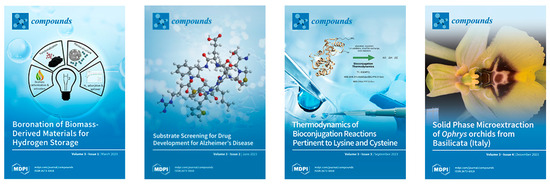
Figure 1.
Cover stories for Volume 3 issues [2,3,4,5].
In addition, we have published 24 research articles, 5 short communications, 8 review articles, 1 perspective article, and 3 editorial articles in four issues (which represents an increase of 15% compared with 2022), as depicted in Figure 2. During these two years, the articles published in Compounds have been viewed more than 60,000 times, which demonstrates the acceptance that our journal is beginning to have among the scientific community. These data came from article metrics on the MPDI publishing platform, where multiple requests from the same IP address are counted as one view/download. These articles have accumulated more than 54 views (data from article metrics on the MPDI publishing platform, where multiple requests from the same IP address are counted as one view/download). This implies that since 2021, the articles published in Compounds have accumulated more than 110,000 views. This is proof that the milestone of our journal beginning to have a presence in the scientific community has been reached. Furthermore, and according to Crossref, the articles corresponding to Volume 3 already have 46 citations within one year of its publication. Thus, Volumes 1, 2, and 3 of Compounds have accumulated a total of 260 citations. In the last 12 months, the most successful publication was “Polyphenols in Health and Disease: Gut Microbiota, Bioaccessibility, and Bioavailability” [6], which accumulated a total of 23 citations and almost 6,000 views over the year.

Figure 2.
Evolution of publications in Compounds during its first three years.
We should also point out that eight Special Issues have been published, to which authors can still make contributions during 2024 (Table 1).

Table 1.
Special Issues open for submissions.
Likewise, we have continued with the Editor’s Choice Articles section, where eight new articles have been incorporated [10,11,12,13,14,15,16,17].
Another issue to underline is the international expansion of Compounds, diversifying the geographical origin of the authors who have participated as the journal has developed (see Figure 3 and Figure 4). This is another achievement of which we are proud.
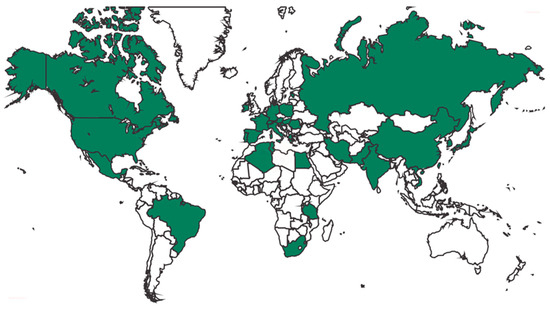
Figure 3.
Geographic distribution of the authors who have participated in Compounds (2021–2023).
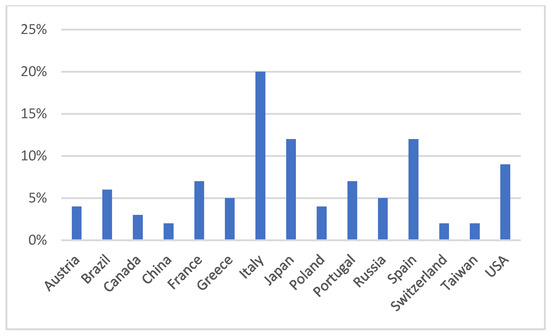
Figure 4.
Author distribution in 2023.
Compounds currently appears on different indexing and abstracting services platforms (CA Plus/Sc Finder, CNKI, CNPIEC, Digital Science, DOAJ, EBSCO, and PATENTSCOPE), different content aggregators (Google Scholar, Scilit and World CAT/OCLC), and journal directories and repository delivery services (Sherpa Romeo, DeepGreen, and Jisc). Our Editorial Office is currently working to include Compounds in new indexing and abstracting services and journal ranking lists, to give greater visibility to the contributions we publish.
Our primary objective continues to be improvements day by day, so that Compounds will be positioned as a quality reference journal, thus becoming a forum in which to expose, debate, and disseminate the most cutting-edge achievements in the field of chemistry. Therefore, in this Editorial, and both on my behalf and on behalf of the members of the Editorial Committee, I invite the scientific community to continue their trust in Compounds. Scientific articles, short communications, review articles, and letters are welcome. Likewise, I also invite collaboration with us in the editing and publication of Special Issues dedicated to topics that are aligned with the scope of Compounds.
Finally, I want to express my most sincere gratitude for the invaluable help from all those who have collaborated in this challenge during the third year of Compounds, without forgetting, of course, the magnificent work carried out by the many different reviewers who have collaborated throughout the editorial process, and without whom this adventure would not have been possible [18].
Conflicts of Interest
The author declares no conflicts of interest.
References
- Mejuto, J.C. Introducing Compounds: An Interdisciplinary Open Access Journal. Compounds 2021, 1, 1–2. [Google Scholar] [CrossRef]
- Lazzarini, A.; Marino, A.; Colaiezzi, R.; De Luca, O.; Conte, G.; Policicchio, A.; Aloise, A.; Crucianelli, M. Boronation of Biomass-Derived Materials for Hydrogen Storage. Compounds 2023, 3, 244–279. [Google Scholar] [CrossRef]
- Yamada, R.; Midorikawa, M.; Asai, A.; Takasu, N.; Fujii, R.; Kakizawa, T. Enzymatic Screening of β-Amyloid Precursor Protein-Based Substrates. Compounds 2023, 3, 341–347. [Google Scholar] [CrossRef]
- Lopandic, M.; Merza, F.; Honek, J.F. Thermodynamic Overview of Bioconjugation Reactions Pertinent to Lysine and Cysteine Peptide and Protein Residues. Compounds 2023, 3, 464–503. [Google Scholar] [CrossRef]
- D’Auria, M.; Lorenz, R.; Mecca, M.; Racioppi, R.; Romano, V.A. Composition of the Scent in Some Ophrys Orchids Growing in Basilicata (Southern Italy): A Solid-Phase Microextraction Study Coupled with Gas Chromatography and Mass Spectrometry. Compounds 2023, 3, 573–583. [Google Scholar] [CrossRef]
- Bié, J.; Sepodes, B.; Fernandes, P.C.B.; Ribeiro, M.H.L. Polyphenols in Health, and Disease: Gut Microbiota, Bioaccessibility, and Bioavailability. Compounds 2023, 3, 40–72. [Google Scholar] [CrossRef]
- Pereira, J.F.B.; Mussagy, C.U. (Eds.) Special Issue “(Bio)molecules from Natural Extracts: An Infinite World of Opportunities”. Available online: https://www.mdpi.com/journal/compounds/special_issues/14RHRZ0230 (accessed on 20 December 2023).
- Dominguez-Alvarez, E.; Marc, M.A. (Eds.) Special Issue “Organic Compounds with Biological Activity”. Available online: https://www.mdpi.com/journal/compounds/special_issues/V489KW2208 (accessed on 20 December 2023).
- Mejuto, J.C. (Ed.) Special Issue “Feature Papers in Compounds”. 2024. Available online: https://www.mdpi.com/journal/compounds/special_issues/0I7EB63828 (accessed on 20 December 2023).
- Griebeler, C.H.; Bach, M.F.; Silva, H.C., Jr.; Rodembusch, F.S.; Coelho, F.L.; Schneider, P.H. Thiazolidine-Based Fluorescent Chiral Ionic Liquids for Trace Copper (II) Ion Sensing. Compounds 2023, 3, 430–446. [Google Scholar] [CrossRef]
- Polevik, A.O.; Sobolev, A.V.; Glazkova, I.S.; Presniakov, I.A.; Verchenko, V.Y.; Link, J.; Stern, R.; Shevelkov, A.V. Interplay between Fe (II) and Fe (III) and Its Impact on Thermoelectric Properties of Iron-Substituted Colusites Cu26−xFexV2Sn6S32. Compounds 2023, 3, 348–364. [Google Scholar] [CrossRef]
- D’Auria, M. The Effect of Strain on the Aromatic Character of Infinitene. Compounds 2023, 3, 336–340. [Google Scholar] [CrossRef]
- Sadat, T. Predicting the Average Composition of an AlFeNiTiVZr-Cr Alloy with Machine Learning and X-ray Spectroscopy. Compounds 2023, 3, 224–232. [Google Scholar] [CrossRef]
- Yamada, S.; Takahashi, Y.; Konno, T. Fluorinated Merophosphinine and Phosphinine Dyes: Synthesis and Evaluation of UV-Visible Light Absorption Properties. Compounds 2023, 3, 153–168. [Google Scholar] [CrossRef]
- Pooladian, F.; Crawford, P.W.; Kessler, J.M.; Casey, G.R.; Ragain, C.M. Reduction Potential Predictions for Thirty-Seven 1,4-di-N-Oxide Quinoxaline-2-Carboxamide Derivatives with Anti-Tuberculosis Activity. Compounds 2023, 3, 83–95. [Google Scholar] [CrossRef]
- Ta, D.D.; Favret, J.M.; Dzyuba, S.V. Facile Synthesis of Pyrrolyl-Containing Semisquaraines in Water as Precursors for Non-Symmetric Squaraines. Compounds 2023, 3, 17–26. [Google Scholar] [CrossRef]
- Jackson, J.; Romero, G.M.; Hawkins, D.; Cornwall, R.G.; Lukov, G.L. Identifying the Structural Components Responsible for the Antiproliferative Properties of Hydroxychavicol. Compounds 2023, 3, 552–560. [Google Scholar] [CrossRef]
- Acknowledgment of the Reviewers of Compounds in 2023. Available online: https://www.mdpi.com/about/announcements/7409 (accessed on 21 January 2024).
Disclaimer/Publisher’s Note: The statements, opinions and data contained in all publications are solely those of the individual author(s) and contributor(s) and not of MDPI and/or the editor(s). MDPI and/or the editor(s) disclaim responsibility for any injury to people or property resulting from any ideas, methods, instructions or products referred to in the content. |
© 2024 by the author. Licensee MDPI, Basel, Switzerland. This article is an open access article distributed under the terms and conditions of the Creative Commons Attribution (CC BY) license (https://creativecommons.org/licenses/by/4.0/).