Skip to Content
  • Tracked for
    Impact Factor
  • 2.9
    CiteScore
  • 23 days
    Time to First Decision

Forensic Sciences

Forensic Sciences is an international, peer-reviewed, open access journal on all aspects of forensic science published quarterly online by MDPI.
The Portuguese Association of Forensic Sciences (APCF) is affiliated with Forensic Sciences and their members receive a discount on the article processing charges.

All Articles (274)

Background/Objectives: The Casablanca-Settat region of Morocco, located at the interface between Arab and Amazigh cultural zones, has only recently been investigated using autosomal short tandem repeat (STR) markers. The objective of this study was to characterize the genetic diversity and forensic efficiency of 15 autosomal STR loci in the Casablanca-Settat population and to evaluate its genetic relationships with other Moroccan populations. Methods: Fifteen autosomal STR loci were genotyped in 138 unrelated Arabic-speaking individuals from the Casablanca-Settat region. Allele frequencies, Hardy–Weinberg equilibrium, and standard forensic parameters were calculated. The genetic structure of the population was further examined through comparative analyses with 12 previously published Moroccan reference populations using multivariate and phylogenetic approaches. Results: A total of 146 distinct alleles were identified across the 15 loci. D18S51 was the most polymorphic marker (Ho = 0.9203), whereas D3S1358, TPOX, D5S818, and D16S539 exhibited lower allelic diversity. No statistically significant deviation from Hardy–Weinberg equilibrium was detected after correction for multiple testing. The combined power of discrimination exceeded 0.99, and the combined power of exclusion reached 0.99999965, demonstrating the high forensic efficiency of the STR panel. Population structure analyses positioned the Casablanca-Settat population within an intermediate genetic cluster, closely related to central Moroccan populations, consistent with historical gene flow and admixture. Conclusions: This study provides robust autosomal STR reference data for the Casablanca-Settat population, confirming the suitability of these markers for forensic identification in Morocco and offering valuable insights into regional population structure and genetic diversity.

21 February 2026
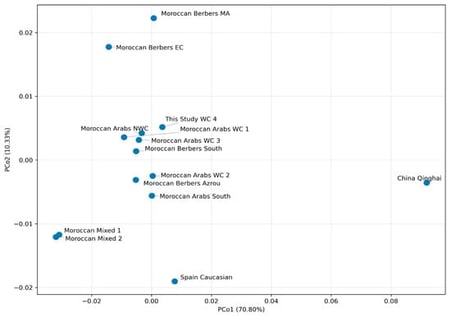
Principal Coordinates Analysis (PCoA) based on Nei’s genetic distances among 14 reference populations. Each point represents a population. The first two coordinates (PCo1 and PCo2) explain 70.80% and 10.33% of the total genetic variation, respectively.

Background/Objectives: Personal identification is a cornerstone of Forensic Medicine. Historical records indicated that 27 Italian soldiers were executed by Tito’s army in April 1945 and buried in the mass grave of Ossero (Cres Island, Croatia). Methods: The remains, exhumed in 2019 by Croatian authorities and transferred to the Sacrario d’Oltremare (Bari, Italy), underwent radiographic and anthropological analyses. Genetic analysis was later performed on 147 bone samples, leading to the identification of 10 soldiers. Results: Anthropological analyses revealed commingled remains of at least 34 individuals (15–45 years; 161–181 cm), including eight skeletal elements of female sex. Forensic examination confirmed cranial and post-cranial gunshot wounds. Conclusions: Extensive commingling and fragmentation of the remains prevented full reconstruction of individual skeletons, yet comparison with ante-mortem data supported their identification as the aforementioned soldiers. Unexpected findings, including historically undocumented females, were confirmed by DNA analysis. These findings underscore the value of a multidisciplinary approach to optimize recovery and subsequent forensic and genetic investigations.

20 February 2026

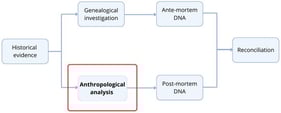
DVI workflow. The development of the anthropological investigation described in the present study is shown in the red box.

Use of Epigenetic Markers to Predict Age and Smoking Status in an Italian Population Sample

  • Domenico Colloca,
  • Matteo Manfredini and
  • Cristina Dallabona
  • + 3 authors

Background/Objectives: DNA profiling in forensic investigation typically compares genetic profiles, usually derived from the analysis of STR markers. However, this method has limitations when there is no biological reference sample or match in the DNA database. The aim of the current study is thus to replicate, in an Italian cohort, epigenetic markers previously identified in the literature for distinguishing tobacco smokers from non-smokers or estimating chronological age, so as to help narrow down the pool of suspects. Methods: DNA methylation at four CpG dinucleotides located around the cg05575921 site of the AHRR gene, widely associated with tobacco consumption, was measured. Additionally, five CpG dinucleotides in the ELOVL2, FHL2, KLF14, TRIM59, and C1orf132 genes were examined for chronological age estimation in buccal swab samples of 102 volunteers through pyrosequencing. Results: A multiple linear regression model for estimating chronological age shows that ELOVL2-C7, C1orf132-C1, and TRIM59-C7 have a significant effect on age. In this model, the prediction error increases with age. Two logistic regression models were used for determining smoker/non-smoker status, proving that two CpG sites significantly influence the odds of being classified as a smoker. When ex-smokers are included in the non-smoking group, the model correctly classifies the two conditions in about 80% of cases. Conclusions: The results demonstrate that the models generated from pyrosequencing data are useful for identifying tobacco smokers and estimating an individual’s chronological age, particularly for younger subjects. Further studies are needed to develop models with higher predictive accuracy and to integrate these tools into regular forensic practice.

19 February 2026

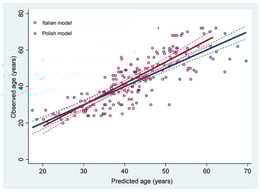
Observed versus predicted age scatter plot for the Italian cohort analyzed in this study (n = 102; age range 20–72 years). Predicted ages are derived from either the Italian regression model (blue) or the Polish regression model (red). Solid lines represent the fitted regression relationships, with shaded bands indicating the corresponding 95% confidence intervals. The dash lines are the confidence intervals, defined as shaded bands in the text.

Evaluation of a Subsampling Protocol for RapidHITTM ID V2 Analysis

  • Marion Defontaine,
  • Logan Privat and
  • Francis Hermitte
  • + 5 authors

Background/Objectives: Rapid DNA systems accelerate STR profiling but often require the consumption of the entire swab, limiting confirmation testing or downstream analyses. We previously validated a simple subsampling protocol for blood swabs on the RapidHITTM ID, using a rigid subungual mini-swab (Copan Italia S.p.A). A new version of this instrument has recently been released, featuring redesigned software and consumables. The RapidINTELTM Plus sample cartridge now enables two distinct lysis/extraction protocols, expanding analytical possibilities for rich biological traces. We evaluated subsampling performance using the subungual mini-swab and microFLOQ® swabs (Copan Italia S.p.A), and assessed feasibility for both blood and buccal reference swabs. Methods: Whole blood from four donors was deposited onto regular Copan swabs (10 µL) or microFLOQ® swabs (1 µL). A comparison was performed between the direct analysis of blood swabs using a RapidHITTM ID V1 (RapidINTELTM cartridge) and a RapidHITTM ID V2 (RapidINTELTM Plus cartridge, GENERAL protocol). Subsequently, both the GENERAL and SPECIALIZED protocols were tested after subsampling from primary blood or buccal swabs dried for 24 h using either a subungual mini-swab or a microFLOQ®. Results: Blood-swab subsampling on the V2 produced usable STR profiles with both the subungual mini-swab and the microFLOQ®. The subungual mini-swab was compatible with both the GENERAL and SPECIALIZED protocols. For blood applications, microFLOQ® fiber treatment showed no inhibitory effects. Reference buccal swabs were successfully analyzed with the RapidINTELTM Plus cartridge, either directly (regular swab) or via subungual subsampling under both protocols. In contrast, in this feasibility dataset (single analysis per donor per condition), subsampling a reference swab with microFLOQ® did not yield suitable profiles for RapidINTELTM Plus analysis under the tested conditions. Conclusions: This feasibility study indicates that the subsampling strategy can be applied on the RapidHITTM ID V2, particularly using subungual mini-swabs, to retain the primary swab for potential downstream testing while maintaining usable STR profile quality for blood and buccal reference workflows under the tested conditions.

19 February 2026

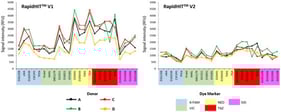
Signal intensity across all amplified markers for each blood donor sample. Charts show average RFUs for an initial blood volume of 10 µL deposited on a Copan regular flocked swab and analyzed on a RapidHITTM ID instrument version 1 and version 2. All conditions were tested in three independent analyses.

News & Conferences

Issues

Open for Submission

Editor's Choice

Get Alerted

Add your email address to receive forthcoming issues of this journal.

XFacebookLinkedIn
Forensic Sci. - ISSN 2673-6756