Article

Evaluation of a Subsampling Protocol for RapidHITTM ID V2 Analysis

1
Institut de Recherche Criminelle de la Gendarmerie Nationale (IRCGN), 95000 Cergy-Pontoise, France
2
UPR-CHROME, Faculté des Sciences Place Gabriel Péri, 30000 Nîmes, France
3
Ecole de l’ADN, 19 Grand Rue, 30000 Nîmes, France
4
Copan Italia S.p.A, 25125 Brescia, Italy
5
Equipe de Recherche sur les Relations Matrice Extracellulaire-Cellules, ERRMECe, (EA1391), Groupe Matrice Extracellulaire et Physiopathologie (MECuP), Institut des Matériaux, I-MAT (FD4122), CY Cergy Paris Université, 1 Rue Descartes, 95000 Neuville-sur-Oise, France
*
Authors to whom correspondence should be addressed.
These authors contributed equally to this work.
Forensic Sci. 2026, 6(1), 19; https://doi.org/10.3390/forensicsci6010019
Submission received: 29 December 2025 / Revised: 13 February 2026 / Accepted: 17 February 2026 / Published: 19 February 2026

Abstract

Background/Objectives: Rapid DNA systems accelerate STR profiling but often require the consumption of the entire swab, limiting confirmation testing or downstream analyses. We previously validated a simple subsampling protocol for blood swabs on the RapidHITTM ID, using a rigid subungual mini-swab (Copan Italia S.p.A). A new version of this instrument has recently been released, featuring redesigned software and consumables. The RapidINTELTM Plus sample cartridge now enables two distinct lysis/extraction protocols, expanding analytical possibilities for rich biological traces. We evaluated subsampling performance using the subungual mini-swab and microFLOQ® swabs (Copan Italia S.p.A), and assessed feasibility for both blood and buccal reference swabs. Methods: Whole blood from four donors was deposited onto regular Copan swabs (10 µL) or microFLOQ® swabs (1 µL). A comparison was performed between the direct analysis of blood swabs using a RapidHITTM ID V1 (RapidINTELTM cartridge) and a RapidHITTM ID V2 (RapidINTELTM Plus cartridge, GENERAL protocol). Subsequently, both the GENERAL and SPECIALIZED protocols were tested after subsampling from primary blood or buccal swabs dried for 24 h using either a subungual mini-swab or a microFLOQ®. Results: Blood-swab subsampling on the V2 produced usable STR profiles with both the subungual mini-swab and the microFLOQ®. The subungual mini-swab was compatible with both the GENERAL and SPECIALIZED protocols. For blood applications, microFLOQ® fiber treatment showed no inhibitory effects. Reference buccal swabs were successfully analyzed with the RapidINTELTM Plus cartridge, either directly (regular swab) or via subungual subsampling under both protocols. In contrast, in this feasibility dataset (single analysis per donor per condition), subsampling a reference swab with microFLOQ® did not yield suitable profiles for RapidINTELTM Plus analysis under the tested conditions. Conclusions: This feasibility study indicates that the subsampling strategy can be applied on the RapidHITTM ID V2, particularly using subungual mini-swabs, to retain the primary swab for potential downstream testing while maintaining usable STR profile quality for blood and buccal reference workflows under the tested conditions.

1. Introduction

Rapid DNA analysis instruments such as the RapidHITTM ID have accelerated forensic genotyping, enabling usable STR profiles in ~90 min and supporting decentralized deployments when laboratory access is compromised (e.g., French overseas territories) [1,2,3]. However, a major operational drawback remains: most rapid DNA workflows consume the entire swab, leaving no material for confirmation or downstream analyses. This poses a challenge when investigators have only one sample available and additional testing or reanalysis is needed in contexts where collection opportunity is limited or the sampling conditions are suboptimal. To mitigate this, our previous study established a simple subsampling protocol using a rigid 4N6FLOQSwabs® subungual mini-swab to recover material from a primary blood swab while still obtaining complete profiles on a RapidHITTM ID (V1, RapidINTELTM cartridge) and ensuring reproducibility across different operators [4].
Since then, the RapidHITTM ID V2 and the RapidINTELTM Plus cartridge have been introduced with updated chemistry and dedicated GENERAL and SPECIALIZED protocols. Manufacturer documentation and prior validations of the RapidHITTM ID system indicate changes that can influence sensitivity, PCR cycling, and input handling, warranting renewed evaluation of subsampling under V2 conditions [5]. Moreover, extending subsampling beyond blood to reference buccal swabs could streamline cartridge logistics (RapidINTELTM/RapidINTELTM Plus) in operational settings already leveraging decentralized rapid DNA workflows. Finally, there are practical questions about the compatibility of microFLOQ® direct swabs, which are used in trace collection and direct amplification, with V2 cartridges and whether the treatment of the nylon fiber in the swabs affects rapid DNA analysis outcomes [6].
In this background, a targeted, practice-oriented evaluation of a subsampling protocol on the RapidHITTM ID V2 is necessary to confirm its performance on blood swabs [7,8], test the microFLOQ® options, and assess its feasibility with buccal swabs—all while preserving material, maintaining reproducibility, and aligning with routine casework constraints.
In the RapidHITTM ID V2 workflow, two software protocols are used in this manuscript, named GENERAL and SPECIALIZED. GENERAL corresponds to the standard operating mode for routine processing when DNA input is expected to be sufficient, whereas SPECIALIZED is an increased-sensitivity option intended for lower or more variable DNA input. As these protocols differ in sensitivity and may lead to different workflow outcomes, they should not be considered interchangeable. In this study, both were evaluated to reflect realistic operational choices, and all of the analysis and interpretation parameters were applied as per laboratory validated settings.
The objective of this work builds directly on our previous study assessing a subsampling protocol with the rapidHITTM ID V1. This study aimed to (i) check consistency with the RapidHITTM ID V1 (RapidINTELTM cartridge) and the RapidHITTM ID V2 (RapidINTELTM Plus cartridge, GENERAL protocol) on standardized blood swabs; (ii) validate the subsampling procedure for blood swabs on the RapidHITTM ID V2 using the subungual mini-swab and evaluate microFLOQ®-based subsampling protocols; and (iii) extend subsampling to buccal swabs using the RapidINTELTM Plus cartridge to support operational standardization in decentralized rapid DNA workflows. ACE cartridges are dedicated to reference sample processing within RapidHITTM ID workflows. In the present feasibility study, a RapidINTELTM Plus was intentionally used to evaluate whether a streamlined cartridge strategy should be considered when subsampling is implemented. The practical objective was harmonizing consumables, particularly in complex delivery and consumable management contexts, such as in French overseas territories [4], and retaining the primary swab for potential downstream testing. This choice is not intended to necessarily replace ACE cartridges for routine reference processing in all laboratories, but rather to assess subsampling compatibility and its operational uses.

2. Materials and Methods

2.1. Sample Collection

This study follows all of the recommendations issued by the ethics commission of the ‘Unité Nationale de Police Judiciaire’ (UNPJ) concerning good practice for the ethical classification of biological data and the recovery of biological material. For these samples, the ethics committee issued recommendations for these experiments and provided its approval on 10 September 2025 (recommendation n° 34).
Blood samples were collected from four volunteers (A, B, C, and D) after obtaining informed consent. Buccal samples were also collected from four volunteers (C, E, F, and G) after obtaining informed consent.

2.2. Study Design and Overview

Throughout the entire study, a single RapidHITTM ID instrument (Thermo Fisher Scientific, Waltham, MA, USA) was used, initially with software version 1.3.3 and RapidINTELTM sample cartridges, and subsequently with the software updated to version 2.0 and RapidINTELTM Plus sample cartridges. The software evolution from RapidHITTM ID V1 to RapidHITTM ID V2 was conducted following laboratory recommendations and standard system practices (ISO 17025 accreditation scope 82527, www.cofrac.fr) for software update verification/validation. We chose to use a single RapidHITTM ID instrument to avoid potential biases that could arise from minor inter-instrument variability. The use of a single device allowed us to focus on assessing the subsampling method’s effectiveness without introducing additional variables.
We designed a stepwise evaluation to (i) establish a V1 reference baseline and compare it with RapidHITTM ID V2 (RapidINTELTM Plus) GENERAL protocols, (ii) to assess subsampling using a 4N6FLOQSwabs® subungual mini-swab (4N6FLOQSwabs® subungual shape code 40U022D – Copan Italia S.p.A, Brescia, Italy) and a microFLOQ® direct (code 60U001D – Copan Italia S.p.A) on blood samples and (iii) on buccal samples.
Experiments 1–3 are described below. For all of the experiments, storage of the samples was conducted at room temperature [9]. Subsampling was performed using either a subungual mini-swab or a microFLOQ®. For this purpose, the subungual mini-swab was moistened with 15 μL of ultra-pure DNA-free water and then blood was recovered by rolling and tapping on the regular swab; the microFLOQ® was moistened with 1 μL of ultra-pure DNA-free water and then blood was recovered by only tapping repeatedly for 10 s on the regular swab.

2.2.1. Experiment 1: Comparison of Direct Analysis of Blood Swabs Between RapidHITTM ID V1 and V2

For each donor, a volume of 10 μL of blood was deposited directly on six regular flocked swabs (4N6FLOQSwabs® code 4504C – Copan Italia S.p.A) and dried for 24 h by the active drying system in the cap of the device. Three swabs were analyzed on the RapidHITTM ID V1 instrument using the RapidINTELTM cartridge, and three swabs on the RapidHITTM ID V2 using the RapidINTELTM Plus cartridge and the GENERAL protocol.

2.2.2. Experiment 2: Subsampling of Blood Swabs for Analysis on RapidHITTM ID V2

For each donor, a volume of 10 μL of blood was deposited directly on twelve regular flocked swabs and dried for 24 h by the active drying system in the cap of the device. For six regular swabs, the subsampling was performed with a subungual mini-swab; three were analyzed using the GENERAL protocol; three were analyzed using the SPECIALIZED one. The other six regular swabs were subsampled for one half, using a untreated microFLOQ® (custom-manufactured by Copan Italia S.p.A for this study; not commercially available), and using a standard microFLOQ® for the second half. To evaluate the effect of the microFLOQ® fiber treatment on blood analysis with the RapidHITTM ID, a direct analysis was also performed for each donor in triplicate using both an untreated and a standard microFLOQ® swab. For this test, 10 µL of blood was deposited on the swab tip and dried for 24 h using the active drying system integrated in the device cap. Both microFLOQ® types were analyzed on the RapidHITTM ID V2 using the SPECIALIZED protocol.

2.2.3. Experiment 3: Subsampling of Buccal Swabs for Analysis on RapidHITTM ID V2

For each donor, four regular swabs with buccal cells were collected by rubbing the inner cheek five times and then dried for 24 h by the active drying system in the cap of the device. One regular swab was analyzed directly on the RapidHITTM ID V2 using the GENERAL protocol as a reference. Two regular swabs were subsampled using a subungual mini-swab each, and analyzed on the RapidHITTM ID V2 using both the GENERAL and SPECIALIZED protocols. Only one analysis per device or protocol was performed for each donor. The last regular swab was subsampled with a standard microFLOQ® and processed only with the SPECIALIZED protocol. All buccal swab analyses in Experiment 3 were performed using the RapidINTELTM Plus cartridge on the RapidHITTM ID V2 system. Experiment 3 was intentionally designed as a feasibility assessment to explore subsampling applicability to buccal reference swabs on the RapidHITTM ID V2. Consequently, a simplified design was used, with one analysis per donor per condition, to generate preliminary workflow-level observations rather than a full reproducibility evaluation.

2.3. Primary and Secondary Rapid DNA Analysis

The primary analysis of the obtained STR profile was automatically performed on the RapidHITTM ID, returning information on the quality of the results [10,11]. Upon primary analysis completion, the RapidHITTM ID system provides one of three possible status results: a green checkmark (indicating that all system threshold criteria are met), a yellow checkmark (indicating that one or more system threshold criteria are not met and a manual review is required), or a red ‘X’ (indicating that no result was generated due to a failed run).
Regardless of the quality flag, all results underwent manual review during a secondary analysis using GeneMapper™ ID-X Software v1.6 (Thermo Fisher Scientific). The results were analyzed using a simplified pipeline with a specific threshold for allele detection and calls and for heterozygous balance examination.

2.4. Statistical Analysis

The primary quantitative comparisons were performed at the locus level (marker-wise allelic peak heights expressed in RFUs). To support operational interpretation, complementary profile-level endpoints (e.g., profile completeness) were also evaluated. Except for in Experiment 3, the various results obtained are presented as the means of different independent experimental replicates. Several types of statistical analyses were used to compare the signal intensities of each marker individually. To check whether the distribution was normal, a Shapiro–Wilk normality test was performed for all experiments. Subsequently, a one-way analysis of variance (ANOVA) was used to assess significant differences in the different types of flocked swabs tested. Then, a t-test was performed to compare the intensity (allelic peak heights expressed in RFUs) of the genetic profiles obtained with the different subsampling tests for each donor.

3. Results

3.1. Comparison of Direct Analysis of Blood Swabs Between RapidHITTM ID V1 and V2

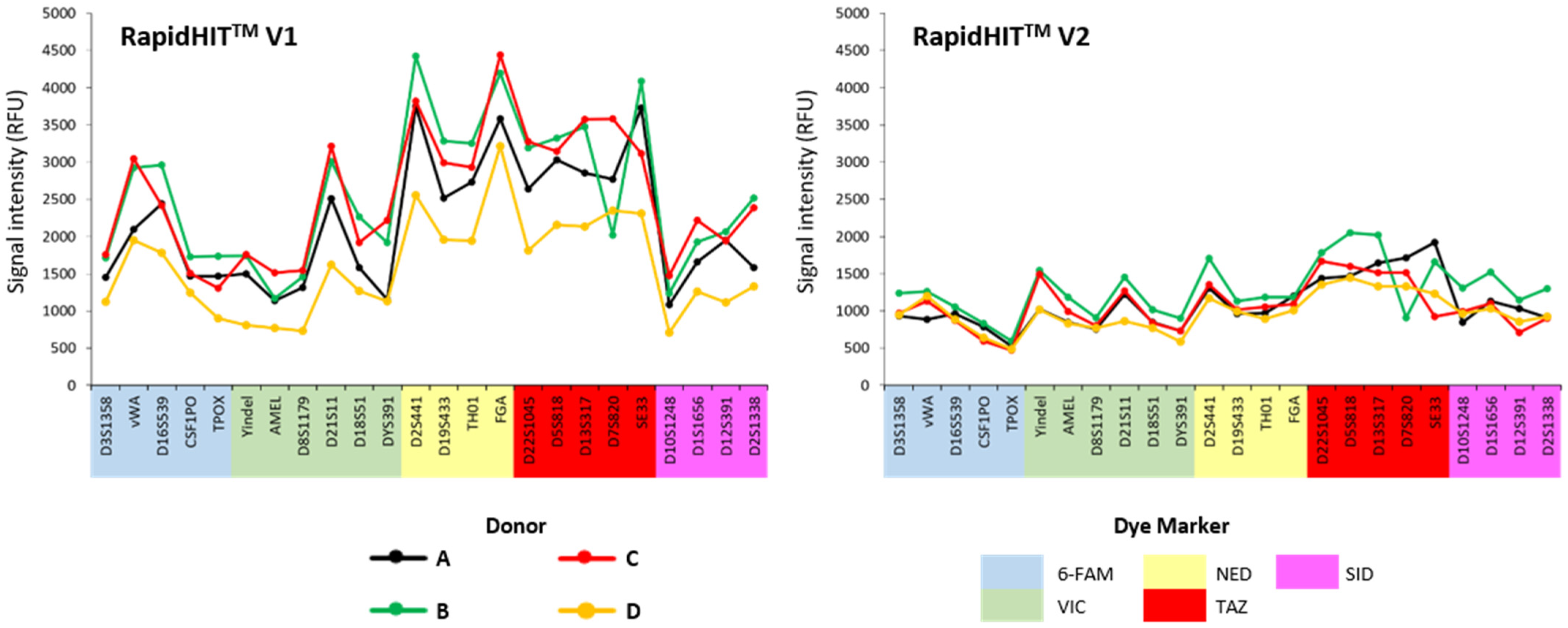
We first investigated whether the version of the RapidHITTM ID instrument had any effect on the result obtained using flocked swabs, starting with an initial blood deposit of 10 µL. We repeated the analyses in triplicate using samples from four donors (A, B, C and D) on the RapidHITTM ID instrument version 1 and after the update to version 2 (GENERAL protocol only) (Figure 1). Statistical analysis performed with the ANOVA tests showed no significant difference after the version 2 update for all markers for donor A and D samples, for 58% of the markers for donor B samples and for 29% of the markers for donor C samples (p-value = 0.01). Complete interpretable profiles were obtained with the RapidHITTM ID instrument, with both software version 1 or 2 in all tests.

3.2. Subsampling of Blood Swabs for Analysis on RapidHITTM ID V2

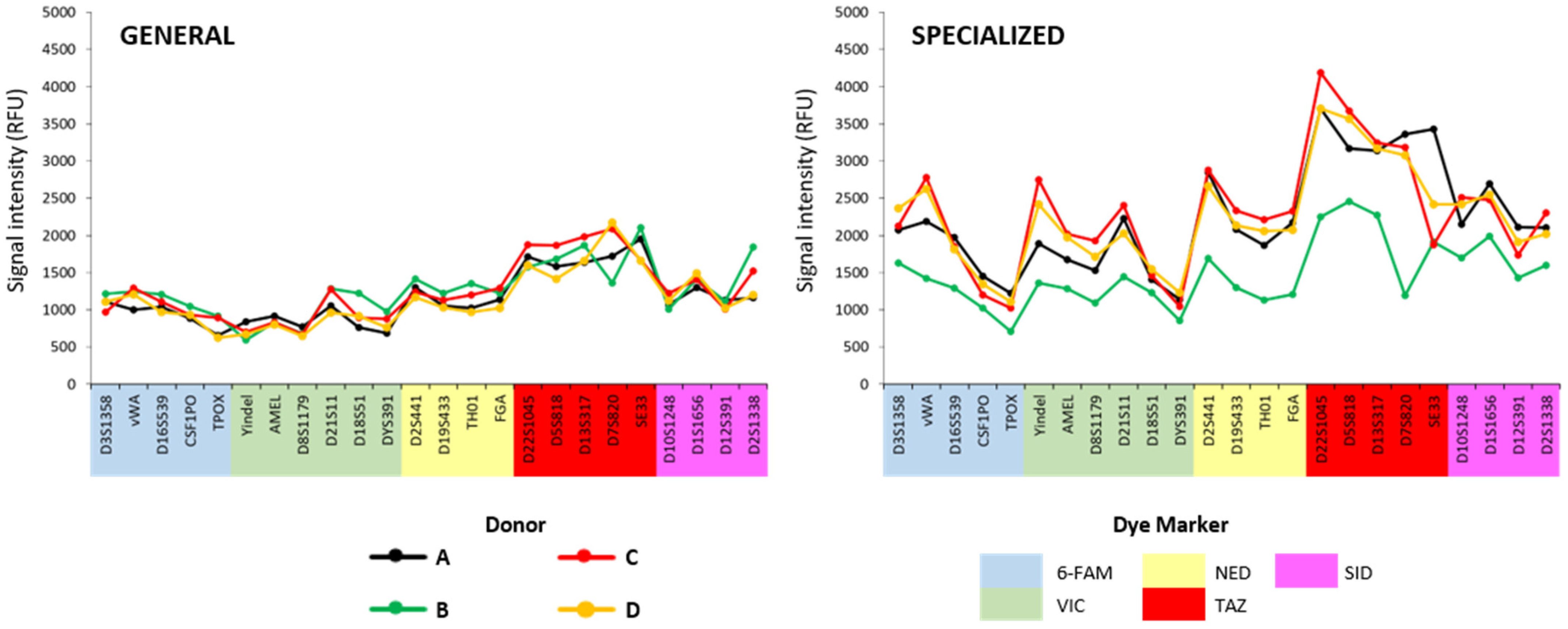
The technique of subsampling the blood swabs with the subungual mini-swab was effective, consistently yielding usable STR profiles under the RapidINTELTM Plus cartridge conditions. The subungual mini-swab was compatible with both the GENERAL and SPECIALIZED protocols on the RapidHITTM ID V2, supporting flexible deployment across instrument settings (Figure 2). Statistical analysis performed with the ANOVA tests showed no significant difference between the two instrument protocols used (p-value = 0.01) and complete interpretable profiles were obtained.
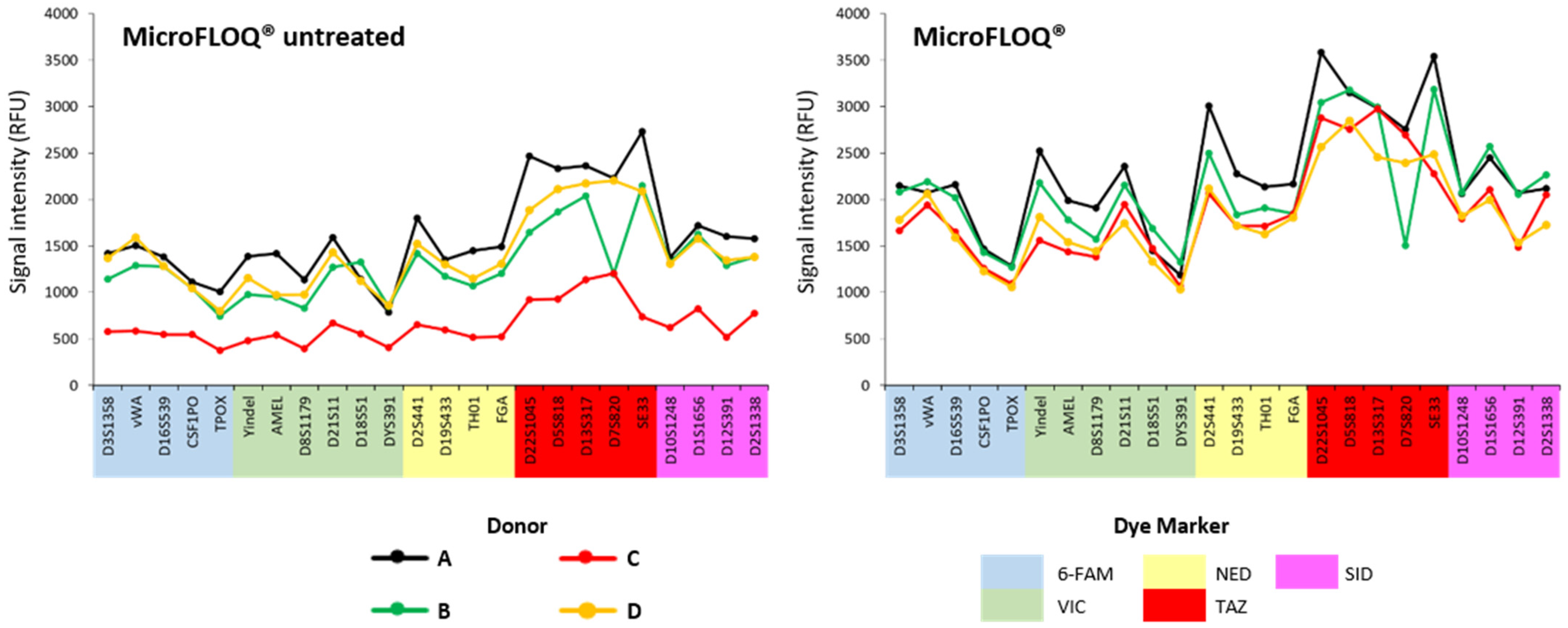
We then chose to test the microFLOQ® as a subsampling tool. Indeed, the implementation of the SPECIALIZED protocol made this device compatible with the analysis used by the RapidHITTM ID instruments. We first investigated whether the proprietary treatment that is present on the microFLOQ® tip had any effect on the result. We started with an initial blood deposit of 1 µL and a direct analysis on the RapidHITTM ID V2 with the SPECIALIZED protocol. Then, we repeated the analyses in triplicate using samples from all donors, both using untreated microFLOQ® provided by Copan for this research only, and the standard microFLOQ®. Results indicated that the proprietary microFLOQ® treatment of the nylon fibers did not produce an inhibitory effect on the RapidHITTM ID analysis, and may even have a beneficial effect on the quality of the result (only for the donor B (63% of the markers) and C (75% of the markers) samples, with significant differences observed between the two devices tested (p-value = 0.01)) (Figure 3). Again, complete genetic profiles were obtained using both devices.
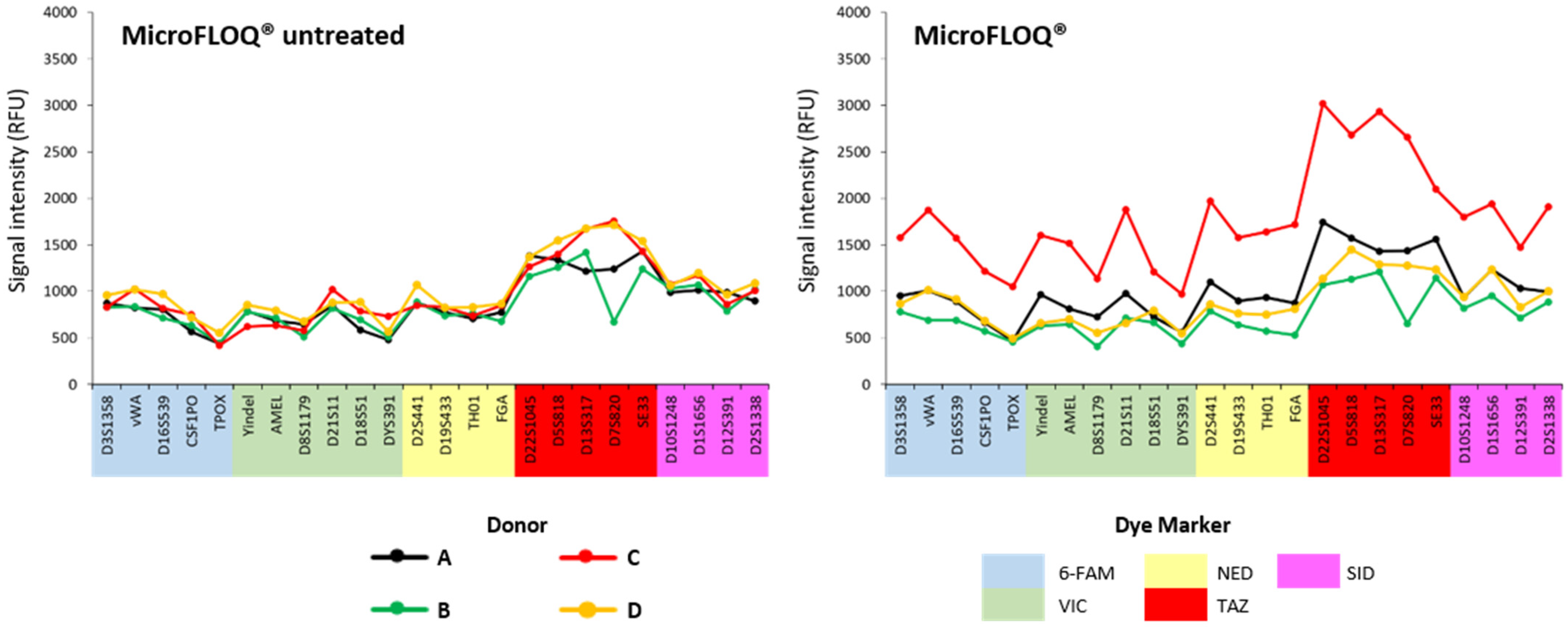
Based on the obtained results, we then tested both an untreated microFLOQ® and a standard microFLOQ® as a subsampling tool. The subsampling technique enabled the generation of a fully usable genetic profile from an initial deposit of 10 µL of blood on the regular primary swab, regardless of the type of microFLOQ® used (Figure 4), with no statistically significant difference observed (p-value = 0.01) and a complete genetic porfile obtained.

3.3. Subsampling of Buccal Swabs for Analysis on RapidHITTM ID V2

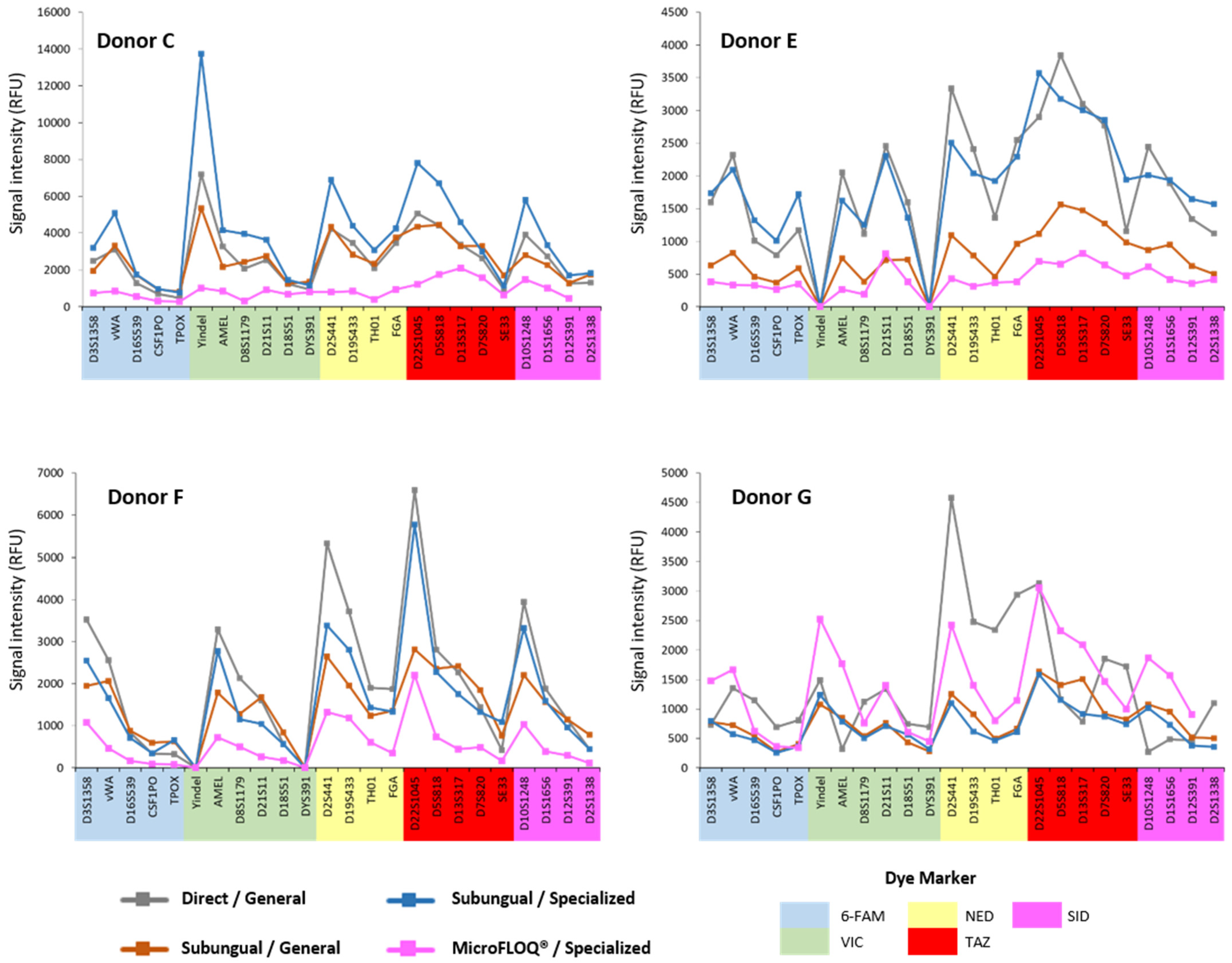
Considering the results obtained when subsambling the blood swabs, we decided to test the subsampling protocol on buccal swabs using the commercialized subungual mini-swab and microFLOQ®. These tests are used as a feasibility outcome limited to the tested conditions. For the study, buccal samples were collected from the inner cheek of four different donors, identified as C, E, F, and G. Only one analysis per device or protocol was performed per donor. Reference buccal swabs could be processed with RapidINTELTM Plus, either directly as regular swabs with the GENERAL protocol, or via the subsampling technique with the subungual swab, with both the GENERAL and SPECIALIZED protocols. In contrast, subsampling a reference buccal swab using a microFLOQ® was not suitable for analysis with the RapidINTELTM Plus cartridge, representing the principal limitation observed in this study (Figure 5).

4. Discussion

Our previous study demonstrated that subsampling blood from a primary swab with a 4N6FLOQSwabs® subungual mini-swab yields complete, operator-robust STR profiles on a RapidHITTM ID V1, while preserving the primary swab for potential downstream use and directly addressing the full-consumption limitation of rapid DNA workflows [12]. The present work translates that operational solution to the RapidHITTM ID V2 with the RapidINTELTM Plus cartridge and explores its practical variants, including microFLOQ®-based subsampling and applications to buccal reference swabs, ensuring that the subsampling paradigm remains aligned with current instrumentation and cartridge logistics [13,14,15].
Three findings are operationally informative within the scope of this feasibility assessment. First, the subsampling of blood swabs produced usable profiles on the RapidHITTM ID V2 with both subungual mini-swab and microFLOQ® tools using the RapidINTELTM Plus cartridge, while retaining the primary swab for potential confirmation or downstream testing under the conditions evaluated [1,16]. Second, the subungual mini-swab is compatible with both the GENERAL and SPECIALIZED protocols, which matters for field operators who may switch protocols based on matrix, case priority, or throughput needs [17]. Third, for blood samples, the microFLOQ® fiber treatment did not exhibit inhibition under the tested conditions; however, using microFLOQ® to subsample reference buccal swabs did not yield suitable profiles in this feasibility dataset (single analysis per donor per condition), and therefore cannot be recommended on the basis of the current evidence alone. Testing an untreated microFLOQ® for buccal subsampling would help distinguish whether the reduced performance versus blood is driven by the swab treatment or the biological matrix. However, such a study may be only for research purposes, as the standard version showed compatibility with the RapidINTELTM Plus cartridge for blood subsampling and the untreated version is not planned to be commercialized. Indeed, microFLOQ® treatment of the nylon fibers is intended to prepare the collected biological material for direct amplification. Moreover, quantifying the residual biological material remaining on the primary swab after subsampling would provide empirical support for the material-retention rationale underlying the original subsampling protocol [8,18,19]. More importantly, this study was designed as a feasibility assessment and therefore includes a limited number of donors, a single-instrument evaluation, and controlled reference-type samples. For Experiment 3 (buccal subsampling), only one analysis per donor per condition was performed; therefore, reproducibility and stochastic variation cannot be assessed for that experiment, and conclusions are restricted to the tested conditions.
The RapidHITTM ID V2 instrument introduces altered cycling and input handling that can influence sensitivity. This work supports the feasibility of applying the RapidHITTM ID V1 subsampling strategy on RapidHITTM ID V2 under controlled conditions. These findings may inform policy updates, SOPs, and training in relevant settings, while recognizing that broader generalization across instruments, operators, and operational casework conditions requires further evaluation [12,20]. The data also support a pragmatic approach to streamline cartridge logistics for reference samples, either through direct analysis of regular swabs or by applying subungual-based subsampling on the RapidINTELTM Plus under the GENERAL or SPECIALIZED protocols. This strategy reduces reliance on multiple cartridge types and simplifies field operations [21]. Indeed, reference sample analysis is initially dedicated to ACE cartridges on RapidHITTM ID systems [20].

5. Conclusions

This work operationalizes a simple subsampling strategy for analysis with the RapidHITTM ID V2 that preserves the primary swab for potential downstream testing, and supports that the approach previously validated on the RapidHITTM ID V1 remains effective under updated chemistry and protocols. Subungual mini-swab subsampling successfully generated usable STR profiles from blood using the RapidINTELTM Plus cartridge under both the GENERAL and SPECIALIZED protocols, while preserving the core benefit of keeping the source material available for confirmatory or downstream testing and extending the relevance of our initial RapidHITTM ID V1 study to current deployments [22]. Within the same RapidHITTM ID V2 framework, microFLOQ® did not evidence inhibition in blood applications; however, for buccal reference swabs, microFLOQ® subsampling did not yield suitable profiles in this feasibility dataset (single analysis per donor per condition) with RapidINTELTM Plus cartridges, and therefore cannot be recommended based on the current evidence alone [23].
These findings may help inform cartridge logistics for reference samples in RapidHITTM ID V2 workflows, either through direct analysis of regular swabs or subsampling with the subungual mini-swab, while recognizing that evaluation under operational casework conditions and broader deployment contexts remains necessary.
In conclusion, this study provides an updated feasibility-oriented appraisal for RapidHITTM ID V2 users and outlines a practical approach to retain the primary swab for potential downstream testing while maintaining usable profiles under the tested conditions. Further work is required to assess reproducibility across instruments and operators and to confirm performance under operational casework conditions.

Author Contributions

Conceptualization, F.H., S.H. and M.D.; Methodology, F.H., S.H., M.D., L.P., A.F. and M.R.; Validation, F.H.; Formal analysis, L.P. and M.D.; Investigation, C.S. (Chloé Scherer), L.P. and M.D.; Resources, F.H., S.H. and A.F.; Data curation, F.H. and L.P.; Writing—original draft preparation, C.S. (Christian Siatka) and F.H.; Writing—review and editing, C.S. (Christian Siatka), L.P., F.H., A.F. and M.R.; Visualization, F.H., C.S. (Christian Siatka), M.D. and L.P.; Supervision and project administration, F.H. All authors have read and agreed to the published version of the manuscript.

Funding

This research received no external funding.

Institutional Review Board Statement

This study follows recommendation n° 34 issued by the ‘Unité Nationale de Police Judiciaire’ (UNPJ) ethics committee. This committee reviewed and provided its approval concerning these experiments on 10 September 2025.

Informed Consent Statement

Informed consent was obtained from all subjects involved in the study.

Data Availability Statement

The data presented in this study are available upon request from the corresponding author.

Acknowledgments

The authors want to thank Thermo Fisher for their support of this work through the donation of all consumables and reagents for the RapidHITTM ID instrument. The authors also thank Audric Negron for his careful proofreading of the manuscript.

Conflicts of Interest

Authors C.H., L.P., M.D., F.H. and S.H. declare no conflicts of interest. At the time of manuscript submission, authors A.F. and M.R. are employees of Copan Italia S.p.A., the manufacturer of 4N6FLOQSwabs® and microFLOQ®; opinions, findings, and conclusions expressed in this publication are those of the authors and do not necessarily reflect those of Copan Italia S.p.A.

References

  1. LaRue, B.L.; Moore, A.; King, J.L.; Marshall, P.L.; Budowle, B. An Evaluation of the RapidHIT(®) System for Reliably Genotyping REFERENCE Samples. Forensic Sci. Int. Genet. 2014, 13, 104–111. [Google Scholar] [CrossRef] [PubMed]
  2. Murakami, C.; Irie, W.; Sasaki, C.; Nakamaru, N.; Sakamoto, M.; Nagato, J.; Satoh, F. Individual Identification Using the RapidHITTM ID System for Forensic Samples. Leg. Med. 2020, 47, 101776. [Google Scholar] [CrossRef] [PubMed]
  3. Sauvagère, S.; Pussiau, A.; Hubac, S.; Gouello, A.; Poussard, A.; Lavigne, J.-P.; Larnane, A.; Siatka, C.; Hermitte, F. Innovations in Forensic Sciences for Human Identification by DNA in the French Gendarmerie during the Last 10 Years. Forensic Sci. 2023, 3, 316–329. [Google Scholar] [CrossRef]
  4. Siatka, C.; Privat, L.; Franzoni, A.; Rosso, M.; Hubac, S.; Hermitte, F. Subsampling Blood Swabs as an Efficient and Good Practice for RapidHIT ID® Analyses. Forensic Sci. 2024, 4, 677–685. [Google Scholar] [CrossRef]
  5. Romsos, E.L.; Moreno, L.I.; Hares, D.R. Results of the 2023 Rapid DNA Multi-Laboratory Study—RapidINTEL Plus Sample Cartridge. Forensic Sci. Int. Rep. 2024, 10, 100396. [Google Scholar] [CrossRef]
  6. Aljumaili, T.; Haines, A.M. An Evaluation of the RapidHITTM ID System for Hair Roots Stained with DiamondTM Nucleic Acid Dye. Forensic Sci. Int. Genet. 2024, 69, 103003. [Google Scholar] [CrossRef] [PubMed]
  7. Eaton, M.; Woolf, M.S.; Pemmasani, S.; Turner, T.; Deeb, J.G.; Dawson Green, T. Two Simplified Tooth Sample Preparation Methods for Conventional Laboratory and RapidHITTM ID Workflows. J. Forensic Sci. 2024, 69, 2197–2208. [Google Scholar] [CrossRef] [PubMed]
  8. Koh, U.N.; Lee, J.H.; Kang, H.J.; Joo, K.M.; Lee, J.C.; Lim, S.-K. Application of RapidHITTM ID for Cell Authentication by Fast and Convenient STR Profiling. Genes Genom. 2023, 45, 1263–1271. [Google Scholar] [CrossRef] [PubMed]
  9. Rosso, M.; Franzoni, A. Exploring the Long-Term DNA Stability on Buccal 4N6FLOQSwabs® in Simulated Paternity Cases Using a Traditional and an Alternative Forensic Workflow. In Proceedings of the 30th Congress of the International Society for Forensic Genetics, Santiago de Compostela, 9–13 September 2024; Universidad de Santiago de Compostela: Santiago de Compostela, Spain, 2024; Volume 2025, pp. 365–372. [Google Scholar] [CrossRef]
  10. ThermoFisher Scientific. RapidINTELTM Sample Cartridge for Blood and Saliva Samples USER BULLETIN—RapidHITTM ID System v1.1.3; ThermoFisher Scientific: Waltham, MA, USA, 2019. [Google Scholar]
  11. ThermoFisher Scientific. RapidINTELTM Plus Sample Cartridge USER BULLETIN—For Use with RapidHITTM ID System v2.0 or Later; ThermoFisher Scientific: Waltham, MA, USA, 2025. [Google Scholar]
  12. Martin, B.; Kaesler, T.; Linacre, A. Analysis of Rapid HIT Application to Touch DNA Samples. J. Forensic Sci. 2022, 67, 1233–1240. [Google Scholar] [CrossRef] [PubMed]
  13. Wiley, R.; Sage, K.; LaRue, B.; Budowle, B. Internal Validation of the RapidHIT® ID System. Forensic Sci. Int. Genet. 2017, 31, 180–188. [Google Scholar] [CrossRef] [PubMed]
  14. Bruijns, B.; van Asten, A.; Tiggelaar, R.; Gardeniers, H. Microfluidic Devices for Forensic DNA Analysis: A Review. Biosensors 2016, 6, E41. [Google Scholar] [CrossRef] [PubMed]
  15. Bruijns, B.; Knotter, J.; Tiggelaar, R. A Systematic Review on Commercially Available Integrated Systems for Forensic DNA Analysis. Sensors 2023, 23, 1075. [Google Scholar] [CrossRef] [PubMed]
  16. Sun, S.; Tian, Y.M.; Tang, J.M.; Zhang, Q.X.; Hu, Y.L.; Wang, P.F.; Xue, L.Y.; Liu, L.; Tang, H. Application of RapidHITTM 200 System in Forensic Medicine. Fa Yi Xue Za Zhi 2018, 34, 161–164. [Google Scholar] [CrossRef] [PubMed]
  17. Thong, Z.; Phua, Y.H.; Loo, E.S.; Goh, S.K.; Ang, J.; Looi, W.F.; Syn, C.K.C. Evaluation of the RapidHITTM 200 System: A Comparative Study of Its Performance with Maxwell(®) DNA IQTM/Identifiler(®) Plus/ABI 3500xL Workflow. Forensic Sci Int Genet 2015, 19, 22–27. [Google Scholar] [CrossRef] [PubMed]
  18. Sherier, A.J.; Kieser, R.E.; Novroski, N.M.M.; Wendt, F.R.; King, J.L.; Woerner, A.E.; Ambers, A.; Garofano, P.; Budowle, B. Copan MicroFLOQ® Direct Swab Collection of Bloodstains, Saliva, and Semen on Cotton Cloth. Int. J. Leg. Med. 2020, 134, 45–54. [Google Scholar] [CrossRef] [PubMed]
  19. Date-Chong, M.; Hudlow, W.R.; Buoncristiani, M.R. Evaluation of the RapidHITTM 200 and RapidHIT GlobalFiler(®) Express Kit for Fully Automated STR Genotyping. Forensic Sci. Int. Genet. 2016, 23, 1–8. [Google Scholar] [CrossRef] [PubMed]
  20. Cihlar, J.C.; Kapema, K.B.; Budowle, B. Validation of the Applied Biosystems RapidHIT ID Instrument and ACE GlobalFiler Express Sample Cartridge. Int. J. Leg. Med. 2022, 136, 13–41. [Google Scholar] [CrossRef] [PubMed]
  21. Buscaino, J.; Barican, A.; Farrales, L.; Goldman, B.; Klevenberg, J.; Kuhn, M.; Lin, F.; Nguyen, P.; Salceda, S.; Schueren, R.; et al. Evaluation of a Rapid DNA Process with the RapidHIT® ID System Using a Specialized Cartridge for Extracted and Quantified Human DNA. Forensic Sci. Int. Genet. 2018, 34, 116–127. [Google Scholar] [CrossRef] [PubMed]
  22. Bowman, Z.; Daniel, R.; Gerostamoulos, D.; Woodford, N.; Hartman, D. Rapid DNA from a Disaster Victim Identification Perspective: Is It a Game Changer? Forensic Sci. Int. Genet. 2022, 58, 102684. [Google Scholar] [CrossRef] [PubMed]
  23. Watherston, J.; Watson, J.; Bruce, D.; Ueland, M.; McNevin, D.; Ward, J. An in-field evaluation of rapid DNA instruments for disaster victim identification. Int. J. Leg. Med. 2022, 136, 493–499. [Google Scholar] [CrossRef] [PubMed]
Figure 1. Signal intensity across all amplified markers for each blood donor sample. Charts show average RFUs for an initial blood volume of 10 µL deposited on a Copan regular flocked swab and analyzed on a RapidHITTM ID instrument version 1 and version 2. All conditions were tested in three independent analyses.
Forensicsci 06 00019 g001
Figure 2. Signal intensity across all amplified markers for each blood donor sample after subsampling using a subungual mini-swab. Charts show average RFUs for an initial blood volume of 10 µL deposited on a Copan regular flocked swab, subsampled, and analyzed on a RapidHITTM ID instrument version 2, either with the GENERAL or SPECIALIZED protocol. All conditions were tested in three independent analyses.
Forensicsci 06 00019 g002
Figure 3. Signal intensity across all amplified markers for each blood donor sample. Charts show average RFUs for an initial blood volume of 1 µL deposited on a Copan untreated microFLOQ® or on a standard microFLOQ®, and analyzed on a RapidHITTM ID instrument version 2 with the SPECIALIZED protocol. All conditions were tested in three independent analyses.
Forensicsci 06 00019 g003
Figure 4. Signal intensity across all amplified markers for each blood donor sample after subsampling using an untreated microFLOQ® or a standard microFLOQ®. Charts show average RFUs for an initial blood volume of 10 µL deposited on a Copan regular flocked swab, subsampled, and analyzed on a RapidHITTM ID instrument version 2 with the SPECIALIZED protocol. All conditions were tested in three independent analysis.
Forensicsci 06 00019 g004
Figure 5. Signal intensity across all amplified markers for each reference buccal sample. Charts show RFUs from a single analysis of a regular flocked swab (GENERAL protocol), after subsampling using a subungual mini-swab (GENERAL and SPECIALIZED protocol) or using a microFLOQ® (SPECIALIZED protocol), used as a feasibility assessment limited to the tested conditions.
Forensicsci 06 00019 g005
Disclaimer/Publisher’s Note: The statements, opinions and data contained in all publications are solely those of the individual author(s) and contributor(s) and not of MDPI and/or the editor(s). MDPI and/or the editor(s) disclaim responsibility for any injury to people or property resulting from any ideas, methods, instructions or products referred to in the content.