


Abstract
Cross-modal and immersive technologies offer new opportunities for experiential learning in early childhood, yet few studies examine integrated systems that combine multimedia, mini-games, 3D exploration, virtual reality (VR), and augmented reality (AR) within a unified environment. This article presents the design and implementation of the Solar System Experience (SSE), a cross-modal extended reality (XR) learning suite developed for preschool education and deployable on low-cost hardware. A dual-perspective evaluation captured both preschool teachers’ adoption intentions and preschool learners’ experiential responses. Fifty-four teachers completed an adapted Technology Acceptance Model (TAM) and Theory of Planned Behavior (TPB) questionnaire, while seventy-two students participated in structured sessions with all SSE components and responded to a 32-item experiential questionnaire. Results show that teachers held positive perceptions of cross-modal XR learning, with Subjective Norm emerging as the strongest predictor of Behavioral Intention. Students reported uniformly high engagement, with AR and the interactive eBook receiving the highest ratings and VR perceived as highly engaging yet accompanied by usability challenges. The findings demonstrate how cross-modal design can support experiential learning in preschool contexts and highlight technological, organizational, and pedagogical factors influencing educator adoption and children’s in situ experience. Implications for designing accessible XR systems for early childhood and directions for future research are discussed.
1. Introduction
Digital technologies have become deeply embedded in children’s everyday lives, shaping how they play, communicate, and explore the world through richly mediated environments [1]. From animated stories and interactive videos to early learning apps and mobile games, preschool-aged children today encounter a wide spectrum of digital experiences both at home and in educational settings. This pervasive exposure has motivated educators and researchers to explore how such technologies can be reimagined not merely as entertainment, but as tools that nurture curiosity, creativity, and active learning from an early age [2]. At the same time, this growing ubiquity underscores the need for intentional, developmentally appropriate, and pedagogically grounded designs that move beyond isolated applications toward coherent, classroom-ready learning experiences.
Among emerging innovations, immersive and interactive media such as Virtual Reality (VR), Augmented Reality (AR)—collectively referred to as Extended Reality (XR)—along with interactive eBooks and serious games, are uniquely positioned to offer distinctive opportunities for experiential and multi-sensory learning [3]. These environments can allow learners to visualize abstract phenomena, manipulate digital objects, and observe the consequences of their actions within controlled yet vivid settings [4]. In preschool contexts, such experiences align naturally with experiential [5] and constructivism [6] learning theories that emphasize learning through doing, observing, and reflecting [7]. However, their effective use requires careful calibration of complexity, scaffolding, and cognitive load [8], making it essential to integrate immersive modalities into broader pedagogical sequences rather than treat them as standalone novelty tools.
Educational research has long recognized that no single medium suffices to address the diverse cognitive, affective, and social needs of young learners. Cross-modal or multimodal approaches—combining visual, auditory, kinesthetic, and interactive components—are increasingly viewed as essential for fostering deep and sustained engagement [9]. When properly orchestrated, sequences of complementary media (e.g., video, game, eBook, VR/AR) can balance structure and exploration, providing a continuum from guided instruction to open discovery [10]. Yet, despite strong theoretical support, empirical work demonstrating the classroom feasibility of such approaches in early childhood education remains limited. Most existing studies examine single applications or isolated prototypes, leaving open how full ecosystems of interconnected modalities can be designed, implemented, and evaluated in real preschool environments.
Successful implementation depends not only on children’s capabilities but also on teachers’ readiness, confidence, and perceived institutional support [11]. Teachers’ perceptions of usefulness, ease of use, and normative expectations play decisive roles in shaping the adoption of emerging technologies [12]. Early childhood educators often express enthusiasm but face infrastructural limitations, lack of training, and curricular pressures when introducing XR-driven activities [13]. Accordingly, evaluating immersive media in early childhood requires a dual lens: examining (a) teachers’ adoption intentions and pedagogical readiness prior to implementation, and (b) children’s in situ experiential responses during authentic classroom use. These complementary viewpoints help determine both feasibility and actual educational value.
To address these needs, the present study introduces and evaluates a cross-modal immersive educational game developed for Greek preschool education, targeting, as a case study, specific curricula modules that blend technology-oriented activities with space science concepts. The game, suitably named “Solar System Experience” (SSE), rather than privileging a single technology, brings together complementary components. In essence, it comprises an interactive media suite of short multimedia clips, playful mini-games, an interactive eBook with quizzes, three-dimensional (3D) space exploration applications (in free- and guided-tour modes), and XR modules in VR and AR, organized around a common educational theme: the Solar System. The design embodies the principle that different modalities contribute uniquely to learning, with structured media providing conceptual clarity and immersive media eliciting emotional engagement and curiosity. The system was implemented and evaluated in real preschool classrooms to examine both feasibility and pedagogical impact. Importantly, the suite was engineered to operate on accessible, low-cost hardware commonly found in Greek schools, ensuring that the proposed approach remains realistic and scalable within typical early childhood education contexts.
Under this light, the study’s contribution is multifaceted:
- It proposes a cross-modal XR learning framework tailored to early childhood, demonstrating how conventional and immersive technologies can be sequenced to scaffold understanding through multisensory engagement. This framework concretizes how different modalities can be aligned to support progressive conceptual development in preschool learning.
- It presents an integrated design and implementation of a complete educational game suite (i.e., the SSE) based on this framework, articulating how VR, AR, interactive eBooks, and mini-games can coexist within a coherent pedagogical narrative. Rather than describing isolated components, the study treats SSE as a unified software learning ecosystem, detailing its technical and pedagogical interconnections and offering an implementable model for multimodal orchestration within realistic classroom conditions.
- It conducts a dual-perspective evaluation combining teachers’ adoption intentions with students’ in situ experiences characterized by high granularity, providing a holistic view of feasibility, usability, engagement, and educability across modalities. Here, “dual-perspective evaluation” refers explicitly to the combined analysis of teachers’ responses, guided by an adapted Technology Acceptance Model (TAM) [14] and Theory of Planned Behavior (TPB) [15] assessment instrument, alongside kindergarten students’ experiential ratings during actual classroom use. These perspectives are grounded in authentic Greek preschool curricular interventions.
- It derives empirically grounded guidelines for designing and implementing experiential learning in preschool contexts, bridging the gap between theoretical promise and classroom practice. These guidelines synthesize insights across system design, cross-modal sequencing, and parallel evaluation perspectives.
Together, these contributing aspects aspire to advance the understanding of how cross-modal interactive and immersive media can support meaningful, age-appropriate, and experiential learning in early childhood education. To the best of our knowledge, no prior study has explored such cross-modality while collecting parallel empirical data from both preschool teachers and learners in relation to immersive XR learning.
Accordingly, the study addresses a clearly articulated research gap by treating SSE as a software learning ecosystem and evaluating both its adoption conditions and its interaction performance in situ. To guide the empirical evaluation and structure the dual-perspective analysis, the following research questions (RQs) are formulated:
- RQ1.
- How do preschool teachers perceive the design, usability, and classroom applicability of the SSE cross-modal XR learning suite, and which factors shape their behavioral intention to adopt such a system in their teaching practice?
- RQ2.
- How do preschool students experience and evaluate the different components of the SSE suite as a digital learning system, in terms of usability, engagement, and comparative experiential quality across modalities?
Beyond addressing RQ1 and RQ2, the SSE suite and accompanying dual-perspective evaluation serve as a replicable blueprint for cross-modal XR ecosystems in preschool education. The remainder of the paper is structured as follows: Section 2 reviews relevant literature; Section 3 outlines the methodological approach; Section 4 presents the design of the SSE; Section 5 details the applications; Section 6 reports teacher and student results; Section 7 synthesizes implications; and Section 8 concludes the paper.
2. Literature Review
Immersive, interactive, and multimodal technologies have increasingly attracted scholarly attention as potential drivers of enriched learning experiences across educational levels. While prior research highlights the benefits of discrete technologies such as VR, AR, or serious games, a growing body of work stresses the importance of multimodal orchestration rather than isolated interventions. Accordingly, this section synthesizes three key strands of literature relevant to the present study: (i) VR and AR in education; (ii) serious games and gamification; and (iii) cross-modal and multimedia approaches for experiential learning.
2.1. Virtual Reality and Augmented Reality in Education
Virtual Reality has been explored as an educational tool for more than three decades. Early definitions conceptualized VR primarily in terms of immersion and telepresence [16], establishing its foundation as a medium capable of fostering a sense of “being there”. Subsequent frameworks, such as the I3 paradigm (Interaction, Immersion, Imagination) [17], extended this foundation by emphasizing VR’s multisensory affordances (visual, auditory, and occasionally haptic), thereby framing VR as a technology suited for experiential learning [18].
Contemporary systematic reviews have demonstrated consistent benefits of VR for increasing motivation, engagement, inclusion, and conceptual understanding across education domains [19,20,21]. VR’s contribution to conceptual learning is especially notable in contexts that require visualization of abstract or non-intuitive phenomena, as VR environments can situate learners within dynamic, manipulable representations that facilitate conceptual change [22]. Moreover, immersive VR experiences have been shown to enhance affective engagement, attention, and memory retention [23], and to support the development of cognitive and non-cognitive skills [24]. These findings align with experiential learning theories [25] and emerging evidence on embodied cognition [26], illustrating how immersive interaction can strengthen perceptual grounding and conceptual clarity.
Though VR’s capability to facilitate a visual understanding of complex concepts for students and, hence, reduce misconceptions, is undeniable [27,28], research in early childhood education remains more limited, albeit steadily expanding. Existing studies show that when VR is adapted to the developmental needs of young children—through simplified interfaces, short sessions, and guided facilitation—it can support exploratory learning, curiosity, and spatial reasoning [29]. However, challenges persist, including cognitive load, motion sickness, usability constraints, and the need for adult mediation [30]. Low-cost mobile VR solutions (e.g., Google Cardboard) offer accessible alternatives, particularly in resource-limited school contexts, though they demand careful interaction design (e.g., gaze-based selection, sensory stabilization) [31]. Recent reviews further emphasize that VR’s educational impact is maximized when embedded within a pedagogical framework that ensures conceptual integration rather than technological novelty [19].
Augmented Reality differs from VR by overlaying digital content onto the physical environment [32], creating hybrid learning spaces that combine tangible interaction with digital augmentation. AR supports situated and embodied learning, enabling young learners to explore concepts through manipulation of 3D models, markers, or physical artifacts [33]. Reviews have demonstrated AR’s positive effects on motivation, spatial understanding, and conceptual acquisition [34,35]. In preschool contexts, AR has been applied to storytelling, science education, and language development [36], typically through marker-based systems or tablet-mediated interactions. AR’s lower cognitive and physical demands, relative to VR, make it particularly suitable for early childhood classrooms both from learner [8] and educator [11] standpoints.
Studies suggest that AR can foster fine motor skills, collaborative exploration, and early scientific reasoning, especially when 3D models or gamified elements are incorporated [37,38], even more so than 2D material [39]. Yet, scholars also emphasize that AR’s educational effectiveness depends not only on technological quality but on pedagogical orchestration, including task structure, scaffolding, and alignment with curricular goals [40].
Together, the VR and AR literature indicates strong potential for immersive learning in preschool settings [3], while underscoring the need for thoughtful, developmentally appropriate design. In the present study, these insights are realized through low-cost, classroom-ready VR and AR modules that are embedded in a broader cross-modal sequence rather than deployed as stand-alone prototypes.
2.2. Serious Games and Gamification in Education
Serious games integrate instructional objectives within interactive game environments [41,42], drawing on principles of feedback, challenge, and narrative to support cognitively meaningful learning. Meta-analytic evidence demonstrates that serious games can outperform traditional instructional methods in terms of knowledge acquisition, engagement, and retention [43,44]. These effects are particularly pronounced when game mechanics are conceptually aligned with learning goals rather than appended superficially.
Beyond cognitive gains, serious games can enhance visual–spatial abilities and problem-solving skills [45]. Such effects may be further supported when game experiences incorporate immersive or semi-immersive interaction, as reflected in the I3 paradigm [17]. As such, they provide structured opportunities for experiential learning through iterative experimentation and active manipulation, resonating strongly with constructivism learning frameworks and experiential theories [6,46]. When combined with VR/AR affordances, game-based environments may also leverage heightened presence and curiosity, contributing to deeper engagement [47].
From a pedagogical perspective, serious games can help counteract the limitations of linear, didactic teaching by encouraging active participation and self-directed exploration [48]. The literature further indicates that game-based learning can foster intrinsic motivation, curiosity, and emotional involvement, provided that challenges are developmentally appropriate and scaffolded to support young learners’ needs [49].
Gamification, defined as the use of game-like elements (e.g., points, badges, quests) in non-game contexts [50], has emerged as a complementary approach for enhancing engagement in early childhood education [51]. However, evidence suggests that simple “pointification” yields short-lived motivational effects [52]. More effective implementations rely on deeper gamification structures, including narrative progression, meaningful feedback loops, and exploratory challenges that connect with learners’ intrinsic interests [53]. A major meta-analysis [54] found that although educational gamification tends to rely heavily on reward systems, future research should prioritize richer, constructivism-supportive gamification models. This aligns with the present study’s emphasis on integrating game mechanics and gamified feedback within a broader, sequenced learning pathway (from conventional media to semi-immersive 3D to XR), rather than relying primarily on extrinsic rewards.
2.3. Cross-Modal Educational Approaches
Preschool learning environments increasingly favor concrete, multisensory experiences that help young children build conceptual understanding through active engagement and perceptual grounding. As such, immersive and multimodal technologies—whether VR, AR, games, or interactive media—offer important opportunities for enriched inquiry-based learning [55]. However, several studies emphasize that developmental appropriateness depends on careful orchestration: interaction design must remain simple, sessions short, and adult mediation consistent [56].
While much research focuses on the educational impact of individual technologies, multimedia learning theories underscore that no single modality is sufficient for supporting the diverse cognitive and affective needs of young learners [57]. Instead, structured combinations of modalities can promote deeper, more durable learning outcomes [58]. Videos and animations are effective for initial explanation and attention capture; games support active experimentation; interactive books foster narrative comprehension and literacy; and VR/AR environments provide spatial immersion and hands-on manipulation [23]. A progression across these media supports a shift from guided to exploratory learning while maintaining conceptual continuity.
Studies on multimodal sequencing demonstrate that combining modalities across the VR–AR continuum can significantly enhance motivation, comprehension, and retention compared to single-medium approaches [59]. Moreover, multimodal systems can support early “precision education”, offering adaptive pacing and personalized resources based on learner needs [60].
Recent advances in embodied learning theory reinforce the importance of designing for movement, sensory engagement, and physical interaction. Embodied cognition frameworks posit that understanding emerges through perceptual-motor experience, which can be amplified by XR environments where learners actively navigate or manipulate content [26]. This is particularly relevant in preschool contexts where bodily engagement is a core mechanism for meaning-making.
Despite these advantages, the applicability of immersive and multimodal tools remains uneven across educational contexts. Schools vary widely in technological infrastructure, teacher preparedness, and socio-economic conditions, leading to persistent digital divides that directly impact whether XR and multimodal solutions can be implemented effectively [61]. These disparities not only shape access to devices but also affect instructional coherence, as teachers may lack the training or institutional support needed to integrate complex digital modalities into existing curricula.
Moreover, multimodal learning environments are most effective when accompanied by appropriate and adaptive scaffolding [62]. Young children benefit from teacher mediation, predictable interaction metaphors, and structured exploration paths that balance autonomy with guidance [56]. Designing such scaffolds requires aligning digital affordances with pedagogical intentions so that cognitive load remains manageable during highly stimulating XR experiences.
Research also highlights that much of the existing work on immersive media for children focuses on isolated modules (e.g., one AR activity, one VR prototype, or a single serious game), and rarely addresses how such tools can be combined in coherent learning ecosystems. Few studies investigate cross-modal progressions (e.g., moving from videos, to mini-games, to interactive books, to XR), despite theoretical frameworks strongly supporting such orchestrated learning sequences. Evidence suggests that carefully sequenced multimodal systems can produce synergistic effects, yet empirical validation remains limited, particularly in preschool settings. The SSE suite directly addresses this gap by implementing and empirically evaluating such a cross-modal progression with both teacher and student data in authentic preschool classrooms.
2.4. Research Gap
Across the literature on VR/AR in education, serious games, gamification, and cross-modal learning, several gaps emerge that motivate the present study.
- Most empirical research examines single-modality systems in isolation, offering limited insight into how diverse technologies can be orchestrated into unified pedagogical workflows. This creates a disconnect between theoretical arguments for multimodal integration and actual classroom practice. For example, the work in [63] investigates a multimodal educational game for first-grade learners using audiovisual animation but without XR components. Other studies [8,64] examine the benefits of AR for motivation and conceptual understanding, but remain restricted to AR-only approaches. Similarly, [65] compares traditional teaching to VR-enhanced instruction, focusing exclusively on VR. Collectively, these studies highlight isolated modality use rather than cross-modal orchestration.
- Very few works present technically integrated XR ecosystems that combine multiple modalities around a common thematic narrative—particularly in early childhood education. Although gamification is blended with VR in [66] and with AR in [67], to our knowledge no existing system integrates multimedia, mini-games, interactive books, 3D exploratory environments, and both VR and AR within a coherent workflow. Existing systems are typically domain-specific, hardware-intensive, or targeted at older learners, leaving a gap in accessible, age-appropriate XR ecosystems for preschool contexts. In contrast, the SSE suite combines these components so that immersive experiences function within a broader educational sequence rather than as stand-alone interventions, thereby providing a technically unified and pedagogically orchestrated ecosystem beyond the single-modality focus of prior work.
- Cross-modal research rarely addresses practical constraints such as low-cost hardware, limited infrastructure, or varying teacher readiness—factors especially relevant in public preschool environments such as Greek schools [68]. Few studies explore how immersive tools can be adapted for equitable use in resource-constrained classrooms. In view of this gap, the current study demonstrates how such modalities can be integrated coherently and developmentally appropriately in real preschool classrooms under everyday constraints.
- Although teacher readiness is recognized as a critical determinant of adoption [12,13], few evaluations integrate both educator and learner perspectives within the same study (e.g., [39,64,65]). Some works discuss implications for both groups [9,69], yet they do not directly link the perceptions of those implementing immersive systems (teachers) and those experiencing them (students). There remains a lack of dual-perspective, field-based evaluations that combine (a) validated adoption models for teachers and (b) fine-grained, module-level experiential data from preschool learners.
The present study addresses these limitations by introducing the SSE, a fully integrated, low-cost cross-modal educational suite designed specifically for preschool learners. It contributes: (i) a pedagogically coherent XR ecosystem spanning multimedia, games, interactive books, VR, and AR; (ii) realistic implementation under everyday classroom constraints; and (iii) a dual-perspective evaluation incorporating both teacher adoption intentions and children’s in situ experiential responses. To our knowledge, this is the first empirical study to investigate such a system using a cross-modal, developmentally appropriate, and resource-aware design in Greek preschool education.
3. Methods
Teaching in primary school often takes the form of projects [70], which may stem from children’s in-class activities or be guided by the kindergarten teacher within a broader learning framework. Within this context, topics are typically approached interdisciplinarily: knowledge is built through multiple curricular perspectives, aiming at children’s holistic development while strengthening soft skills, creative communication, and collaboration in an organized learning environment [71].
In the present study, these pedagogical principles were translated into a structured methodological process that guided the design, development, and orchestration of the cross-modal SSE suite. The following subsections outline the hybrid development model, the pedagogical and interaction design principles adopted, and the technical workflow used to integrate multiple digital modalities into a coherent educational system.
3.1. Development Methodology: Hybrid ADDIE and FDD
To facilitate the development of the SSE, instructional design modeling [72] was taken into consideration. Instructional Design Models (IDM) have been proposed in the literature as an effective means for creating educational games [47]. In the present work, the development of the SSE followed a hybrid methodological approach that combined (i) the “Analysis, Design, Development, Implementation, and Evaluation” (ADDIE) IDM and (ii) a “Feature-Driven Design” (FDD) software engineering process. This hybridization reflects the dual nature of the project, i.e., educationally grounded yet technically complex.
ADDIE [73] provided an overarching structure for the entire project. The Analysis phase examined preschool developmental characteristics, curricular constraints, and infrastructural limitations in Greek kindergartens. The Design phase (see Section 4) specified learning objectives, cognitive load boundaries, interaction metaphors, and cross-modal sequencing. During Development (see Section 5), assets and prototypes were iteratively implemented in Unity and web technologies. Implementation involved staged classroom testing, and Evaluation consisted of dual-perspective data collection from teachers and students (see Section 6).
FDD [74,75] complemented ADDIE by structuring the engineering of each system component into small, testable feature units. Each SSE application (3D tour, interactive eBook, AR marker system, VR gaze-based interface) was treated as a feature cluster. For every feature, the workflow included breakdown, class and object modeling in Unity, functionality scripting, iterative prototyping, and refinement based on early testing. This ensured modularity, efficient debugging, and parallel development across the suite.
Table 1 synthesizes how ADDIE and FDD jointly shaped the design and implementation of each SSE application, illustrating how pedagogical goals and development practices were aligned throughout the production lifecycle.

Table 1.
Summary of ADDIE and FDD application across the SSE modules.
The combination of ADDIE and FDD enabled SSE to maintain educational coherence at the macro level while supporting precise feature construction at the micro level. This hybrid process is particularly suitable for preschool XR systems, where pedagogical soundness and low-friction interaction must be balanced with software robustness.
3.2. Pedagogical and Interaction Design Principles
Building on the literature reviewed in Section 2, the SSE embodied principles from experiential learning, multimodal learning theory, and embodied cognition.
Experiential learning [76,77] informed the design of activities that require observation, hands-on interaction, and reflective engagement. The SSE’s cross-modal sequence, from videos to games, to 3D exploration, to XR immersion, and so on, mirrors experiential learning cycles by gradually increasing agency and sensory involvement.
Multimodal learning theory [57] guided the orchestration of complementary media types. Structured content (e.g., multimedia, eBook) was used for conceptual introduction, while exploratory or immersive content (e.g., 3D, VR, AR) was introduced later to deepen affective engagement and reinforce spatial understanding.
Embodied learning [10,26] informed interaction design by encouraging movement, manipulation of digital objects, and sensory-rich engagement. Aligning with recent research [78], this was especially evident in the 3D and XR components, where learners explored spatial relations through camera motion, head-tracking, or device movement.
To enhance user experience (UX) and ensure developmental appropriateness for preschool students, the SSE incorporated: (1) low-complexity interaction metaphors (point-and-click, drag, tap, gaze dwell), (2) short interaction loops to fit attention spans, (3) structured transitions between modalities to regulate cognitive load, and (4) consistent iconography and user interface (UI) design across all applications. These principles ensured the SSE components remained intuitive, predictable, and pedagogically aligned with preschool learners’ attentional and motor profiles (e.g., working-memory capacity and emergent fine-motor control), enabling learners to navigate increasingly complex modalities without becoming overwhelmed and without allowing interaction demands to overshadow the underlying conceptual goals. Concretely, this was tackled through short interaction loops, single-action input schemes (e.g., tap, click, dwell), and predictable cause and effect mappings appropriate for preschool learners.
3.3. System Architecture and Design Workflow
The SSE was implemented as a modular ecosystem comprising web-based applications, 3D game environments, mobile XR modules, and supporting pedagogical materials. A cross-modal workflow ensured smooth transitions between modalities; each component was built as an independent module following FDD principles but aligned through shared narrative elements, consistent UI metaphors, and compatible input schemas. As a result, SSE functions as a cohesive ecosystem rather than a set of disconnected applications.
Architecturally, the system follows a three-layer design: (i) an application layer, which includes the website, interactive eBook, game interfaces, and XR modules that pupils directly engage with; (ii) an interaction layer, implemented mainly in Unity (C# scripts) and JavaScript (JS), which handles interaction mechanics (e.g., gaze-based selection, puzzle logic, 3D navigation, quiz progression) and state transitions between modules; and (iii) a content layer, which stores multimedia assets (videos, images, audio narration, animations), 3D models, and AR markers used across the suite. Communication between layers is deliberately simple and file-based (e.g., local asset bundles and web links) to avoid complex networking requirements and to ensure that individual components can be deployed independently on typical school hardware.
Figure 1 provides a high-level overview of this architecture, illustrating how the web front-end (website and eBook) acts as an access hub and content anchor, while Unity-based 3D, VR, and AR modules form the interactive core. The schematic also highlights the deployment topology; web components are served through standard browsers on laptops or tablets, whereas Unity applications run locally on Windows laptops (3D) and Android smartphones (XR), with all devices relying on local execution rather than persistent Internet connectivity. This arrangement reflects typical ICT conditions in Greek public schools, where network reliability and centralized server infrastructure cannot be assumed.
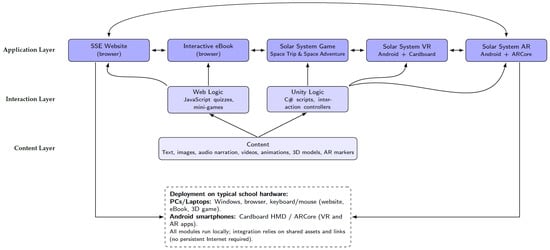
Figure 1.
Schematic overview of the SSE system architecture, showing the three-layer structure formed by the content, interaction logic and the SSE applications, their interconnection as a cross-modal workflow, as well as their deployment on typical school hardware (PCs/laptops and Android smartphones with Cardboard/ARCore).
Web-based components (website, interactive eBook, multimedia) were developed using standard HTML/CSS/JS for maximum compatibility with the browsers and devices commonly found in Greek public schools [68]. This decision reflects an intentional low-cost strategy rooted in the infrastructural realities of early childhood education, where specialized hardware is rarely available [61].
3D Space touring applications (Space Trip and Space Adventure) were developed in Unity, enabling real-time rendering, responsive camera systems, and lightweight physics calculations suitable for intuitive exploration. Interaction design prioritized stability and predictability. Hence, students move through space using simple controls, and information is surfaced via point-and-click mechanics, minimizing motor demands. Frame rates and polygon budgets were constrained during development so that 3D scenes remain responsive on mid-range laptops with integrated graphics.
XR modules (VR and AR) were also implemented in Unity using the Google Cardboard XR Plugin and AR Foundation with ARCore, respectively, and taking into account the Inertial Measurement Unit (IMU) sensors of mobile devices (e.g., accelerometer, gyroscope, magnetometer). These tools were selected because they support accessible, low-cost hardware and provide stable pipelines for mobile-based gaze interaction (VR) and image-marker tracking (AR). This technical decision aligns with pedagogical constraints; that is, XR experiences must remain brief, intuitive, and comfortable for young learners. In practice, this meant limiting the number of concurrent dynamic objects in view, simplifying shaders and lighting, and carefully tuning camera motion to accommodate the limited field-of-view and basic inertial sensors of mid-range smartphones.
To ensure coherence across modalities, a unified design system was created, covering visual identity (color palettes, layouts, iconography), standardized interaction elements (buttons, panels, markers), common feedback mechanisms (audio cues, assistive popups, subtle animations), and a uniform narration style. This consistency reduced cognitive load and prevented disorientation when moving from 2D interfaces to 3D or XR formats, supporting a structured progression from familiar to immersive experiences.
3.3.1. Implementation Stack and Technical Constraints
To complement the architectural overview and clarify how technical constraints informed the cross-modal design workflow, Table 2 summarizes the core elements of the SSE implementation stack and their corresponding pedagogical and interaction implications. These aspects are described in detail in upcoming sections.
Table 2.
Implementation stack and technical constraints shaping the SSE design.
3.3.2. System Specifications and Testing Environment
The SSE was developed and evaluated (see Section 6) using accessible, low-cost consumer hardware representative of the typical Information and Communications Technology (ICT) infrastructure available in Greek schools. Table 3 summarizes the exact hardware and software configurations used during development and classroom testing.
Table 3.
Hardware and software specifications used for development and testing of the SSE suite.
These configurations reflect the ongoing digital divide and ICT disparities among Greek schools, where specialized high-end equipment or reliable technical support are often absent. Most primary schools still rely on basic Internet connectivity and low-cost devices such as laptops, tablets, and projectors [68]. Designing SSE to run smoothly on affordable hardware therefore maximizes its potential penetration in both educational environments and student households.
At the same time, hardware limitations (e.g., occasional FPS (frames per second) drops, thermally induced performance throttling during extended VR use, and reduced gyroscope accuracy) informed concrete implementation choices. For example, VR scenes were optimized by restricting dynamic light sources and simplifying shaders, limiting the number of simultaneously visible celestial bodies, and using baked lighting where possible. Similarly, AR tracking was tuned for robustness in typical classroom lighting, with printed markers sized for reliable detection by mid-range cameras. These measures helped keep latency, tracking jitter, and visual clutter within tolerable bounds for preschool users while preserving the educational fidelity of the Solar System representation.
3.4. Cross-Modal Orchestration Strategy
A central methodological goal was to orchestrate modalities in a developmentally appropriate sequence that mitigates overload by establishing conceptual structure before introducing spatially and sensory-rich experiences. In alignment with Cognitive Load Theory [79], this would improve memory processing and understanding of information by regulating intrinsic and extraneous load through careful modality sequencing. SSE therefore adopts a progressive immersion strategy, beginning with familiar, low-friction formats and gradually introducing more complex or immersive ones: (1) multimedia clips, (2) mini-games, (3) interactive eBook, (4) 3D exploration (Space Trip and Space Adventure), and (5) XR immersion (VR and AR). Each step increases agency, interactivity, and sensory complexity while maintaining conceptual continuity, in line with multimodal learning frameworks [57], scaffolded discovery [56], and embodied learning [10].
This sequence was initially defined during the Analysis and Design phases of ADDIE and then refined through pilot testing observations during Implementation. The goal was to help pupils maintain focus, reduce confusion, and facilitate smoother transitions into more demanding XR experiences. Accordingly, the early steps (segmented clips, short games, and eBook activities) provide a stable scaffold that reduces the likelihood of cognitive overload during later XR exposure.
Additionally, several of these design choices also serve accessibility needs, since short, segmented activities, minimal text dependency, large visual cues, and predictable interaction structures can support learners with early reading difficulties, lower fine-motor control, or attentional variability. By privileging low-friction modalities and clear visual anchors, the SSE suite maintains usability for a diverse range of preschool learners.
3.5. Methodological Alignment with Preschool Pedagogy
It is worth mentioning that the methodological design of the SSE is aligned with the broader pedagogical framework of Greek preschool education, which nowadays emphasizes interdisciplinary, exploratory, and play-based learning [80]. The use of structured play (in games and puzzles), multimodal storytelling (in the eBook), spatial exploration (in 3D applications), and embodied interaction (in XR modules) reflects the core learning domains of early childhood (e.g., cognitive, socio-emotional, motor, and creative development).
Teacher mediation was incorporated as a methodological requirement in all phases. Teachers were encouraged to facilitate transitions between modalities, support comprehension during immersive activities, and help students reflect on their experiences, a fact that is consistent with established practices in inquiry-based learning for young children [81].
3.6. Evaluation Design and Instruments
To examine the feasibility, usability, and experiential value of the SSE suite, a dual-perspective evaluation was designed involving (a) preschool teachers and (b) kindergarten students. This subsection outlines the participants, procedures, and measurement instruments used. Statistical analyses and detailed findings are presented in Section 6. In this design, teacher data were collected via a self-report adoption questionnaire, whereas student data were gathered during in situ classroom interventions with the SSE applications, capturing experiential responses under everyday teaching conditions.
3.6.1. Teacher Evaluation: TAM/TPB-Based Adoption Questionnaire
Fifty-four preschool teachers participated voluntarily in a cross-sectional survey assessing their intention to adopt the SSE suite in classroom practice. The instrument was adapted from established Technology Acceptance Model (TAM) [14] and Theory of Planned Behavior (TPB) [15] scales, with item wording contextualized for immersive learning in early-childhood education. Note that the resulting sample of 54 teachers corresponds to the full set of in-service early-childhood educators who both had exposure to the SSE suite and consented to participate. Although not large enough for covariance-based structural modeling, this number is typical for exploratory TAM/TPB applications in early-childhood contexts and adequate for the descriptive and regression analyses reported next.
The administered questionnaire included six latent constructs: Perceived Usefulness (PU), Perceived Ease of Use (PEU), Attitude Toward Use (ATT), Subjective Norm (SN), Perceived Behavioral Control (PBC), and Behavioral Intention (BI). All items were rated on a 5-point Likert scale (1 = strongly disagree to 5 = strongly agree). Internal consistency for all constructs was assessed using Cronbach’s . At the analysis stage, descriptive statistics were computed for all items, construct interrelations were examined using Pearson correlation coefficients, and multiple regression was applied with BI as the dependent variable and PU, PEU, PBC, ATT, and SN as predictors. More advanced modeling (e.g., confirmatory factor analysis (CFA)) was not pursued due to sample size constraints.
Participation was anonymous and no identifying information was collected. The questionnaire was administered as an online self-report instrument outside the student intervention sessions, without laboratory-style controls or standardized environmental conditions, focusing on teachers’ perceptions rather than behavior in an experimental setting. Evaluation results are reported in Section 6.1.
3.6.2. Student Evaluation: Experiential Questionnaire and Classroom Procedure
Seventy-two kindergarten students (ages 5–6) participated in structured classroom sessions, representing the complete cohort of pupils enrolled in the three collaborating public kindergartens where the interventions took place, involving all components of the SSE suite (multimedia content, mini-games, the interactive eBook, 3D exploration, VR, and AR). The students’ interaction flow with the SSE applications was randomized to minimize order effects, while ensuring consistent exposure and allowing for natural teacher facilitation.
After the activities, students completed an age-appropriate 32-item experiential questionnaire. Items were presented using a child-friendly Likert scale (ranging from 1 to 5) and administered with teacher/researcher assistance to support comprehension without influencing responses. Given the participants’ age, items were also orally presented using standardized phrasing to preserve quantitative consistency.
The questionnaire consisted of:
- General Experience (Q1–Q16), assessing affective response, motivation, usability, and perceived learning.
- Module-Specific Experience (Q17–Q32), evaluating multimedia, mini-games, the interactive eBook, 3D exploration modes, VR, and AR (see Section 5).
No personal or demographic data beyond age group and classroom were collected. Reliability analyses for these item groups (Cronbach’s ) and descriptive findings along with evaluation results are reported in Section 6.2. It is worth noting that, given the age of the participants and the exploratory character of this first deployment, this part of the evaluation was intentionally focused on descriptive and comparative patterns rather than on complex inferential modeling.
4. Design of the Cross-Modal SSE Learning Suite
The methods described above (hybrid ADDIE–FDD development, pedagogically grounded interaction principles, system architecture, and cross-modal orchestration) jointly shaped the SSE applications. The overall design process is also aligned with game motivators and design principles for educational games described in [82].
4.1. Cross-Curricular Framework
For this study, we focused on the “Earth, Planetary System and Space” module in the Greek kindergarten curriculum. Adopting a cross-curricular approach, the module links the broader thematic field of “Child and Exact Sciences” with “Child and Communication”, which includes the “Information and Communication Technologies” sub-module.
Table 4 summarizes the outcomes of bridging these two domains. The core idea lies in the design and creation of an immersive educational game that incorporates VR, AR and gamification mechanics, along with conventional serious video game applications and supplementary digital material, to offer multimodal interaction and multimedium pedagogical content that promotes experiential learning inside and outside the classroom.
Table 4.
Cross-curricular approach adopted in the current study.
Within this framework, SSE provides a structured digital environment in which each technological component directly supports the targeted learning outcomes. VR and 3D exploration foster spatial reasoning and planetary visualization; AR links physical classroom activities with digital augmentation; and multimedia clips, eBooks, and mini-games reinforce factual knowledge and conceptual understanding. The modalities are intentionally aligned with curriculum competencies so that cognitive, perceptual, and exploratory goals are addressed holistically through diversified interaction.
4.2. Game Overview
The SSE aims to provide a holistic educational experience in which kindergarten students actively construct knowledge. Through interaction with an immersive virtual environment that combines multiple media and gamification mechanics, students explore realistic visualizations of key concepts while receiving complementary digital material. Inspired by [54], both training and assessment take place within the virtual environment via mini-tests and mini-games, supporting a playful yet structured learning journey.
Figure 2 presents a high-level information structure of the SSE. Note that the overall approach is influenced in part by the Theory of Constructivism [6] and grounded in the belief that knowledge should be steadily constructed as part of the educational process itself in order to make the whole experience more productive and contextually meaningful to the students. Therefore, the structure is separated into different parts that employ diversified engagement mediums and may be progressively explored based on the desired learning outcomes.
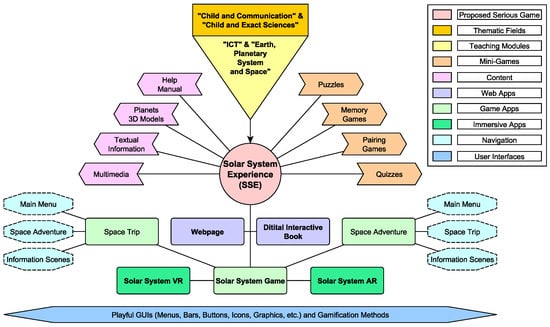
Figure 2.
High-level visualization of the SSE suite application structure.
To support the developmental characteristics of preschool learners, interaction mechanisms, session duration, sensory load, and narrative pacing were carefully calibrated. VR employs gaze-based controls and limited locomotion to manage cognitive load, while AR relies on simple manipulation metaphors linking digital content to tangible classroom contexts. Multimedia components provide pre-training before immersive exploration, ensuring that each application contributes a clear pedagogical function within the overall learning pathway.
4.3. Game Motivators and Design Principles
As stated, the design strategy applied to SSE to increase the game’s instructional effectiveness is heavily influenced by the educational game design framework discussed in a systematic review of 41 relevant studies [82]. The framework demonstrates a taxonomy of fourteen (14) major game motivator classes that can contribute to motivated engagement in educational games. Table 5 summarizes the motivators and how they are adopted here.
In refining the SSE design, each motivator was applied with explicit consideration of preschool cognitive characteristics, limited reading fluency, and the need for immediate, multimodal feedback. Rather than being added as isolated game features, motivators were explicitly mapped onto instructional goals defined by the cross-curricular framework and ADDIE analysis. In this way, they support learning intention, exploratory behavior, and sustained engagement while promoting conceptual understanding of the Solar System.
These principles shaped both the multimedia components and the transitions between modalities. Coherence and signaling informed the structuring of video segments before mini-games; pre-training guided introductory clips before VR exploration; and segmenting influenced the pacing of tasks within mini-games and eBook interactions. Thus, multimedia principles acted as cross-cutting constraints, ensuring that each component served a clear cognitive purpose within the overall learning flow.
4.4. Gameplay
The ultimate goal of the SSE game is for preschool pupils to learn facts about all planets (Mercury, Venus, Earth, Mars, Jupiter, Saturn, Uranus, Neptune) in the Solar System. To do so, SSE expands the educational process by using a virtual environment that realistically represents a model of the Solar System. By interacting with the virtual environment, students are able to explore key attributes of the planets such as their conditions (e.g., weather, temperature, wind speed, ground and air composition, oxygen and water levels, gravity), formation, texture, size, and structuring. They can also understand spatial relations among planets, recognizing their relative distance from the Sun and their orbital behavior.
4.5. Multimedia Learning Principles
In parallel, the design incorporates the multimedia learning principles of [57] when creating instructional material for interactive e-learning, with the aim of fostering active and creative engagement (see Table 6).
It is worth mentioning that, besides educational material and textbooks of the Greek educational system, all astronomical information has been retrieved and reproduced in detail from credited scientific sources such as the European Space Agency (ESA), the National Aeronautics and Space Administration (NASA), and the National Observatory of Athens (NOA). High-resolution planetary textures (equirectangular projection) are based on NASA’s elevation and imagery datasets. For instance, the textures used for 3D rendering of the planets correspond to high-resolution planetary maps in equirectangular projection of their surface, and are based on NASA’s actual elevation and imagery data libraries.
Table 5.
Game motivators associated with SSE. Adapted from [82].
Table 5.
Game motivators associated with SSE. Adapted from [82].
| Motivator | Definition | Usage Description |
|---|---|---|
| Challenge | Players are presented with tasks that are suitable to their skill level. | All applications are specially tailored for kindergarten students, based on the acquired knowledge and with playful design, high level of replayability, help systems, and no repercussions in case of mistakes or erroneous operations. |
| Competence | Users develop new skills or abilities by completing challenges and reaching goals. | The SSE is created with the aim of sharpening knowledge acquisition, which is immediately reflected within the game world as each piece of new information (e.g., on the planetary system) builds on the knowledge received in previous steps and is evaluated via in-game challenges. |
| Competition | Learners compete with other players (interpersonal) or themselves (intrapersonal), or cooperate (collaborative) towards a common objective. | Though not the main goal of SSE, for each challenge, special game elements such as timers, stars, or progress bars are incorporated to drive students into a positive competitiveness state, but within a safe virtual environment. Students can also form groups and tackle the tasks together. |
| Control | Users are free to influence the game world and its events. | Options are provided to choose the exploration mode and elements are enabled to interact with the visual objects (e.g., enlarge planets). |
| Curiosity | Provide cognitive and sensory experiences that ignite interest for content exploration. | Students are allowed to freely navigate the complete solar system from the cockpit of a spaceship, while the VR and AR apps enable manipulation of the celestial objects via gaze and gestures, respectively. |
| Emotions | Evoke emotions that make the experience memorable and appealing. | UIs are adapted to have a playful design, tasks offer rewards to arouse feelings of accomplishment, VR/AR and gaming properties foster fun and awareness, gamification is used to provide motivation, and meanwhile, great efforts are made to increase engagement in all mediums. |
| Fantasy | Refers to mental images of situations that are not typically found in the real world. | The capability of traveling around the solar system, piloting a spacecraft, and visiting planets, moons, meteorites and the sun triggers the fantasy of the users, while the ability to superimpose the real world with visual augmentations of the celestial objects evokes their imagination. |
| Feedback | Relates to the timely game response to user interaction. | The SSE incorporates various feedback mechanics, including instant dialog boxes, information popup windows, encouraging messages, visual interactive elements, menu tools, progress bars and rewards, etc. |
| Immersion | Reduce user self-awareness and perception of time by increasing concentration and feelings of presence. | The SSE embeds multimodal sensory stimuli, including visual, audio, and haptics, using both conventional and immersive technologies as well as (photo-) realistic solar system representations and conditions to strengthen the sense of “being there”. |
| Novelty | Offer inventive and innovative experiences by combining leading-edge interaction technologies. | The SSE integrates a plethora of state-of-the-art content exploration tools, combining web technologies, video games, multimedia, gamification, VR, and AR. |
| Rules & Goals | Have rules that govern activities and events in the game world and set boundaries, including goals and how to reach them. | Students are given comprehensive instructions for each activity and its goals within the game world; a help manual has been created to provide further assistance, while a website has been developed to offer extra clarifications and information. |
| Real World Relation | Link the real world with the game world to make it relatable to users. | The SSE presents content, interaction, and navigation that directly relates to the real world, e.g., focus gaze on an object to inspect it in VR mode. |
| Social Interaction | Enhance feelings of belongingness and connectedness with others. | The SSE challenges, activities, and tasks can be solved in cooperation with other students and provide recognition upon successful completion that can be shared among them for increased synergism. |
| Usefulness | Adopt a purpose other than plain entertainment and link it to milestones. | The SSE sharpens skill training and understanding in relation to the targeted learning module and makes players aware of its goals with appropriate resources from start to finish. |
Within this environment, specific educational objectives are addressed through playful, easy-to-use graphical user interfaces (GUIs) and supplementary media. Each section introduces a celestial body and is followed by mini-games or challenges that reinforce the content. Gameplay follows a progressive exploration structure: conceptual material is first presented through multimedia and textual/visual hints, followed by guided interaction (e.g., focusing on a planet, activating information windows), and finally by exploratory activities such as VR or 3D spaceship navigation. A help manual is accessible at all times, and the non-linear exploration model allows teachers to flexibly embed SSE into their routines, with high replayability through dynamically generated challenge content.
Table 6.
Multimedia learning principles associated with SSE. Adapted from [57].
Table 6.
Multimedia learning principles associated with SSE. Adapted from [57].
| Principle | Definition | Usage Description |
|---|---|---|
| Coherence | People learn better when extraneous material is excluded; keep the design concise, short, and relevant to the instructional goal. | Succinct help, guidance, and feedback are used throughout the SSE to direct students’ concentration on the actions they should take. |
| Signaling | People learn better when essential material is highlighted. | Important textual or graphics information and interaction tools are highlighted with playful coloring, high contrast, and centralized positioning. |
| Redundancy | People learn better from graphics and narration than from graphics, narration, and onscreen text. | The design avoids concurrent display of on-screen text, audio, and media presenting the same information; videos are preferred when possible. |
| Spatial Contiguity | Corresponding text and graphics should be close to each other. | Informational overlays appear near the planet or object being studied. |
| Temporal Contiguity | Narration and graphics should be presented simultaneously. | Textual elements are paired with simultaneous imagery or audiovisual cues. |
| Segmenting | Lessons presented in user-paced segments enhance learning. | Learning content is broken down into small tasks and missions. |
| Pre-training | Teaching key terms first aids subsequent learning. | Each major activity includes a brief tutorial or video introducing core concepts. |
| Modality | Spoken explanations are superior to text-only formats. | Narrated videos accompany most conceptual explanations. |
| Multimedia | People learn better from words and graphics than words alone. | Text is always coupled with imagery, sound, 3D assets, or animations. |
| Personalization | Conversational style enhances engagement. | Instructions and messages are written in child-friendly, positive phrasing. |
| Voice | Human voice enhances learning. | All sound narration uses recordings by real educators. |
| Embodiment | Human-like movement or gestures aid comprehension. | Demonstration videos use real gestures; VR/AR afford embodied interaction. |
4.6. Game Interaction
Because SSE is designed for preschool-aged users, particular emphasis is placed on lowering interaction complexity and ensuring that all inputs are intuitive, scaffolded, and accompanied by immediate feedback.
4.6.1. User Interface (UI)
The UI elements draw inspiration from children’s existing exposure to playful digital interfaces. In general, regardless of age, users prefer engaging with websites or applications that adopt a similar logic and structuring to what they are already familiar with. For this reason, the UI design—despite its immersive properties and focus on experiential knowledge of the Solar System—is influenced by serious video games for early childhood that already feel familiar to this age group.
Under this light, the different game screens have been developed with great attention to simplicity and fun design (e.g., see the “Main Menu” scene in Figure 3), with organized and guided steps so the student can easily get acquainted with the various graphical components and their role. Moreover, it provides variety in how information is presented, with continuous positive feedback. While erroneous input may appear (e.g., when the user commences intermediate in-game activities or mini-game missions like quizzes), as is the case in video games in general, any such occurrences are totally reversible with clear indications as to the correct pathway the student must take to complete the given task, making the experience more well-rounded and fulfilling. At the same time, these mistakes in the user’s choices have a constructive and educative nature since they anyway lead back to the corresponding learning material, providing food for thought and requiring critical thinking from the children in order to solve them.
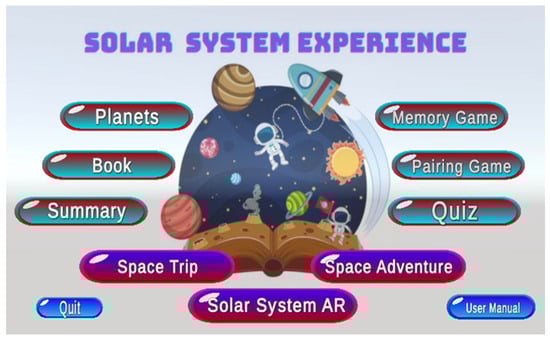
Figure 3.
Main Menu of the SSE.
To reinforce user-friendliness and coherence, interface elements were kept consistent across all modalities (games, VR, AR, interactive eBook). Core interaction elements appear with the same form, font, position, size, and coloring so that moving between media does not require relearning the interface logic.
4.6.2. User Experience (UX)
Regarding UX, the game was designed so that the commands are clear and intuitive and do not present usability problems. Beyond playful styling, the primary goal was to make the game easy to learn so toddlers could use it effectively in educational contexts without risk of information overload. For this reason, any 2D content follows a minimalist design, avoiding unnecessary textual information, with options grouped on the user’s screen according to their content and icons referencing corresponding operations. Within the 3D virtual environments, on the other hand, the screen was limited to graphics necessary for clear navigation or redirection to other useful materials. The aim was to increase the learners’ attention span, allowing them to concentrate on the key aspects of the displayed 3D content without getting constantly distracted.
Still, if for any reason some functionality remains incomprehensible to the students, a “User Manual” button has been added with help instructions (see Figure 4). For instance, in cases where users need assistance in some task they find difficult to perform, through the given guidelines, the teachers, or even the students themselves, can immediately and easily identify what is required of them in order to reach the solution to the problem they are facing.
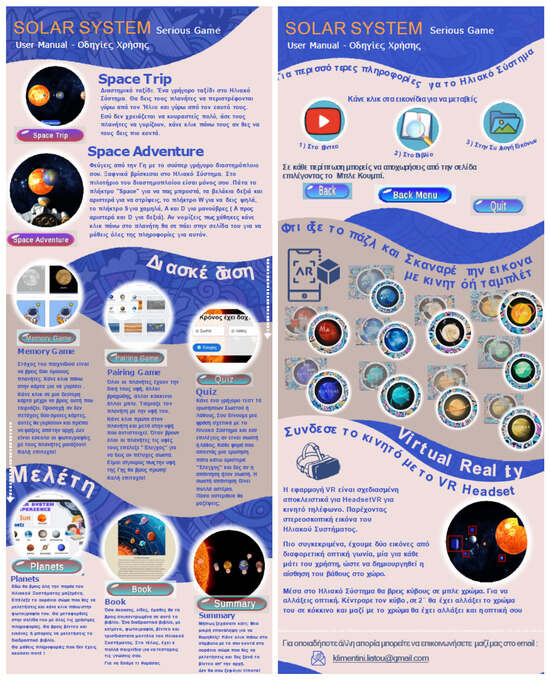
Figure 4.
Views of the SSE User Manual; currently, supported language is Greek but English translations are planned in future updates. (Left): Guidelines on how to play the SSE games; (Right): Instructions on how to use the AR and VR applications.
Regarding engagement, several interaction patterns, in line with embodied learning principles, promote bodily engagement and improve UX: AR encourages device movement around 3D models, VR uses gaze-based activation for teleportation, and the 3D spacecraft controller enables spatial maneuvering through familiar keyboard mappings. To support diverse classroom devices, loading times, texture resolutions, and UI scaling were systematically optimized, minimizing bugs and display issues, thereby enabling reliable use in typical Greek kindergarten environments where hardware capabilities vary widely [68].
Additionally, the cross-modal sequencing was intentionally designed to accommodate learners with varying levels of motor coordination, attentional control, and emergent literacy skills. Low-specification modalities such as multimedia clips, the interactive eBook, and AR markers require minimal fine-motor skill, while VR and 3D exploration rely on simple gaze-based navigation mechanics or point-and-click interactions. Although SSE does not yet include dedicated accessibility profiles, these multimodal entry points offer flexible interaction pathways that can support diverse learner needs in inclusive settings.
5. The “Solar System Experience” Game Application Suite
All applications of the SSE game have been created using the Unity game engine (available at: https://unity.com/; last accessed: 11 December 2025). Unity was selected because it (i) runs on relatively low-cost hardware, (ii) offers extensive documentation and community support, (iii) provides free plans and an asset store with reusable resources, and (iv) supports multiple platforms, such as PCs, gaming consoles, mobile devices, Web exports and HMDs, as well as interoperability with third-party libraries and SDKs (e.g., Google Cardboard SDK, Vuforia, Mixed Reality ToolKit, Spatial.io). In line with the cross-modal instructional design described earlier, Unity’s cross-platform workflow enabled consistent implementation across modalities (2D, 3D, VR, AR) while preserving pedagogical alignment and a coherent interaction logic throughout the SSE.
Although Unity supports a wide range of targets, the SSE is specifically tailored to desktop-based systems (PCs, laptops) with Windows OS and Android-based mobile devices (smartphones, tablets). This choice ensures that the main game (Space Trip and Space Adventure, jointly termed the Solar System Game) and the immersive mobile applications (Solar System VR and Solar System AR) are compatible with low-cost technologies typically available in Greek schools, which often lack high-end devices due to budget constraints [68]. These systems are also more familiar to inexperienced users and widely available at home, increasing the likelihood that students can revisit the SSE outside school under parental supervision. This design decision aligns with the methodological emphasis on feasibility and ecological validity (Section 3), ensuring that SSE can be deployed under realistic infrastructural constraints. To further broaden access, future builds for additional platforms and language localizations (beyond Greek) are planned.
Besides the downloadable SSE game, an interactive eBook and a public website have been developed to complement and promote the suite. Combined, these components function as interlinked entry points within the cross-modal learning pathway described in Section 4, supporting structured transitions between modalities and progressive knowledge acquisition. The following subsections briefly present each application.
5.1. The Website
The SSE website (Figure 5), titled “Solar System Experience-Serious Game” (available at: https://sites.google.com/view/solarsystemexperience; last accessed: 13 December 2025), serves as the main public entry point to the suite, providing access to all content and project information. It was developed with Google Sites, a structured wiki-like web authoring tool that enables rapid prototyping without additional software installation. Google Sites is free to build, host and maintain, supports online collaboration among team members, and can be extended by embedding services from Google Workspace (e.g., Maps, Forms) or custom code. The website thus functions as a navigational hub in the SSE ecosystem, enabling consistent access to cross-modal components for both learners and teachers.
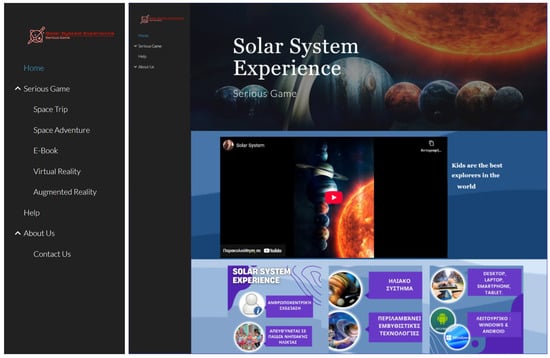
Figure 5.
Views of the SSE website. (Left): The navigation menu; (Right): The home page.
The website is structured to provide easy access to:
- Home, offering a general introduction to the SSE game suite and a suggested navigation path across applications.
- Serious Game, listing individual applications, short descriptions, and download links.
- Help, containing documentation on how to install and use the applications.
- About, presenting the goals of the SSE and the development team, along with contact information.
Content is maintained by the development team. In future iterations, a migration to a more robust Content Management System (e.g., WordPress, WIX) is envisaged. Such a CMS upgrade would facilitate multilingual support and improved analytics for monitoring usage patterns and user navigation.
5.2. The Interactive eBook
The interactive eBook was created using standard web technologies (HTML/CSS and JavaScript) to ensure compatibility with mainstream web browsers. It functions as an alternative digital textbook, consolidating Solar System information in textual and audio-visual format (video and images). While it can be used independently, it is designed to integrate with the rest of the SSE components. Besides expository content, it embeds mini-games, additional material that did not fit into the game applications, and direct download links for the VR/AR modules. Importantly, the eBook acts as the “multimedia anchor” of the SSE sequence by providing structured conceptual grounding before learners transition to exploratory 3D, VR, or AR experiences.
The eBook is organized into sections, one per celestial body, each including a concise textual description and associated video and photographic material. Figure 6 illustrates part of the “Earth” section.
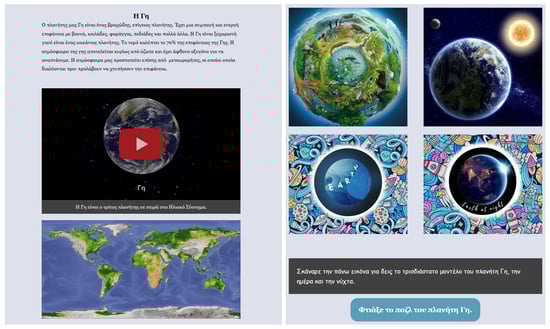
Figure 6.
Information for planet Earth inside the interactive eBook. (Left): Textual information accompanied by video narration and texture analysis; (Right): Photos and custom markers for accessing the “Earth during the day” and “Earth during the night” 3D models in AR mode.
Beyond presenting the planets, the eBook employs gamification to encourage continued engagement [53]. Students can complete small digital mini-games (e.g., puzzles) to win 3D models of planets, which can subsequently be viewed in AR on compatible devices. These reward-based elements link conceptual learning with interactive reinforcement and prepare learners for subsequent XR activities within the broader suite.
A dedicated “Time to Play” section offers two types of activities: (i) visual mini-games (puzzles, memory, pairing) and (ii) simple quizzes (True/False, multiple choice) that consolidate knowledge. These activities were aligned with the cognitive and motivational characteristics of preschoolers, emphasizing short interaction loops, immediate feedback, and low penalty for errors.
Finally, after completing all activities, following standard gamification practices [38], students can unlock an additional section on Pluto. This hidden module acts as a final reward, providing extra information on a dwarf planet that is usually less prominent in introductory Solar System teaching. This optional extension supports differentiated learning pathways, enabling highly motivated learners to deepen their exploration without overloading others.
5.3. The Solar System Game
The Solar System Game is the core 3D experience of the SSE, allowing students to explore a virtual model of the Solar System. It is divided into two scenes: Space Trip and Space Adventure. The former offers a guided tour that gradually introduces celestial bodies in a pedagogically meaningful order, mirroring the sequence used in the interactive eBook. The latter provides a free exploration mode with greater freedom of movement (FOM), similar to modern 3D games. Students can switch between the two modes at any time, though new players are advised to start with the guided tour. This dual-structure reflects the segmenting strategy discussed in Section 4, where structured scaffolding precedes open exploratory learning.
5.3.1. Space Trip Mode
The Space Trip scene (Figure 7) introduces students to the 3D environment and acts as their first “excursion” into space. A realistic depiction of the Solar System is presented, with planets revolving around the Sun and rotating around their axes. The tour starts from the Sun and proceeds through the planets from the inner to the outer Solar System, taking into account that many preschoolers have limited prior experience with 3D navigation.
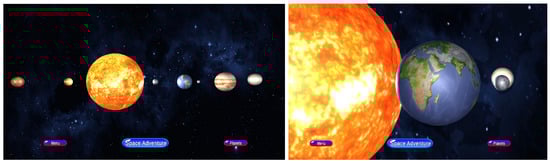
Figure 7.
Views from the Space Trip scene. (Left): Initial point of entry; (Right): Zooming into a planet (Earth).
Interaction is limited to selecting a celestial body and performing point-and-click actions to open informational pop-up windows. All interactive elements are implemented as event triggers in C#. Popup windows and interaction hotspots follow spatial and temporal contiguity principles so that inspection and textual information appear together, supporting immediate conceptual linking for young learners. The scene is deliberately designed as a gentle first contact with the environment to minimize insecurity and encourage students to continue to the more demanding Space Adventure scene. In this sense, Space Trip functions as a cognitive and interactional “warm-up” that lowers initial barriers for children with limited familiarity with digital games or 3D environments.
On top of this, the use of single-action point-and-click selection, fixed camera paths, and predictable object behavior was intended to support children with emerging motor coordination or attentional difficulties. By avoiding multi-step interaction sequences and rapid input timing, Space Trip maintains low motor demands while preserving a sense of agency.
5.3.2. Space Adventure Mode
In Space Adventure (Figure 8), students pilot a 3D spacecraft around the Solar System in third-person perspective (3PP). The spacecraft acts as a controller and visible avatar, allowing students to approach celestial bodies and inspect them from different angles. Prior studies report no major differences in spatial presence between 3PP and first-person perspective (1PP) [83]; here, 3PP was preferred because it also introduces students to basic aerospace concepts and rocket science.
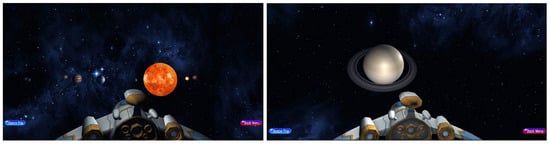
Figure 8.
Views from the Space Adventure scene. (Left): Initial point of entry; (Right): close-up view of Saturn.
Movement is controlled via the keyboard (right/left, up/down, forward), without backward motion to maintain consistency with real-world aircraft and spacecraft movement. Additional horizontal maneuvers facilitate better positioning around planets. This relatively restricted movement scheme serves an additional purpose: it limits the need for simultaneous key combinations, reducing motor complexity and supporting learners who may struggle with coordinating multiple directional inputs.
Besides navigation, interaction is again performed by aiming at points of interest (POIs) and clicking to retrieve information. This is intentional in order to match various preschool motor and cognitive profiles, offering minimal controls, predictable motion, and persistent visual anchors that support ease of use without overwhelming the learner.
Overall, the Space Trip and Space Adventure modes form complementary components within the cross-modal sequence. The former strengthens conceptual clarity via guided visualizations, while the latter fosters curiosity, autonomy, and exploratory behavior. Together, they offer a structured yet flexible learning pathway that accommodates diverse learner profiles.
5.4. Solar System VR
“Solar System VR” is designed for stereoscopic projection and focused on placing students “inside” the 3D Solar System model. It thereby extends the visual–spatial learning afforded by desktop applications into a fully embodied environment.
The VR app targets Android devices and was developed using the Google Cardboard (developer page: https://developers.google.com/cardboard; last accessed: 12 December 2025). XR Plugin for Unity (SDK available at: https://github.com/googlevr/cardboard-xr-plugin; last accessed: 12 December 2025), a software development kit (SDK) that supports motion tracking, stereoscopic rendering, and input via viewer buttons. It can be used with cardboard-like viewers or other mobile-based HMDs. This low-cost configuration follows the design principle of technological frugality, making VR feasible in typical Greek preschool classrooms.
These hardware conditions directly influenced the interaction model, as IMU-based head tracking and limited processing power made continuous locomotion or controller-based schemes impractical. Consequently, gaze-triggered dwell activation was adopted as a stable, low-overhead technique that minimizes fine-motor demands and reduces usability frictions under low-cost constraints. In parallel, simplified shaders and reduced scene complexity were employed to maintain frame-rate stability across heterogeneous devices.
To further support access, a “Manufacturer Kit” is provided, including technical specifications and drawings for lenses, conductive strips, and casing patterns so that schools or families can build their own cardboard headsets from simple materials (cardboard, lenses, magnets, rubber bands). This hands-on construction activity reinforces constructivism principles [6] and strengthens students’ sense of ownership over their tools.
The VR scene is rendered in first-person perspective (1PP) using stereoscopic imaging: separate views are presented to each eye, and the brain combines them into a single 3D percept via stereopsis [84]. Planets revolve around the Sun and rotate around their axes, as in the 3D desktop applications.
To simplify space exploration and accommodate young learners’ attentional span, motor coordination, and head–body stability, navigation is based on teleportation to POIs represented as cubes discreetly placed around celestial bodies. The system tracks head movement and uses gaze-based activation. In detail, students must focus the center of their vision on a cube for three seconds to trigger teleportation, implemented in C# via ray casting. This minimalist gaze-based interaction avoids reliance on handheld controllers and reduces motor and cognitive demands, supporting predictable navigation in the stereoscopic environment while still promoting active discovery.
During the dwell period, the cube gradually changes from deep blue to bright red, indicating activation (Figure 9). When the timer elapses, the user is transported to the new location, gaining a different vantage point of the Solar System. This simple mapping between visual focus and system response makes interaction easy to learn. A dedicated tutorial section in the help manual guides students and teachers in using VR safely and effectively.
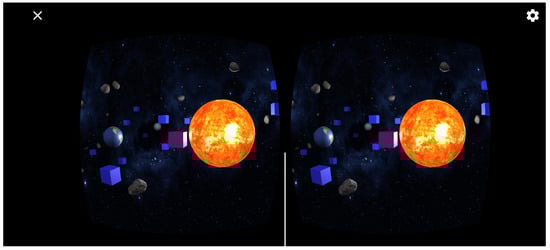
Figure 9.
View of the Solar System mobile VR environment during a gaze-triggered teleportation operation.
It is worth noting that gaze-based 3D touring may seem at first glance counter-intuitive since momentary tracking instability can occur when students perform abrupt head turns. However, when weighing in age-related issues, providing predictable navigation controls that are accompanied by visual stimuli reduces learning curves and VR usability frictions while maintaining comfort.
5.5. Solar System AR
The “Solar System AR” application was implemented as a separate Unity project using AR Foundation (SDK available at: https://docs.unity3d.com/Packages/com.unity.xr.arfoundation@6.0/manual/index.html; last accessed: 13 December 2025) and the ARCore XR Plugin (documentation: https://docs.unity3d.com/Packages/com.unity.xr.arcore@4.2/manual/index.html; last accessed: 13 December 2025), which provide a cross-platform framework for image-based AR experiences.
AR functionality is marker-based. Custom-designed image markers are integrated into an image library, each corresponding to a 3D model of a specific celestial body. Because Unity’s default AR workflow typically maps one model to one or more markers, custom C# code was written to support multi-image tracking and uniquely associate each marker with a different model, allowing multiple 3D planets to appear simultaneously. This extension was crucial for enabling side-by-side comparison of celestial bodies, which is particularly beneficial for conceptual differentiation and inquiry-based learning.
When the camera detects an image, the app checks whether it exists in the library. If it does, it compares the marker name with those of the planet prefabs and, on a match, projects the corresponding 3D model into the physical space, viewable through the mobile device. For instance, the “Earth” marker triggers the 3D Earth model (Figure 10). The resulting AR superimposition allows children to walk around, change perspective, and inspect planets from multiple angles, aligning with embodied cognition principles.
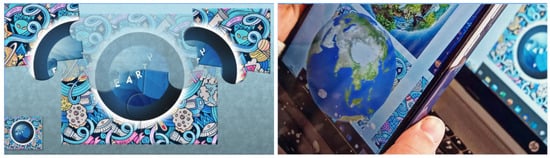
Figure 10.
Views of the Solar System AR app. (Left): Puzzle of planet Earth that students must complete before receiving the Earth image marker; (Right): 3D model of Earth in AR mode after scanning the marker.
All markers and the AR application are available in high resolution via the SSE website and interactive eBook and can be scanned, downloaded, or printed. To increase motivation, markers are also provided as photo puzzles: students first reconstruct the image and then use the AR app to visualize the planet in 3D. This pre-AR challenge combines fine-motor practice, visual discrimination, and gamified reward, forming a compact activity chain that aligns with segmenting and signaling principles. The AR models are designed to appear in isolation, without the rest of the Solar System, to support focused inspection of each body’s shape, texture, and rotation.
The marker-based AR workflow also supports inclusivity, as it does not require precise touch interactions or complex gestures. Children simply orient the device toward a printed marker, allowing those with limited fine-motor precision to engage with the 3D content with minimal interaction barriers.
During AR testing, performance was generally stable, though minor jitter appeared under low-light conditions or when markers were partially occluded. Variability in camera auto-focus speeds also influenced detection time. These observations motivated the use of high-contrast markers and the recommendation that teachers conduct in-class AR activities in well-lit areas.
In any case, the AR, along with the VR, extends the SSE beyond conventional screen-based interaction, offering an embodied, multisensory continuum of exploration. Integrated within the broader cross-modal framework, these modalities remain pedagogically anchored, developmentally appropriate, and tightly connected to the overall instructional sequence.
Illustrative Cross-Modal Lesson Scenario Using the SSE Suite
To demonstrate how the SSE applications can be enacted in an authentic preschool setting, this subsection outlines a representative instructional scenario that integrates all components into a multimodal learning pathway targeting the “Earth, Planetary System and Space” module (Section 4.1). The scenario is structured to progressively build conceptual understanding while regulating cognitive load through modality sequencing.
- Opening: Conceptual priming (approx. 30 min). The lesson begins with short teacher-led activities using familiar media. Students watch selected videos/animations and engage in guided discussion about the Sun, Earth, and planets. This phase introduces core concepts and vocabulary before interactive exposure.
- Phase 1: Structured multimodal consolidation (approx. 40 min). Students work in small groups with the interactive eBook, studying specific celestial bodies through narrated content, images, and embedded micro-quizzes. Teachers provide light facilitation. The eBook functions as a low-friction scaffold that presents information in short, user-paced segments.
- Phase 2: Gamified reinforcement (approx. 40 min). Students then complete short mini-games (puzzles, memory, pairing) aligned with the studied bodies. These activities offer immediate reinforcement and sustain motivation through repetition, feedback, and simple challenge structures.
- Phase 3: Spatial exploration in 3D (approx. 50 min). Students experience the Solar System Game (Space Trip followed by Space Adventure). First, they follow a guided 3D tour that situates planets within the system; afterwards, they freely pilot the spacecraft, approach planets, and trigger information pop-ups. This phase strengthens spatial reasoning and embodied comprehension through semi-immersive exploration.
- Phase 4: Immersive deepening (approx. 50 min). Students engage with VR and AR. In VR, they explore the Solar System stereoscopically using gaze-trigger teleportation. In AR, they scan gamified image markers to project individual planets into the classroom. This phase provides a motivational peak and vivid reinforcement of previously consolidated concepts.
- Closure: Reflection (approx. 30 min). The session closes with a brief reflective discussion. Students describe discoveries, compare planets, and express preferred modalities. The teacher summarizes key points and may assign optional eBook or AR activities for follow-up revision.
This scenario is not intended to prescribe a rigid order of module use; rather, it illustrates a pedagogically coherent progression that teachers can adapt to classroom needs, time constraints, technological availability, and student profiles. In practice, educators may alternate between SSE applications depending on learning objectives and emerging student responses. This flexibility is compatible with the randomized and counterbalanced module exposure used in the evaluation interventions (Section 6.2), which mitigated order-related biases during data collection while preserving consistent exposure to all modalities.
6. Results
This section reports results from the empirical evaluation of the SSE from two complementary perspectives aligned with RQ1 and RQ2: (i) teachers’ adoption readiness regarding cross-modal and XR-enhanced pedagogical tools, and (ii) students’ immediate experiential and usability responses to each SSE component during classroom interventions. When jointly considered, these perspectives provide an end-to-end view of feasibility, usability, acceptability, and perceived pedagogical value across stakeholder groups.
6.1. RQ1: Teachers’ Evaluation and Adoption Readiness
Teachers play a pivotal role as both implementers of new pedagogical methods and gatekeepers of classroom innovation; their attitudes and intentions are therefore decisive for the successful integration of XR-based tools in early-childhood education [13]. In direct relation to RQ1, this subsection analyzes their views on adopting cross-modal and XR-enhanced approaches in the kindergarten classroom.
6.1.1. Participants and ICT Proficiency
Fifty-four preschool teachers participated in the evaluation (), following GDPR-compliant procedures. All respondents self-identified as women, reflecting national demographics in Greek early-childhood education, where approximately 98.5% of kindergarten teachers are female [85]. Age distribution was diverse: 42.6% were 20–30 years old, 25.9% 31–40, 20.4% 41–50, and 11.1% above 50.
Educational attainment was high, i.e., 59.3% held a Bachelor’s degree, 38.8% a Master’s, and 1.9% a PhD. ICT familiarity varied, but none reported zero experience. Specifically, 27.8% held ECDL certification, 18.5% the national A’ Level IT certificate, 9.3% the B’ Level, 31.5% had a university degree in informatics, and 13% reported substantial informal ICT knowledge. Teachers completed the survey anonymously via an online platform.
6.1.2. Instrument Design and Reliability
As described in Section 3.6, teacher perceptions were assessed using an adapted TAM/TPB questionnaire measuring six constructs: PU, PEU, ATT, SN, PBC, and BI. The items used (see Table 7) were adapted from established TAM/TPB instruments (e.g., [11,86]), aligning statements with preschool XR-enhanced learning. Cronbach’s coefficients ranged from to , indicating strong internal consistency. BI () and PBC () displayed the highest reliability; PU (), SN (), and PEU () also exceeded the conventional threshold, while ATT () remained acceptable.
Table 7.
TAM/TPB instrument: descriptive and reliability statistics (teachers; ).
6.1.3. Descriptive Patterns
Construct means indicate strong positive perceptions overall. In detail, teachers reported highly favorable attitudes (ATT: ), strong behavioral intentions (BI: ), and high perceived usefulness (PU: ). In contrast, perceived ease-of-use (PEU: ) and behavioral control (PBC: ) were noticeably lower, pointing to concerns about complexity, resources, and confidence. The observed dispersion (SDs in Table 7) further suggests heterogeneous readiness levels across the cohort.
6.1.4. Construct Interrelations
As shown in Table 8, BI correlated most strongly with SN (), followed by ATT () and PU (). Overall, these patterns indicate that normative pressures, affective orientation toward use, and perceived pedagogical value co-vary strongly with intention to adopt.
Table 8.
Construct-level Pearson correlation matrix (teachers).
6.1.5. Predictors of Behavioral Intention
To determine the unique contribution of each TAM/TPB construct, a multiple regression analysis was performed with BI as the dependent variable and PU, PEU, PBC, ATT, and SN as predictors (Table 9). The model demonstrated strong explanatory power (, adjusted , , ), indicating that the construct set collectively accounted for a substantial proportion of variance in BI.
Table 9.
Multiple regression predicting teachers’ BI from TAM/TPB constructs.
When all predictors were entered simultaneously, only SN emerged as a statistically significant predictor of teachers’ intention to adopt immersive technologies (, ). Thus, perceived expectations of colleagues, school communities, and broader institutional environments exerted the strongest influence on adoption intent. Once SN was included in the model, the unique contributions of PU, ATT, PEU, and PBC became non-significant, despite their strong bivariate correlations with BI.
This pattern suggests that adoption readiness is shaped primarily by perceived social and institutional endorsement rather than by individual confidence or perceived usefulness alone, in line with previous reports on the decisive role of normative influence in teacher technology uptake [61,87]. In this respect, the strong predictive power of subjective norms implies that large-scale uptake is unlikely to occur without explicit institutional backing and visible endorsement within the school ecosystem. At the same time, the relatively low means of PEU and PBC highlight the need for structured training, professional development, and adequate resources so that positive attitudes can be translated into confident classroom use.
- Summary of RQ1. Teachers expressed clear willingness to adopt immersive, cross-modal learning tools, with strong positive attitudes and behavioral intentions. However, their readiness is strongly conditioned by social norms and perceived institutional support, and moderated by concerns regarding ease-of-use and control. Successful deployment of suites such as the SSE thus depends not only on the quality of the applications, but also on supportive organizational conditions and targeted teacher training. This imbalance is visually summarized in Figure 11, which depicts a readiness profile characterized by high perceived usefulness, positive attitudes, and behavioral intention, contrasted with comparatively lower perceived ease of use and perceived behavioral control.
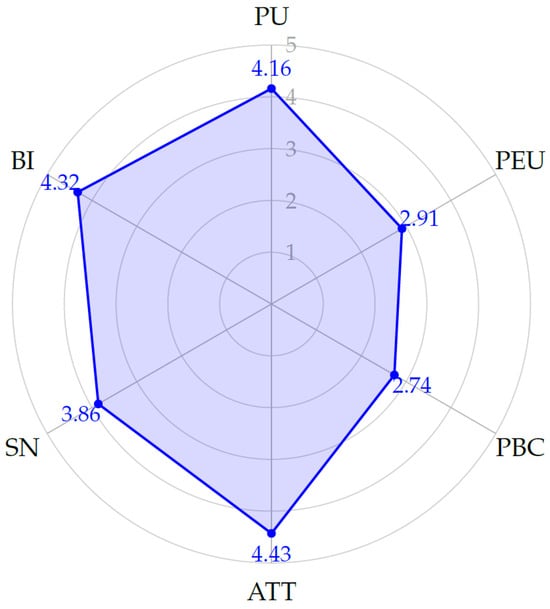 Figure 11. Radar chart depicting mean teacher ratings across the six TAM/TPB constructs (PU, PEU, PBC, ATT, SN, BI) on a 5-point Likert scale. The visual profile highlights strong perceived usefulness, positive attitudes, and behavioral intention to adopt immersive technologies, alongside comparatively lower perceived ease of use and behavioral control, indicating an uneven adoption readiness structure.
6.2. RQ2: Students’ Experiential Evaluation
To complement teacher-based adoption data, RQ2 examined the experiential responses of preschool learners who interacted directly with the SSE components during structured classroom interventions. While the teacher survey provided a pre-implementation perspective, the student evaluation (see Section 3.6) captured their in situ usability, enjoyment, perceived learning, and modality-specific experience.
6.2.1. Participants and Intervention Procedure
As previously mentioned, seventy-two preschool students (), aged 5–6, participated in classroom interventions across three public kindergarten schools in Kefalonia, Greece. Participation required written parental and teacher consent and was approved by school leadership in accordance with national regulations. Interventions followed a structured four-hour sequence involving demonstrations, guided exploration, and individual interaction with each SSE module. Figure 12 shows two students using SSE apps during these sessions.
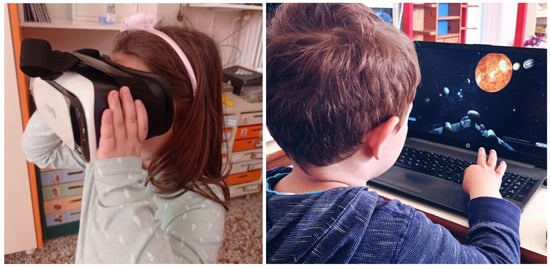
Figure 12.
Pilot-testing the SSE with kindergarten students. (Left): A student interacting with the Solar System VR; (Right): A student 3D touring the Solar System Game in the Space Adventure mode.
As noted in Section Illustrative Cross-Modal Lesson Scenario Using the SSE Suite, to reduce order effects (e.g., novelty, fatigue, priming), students were divided into equal groups and the order of module exposure was randomized and counterbalanced. All activities were jointly supervised by the authors and classroom teachers. After the intervention, students completed the structured 32-item experiential questionnaire, consisting of the General Experience (Q1–Q16) and Module-Specific Experience (Q17–Q32) items.
6.2.2. General Experience (Q1–Q16)
Table 10 presents descriptive findings for the General Experience items. Internal consistency for this 16-item scale was acceptable (Cronbach’s ), indicating coherent measurement of affective, cognitive, and usability-related impressions.
Table 10.
Students’ General Experience with the SSE (Q1–Q16; ).
Across all sixteen items, responses were strongly positive, with most means exceeding on the 5-point scale. Affective indicators such as happiness (Q1, ), interest (Q2, ), and perceived immersion (Q4, ) were among the highest-rated items, suggesting that the cross-modal SSE structure successfully elicited high levels of enjoyment and engagement [3,4]. Items related to perceived learning (Q5–Q7) also demonstrated high agreement; students reported that SSE introduced new knowledge (Q6, ) and supported conceptual understanding, consistent with multimedia learning and cognitive load principles [7]. Usability evaluations (Q8–Q13) were equally positive: the suite was perceived as easy to use (Q10, ), visually appealing (Q12, ), and well organized (Q13, ), indicating that interaction mechanics were well aligned with the developmental profile of 5–6-year-olds. Innovation and novelty (Q14, , ) received slightly lower but still high scores, reflecting some variability in prior exposure to XR. Future-intent items (Q15–Q16) were particularly strong, with Q16 (, ) indicating a clear desire for similar cross-media lessons. Overall variability remained modest (SDs mostly ), suggesting broad consensus rather than polarization.
6.2.3. Module-Specific Experience (Q17–Q32)
To examine experience with each modality, Table 11 presents descriptive statistics for the 16 module-specific items, covering Multimedia, Mini-Games, Interactive eBook, 3D Tour, Virtual Reality, and Augmented Reality. Overall, the item-level pattern suggests meaningful differentiation across modalities while preserving consistently high experiential ratings.
Table 11.
Students’ Module-Specific Experiences with the SSE (Q17–Q32; ).
Multimedia (Q17–Q18). Multimedia was positively evaluated, though with slightly lower means and higher variability than more interactive components. It effectively supported understanding () but, as a more passive modality, was less distinctive in terms of enjoyment, aligning with its role as an introductory scaffold [57].
Mini-Games (Q19–Q21). Mini-games performed robustly (). Their simplicity and clarity, combined with immediate feedback, reflect appropriate cognitive load calibration and confirm the suitability of short, visual-matching activities for early-childhood gamification [53].
Interactive eBook (Q22–Q24). Two items reached absolute ceiling values (, ), indicating unanimous agreement that the eBook was practical and creative. This underscores the value of structured, guided multimodal content for conceptual consolidation and fits well with segmentation and contiguity principles [7,57].
3D Tour (Q25–Q26). The 3D Tour achieved strong ratings in enjoyment (Q25, ) and navigational predictability (Q26, ). Semi-immersive spatial exploration thus appears to effectively support curiosity and spatial reasoning without overwhelming learners [26].
Virtual Reality (Q27–Q29). VR items capturing interest and perceived benefit of extended exposure reached ceiling levels (Q27, Q29), confirming the motivational power of immersive media. However, ease-of-use was substantially lower (Q28, ), highlighting interface complexity and hardware constraints in low-cost mobile VR for this age group [83]. This pattern is consistent with the feasibility-oriented VR design choices described earlier (e.g., mobile HMD ergonomics and gaze-based teleportation), which may increase perceived difficulty despite high interest. For example, some students needed assistance stabilizing the headset or when recentering their viewpoint after minor IMU drift.
Augmented Reality (Q30–Q32). All AR items achieved with zero variance, indicating universal endorsement. AR was experienced as fun, simple, and emotionally positive, aligning with prior work showing marker-based AR to have minimal interaction overhead and strong developmental appropriateness [33].
Overall, these findings validate the intentional sequencing of modalities in the SSE design. Structured, low-friction media (eBook, AR, mini-games) provide strong cognitive anchoring, while exploratory and immersive components (3D tours, VR) deliver motivational peaks that reinforce conceptual engagement.
6.2.4. Module-Level Summary
For a direct comparison across modalities, Table 12 aggregates module-level means (computed across the corresponding items), standard deviations, and 95% confidence intervals.
Table 12.
Module-level summary (means of items per component with 95% confidence intervals).
All components achieved high satisfaction and engagement, with narrow confidence ranges and low variability. A clear hierarchy emerges: AR and the eBook achieved the highest evaluations (AR: , ; eBook: , ), followed by 3D Tour and mini-games (3D Tour: , ; mini-games: , ). VR (, ) remained highly attractive but less accessible, while multimedia (, ) served as a positively rated, yet comparatively less distinctive, introductory modality. Overall, the ranking aligns with the multimodal orchestration strategy proposed in [56], in which structured, low-friction modalities support conceptual grounding and later immersive modalities amplify engagement.
- Summary of RQ2. Preschool learners engaged very positively with the SSE suite and differentiated meaningfully across modalities. Structured, low-friction components (interactive eBook, AR puzzles) yielded exceptionally high enjoyment, usability, and perceived learning, reflecting strong developmental fit. Exploratory modalities (3D Tour, mini-games) were also rated highly, indicating that semi-immersive spatial interaction effectively supports conceptual reinforcement. VR triggered strong interest but presented usability frictions stemming from mobile HMD ergonomics and gaze-based navigation. Overall, the results confirm that the cross-modal orchestration of SSE provides a developmentally appropriate, motivating, and pedagogically coherent experience, with each modality contributing complementary affordances.
Complementing the descriptive results, Figure 13 provides a concise visual comparison across SSE modalities by presenting the mean experiential scores, as reported by the students, for each module, ordered in ascending order and accompanied by standard deviations. This visualization makes the relative positioning of modalities more transparent, while highlighting the comparatively larger variability of modules that impose higher interaction demands (e.g., 3D touring and VR).
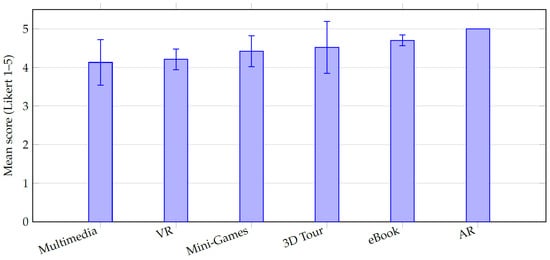
Figure 13.
Module-level mean () experiential scores for the SSE components, ordered in ascending mean value. Error bars indicate SD () values.
The figure offers a transparent and data-driven overview of how individual modules shape the preschool learning experience. However, to further consolidate these patterns and offer a unified, higher-order view of students’ multimodal experience, Table 13 presents a thematic synthesis that integrates the most salient affective, cognitive, usability, and immersion-related tendencies observed across the entire set of items.
Table 13.
Thematic synthesis of students’ experiential responses across general and module-specific items (RQ2).
6.3. Practical Guidelines for Implementation
Drawing upon the dual-perspective empirical results and the cross-modal design rationale, Table 14 summarizes practical guidelines for implementing immersive, multimodal learning in preschool settings. These guidelines integrate pedagogical and organizational factors, connecting teacher adoption conditions with students’ experiential responses.
Table 14.
Practical guidelines for implementing cross-modal immersive learning in preschool settings.
6.4. Threats to Validity
Although the evaluation combined educator adoption data with in situ student experience, several methodological limitations must be considered.
6.4.1. Internal Validity
Teacher responses were self-reported and may be affected by social desirability, particularly given awareness of the study’s educational aims. Although construct-level reliability was robust, reported intentions may not fully predict future behavior.
For students, novelty effects associated with XR exposure may have elevated affective responses (e.g., Q27, Q30–Q32). Activity order was randomized and short breaks were used where feasible, yet residual order or carryover effects cannot be entirely excluded. VR-related usability challenges (Q28) also reflect age-typical limitations in fine motor coordination, sustained attention, and head–body stabilization, interacting with the ergonomics of low-cost mobile VR HMDs. Finally, questionnaire items were necessarily short and concrete, and administration was assisted by adults, which may have constrained nuance and subtly shaped interpretations.
6.4.2. Construct Validity
The teacher instrument was adapted from established TAM/TPB models but validated primarily via internal consistency. The relatively small teacher sample () did not permit CFA or structural equation modeling (SEM), limiting the extent to which the construct structure can be empirically verified at this stage. As such, results should be interpreted as preliminary indicators of adoption readiness, pending replication with larger and more diverse teacher populations.
For students, ceiling effects in the AR and eBook modules indicate highly uniform responses but limit sensitivity to subtle experiential differences. Given the young age of participants, items were simplified and interviewer assistance was occasionally required, increasing susceptibility to acquiescence bias and limited response differentiation.
6.4.3. External Validity
Teacher participants were exclusively female, mirroring Greek early-childhood demographics but limiting gender variability. The student sample originated from one island region (Kefalonia), constraining generalizability to other geographical or cultural contexts.
All teachers reported at least moderate ICT familiarity; individuals with minimal or no ICT experience were not represented. This may have positively biased perceptions of usefulness, attitudes, and behavioral intention, potentially overestimating adoption readiness in less digitally confident populations. Moreover, the hardware configuration (mid-range Android smartphones, low-cost Google Cardboard VR, standard laptops) reflects realistic school conditions but may not generalize directly to high-end XR systems with superior optics, tracking, and ergonomics.
In addition, organizational factors were not measured directly. Differences in school-level support, availability of ICT coordinators, and pre-existing digital infrastructure may have influenced teachers’ perceptions but were not captured in the evaluation design. Future studies should explicitly assess institutional readiness to better understand how organizational conditions mediate adoption trajectories.
Finally, the educational theme (Solar System) and the specific Greek preschool curriculum module (see Section 4.1) may not transfer directly to other domains or national frameworks without adaptation. Replications in different curricular topics and educational systems are required to test broader applicability.
In addition, given the exploratory character of this deployment and the available sample sizes, the quantitative analyses focused on descriptive statistics, correlations, and a regression model rather than on more elaborate inferential testing or effect-size estimation. Future work can extend the analytic scope and complement the results presented here with additional interventions and analyses to further substantiate the observed patterns.
6.5. Synthesis of Findings
The dual-perspective evaluation offers a coherent picture of the pedagogical, experiential, and organizational conditions under which cross-modal immersive learning can be integrated into preschool classrooms.
Teachers reported strong positive attitudes, high perceived usefulness, and robust behavioral intentions, yet expressed lower ease-of-use and control, with adoption strongly driven by subjective norms. This underscores the importance of institutional support, peer culture, and professional development in enabling XR uptake.
Students demonstrated uniformly high engagement, enjoyment, and perceived learning across modalities, while also differentiating between them. Structured, highly intuitive components (eBook, AR, mini-games) produced the strongest evaluations, whereas VR, although highly motivating, exposed usability barriers linked to hardware and interaction demands. These patterns confirm that cross-modal orchestration—sequencing structured and immersive modalities—can balance cognitive load, interaction complexity, and motivational impact in early-childhood settings.
When jointly considered, the results validate the overarching design of the SSE suite and provide evidence-based guidelines for using immersive, multimodal tools in preschool education. They also lay the groundwork for future work with larger and more diverse samples, deeper qualitative inquiry into teacher and student perspectives, and extended analyses of presence, engagement trajectories, and learning outcomes over time.
7. Discussion
This study examined the feasibility, pedagogical value, and experiential impact of the SSE through a dual-perspective evaluation with preschool teachers (RQ1) and kindergarten students (RQ2). This section interprets the findings in relation to prior work on cross-modal XR learning and outlines educational, technological, and organizational implications.
7.1. Teacher Adoption Readiness in Context
Teachers expressed very positive attitudes toward immersive XR, high perceived usefulness, and strong behavioral intentions to use tools such as the SSE suite. However, lower perceived ease-of-use and diminished behavioral control point to a readiness gap, echoing prior work in early-childhood educational technology where normative influence and institutional culture often outweigh individual technological confidence [61,87].
The central role of SN in predicting BI (Section 6.1) highlights the sociocultural and organizational dependencies of educational innovation. Consistent with TAM/TPB-based adoption studies (e.g., [11]), expectations from colleagues, school leadership, and policy frameworks can shape whether emerging technologies move from pilot experimentation to regular practice. In this light, successful implementation of cross-modal immersive tools requires not only teacher enthusiasm but also explicit institutional endorsement, targeted professional development, and opportunities for structured peer exchange.
A further consideration is that all participating teachers reported at least moderate ICT familiarity, a common yet restrictive feature of pilot studies. Adoption readiness may thus be positively biased, and teachers with weaker ICT skills could show lower intention and confidence. Future research should intentionally include more heterogeneous ICT profiles and examine how digital self-efficacy or perceived support moderate adoption trajectories.
7.2. Students’ Multimodal and Immersive Experience
Students responded very positively to the SSE suite across affective, cognitive, and usability dimensions (Section 6.2). Exceptionally high ratings for the interactive eBook and AR components, combined with strong global experience scores, indicate that the suite embedded developmentally appropriate multimodal learning principles. This aligns with multimedia learning theory [7] and suggests that structured, low-friction modalities are particularly effective for anchoring core concepts in early childhood.
The strong performance of the Solar System Game, including its guided and free 3D tour modes, further supports insights from embodied learning and spatial cognition, which argue that semi-immersive environments can enhance spatial reasoning without imposing excessive interaction complexity [26]. By contrast, VR elicited the strongest motivational response but also the most pronounced usability challenges and interaction frictions. For instance, students showed intermittent difficulty maintaining steady gaze to activate dwell-based teleportation, and several required physical guidance to stabilize the lightweight cardboard HMD during scene transitions and avoid unintentional triggering. These issues did not impede participation but highlight developmentally typical motor and attention-related constraints that plausibly contributed to the observed ease-of-use scores. These observations are consistent with evidence that low-cost mobile VR can introduce physical, attentional, and sensorimotor demands that exceed the capabilities of novice kindergarten pupils [83]. Nevertheless, they also motivate concrete refinements (e.g., increasing dwell-time thresholds, reducing the number of required gaze-based selections per activity, or introducing a brief staged tutorial) to ensure that remaining frictions stem primarily from age-related constraints rather than from avoidable interface calibration issues. Moreover, mismatches between expectations, avatar affordances, and available interaction techniques can weaken plausibility and bodily engagement [88], underscoring the need for simplified, coherent interaction schemes in preschool contexts.
Ceiling effects in the eBook and AR components should be interpreted within the developmental context of early-childhood surveys, where concrete and affect-laden judgments often compress response ranges. Nonetheless, the high consensus across items suggests a genuine fit between these modalities and young learners’ cognitive and interactional characteristics. The resulting hierarchy (i.e., eBook/AR > Mini-Games/3D Tour > VR) offers an empirically grounded roadmap for sequencing immersive learning activities.
7.3. Cross-Modal Orchestration as a Pedagogical Mechanism
A core design principle of the SSE suite is cross-modal integration; that is, structured multimedia, text–image narration, guided spatial tours, game-based reinforcements, and immersive modes provide complementary affordances rather than isolated experiences. The empirical results validate this design logic and align with theoretical work on embodied cognition and cognitive load, which argues that embodied experiences are most beneficial when introduced after foundational conceptual structures are established [26]. The multimodal pathway described in Section 4 mirrors this principle by progressing from lower-load modalities (eBook, multimedia) to higher sensory engagement (3D Tour, VR/AR) while managing intrinsic load through instructional design [7].
The strong student preference for embodied and spatial modes illustrates the motivational value of immersive media, but the VR findings, similar to existing work on game-based learning [62], underscore the need for scaffolding and gradual familiarization when adopting fully immersive technologies. The interplay of structured and exploratory modalities in SSE echoes results from cross-modal multisensory experiential learning (e.g., [9,60]), where carefully orchestrated transitions between modalities can heighten attention, reinforce concepts, and support memory consolidation. The present findings therefore advance existing XR research by demonstrating that immersive modalities yield greater pedagogical consistency and learner accessibility when embedded within a cross-modal progression rather than deployed as isolated innovations.
7.4. Implications for Software Design and Classroom Integration
From a technological standpoint, the SSE suite shows that low-cost hardware ecosystems, such as mid-range Android devices, Google Cardboard HMDs, and standard laptops, can support high perceived learning and engagement when paired with careful interaction design. The success of AR and the interactive eBook emphasizes the importance of minimizing interaction overhead, while the mixed VR results point to the need for refining gaze-based navigation, considering optional controller support, and, where possible, adopting more ergonomic HMD solutions.
Apart from these, other observed technical constraints during deployment, including FPS drops in 3D games, occasional latency in cardboard-based VR, intermittent IMU drift affecting gaze stability, and AR marker jitter under suboptimal lighting, can further inform future refinements. These, among others, may include improved asset compression, lightweight rendering pipelines, optional controller-assisted interaction when available, and adaptive quality settings that adjust scene complexity to device capabilities.
From an inclusivity standpoint, several accessibility-oriented enhancements are also envisioned and are compatible with the existing SSE architecture, including optional audio narration overlays across modules, adjustable textual elements in the eBook, and scalable UI features (e.g., alternative input mappings) to accommodate visual or motor differences. While not yet implemented as formal accessibility profiles, these options would build upon the suite’s low-friction design to better support diverse learning profiles.
At the organizational level, successful integration also depends on whether schools can allocate time for familiarization with the suite, coordinate shared device usage, and designate ICT support roles. Even lightweight systems such as SSE benefit from repeatable routines for device preparation, troubleshooting, and post-activity reflection, which can reduce teacher cognitive load and support sustainable classroom use.
Pedagogically, the findings highlight the value of modality sequencing, micro-scaffolds, and multimodal redundancy. Teachers can flexibly combine SSE-like components based on lesson duration, classroom readiness, and available ICT infrastructure. The practical guidelines derived from the evaluation offer concrete recommendations for managing cognitive load, promoting inclusivity, and sustaining motivation across extended activity periods, supporting the transition from isolated XR demonstrations to integrated instructional practice.
7.5. Methodological Considerations and Remaining Limitations
Several limitations must be acknowledged. First, the teacher sample size precluded CFA, limiting empirical validation of the adapted TAM/TPB construct structure. Second, the universal ICT familiarity of the teacher sample constrains the generalizability of adoption findings. Third, the student sample was derived from a single geographical region, reflecting a specific cultural and institutional context. Fourth, student survey administration required adult assistance, which may have influenced item interpretation and contributed to ceiling effects. Finally, equipment constraints, particularly the ergonomics of low-cost VR, likely affected usability evaluations.
Accordingly, the present study should be viewed primarily as a feasibility- and experience-focused evaluation rather than as a validation of long-term learning outcomes or sustained adoption trajectories. Future work should employ longitudinal designs, larger and more diverse samples, qualitative interviews with teachers and students, and enhanced measures of presence and cognitive load, alongside iterative usability refinements.
Finally, although the SSE design incorporates several low-demand interaction conventions, accessibility was not evaluated systematically, nor were participants with diagnosed disabilities included. Future work should therefore examine the accessibility affordances of each modality in more diverse classrooms and assess how customizable interaction parameters could support broader inclusion.
7.6. Final Remarks
Overall, the study provides evidence for the feasibility and pedagogical promise of cross-modal immersive learning in preschool contexts. Teachers show high adoption potential, conditional on institutional support and training, while students exhibit strong motivation, enjoyment, and perceived learning across modalities. The alignment of structured multimedia, guided interaction, and immersive exploration in the SSE suite offers a coherent model for developmentally appropriate XR-enhanced learning and contributes to broader discussions on integrating immersive technologies into early-childhood education.
In this sense, SSE functions not only as a single case study but also as an instance of a potentially generalizable design pattern for XR-supported preschool learning. The combination of a clearly specified cross-modal architecture, a transparent instructional workflow, and a dual-perspective evaluation strategy can inform future classroom innovations that seek to move from isolated XR pilots toward systematically designed, evidence-based ecosystems.
8. Conclusions
This article presented the design, implementation, and classroom evaluation of a cross-modal experiential learning suite for preschool education, combining familiar digital media with interactive XR components. By integrating short multimedia segments, mini-games, an interactive eBook with quizzes, 3D exploration, and VR/AR activities into a cohesive pedagogical sequence, the SSE suite aimed to leverage the complementary affordances of different modalities to support meaningful, immersive learning in early childhood.
The dual-perspective evaluation addressed two main research questions. In relation to RQ1, preschool teachers reported strong perceived usefulness and behavioral intention to adopt cross-modal and XR technologies, while also indicating that ease of use, pedagogical clarity, and institutional support condition their readiness. Concerning RQ2, students demonstrated consistently high engagement across all components, with structured modalities (such as the interactive eBook and AR activities) yielding the most positive experiential ratings. VR experiences were perceived as highly engaging but exposed usability frictions that underline the need for age-appropriate scaffolding and carefully calibrated interaction design.
The findings confirm that cross-modal immersive learning can be developmentally appropriate, pedagogically coherent, and technologically feasible, even when implemented on low-cost hardware. The SSE suite illustrates how structured, exploratory, and immersive modalities can be sequenced to balance cognitive load, sustain motivation, and reinforce conceptual understanding in early science learning. At the same time, the results emphasize that successful adoption depends not only on the applications themselves but also on broader organizational conditions, including teacher self-efficacy, perceived behavioral control, and especially normative support within school communities. The practical guidelines derived from the evaluation provide an evidence-based roadmap for integrating cross-modal immersive learning into preschool classrooms, highlighting modality sequencing, teacher readiness, multimodal redundancy, interaction scaffolding, and infrastructural flexibility as key determinants of sustainability beyond short-term pilot deployments.
Future work will extend this approach to new thematic domains and emotion-aware extensions, linking real-time engagement analytics with adaptive pedagogical decision-making in early childhood XR environments. Planned developments include refinements of VR interaction (e.g., stabilization aids, gaze-based confirmations, progressive tutorials) and longitudinal classroom studies that examine both short- and long-term learning outcomes in relation to curriculum objectives and other teaching modules. In addition, future research should broaden teacher sampling to support confirmatory factor analysis of the adapted TAM/TPB instrument, incorporate qualitative perspectives from teachers and students, and investigate how cross-modal orchestration relates to learning transfer, presence, and cognitive load over extended use. Such efforts will help consolidate cross-modal XR as a robust and scalable pedagogical approach in early-childhood education. Under the same light, future iterations of the SSE initiative will also prioritize the release of supplementary technical documentation, configuration guidelines, and selected source-code examples or templates so that other educators and researchers can replicate, adapt, and extend the system in their own contexts, thereby amplifying open access and wider reuse.
Author Contributions
Conceptualization, K.L. and A.T.; methodology, K.L. and A.T.; software, K.L. and A.T.; validation, K.L. and A.T.; formal analysis, K.L. and A.T.; investigation, K.L. and A.T.; resources, K.L.; data curation, K.L. and A.T.; writing—original draft preparation, K.L. and A.T.; writing—review and editing, K.L. and A.T.; visualization, K.L. and A.T.; supervision, A.T. All authors have read and agreed to the published version of the manuscript.
Funding
This research received no external funding.
Institutional Review Board Statement
The study was conducted in accordance with the Declaration of Helsinki. Ethical review and approval were waived for this study since according to Greek legislation (Law 4957/2022, Chapter L, Paragraph 279, https://www.kodiko.gr/nomothesia/document/807164/nomos-4957-2022, accessed on 20 October 2025), ethics approval for a study by the relevant ethics committee is mandatory only for funded research in humans, in human-derived material such as genetic material, cells, tissues, and personal data, in animals or in the environment, natural and cultural. In this context, the part of this research that included human subjects did not require the approval of an ethics committee because it was not funded while, at the same time, it did not pose any threats or risks to the participants, it was not associated with high physical or emotional stress, and the data collection methods were non-interventional and in full compliance with GDPR guidelines.
Informed Consent Statement
Informed consent was obtained from all participants involved in the study. Specifically, written informed consent was obtained from all teachers. For students (minors), written informed consent was obtained from parents/guardians prior to participation; children provided age-appropriate verbal assent during school activities.
Data Availability Statement
The data presented in this study are available on request from the corresponding author.
Acknowledgments
The authors wish to acknowledge the valuable contribution of all involved parties from the 1st and 2nd Kindergarten Schools of Lixouri and the Kindergarten School of Saint Thekli in Kefalonia, Greece, for their participation in this study.
Conflicts of Interest
The authors declare no conflicts of interest.
Abbreviations
The following abbreviations are used in this article:
| 2D | Two-Dimensional |
| 3D | Three-Dimensional |
| 1PP | First-Person Perspective |
| 3PP | Third-Person Perspective |
| ADDIE | Analysis, Design, Development, Implementation, and Evaluation |
| AR | Augmented Reality |
| CMS | Content Management System |
| FDD | Feature-Driven Development |
| FOM | Freedom of Movement |
| FPS | Frames Per Second |
| GDPR | General Data Protection Regulation |
| GUI | Graphical User Interface |
| HMD | Head-Mounted Display |
| ICT | Information and Communication Technologies |
| IDM | Instructional Design Model |
| IMU | Inertial Measurement Unit |
| POI | Point of Interest |
| QR | Quick Response |
| RQ | Research Question |
| SDK | Software Development Kit |
| SSE | Solar System Experience |
| TAM | Technology Acceptance Model |
| TPB | Theory of Planned Behavior |
| UI | User Interface |
| UX | User Experience |
| VR | Virtual Reality |
| XR | Extended Reality |
References
- Flynn, R.M.; Richert, R.A.; Wartella, E. Play in a digital world: How interactive digital games shape the lives of children. Am. J. Play 2019, 12, 54–73. [Google Scholar]
- Stephen, C.; Edwards, S. Young Children Playing and Learning in a Digital Age: A Cultural and Critical Perspective, 1st ed.; Routledge: Oxfordshire, UK, 2017. [Google Scholar] [CrossRef]
- Crogman, H.T.; Cano, V.D.; Pacheco, E.; Sonawane, R.B.; Boroon, R. Virtual Reality, Augmented Reality, and Mixed Reality in Experiential Learning: Transforming Educational Paradigms. Educ. Sci. 2025, 15, 303. [Google Scholar] [CrossRef]
- Fitrianto, I.; Saif, A. The role of virtual reality in enhancing Experiential Learning: A comparative study of traditional and immersive learning environments. Int. J. Post Axial Futur. Teach. Learn. 2024, 2, 97–110. [Google Scholar]
- Devi, M.K.K.; Thendral, M.S. Using Kolb’s Experiential Learning Theory to Improve Student Learning in Theory Course. J. Eng. Educ. Transform. 2025, 37, 70–81. [Google Scholar] [CrossRef]
- Tan, C.; Ng, C.S. Constructivism in Education; Oxford University Press: Oxford, UK, 2021. [Google Scholar] [CrossRef]
- Fromm, J.; Radianti, J.; Wehking, C.; Stieglitz, S.; Majchrzak, T.A.; vom Brocke, J. More than experience?—On the unique opportunities of virtual reality to afford a holistic experiential learning cycle. Internet High. Educ. 2021, 50, 100804. [Google Scholar] [CrossRef]
- Aydoğdu, F. Augmented reality for preschool children: An experience with educational contents. Br. J. Educ. Technol. 2022, 53, 326–348. [Google Scholar] [CrossRef]
- Volpe, G.; Gori, M. Multisensory interactive technologies for primary education: From science to technology. Front. Psychol. 2019, 10, 1076. [Google Scholar] [CrossRef]
- Lindgren, R.; Johnson-Glenberg, M. Emboldened by Embodiment: Six Precepts for Research on Embodied Learning and Mixed Reality. Educ. Res. 2013, 42, 445–452. [Google Scholar] [CrossRef]
- Şakir, A. Augmented reality in preschool settings: A cross-sectional study on adoption dynamics among educators. Interact. Learn. Environ. 2025, 33, 2954–2977. [Google Scholar] [CrossRef]
- Scherer, R.; Siddiq, F.; Tondeur, J. The technology acceptance model (TAM): A meta-analytic structural equation modeling approach to explaining teachers’ adoption of digital technology in education. Comput. Educ. 2019, 128, 13–35. [Google Scholar] [CrossRef]
- Meccawy, M. Teachers’ prospective attitudes towards the adoption of extended reality technologies in the classroom: Interests and concerns. Smart Learn. Environ. 2023, 10, 36. [Google Scholar] [CrossRef]
- Davis, F.D. Perceived Usefulness, Perceived Ease of Use, and User Acceptance of Information Technology. MIS Q. 1989, 13, 319–340. [Google Scholar] [CrossRef]
- Ajzen, I. The theory of planned behavior. Organ. Behav. Hum. Decis. Process. 1991, 50, 179–211. [Google Scholar] [CrossRef]
- Souza, V.; Maciel, A.; Nedel, L.; Kopper, R. Measuring Presence in Virtual Environments: A Survey. ACM Comput. Surv. 2021, 54, 1–37. [Google Scholar] [CrossRef]
- Bordegoni, M.; Carulli, M.; Spadoni, E. Multisensory Interaction in eXtended Reality. In Prototyping User eXperience in eXtended Reality; Springer Nature: Cham, Switzerland, 2023; pp. 49–63. [Google Scholar] [CrossRef]
- Soliman, M.; Pesyridis, A.; Dalaymani-Zad, D.; Gronfula, M.; Kourmpetis, M. The Application of Virtual Reality in Engineering Education. Appl. Sci. 2021, 11, 2879. [Google Scholar] [CrossRef]
- Radianti, J.; Majchrzak, T.A.; Fromm, J.; Wohlgenannt, I. A systematic review of immersive virtual reality applications for higher education: Design elements, lessons learned, and research agenda. Comput. Educ. 2020, 147, 103778. [Google Scholar] [CrossRef]
- Hari Rajan, M.; Herbert, C.; Polly, P. A synthetic review of learning theories, elements and virtual environment simulation types to improve learning within higher education. Think. Skills Creat. 2025, 56, 101732. [Google Scholar] [CrossRef]
- Poggianti, C.; Chessa, S.; Pelagatti, S.; Kocian, A. Immersive Technologies for Inclusive Digital Education: A Systematic Survey. Hum. Behav. Emerg. Technol. 2025, 2025, 8888303. [Google Scholar] [CrossRef]
- Parong, J.; Mayer, R.E. Learning science in immersive virtual reality. J. Educ. Psychol. 2018, 110, 785. [Google Scholar] [CrossRef]
- Devon, A.; von Mühlenen, A. Learning in virtual reality: Effects on performance, emotion and engagement. Res. Learn. Technol. 2018, 26, 2140. [Google Scholar] [CrossRef]
- Zekeik, H.; Chahbi, M.; Sefian, M.L.; Bakkali, I. Augmented reality and virtual reality in education: A systematic narrative review on benefits, challenges, and applications. EURASIA J. Math. Sci. Technol. Educ. 2025, 21, em2699. [Google Scholar] [CrossRef]
- Morris, T.H. Experiential learning—A systematic review and revision of Kolb’s model. Interact. Learn. Environ. 2020, 28, 1064–1077. [Google Scholar] [CrossRef]
- Zou, L.; Zhang, Z.; Mavilidi, M.; Chen, Y.; Herold, F.; Ouwehand, K.; Paas, F. The synergy of embodied cognition and cognitive load theory for optimized learning. Nat. Hum. Behav. 2025, 9, 877–885. [Google Scholar] [CrossRef] [PubMed]
- Wei, Z.; Yuan, M. Research on the Current Situation and Future Development Trend of Immersive Virtual Reality in the Field of Education. Sustainability 2023, 15, 7531. [Google Scholar] [CrossRef]
- Zhu, Y.; Su, Y.S. Virtual reality trends and challenges in teacher education: A systematic literature review. Interact. Learn. Environ. 2025, 33, 5325–5346. [Google Scholar] [CrossRef]
- Di, X.; Zheng, X. A meta-analysis of the impact of virtual technologies on students’ spatial ability. Educ. Technol. Res. Dev. 2022, 70, 73–98. [Google Scholar] [CrossRef]
- Tuli, N.; Mantri, A. Evaluating Usability of Mobile-Based Augmented Reality Learning Environments for Early Childhood. Int. J. Human Computer Interact. 2021, 37, 815–827. [Google Scholar] [CrossRef]
- Wang, Z.; Chan, M.T. A systematic review of google cardboard used in education. Comput. Educ. X Real. 2024, 4, 100046. [Google Scholar] [CrossRef]
- Álvarez-Marín, A.; Velázquez-Iturbide, J.Á. Augmented Reality and Engineering Education: A Systematic Review. IEEE Trans. Learn. Technol. 2021, 14, 817–831. [Google Scholar] [CrossRef]
- Ibáñez, M.B.; Delgado-Kloos, C. Augmented reality for STEM learning: A systematic review. Comput. Educ. 2018, 123, 109–123. [Google Scholar] [CrossRef]
- Mystakidis, S.; Christopoulos, A.; Pellas, N. A systematic mapping review of augmented reality applications to support STEM learning in higher education. Educ. Inf. Technol. 2022, 27, 1883–1927. [Google Scholar] [CrossRef]
- Zulfiqar, F.; Raza, R.; Khan, M.O.; Arif, M.; Alvi, A.; Alam, T. Augmented Reality and its Applications in Education: A Systematic Survey. IEEE Access 2023, 11, 143250–143271. [Google Scholar] [CrossRef]
- Yilmaz, R.M.; Goktas, Y. Using augmented reality technology in storytelling activities: Examining elementary students’ narrative skill and creativity. Virtual Real. 2017, 21, 75–89. [Google Scholar] [CrossRef]
- Adeyele, V.O. Integrating augmented reality in preschool education: A systematic review. Int. J. Technol. Enhanc. Learn. 2025, 17, 265–284. [Google Scholar] [CrossRef]
- Lampropoulos, G.; Keramopoulos, E.; Diamantaras, K.; Evangelidis, G. Augmented Reality and Gamification in Education: A Systematic Literature Review of Research, Applications, and Empirical Studies. Appl. Sci. 2022, 12, 6809. [Google Scholar] [CrossRef]
- Zilong, P.; Mary, L.; Chenglu, L.; Min, L. Introducing augmented reality in early childhood literacy learning. Res. Learn. Technol. 2021, 29, 2539. [Google Scholar] [CrossRef]
- Garzón, J. An Overview of Twenty-Five Years of Augmented Reality in Education. Multimodal Technol. Interact. 2021, 5, 37. [Google Scholar] [CrossRef]
- Zourmpakis, A.I.; Kalogiannakis, M.; Papadakis, S. Adaptive Gamification in Science Education: An Analysis of the Impact of Implementation and Adapted Game Elements on Students’ Motivation. Computers 2023, 12, 143. [Google Scholar] [CrossRef]
- Chen, C.H.; Chen, C.H. The timing of digital games in STEM instruction: Effects on learning outcomes, collaborative problem-solving, intrinsic motivation, cognitive load, and learning behavior. Res. Sci. Technol. Educ. 2025, 0, 1–20. [Google Scholar] [CrossRef]
- Clark, D.B.; Tanner-Smith, E.E.; Killingsworth, S.S. Digital Games, Design, and Learning: A Systematic Review and Meta-Analysis. Rev. Educ. Res. 2016, 86, 79–122. [Google Scholar] [CrossRef] [PubMed]
- Gui, Y.; Cai, Z.; Yang, Y.; Kong, L.; Fan, X.; Tai, R.H. Effectiveness of digital educational game and game design in STEM learning: A meta-analytic review. Int. J. STEM Educ. 2023, 10, 36. [Google Scholar] [CrossRef]
- Gundersen, S.W.; Lampropoulos, G. Using Serious Games and Digital Games to Improve Students’ Computational Thinking and Programming Skills in K-12 Education: A Systematic Literature Review. Technologies 2025, 13, 113. [Google Scholar] [CrossRef]
- Ranken, E.; Wyse, D.; Manyukhina, Y.; Bradbury, A. The effect of experiential learning on academic achievement of children aged 4–14: A rapid evidence assessment. Curric. J. 2025, 36, 417–434. [Google Scholar] [CrossRef]
- Alrehaili, E.A.; Osman, H.A. A virtual reality role-playing serious game for experiential learning. Interact. Learn. Environ. 2022, 30, 922–935. [Google Scholar] [CrossRef]
- Pacheco-Velazquez, E.; Rodés Paragarino, V.; Glasserman, L.D.; Carlos Arroyo, M. Playing to learn: Developing self-directed learning skills through serious games. J. Int. Educ. Bus. 2024, 17, 416–430. [Google Scholar] [CrossRef]
- Ding, A.C.E.; Yu, C.H. Serious game-based learning and learning by making games: Types of game-based pedagogies and student gaming hours impact students’ science learning outcomes. Comput. Educ. 2024, 218, 105075. [Google Scholar] [CrossRef]
- Sanchez, D.R.; Langer, M.; Kaur, R. Gamification in the classroom: Examining the impact of gamified quizzes on student learning. Comput. Educ. 2020, 144, 103666. [Google Scholar] [CrossRef]
- Wijoyo, A. Gamification in Early Childhood Education: A Novel Adaptive Learning Framework for Enhancing Cognitive and Social Skills in Kindergarten Students. J. Games Game Art Gamification 2025, 10, 74–81. [Google Scholar] [CrossRef]
- Huang, B.; Hew, K.F.; Lo, C.K. Investigating the effects of gamification-enhanced flipped learning on undergraduate students’ behavioral and cognitive engagement. Interact. Learn. Environ. 2019, 27, 1106–1126. [Google Scholar] [CrossRef]
- Sailer, M.; Hense, J.U.; Mayr, S.K.; Mandl, H. How gamification motivates: An experimental study of the effects of specific game design elements on psychological need satisfaction. Comput. Hum. Behav. 2017, 69, 371–380. [Google Scholar] [CrossRef]
- Huang, R.; Ritzhaupt, A.D.; Sommer, M.; Zhu, J.; Stephen, A.; Valle, N.; Hampton, J.; Li, J. The impact of gamification in educational settings on student learning outcomes: A meta-analysis. Educ. Technol. Res. Dev. 2020, 68, 1875–1901. [Google Scholar] [CrossRef]
- Ata, R.; Yıldırım, K. A systematic review of the use of immersive technologies in young children’s education. Int. J. Learn. Technol. 2025, 20, 238–261. [Google Scholar] [CrossRef]
- Dong, W.; Zhou, M.; Zhou, M.; Jiang, B.; Lu, J. An overview of applications and trends in the use of extended reality for teaching effectiveness: An umbrella review based on 20 meta-analysis studies. Electron. Libr. 2023, 41, 557–577. [Google Scholar] [CrossRef]
- Mayer, R. Using multimedia for e-learning. J. Comput. Assist. Learn. 2017, 33, 403–423. [Google Scholar] [CrossRef]
- Hu, H.; Liu, G.; Xie, T. Multimodal interaction in virtual reality supported education: A systematic review. Interact. Learn. Environ. 2025, 33, 170–191. [Google Scholar] [CrossRef]
- Rakkolainen, I.; Farooq, A.; Kangas, J.; Hakulinen, J.; Rantala, J.; Turunen, M.; Raisamo, R. Technologies for Multimodal Interaction in Extended Reality—A Scoping Review. Multimodal Technol. Interact. 2021, 5, 81. [Google Scholar] [CrossRef]
- Qushem, U.B.; Christopoulos, A.; Oyelere, S.S.; Ogata, H.; Laakso, M.J. Multimodal Technologies in Precision Education: Providing New Opportunities or Adding More Challenges? Educ. Sci. 2021, 11, 338. [Google Scholar] [CrossRef]
- Tondeur, J.; Aesaert, K.; Prestridge, S.; Consuegra, E. A multilevel analysis of what matters in the training of pre-service teacher’s ICT competencies. Comput. Educ. 2018, 122, 32–42. [Google Scholar] [CrossRef]
- Chen, C.H.; Law, V.; Huang, K. Adaptive scaffolding and engagement in digital game-based learning. Educ. Technol. Res. Dev. 2023, 71, 1785–1798. [Google Scholar] [CrossRef]
- Aslan, S.; Agrawal, A.; Alyuz, N.; Chierichetti, R.; Durham, L.M.; Manuvinakurike, R.; Okur, E.; Sahay, S.; Sharma, S.; Sherry, J.; et al. Exploring Kid Space in the wild: A preliminary study of multimodal and immersive collaborative play-based learning experiences. Educ. Technol. Res. Dev. 2022, 70, 205–230. [Google Scholar] [CrossRef]
- Rapti, S.; Sapounidis, T.; Tselegkaridis, S. Enriching a Traditional Learning Activity in Preschool through Augmented Reality: Children’s and Teachers’ Views. Information 2023, 14, 530. [Google Scholar] [CrossRef]
- Rapti, S.; Sapounidis, T.; Tselegkaridis, S. Investigating Educators’ and Students’ Perspectives on Virtual Reality Enhanced Teaching in Preschool. Early Child. Educ. J. 2025, 53, 1107–1118. [Google Scholar] [CrossRef]
- Tariq, M.U. Gamification and Virtual Reality: Transforming Early Childhood Language Learning. In Digital Pedagogy in Early Childhood Language Development; IGI Global Scientific Publishing: Hershey, PA, USA, 2025; pp. 25–52. [Google Scholar] [CrossRef]
- Farooq, S.S.; Rahman, H.; Raza, S.A.N.; Raees, M.; Jung, S.K. Designing Gamified Application: An Effective Integration of Augmented Reality to Support Learning. IEEE Access 2022, 10, 121385–121394. [Google Scholar] [CrossRef]
- Anastasopoulou, E.; Gkika, K.; Tsagri, A.; Travlou, C.; Spanou, A.; Katsivelou, V. ICT in Greek Primary Education: A Literature Review. Asian J. Educ. Soc. Stud. 2025, 51, 959–973. [Google Scholar] [CrossRef]
- Mills, K.A.; Brown, A.; Funnell, P. Virtual reality games for 3D multimodal designing and knowledge across the curriculum. Aust. Educ. Res. 2024, 51, 2323–2353. [Google Scholar] [CrossRef]
- Aizenberg, M.; Zadok, Y. Project-based learning in kindergartens. J. Early Child. Res. 2025, 23, 124–136. [Google Scholar] [CrossRef]
- Parwoto, P.; Ilyas, S.N.; Bachtiar, M.Y.; Marzuki, K. Fostering creativity in kindergarten: The impact of collaborative project-based learning. South Afr. J. Child. Educ. 2024, 14, 1462. [Google Scholar] [CrossRef]
- Gagne, R.M.; Wager, W.W.; Golas, K.C.; Keller, J.M.; Russell, J.D. Principles of instructional design, 5th edition. Perform. Improv. 2005, 44, 44–46. [Google Scholar] [CrossRef]
- Abuhassna, H.; Alnawajha, S. Instructional Design Made Easy! Instructional Design Models, Categories, Frameworks, Educational Context, and Recommendations for Future Work. Eur. J. Investig. Heal. Psychol. Educ. 2023, 13, 715–735. [Google Scholar] [CrossRef]
- Palmer, S.R.; Felsing, M. A Practical Guide to Feature-Driven Development, 1st ed.; Pearson Education: London, UK, 2001. [Google Scholar]
- Tetteh, S.G. Empirical Study of Agile Software Development Methodologies: A Comparative Analysis. Asian J. Res. Comput. Sci. 2024, 17, 30–42. [Google Scholar] [CrossRef]
- Kolb, D.A. Experiential Learning: Experience as the Source of Learning and Development; FT Press: Upper Saddle River, NJ, USA, 2014. [Google Scholar]
- Azeez, F.; Aboobaker, N. Exploring new frontiers of experiential learning landscape: A hybrid review. Learn. Organ. Int. J. 2024, 31, 985–1007. [Google Scholar] [CrossRef]
- Kwon, K.; Brush, T.A.; Kim, K.; Seo, M. Embodied Learning for Computational Thinking in a Mixed-Reality Context. J. Educ. Comput. Res. 2025, 62, 1719–1740. [Google Scholar] [CrossRef]
- Haryana, M.R.A.; Warsono, S.; Achjari, D.; Nahartyo, E. Virtual reality learning media with innovative learning materials to enhance individual learning outcomes based on cognitive load theory. Int. J. Manag. Educ. 2022, 20, 100657. [Google Scholar] [CrossRef]
- Stamatoglou, M. The role of play in early childhood education curricula in Greece and the world: A systematic literature review. Mediterr. J. Soc. Behav. Res. 2024, 8, 3–12. [Google Scholar] [CrossRef]
- Harms, S.; Hastings, J. A cross-curricular approach to fostering innovation such as virtual reality development through student-led projects. In Proceedings of the 2016 IEEE Frontiers in Education Conference (FIE), Erie, PA, USA, 2–15 October 2016; pp. 1–9. [Google Scholar] [CrossRef]
- Laine, T.H.; Lindberg, R.S.N. Designing Engaging Games for Education: A Systematic Literature Review on Game Motivators and Design Principles. IEEE Trans. Learn. Technol. 2020, 13, 804–821. [Google Scholar] [CrossRef]
- Gorisse, G.; Christmann, O.; Amato, E.A.; Richir, S. First- and Third-Person Perspectives in Immersive Virtual Environments: Presence and Performance Analysis of Embodied Users. Front. Robot. AI 2017, 4, 33. [Google Scholar] [CrossRef]
- Jo, J.W.; Kim, Y.; Jung, S.M.; Kim, J.M. Progress in 3D Display Technologies for Immersive Visual Experiences. IEEE Open J. Immersive Displays 2024, 1, 155–164. [Google Scholar]
- Hellenic Statistical Authority. Primary Education Statistics-Kindergartens. 2022. Available online: https://www.statistics.gr/el/statistics/-/publication/SED11/2022 (accessed on 22 October 2025).
- Geng, J.; Chai, C.S.; Jong, M.S.Y.; Luk, E.T.H. Understanding the pedagogical potential of Interactive Spherical Video-based Virtual Reality from the teachers’ perspective through the ACE framework. Interact. Learn. Environ. 2021, 29, 618–633. [Google Scholar] [CrossRef]
- Lomos, C.; Luyten, J.; Tieck, S. Implementing ICT in classroom practice: What else matters besides the ICT infrastructure? Large-Scale Assessments Educ. 2023, 11, 1. [Google Scholar] [CrossRef]
- Dufresne, F.; Dubosc, C.; Lefrou, T.; Gorisse, G.; Christmann, O. Am I (Not) a Ghost? Leveraging Affordances to Study the Impact of Avatar/Interaction Coherence on Embodiment and Plausibility in Virtual Reality. IEEE Trans. Vis. Comput. Graph. 2025, 31, 2611–2621. [Google Scholar] [CrossRef]
Disclaimer/Publisher’s Note: The statements, opinions and data contained in all publications are solely those of the individual author(s) and contributor(s) and not of MDPI and/or the editor(s). MDPI and/or the editor(s) disclaim responsibility for any injury to people or property resulting from any ideas, methods, instructions or products referred to in the content. |
© 2025 by the authors. Licensee MDPI, Basel, Switzerland. This article is an open access article distributed under the terms and conditions of the Creative Commons Attribution (CC BY) license.