1. Introduction
In Canada, the age-standardized incidence rate of colorectal cancer is 60.5 cases per 100,000 people, placing it among the top four highest-incidence cancers [
1]. The current standard of care for patients with locally advanced rectal cancer is preoperative radiation therapy or chemo-radiation, followed up with total mesorectal excision [
2]. Radiation therapy may be delivered via 3D conformal radiation therapy (3DCRT), intensity-modulated radiation therapy (IMRT), and volumetric modulated arc therapy (VMAT).
VMAT has been shown to be of clinical benefit in treating rectal cancer patients. Dosimetrically, there is superior small bowel sparing compared with 3DCRT techniques, along with an excellent conformality to the target [
3]. Using image-guided radiation therapy mediated with in-room cone beam CT imaging (CBCT), highly conformal VMAT plans can be delivered accurately relative to the patient anatomy.
Traditionally, rectal cancer was treated in the prone position and on a belly board [
4,
5,
6]. The aim of this setup was to move the small bowel away from the treatment volume by depending the abdomen through a hole in the belly board. With increasing sophistication in beam delivery, the supine position has been explored as a more comfortable treatment setup [
7,
8,
9]. A comparison of prone and supine setups with VMAT demonstrated that small bowel and bladder doses are not significantly different between prone and supine setup patients and the supine orientation is more reproducible, as shown by CBCT-derived metrics [
8].
The posterior skin dose may become a concern when using the supine position and VMAT. In the supine position, the patient posterior is in contact with the linear accelerator’s carbon fiber couch (CFC). The bolusing effect of CFCs on the skin dose is not negligible [
10,
11,
12,
13]. A standard prescription dose for preoperative rectal cancer, 50.4 Gy in 28 fractions, is in the skin toxicity range [
14,
15], and the planning target volume (PTV) is typically near the posterior surface. Posterior beam entry is often employed for VMAT techniques that use partial or full arcs, producing bolusing effects when passing through the treatment couch and other support structures. In consideration of this, we treat supine patients on top of a 10 cm thick hard foam board for the purposes of posterior skin sparing. There are other potential options, such as having the patient lying on top of either a thin mattress or directly on the CFC, both of which are explored in this study.
The objective of this work is to quantify the relative effects of three mounting surfaces on the posterior skin dose: the patient lying directly on the CFC, on a thin standard treatment mattress on top of the CFC, and on a foam board on top of the CFC. We delivered clinical VMAT plans for rectal cancer patients to a solid water phantom propped on these three mounting surfaces and measured the posterior surface dose using optically stimulated luminescence dosimeters (OSLDs) [
16,
17]. In addition to the phantom measurements, we estimated the posterior skin doses of the clinical plan with the patient anatomy by simulating the effect of the three mounting surfaces in the TPS. There was no expectation that the surface dose is accurately calculated by the TPS due to approximations in the surface dose calculation, particularly when adjacent to low-density accessories [
12,
18]; however, the TPS results may provide supplementary data to support the conclusions from the phantom measurements.
2. Materials and Methods
2.1. Radiation Treatment Planning
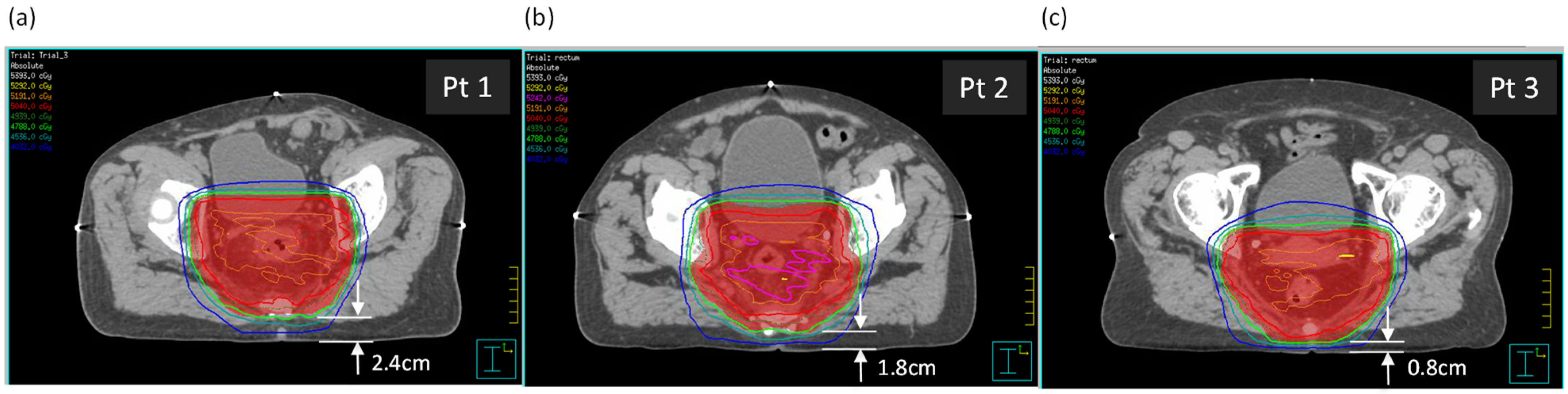
Three rectal cancer patient plans with supine setup were selected, with varying distances between the posterior skin surface and the planning target volume (PTV). Dimensions relevant to the study are in
Table 1. The three patients were selected partially due to similar anterior–posterior (AP) and lateral separations, as well as a variation in the distance between the posterior surface and the PTV (see
Figure 1). The tabletop height (TTH) is the distance from the posterior surface to the treatment isocenter.
Patients were simulated and treated supine and on top of a 10 cm thick hard foam board, with the intention of reducing the posterior skin dose. Clinical treatment plans were generated in the Pinnacle3 v9.8 TPS from Philips (Amsterdam, The Netherlands) for delivery on the Synergy Agility treatment linac from Elekta (Stockholm, Sweden). The VMAT arc geometry was a ~180° posterior arc. Planners aimed to meet a CTV coverage of V50.4 > 99% and a PTV coverage of V47.9 > 99%, limiting V52.9 to <1% of the PTV.
At our center, for all clinical plans, we simulate the attenuation of the treatment couch in our TPS using a density-overridden contour (relative density of 1, thickness of 1 cm) that has a water-equivalent thickness to the treatment couch, as suggested by AAPM’s Task Group 176 [
11]. This couch model is placed at the level of the CT simulator couch top.
2.2. Carbon Fiber Couch, Mattress, and Foam Board Descriptions
The carbon fiber couch was an iBeam evo couch top manufactured by Elekta mounted on their linear accelerator systems. The construction is a carbon fiber shell with a low-density foam core.
The mattress is from Donaldson Marphil Medical (Brossard, QC, Canada), made of a thin, blue vinyl covering filled with low-density padding material. With a patient or phantom on top of the mattress, it compresses to ~1 cm thick. The density of the mattress interior as measured by CT is approximately 0.05 g/cm3.
The foam board was built in-house, consisting of 10 cm thick low-density structural foam covered with thin plastic sheeting for easy cleaning. The foam board is hard enough that it does not deform with a patient’s weight. The density of the foam board as measured by CT is approximately 0.03 g/cm3.
2.3. Optically Stimulated Luminescence Dosimetry
A commercially available optically stimulated luminescence dosimetry system, the MicroStar reader from Landauer (Glenwood, IL, USA), was used for surface dose measurement. The individual dosimeters were high-accuracy nanoDots (also from Landauer) readable with the MicroStar system.
The nanoDot OSLDs, in their casing, are 10 × 10 × 2 mm in size. Encapsulated within a black plastic casing is a small disc of the optically stimulated luminescence dose-sensitive material, which is Al2O3 doped with carbon. The individual OSLD calibration factor is encoded in a 2D barcode printed on a label affixed to the OSLD. After irradiation, the OSLDs can be inserted into an optically stimulated luminescence reader to obtain the dose.
With our monthly quality assurance process, we determined that, in the dose range of 10–300 cGy, the dose accuracy of the OSLD system is ±3% (all OSLD measurement readings in this study are comfortably within this dynamic range). Angular dependence was determined by Jursinic to be within typical OSLD measurement uncertainty and was not a concern for our phantom geometry [
16,
17]. We measured the radiological buildup of the OSLD casing and found it to be 1.2 mm for a 6 MV beam, approximately the same as half of the physical thickness of the casing. Although these dosimeters measure at 1.2 mm depth and technically represent the near-surface dose, we refer to OSLDs measuring “surface dose” throughout for brevity.
2.4. Solid Water Phantom Setup
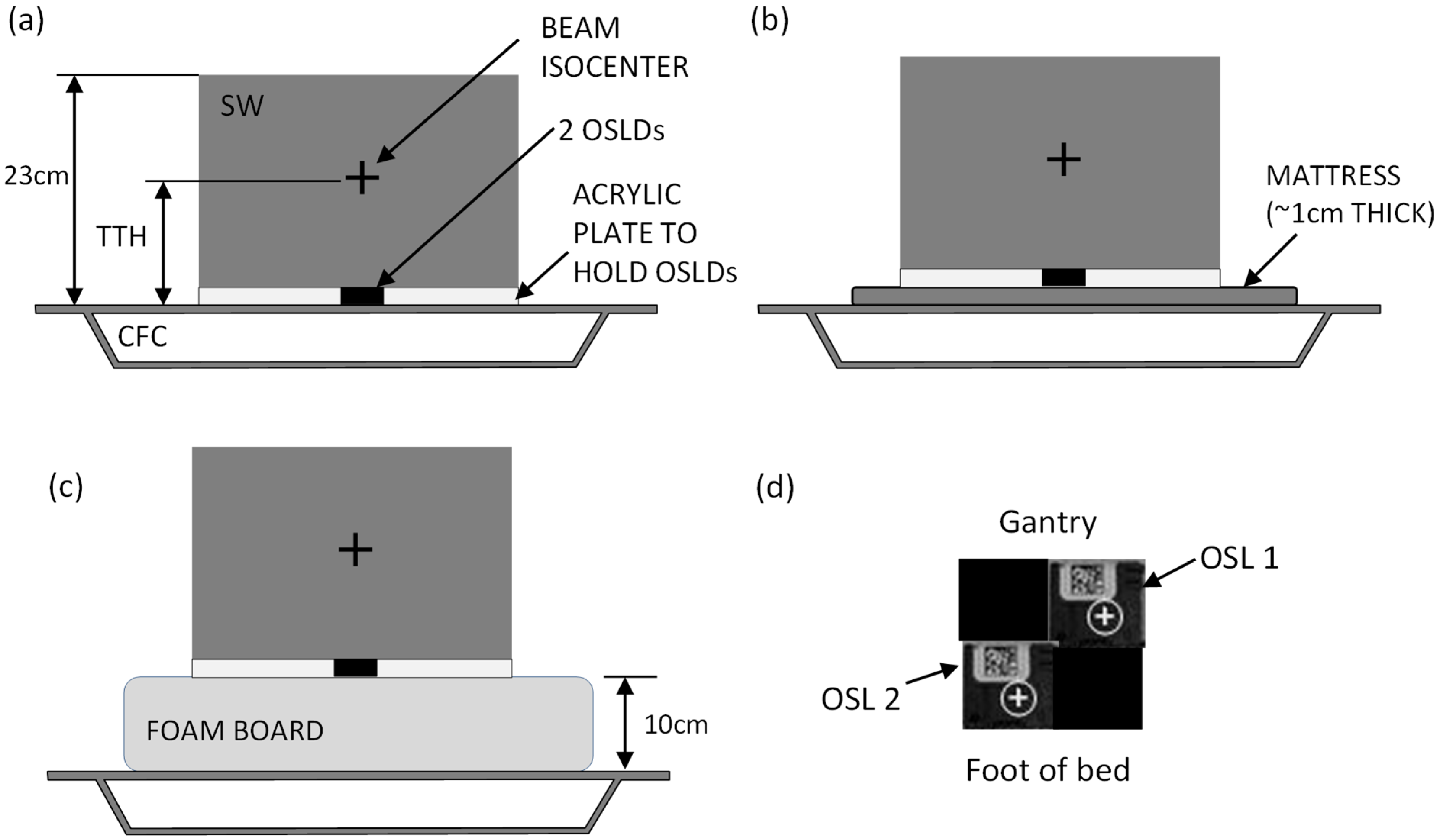
Solid water (SW) phantom measurements were selected for a controlled evaluation of posterior surface dose under reproducible conditions. This approach isolated the dosimetric effects of different support structures while avoiding confounding factors such as patient motion or setup variability. A stack of solid water 23 cm high, 30 cm long and 30 cm wide was used to simulate the patient anatomy (
Figure 2) and is representative of patient anterior–posterior and lateral separations (
Table 1), although there are limitations, as the phantom does not replicate patient contours or internal anatomy. The density of the solid water was 1.0 g/cm
3. The SW sat upon a 2 mm thick acrylic plate with a central square hole for inserting OSLDs. Two OSLDs were placed inside this acrylic plate, as shown in
Figure 2d. Three setups were used: the phantom directly on top of the CFC; the phantom on top of a mattress mounted on the CFC; and the phantom on top of a foam board mounted on the CFC (
Figure 2a–c). The VMAT plan of each of the three patients was delivered to this phantom for each of the three setups, with the beam isocenter placed according to the specified TTH parameter for each plan. The OSLDs were read <24 h afterwards.
2.5. TPS Estimation of Skin Doses
Although TPS estimation of the surface and buildup doses has accuracy issues when using a collapsed cone convolution algorithm [
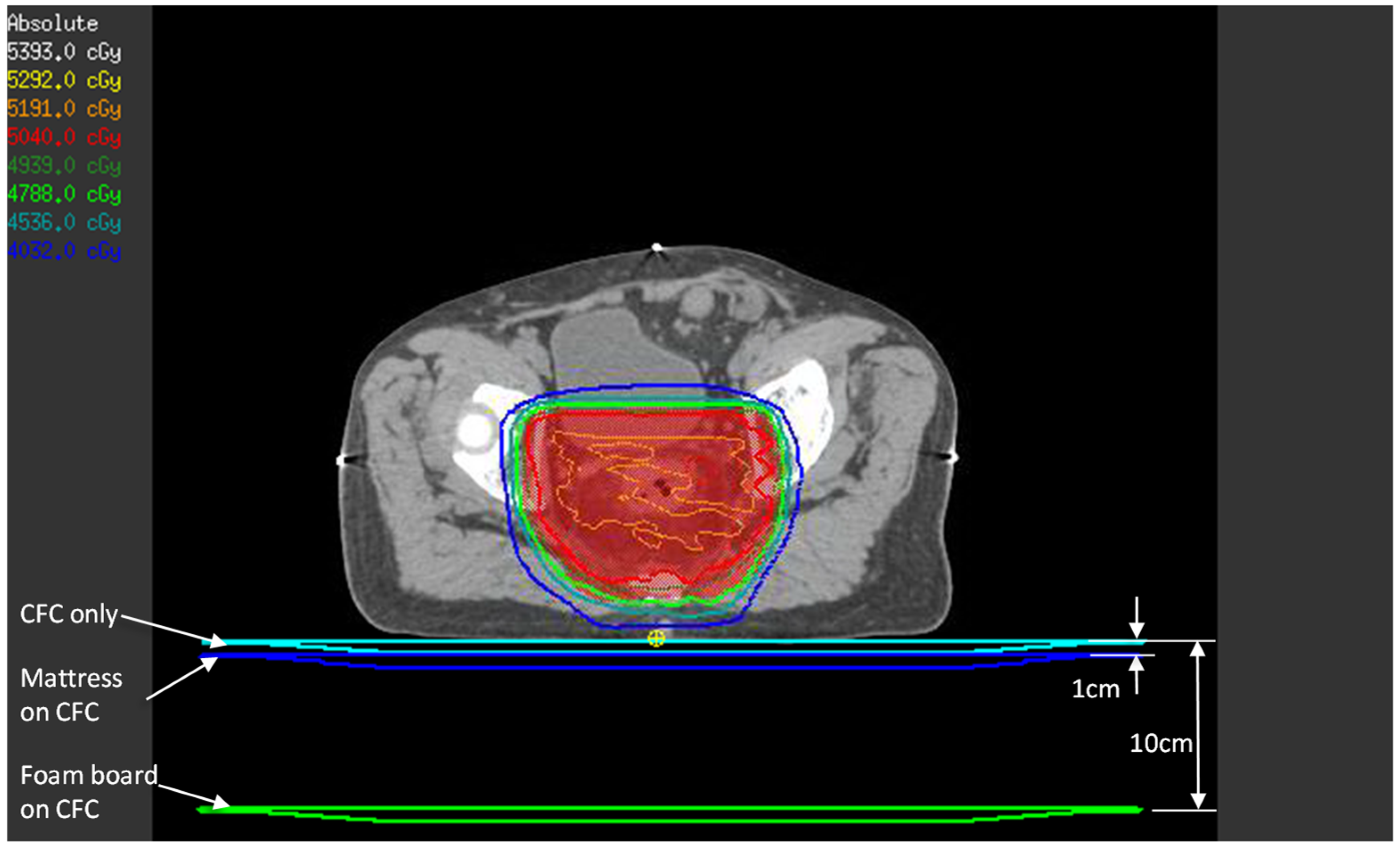
18], we thought it would be instructive to compare TPS calculations and the OSLD phantom measurements. The patients’ treatment CT images and VMAT plans were used in this estimation. To simulate the effect of each setup, the 1 cm water-equivalent couch model that we use clinically was placed directly under the patient (simulates CFC only setup), 1 cm from the posterior of the patient (simulates mattress setup), and 10 cm from the patient’s posterior surface (simulates foam board setup), as in
Figure 3. A dose point was created at 1.2 mm depth from the patient’s posterior surface immediately below the beam isocenter—this represents the approximate location of the OSLD sensitive volume in the phantom experiment.
In the Pinnacle3 TPS, creating a region of interest to represent the mattress or the foam board and density-overriding it does not factor into the dose calculation. The TPS treats these as “air”, since the mattress and the foam board have a much lower density than the threshold density above which the dose calculation algorithm acts upon (we set this threshold to 0.6 g/cm3). Hence, the method described above is the closest approximation to the three setups in this study.
Although the phantom experiment and the TPS estimation process use different geometries to determine dose (i.e., SW stack vs. patient CT), reasonably close numerical agreements are expected since the lateral and AP separations are well matched.
4. Discussion
In clinical rectal cancer treatment with VMAT, posterior beam entry is common due to the target location and dose constraints for normal tissue. The interaction of the beam with supportive structures underneath the patient and the patient’s posterior surface may not be fully accounted for with regard to the posterior surface dose. This study examined three support structures—the linac’s carbon fiber couch, a standard treatment mattress that is typically used for patient comfort, and a 10 cm thick foam board—to determine their effect on posterior surface dose.
The phantom measurements in this study show a minimal decrease in the posterior skin dose due to the mattress, and a much larger decrease due to the foam board. The average reduction due to the mattress of 1.3% is not nearly enough to justify its use as a skin sparing device, though it does not increase the surface dose either. Also, the mattress is deformable, which may result in some inaccuracies due to interfraction changes in the patient posterior surface. The foam board, on the other hand, resulted in an 8.3% average posterior skin dose reduction. At skin dose levels spanning 35–46.5 Gy with the CFC only, this level of dose reduction may be clinically meaningful for patient skin toxicity [
14]. However, clinical outcomes are out of the scope of this study; only dosimetric results are reported here. The foam boards are rigid enough that they do not deform under a patient’s weight.
For the CFC-only setup, the OSLD measurements and the TPS estimated doses were similar. The OSLD averages and the TPS estimates were, for patient 1, 4103 cGy and 4167 cGy; for patient 2, 3814 cGy and 3832 cGy; and, for patient 3, 4611 cGy and 4882 cGy. As mentioned previously, this should not be too surprising, as the solid water phantom dimensions and the patient AP and lateral separations were well-matched. The TPS estimates of percent reduction statistics for the mattress and foam board were quite far apart from the OSLD measurements (
Table 2 and
Table 3). One partial explanation is that Pinnacle underestimates the surface dose because the electrons liberated from the mattress or the foam board are not accounted for in the dose calculation. Indeed, the TPS posterior skin dose estimates for the mattress and foam board setups are much less than those of the OSLD measurements. Also, superposition–convolution dose algorithms rely on precomputed dose kernels that assume a charged particle equilibrium, which breaks down near material interfaces, particularly where there are pronounced build-up effects. It is reasonable to trust the phantom measurements for the mattress and foam board setups over the calculations from the TPS.
The differences between the measurements and the TPS results suggest that using inverse optimization to limit the posterior skin dose during planning is limited by the ability of the TPS to accurately model dose near the patient’s surface. Monte Carlo treatment planning systems, with their superior ability to model interface effects compared to convolution systems, may prove useful in this regard [
19]; however, the inherent bolusing effects associated with treatment couches and support devices remain, as elucidated in TG176 [
11], which this work aims to address.
There is a variation in VMAT implementations for pelvic radiation therapy, with full arcs, multiple arcs, and a diversity of treatment platforms being available. For rectal cancer radiation therapy, the target is typically posteriorly located, and VMAT arcs commonly include posterior beam entry. Although this study was limited to using a 180° posterior VMAT arc, other VMAT arc geometries are expected to exhibit similar posterior surface dose effects, as beams are likely to enter the posterior surface across most clinical implementations.
To our knowledge, this is the first look at how the posterior skin dose might be affected when treating rectal cancer patients in the supine position and with VMAT. For the prone setup, this was never a concern because the patient posterior surface was in air and benefiting from the full skin sparing effect of megavoltage photon energies. When supine, beaming through a mounting surface on the way to the posterior skin may result in unintentional bolusing, the effects of which were studied in this work.
5. Conclusions
In this study, we demonstrated that the selection of support surfaces can meaningfully influence the posterior surface dose, and that these effects may not be reliably reflected in treatment planning system dose calculations. We measured in-phantom the posterior surface dose for rectal cancer patients in the supine position and using VMAT, with three different setups: the direct placement on a CFC, with a standard mattress, and with a 10 cm foam board. The mattress in this study does not reduce the posterior skin dose enough to warrant its use as a skin sparing device; its primary use is for patient comfort. The CFC produces a bolusing effect that can be reduced by separating the patient from the CFC with a 10 cm foam board, which may be clinically desirable.
By providing a measurement-based characterization of the posterior surface dose under controlled phantom conditions, this work supplements planning-based approaches and supports more informed evaluations of patient support material effects for supine rectal cancer VMAT treatments, as well as similar patient treatment settings.