
Assessment of Mental Health Literacy and Perceived Social Stigma Among High School Teachers in Najran City, Saudi Arabia: A Respondent-Driven Survey

 , , , and
Abstract
1. Introduction
2. Materials and Methods
3. Results
4. Discussion
5. Conclusions
Author Contributions
Funding
Institutional Review Board Statement
Informed Consent Statement
Data Availability Statement
Conflicts of Interest
Abbreviations
| MAKS | Mental Health Knowledge Schedule |
| PDD | Perceived Devaluation and Discrimination Scale |
| SPSS | Statistical Package for Social Sciences |
| SD | Standard Deviation |
| χ2 | Chi-Square Test |
References
- World Health Organization [WHO]. Adolescent Mental Health 2020. Available online: https://www.who.int/news-room/fact-sheets/detail/adolescent-mental-health (accessed on 13 May 2025).
- Mental Health Foundation. Mental Health Statistics: UK and Worldwide: Mental Health Foundation. 2022. Available online: https://www.mentalhealth.org.uk/explore-mental-health/statistics/children-young-people-statistics (accessed on 22 July 2025).
- Sher, L. Individuals with untreated psychiatric disorders and suicide in the COVID-19 era. Braz. J. Psychiatry 2020, 43, 229–230. [Google Scholar] [CrossRef] [PubMed]
- Brown, J.S. Student mental health: Some answers and more questions. J. Ment. Health 2018, 27, 193–196. [Google Scholar] [CrossRef]
- Kaushik, A.; Kostaki, E.; Kyriakopoulos, M. This systematic review examines the stigma of mental illness in children and adolescents. Psychiatry Res. 2016, 243, 469–494. [Google Scholar] [CrossRef]
- Al Omari, O.; Wynaden, D.; Alkhawaldeh, A.; Al-Delaimy, W.; Heslop, K.; Al Dameery, K.; Salameh, A.B. Knowledge and attitudes of young people toward mental illness: A cross-sectional study. Compr. Child. Adolesc. Nurs. 2020, 43, 301–313. [Google Scholar] [CrossRef] [PubMed]
- AlAzzam, M.; Abuhammad, S. Knowledge and attitude toward mental health and mental health problems among secondary school students in Jordan. J. Child Adolesc. Psychiatr. Nurs. 2021, 34, 57–67. [Google Scholar] [CrossRef]
- Imran, N.; Rahman, A.; Chaudhry, N.; Asif, A. World Health Organization “School Mental Health Manual”-based training for school teachers in urban Lahore, Pakistan: Study protocol for a randomized controlled trial. Trials 2018, 19, 290. [Google Scholar] [CrossRef]
- Masumoto, Y.; Morinobu, S.; Fujimaki, K.; Kasagi, K. The observation dimensions of high school Yogo teachers play a crucial role in identifying prodromal symptoms of mental health issues in adolescents. J. Affect. Disord. Rep. 2021, 5, 100173. [Google Scholar]
- Oban, G.; Küçük, L. Factors affecting stigmatization about mental disorders among adolescents. J. Psychiatr. Nurs. 2011, 2, 31–39. [Google Scholar]
- Stensen, K.; Lydersen, S.; Stenseng, F.; Wallander, J.L.; Drugli, M.B. Teacher nominations of preschool children at risk for mental health problems: How false is a false positive nomination and what make teachers concerned? J. Psychopathol. Behav. Assess. 2021, 43, 646–656. [Google Scholar] [CrossRef]
- Mcluckie, A.; Kutcher, S.; Wei, Y.; Weaver, C. Sustained improvements in students’ mental health literacy with use of a mental health curriculum in Canadian schools. BMC Psychiatry 2014, 14, 379. [Google Scholar] [CrossRef] [PubMed]
- Hadlaczky, G.; Hökby, S.; Mkrtchian, A.; Carli, V.; Wasserman, D. Mental Health First Aid is an efective public health intervention for improving knowledge, attitudes, and behaviour: A meta-analysis. Int. Rev. Psychiatry 2014, 26, 467–475. [Google Scholar] [CrossRef] [PubMed]
- Jorm, A.F. Mental health literacy: Public knowledge and beliefs about mental disorders. Br. J. Psychiatry 2000, 177, 396–401. [Google Scholar] [CrossRef]
- Sampaio, F.; Gonçalves, P.; Sequeira, C. Mental health literacy: It is now time to put knowledge into practice. Int. J. Environ. Res. Public. Health 2022, 19, 7030. [Google Scholar] [CrossRef]
- Calandri, E.; Mastrokoukou, S.; Marchisio, C.; Monchietto, A.; Graziano, F. Teacher Emotional Competence for Inclusive Education: A Systematic Review. Behav. Sci. 2025, 15, 359. [Google Scholar] [CrossRef]
- Gile, K.J.; Johnston, L.G.; Salganik, M.J. Diagnostics for respondent-driven sampling. J. R. Stat. Soc. Ser. A Stat. Soc. 2015, 178, 241–269. [Google Scholar] [CrossRef]
- White, R.G.; Hakim, A.J.; Salganik, M.J.; Spiller, M.W.; Johnston, L.G.; Kerr, L.; Kendall, C.; Drake, A.; Wilson, D.; Orroth, K.; et al. Strengthening the reporting of observational studies in epidemiology for respondent-driven sampling studies:“STROBE-RDS” statement. J. Clin. Epidemiol. 2015, 68, 1463–1471. [Google Scholar] [CrossRef]
- Dean, A.G.; Sullivan, K.M.; Soe, M.M. OpenEpi: Open Source Epidemiologic Statistics for Public Health, Version 3.01; Emory University: Atlanta, GA, USA, 2013; Available online: https://www.openepi.com (accessed on 7 June 2025).
- Google Privacy and Terms. Available online: https://policies.google.com/privacy?hl=en-US (accessed on 12 November 2024).
- Ben Amor, M.; Zgueb, Y.; Bouguira, E.; Metsahel, A.; Aissa, A.; Thonicroft, G.; Ouali, U. Arabic validation of the “Mental Health Knowledge Schedule” and the “Reported and Intended Behavior Scale”. Front. Psychiatry 2023, 14, 1241611. [Google Scholar] [CrossRef]
- Evans-Lacko, S.; Little, K.; Meltzer, H.; Rose, D.; Rhydderch, D.; Henderson, C.; Thornicroft, G. Development and psychometric properties of the Mental Health Knowledge Schedule. Can. J. Psychiatry 2010, 55, 440–448. [Google Scholar] [CrossRef]
- Pattyn, E.; Verhaeghe, M.; Sercu, C.; Bracke, P. Public stigma and self-stigma: Differential association with attitudes toward formal and informal help seeking. Psychiatr. Serv. 2014, 65, 232–238. [Google Scholar] [CrossRef] [PubMed]
- Bifftu, B.B.; Dachew, B.A. Perceived Stigma and Associated Factors among People with Schizophrenia at Amanuel Mental Specialized Hospital, Addis Ababa, Ethiopia: A Cross—Sectional Institution Based Study. Psychiatry J. 2014, 2014, 694565. [Google Scholar] [CrossRef] [PubMed]
- Rayan, A.; Jaradat, A. Stigma of Mental Illness and Attitudes toward Psychological Help-seeking in Jordanian University Students. Res. Psychol. Behav. Sci. 2016, 4, 7–14. [Google Scholar]
- IBM Corp. IBM SPSS Statistics for Windows, Version 25.0; IBM Corp: Armonk, NY, USA, 2017. [Google Scholar]
- Nalipay, M.J.; Chai, C.S.; Jong, M.S.; King, R.B.; Mordeno, I.G. Positive mental health literacy for teachers: Adaptation and construct validation. Curr. Psychol. 2024, 43, 4888–4898. [Google Scholar] [CrossRef]
- Paakkari, L.; Torppa, M.; Mazur, J.; Boberova, Z.; Sudeck, G.; Kalman, M.; Paakkari, O. A comparative study on adolescents’ health literacy in Europe: Findings from the HBSC study. Int. J. Environ. Res. Public. Health 2020, 17, 3543. [Google Scholar] [CrossRef]
- González-Sanguino, C.; Rodríguez-Medina, J.; Redondo-Pacheco, J.; Betegón, E.; Valdivieso-León, L.; Irurtia, M.J. An exploratory cross-sectional study on Mental health literacy of Spanish adolescents. BMC Public Health 2024, 24, 1469. [Google Scholar] [CrossRef]
- Renwick, L.; Pedley, R.; Johnson, I.; Bell, V.; Lovell, K.; Bee, P.; Brooks, H. Mental health literacy in children and adolescents in low-and middle-income countries: A mixed studies systematic review and narrative synthesis. Eur. Child Adolesc. Psychiatry 2024, 33, 961–985. [Google Scholar] [CrossRef]
- He, X.Y.; Tan, W.Y.; Guo, L.L.; Ji, Y.Y.; Jia, F.J.; Wang, S.B. Mental Health Literacy Among Urban and Rural Residents of Guangdong Province, China. Risk Manag. Healthc. Policy 2024, 17, 2305–2318. [Google Scholar] [CrossRef] [PubMed]
- Grohmann, E.; Al-Addous, A.; Sander, C.; Dogan-Sander, E.; Baumann, E.; Angermeyer, M.C.; Schomerus, G. Changes in the ability to correctly identify schizophrenia and depression: Results from general population surveys in Germany over 30 years. Soc. Psychiatry Psychiatr. Epidemiol. 2024, 59, 1793–1801. [Google Scholar] [CrossRef] [PubMed]
- Chaves, A.; Arnáez, S.; Roncero, M.; García-Soriano, G. Teachers’ knowledge and stigmatizing attitudes associated with obsessive-compulsive disorder: Effectiveness of a brief educational intervention. Front. Psychiatry 2021, 12, 677567. [Google Scholar] [CrossRef] [PubMed]
- Chu, Z.; Xie, J.; Liu, R.; Ou, L.; Lan, Z.; Xie, G. Gender-specific differences in mental health literacy and influencing factors among residents in Foshan City, China: A cross-sectional study. Front. Public Health 2025, 13, 1555615. [Google Scholar] [CrossRef]
- Baklola, M.; Terra, M.; Taha, A.; Elnemr, M.; Yaseen, M.; Maher, A.; Buzaid, A.H.; Alenazi, R.; Osman Mohamed, S.A.; Abdelhady, D.; et al. Mental health literacy and help-seeking behaviour among Egyptian undergraduates: A cross-sectional national study. BMC Psychiatry 2024, 24, 202. [Google Scholar] [CrossRef]
- Wendt, D.; Shafer, K. Gender and attitudes about mental health help seeking: Results from national data. Health Soc. Work 2016, 41, e20–e28. [Google Scholar] [CrossRef]
- Prabhu, V.; Ashok, L.; Kamath, V.G.; Sekaran, V.C.; Kamath, A.; Padickaparambil, S.; Hegde, A.P.; Devaramane, V. What predicts mental health literacy among school teachers? Ghana Med. J. 2021, 55, 141–146. [Google Scholar] [CrossRef]
- Pullen, E.; Ekl, E.A.; Felix, E.; Turner, C.; Perry, B.L.; Pescosolido, B.A. Labeling, causal attributions, and social network ties to people with mental illness. Soc. Sci. Med. 2022, 293, 114646. [Google Scholar] [CrossRef]
- Corrigan, P.W.; Watson, A.C. Understanding the impact of stigma on people with mental illness. World Psychiatry 2002, 1, 16. [Google Scholar] [PubMed]
- Yang, J.; Li, Y.; Gao, R.; Chen, H.; Yang, Z. Relationship between mental health literacy and professional psychological help-seeking attitudes in China: A chain mediation model. BMC Psychiatry 2023, 23, 956. [Google Scholar] [CrossRef] [PubMed]
- Wang, W.; Xia, J.; Chen, W.; Ye, J.; Xie, K.; Zhang, Z.; Binti Mohamad, S.M.; Shuid, A.N. Exploring the interplay of mental health knowledge, stigma, and social distance among clinical nurses: A study in Liaoning, China. Front. Psychiatry 2025, 16, 1478690. [Google Scholar] [CrossRef]



| Socio-Demographic Variables | Study Participants (716) | |
|---|---|---|
| No. | % | |
| Age: | ||
| <40 years | 461 | 64.4 |
| ≥40 years | 255 | 35.6 |
| Sex: | ||
| Male | 318 | 44.4 |
| Female | 398 | 55.6 |
| Marital status: | ||
| Married | 388 | 54.2 |
| Single | 274 | 38.3 |
| Divorced | 25 | 3.5 |
| Widow | 29 | 4.0 |
| Years of experience: | ||
| <10 years | 144 | 20.1 |
| 10–20 years | 289 | 40.4 |
| ≥20 years | 283 | 39.5 |
| Educational level: | ||
| Bachelor | 487 | 68.0 |
| Master | 229 | 32.0 |
| Teaching specialty: | ||
| Science subjects | 314 | 43.9 |
| Humanitarian subjects | 402 | 56.1 |
| Previously diagnosed with a mental disorder: | ||
| No | 695 | 97.1 |
| Depression | 10 | 1.4 |
| Anxiety | 7 | 1.0 |
| PTSD | 3 | 0.4 |
| OCD | 1 | 0.1 |
| Relationship with mental disorder patients: | ||
| No | 589 | 82.3 |
| Family member | 45 | 6.3 |
| Friend | 32 | 4.5 |
| College | 26 | 3.6 |
| Neighbour | 19 | 2.7 |
| Other | 5 | 0.6 |
| Scale Items | Mean ± SD |
|---|---|
| 1. Most people with mental health problems want to have paid employment | 3.5 ± 0.9 |
| 2. If a friend had a mental health problem, I know what advice to give them to get professional help | 3.7 ± 0.9 |
| 3. Medication can be an effective treatment for people with mental health problems | 4.0 ± 0.8 |
| 4. Psychotherapy (for example, talking therapy or counseling) can be an effective treatment for people with mental health problems | 4.0 ± 0.8 |
| 5. People with severe mental health problems can fully recover | 3.8 ± 0.9 |
| 6. Most people with mental health problems go to a healthcare professional to get help | 3.2 ± 1.1 |
| Total score of the scale | |
| Mean ± SD | 22.2 ± 3.1 |
| Median | 22.0 |
| Min.–Max. | 14.0–30.0 |
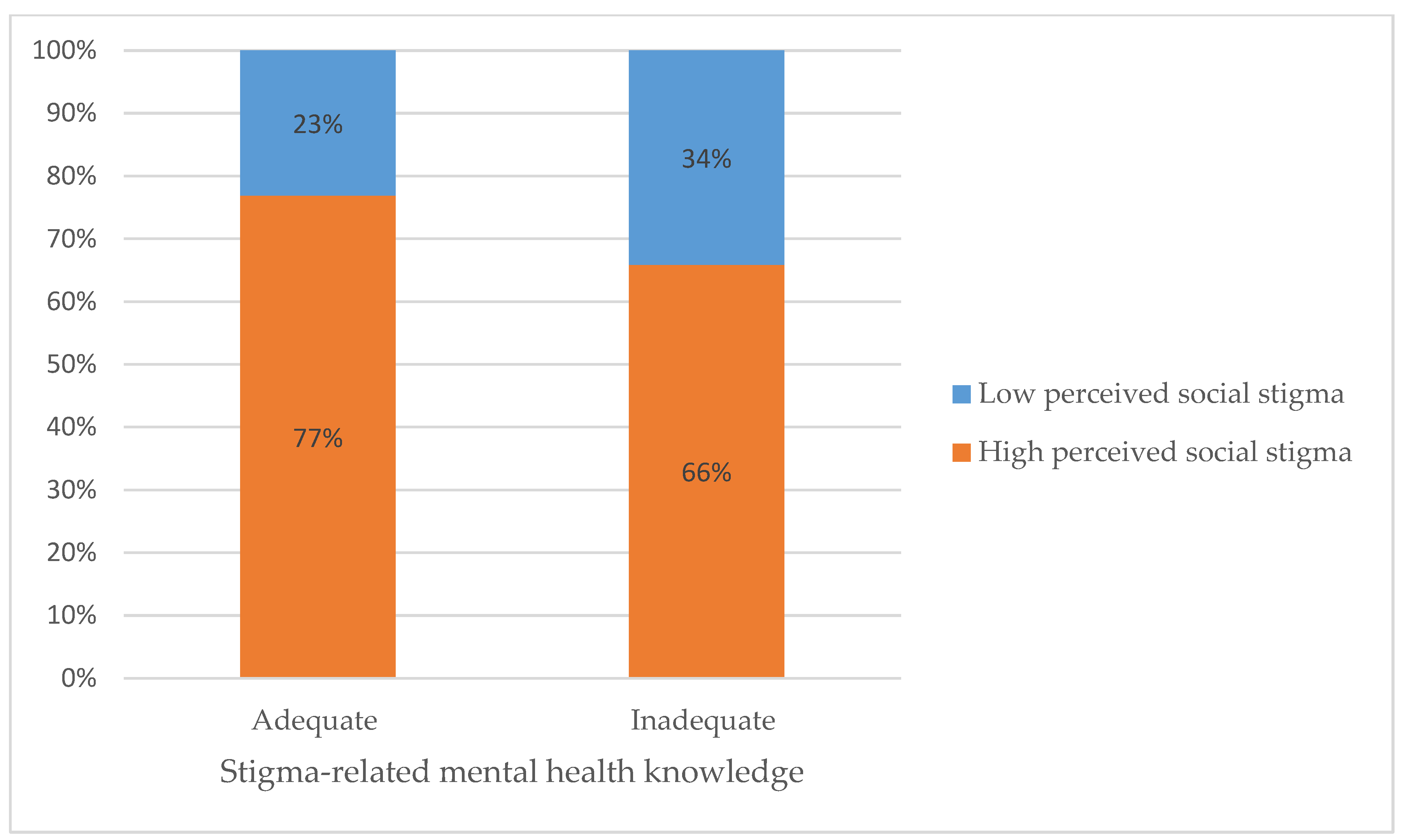
| Adequate knowledge | 502 (70.1%) |
| Inadequate knowledge | 214 (29.9%) |
| Perceived Devaluation and Discrimination Scale (PDD) | Perceived Social Stigma | |
|---|---|---|
| High | Low | |
| 1. Most people would be close friends with a person who once had a severe mental illness. | 613 (85.6%) | 103 (14.4%) |
| 2. Most people believe that a person who has a severe mental illness is just as intelligent as anyone else. | 583 (81.4%) | 133 (18.6%) |
| 3. Most people think that someone who has received treatment for a severe mental illness is equally trustworthy as everyone else. | 583 (81.4%) | 133 (18.6%) |
| 4. Most people would accept a person who has had severe mental illness as a teacher in a school. | 472 (65.9%) | 244 (34.1%) |
| 5. Most people believe that receiving treatment for severe mental illness is a sign of personal failure. | 436 (60.9%) | 280 (39.1%) |
| 6. Most people won’t hire someone who has been hospitalized for severe mental illness to care for their children, even if they are well now. | 579 (80.9%) | 137 (19.1%) |
| 7. Most people have a negative perception of someone who has received treatment for a serious mental illness. | 538 (75.1%) | 178 (24.9%) |
| 8. Even if a candidate has received treatment for a severe mental illness, most employers will still hire them. | 618 (86.3%) | 98 (13.7%) |
| 9. Most employers would prefer to hire someone who does not have a history of severe mental illness. | 562 (78.5%) | 154 (21.5%) |
| 10. The majority of people I know would treat someone who has undergone severe mental illness in the same manner as everyone else. | 563 (78.6%) | 153 (21.4%) |
| 11. Most young women would be hesitant to date a man who has undergone extensive mental health treatment. | 596 (83.2%) | 120 (16.8%) |
| 12. Most people think that a person who has been hospitalized for severe mental illness is dangerous and unpredictable. | 597 (83.4%) | 119 (16.6%) |
| Total score | 527 (73.6%) | 189 (26.4%) |
| Outcome | Estimator | Weighted Estimate | 95% CI | Note |
|---|---|---|---|---|
| Inadequate knowledge | SS | 18.7% | 15.4–22.3 | N(pop) = 1150 |
| Adequate knowledge | SS | 51.8% | 47.6–56.0 | Median split |
| Mean PDD | SS | 44.2 | 43.1–45.3 | Higher = lower stigma |
| Low perceived stigma (≥41) | SS | 63.5% | 59.1–67.6 | — |
| Inadequate knowledge | VH | 19.4% | 16.0–23.1 | Sensitivity |
| Mean PDD | VH | 44.0 | 42.9–45.1 | Sensitivity |
| Socio-Demographic Variables | Stigma-Related Mental Health Knowledge | χ2 | p | |
|---|---|---|---|---|
| Adequate | Inadequate | |||
| Age: | 16.4 | <0.001 * | ||
| <40 years (n = 461) | 347 (75.3%) | 114 (24.7%) | ||
| ≥40 years (n = 255) | 155 (60.8%) | 100 (39.2%) | ||
| Sex: | 4.6 | 0.03 * | ||
| Male (n = 318) | 236 (74.2%) | 82 (25.8%) | ||
| Female (n = 398) | 266 (66.8%) | 132 (33.2%) | ||
| Marital status: | 5.3 | 0.02 * | ||
| Married (n = 388) | 258 (66.5%) | 130 (33.5%) | ||
| Not married (n = 328) | 244 (74.4%) | 84 (25.6%) | ||
| Years of experience: | 0.4 | 0.5 | ||
| <10 years (n = 144) | 104 (72.2%) | 40 (27.8%) | ||
| 10–20 years (n = 289) | 191 (66.1%) | 98 (33.9%) | ||
| ≥20 years (n = 283) | 207 (73.1%) | 76 (26.9%) | ||
| Educational level: | 15.6 | <0.001 * | ||
| Bachelor (n = 487) | 364 (74.7%) | 123 (25.3%) | ||
| Master (n = 229) | 138 (60.3%) | 91 (39.7%) | ||
| Teaching specialty: | 7.1 | 0.01 * | ||
| Science subjects (n = 314) | 204 (65.0%) | 110 (35.0%) | ||
| Humanitarian subjects (n = 402) | 298 (74.1%) | 104 (25.8%) | ||
| Previously diagnosed with a mental disorder: | 9.2 | 0.002 * | ||
| Yes (n = 21) | 21 (100%) | 0 (0.0%) | ||
| No (n = 695) | 481 (69.2%) | 214 (30.8%) | ||
| Relationship with mental disorder patients: | 5.5 | 0.02 * | ||
| Yes (n = 127) | 100 (78.7%) | 27 (21.3%) | ||
| No (n = 589) | 402 (68.3%) | 187 (31.7%) | ||
| Socio-Demographic Variables | Perceived Social Stigma | χ2 | p | |
|---|---|---|---|---|
| High | Low | |||
| Age: | 2.9 | 0.09 | ||
| <40 years (n = 461) | 349 (75.7%) | 112 (24.3%) | ||
| ≥40 years (n = 255) | 178 (69.8%) | 77 (30.2%) | ||
| Sex: | 0.5 | 0.5 | ||
| Male (n = 318) | 230 (72.3%) | 88 (27.7%) | ||
| Female (n = 398) | 297 (74.6%) | 101 (25.4%) | ||
| Marital status: | 5.3 | 0.02 * | ||
| Married (n = 388) | 272 (70.1%) | 116 (29.9%) | ||
| Not married (n = 328) | 255 (77.3%) | 73 (22.3%) | ||
| Years of experience: | 13.7 | <0.001 * | ||
| <10 years (n = 144) | 80 (55.6%) | 64 (44.4%) | ||
| 10–20 years (n = 289) | 232 (80.3%) | 57 (19.7%) | ||
| ≥20 years (n = 283) | 215 (76.0%) | 68 (24.0%) | ||
| Educational level: | 1.0 | 0.3 | ||
| Bachelor (n = 487) | 364 (74.7%) | 123 (25.3%) | ||
| Master (n = 229) | 163 (71.2%) | 66 (28.8%) | ||
| Teaching specialty: | 2.0 | 0.1 | ||
| Science subjects (n = 314) | 232 (76.3%) | 72 (23.7%) | ||
| Humanitarian subjects (n = 402) | 295 (71.6%) | 117 (28.4%) | ||
| Previously diagnosed with a mental disorder: | 0.05 | 0.8 | ||
| Yes (n = 21) | 15 (71.4%) | 6 (28.6%) | ||
| No (n = 695) | 512 (73.7%) | 183 (26.3%) | ||
| Relationship with mental disorder patients: | 0.01 | 0.9 | ||
| Yes (n = 127) | 94 (74.0%) | 33 (26.0%) | ||
| No (n = 589) | 433 (73.5%) | 156 (26.5%) | ||
| Outcome | Predictors | B | SE | β | t | p | 95% CI | VIF | Model |
|---|---|---|---|---|---|---|---|---|---|
| MAKS | Intercept | 17.90 | 0.58 | — | 30.86 | <0.001 | [16.77–19.03] | — | R2 = 0.186 Adjusted R2 = 0.180 Cohen’s f2 = 0.228 |
| Female (ref: male) | 0.95 | 0.28 | 0.12 | 3.36 | 0.001 | [0.40–1.49] | 1.14 | ||
| Education: Master’s | 1.25 | 0.32 | 0.14 | 3.91 | 0.001 | [0.62–1.88] | 1.07 | ||
| Experience (years) | 0.06 | 0.02 | 0.09 | 3.00 | 0.003 | [0.02–0.10] | 2.75 | ||
| Contact with MH patient (yes) | 0.88 | 0.29 | 0.11 | 3.03 | 0.003 | [0.32–1.44] | 1.12 | ||
| Prior MH training (yes) | 1.72 | 0.35 | 0.18 | 4.94 | <0.001 | [1.03–2.41] | 1.05 | ||
| PDD | Intercept | 33.78 | 1.21 | — | 27.93 | <0.001 | [31.40–36.16] | — | R2 = 0.264 Adjusted R2 = 0.258 Cohen’s f2 = 0.359 |
| Female (ref: male) | 1.35 | 0.49 | 0.10 | 2.76 | 0.006 | [0.40–2.30] | 1.14 | ||
| Experience (years) | 0.09 | 0.03 | 0.09 | 3.00 | 0.003 | [0.03–0.15] | 2.75 | ||
| Contact with MH patient (yes) | 2.10 | 0.52 | 0.13 | 4.04 | <0.001 | [1.08–3.12] | 1.12 | ||
| Prior MH training (yes) | 2.80 | 0.58 | 0.16 | 4.83 | <0.001 | [1.67–3.93] | 1.05 | ||
| MAKS knowledge (total) | 0.28 | 0.05 | 0.24 | 5.60 | <0.001 | [0.18–0.38] | 1.22 |
Disclaimer/Publisher’s Note: The statements, opinions and data contained in all publications are solely those of the individual author(s) and contributor(s) and not of MDPI and/or the editor(s). MDPI and/or the editor(s) disclaim responsibility for any injury to people or property resulting from any ideas, methods, instructions or products referred to in the content. |
© 2025 by the authors. Licensee MDPI, Basel, Switzerland. This article is an open access article distributed under the terms and conditions of the Creative Commons Attribution (CC BY) license (https://creativecommons.org/licenses/by/4.0/).
Share and Cite
Eldeeb, S.; Shahtou, A.; Alrefaey, H.; Almesned, F.; Alqureshah, H.; Alhawkash, S.; Alhawkash, N.; Alsahag, A.; Alqudhaya, H. Assessment of Mental Health Literacy and Perceived Social Stigma Among High School Teachers in Najran City, Saudi Arabia: A Respondent-Driven Survey. Psychiatry Int. 2025, 6, 147. https://doi.org/10.3390/psychiatryint6040147
Eldeeb S, Shahtou A, Alrefaey H, Almesned F, Alqureshah H, Alhawkash S, Alhawkash N, Alsahag A, Alqudhaya H. Assessment of Mental Health Literacy and Perceived Social Stigma Among High School Teachers in Najran City, Saudi Arabia: A Respondent-Driven Survey. Psychiatry International. 2025; 6(4):147. https://doi.org/10.3390/psychiatryint6040147
Chicago/Turabian StyleEldeeb, Seham, Ammar Shahtou, Hesham Alrefaey, Fahd Almesned, Hassan Alqureshah, Saleh Alhawkash, Nasser Alhawkash, Ashraf Alsahag, and Hidar Alqudhaya. 2025. "Assessment of Mental Health Literacy and Perceived Social Stigma Among High School Teachers in Najran City, Saudi Arabia: A Respondent-Driven Survey" Psychiatry International 6, no. 4: 147. https://doi.org/10.3390/psychiatryint6040147
APA StyleEldeeb, S., Shahtou, A., Alrefaey, H., Almesned, F., Alqureshah, H., Alhawkash, S., Alhawkash, N., Alsahag, A., & Alqudhaya, H. (2025). Assessment of Mental Health Literacy and Perceived Social Stigma Among High School Teachers in Najran City, Saudi Arabia: A Respondent-Driven Survey. Psychiatry International, 6(4), 147. https://doi.org/10.3390/psychiatryint6040147