


Abstract
In the present research, an alternative eco-efficient biotechnology system, both selective and environmentally viable, is proposed and compared to a conventional scheme. The results showed an optimal process function and a significant difference (p < 0.001) in wastewater measured quality parameters compared to the conventional scheme. Indeed, the treated wastewater from the eco-efficient process revealed significant concentrations of organic matter and nutrients. Accordingly, there was an improvement in soil and plant quality parameters as a result of irrigation with raw urban wastewater and treated wastewater from the eco-efficient system compared to ground water.
1. Introduction
In arid and semi-arid regions, the demand for clean water is continuously increasing. Therefore, wastewater is considered a valuable and attractive source of irrigation water and a fertilizing material for these regions [1,2]. Although wastewater reuse in irrigation is a common practice in these regions, there is a widespread and growing concern about its opposing impact on the environment and health [3]. Thus, inappropriate handling and management of wastewater reuse for irrigation can create serious environmental and health risks [4].
The application of advanced technologies in wastewater treatment, including several physical, chemical and biological methods as well as various combinations of them, lead to efficient process performances [5]. Therefore, regarding the high concentration of organic matter and nutrients content in raw wastewater, this wastewater constitutes a significant source of beneficial compounds for agriculture [6,7]. However, advanced abetment of organic matter and nutrients is not frequently suitable from wastewater, particularly if the objective is reuse in agriculture. Thus, the removal of sanitary risks simultaneously and the conservation of specific nutrients such as nitrogen and phosphorus during wastewater treatment could be interesting and beneficial for both soil and plant. However, most existing wastewater treatment approaches are not selective in terms of organic matter and nutrient abatement, and it is crucial to explore alternative selective approaches and environmentally viable options.
In this optic, we investigated an innovative and sustainable alternative methodology for wastewater treatment and valorization in agriculture. To this end, physicochemical and bacteriological parameters of raw and treated urban wastewater from both systems were investigated. Thereby, we evaluated the fertigation effect of irrigation with raw and treated wastewaters on soil and plants.
2. Materials and Methods
2.1. Experimental Setup and Procedure
Two experimental systems were assessed during the operation of this experiment (Figure 1). (a) A conventional activated sludge system composed of an anoxic basin, aeration tank and a settling tank. (b) An eco-efficient system in which total flow rate was split into two portions, the first portion collected from the anoxic basin (Split 1) and the second collected from the aerobic basin (Split 2). After that, effluent was sent to a secondary settling tank, filtered through a send filter (SF), and finally disinfected in a disinfection tank using PAA.
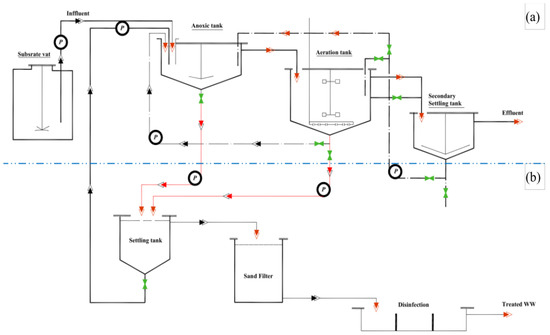
Figure 1.
Schematic diagram of the conventional and eco-efficient schemes. (a) Conventional activated sludge system; (b) eco-efficient activated sludge system.
2.2. Raw and Treated Urban Wastewaters Characteristics
Physicochemical characteristics of raw and treated wastewaters as well as groundwater were determined according to standard methods [8,9,10]. The monitored parameters were the electrical conductivity (EC), total suspended solids (TSS), chemical oxygen demand (COD), five-day biological oxygen demand (BOD5), nitrogen (TKN and NH4), phosphorus (TP and PO43−), chloride (Cl−), sodium (Na+) and calcium (Ca2+).
2.3. Soil and Plant Sampling and Analytical Methods
Soil and plant quality parameters were performed according to standards methods [11,12,13]. The monitored parameters were pH, EC, TKN Phosphorus, Total organic carbon (TOC), Macro-elements and microelements, and were analyzed by X-ray fluorescence spectrometry and flame photometry.
2.4. Statistical Analysis
One-way ANOVA was used to evaluate the effects of water irrigation on the assessed parameters in soil and plants. All differences were considered significant at 5% (p < 0.05). Principal component analysis (PCA) was performed to obtain data using R program.
3. Results
Figure 2 shows the Organic matter (COD, BOD5) and nitrogen (NTK and ) in two systems during the experimental period.
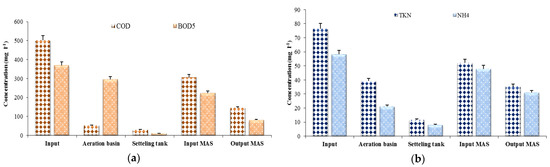
Figure 2.
Organic matter and nutrient load evaluation from both systems: (a) BOD5 and COD evolution in conventional and eco-efficient systems; (b) TN and evolution in both systems during this experiment.
4. Discussions
The obtained results from this research study suggest that the eco-efficient process allows for partial abatement of organic matter (BOD5 and COD) and nutrients (nitrogen and phosphorous). This propose that the eco-efficient process is the optimal choice regarding agriculture reuse. Indeed, this process provides hygienic effluent with high organic matter and nutrient content. If the goal is to discharge into receiving environmental systems, the convention process is the best choice by ensuring significant abetment of organic load. Hence, COD and BOD5 abatement levels were around 55% and 66% on average, respectively, and thus lower than the conventional system, at 94% and 97%, respectively (Figure 2a). Concerning nutrients, such as nitrogen, the eco-efficient scheme leads to a partial removal of nitrogen (41% of TKN and 40% NH4). By contrast, the conventional system provides high nitrogen-removal efficiency of about 85% and 86% for TKN and NH4, respectively (Figure 2b). In addition, the output effluent concentrations from conventional process were in accordance with the Moroccan applied discharges standards [14]. Assessment of the fertigation effect of irrigation water quality on soil and plants from both process shows a significant correlation between irrigation water and quality parameters of plants and soil (Figure 3). Indeed, soil and plants irrigated with eco-efficient-treated wastewaters showed an improvement in their proprieties compared to control soil and ground water. There was a significant impact (p < 0.05) on soil-fertility-indicating parameters OM, TKN, TP, and micro- and macro-nutrients. Compared to control soil, Na and EC concentrations in soil irrigated with raw and different treated wastewaters were significant. Consequently, amplified salinity in soils could decrease the potential for soil dispersion due to enhanced Na concentration [15]. This result was sustained with PCA analysis, as presented in Figure 3.
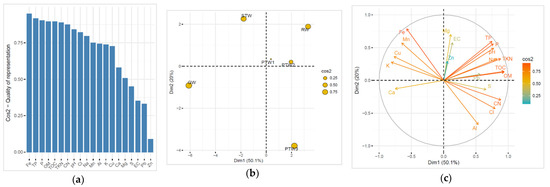
Figure 3.
Scatter plot based on principal component analysis (PCA): (a) Cos2 of variables’ contribution; (b) PCA of treated wastewater from both systems; (c) PCA analysis using all using all the measured soil parameters.
5. Conclusions
The results reported in this experiment suggest that the developed innovative schemes provide a partial elimination of organic matter and nutrients. Indeed, the results showed a great positive impact of treated urban wastewaters from the eco-efficient activated sludge process on plant productivity and soil proprieties.
Author Contributions
T.E.M.: Conceptualization, methodology and writing—original draft preparation; M.O.B.: investigation and formal analysis; L.M., S.W. and S.M.: visualization; N.O.: supervision and validation. All authors have read and agreed to the published version of the manuscript.
Funding
This research received no external funding.
Institutional Review Board Statement
Not applicable.
Informed Consent Statement
Not applicable.
Data Availability Statement
Data sharing not applicable.
Acknowledgments
The authors would like to knowledge RADEEMA and CNEREE for their technical support.
Conflicts of Interest
The authors declare no conflict of interest.
References
- Al-Rashed, M.F.; Sherif, M.M. Water resources in the GCC countries: An overview. Water Resour. Manag. 2000, 14, 59–73. [Google Scholar] [CrossRef]
- Mohammad, M.J.; Mazahreh, N. Changes in soil fertility parameters in response to irrigation of forage crops with secondary treated wastewater. Commun. Soil Sci. Plant Anal. 2003, 34, 1281–1294. [Google Scholar] [CrossRef]
- Jiries, A.; Hussain, H.; Lintelmann, J. Determination of polycyclic aromatic hydrocarbons in wastewater: Sediments, sludge and plants in Karak Province, Jordan. Water Air Soil Pollut. 2000, 121, 217–228. [Google Scholar] [CrossRef]
- Haruvy, N.; Offer, R.; Hadas, A.; Ravina, I. Wastewater irrigation economic concerns regarding beneficiary and hazardous effects of nutrients. Water Resour. Manag. 1999, 13, 303–314. [Google Scholar] [CrossRef]
- El Moussaoui, T.; Wahbi, S.; Mandi, L.; Masi, S.; Ouazzani, N. Reuse study of sustainable wastewater in agroforestry domain of Marrakesh city. J. Saudi Soc. Agric. Sci. 2019, 18, 288–293. [Google Scholar] [CrossRef]
- Belloulid, M.O.; El Moussaoui, T.; Latrach, L.; Saykouk, J.; El Azzouzi, F. National Program of Sanitation and Wastewater Treatment in Morocco: Objectives, Achievements and Challenges. Environ. Water Sci. Public Health Territ. Intell. J. 2018, 2, 67–76. [Google Scholar] [CrossRef]
- WHO. Guidelines for the Safe Use of Wastewater, Excreta and Greywater, 3rd ed.; World Health Organization: Geneva, Switzerland, 2006; ISBN 9789241546867.
- Oller, I.; Malato, S.; Sánchez-Pérez, J.A. Combination of Advanced Oxidation Processes and biological treatments for wastewater decontamination-A review. Sci. Total Environ. 2011, 409, 4141–4166. [Google Scholar] [CrossRef] [PubMed]
- Metcalf, W. Metcalf and Eddy Wastewater Engineering: Treatment and Reuse, 4th ed.; McGraw-Hill: New York, NY, USA, 2003. [Google Scholar]
- French Standardization Association. Qualité de l’eau. recueil des normes françaises, evironnement [Water Quality. Collection of French Standards, Environment]; Tomes 1, 2, 3 and 4; AFNOR: Paris-La Defense, France, 1997; 1372p. (In French) [Google Scholar]
- Rodier, J. L’analyse de l’eau, 9th ed.; DUNOD: Paris, France, 2009; 1579p. [Google Scholar]
- APHA. Standard Methods for the Examination of Water and Wastewater; American Public Health Association: Washington, DC, USA, 2005. [Google Scholar]
- Bremner, J.M. Nitrogen-Total. In Methods of Soil Analysis, Part 3, Chemical Methods; SSSA Book Set: 5; Sparks, D.L., Ed.; American Society of Agronomy Inc.: Madison, WI, USA, 1996; pp. 1085–1121. [Google Scholar]
- Moroccan Discharge Standards. [arrêté conjoint 2013] Ministre de l’intérieur, du Ministre de l’énergie, des Mines, de l’eau et de l’environnement, du Ministre de l’industrie, du Commerce et des Nouvelles Technologies et du Ministre de l’artisanat N° 2942-13 du 1er Hija 1434 (7 Octobre 2013) Fixant les Valeurs Limites Générales de Rejet dans les Eaux Superficielles ou Souterraines. Bulletin Officiel du Royaume du Maroc N° 6202-3. 2013; pp. 2456–2458. Available online: http://www.environnement.gov.ma/fr/78-cat1/1012-valeurs-limites-des-rejets (accessed on 30 May 2022).
- Heidarpour, M.; Mostafazadeh-Fard, B.; Abedi Koupai, J.; Malekian, R. The effects of treated wastewater on soil chemical properties using subsurface and surface irrigation methods. Agric. Water Manag. 2007, 90, 87–94. [Google Scholar] [CrossRef]
Publisher’s Note: MDPI stays neutral with regard to jurisdictional claims in published maps and institutional affiliations. |
© 2022 by the authors. Licensee MDPI, Basel, Switzerland. This article is an open access article distributed under the terms and conditions of the Creative Commons Attribution (CC BY) license (https://creativecommons.org/licenses/by/4.0/).