


Abstract
Salinity is one of the major severe constraints that limit crop productivity in 40% of the land surface, notably in the Mediterranean region. In this study, we worked in an argan orchard located in Laâyoune, Morocco. The orchard is characterized by a saline soil and trees that are irrigated with highly saline water. The study aimed to evaluate the effect of irrigation with saline water on oil yield, total phenolic content, flavonoid content, antioxidant activity, and fatty acid composition. The results show that saline water irrigation has a no significant effect on oil yield and most oil quality parameters, yet has a highly significant effect on total polyphenols, flavonoid content as well as two saturated acids (C16:0 and C20:0).
Keywords:
salinity; argan; oil yield; total polyphenol; flavonoid content; antioxidant activity; fatty acids 1. Introduction
Around the world, it is estimated that approximately 20% of irrigated cultivated lands since 1990 are affected by salinization [1]. The growing demand for water and the climate change shift seem to increasingly limit crop production, making the issues even worse [2]. Agriculture will then increasingly be forced to use low-quality waters such as brackish water or reclaimed effluent which in turn increases the risks of soil salinization and yield reduction [3]. The introduction of plant species that are tolerant to salt stress of great socio-economic values is one of the possible approaches to promote salt-affected soils and tackle this major abiotic factor that reduces agricultural yield [4]. The approach would improve the vegetation cover and solve the regeneration of particular forest species, such as the argan tree (Argania spinosa) that occurs in a restricted arid areas and which certainly represents a threatened ecological wealth in Southwestern Morocco [3].
Adult argan trees are adapted to aridity and are able to survive long drought periods. They can produce leaves, branches and fruits under as little as 100 mm rainfall [5]. It was shown that the argan tree could tolerate water salinity at germination stage and at the first phases of its in vitro growth [4]. Yet, the majority of studies consider the vegetative parameters, germination or oil quality of argan trees. Despite this knowledge, little is known about the effect of salinity on argan oil quality, and such understanding could help mitigate and buffer extreme events caused by climate change. Therefore, we conducted a comprehensive study on the quality of argan oil obtained from trees domesticated under saline constraints in the Saharan climate in Laâyoune.
2. Materials and Methods
2.1. Site and Plant Materials
The study was carried out in a 700 m2 orchard in Laâyoune, Morocco. Twelve argan trees were investigated, eight of which were at production stage during the sampling period (Figure 1). The trees have been planted since 1996 at a density of 5 × 5 m and have been irrigated twice a month with 40 L of saline well water per tree. The soil is a sandy-loamy-clayey texture on a limestone slab, with a pH of 7.95, an electrical resistivity of 7.64 dS m−1 and a 108 ppm Na+. As for the irrigation water, the pH, the electrical conductivity and the sodium content were 7.27, 16.45 dS m−1 and 3083 ppm, respectively (experimental INRA-field, Laâyoune data).
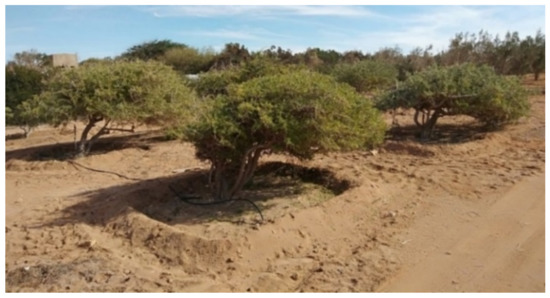
Figure 1.
The argan orchard design with the twelve domesticated trees at experimental INRA-field, Laâyoune.
The kernels were recovered from the ripped fruits and grinded. The powder was fried down for 24 h at 40 °C to eliminate all traces of humidity
2.2. Extraction
Once oven dried, a 10 g mass was mixed with 80 mL hexane then poured in a 100 mL flask. The mixture was then exposed to an ultrasonic bath set at 50 ± 1 C for 45 min at a frequency of 28 kHz.
2.3. Physico-Chemcial and Biochemical Study
The extraction of phenolic compounds was achieved following the method of polarity [6]. The determination of the total polyphenol and flavonoid content was carried out by colorimetry using the Folin–Ciocalteu reagent [7], and the aluminum trichloride (AlCl3) and sodium nitrite (NaNO2) [8] methods, respectively. To study the anti-radical activity of the different extracts, the method based on diphenyl picryl-hydrayl (DPPH) as a relatively stable free radical was used according to the protocol described by [9]. The International Organization for Standardization (ISO 5509:2009) [10] method was used for fatty acid composition. Data were analyzed using analysis of variance (ANOVA). Statistica software version 10 was used to assess the statistical significance of mean variations in terms of the effect on the quality of oil. The threshold for significance was set at <0.05 p values.
3. Results
Table 1 shows that the mean oil yields ranged from 37.04% to 47.60%. The total polyphenols and flavonoids ranged from 0.075 to 0.094 and 1.749 to 2.494, respectively. The antioxidant activity varied between 22.80% and 46.17%. As for the fatty acid profiles, the results show variations between 12.82 and 15.1 in C16:0, 0.1 and 0.14 for C16:1, 5.36 and 7.9 for C18:0, 44.33 and 53.66 for C18:1, 25.27 and 34.78 for C18:2, 0.06 and 0.1 for C20:0 and 0.02 and 0.04 for C20:1. From the table, we observe that the results obtained show an interesting aspect in terms of the several analyses carried out.

Table 1.
Analysis of variance data of oil yield and quality under highly saline water irrigation.
Table 1 also shows that irrigation with highly saline water has no significant effect on oil yield, a highly significant effect on the content of both total polyphenols and flavonoids, a non-significant effect on the antioxidant activity relative to the control treatments. For the fatty acid, the ANOVA showed a highly significant effect of saline irrigation water on two saturated acids which are palmitic C 16:0 and arachidic acid C20:0, for the rest of the fatty acids, the results shows that there is no significant effect.
4. Discussion
Soil and water of the orchards were classified as moderately and highly saline, respectively [1,11]. We observed that the mean of the oil yield of trees irrigated with saline water is lower than that in the previous findings of Charrouf, Kouidri and Mechqoq [12,13,14], who reported an oil yield with solvent ranging between 50–55%, a yield of 55.94% and a yield of 57.12%, respectively. This could be explained by the fact that the yields obtained by those authors were extracted using the Soxhlet method, which generally gives better yield than UAE. However, the total polyphenol content for all irrigated trees with highly saline water was higher than the values obtained by Sour and Demnati [15,16], 0.083 mg EGA/g oil vs. 0.0563 and 0.0724 mg EGA/g oil, respectively. The high stress phase of argan trees under high saline conditions in our orchards would stimulate the production of the secondary metabolites and therefore explain their high values. Similar higher values were obtained for flavonoids, relative to the control. The antioxidant activity values were slightly lower than those of the control yet both are lower than the value obtained by [17], who reported 86.45% antioxidant activity for non-irrigated, old trees. Perhaps the antioxidant activity difference is mostly due to the climate or tree age. Chromatographic profiles showed that the results are overly within the ranges given by the Moroccan standers [18] except for some slight variation, for example in A2 for C16:0, B1 and C2 for C18:0, A1, A2, B1 and C1 for C18:1 and C18:2, all trees for C20:0 and C20:1 (except A2 for the last acid).
5. Conclusions
Our results suggest that except the secondary metabolites, all parameters are either genetically controlled by the tree treats or are affected biotic/abiotic factors such as soil type, climate, age, extraction methods, etc. For a better understanding of those interactions, a profound study on different concentrations, different soils and climates should be conducted.
Author Contributions
Conceptualization: C.A. and N.A.A.; Methodology: C.A. and N.A.A.; Investigation and writing—original draft preparation: C.A.; Writing—review and editing: C.A., N.A.A., J.H. and F.M.; Formal analysis: C.A., N.A.A., J.H. and F.M.; Funding acquisition: N.A.A. and A.M. All authors have read and agreed to the published version of the manuscript.
Funding
This work was supported by National Institute of Agronomic Research, Regional Center of Agronomic Research of Agadir, Morocco (Grant id: PRMT Arganier 2021–2024).
Institutional Review Board Statement
Not applicable.
Informed Consent Statement
Not applicable.
Data Availability Statement
Data available by contacting the corresponding author.
Conflicts of Interest
The authors declare no conflict of interest.
References
- Shahid, S.A.; Heng, L. Guideline for Salinity Assessment, Mitigation and Adaptation Using Nuclear and Related Techniques; Springer Nature: Cham, Switzerland, 2018. [Google Scholar]
- Stefanoudaki, E.; Williams, M.; Chartzoulakis, K.; Harwood, J. Olive oil qualitative parameters after orchard irrigation with saline water. J. Agric. Food Chem. 2009, 57, 1421–1425. [Google Scholar] [CrossRef] [PubMed]
- Chakhchar, A.; Haworth, M.; El Modafar, C.; Lauteri, M.; Mattioni, C.; Wahbi, S.; Centritto, M. An assessment of genetic diversity and drought tolerance in argan tree (Argania spinosa) populations: Potential for the development of improved drought tolerance. Front. Plant Sci. 2017, 8, 276. [Google Scholar] [CrossRef] [PubMed] [Green Version]
- Reda Tazi, M.; Boukroute, A.; Berrichi, A.; Rharrabti, Y.; Kouddane, N. Growth of young argan tree seedlings (Argania spinosa L. Skeels) in northeast of morocco under controlled conditions at different NaCl concentrations. J. Mater. Environ. Sci. 2018, 9, 212–218. [Google Scholar]
- Bani-Aameur, F.; Sipple-Michmerhuizen, J. Germination and seedling survival of Argan (Argania spinosa) under experimental saline conditions. J. Arid. Environ. 2001, 49, 533–540. [Google Scholar] [CrossRef]
- Papoti, V.T.; Tsimidou, M.Z. Looking through the qualities of a fluorimetric assay for the total phenol content estimation in virgin olive oil, olive fruit or leaf polar extract. Food Chem. 2009, 112, 246–252. [Google Scholar] [CrossRef]
- Bettaieb Rebey, I.; Bourgou, S.; Saidani Tounsi, M.; Fauconnier, M.-L.; Ksouri, R. Etude de la composition chimique et de l’activité antioxydante des différents extraits de la Lavande dentée (Lavandula dentata). J. New Sci. Agri Biotech 2017, 39, 2096–2105. [Google Scholar]
- Bougandoura, B. Evaluation de l ’activité antioxydante des extraits aqueux et méthanolique de Satureja calamintha ssp. Nepeta (L.) Briq. Nat. Technol. 2013, 9, 14–19. [Google Scholar]
- Chaouche, T.M.; Haddouchi, F.; Atik-bekara, F.; Ksouri, R.; Azzi, R.; Boucherit, Z.; Tefiani, C.; Larbat, R. Antioxidant, haemolytic activities and HPLC–DAD–ESI–MSn characterization of phenolic compounds from root bark of Juniperus oxycedrus subsp. oxycedrus. Ind. Crop. Prod. 2015, 64, 182–187. [Google Scholar] [CrossRef]
- ISO 5509:2009; Animal and Vegetable Fats and Oils—Preparation of Methyl Esters of Fatty Acids. ISO: Geneva, Switzerland, 2009.
- Chowdhury, N. Advances in Agriculture Sciences; AkiNik Publications: Delhi, India, 2020. [Google Scholar]
- Charrouf, Z.; Guillaume, D. Argan oil: Occurrence, composition and impact on human health. Eur. J. Lipid Sci. Technol. 2008, 110, 632–636. [Google Scholar] [CrossRef]
- Kouidri, M. Extraction et Caractérisation Physico-Chimique de l’Huile d’Argan Provenant d’Arbres Cultivés dans deux Régions de l’Algérie (Tindouf et Mostaganem). Doctoral Thesis, Université Hassiba Benbouali, Chlef, Algeria, 2008. [Google Scholar]
- Mechqoq, H.; El Yaagoubi, M.; Momchilova, S.; Msanda, F.; El Aouad, N. Comparative study on yields and quality parameters of argan oils extracted by conventional and green extraction techniques. Grain Oil Sci. Technol. 2021, 4, 125–130. [Google Scholar] [CrossRef]
- Sour, S. Effet Hypolipidémiant et Antioxydant de l’Huile d’Argania Spinosa. Doctoral Thesis, Université Abou Bekr Belkaïd, Tlecmen, Algeria, 2009. [Google Scholar]
- Demnati, D.; Sánchez, S.; Pacheco, R.; Zahar, M. Comparative study of argan and olive fruits and oils. In Proceedings of the Premier Congrès International de l’ Arganier, Agadir, Morocco, 15–17 December 2011; pp. 435–441. [Google Scholar]
- Belahcen, O.; (Faculty of sciences Ben M’sik, University of Hassan II, Casablanca, Morocco); Harmel, H.; (Faculty of Sciences Ben M’sik, University of Hassan II, Casablanca, Morocco). Valorisation des produits et des sousproduits d’Arganier pour usage cosmétique. Personal communication, 2018. Unpublished work. [Google Scholar]
- SNIMA. NORME MAROCAINE NM 08.5.090.pdf. 2003. Available online: https://www.imanor.gov.ma/Norme/nm-08-5-090/ (accessed on 13 November 2019).
Publisher’s Note: MDPI stays neutral with regard to jurisdictional claims in published maps and institutional affiliations. |
© 2022 by the authors. Licensee MDPI, Basel, Switzerland. This article is an open access article distributed under the terms and conditions of the Creative Commons Attribution (CC BY) license (https://creativecommons.org/licenses/by/4.0/).