


Abstract
We developed an evaluation index model for healing gardens designed using computer-aided design. The landscape therapy theory, innovative methodologies such as the fuzzy Delphi method, and the analytic hierarchy process (AHP) were integrated into the model. Three core design indices for healing gardens—somatosensory elements, visual components, and physical activity features—were identified and analyzed using the developed index model in this study. Plant diversity was identified as the most significant factor, followed by modeling aesthetics, color variety, plant healing properties, spatial recreational features, sensory richness, unobstructed circulation, and barrier-free design. While the developed evaluation index model has limitations, it is a novel and systematic model based on innovative computing methods to assess and enhance contemporary healing garden design.
1. Introduction
By 2026, Taiwan is expected to become a super-aged society, with its population aging faster than that of Japan. Aging, life stresses, and awareness of human rights in the support of people with disabilities, in particular, must be alleviated using landscape therapy; here, environmental elements are used to stimulate the senses and provide external therapies [1]. Therefore, we explored ways of reducing physical stress, enhancing emotional wellbeing, and aiding disease treatment through healing garden designs.
Although horticultural therapy is a relatively new field in Taiwan, it has been implemented to support disadvantaged individuals. In the 19th century, practitioners in the U.S. used horticultural therapy for psychiatric patients, with the therapeutic approach gaining much acceptance in the 1920s and 1930s. The American Horticultural Therapy Association, established in 1973, promotes horticultural therapy and implements a professional registration system. In Taiwan, horticultural therapy is widely used, with courses being provided in schools and civil education institutions.
The American Horticultural Therapy Association (www.ahta.org) stated that horticultural therapy provides social, emotional, physical, cognitive, spiritual, and creative benefits through structured horticultural activities, including phytotherapy, aromatherapy, flower therapy, herbal therapy, botanical art therapy (flower arrangement, flower pressing, and bonsai), and landscape therapy. It is appropriate for use with diverse groups, including elderly people, Alzheimer’s patients, stroke patients, children, youth, psychiatric patients, and people experiencing drug and alcohol addiction, and mainly involves horticulture courses and healing gardens.
By identifying the essential factors in planning and designing healing gardens, evaluation indices were identified for healing garden design, and the evaluation model with the indices provides a reference for future designs.
2. Literature Review
2.1. Therapy and Healing
Therapy involves treating diseases or disorders through medical means, often with medicine or drugs. “Therapeutic” pertains to treatments that use a given therapy. Healing refers to restoring health, including biomedical therapy, mental wellbeing, and recovery [2]. Healing gardens provide non-therapeutic environments for recovery and perception.
2.2. Horticultural Therapy
Horticultural therapy integrates human and natural elements to restore mental and physical balance by stimulating sensory abilities. According to the American Horticultural Therapy Association [3], therapeutic horticulture, gardens, social horticulture, and healing gardens are used and taught in related courses. In healing, therapeutic, and horticultural therapy, restorative gardens are widely used in therapeutic horticulture, social horticulture, and vocational horticulture. Horticultural therapists are trained in horticultural therapy, horticulture, therapeutics, life science, and management [1] to guide participants to achieve their therapeutic goals. Horticultural activities have shown positive outcomes in physical, mental, social, cognitive, economic, and intellectual functions, helping patients in overcoming psychological disorders. Patients, regardless of age or mental capacity, including victims of domestic violence or former prisoners, can participate in physical, mental, life, and ecological education [4]. By interacting with plants, individuals experience the rhythm of life by engaging in simple, repetitive garden management tasks [5].
2.3. Landscape Therapy
Landscape therapy involves passive and active engagement with gardens. Passive engagement means experiencing therapeutic effects through the senses of touch, taste, hearing, sight, and smell without direct interaction. Such interaction is crucial in the design of healing landscapes. Active engagement involves hands-on care for plants, providing therapeutic benefits through physical interaction. Landscape therapy highlights the positive physical and psychological effects of gardens. Integrating horticultural activities within healing gardens enhances the therapeutic benefits of plants to their fullest potential [1]. Therefore, we built an index system that included essential landscape elements.
2.4. Healing Garden Benefits
Healing gardens offer psychological benefits, providing safety, relief, comfort, and vigor [6,7,8]. They facilitate stress adaptation and recovery that positively impact patients, visitors, and employees. In this study, we focused on broadly defined healing gardens to develop design evaluation factors. Table 1 shows research results attesting to the way in which healing gardens promote health and wellbeing by (1) reducing physical symptom perception, (2) reducing stress and enhancing comfort in medical settings, and (3) improving overall health and hope during medical processes [8,9].

Table 1.
Previous studies on healing gardens’ effects.
The results of our review of landscape therapy theories suggested that medical institutions need to arrange outdoor landscape spaces to improve security and accessibility and to benefit the patients using green spaces in their recovery [18]. Special attention must be paid to anti-skid pavements, bright lighting, accessible entrances, and garden design affinity, as these factors influence healing effects [18]. Based on the design principles and indices for healing garden evaluation, we identified relevant indices and calculated their weights using the fuzzy Delphi method and the analytic hierarchy process (AHP). The results were used to develop an optimal evaluation model for healing landscape planning.
2.5. Healing Garden Design Principles
Different parks or gardens present different spatial properties, attracting different numbers of visitors. Healing garden visitors have varying psychological strengths [19]. Thus, healing gardens must be designed to meet diverse psychological needs. The United States leads in healing garden research and design. Studies on healing garden design principles (Table 2) showed that healing gardens create opportunities for physical exercise and private spaces and encourage self-training for behavioral recovery and meetings with people to enhance social communication, nature interaction, and distraction. Healing gardens, as special spaces for healing activities, must meet high environmental standards [1].
Table 2.
Healing landscape design principles.
3. Materials and Methods
Based on the landscape therapy theory, we determined six design indices, namely touch, taste, hearing, sight, smell, and physical activities. These are felt by visitors from the environment. The 18 healing garden design factors identified in this study are presented in Table 3.
Table 3.
Healing landscape design indices.
3.1. Healing Landscape Design Indices
To determine relevant scientific and objective indices, the fuzzy Delphi method was used to calculate the evaluation value of each index. A verification value (Zi) > 0 indicates expert consensus. The approach, guided by expert consensus, determined the threshold for selecting influencing factors based on their importance.
3.2. Identified Indices
The threshold was set as 6.73. Factors (taste, hearing, and smell) with Gi values below the threshold were removed to reduce the number of the indices from six to three (Table 4). Facility variability in touch, plant edibility in taste, fun of plants in hearing and smell, and horticultural operation in physical activity were also removed, reducing the number of factors from 18 to 12. The sustained factors were further reviewed and analyzed.
Table 4.
First index selection for healing garden design.
Due to inconsistencies in expert opinions, indices and factors were re-evaluated using the expert panel method. The experts suggested that touch, hearing, and smell must be modified in the somatosensory index, in which factors of all indices were summarized. As a result, 3 indices and 12 design factors were finally selected in this study. Accordingly, the second expert questionnaire survey was carried out, in which the threshold was set to 6.73. Table 5 shows that design factors were reduced from 12 to 8, and the fun of plants, bird attraction of plants, seasonal variability, and horticultural operation were removed because their values fell under the threshold.
Table 5.
Final index selection after expert consensus.
3.3. Weights of Design Factors
The AHP was used to analyze and calculate the weights of the factors after conducting consistency tests (Table 6). The weight of plant diversity was 0.230; the weights of aesthetics (0.216), color richness (0.207), plant healing (0.119), spatial recreation (0.089), sensory richness (0.072), clear circulation (0.039), and barrier-free design (0.028) were also calculated. Plant diversity was the most important factor showing that plants had therapeutic benefits, which aligned with the horticultural therapy theory.
Table 6.
Weights of healing garden design factors.
3.4. Healing Garden Design Factors
The evaluation method was established based on the indices and factors (Table 7). Indices were scored on a five-point scale (0, 2.5, 5, 7.5, and 10 points). The fuzzy Delphi method was used to create the “healing garden design evaluation indices” questionnaire. With the healing landscape design, primary and secondary criteria for the AHP structure were identified.
Table 7.
Evaluation results of healing garden design.
4. Results and Discussion
4.1. Health Organic Garden of Changhua Christian Hospital
Changhua Christian Hospital, the oldest medical center in Central Taiwan, offers international medical care, research, education, and environmental education. To support patients, elderly people, and those experiencing life stressors, a 0.76-hectare healing garden was constructed next to the Changqing Area of Lukang Christian Hospital. This garden provides an outdoor space for relaxation and recovery, emphasizing that medical treatment can occur both indoors and outdoors.
4.2. Planning and Design
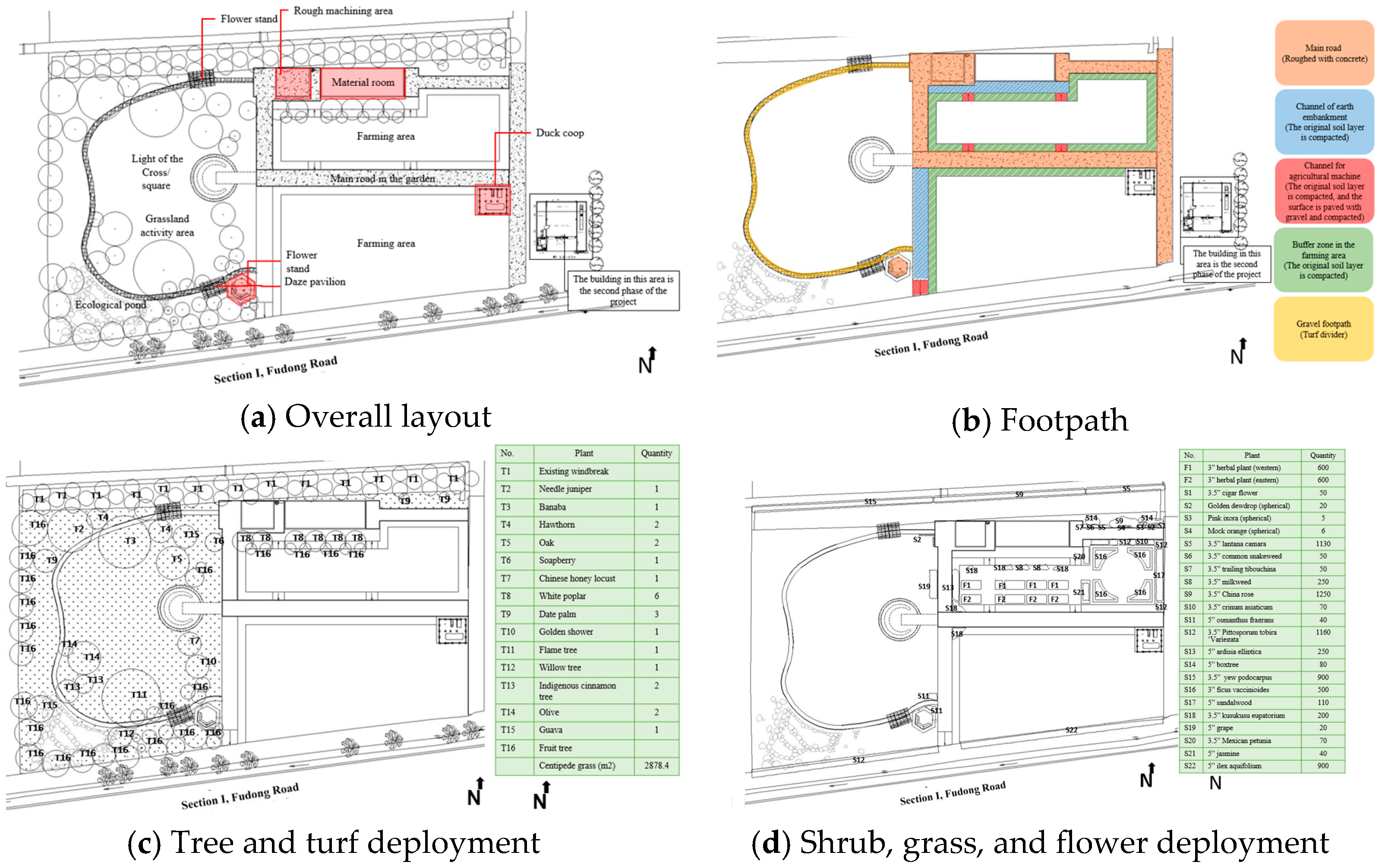
The garden was designed by Mingdao University’s Department of Landscape Architecture and Environmental Planning based on the concept of a healing garden. It includes a duck coop, a farming area, a daze pavilion, a flower stand, an ecological pond, a cross light, a grass activity area, a rough machining area, and a material room, based on the hospital’s needs (Figure 1).
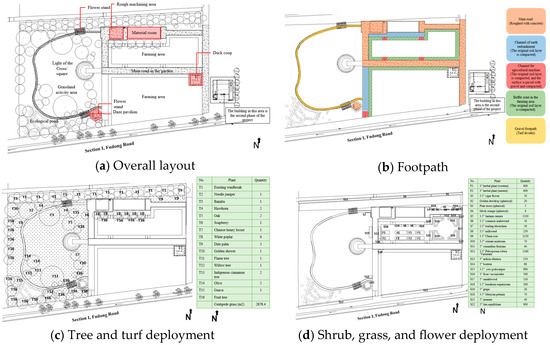
Figure 1.
Design of healing garden at Changhua Christian Hospital.
4.3. Evaluation of Healing Garden Design
- 1.
- Plant healingFour aromatic plants were planted: jasmine, sandalwood, Osmanthus, and mock orange. Plants were rated grade 5 and scored 10 for calming emotions.
- 2.
- Sensory richnessThe design creates a landform for drainage and lawn space, diverse plants, and an ecological pool. Flat, clear pavement circulations and seasonal plant variation were rated grade 5 and scored 10 for the five landscape elements.
- 3.
- Plant diversitySpecies diversity (SDIt) was used for empirical tests, and the result was SDIt = 0.9. Plant diversity was rated grade 5 with SDIt ≥ 0.7, scoring 10.
- 4.
- Color richnessA total of 8401 plants were implemented in the healing garden, with 4464 color changes and a color richness value of 0.53. This earned a grade of 3 and 5 points, as the proportion exceeded 0.5.
- 5.
- Modeling aestheticsThe aesthetic pavilion was added and simply and geometrically ordered in the garden. For durability, artificial materials were used. The modeling aesthetics was rated grade 3 and scored 5.
- 6.
- Spatial recreationThe availability of shaded, sheltered, and secluded resting spaces in the garden was assessed. The daze pavilion provided shade, while the flower stand offered semi-shading. However, the recreational facilities lacked adequate shelter and privacy. As a result, spatial recreation was rated 3, scoring 5 for the shaded resting area.
- 7.
- Clear circulationThe garden featured connected, directional, and clearly defined circulations with single entrances, exits, and safe paths to prevent getting lost. This circulation was rated with a grade, with a score of 10.
- 8.
- Barrier-free designPavements were minimized, with main footpaths roughened with cement to meet barrier-free requirements. However, the gravel paths were not user-friendly. The barrier-free design received a grade of 3 and 5 points.
4.4. Evaluation Results
We integrated factor scores for the evaluation of optimal planning and design of a healing garden. The total score was 7.3.
The evaluation index model for healing garden design was used to assess the Great Health Organic Garden at Changhua Christian Hospital. The garden scored 7.3, indicating a medium level of planning and design but highlighting areas for improvement. In the “somatosensory” index, “plant healing” and “sensory richness” were rated grade 5. In the “sight” index, “plant diversity” was rated 5, while “color richness” and “modeling aesthetics” were rated 3.
Located in Lukang Town, Changhua County, the garden faces strong winter monsoons, requiring plants with high vitality, ever-greenness, wind resistance, and salt tolerance, leading to low “color richness.” Despite the presence of a simple geometric design, modeling aesthetics scored low due to the use of durable artificial materials for environmental considerations. In the “physical activity” index, only “clear circulation” received a grade 5 rating, while “spatial recreation” and “barrier-free design” were rated grade 3. Future design adjustments are necessary to enhance the garden’s effectiveness as a healing space.
5. Discussion
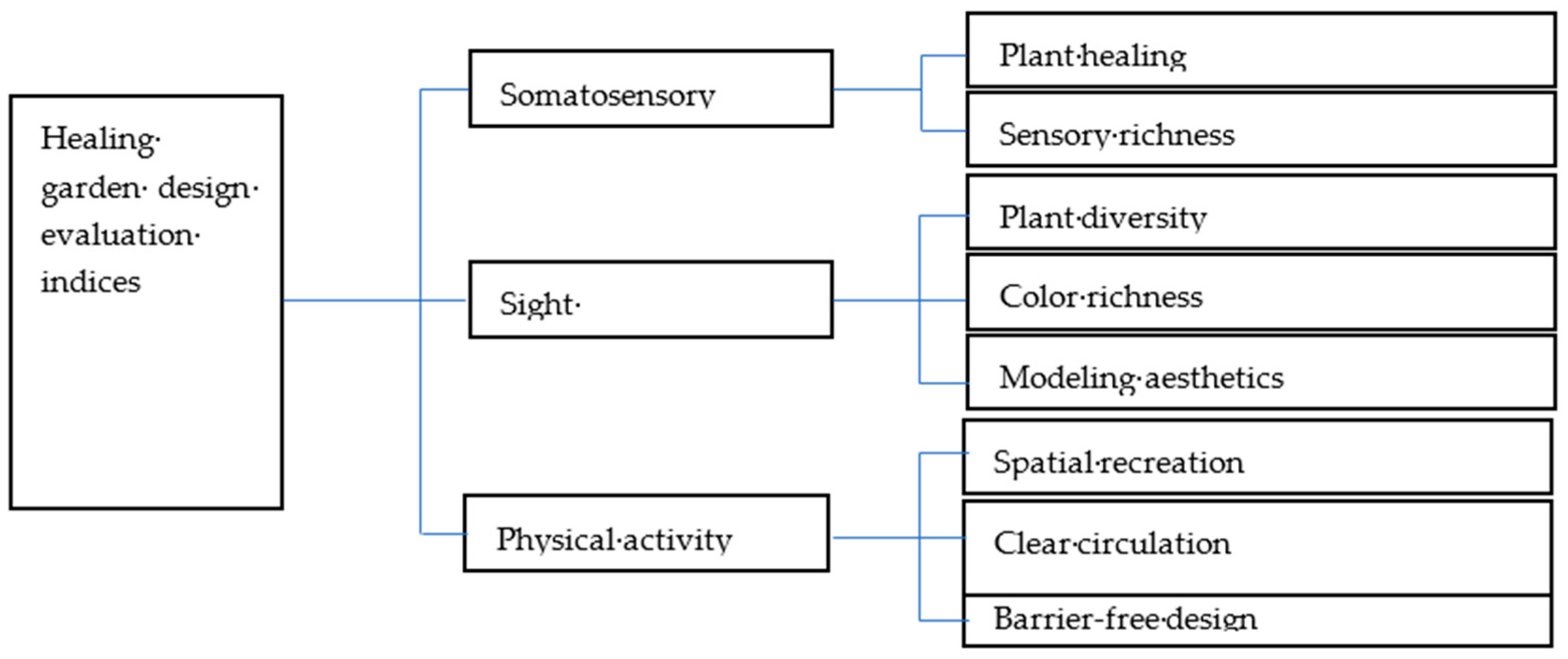
We identified evaluation indices for healing garden design, emphasizing their role in landscape therapy as stress-relief elements. The index system is required as Taiwan is transitioning to a super-aged society. With the aging status of population and increased social demands in meeting the needs of people with disabilities, healing gardens are mandatory in urban areas. The healing garden evaluation indices can be used in evaluating urban parks, open spaces, squares, and green belts, and can be used to assess the benefits of healing landscape design in Taiwan. Current horticultural therapy in Taiwan mainly offers a healing curriculum and garden design as a new concept. However, there is a lack of an evaluation model for healing garden planning and design principles. Therefore, we constructed the evaluation index model for healing garden design based on the results of this study (Figure 2).
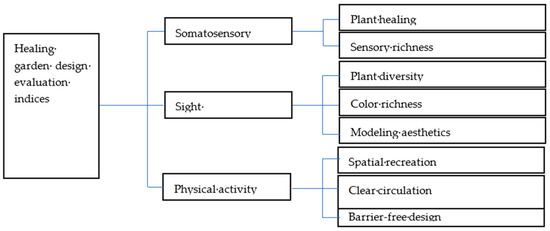
Figure 2.
Identified indices and factors in this study.
The factors affecting healing garden design were identified to develop a hierarchical evaluation structure. To design and establish an objective and feasible evaluation structure, the constructed healing garden design evaluation model can be used. The model and the evaluation results in this study provide a reference for landscape planners and designers in making decisions and evaluations by establishing the “evaluation index system of healing garden design”.
In the evaluation model, plant diversity, modeling aesthetics, color richness, and plant healing showed high weights, indicating their considerable effects on the optimal planning and design factors of healing gardens. Therefore, in planning and designing healing gardens, plant diversity, modeling aesthetics, color richness, and plant healing must be included to improve visual elements, foster physical activities, and provide the therapeutic benefits of healing gardens. With horticultural therapy, which is new in Taiwan, the implementation of the evaluation model allows designers to plan and design healing gardens. It is practical and appropriate to include elements in the landscape configuration. In planning and designing healing gardens, flexible and less constrained elements must be included to maximize their benefits. In this study, environmental senses were considered to be important factors in evaluating healing garden design. New planning and design models are necessary in healing landscape planning.
6. Conclusions
The results of this study showed that the weights of plant diversity, modeling aesthetics, and color richness were 0.230, 0.216, and 0.207. These three indices belonged to the “sight” design factor, indicating that “sight” is the most important index. Therefore, in future healing garden designs, ecology, with plant diversity, landscaping materials, and the visual effect of landscapes, needs to be emphasized, with plant colors being important design principles.
In Taiwan’s landscape and plant planning, attention needs to be paid to ensuring low maintenance costs and convenient management, so the appropriateness of plants must be considered. In addition to the ecological benefits of landscape design elements and plant diversity, their effects on the healing landscape were discussed in this study. To construct a detailed, convenient, and integrated database of indigenous plant information, plants must be chosen in relation to the landscape’s design. As healing gardens involve open space planning and design, spatial recreation, sensory richness, and clear circulation, barrier-free design is significant in the planning and design of healing spaces. Therefore, based on the obtained weights, healing gardens can be designed to provide spaces to relieve stress and relax.
The important indices determined in the study were sight, somatosensory elements, and physical activity, indicating that people’s visual sensory experience was the most important. Although somatosensory and physical activity were not considered important in the model, different perceptions of “plant diversity,” “clear circulation,” or “barrier-free design” must be addressed. Big data, including feedback, needs to be collected from the Great Health Organic Garden of Changhua Christian Hospital to improve the planning and design of the healing garden. Medical practitioners need to participate in landscape planning and design. Future studies should survey medical professionals in the aim of improving healing garden design strategies.
Author Contributions
Conceptualization, C.-K.W. and C.-F.L.; methodology, C.-K.W.; formal analysis, C.-F.L.; investigation, W.-C.Y.; writing—original draft preparation, C.-K.W.; writing—review and editing, C.-F.L. and W.-C.Y. All authors have read and agreed to the published version of the manuscript.
Funding
This research received no external funding.
Institutional Review Board Statement
Not applicable.
Informed Consent Statement
Not applicable.
Data Availability Statement
Data sharing is not applicable.
Conflicts of Interest
The authors declare no conflicts of interest.
References
- Kuo, Y.J. Horticulture Therapy & Healing Landscape—Theory & Practical Handbook; Chinese Culture University: Taipei, Taiwan, 2002. [Google Scholar]
- Gesler, W.M. Therapeutic landscape. In International Encyclopedia of Human Geography; Kitchin, R., Thrift, N., Eds.; Elsevier: Oxford, UK, 2009; pp. 229–230. [Google Scholar]
- AHTA. American Horticultural Therapy Association Definitions and Positions. Available online: https://sites.temple.edu/vrasp/files/2016/12/Horticultural-Therapy-.pdf (accessed on 3 August 2020).
- Huang, S.L. Enter the World of Horticultural Therapy; PsyGarden Publishing Company: Taipei, Taiwan, 2015. [Google Scholar]
- Kuo, Y.R. Meet Horticultural Therapy in Full Bloom; Yang Pei Culture: New Taipei City, Taiwan, 2015. [Google Scholar]
- Relf, P.D. The therapeutic values of plants. Pediatr. Rehabil. 2005, 8, 235–237. [Google Scholar] [CrossRef] [PubMed]
- Lau, S.S.; Yang, F. Introducing healing gardens into a compact university campus: Design natural space to create healthy and sustainable campuses. Landsc. Res. 2009, 34, 55–81. [Google Scholar] [CrossRef]
- Marcus, C.C. Healing gardens in hospitals. Des. Health 2007, 1, 1–27. [Google Scholar]
- Chiang, T.Y.; Wu, C.C.; Lin, F.L.; Chiu, Y.T.; Yin, Y.S.; Liu, T.C.; Lo, Y.W., Translators; Healing Gardens: Therapeutic Benefits and Design Recommendations; Marcus, C.C., Barnes, M., Eds.; Wu Nan Books: Taipei, Taiwan, 2008. [Google Scholar]
- Calkins, M.P. Design for Dementia: Planning Environments for the Elderly and the Confused; National Health Publishing Press: Owings Mills, MD, USA, 1988. [Google Scholar]
- McDowell, C.F.; Clark-McDowell, T. The Sanctuary Garden: Creating a Place of Refuge in Your Yard or Garden; Simon & Schuster Press: New York, NY, USA, 1988. [Google Scholar]
- Carstens, D.Y. Outdoor Spaces in Housing for the Elderly. In People Places: Design Guidelines for Urban Open Space; Marcus, C.C., Francis, C., Eds.; John Wiley & Sons Press: New York, NY, USA, 1998; pp. 209–257. [Google Scholar]
- Zeisel, J.; Tyson, M.M. Alzheimer’s treatment gardens. In Healing Gardens: Therapeutic Benefits and Design Recommendations; Marcus, C.C., Barnes, M., Eds.; John Wiley & Sons Press: New York, NY, USA, 1999; pp. 437–504. [Google Scholar]
- Marcus, C.C.; Barnes, M. Healing Gardens: Therapeutic Benefits and Design Recommendations; John Wiley & Sons Press: New York, NY, USA, 1999. [Google Scholar]
- Christenson, R.A. Healing the Mind, Body, and Soul: A Therapeutic Landscape Design for Crest-Mark of Roselawn. Ph.D. Thesis, Ball State University, Muncie, IN, USA, 2006. [Google Scholar]
- Furgeson, M. Healing Gardens. Available online: http://www.sustland.umn.edu/design/healinggardens.html (accessed on 12 August 2006).
- Noell-Waggoner, E. A Community’s Gift to Those Living with Alzheimer’s Disease and Their Care-Givers. Available online: http://www.centerofdesign.org/pages/memorygarden.html (accessed on 20 June 2020).
- Tseng, T.H.; Chang, C.Y.; Hsieh, C.Y. Differences in Hospital Landscape Environments on the Psychological Response of Patients. In Proceedings of the 10th Architectural Research Achievement Conference, Taipei City, Taiwan, 23 November 1997. [Google Scholar]
- Stigsdotter, U.A.; Grahn, P. What makes a garden a healing garden. J. Ther. Hortic. 2002, 13, 60–69. [Google Scholar]
- Chang, C.Y. Design the garden for dementias. J. Sci. Agric. 2001, 49, 124–132. [Google Scholar]
- Wu, T.C. The Wellness Design Concept for a Healing Environment. In Proceedings of the 2011 Global and Welfare Forum in Taiwan, Taipei City, Taiwan, 31 October–1 November 2011. [Google Scholar]
Disclaimer/Publisher’s Note: The statements, opinions and data contained in all publications are solely those of the individual author(s) and contributor(s) and not of MDPI and/or the editor(s). MDPI and/or the editor(s) disclaim responsibility for any injury to people or property resulting from any ideas, methods, instructions or products referred to in the content. |
© 2025 by the authors. Licensee MDPI, Basel, Switzerland. This article is an open access article distributed under the terms and conditions of the Creative Commons Attribution (CC BY) license (https://creativecommons.org/licenses/by/4.0/).