


Abstract
The past and current situation of the SARS-CoV-2 pandemic has put the entire society, and especially all hospital systems, worldwide to the test. It is essential that health system managers and decision makers optimize the management of resources, even being forced to improvise new units, divert resources usually destined to other functions and/or change the usual care modality by considerably enhancing aspects of telemedicine. Artificial Intelligence (AI) techniques and procedures are of great help in decision making in emergency environments due to severe pandemics because of their predictive capacity. This paper presents the PRACTICUM DIRECT project, which proposes the design and implementation of a tool to assist health system managers in making decisions on the early management of hospital resources. It makes use of AI techniques to identify the most critical variables in each case and build models capable of showing the possibilities and consequences of the decisions taken on resources at each moment of the emergency. It includes a simulator that shows how they would affect management. The current status is that of the selection of the most appropriate variables, taking into account those affected during the SARS-CoV-2 pandemic: infectious diseases, cardio-neuro-circulatory diseases, metabolic diseases and rehabilitative medicine.
1. Introduction
Decision making based on prior knowledge or experience is a very common practice in medicine [1], especially because of the current situation experienced by the SARS-Cov-2 pandemic [2], where many centers, regardless of the country, have been overwhelmed by the increasing number of admissions and the scarce number of available staff and beds [3]. Some facilities or medical systems take advantage of all this lived knowledge to create reports or systematic reviews that can be used for future cases [4]. The use of prior knowledge for decision making in future situations is very common in pandemics [5]. This allows decisions to be determined more quickly and effectively, since, during the pandemic, many treatments and diagnoses, both SARS-Cov-2-dependent and independent, have been reconsidered, most of them having to be postponed or canceled [6].
This paper introduces the PRACTICUM DIRECT project. It proposes a tool to assist in decision making on the optimization of resources in the case of pandemics. This tool is supported by Artificial Intelligence (AI) techniques to have a greater predictive capacity and, thus, to have a better assistance from the tool.
2. Materials and Methods
This section describes the tool architecture and introduces the current status of the project.
2.1. Software Architecture
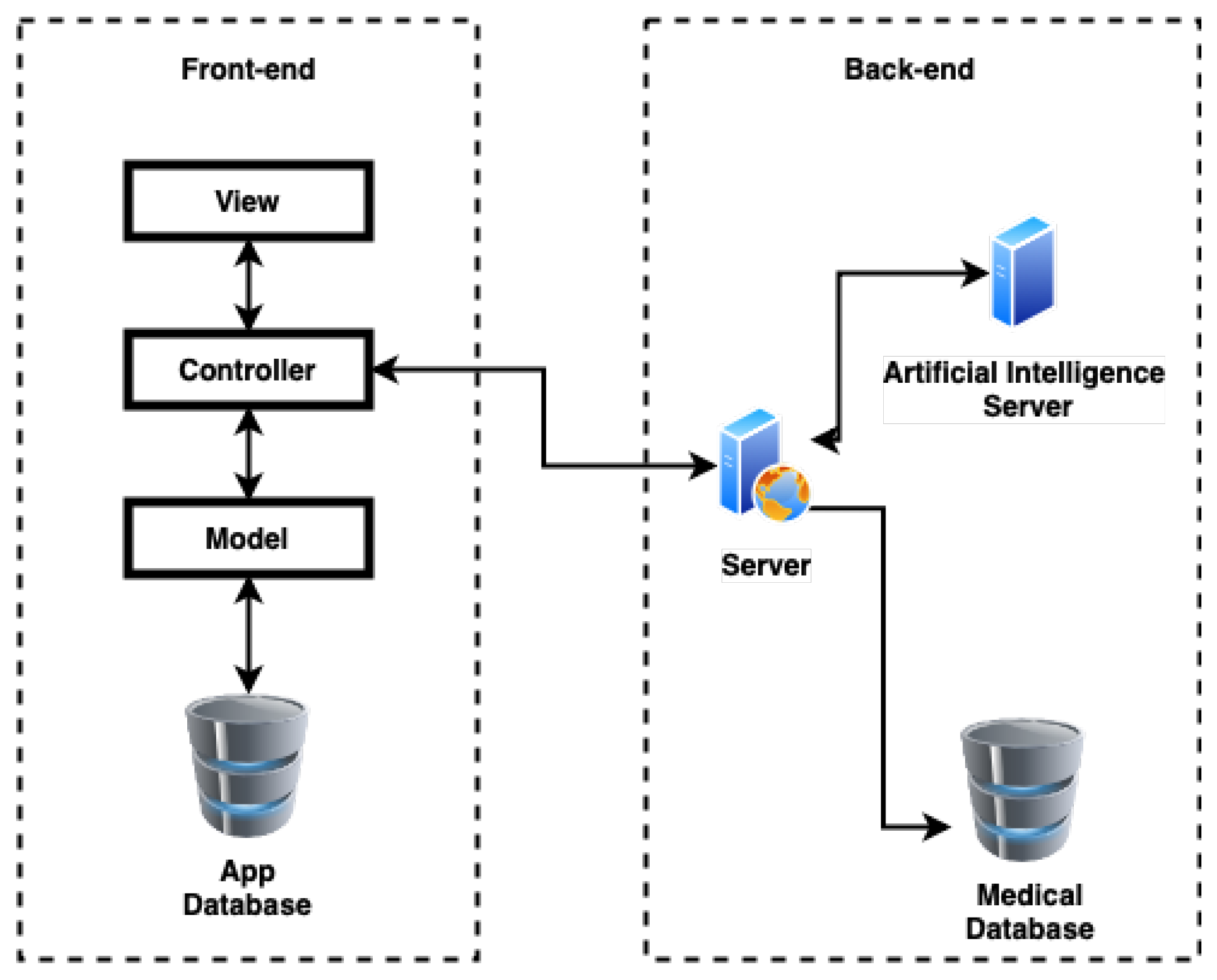
As architecture, we opted for the classic architecture divided into front-end and back-end (Figure 1). The front-end is in charge of visualization and user authentication. The back-end is in charge of all medical data processing.
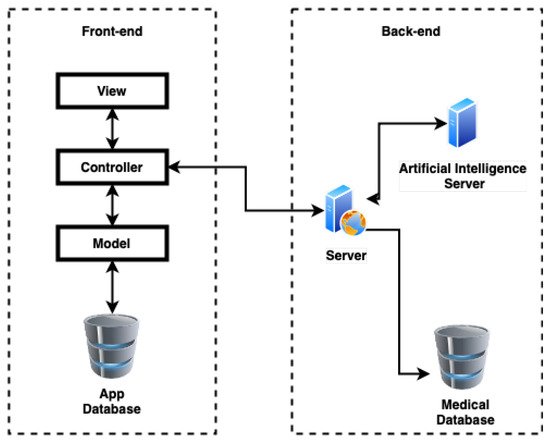
Figure 1.
Simplified diagram of the tool structure. In the back-end, predictions are determined by means of AI models. The front-end is responsible for authentication and visualization of the application.
For better usability, the graphical interface will be simplified with a traffic light system to indicate how urgent the situation is and the actions to be taken. Thus, green would indicate a situation of minimal urgency, yellow would be medium urgency and red would be extreme urgency.
2.2. Proposed Model
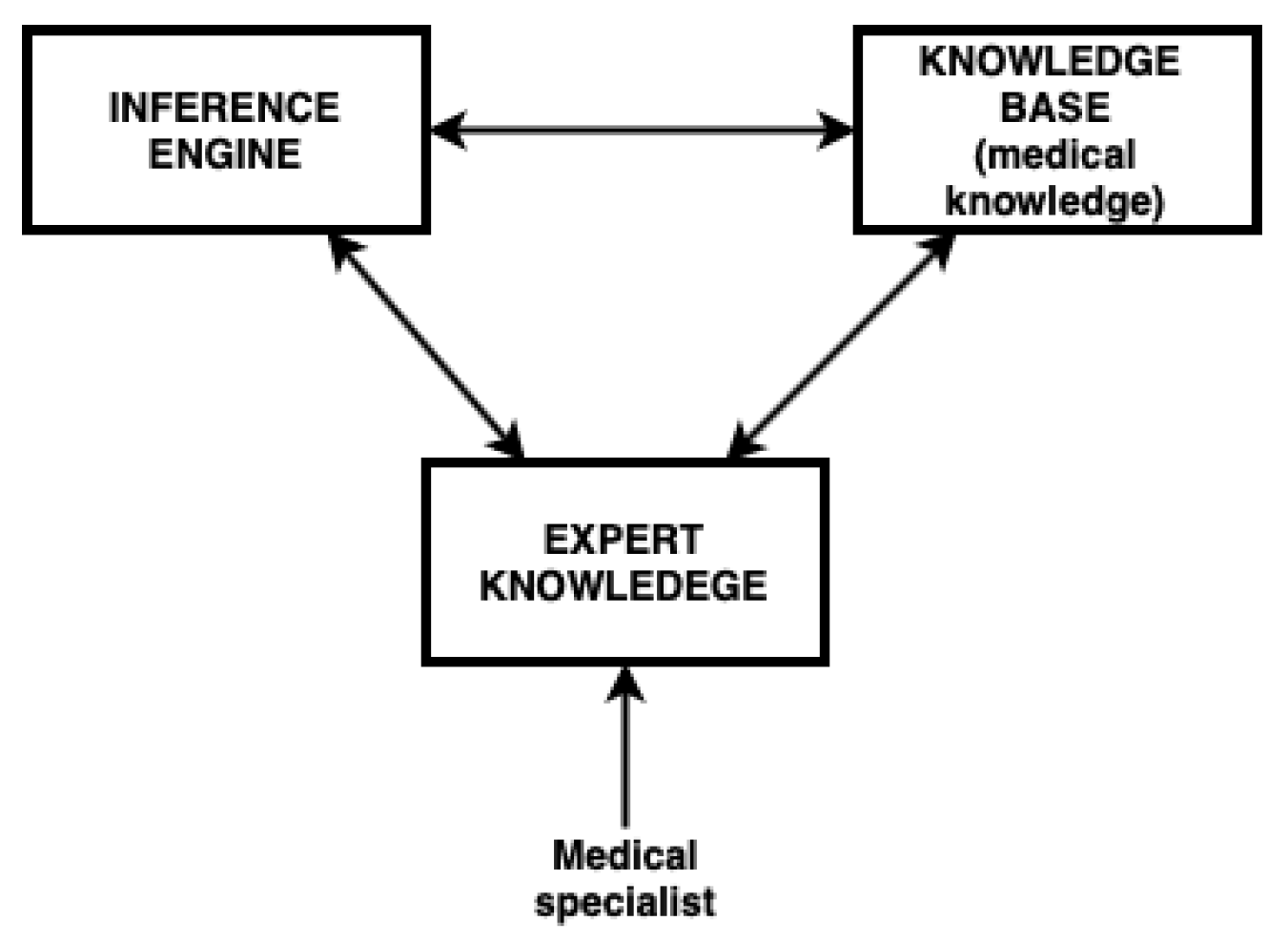
The proposed Artificial Intelligence [7] model is a rule-based expert system [8]. In this way, knowledge can be inferred (inference engine) from the experience of the medical specialists (expert knowledge) and from all the previous information on pandemic actions collected in the center itself and in other centers (knowledge base). The combination of information allows to obtain the current information that the specialists have, while considering other known previous actions, some being from other centers (Figure 2).
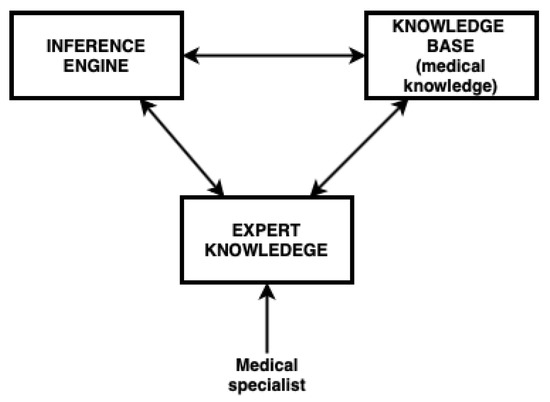
Figure 2.
Basic scheme of the operation of a rule-based expert system applied in medicine. Knowledge inference is conducted in the inference engine from all the knowledge.
2.3. Medical Variables
Currently, a study is underway to select the medical variables with which to train the model and test the system. For the evaluation of the selection, four pathologies that were among the most affected during the SARS-CoV-2 pandemic due to their urgency of treatment or lethality were taken into account: infectious diseases, diseases of the circulatory system, metabolic diseases and rehabilitations.
3. Conclusions
The main conclusion is that there is a wide range of variables to be taken into account. For the initial phases of the project, it is necessary to filter and select only those most affected by the pandemic.
The development of the software tool has to guarantee security regarding access to the information of the resources and medical variables, all this while maintaining efficiency and usability.
Funding
This research was funded by the General Directorate of Culture, Education and University Management of Xunta de Galicia “PRACTICUM DIRECT” Ref. IN845D-2020/03 and the GRANT FOR THE PROGRAM FOR CONSOLIDATION AND STRUCTURING OF COMPETITIVE RESEARCH UNITS Ref. ED431C 2018/49.
Institutional Review Board Statement
Not applicable.
Informed Consent Statement
Not applicable.
Conflicts of Interest
The authors declare no conflict of interest.
Abbreviations
The following abbreviations are used in this manuscript:
| SARS-CoV-2 | Severe Acute Respiratory Syndrome Coronavirus 2 |
| AI | Artificial Intelligence |
References
- Sackett, D.L.; Rosenberg, W.M.; Gray, J.M.; Haynes, R.B.; Richardson, W.S. Evidence based medicine: What it is and what it is not. BMJ 1996, 312, 71. [Google Scholar] [CrossRef] [PubMed] [Green Version]
- Petersen, E.; Koopmans, M.; Go, U.; Hamer, D.H.; Petrosillo, N.; Castelli, F.; Storgaard, M.; Al Khalili, S.; Simonsen, L. Comparing SARS-CoV-2 with SARS-CoV and influenza pandemics. Lancet Infect. Dis. 2020, 20, e238–e244. [Google Scholar] [CrossRef]
- Borasio, G.D.; Gamondi, C.; Obrist, M.; Jox, R. COVID-19: Decision making and palliative care. Swiss Med. Wkly. 2020, 150, 1314. [Google Scholar] [CrossRef] [PubMed]
- Fretheim, A.; Brurberg, K.G.; Forland, F. Rapid reviews for rapid decision-making during the coronavirus disease (COVID-19) pandemic, Norway, 2020. Eurosurveillance 2020, 25, 2000687. [Google Scholar] [CrossRef] [PubMed]
- Lal, A.; Ashworth, H.C.; Dada, S.; Hoemeke, L.; Tambo, E. Optimizing pandemic preparedness and response through health information systems: Lessons learned from Ebola to COVID-19. In Disaster Medicine and Public Health Preparedness; Cambridge University Press: Cambridge, MA, USA, 2020; pp. 1–8. [Google Scholar]
- Chang, H.; Yu, J.Y.; Yoon, S.Y.; Hwang, S.Y.; Yoon, H.; Cha, W.C.; Sim, M.S.; Jo, I.J.; Kim, T. Impact of COVID-19 Pandemic on the Overall Diagnostic and Therapeutic Process for Patients of Emergency Department and Those with Acute Cerebrovascular Disease. J. Clin. Med. 2020, 9, 3842. [Google Scholar] [CrossRef] [PubMed]
- Russel, S.; Norvig, P. Artificial Intelligence: A Modern Approach; Prentice Hall: Hoboken, NJ, USA, 2003; Volume 178. [Google Scholar]
- Clancey, W.J. The epistemology of a rule-based expert system—A framework for explanation. Artif. Intell. 1983, 20, 215–251. [Google Scholar] [CrossRef]
Publisher’s Note: MDPI stays neutral with regard to jurisdictional claims in published maps and institutional affiliations. |
© 2021 by the authors. Licensee MDPI, Basel, Switzerland. This article is an open access article distributed under the terms and conditions of the Creative Commons Attribution (CC BY) license (https://creativecommons.org/licenses/by/4.0/).